35.693 risultati
1997rif. 2092902141203308Chinese book office 1997. Soft Cover. Fine. Volume: 1 Chinese book office paperback
1980rif. 2092902141204988Chinese book office 1980. Soft Cover. Fine. Volume: 1 Chinese book office paperback
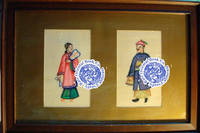
rif. 34040601Canton 1800-1820 Lam-Qua. Framed & glazed gold mat a pair of hand-painted "Pith" paintings 5.7 x 9.5 cm. matted size very clean bright excellent examples. ORIGINAL HAND-PAINT IN FULL COLOR. R A R E ! . . . A RARE PAIR OF 'PITH' PAINTINGS . . . IN EXCELLENT CONDITION . . A pair of lovely and delicately color painted Chinese couple. The woman on the left wears a long ping silk gown with emerald green under skirt. She hold a silk fan with a painted flower in her left hand and in her right a silken cloth. She wears jade earring and has a flower in her hair. She wears white shoes with orange tops. The man clearly a Mandarin wears a purple robe with his "Mandarin Square" silk embroidered rank on his chest. His undergarment is the typical Imperial green red and yellow colors. He wear the typical Mandarin's hat of red and pink with a green feather. His shoes are the typical black cloth top with white felt soles. The both look at each other. A typical Mandarin scene. . LAM-QUA & TING-QUA SCHOOLS: The works are done in the Canton style of Lam-Qua and his brother Ting-qua. See item #2 below for a link. . Ting-qua born ca. 1809; flourished 1840-70. He was the brother of Lam-Qua 1801-1860 and probably a close relation of Spoilum. Ting-qua's studio at 16 China Street Guangzhou was perhaps the most prolific source of Chinese export paintings of its time. Working in a manner influenced by Western artistic traditions Ting-qua and the painters of his studio restricted themselves to gouache and water-colors perhaps to avoid rivalry with Lam-qua's oil paintings. Their pictures which were often sold in sets." Quoted from item #2 below. . PITH PAPER: The paintings were done on pith paper. "Pith paper or rice paper a misnomer as it is sometimes known is made from the inner pith of the plant Tetrapanex papyrifera which is a member of the Araliaceae family. The plant is a shrub native to Southern China and Taiwan. As well as a painting material pith paper was used to make artificial flowers and surgical dressings." Cited from item #1 below. . THE LEGAL SYSTEM OF CHINA IN EARLY 19TH CENTURY: Justice was swift and usually done to make an example of the accused. If the accused pleaded guilty and confessed his punishment was lessoned. If he persisted in innocence even though he was not guilty his punishment was more severe. Showing a cooperative attitude was of advantage. Nearly all people accused of a crime were assumed to be guilty. The punishment for various crimes were commonly known and justice was meted out by the magistrate. . RARITY: Gouache pith paintings are now rare most were damaged cracked and brittle rendering them useless. The few that survived are considered RARE and uncommon. The paintings were drawn with much skill and patience and were for the most part drawn for and sold to foreigners in the treaty ports of China in the early 19th century. Drawn with a fine brush in vivid colors the paintings depicted things that would fascinate foreigners and encourage them to bring home as souvenirs. The current examples often caught the eye of foreigners who may have actually seen some form of public punishment or execution. . CONDITION: The work is remarkable clean and solid. There are no damage to the paintings visible from the glazed side the back has not been opened but the images look very clean solid with none of the usual cracking or other damage often found on these kinds of early paintings. The frame is clean solid and ready for library or display. . THE FRAMING AND MOUNTING: The pair of painting have been western-style gold-matted framed in brown wood and glazed. The over all size of the frame is 25.5 x 17.5 cm. The verso or back has brown paper glued to all edges and two tiny holes in the back where eyelets were probably screwed in to hold the hanging wire not present. . REFERENCES: . ease see this site for copious details on pith plant and its uses. -org/wiki/Lam_Qua C.L. Crossman.: THE DECORATIVE ARTS OF THE CHINA TRADE p.173-203 and the associated color and b.w. photo examples. . C.L. Crossman.: THE CHINA TRADE p.93-120 and the photos. Arthur Chu.: ORIENTAL ANTIQUES AND COLLECTIBLES pp.62-67 photo #60. . . unknown
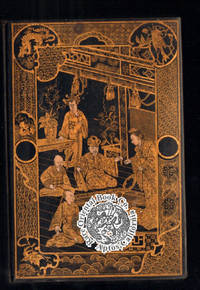
rif. 35006201Canton ca.1800-1820 Lam-Qua.Black lacquer gold painted 12 fine gouache hand-drawn & colored paintings 12.5 x 16.5 cm. very fine condition each mounted in an album with old gold paper corners on pith paperexcellent example. RARE ! . . . A SUPERB SUITE OF TWELVE STUNNING COLOR PITH PAINTINGS . . . ILLUSTRATING VARIOUS CHINESE IN ELABORATE COSTUME . This is a charming suite of 12 lovely portraits of Chinese men women and military men. . THE PAINTED SUBJECTS: . 1. An old sage holds a scroll of holy texts while he is seated behind him stands a guard with a pole sword. . 2. A young warrior holds a long axe ready for action. . 3. A young lady a white porcelain teacup. . 4. A warrior holds his halberd ready for action. . 5. A fierce older warrior holds a sword and his shield. . 6. A guard holds his long sword at the ready. . 7. An elderly man strokes his long beard. . 8. A young man takes a stroll holding a fan behind his back. . 9. An elderly an holds two Burmese-green jade bracelets. . 10. A man holds a feather fan. . 11. A very old man holds his long sword. . 12. A bearded man points with his hand toward the right. . The twelve paintings are gently mounted to stiff black album pages with the old style "NuAce" photo mounting corners. There is no damage to the paintings with this technique. . THE STUNNING GOLD OVER BLACK ILLUSTRATED LACQUER COVERS: This is a very unusual binding hand-painted in gold lacquer over black lacquer background on wooden boards. . The cover illustration shows five Chinese: The Lord & Master; his concubine; his son Prince; his retainer; and the maid. . The Lord & master is seen seated before a tea service with three golden cups and a golden ceramic tea pot. The Lord & Master reaches for the hand of his fair and very young concubine who holds a fan. The tea service is clearly for three people: The Lord & Master his son the Prince and the concubine. . The retainer is seated just behind the Lord & Master's right side showing proper respect by looking at the floor. The young Prince the son is seated before his father and looks at the concubine. At the rear is the maid waiting for order. She puts her right hand on the adjacent table holding a tray. . The work has an elaborate and stunning border. In the upper corners are two stunning illustrations: the upper left sows the Golden Dragon in the upper right is the Phoenix. At the left center margin is a golden Peacock. The margin-borders are elaborately done with differing traditional Chinese patterns and designs. A most stunning view inside of the . The back is plain black lacquer. . The spine is black leather with period Chinese swastika design white over black end papers. Some of the old glue is showing through the very thin tissue endpapers else very solid with heavy black pages. . CONDITION OF THE GOLD AND BLACK LACQUER COVERS: The covers are in exceptionally good condition. There are two minor spots: one ca. 1.5 cm spot at the son's midsection and another black spot .05 cm just below his robe. . There is the very small amount of occasional and barely visible usual and very minor mild scuffing with a minor discoloration of the face of the maid. There is a bit of 'crackle' to the black lacquer which is normal for a piece 200 years old. Else this is in very nice condition. . CONDITION OF THE PAINTINGS: These are exceptionally bright and clean drawings lightly mounted on a now browned backing paper with blue-glossy patterned paper borders. . Numbers: . 1 has a tiny 1.5 & .5 cm. small split at bottom left this does not affect the painting. . 2 has the lower portion folded in the process of paper-making which is normal variation and does not detract. . 5 has a tiny 1 cm. split at top in the margin this does not affect the painting. . 9 has a 7 cm. split from the elbow to the bottom of the work apparently restored from the verso minimal impact. . 11 has a small 1 cm. scuff in the right margin this does not affect the image. . 12 has a similar but less obvious 1 cm. scuff in the right margin at the same place as #11 this does not affect the image. . The balance i.e. numbers: 3467810 are without issues. . OVERLY CRITICAL: We are commonly obsessive and overly critical about pointing out any and all defects. Please view the scans posted to our website. All in all these look much better than the above description. Perfectly clean no blemishes. . NOTE: Typically "pith" paintings are prone to be very brittle and delicate. We are happy to state this suite is exceptionally very solid and intact. The colors are brilliant bright and stunningly fresh without any fading or issues. They appear to have been properly cared for protected. These are in excellent "Collector's Condition." . PAINTING QUALITY AND FRESH BRILLIANTLY COLORED: The paintings are meticulously executed with fine detail painted a steady skilled hand. . LAM-QUA TING-QUA SCHOOLS: The works are done in the Canton style of Lam-Qua and his brother Ting-qua. See link below. . Ting-qua born ca. 1809; flourished 1840-70. He was the brother of Lam-Qua 1801-1860 and probably a close relation of Spoilum. Ting-qua's studio at 16 China Street Guangzhou was perhaps the most prolific source of Chinese export paintings of its time. Working in a manner influenced by Western artistic traditions Ting-qua and the painters of his studio restricted themselves to gouache and water-colors perhaps to avoid rivalry with Lam-qua's oil paintings. Their pictures which were often sold in sets." . PITH PAPER: The paintings were done on pith paper. "Pith paper or rice paper" a misnomer as it is sometimes known is made from the inner pith of the plant Tetrapanex papyrifera which is a member of the Araliaceae family. The plant is a shrub native to Southern China and Taiwan. As well as a painting material pith paper was used to make artificial flowers and surgical dressings." . RARITY: Gouache pith paintings are now rare most were damaged cracked and brittle rendering them useless. The few that survived are considered RARE and uncommon. The paintings were drawn with much skill and patience and were for the most part drawn for and sold to foreigners in the treaty ports of China in the early 19th century. Drawn with a fine brush in vivid colors the paintings depicted things that would fascinate foreigners and encourage them to bring home as souvenirs. The current examples shows portraits of Chinese officials guards military men as well as upper class citizens. . Albums of pith paintings were typically issued in a suite of twelve. . BIBLIOGRAPHY: . -org/wiki/Lam_Qua C.L. Crossman.: THE DECORATIVE ARTS OF THE CHINA TRADE p.173-203 and the associated color and b.w. photo examples. . C.L. Crossman.: THE CHINA TRADE p.93-120 and the photos. Arthur Chu.: ORIENTAL ANTIQUES AND COLLECTIBLES pp.62-67 photo #60. . . unknown
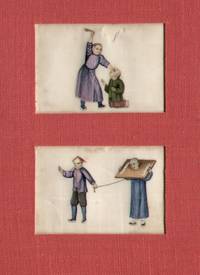
rif. 30018401Canton ca. 1800-1820 Lam-Qua. Red flax mat six goauche color paintings on pith paper each 10 x 7 cm two per mat very good clean two with marginal chipsimage not affected meticulously color drawn in much detail. R A R E . . . THE SUITE OF SIX COLOR GOUACHE PAINTINGS . . Begins with the a painting of Imperial police bringing the accused to where he will be punished. He wears a cangue or a large wooden collar clamped around his neck with his crime written on paper which is then glued to the wood. Image two shows the guilty on his knees being beaten with a leather strap by the punisher. Image three shows the policeman pulling a chain connected to a metal ring on the neck of the accused. The next shows the image of a large rock connected to a chain and the accused sitting on the rock with the chain fastened to his leg. The fifth shows the magistrate pointing his finger at the guilty as he while being admonished the guilty is forced to kneel on small rocks while a policeman holds ears. The last image shows the executioner with a long sword at the ready while the accused has a very sour look on his face his hands tied behind his back with his crime written on a long piece of wood at his side. It was common to parade the guilty through the streets for all to see the criminal as he was led to the execution grounds. . LAM-QUA TING-QUA SCHOOL: The works are done in the Canton style of Lam-Qua and his brother Ting-qua. See item #2 below for a link. . Ting-qua born ca. 1809; flourished 1840-70. He was the brother of Lam-Qua 1801-1860 and probably a close relation of Spoilum. Ting-qua's studio at 16 China Street Guangzhou was perhaps the most prolific source of Chinese export paintings of its time. Working in a manner influenced by Western artistic traditions Ting-qua and the painters of his studio restricted themselves to gouache and water-colors perhaps to avoid rivalry with Lam-qua's oil paintings. Their pictures which were often sold in sets." Quoted from item #2 below. . PITH PAPER: The paintings were done on pith paper. "Pith paper or rice paper" a misnomer as it is sometimes known is made from the inner pith of the plant Tetrapanex papyrifera which is a member of the Araliaceae family. The plant is a shrub native to Southern China and Taiwan. As well as a painting material pith paper was used to make artificial flowers and surgical dressings." Cited from item #1 below. . THE LEGAL SYSTEM OF CHINA IN EARLY 19TH CENTURY: Justice was swift and usually done to make an example of the accused. If the accused pleaded guilty and confessed his punishment was lessoned. If he persisted in innocence even though he was not guilty his punishment was more severe. Showing a cooperative attitude was of advantage. Nearly all people accused of a crime were assumed to be guilty. The punishment for various crimes were commonly known and justice was meted out by the magistrate. . RARITY: Gouache pith paintings are now rare most were damaged cracked and brittle rendering them useless. The few that survived are considered RARE and uncommon. The paintings were drawn with much skill and patience and were for the most part drawn for and sold to foreigners in the treaty ports of China in the early 19th century. Drawn with a fine brush in vivid colors the paintings depicted things that would fascinate foreigners and encourage them to bring home as souvenirs. The current examples often caught the eye of foreigners who may have actually seen some form of public punishment or execution. . CONDITION: The work is remarkable clean and solid. As usual when ever pith paper is fastened at the corners there is a reaction to moisture in the air and the paper will expand or contract and thus snap its connection. By and large these works are not damaged except for two corners where there was some loss. Please see link #1 below on how to mount and care for pith paintings. These can be re-matted per the link and preserved on acid-free paper and reframed for display. . Color photos are posted to our website. . BIBLIOGRAPHY: . C.L. Crossman: THE DECORATIVE ARTS OF THE CHINA TRADE p.173-203 and the associated color and b.w. photo examples. C.L. Crossman THE CHINA TRADE p.93-120 and the photos. A. Chu: ORIENTAL ANTIQUES AND COLLECTIBLES pp.62-67 photo #60. 1: see: artfacts dot org/artinfo/articals/pith_paper dot html 2. www dot answers dot com/topic/tingqua 3. Wikipedia: Lam_Qua C.L. Crossman: THE DECORATIVE ARTS OF THE CHINA TRADE p.173-203 and the associated color and b.w. photo examples. C.L. Crossman THE CHINA TRADE p.93-120 and the photos. A. Chu: ORIENTAL ANTIQUES AND COLLECTIBLES pp.62-67 photo #60. . unknown
1990rif. 2092902141202331Peking University 1990. Soft Cover. Fine. Volume: 1 Peking University paperback
1990rif. 2092902141200455Peking University 1990. Soft Cover. Fine. The book is in fine condition. Peking University paperback
2014rif. 2081502111900239Chinese book office 2014. Soft Cover. Fine. Size:Soft Cover Chinese book office paperback
1999rif. 2081502111901627Chinese book office 1999. Soft Cover. Fine. Size: A5 Soft Cover Book Chinese book office paperback
2001rif. 15313Suhaila Productions 2001. Large spiral-bound softcover in near fine condition. Plastic comb binding. 1st edition January 2001. Level II Beginning. 1st Edition. Soft cover. Near Fine. Suhaila Productions Paperback
1921rif. AUB-4648Neuchâtel et Paris, éd. Delachaux & Niestlé 1921 (2e éd.). Bon exemplaire broché, in-8, 246 pages avec avant-propos et table.
rif. 1094Description du livre: EDITIONS DELACHAUX e NIESTLE' NEUCHATEL-PARIS 1921, 1921. Volume in -8 (16 x 23 cm.), legatura d'epoca mezza stoffa col. prugna, piatti percalina in tinta più scura, scritte in oro al dorso, pp. 246, (2), 88. Qualche sottolineatura a matita, per il resto in buone condizioni. Testo in francese. DEUXIEME EDITION - Livre in -8, percaline rouge foncé, pag. 246, (2), 88. Bon état. La deuxième partie traite: L'AUTOSUGGESTION APPLIQUEE A LA CONDUITE DE LA VIE.
1922349p. Uncut & unopened. 8vo. Original full cloth binding. Explores the role of suggestion and auto-suggestion in education and self-healing. Provides good view of the state of psychiatry, psychology, physiology, and self-actualization at the beginning of the 1920s. SCARCE. OCC 2
rif. ria9781399536097_inpHardback. New. New Book; Fast Shipping from UK; Not signed; Not First Edition; Examines the development of Sufism in Western Europe in the 21st Century hardcover
1978rif. 2091502135304127Nichirinkaku 1978. Soft Cover. Fine. Volume: 1 Nichirinkaku paperback
rif. 0887430112New. paperback. New. Satisfaction Guaranteed or your money back. paperback
1984rif. Q-0887430112School Zone Publishing 1984-05-01. Paperback. New. In shrink wrap. Looks like an interesting title! School Zone Publishing paperback
rif. 0105643971.Gpaperback. Good. Access codes and supplements are not guaranteed with used items. May be an ex-library book. paperback
1982262 pages. With sixty-nine engaging, cognitively-oriented activities, this fully illustrated, balanced activities book is a practical aid to strengthening and improving your students' language arts skills. It is an ideal reference/resource for use with elementary school students of varying levels and capabilities in multi-lingual, mainstreaming, and accelerated teaching situations. Clean, bright and unmarked with light wear. Nice copy. Book
rif. 1507524536.Gpaperback. Good. Access codes and supplements are not guaranteed with used items. May be an ex-library book. paperback
1996rif. x-0749418672Kogan Page Ltd 1996. Paperback. New. 104 pages. 8.50x5.75x0.50 inches. Kogan Page Ltd paperback
rif. ria9781473759114_inpPaperback / softback. New. New Book; Fast Shipping from UK; Not signed; Not First Edition; N/A paperback
2013rif. SONG1475809026Rowman & Littlefield Publishers 2013-12-16. hardcover. Used: Good. 6.24x0.88x9.42. Buy with confidence. Excellent Customer Service & Return policy. Rowman & Littlefield Publishers hardcover
2013rif. DADAX1475809026Rowman & Littlefield Publishers 2013-12-16. hardcover. New. 6.24x0.88x9.42. Buy with confidence. Excellent Customer Service & Return policy. Rowman & Littlefield Publishers hardcover