|
JAGUER, Edouard
Longue lettre signée d'Edouard Jaguer datée du 2 novembre 1968. Il y évoque les relations de la médecine et de la psychiatrie au mouvement surréaliste. On joint : Phases [ Catalogue de la première Exposition consacrée au mouvement Phases au musée d'Ixelles du 18-10 au 15-11-1964 ]
L.S. dactylographiée de 4 feuillets in-4, 1968, et 1 brochure in-8 carré br., 32 ff. avec 2 prospectus joints. Rappel du titre complet : Longue lettre signée d'Edouard Jaguer datée du 2 novembre 1968. Il y évoque les relations de la médecine et de la psychiatrie au mouvement surréaliste. On joint : Phases [ Catalogue de la première Exposition consacrée au mouvement Phases au musée d'Ixelles du 18-10 au 15-11-1964 ] Bon état pour cette intéressante lettre d'un des meilleurs connaisseurs (et acteur) du surréalisme. Français

|
|
|
JAGUER, Edouard
Longue lettre signée d'Edouard Jaguer datée du 2 novembre 1968. Il y évoque les relations de la médecine et de la psychiatrie au mouvement surréaliste. On joint : Phases [ Catalogue de la première Exposition consacrée au mouvement Phases au musée d'Ixelles du 18-10 au 15-11-1964 ]
L.S. dactylographiée de 4 feuillets in-4, 1968, et 1 brochure in-8 carré br., 32 ff. avec 2 prospectus joints. Rappel du titre complet : Longue lettre signée d'Edouard Jaguer datée du 2 novembre 1968. Il y évoque les relations de la médecine et de la psychiatrie au mouvement surréaliste. On joint : Phases [ Catalogue de la première Exposition consacrée au mouvement Phases au musée d'Ixelles du 18-10 au 15-11-1964 ]
Riferimento per il libraio : 39707

|
|
|
Jaguer, Édouard, Schriftsteller, Zeichner und Kunstkritiker (1924-2006)
Masch. Brief mit eigenh. U.
o.J. Paris, 23. XI. 1957, Fol. 4 Seiten auf 4 Blättern.
Riferimento per il libraio : 52757
|
|
|
Jahn, Ferdinand, Mediziner, Leibarzt des Herzogs von Sachsen-Meiningen (1804-1859)
Eigenh. Brief mit U.
o.J. Meiningen, 6. VI. 1848, 22 x 14,5 cm. 1 1/2 Seiten. Doppelblatt mit Adresse und Siegelausriss.
Riferimento per il libraio : 60713
|
|
|
Jahn, Friedrich Ludwig, auch "Turnvater Jahn", Pädagoge und Begründer der deutschen Turnbewegung (1778-1852).
Eigenh. Schriftstück mit U. Freyburg (Unstrut), 30. XI. 1826.
¾ S. Kl.-4to. "Herr Karl Reimer (Weidmannische Buchhandlung zu Leipzig, im Bosischen Garten) erhalten 2 Säcke, worin rohe Bücher, gezeichnet H. K. Reimer, Weidmannische Buchhandlung zu Leipzig No. I. u. No. II | Friedrich Ludwig Jahn | Dr. der Philosophie".
|
|
|
Jahn, Moritz, Schriftsteller (1884-1979)
6 Werke mit ausführlichen eigenh. Widmungen oder Buchzitaten (2 in griechischer Sprache), dazu zwei eigenh. Postkarten, 1 eigenh. Brief und 1 eigenh. beschriftete Visitenkarte, jeweils mit U.
o.J. Ohne Ort, Juli bis November 1950, Verschiedene Formate. Original-Pappbände.
Riferimento per il libraio : 59619
|
|
|
Jahn, Otto, klassischer Philologe und Archäologe (1813-1869).
Eigenh. Schriftstück. Leipzig, 28. VI. 1847.
42:174 mm. Bürgt für die "von der Universitätsbibliothek während des Sommersemesters 1847" ausgeliehenen Bücher des "Hr. Studiosus Holm aus Lübeck". - Otto Jahn war seit 1847 Professor der Philologie und Archäologie in Leipzig, wurde jedoch 1851 wegen seiner politischen Gesinnung seines Amtes enthoben. 1855 ging er als Professor der Altertumswissenschaft und Direktor des Akademischen Kunstmuseums nach Bonn, 1867 folgte er einem Ruf nach Berlin. Jahn verfaßte philologische und archäologische Arbeiten und trat auch mit Schriften zu Kunst und Musik, insbesondere durch seine lange Zeit als Standardwerk geachtete Biographie zu Mozart hervor. - Die Unterschrift alt ausgeschnitten.

|
|
|
Jahn, Wilhelm, Dirigent und Hofoperndirektor (1835-1900).
Eigenh. Albumblatt mit U. O. O. u. D., "Mercredi".
1 S. 8vo. Ein Rätsel mit Text und Noten. - Wilhelm Jahn trat bereits mit neun Jahren als Sängerknabe an der Metropolitankirche in Olmütz auf, sang seit 1852 im Chor in Temesvar und war 1856/57 Kapellmeister an der Deutschen Oper in Amsterdam. "1859 trat er am Deutschen Landestheater in Prag auf, übernahm 1864 die Leitung des kgl. Theaters in Wiesbaden und wurde 1881 Direktor der Hofoper in Wien. 1897 zog er sich vom Bühnenleben zurück. Viele soziale Einrichtungen gehen auf Jahn zurück, u. a. Spielgelder für das Chor- und Ballettpersonal, Unfallversicherungen und Alterszulagen" (DBE).

|
|
|
Jahn, Wilhelm, Dirigent und Hofoperndirektor (1835-1900).
Eigenh. Brief (Fragment) mit U. ("W. Jahn"). O. O., 14. IV. 1889.
2 SS. auf Doppelblatt. 8vo. An einen nicht identifizierten Adressaten: "[...] Allen Agenten bitte ich zu schreiben, daß ich momentan verreist sei und erst bei meiner Rückkunft Entscheidungen treffen werde. Jedenfalls aber würde ich mir die aus den Empfohlenen besonders Auserwählten vorerst persönlich anhören, um unnütze u. für unser Publikum zwecklose Gastspiele zu vermeiden. In diesem Sinne bitte ich die betreffenden Mittheilungen an die Agenten abgehen zu lassen [...]". - Wilhelm Jahn trat bereits mit neun Jahren als Sängerknabe an der Metropolitankirche in Olmütz auf, sang seit 1852 im Chor in Temesvar und war 1856/57 Kapellmeister an der Deutschen Oper in Amsterdam. "1859 trat er am Deutschen Landestheater in Prag auf, übernahm 1864 die Leitung des kgl. Theaters in Wiesbaden und wurde 1881 Direktor der Hofoper in Wien. 1897 zog er sich vom Bühnenleben zurück. Viele soziale Einrichtungen gehen auf Jahn zurück, u. a. Spielgelder für das Chor- und Ballettpersonal, Unfallversicherungen und Alterszulagen" (DBE).

|
|
|
Jahn, Wilhelm, Dirigent und Hofoperndirektor (1835-1900).
Eigenh. Brief (Fragment?) mit U. ("W. Jahn"). Mährisch Schönberg, 15. IV. 1889.
2 SS. auf Doppelblatt. 8vo. An einen nicht identifizierten Adressaten: "An Schröder habe ich von hier aus geschrieben, daß sein Gesuch erst nach meiner Rückkehr erledigt werden könne; er möge sich einstweilen telegraphisch an H. Reg. Rath Wlassak um einen Vorschuß [...] wenden [...]". Weiters mit der Bitte um Mitteilungen an Dr. Alois Mayer ("daß ich auf Reisen bin u. daher leider der Vermählung seiner lieben Tochter nicht anwohnen kann") und an den Intendanten des Kasseler Hoftheaters, Adolf Frh. von Gilsa ("daß Herr Reichmann nicht unter erschwerten Umständen, sondern vollkommen legal aus dem Verbande des kk Hofopernthaters geschieden sei"). - Wilhelm Jahn trat bereits mit neun Jahren als Sängerknabe an der Metropolitankirche in Olmütz auf, sang seit 1852 im Chor in Temesvar und war 1856/57 Kapellmeister an der Deutschen Oper in Amsterdam. "1859 trat er am Deutschen Landestheater in Prag auf, übernahm 1864 die Leitung des kgl. Theaters in Wiesbaden und wurde 1881 Direktor der Hofoper in Wien. 1897 zog er sich vom Bühnenleben zurück. Viele soziale Einrichtungen gehen auf Jahn zurück, u. a. Spielgelder für das Chor- und Ballettpersonal, Unfallversicherungen und Alterszulagen" (DBE).

|
|
|
Jahn, Wilhelm, Dirigent und Hofoperndirektor (1835-1900).
Eigenh. Visitenkarte mit U. ("W. Jahn"). Wien, 31. XII. 1890.
1 S. Visitkartenformat. Mit eh. adr. Kuvert. An Balduin Bricht: "Herzlichen Dank für Ihre übergroße, freundliche Anerkennung und die besten Glückwünsche für das neue Jahr!" - Wilhelm Jahn trat bereits mit neun Jahren als Sängerknabe an der Metropolitankirche in Olmütz auf, sang seit 1852 im Chor in Temesvar und war 1856/57 Kapellmeister an der Deutschen Oper in Amsterdam. "1859 trat er am Deutschen Landestheater in Prag auf, übernahm 1864 die Leitung des kgl. Theaters in Wiesbaden und wurde 1881 Direktor der Hofoper in Wien. 1897 zog er sich vom Bühnenleben zurück. Viele soziale Einrichtungen gehen auf Jahn zurück, u. a. Spielgelder für das Chor- und Ballettpersonal, Unfallversicherungen und Alterszulagen" (DBE).

|
|
|
Jahn, Wilhelm, Dirigent und Operndirektor (1835-1900)
Lithogr. Schriftstück mit eigenh. U.
o.J. Wien, 14. XI. 1893, Fol. 1 Seite. Doppelblatt.
Riferimento per il libraio : 48260
|
|
|
Jahn-Beer, Berta, Pianistin (1883-1929).
Eigenh. Visitkarte. O. O. u. D.
2 SS. Visitkartenformat. Wohl an den namentlich nicht genannten Hans Nüchtern mit einer Einladung "für meinen ersten Sonaten Abend". - Der aus Wien stammende Journalist und Dramaturg Hans Nüchtern (1896-1962) war seit 1924 Leiter der literarischen Abteilung der RAVAG und unterrichtete auch an der Akademie für Musik und darstellende Kunst sowie am Max Reinhardt-Seminar.

|
|
|
JAKOBSON, Roman
Aufsätze zur Linguistik und Poetik. Herausgegeben und eingeleitet von Wolfgang Raible. Sammlung dialog. [ signed by the author ]
1 vol. in-8 br., Nymphenburger Verlagshandlung, 1974, 289 pp. Exceptionnel exemplaire dédicacé par Roman Jakobson à "René Thom, le créateur de la topologie du langage, hommage de Roman Jakobson". Honoré par la Médaille Fields en 1958, le mathématicien français René Thom (1923 - 2002) est le célèbre fondateur de la théorie des catastrophes. Allemand

|
|
|
JAKOBSON, Roman
Aufsätze zur Linguistik und Poetik. Herausgegeben und eingeleitet von Wolfgang Raible. Sammlung dialog. [ signed by the author ]
1 vol. in-8 br., Nymphenburger Verlagshandlung, 1974, 289 pp.
Riferimento per il libraio : 27914

|
|
|
JAKOBSON, Roman
Form und Sinn. Sprachwissenschaftliche Betrachtungen. [ signed by the author ]
1 vol. in-8 br., Wilhelm Fink Verlag München, 1974, 177 pp. Exceptionnel exemplaire dédicacé par Roman Jakobson à "René Thom, dont j'ai beaucoup appris". Honoré par la Médaille Fields en 1958, le mathématicien français René Thom (1923 - 2002) est le célèbre fondateur de la théorie des catastrophes. Allemand

|
|
|
JAKOBSON, Roman
Form und Sinn. Sprachwissenschaftliche Betrachtungen. [ signed by the author ]
1 vol. in-8 br., Wilhelm Fink Verlag München, 1974, 177 pp.
Riferimento per il libraio : 27882

|
|
|
Jakoncig, Guido, Politiker (1895-1872).
2 (davon 1 eigenh. und 1 ms.) Briefe mit U. Igls und Innsbruck, 1946 und 1947.
Zusammen 2 SS. 4to und 8vo. Mit 2 (davon 1 eigenh. und 1 ms.) Kuverts. Dankt Josef Wesely für ihm übersandte Geburtstagswünsche. - Der Rechtsanwalt und Heimwehrfunktionär war 1932 und 33 Vertrauensmann der Heimwehr und Handels- und Verkehrsminister im Kabinett Dollfuß. Er unterstützte einen Befriedungskurs gegenüber den Nationalsozialisten. Vgl. Öst. Lex. I, 562. - Der ms. Brief auf Briefpapier mit gedr. Briefkopf.

|
|
|
Jaksch von Wartenhorst, August, Historiker (1859-1932).
Eigenh. Brief mit U. [Klagenfurt], 22. X. 1887.
2 SS. Folio. An die namentlich nicht genannte k. k. Central-Commission für Künste und historische Denkmale "bezüglich des Grazer Urkundenfundes": "Ende September erfuhr ich durch Professor R. v. Krones, daß sich am Dachboden der kk Finanzlandesdirektion zu Graz gelegentlich einer vorzunehmenden Aktenskartierung c. 100 Urkunden gefunden hätten, welche aus dem ehemaligen Cisterzienserkloster Viktring stammen sollten [...] Gelegentlich der Ordnungsdurchsuchung war auch eine Konfiguration vom J. 1832 zum Vorschein gekommen, worin die damals bestandene kk. Staatsgüteradministration zu Graz den Empfang von c. 100 Urkunden aus dem Viktringer Archive mit Angabe des Inhaltes u. der alten Archivnummern bestätigt [...] Die kk. Finanzlandesdirektion schloß sich nun nach Einsichtnahme in die Konfiguration, sowie in meinen neu angelegten Viktringer Archivskatalog, wo eben jene fehlenden Urkunden durch rothe Tinte gekennzeichnet waren, vollständig der Anschauung an, daß die gefundenen Urkunden nirgends andershin als in den in unserem Vereinsarchiv aufbewahrten Viktringer Archivskörper hineingehören [...]". - August Rt. von Jaksch war Archivar des Archivs des Kärntner Geschichts-Vereines und wurde 1897 Schriftleiter der Zeitschrift "Carinthia"; 1899 übernahm er die Leitung des Vereinsmuseums. Zudem war er Herausgeber der "Monumenta historica ducatus Carinthiae" (4 Bde., 1896-1906), einer vollständigen Sammlung der Kärntner Geschichtsquellen bis 1269. - Vermutlich ohne ein erstes Blatt mit Adresse; auf Briefpapier mit Stempel des Archivs des Kärntner Geschichts-Vereines.
|
|
|
JAL (Auguste).
Virgilius Nauticus. Examen des passages de l'Enéide qui ont trait à la marine.
Paris Imprimerie royale 1843 1 vol. broché in-8, broché, couverture imprimée, 107 pp. Edition originale formée par le tiré à part des Annales maritimes et coloniales, avec un envoi de l'auteur. Important manque de papier au dos et marges partiellement rognées.
Riferimento per il libraio : 51496
|
|
|
JAL (Auguste).
Virgilius Nauticus. Examen des passages de l'Enéide qui ont trait à la marine.
Paris Imprimerie royale 1843 1 vol. broché in-8, broché, couverture imprimée, 107 pp. Edition originale formée par le tiré à part des Annales maritimes et coloniales, avec un envoi de l'auteur. Important manque de papier au dos et marges partiellement rognées.
Riferimento per il libraio : 51496
|
|
|
JALABERT, Pierre
La Coupe d'Ambroisie. Poèmes de Pierre Jalabert [ Edition originale - Livre dédicacé par l'auteur ]
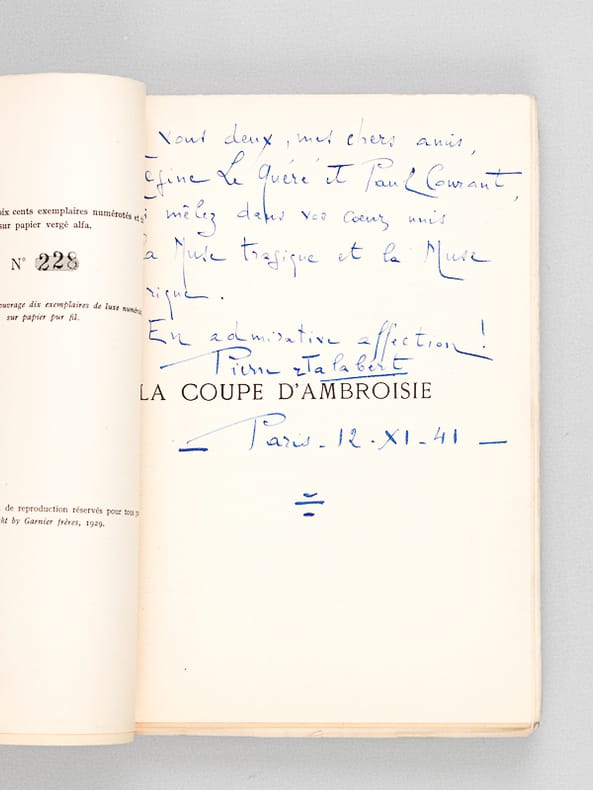
Un des 600 exemplaires sur vergé alfa numérotés (n° 228) après 10 pur fil, 1 vol. in-8 br., La Muse Française, Garnier, Paris, 1930, 124 pp. et 2 ff. Très bel envoi de l'auteur "A vous deux, mes chers amis, Régine le Quéré et Paul Courant, qui mêlez dans vos coeurs unis la Muse Tragique et la Muse Lyrique, en admirative affection !". Bon exemplaire (dos passé,très bon état par ailleurs). Français

|
|
|
JALABERT, Pierre
La Coupe d'Ambroisie. Poèmes de Pierre Jalabert [ Edition originale - Livre dédicacé par l'auteur ]
Un des 600 exemplaires sur vergé alfa numérotés (n° 228) après 10 pur fil, 1 vol. in-8 br., La Muse Française, Garnier, Paris, 1930, 124 pp. et 2 ff.
Riferimento per il libraio : 61302
|
|
|
JALAGUIER Marcel.
Jacques Coeur. Illustration de Louis Lafabrier inspirée de l'oeuvre du statuaire Préault.
1965 Montpellier, Imprimerie Paul Déhan, 1965; In-8°, demi-basane rouge, dos à nerfs, auteur et titre dorés; IX, (III), 237, (4)pp. Illustré dans le texte de lettrines et culs-de-lampe en noir et de 13 planches photographiques hors texte (reproductions de monuments ou documents anciens).
Riferimento per il libraio : 7332
|
|
|
JALE YILMABASAR, (Turkish painter and ceramicist), (1939-).
Typescript document - letter signed 'Jale Yilmabasar', addressed to Gültekin [Sâmanoglu], (1927-2003).
Very Good Turkish Original typescript document - letter signed by Jale Yilmabasar. (30,5x21,5 cm). In Turkish. 10 lines. A pair of puncher holes on the left side of the paper. Letter sent to Gültekin Sâmanoglu, (1927-2003), who was a Turkish poet and one of the founders of a very important literary magazine titled 'Hisar' in the Turkish literature. 1 p. She wrote to him that she received the Hisar magazines that he sent. She thanks and she apologizes that she couldn't call him. Yilmabasar is a Turkish painter and ceramicist. She was born in 1939 in Samsun, Turkey. Yilmabaser's career as a ceramic artist began while studying in the United States at Albany Union High School under an AFS scholarship. In addition to ceramics and painting, Yilmabaser also studied ballet for a large portion of her life. After high school, Yilmabaser returned to Turkey, where she studied ceramics at the State Academy of Fine Arts and the Istanbul Graduate School of Practical Fine Arts. She also studied painting and graphic design at Munich Academy. She graduated from the Department of Ceramic, School of Practical Fine Arts in the year 1962. After graduation, she held an internship at the Arzberg Schonwald Ceramic Factory in Germany. Yilmabaser also lectured at the University of Miami for one year in 1964. She served as a professor at Marmara University for many years. Yilmabaser held art exhibitions all over the world. Her first personal exhibition, "Jale's Roosters" was held in 1963." After this, she went on to open and attend exhibitions in Paris, Munich, London, and Moscow, among other places. Because of her work, Yilmabaser was called upon to create many ceramic panels for hotels and institutes worldwide. In 1968, she was awarded a gold medal in the International Ceramic Competition in Italy, In 1969 she received a gold medal at the International Handicrafts Fair in Germany. She was also elected as one of the six best ceramic artists in the world in 1972. In 1998, she received the title "State Artist" from the Ministry of Culture of Turkey. One year later, she opened the most inclusive exhibition of her work, "15 years with Pictures," in which she showed fifteen years of her art and ceramic work This exhibition was held in the Istanbul Atatürk Culture Center.
|
|
|
JALLAIS (Denise) -
L'arbre et la terre -
Paris : Pierre Seghers (Collection "P.S."), 1954 - un volume in-12 (108x180mm) agrafé sous couverture imprimée en couleurs et rempliée, 39 pages - bon état - Edition originale sur papier courant avec un envoi autographe signé de Denise Jallais àdressé à la directrice de Théâtre et interprète Agnès Capri, aux grandes heures de son cabaret - bon état -
Riferimento per il libraio : 41970

|
|
|
JALLAIS (Denise).
Matin triste.
Paris Seghers, coll. "Poésie 52" 1952 1 vol. broché plaquette in-12, agrafée, couverture à rabats en couleurs sur fond crème, 33 pp. Edition originale. Envoi de l'auteur à G.-E. Clancier. Dos et couverture légèrement jaunis, sinon bon état.
Riferimento per il libraio : 102111
|
|
|
JALLAIS (Denise).
Matin triste.
Paris Seghers, coll. "Poésie 52" 1952 1 vol. broché plaquette in-12, agrafée, couverture à rabats en couleurs sur fond crème, 33 pp. Edition originale. Envoi de l'auteur à G.-E. Clancier. Dos et couverture légèrement jaunis, sinon bon état.
Riferimento per il libraio : 102111
|
|
|
JALOUX (Edmond)
Essences
1944 P. Les éditions du cheval ailé , collection princeps in8, brochécouverture rempliée168 pp ,, exemplaire numéroté, édition originale
Riferimento per il libraio : 8267
|
|
|
JALOUX (Edmond)
La fin d'un beau jour.
1925 P. La cité des livres. 1925 "le roman français d'aujourd'hui" in8, broché, 248 pp. Envoi autographe, signature de l'auteur
Riferimento per il libraio : 3812
|
|
|
JALOUX (Edmond)
Le Centenaire de Baudelaire : manuscrit autographe signé
S.L; [vers avril 1921]. In-folio, 14 pp. (petits manques, déchirures et taches sans gravité pour la lecture).
Riferimento per il libraio : 23152

|
|
|
JALOUX (Edmond)
Observation sur les Rêves : manuscrit autographe signé
S.l.n.d. In-4, 7 pp. 1/2 (quelques petites taches).
Riferimento per il libraio : 23313
|
|
|
JALOUX (Edmond)
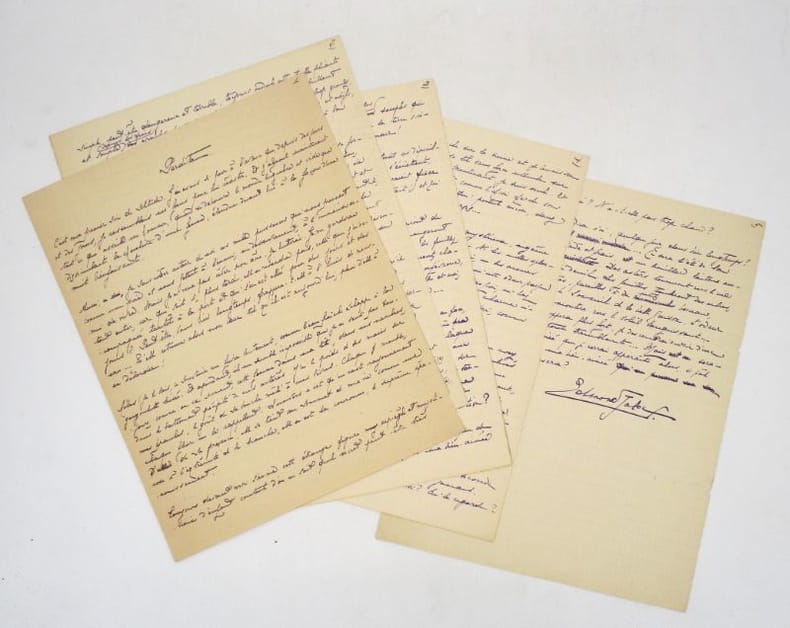
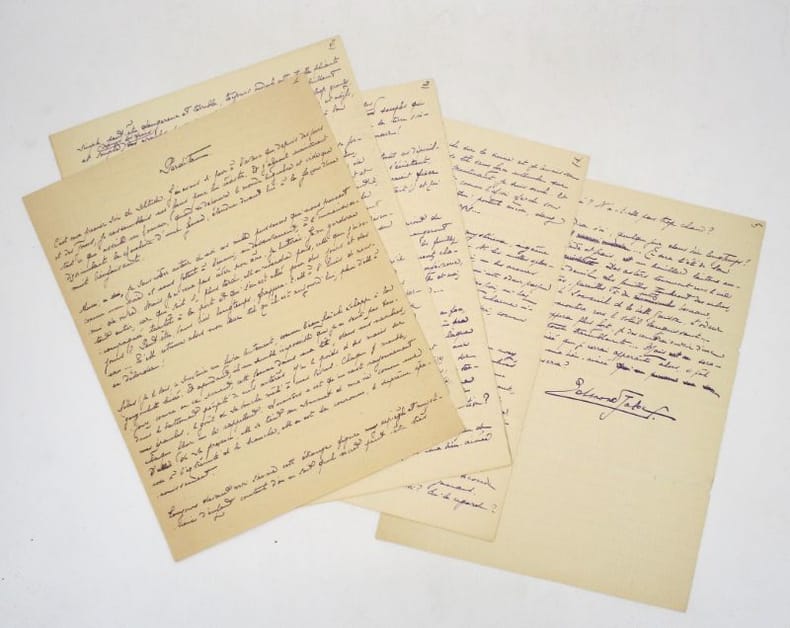
Perdita : manuscrit autographe signé
In-4, 4 pp. 1/2 (infimes déchirures marginales sans atteinte au texte).
Riferimento per il libraio : 23314
|
|
|
JALOUX (Edmond).
L’Oiseau-Lyre.Roman.
Paris,Arthème-Fayard,1938 ; in-8°,broché,couverture imprimée en rouge et noir;3ff.,247pp.
Riferimento per il libraio : cROU-1607
|
|
|
Jaloux Edmond:
La capricieuse - Le pèlerin - La surprise.
Librairie Plon, 1939. In-8, demi-chagrin vert à coins, dos à 4 nerfs avec titre doré, filets dorés sur les plats, tête dorée, plats et gardes marbrés, couvertures conservées, non rogné. Dos uniformément passé.
Riferimento per il libraio : 25407

|
|
|
JAMATI (Paul).
Poèmes. Préface de Léon-Paul Fargue.
Paris Denoël 1938 1 vol. broché in-8, broché, 157 pp. Edition originale. Un des 10 exemplaires hors commerce numérotés sur pur fil, enrichi d'un bel envoi de l'auteur à Anatole de Monzie. Tampon d'ex-libris. Dos légèrement bruni. Couverture un peu salie. Sinon bon état.
Riferimento per il libraio : 19474
|
|
|
JAMATI (Paul).
Poèmes. Préface de Léon-Paul Fargue.
Paris Denoël 1938 1 vol. broché in-8, broché, 157 pp. Edition originale. Un des 10 exemplaires hors commerce numérotés sur pur fil, enrichi d'un bel envoi de l'auteur à Anatole de Monzie. Tampon d'ex-libris. Dos légèrement bruni. Couverture un peu salie. Sinon bon état.
Riferimento per il libraio : 19474
|
|
|
JAMATI (Paul).
Soleils.
Paris Champion, coll. "Les Amis d'Edouard" 1927 1 vol. broché in-16, broché, couverture rempliée, non coupé, 44 pp. Édition originale tirée uniquement à 306 exemplaires, celui-ci numéroté sur Arches et enrichi d'un envoi de l'auteur à Paul Valéry. Dos et bordure de la couverture légèrement brunis. Non coupé. Très bon état.
Riferimento per il libraio : 1410
|
|
|
JAMATI (Paul).
Soleils.
Paris Champion, coll. "Les Amis d'Edouard" 1927 1 vol. broché in-16, broché, couverture rempliée, non coupé, 44 pp. Édition originale tirée uniquement à 306 exemplaires, celui-ci numéroté sur Arches et enrichi d'un envoi de l'auteur à Paul Valéry. Dos et bordure de la couverture légèrement brunis. Non coupé. Très bon état.
Riferimento per il libraio : 1410
|
|
|
James Darmesteter
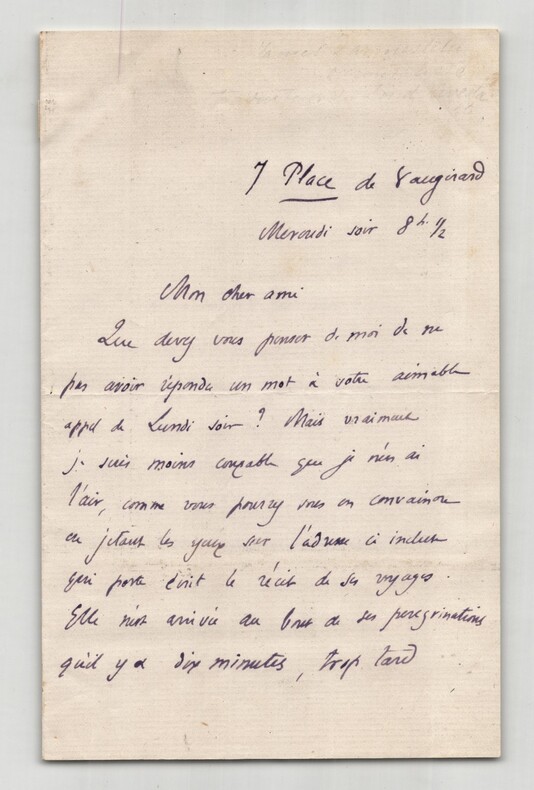
James Darmesteter - Lettre autographe signée "Inconnu au Collège de France"
James Darmesteter. Lettre autographe signée Philologue iranologue français Lettre autographe signée de James Darmesteter, non datée. Rédigée à l'encre bleue sur un double feuillet de papier vergé. Dimensions : 11,1 x 17,6 cm État : Traces d'onglet au dos, sinon bel état de conservation. Nombre de pages : 2 pages James Darmesteter, né le 28 mars 1849 à Château-Salins et mort le 19 octobre 1894 à Maisons-Laffitte, est un philologue iranologue français. Spécialiste du vieux perse, du zoroastrisme et de l’Avesta, il a été professeur au Collège de France et à l'École pratique des hautes études.
Riferimento per il libraio : boz_001890
|
|
|
James Dennistou, Scottish Art Collector
Manuscript Signed Letter by a Scottish Art Collector, Concerning the Acquisition of Paintings by Crivelli.
Manuscript signed letter by Scottish art collector James Dennistoun to Lady Ann Cullum, while both are in Rome, concerning her acquisition of paintings by Crivelli, and making recommendation for a skilled local Italian restorer. 8vo. 3 pages in manuscript, double leaf measuring approximately 12,5 x 19 cm, with seashell watermark, integral address being simply 28 Corso, remnants of a green wax seal. Undated, but similar correspondence in the Cullum archives help to date this letter to the period before 1842. A small segment of mounting paper adhered to verso, loss to one corner at margin, text unobstructed, otherwise in very good condition. The paintings discussed in this correspondence are indeed treasures of antiquity, made by Carlo Crivelli (Venice c. 1430 - Ascoli Piceno 1495), Italian Renaissance painter of conservative Late Gothic decorative sensibility, who spent his early years in the Veneto, where he absorbed influences from the Vivarini, Squarcione and Mantegna. Crivelli's works are exceedingly scarce. Only two can be found today in Venice, both in the church of San Sebastiano. It is interesting to note that the present letter refers to more than one Crivelli painting, "the Crivellis... they" etc. Without seeing these specific art works, but holding the ancient artist in due high regard, Dennistoun states that they would surely equal Crivelli's other well-known and venerated pieces. He also estimates a value of 3,000 piastres [modest indeed for such an invaluable prize]. Manuscript
|
|
|
James Foote Gibb
Signed Letter by James Foote Gibb, Affluent Shipwright and Partner of Gibb and Hutchinson Firm.
Signed letter by James Foote Gibb, affluent shipwright and partner of Gibb and Hutchinson firm. 8vo. Single-leaf, his company's printed stationery, The Ben Line of Steam Tugs. Leaf measures approximately 20cm x 25cm. Very good condition. James Foote Gibb, together with business partner Allan Hutchison, carried on business as shipwrights at the Ratcliff Dry Dock in Shadwell, East London until October 1871, at which time the partnership was dissolved, Hutchison entering retirement and Gibb continuing on his own. In December 1882, five months after this letter was written, he entered into partnership with James Glen Williamson. Gibb's office was located in n City Chambers, Railway Place, Fenchurch Street, in the City of London, advertised on his letterhead. Dealing with matters of personal business, the recipient of this letter is identified only as Annie, and appears to be a prodigal staff, perhaps servant/cook, returning and making amends.
|
|
|
James Grant Wilson
James Grant Wilson - Lettre autographe signée – Paris – à propos de la bibliothèque du duc d'Aumale à Chantilly - 1882
James Grant Wilson - Lettre autographe signée – Paris – à propos de la bibliothèque du duc d’Aumale à Chantilly - 1882 Dimensions : 20.4 x 12.6 cm État : Lettre de deux pages in-8, en bon état, accompagnée de son enveloppe d’origine adressée au comte de Paris à Chantilly. Nombre de pages : 2 pages
Riferimento per il libraio : boz_002744

|
|
|
James II & VII, King of England, Ireland and Scotland (1633-1701).
Autograph letter signed ("J"). Newmarket, 22 March 1682.
4to. 1½ pp. on bifolium. With autograph address and seal. "For my Neece the Countess of Lichfield", i.e. Charlotte Lee, Countess of Lichfield, 1664-1718, previously Lady Charlotte Fitzroy, illegitimate daughter of Charles II and his mistress Barbara Villiers, 1st Duchess of Cleveland, apologizing for not having answered her letter earlier, but "the Scots affairs, and so much company is come to me, I have not any tyme to my self". - Slightly browned due to paper, traces of folding; address leaf with traces of mounting.
|
|
|
James Lowe Autographs
James Lowe Autographs. Catalogue no. 2.
New York: James Lowe Autographs 1960s. 8vo. ca 40 pp. Very Good. Soft Covers. Staples wraps. Some foxing to front cover. Pages fine. Mailed to Frederick G. Ruffner Jr.From the collection of the late Frederick Ruffner Jr. founder of Gale Research Detroit. New York: James Lowe Autographs, [1960s?]. paperback
Riferimento per il libraio : 18-0340

|
|
|
James Mason
James Mason - LETTRE AUTOGRAPHE SIGNÉE À Claude Armand grand collectionneur
James Mason - LETTRE AUTOGRAPHE SIGNÉE À Claude Armand Acteur Lettre autographe signée de James Mason acteur de cinéma britannique au collectionneur Claude Armand Dimensions : 15 x 10,5 cm Nombre de pages : 1
Riferimento per il libraio : boz_001702

|
|
|
James MASON
James MASON autographe - Grande PHOTOGRAPHIE SIGNÉE de sa main
James MASON autographe - PHOTOGRAPHIE SIGNÉE de sa main Acteur Photographie signée par Jason MASON au feutre noir. Provenance : issu de la collection d'autographes de Claude ARMAND, collectionneur suisse. Dimensions : 25,5 x 20 cm État : Voir photos pour plus de détails. Nombre de pages : 1 page
Riferimento per il libraio : boz_002067

|
|
|
James PICHETTE - [Chateauroux 1920 - Paris 1996] - Peintre français
Lettre Autographe Signée à Jean Caillens -
1 page in12 au dos d'un invitation au vernissage de la Galerie de Beaune en 1951 -
Riferimento per il libraio : GF28150
|
|
|
James PICHETTE - [Chateauroux 1920 - Paris 1996] - Peintre français
Lettre Autographe Signée à Jean Caillens - le 26 janvier 1951 -
1 page 1/2 in4 - pli un peu pourssièreux au dos -
Riferimento per il libraio : GF28151
|
|
|
James PICHETTE - [Chateauroux 1920 - Paris 1996] - Peintre français
Lettre Autographe Signée à Jean Caillens - le 7 fevrier 1951 + Manuscrit autographe comportant sa biographie -
1 page in4 et 1 page et demi in4 - une feuille un peu froissée -
Riferimento per il libraio : GF28152
|
|

 Ricevere i risultati per e-mail
 Scaricare i risultati in PDF
 RSS feed
 Link
Link


