|
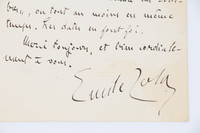
Emile ZOLA
"Je me suis exténué à faire sortir cette vérité de mon livre si l'on ne m'a pas compris la faute en est sans doute à moi."" Signed autograph letter addressed to Henry Fouquier about La Terre
Paris 1888. Fine. Paris 11 février 1888 13.20 x 20.50 cm 2 pages sur un double feuillet Autograph letter signed by Emile Zola addressed to Henry Fouquier written in black ink on a bifolium. Usual folds from mailing. This letter was transcribed in the complete correspondence of Emile Zola published by the CNRS and the Presses de l'Université de Montréal. A fine letter evoking La Terre and Tolstoy's The Power of Darkness. Henry Fouquier 1838-1900 was a literary critic and columnist for numerous newspapers. A close friend of Guy de Maupassant he supported Emile Zolas candidacy for the Académie française. This letter was written to him the day after the performance of Tolstoy's The Power of Darkness at the Théâtre-Libre. We have not found evidence of an article in which the journalist explicitly drew a parallel between the Russian drama and Zolas La Terre but Zola here addresses his thanks: « Merci mon cher Fouquier de ce que vous voulez bien dire de « la Terre » si attaquée. J'en suis touché vivement et croyez à toute ma gratitude. » It must be said that the fifteenth volume of the Rougon-Macquart cycle was harshly received unleashing passions from the moment of its serial publication in Gil Blas. On 18 August 1887 even before the conclusion of the novel was revealed to the public Le Figaro published the Manifeste des Cinq written by Paul Bonnetain J.-H. Rosny Lucien Descaves Paul Margueritte and Gustave Guiches. These young authors issued a severe verdict: « La Terre a paru. La déception a été profonde et douloureuse. Non seulement l'observation est superficielle les trucs démodés la narration commune et dépourvue de caractéristiques mais la note ordurière est exacerbée encore descendue à des saletés si basses que par instants on se croirait devant un recueil de scatologie : le Maître est descendu au fond de l'immondice. . Nous répudions ces bonshommes de rhétorique zoliste ces silhouettes énormes surhumaines et biscornues dénuées de complication jetées brutalement en masses lourdes dans des milieux aperçus au hasard des portières d'express. De cette dernière uvre du grand cerveau qui lança L'Assommoir sur le monde de cette Terre bâtarde nous nous éloignons résolument mais non sans tristesse. Il nous poigne de repousser l'homme que nous avons trop fervemment aimé. » Zola who had been developing the idea of a peasant novel for a decade was deeply affected. Though he never responded publicly to these accusations his correspondence is strewn with clarifications about the work whose sheer brutality alone seemed to occupy readers minds: « Mais vous ajoutez que notre thèse à Tolstoï et à moi est la même et peut se résumer en ceci : le travail de la terre est corrupteur. Tolstoï il me semble protesterait bien haut et quant à moi je vous affirme que je n'ai jamais voulu prouver une telle chose radicalement fausse à mon avis. Ce que je pense c'est que la petite propriété telle qu'elle existe chez nous c'est que la suite de faits sociaux qui ont abouti à notre forme sociale nous ont donné notre paysan d'aujourd'hui avec ses qualités et ses vices. Notre paysan est le prisonnier de sa terre et non l'homme libre qu'il devrait être. Comment voulez-vous qu'il n'y étouffe pas dans son ignorance et sa passion unique Labourer est très sain mais à la condition qu'on sera le maître de son champ au lieu d'en être le forçat. Je me suis exténué à faire sortir cette vérité de mon livre si l'on ne m'a pas compris la faute en est sans doute à moi. » A remarkable letter from the master of Naturalism shedding new light on one of the most brutal volumes of the Rougon-Macquart series. unknown
Référence libraire : 79098
|
|
|
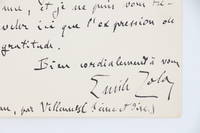
Emile ZOLA
"Vous avez eu l'obligeance de me donner certains détails sur l'inventaire. Vous m'avez dit qu'on choisissait le premier dimanche d'août qu'on fermait les portes et que tous les employés s'y mettaient."" Autograph letter signed unpublished addressed to Léon Carbonnaux head of department at Le Bon Marché and advice for the writing of Au bonheur des Dames
Médan 1882. Fine. Médan 16 novembre 1882 13.60 x 21.40 cm 2 pages sur un double feuillet - enveloppe jointe Autograph letter signed by Emile Zola - apparently unpublished - addressed to Léon Carbonnaux written in black ink on a double sheet. Folds inherent to mailing. Envelope included. Important testimony to the colossal documentation work and the capital role of Emile Zola's informants in depicting his immense natural and social fresco. This letter was sent to Léon Carbonnaux department head at Bon Marché who transmitted precious information to Emile Zola for the creation of the eleventh volume of the Rougon-Macquart series: Au Bonheur des Dames. Only two letters from Léon Carbonnaux to Emile Zola are known: they can be consulted in the digitization of the preparatory file for Bonheur des Dames made available online by the Bibliothèque nationale de France. However we know thanks to this same file which contains a long section entitled ""Notes Carbonnaux"" that this department head at Bon Marché provided a significant amount of information to Zola particularly about employee customs and their remuneration. The two men undoubtedly met when Emile Zola eager for information about the functioning of department stores conducted field research in February and March 1882. ""J'ai pris l'inventaire comme cadre à un de mes chapitres. D'ailleurs je n'ai spécialement besoin que du travail dans le rayon des confections et dans le rayon des soieries. Il est inutile de me renseigner sur les autres rayons."" ""I have taken the inventory as the framework for one of my chapters. Moreover I specifically only need the work in the ready-to-wear department and in the silk department. It is unnecessary to inform me about the other departments."" Thanks to this important letter we understand that it was Léon Carbonnaux who provided the essential information to Emile Zola for writing his very beautiful eleventh chapter devoted to the inventory: ""Vous avez eu l'obligeance de me donner certains détails sur l'inventaire. Vous m'avez dit qu'on choisissait le premier dimanche d'août qu'on fermait les portes et que tous les employés s'y mettaient. On vide toutes les cases n'est-ce pas on jette les marchandises sur les comptoirs ou à terre et l'inventaire n'est terminé que lorsqu'il n'y a plus absolument rien en place."" ""You were kind enough to give me certain details about the inventory. You told me that the first Sunday in August was chosen that the doors were closed and all the employees set to work. All the compartments are emptied aren't they The merchandise is thrown onto the counters or on the ground and the inventory is only finished when there is absolutely nothing left in place.""The final version of Bonheur des Dames contains all the precious information provided by the department head of Bon Marché: ""Le premier dimanche d'août on faisait l'inventaire qui devait être terminé le soir même. Dès le matin comme un jour de semaine tous les employés étaient à leur poste et la besogne avait commencé les portes closes dans les magasins vides de clientes. . Neuf heures sonnaient. . Dans le magasin inondé de soleil par les grandes baies ouvertes le personnel enfermé venait de commencer l'inventaire. On avait retiré les boutons des portes des gens s'arrêtaient sur le trottoir regardant par les glaces étonnés de cette fermeture lorsqu'on distinguait à l'intérieur une activité extraordinaire. C'était d'un bout à l'autre des galeries du haut en bas des étages un piétinement d'employés des bras en l'air des paquets volant par-dessus les têtes ; et cela au milieu d'une tempête de cris de chiffres lancés dont la confusion montait et se brisait en un tapage assourdissant. Chacun des trente-neuf rayons faisait sa besogne à part sans s'inquiéter des rayons voisins. D'ailleurs on attaquait à peine les casiers il n'y avait encore par terre que quelques pièces d'étoffe. La machine devait s'échauffer si l'on voulait finir le soir même. unknown
Référence libraire : 79109
|
|
|
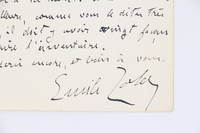
Emile ZOLA
"Comment avez-vous pu vous laisser prendre à la plaisanterie imbécile du Panurge "" Very important autograph letter signed unpublished addressed to Léon Carbonnaux about the false publication of a pre-original of Au bonheur des Dames
Médan 1882. Fine. Médan 1er décembre 1882 13.60 x 21.40 cm 2 pages sur un double feuillet - enveloppe jointe Autograph letter signed by Emile Zola - apparently unpublished - written in black ink on a double sheet and addressed to Léon Carbonnaux department head at Bon Marché. Folds inherent to mailing. Envelope included. Only two letters from Léon Carbonnaux to Emile Zola are known: they can be consulted in the digitized preparatory file for Au bonheur des dames made available online by the Bibliothèque nationale de France. However we know from this same file which contains a long section entitled ""Notes Carbonnaux"" that this department head at Bon Marché provided Zola with a significant amount of information particularly about employee customs their remuneration and especially inventory techniques. The two men probably met when Emile Zola eager for information about the workings of department stores conducted field research in February and March 1882. Very important unpublished letter shedding new light on the pre-original publication of Au bonheur des dames. In his biography of Emile Zola Henri Mitterrand writes: ""Even before the novel was completed Zola gave an extract to Panurge in November; and on November 23 1882 Gil Blas announced its imminent publication in its columns."" Our letter discussing precisely this alleged pre-publication in Panurge attests that it was simply a joke and thus contradicts Henri Mitterrand: ""But your letter surprises and saddens me somewhat. How could you have been taken in by Panurge's stupid joke Did you not notice that the entire issue is a 'farce' Not one of the articles is authentic they are parodies and very poorly done ones at that."" Indeed reading the said extract cannot fool the assiduous reader of Zola despite the introduction that the journalists wrote: ""After Nana and Pot-Bouille those epics of elegant vice and bourgeois vice M. Emile Zola wanted to create one of honesty: Au bonheur des Dames which will appear shortly is a reassuring painting of innocence and virtue; the greatest success is assured for this new work whose characters move in the setting of a large novelty store; Parisian high commerce will not long await its observer and painter. We thank Emile Zola for having kindly cut out especially for Panurge a few pages from his still unpublished work and we are proud to give the public first an extract from this work of such high morality and such powerful interest."" Panurge no. 4 of October 22 1882 The sentences of this false Zolian text are exaggeratedly long and Panurge took the liberty of endowing the novel with a male main character Denis Mouret an amalgam of Denise the true heroine of the book to appear and Octave Mouret. One can think that it is a text composed from elements of Pot-Bouille the previous volume of Rougon Macquart where Octave - future owner of Bonheur des Dames - exercised the function of clerk before his meteoric social rise: ""For already more than two months he had been attached to the 'silks and furs' department; he arrived in the morning at seven o'clock to return home his day finished only at nine o'clock in the evening when all of Paris buzzed strangely with a feverish animation of pleasure and enjoyment and on his way back he followed gawking the great crowded boulevards where blazed the cafés full of girls and where on the asphalt at theater doors the crowd jostled with here and there in the vague rumor of trampling and pressing the roguish intonation of the cries of program vendors and ticket sellers."" Panurge In his letter of November 30 1882 Léon Carbonnaux - reading the extract from Panurge - had reproached Zola for his errors: ""Nowhere except at the Fabriques de France near Les Halles does one arrive at 7 a.m. It's at the earliest 7:30 but more often 8 a.m. and even then. There is no silk and fur counter at the Louvre. . It is so easy for you to be accurate that errors of this kind especially if t unknown
Référence libraire : 79111
|
|
|
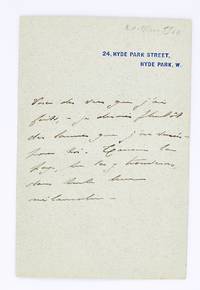
Renee VIVIEN
Poème d'amour autographe inédit à Natalie Clifford Barney ""A l'absente"" Unpublished handwritten poem to Natalie Clifford Barney
s. l. 1900. Fine. s. l. 20 mars 1900 10 x 15.70 cm 2 pages sur un double feuillet Unpublished handwritten poem to Natalie Clifford Barney « à l'absente » 20 March 1900 10 x 157 cm 2 pages on a double leaf Handwritten poem entitled « à l'absente » To the absent one and addressed to Natalie Clifford Barney. Two pages written in black ink on a double leaf headed 24 Hyde Park Street. To our knowledge this three-verse octosyllabic poem is unpublished. It is preceded on the first section of this double leaf by a little handwritten message: These are the verses I have made I would rather say the tears which I have shed for you. Turn the page you will find them there in all their melancholy. Oui c'est toi mon rêve suprême Pendant ces longs ces mornes jours Où je pleure au fond de moi-même L'exil triste de mes amours! . N'as-tu pas entendu ma blonde Le bruit d'un sanglot qui revient Dans le cur de la nuit profonde C'est mon amour qui se souvient. It is at the end of 1899 and through Violette Shillito that Renée Vivien then Pauline Tarn met Natalie Clifford Barney ""this American woman softer than a scarf whose sparkling face shines with golden hair sea blue eyes never-ending teeth"" Colette Claudine à Paris. Natalie who had just experienced a summer romance with the scandalous Liane de Pougy who introduced her to sapphism paid little attention to this new acquaintance. Renée on the other hand was totally captivated by the young American woman and describes this love at first sight in her autobiographical novel Une femme m'apparut: ""I lived again the hour already well past when I saw her for the first time felt the shiver that ran through me when my eyes met the mortal steel of her look those eyes blue and piercing as a blade. I had a dim premonition that this woman would determine the pattern of my fate and that her face was the predestined face of my Future. Near her I felt the luminous dizziness which comes at the edge of an abyss or the attraction of a very deep water. She radiated the charm of danger which drew me to her inexorably."" ""Winter 1899-1900. Beginnings of the idyll. One evening Vivien is invited by her new friend to Mme Barney's studio Natalie's mother 153 avenue Victor-Hugo on the corner of the rue de Longchamp. Natalie finds the courage to read the verses of her composition. As Vivien tells her to love these verses she tells her that it is better to love the poet. A response worthy of the Amazon."" J.-P. Goujon Tes blessures sont plus douces que leurs caresses Two years of unequal happiness will follow punctuated by Natalie's recurring infidelities and Renée's sickly jealousy the letters of which oscillate between inflamed declarations and painful admissions of guilt. ""Renée Vivien is the daughter of Sappho and Baudelaire she is the 1900 flower of evil with fevers broken-up fights sad delights."" Jean Chalon Portrait d'une séductrice In 1901 a major break-up occurred which lasted almost two years; Renée despite requests from Natalie and the others she sent to win her back resisted. ""The two friends saw each other again and in August 1905 went on a pilgrimage to Lesbos which was a disappointment for Natalie Barney and was short-lived. . The spring was broken once and for all. The two former friends stopped seeing each other in 1907 and Vivien died without them seeing each other again."" J.-P. Goujon ibid. unknown
Référence libraire : 78737
|
|
|
Renee VIVIEN
"je n'ai pas beaucoup d'amis et me soucie peu de distribuer des volumes au hasard"" Signed autograph letter addressed to his publisher Edward Sansot
s. l. Paris 1908. Fine. s. l. Paris 1908 13 x 15 cm 3 pages 1/2 sur un double feuillet Autograph letter signed by Renée Vivien addressed to her publisher Edward Sansot written in black ink on a double sheet of headed paper bearing the poet's monogram and her address at 23 avenue du Bois de Boulogne. Transverse folds inherent to mailing two tiny marginal tears without loss at the fold. Fascinating letter written by the Muse of the violets in the last months of her life: ""J'ai reçu avec une très grande joie les volumes des Flambeaux éteints. Remerciez bien de ma part votre soeur d'avoir fait les corrections et je vous en prie amenez-la moi lorsque vous reviendrez Avenue du Bois. Pour les six exemplaires de Sillages décollés donnez-les - je n'ai pas beaucoup d'amis et me soucie peu de distribuer des volumes au hasard. Maintenant s'il est trop tard lorsque ma lettre vous parviendra et que les exemplaires me parvinssent quand même ne soyez pas désolé - cela m'est indifférent je vous les ferai envoyer. Mes meilleurs sentiments d'amitié littéraire. Renée Vivien. Je vous envoie en même temps sept volumes à distribuer au hasard parmi vos amis littéraires."" ""I received the volumes of Flambeaux éteints with very great joy. Please thank your sister on my behalf for having made the corrections and I beg you bring her to me when you return to Avenue du Bois. For the six unbound copies of Sillages give them away - I do not have many friends and care little about distributing volumes at random. Now if it is too late when my letter reaches you and the copies reach me nonetheless do not be sorry - it is indifferent to me I will have them sent to you. My best feelings of literary friendship. Renée Vivien. I am sending you at the same time seven volumes to distribute at random among your literary friends."" The publication of Flambeaux éteints marks the first collaboration between the poet and her new publisher Edward Sansot. In these last painful years of life Sansot and his friend Charles-Brun are her only two links with the literary world whose critics - once highly laudatory - have finally turned their backs on her. It must be said that Renée Vivien has decided to withdraw all her books from commerce and is gradually sinking into solitude and depression. Handsome letter bearing witness to the last literary years of Sappho 1900. unknown
Référence libraire : 79911
|
|
|
Renee VIVIEN
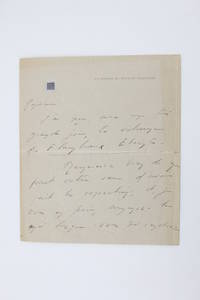
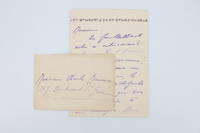
Lettre autographe signée adressée à Charles Maurras : ""En feuillettant votre si intéressant volume : De l'Avenir de l'Intelligence j'ai relu avec un plaisir ému les pages - trop indulgentes vraiment ! - que vous avez consacré à mes ouvrages.""
s. l. Paris 1906. Fine. s. l. Paris s. d. ca. 1906 11.50 x 16 cm 1 page 1/2 sur un double feuillet Autograph letter signed by Renée Vivien addressed to Charles Maurras written in violet ink on a double leaf of headed paper adorned with a border of violets. Transverse folds inherent to mailing envelope included. Beautiful letter of thanks: ""Monsieur En feuillettant votre si intéressant volume : De l'Avenir de l'Intelligence j'ai relu avec un plaisir ému les pages - trop indulgentes vraiment ! - que vous avez consacré à mes ouvrages. Merci infiniment. Et veuillez agréer mes très reconnaissants sentiments de confraternité littéraire. Renée Vivien"" ""Sir While leafing through your most interesting volume: De l'Avenir de l'Intelligence I reread with moved pleasure the pages - too indulgent really! - that you dedicated to my works. Thank you infinitely. And please accept my most grateful sentiments of literary confraternity. Renée Vivien"" Charles Maurras had indeed devoted a dithyrambic chapter of his work to the Muse of violets whose verses he compared to those of Verlaine: ""Le vieux faune sentimental des Fêtes galantes et de Parallèlement reconnaîtrait chez Renée Vivien beaucoup plus qu'une élève certainement une des Surs une de ces Amies terribles qu'il a chantées. Quant à Baudelaire il lui dirait : ""Ma fille"" aux premiers regards échangés. Baudelairisme profond central générateur."" ""The old sentimental faun of Fêtes galantes and Parallèlement would recognize in Renée Vivien much more than a student certainly one of the Sisters one of those terrible Friends he sang of. As for Baudelaire he would say to her: 'My daughter' at first glance. Deep central generative Baudelairism."" unknown
Référence libraire : 79816
|
|
|
Renee VIVIEN
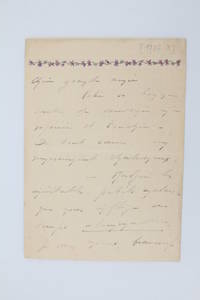
"J'aurai le plaisir de vous présenter ma soeur et mon beau-frère qui seront à Paris. Vous devinez quelle joie me causera leur présence !"" Signed autograph letter addressed to Marcelle Tinayre
s. l. Paris 1907. Fine. s. l. Paris s. d. ca. 1907-1908 11.50 x 16 cm 2 pages 1/2 sur un double feuillet Autograph letter signed by Renée Vivien addressed to Marcelle Tinayre written in black ink on a double sheet of headed paper decorated with a border of violets. Transverse creases inherent to mailing. Also a writer Marcelle Tinayre was close to Renée Vivien who entrusted her first verses to her to read. Upon Vivien's death Tinayre paid tribute to her through several texts notably a very beautiful tribute article published in the review Schéhérazade in 1910 entitled ""Trois images de Renée Vivien"". ""Chère grande amie Votre si bonne carte de souvenir m'a réjouie et touchée. De tout coeur un remerciement chaleureux. Malgré les inévitables petits malaises que nous inflige ce temps abominable je vais mieux beaucoup mieux. Aussi serais-je très heureuse si vous et Monsieur Tinayre étiez libres le 12 et pouviez venir dîner chez moi. J'aurai le plaisir de vous présenter ma soeur et mon beau-frère qui seront à Paris. Vous devinez quelle joie me causera leur présence ! Croyez à toute mon admiration à toute ma sympthie. Renée Vivien."" ""Dear great friend Your so kind remembrance card delighted and touched me. A warm thank you from the heart. Despite the inevitable small ailments this abominable weather inflicts upon us I am better much better. So I would be very happy if you and Monsieur Tinayre were free on the 12th and could come dine at my home. I will have the pleasure of introducing my sister and brother-in-law who will be in Paris. You can imagine what joy their presence will bring me! Believe in all my admiration all my sympathy. Renée Vivien."" The Muse of violets was indeed very close to Toinette her younger sister who lived in London with her husband Francis. Renée Vivien was moreover the godmother of their son Paul a very rare name then in England in honor of his aunt and in 1911 Toinette would give birth to a daughter whom she would name Renée in tribute to her deceased sister. Very beautiful testimony to the friendship that Renée Vivien bore toward Marcelle Tinayre a writer friend who contributed to perpetuating the memory of Sappho 1900. unknown
Référence libraire : 79804
|
|
|
Frederic-Auguste CAZALS
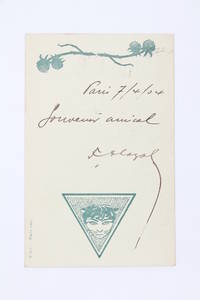
Carte postale autographe signée adressée à Emile Straus
Paris: S. n. 1904. Fine. S. n. Paris 7 avril 1904 14.10 x 9.10 cm une carte postale Autograph postcard signed by Frédéric-Auguste Cazals addressed to Emile Straus: ""Souvenir amical - F. A. Cazals Paris 7/4/04"" ""Friendly remembrance - F. A. Cazals Paris 7/4/04"" Some stains. A great enthusiast of epistolary art Emile Straus founded in 1899 La Carte postale illustrée the newsletter of the association he had just launched the International Poste-Carte Club. S. n. unknown
Référence libraire : 80519
|
|
|
Frederic-Auguste CAZALS
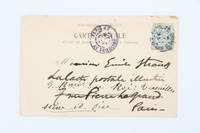
Carte postale autographe signée adressée à Emile Straus
Paris: S. n. 1904. Fine. S. n. Paris 13 août 1904 14.10 x 9.10 cm une carte postale Signed autograph postcard from Frédéric-Auguste Cazals addressed to Emile Straus: ""Amitiés ! F. A. Cazals Paris 13/8/04"" ""Best wishes! F. A. Cazals Paris 13/8/04"" Some staining. A great enthusiast of epistolary art Emile Straus founded in 1899 La Carte postale illustrée the newsletter of the association he had just launched the International Poste-Carte Club. S. n. unknown
Référence libraire : 80518
|
|
|
Jules CLARETIE
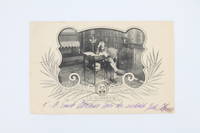
Carte postale autographe signée adressée à Emile Straus
Paris: S. n. 1904. Fine. S. n. Paris 3 janvier 1904 14 x 9 cm une carte postale Signed autograph postcard from Jules Clarétie addressed to Emile Straus on a postcard reproducing the photograph of his portrait at his work table: ""A M. Emile Straus tous mes souhaits. Jules Claretie."" ""To Mr. Emile Straus all my best wishes. Jules Claretie."" Some staining. A great enthusiast of epistolary art Emile Straus founded in 1899 La Carte postale illustrée the newsletter of the association he had just launched the International Poste-Carte Club. S. n. unknown
Référence libraire : 80517
|
|
|
Gerard de NERVAL
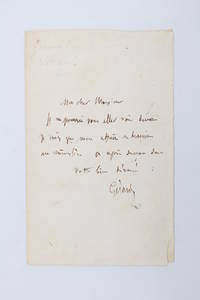
Billet autographe signé de Gérard de Nerval adressé à Georges Guénot-Lecointe
Paris 1842. Fine. Paris 10 juin 1842 10.60 x 17 cm quelques lignes sur un double feuillet Autograph letter signed ""Gérard"" addressed to Georges Guénot-Lecointe: ""Mon Cher Monsieur Je ne pourrai vous aller voir demain. Je crois que mon affaire se termine au Ministère. A après demain donc."" ""My Dear Sir I will not be able to come see you tomorrow. I believe my business is concluding at the Ministry. Until the day after tomorrow then."" Fold marks inherent to postal use. Trace of wax seal and manuscript address on fourth page. This letter has been transcribed in the correspondence published in the Pléiade volume 1 p. 917. The ""business"" referred to here concerns financial aid of 300 francs that had been granted to Nerval two months earlier by the Minister of Public Instruction Abel Villemin. Georges Guénot-Lecointe was a critic for La Sylphide a review to which Gérard de Nerval also contributed. unknown
Référence libraire : 80729
|
|
|
Maurice LEBLANC
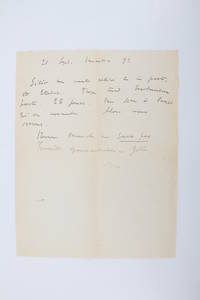
"Revue Blanche ne paie pas."" Signed autograph note
Vaucottes Vattetot-sur-mer 1893. Fine. Vaucottes Vattetot-sur-mer 21 septembre 1893 15.60 x 20.10 cm quelques lignes sur un feuillet Autograph letter signed by Maurice Leblanc to an unknown recipient; a few lines written in black ink on a sheet. Transverse folds inherent to mailing. ""Sitôt ton mot retiré de la poste été Etretat. Trop tard. Natanson parti. 28 jours. Ne sera à Paris qu'en novembre. Alors nous verrons. Revue Blanche ne paie pas. Tempête épouvantable - grêle."" ""As soon as your note was collected from the post office went to Etretat. Too late. Natanson left. 28 days. Won't be in Paris until November. Then we'll see. Revue Blanche doesn't pay. Terrible storm - hail."" unknown
Référence libraire : 80761
|
|
|
Judith GAUTIER
"Mr Clifton est un très jeune américain tout à fait charmant et qui a l'air d'une demoiselle. Soignez-le bien."" Signed autograph letter addressed to Céleste Chrétien
Alger Algiers 1910. Fine. Alger Algiers s. d. ca 1910 13.70 x 18 cm 4 pages sur un double feuillet Autograph letter signed by Judith Gautier addressed to Céleste Chrétien her housekeeper. Four pages written in black ink on a double sheet. Transverse folds inherent to mailing. Judith Gautier here discusses the visit of her friend the musician Chalmers Clifton - whom she liked to nickname Charmeur - to Dinard: ""Voici les dernières instructions : le voyageur arrivera dimanche soir à 7 heures 20. Il faudra le prendre à la gare vous ou Francis et le conduire tout droit à la maison qu'il ne connait pas. Il apporte des draps au cas où il n'y en aurait pas. Il les donnera pour qu'on fasse le lit et on le conduira tout de suite à Michelet pour dîner il faudra prévenir pour qu'on garde un dîner. . Mr Clifton est un très jeune américain tout à fait charmant et qui a l'air d'une demoiselle. Soignez-le bien."" ""Here are the final instructions: the traveler will arrive Sunday evening at 7:20. You or Francis will need to meet him at the station and take him straight to the house which he doesn't know. He is bringing sheets in case there aren't any. He will give them so the bed can be made and he will be taken immediately to Michelet for dinner you must warn them to save a dinner. . Mr. Clifton is a very young American who is quite charming and looks like a young lady. Take good care of him."" unknown
Référence libraire : 80835
|
|
|
Louis-Ferdinand CELINE
" Et puis aussi gratitudes pour tout le soin qu'elle a pris de Mme Gen Paul !. Laquelle ne donne aucune nouvelle. Quelle vacherie encore . Comme c'est amusant !"" Signed autograph letter addressed to Master Thorvald Mikkelsen
s. l. Klarskovgaard 1950. Fine. s. l. Klarskovgaard 17 novembre 1950 21 x 34 cm 2 pages sur un feuillet Autograph letter signed with the initials of Louis-Ferdinand Céline addressed to his lawyer Master Thorvald Mikkelsen. Two pages written in blue ink on a large sheet of white paper; number ""568"" in Céline's hand in red pencil at the top left. Transversal folds inherent to mailing. This letter was very partially transcribed in Année Céline 2005. Early November 1950 Gaby Paul had come to visit Céline and Lucette at Klarskovgaard: ""Oh mille mercis à Mme Christensen pour son aimable repas qui réchauffé fit nos délices ! Et puis aussi gratitudes pour tout le soin qu'elle a pris de Mme Gen Paul !. Laquelle ne donne aucune nouvelle. Quelle vacherie encore . Comme c'est amusant ! Je crois qu'elle avait des projets ""journalistiques"" mais que mon attitude l'a désenchantée. """"Oh a thousand thanks to Madame Christensen for her kind meal which reheated was our delight! And also gratitude for all the care she took of Mme Gen Paul!. Who gives no news. What nastiness again. How amusing! I believe she had 'journalistic' projects but my attitude disenchanted her."" Céline also mentions the Swedish writer Ernst Bendz one of the few to defend Céline alongside Paraz: ""Une lettre amusante de Bendz ! Bendz appartient vraiment à l'aristocratie des esprits ! La preuve ! La façon qu'il ""m'estime""!!!""""An amusing letter from Bendz! Bendz truly belongs to the aristocracy of minds! The proof! The way he 'esteems me'!!!"" In 1947 Céline pursued by French justice for his collaborationist involvement was confined in Denmark. It was in May 1948 accompanied by Lucette and Bébert that he arrived at his lawyer Master Thorvald Mikkelsen's home at Klarskovgaard. The latter owned a large property by the Baltic Sea and invited the exile to stay there. On February 21 1950 as part of the épuration the writer was definitively sentenced in absentia by the civic chamber of the Paris Court of Justice for collaboration to one year of imprisonment which he had already served in Denmark. The Swedish Consul General in Paris Raoul Nordling intervened on his behalf with Gustav Rasmussen Danish Foreign Minister and managed to delay his extradition. On April 20 1951 Jean-Louis Tixier-Vignancour his lawyer since 1948 obtained Céline's amnesty under the title of ""severely disabled veteran of the Great War"" by presenting his file under the name Louis-Ferdinand Destouches without any magistrate making the connection. Céline would leave Denmark the following summer after three years spent at his lawyer's home. unknown
Référence libraire : 80910
|
|
|
Louis-Ferdinand CELINE
"Je ne sais pas quels crimes j'ai commis mais pour ces fourbes canailles du 18eme Arrt. ma légende de bistrot en bistrot est devenue un Super Niebelung d'horreurs ! C'est rigolo. Au point qu'aucun n'ose me venir voir ici !"" Signed autograph letter addressed to Master Thorvald Mikkelsen
s. l. Klarskovgaard 1950. Fine. s. l. Klarskovgaard 17 novembre 1950 21 x 34 cm 1 page sur un feuillet Autograph letter signed with the paraph of Louis-Ferdinand Céline addressed to his lawyer Master Thorvald Mikkelsen. One page written in blue ink on a large sheet of white paper; number ""566"" in Céline's hand in red pencil at the top left. Transversal folds inherent to mailing. This letter was very partially transcribed in Année Céline 2005. Early November 1950 Gaby Paul had come to visit Céline and Lucette at Klarskovgaard: ""Mme Gen Paul a repris la route de Montmartre toute ravie de votre accueil ! A moi de vous remercier chaleureusement car enfin j'espère que votre généreuse réception me sera comptée ""à indulgence""."" ""Mme Gen Paul has taken the road back to Montmartre delighted with your welcome! It is for me to thank you warmly because I finally hope that your generous reception will be counted in my favor as 'indulgence'."" Through her intermediary Céline evidently received news of his former Montmartre companions: ""Je ne sais pas quels crimes j'ai commis mais pour ces fourbes canailles du 18eme Arrt. ma légende de bistrot en bistrot est devenue un Super Niebelung d'horreurs ! C'est rigolo. Au point qu'aucun n'ose me venir voir ici !"" ""I don't know what crimes I committed but for these deceitful scoundrels of the 18th district my legend from bistro to bistro has become a Super Niebelung of horrors! It's amusing. To the point that none dare come to see me here!"" In 1947 Céline pursued by French justice for his collaborationist involvement was confined in Denmark. It was in May 1948 accompanied by Lucette and Bébert that he arrived at his lawyer Master Thorvald Mikkelsen's home at Klarskovgaard. The latter owned a large property by the Baltic Sea and invited the exile to stay there. On February 21 1950 as part of the épuration the writer was definitively sentenced in absentia by the civic chamber of the Paris Court of Justice for collaboration to one year of imprisonment which he had already served in Denmark. The Swedish Consul General in Paris Raoul Nordling intervened on his behalf with Gustav Rasmussen Danish Foreign Minister and managed to delay his extradition. On April 20 1951 Jean-Louis Tixier-Vignancour his lawyer since 1948 obtained Céline's amnesty under the title of ""severely disabled veteran of the Great War"" by presenting his file under the name Louis-Ferdinand Destouches without any magistrate making the connection. Céline would leave Denmark the following summer after three years spent at his lawyer's home. unknown
Référence libraire : 80911
|
|
|
Honore de BALZAC
"j'assiste aujourd'hui à un dîner diplomatique de bons enfants qui veulent rire et boire et comme je suis hébété de travail je n'ai pas le courage de me refuser cette débauche"" Autograph letter signed to Louis Desnoyers
1839. Fine. s. d. ca 1839 13 x 8 cm une feuille Signed handwritten letter to Louis Desnoyers ca 1839 13 x 8 cm one leaf Handwritten letter signed by Honoré de Balzac addressed to Louis Desnoyers written on a white piece of paper in black ink. My dear Mr Desnoyers extraordinarily today I attend a diplomatic dinner of good-natured folk who want to laugh and drink and as I am in a stupor at work I have not had the courage to refuse this debauchery; I will therefore not be at home. Come early Sunday morning. / Yours / de Balzac. Louis Desnoyers plays an important role in the foundation of the Société des gens de lettres which aims to protect literary and artistic property and to create a solidarity fund. Balzac supported the creation of this Society of which Desnoyers was vice-president. Amusing letter testimony of Balzac's love of good food. unknown
Référence libraire : 80345
|
|
|
Judith GAUTIER
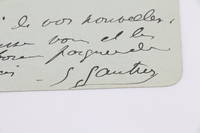
"Je vous enverrai les 3 mètres de taffetas pour la guipure."" Signed autograph card addressed to Celeste Chrétien
Alger Algiers 1910. Fine. Alger Algiers s. d. ca 1910 13 x 7.20 cm une carte Autograph card signed by Judith Gautier addressed to Céleste Chrétien her maid written on both sides in black ink. Judith Gautier did not only employ Céleste for her domestic tasks but also called upon her talents as a seamstress: ""I will send you the 3 meters of taffeta for the guipure. I am hesitating about the color. The dress fits well I wear it over black taffeta undergarments."" unknown
Référence libraire : 80815
|
|
|
Judith GAUTIER
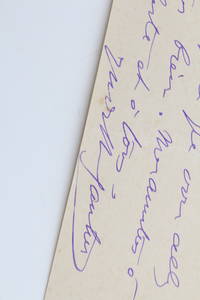
"Je pensais à la cuisine qui va être très noire et à la fenêtre bouchée"" Signed autograph letter addressed to Francis Chrétien
Alger Algiers 1910. Fine. Alger Algiers s. d. ca 1910 16.30 x 20.90 cm 3 pages sur un double feuillet Autograph letter signed by Judith Gautier addressed to Francis Chrétien the husband of her maid Céleste. Three pages written in violet ink on a double sheet with letterhead from 30 rue Washington. Transverse folds inherent to mailing. Judith Gautier sends Francis some instructions regarding the renovation of her house in Dinard le Pré aux oiseaux: ""Je pensais à la cuisine qui va être très noire et à la fenêtre bouchée qui est du côté du jardin sous la fenêtre de la salle à manger. Il me semble qu'elle rendrait du jour et même du soleil si elle était débouchée et bien disposée."" ""I was thinking about the kitchen which will be very dark and the blocked window which is on the garden side under the dining room window. It seems to me that it would provide light and even sunlight if it were unblocked and well arranged."" unknown
Référence libraire : 80881
|
|
|
Judith GAUTIER
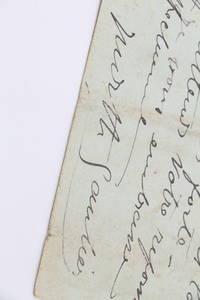
"On va jouer Tristane avec les marionnettes."" Signed autograph letter addressed to Céleste Chrétien
Alger Algiers 1912. Fine. Alger Algiers 14 mars 1912 11.30 x 15.20 cm 4 pages sur un feuillet double Autograph letter signed by Judith Gautier addressed to Céleste Chrétien her maid; four pages written in black ink on a double sheet. This letter mentions the visit of Francis a carpenter by profession and Céleste Chrétien's husband to Paris: ""Does Francis still want to come and spend a few days in Paris Can he do so without harming his work They are going to perform Tristane with marionettes. I would like to have him to help me and I think it would amuse him. I would send him a first-class railway pass he would sleep and eat at my place so as not to incur any expenses. The performance takes place Saturday the 23rd at 4 o'clock; and there will be a dress rehearsal the day before or two days before."" It was in 1910 that Judith Gautier published in La Revue de Paris a triptych in verse entitled Tristane which she had performed in her Little marionette theatre inaugurated in May 1897 at 4 rue Charras in Paris. This theatre which contained about a hundred seats was quickly allocated a subsidy by the Ministry of Fine Arts. unknown
Référence libraire : 80804
|
|
|
Judith GAUTIER
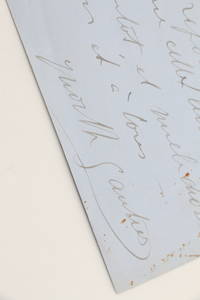
"Je viens vous annoncer aujourd'hui qu'un jeune homme de mes amis va venir s'installer samedi prochain dans la maison pour le mois de juin."" Signed autograph letter addressed to Céleste Chrétien
Alger Algiers 1914. Fine. Alger Algiers s. d. ca 1914 13.70 x 18 cm 4 pages sur un double feuillet Autograph letter signed by Judith Gautier addressed to Céleste Chrétien her maid. Four pages written in black ink on a double sheet. Transverse folds inherent to mailing. Judith announces the upcoming visit of a friend to Dinard: ""I come to announce to you today that a young man who is my friend will come to settle in the house next Saturday for the month of June. He wants to be there all alone to finish some urgent musical work. You will give him my room with the dressing room and the room next to it the ground floor in order and the piano well polished."" unknown
Référence libraire : 80878
|
|
|
Maurice LEBLANC
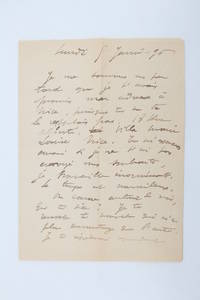
"Je te répèterai répondant ce que je t'ai dit pour ton style."" Signed autograph letter
s. l. 1891. Fine. s. l. 5 janvier 1891 14.20 x 19.20 cm 3 pages sur un double feuillet Autograph letter signed by Maurice Leblanc to an unknown recipient; three pages written in black ink on a double leaf. Transverse folds inherent to posting. At the beginning of this year Maurice Leblanc left the Norman coast to spend the winter in Nice: ""Je me souviens un peu tard que je t'avais promis mon adresse à Nice puisque tu ne te la rappelais pas. 18 rue Alberti villa Marie-Louise Nice. Tu m'excuseras aussi si je ne t'ai pas envoyé mes souhaits je travaille énormément le temps est merveilleux on cause autour de moi que te dire "" ""I remember rather late that I had promised you my address in Nice since you couldn't recall it. 18 rue Alberti villa Marie-Louise Nice. You'll also excuse me if I haven't sent you my wishes I'm working enormously the weather is wonderful people are chatting around me what can I tell you"" Though he had then published only one work he gives his opinion to his correspondent on a text the latter had sent him: ""Je te répèterai répondant ce que je t'ai dit pour ton style : il n'est pas assez travaillé tu écris un peu au hasard de ta plume on ne sent pas de nerfs là-dessous d'os de solide c'est du style de journal de lettre mais pas de style littéraire. Pourquoi n'essayes-tu pas de réfléchir sur chaque phrase avant de l'écrire."" ""I'll repeat in response what I told you about your style: it's not worked enough you write somewhat at random with your pen one doesn't feel any sinew underneath bone solidity it's newspaper style letter style but not literary style. Why don't you try to reflect on each sentence before writing it."" unknown
Référence libraire : 80763
|
|
|
Judith GAUTIER
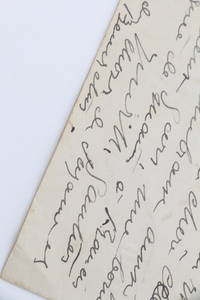
"Je vous enverrai d'autres étoffes si vous avez du temps."" Signed autograph letter addressed to Céleste Chrétien
Alger Algiers 1910. Fine. Alger Algiers s. d. ca 1910 12.90 x 17 cm 4 pages sur un double feuillet Autograph letter signed by Judith Gautier addressed to Céleste Chrétien her maid. Four pages written in black ink on a double sheet. Transverse folds inherent to mailing. Judith Gautier frequently called upon the seamstress talents of her housekeeper: ""J'ai été contente de votre envoi tout allait bien sauf la robe en crêpe de Chine mauve qui était trop courte devant d'au moins 20 centimètres. On peut l'arranger en descendant les lés et en mettant un empiècement. Je vous enverrai d'autres étoffes si vous avez du temps. Mais je cherche un modèle un peu plus nouveau à adopter."" ""I was pleased with your shipment everything was fine except the mauve crepe de Chine dress which was too short in front by at least 20 centimeters. It can be fixed by lowering the panels and adding a yoke. I will send you other fabrics if you have time. But I am looking for a somewhat newer pattern to adopt."" unknown
Référence libraire : 80880
|
|
|
Judith GAUTIER
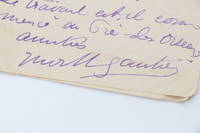
"Le travail est-il commencé au Pré aux Oiseaux "" Signed autograph letter addressed to Céleste Chrétien
Alger Algiers 1910. Fine. Alger Algiers s. d. ca 1910 10.50 x 16.50 cm 1 page sur un double feuillet Autograph letter signed by Judith Gautier addressed to Céleste Chrétien her housekeeper. One page written in violet ink on a double sheet. Transverse folds inherent to the mailing. ""I receive this letter from Mr Lemoine and I don't know what to reply to him not knowing your reasons. Tell me what I should do. Has the work begun at Pré aux Oiseaux"" unknown
Référence libraire : 80834
|
|
|
Jorge AMADO
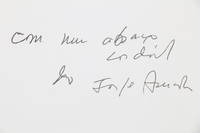
Carte de visite signée de Jorge Amado sur laquelle il a ajouté quelques mots sans doute à l'attention de son amie Alice Raillard traductrice de ses ouvrages en français
s. l.: S. n. 1990. Fine. S. n. s. l. s. d. circa 1990 11 x 7.50 cm une feuille Printed visiting card of Jorge Amado on which he has added a few words probably for his friend and translator of his works into French Alice Raillard: ""Com un abraza cordial do Jorge Amado."" Handsome copy. S. n. unknown
Référence libraire : 81162
|
|
|
Guillaume APOLLINAIRE
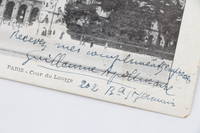
« Je crois qu'on ne peut parler d'une école que si elle existe et non de ce qu'elle pourrait être si elle existait » Unpublished signed autograph postcard addressed to Marcel Mayer
Paris 1913. Fine. Paris 1913 13.30 x 21 cm une carte Unpublished autograph signed postcard by Guillaume Apollinaire addressed to the Dijon art historian Marcel Mayer. Two pages written in black ink on a photographic postcard depicting the courtyard of the Louvre. Charming letter praising the attachment to their roots of the "".fameux Flamands-Espagnols Hollandais et Bourguignons que j'admire tant"" ""famous Flemish-Spanish Dutch and Burgundians whom I admire so much"" and informing his correspondent of the writing and forthcoming publication of a ""petit livre sur Rude"" ""little book on Rude"" that Guillaume Apollinaire will not fail to send him. Fine autograph signature with the autograph address of 202 Boulevard Saint-Germain. unknown
Référence libraire : 82418
|
|
|
Franz MARC
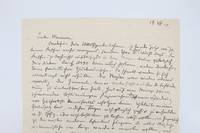
Lettre autographe signée adressée à sa mère Sophie Maurice Signed autograph letter to his mother Sophie Maurice
1915. Fine. 19 août 1915 22.20 x 28.60 cm 2 pages sur un feuillet 19 August 1915 222x286cm 2 pages on a leaf. Autograph letter in German signed by the painter Franz Marc to his mother Sophie Marc née Maurice; two pages in black ink. Trace of horizontal and vertical fold. Unpublished letter. Not in the latest edition of his wartime correspondence Briefe aus dem Feld Norderstedt 2019. Lengthy unpublished letter from Franz Marc to his mother during the First World War written a few months before his death in Verdun. In the horror of the conflict the future martyr of German expressionism recalls childhood images and tells horse stories from the front. Stationed on the Alsace front the famed animal painter recounts a hilarious wild boar hunt improvised during a horseback ride reminding him of an illustrated childhood tale: The Three Jovial Hunstmen by Randolph Caldecott 1880. Franz Marc reveals here an inspiration for his famous horses which gave their name to the Blaue Reiter movement created in 1911 with Wassily Kandinsky. The horses in Caldecott's Huntsmen resemble Franz Marc's paintings from 1905-1910. This anecdote is also related to hunting horses sketched on the front and a postcard sketch of the same Jagende Pferde sent to the poet Else Laske-Schüler in September 1915. The letter gives a glimpse of Franz Marc's daily life on the front. By a cruel irony of fate he fought in the native region of his mother Sophie Marc née Maurice born in 1847 in the Alsatian village of Guebwiller. When war broke out in August 1914 he joined the army hoping for a renewal of Europe like many fellow artists and intellectuals. Due to the circumstances of the war the painter wrote his letter in German and not in French as he was accustomed to do in his correspondence with his mother. His mother's influence was decisive in his aesthetic and spiritual approach: Marc's tireless quest for purity inherited from his Calvinist upbringing eventually led him to abstraction already present in his sketches as he wrote this letter. He gives news of a future promotion thanks his mother for sending him food and fills the page with the story of his miraculous hunt: I have one more amusing story to tell: as I was riding out at dawn before breakfast I suddenly noticed a young boar a wild boar beside me in a ditch. I immediately called my fellow riders; he was surrounded I already felt sorry for the poor animal but the pity came too late! Two of them jumped in one grabbed him by the ears the other poked him and the roast for the steward's table was retrieved. A most comical scene ensued: We ordered the youngest soldier to go home with the boar and got him on horseback; but no sooner did the horse feel the boar on his back horses are very afraid of boars than he reared up and threw the rider and the pig into a great arc. Fortunately nothing happened and the embarrassed rider had to walk the boar back then the horse really reared up as soon as he was approached. A real amateur rider! I was thinking of Dad's old English picture book: the jovial huntsman! With this light-hearted anecdote the painter reveals a source of inspiration still unknown to critics and historians. The Three Jovial Huntsmen certainly influenced the young Franz Marc whose own horses painted in the 1910s including the Weidende Pferde I Lenbachhaus Munich are unmistakably marked by Caldecott's British style. In the following years he added to this subject his kaleidoscopic touch and his emblematic blue red and yellow colors charged with spiritual symbolism. Franz Marc also painted blue wild boars in 1913 Museum Ludwig Cologne. The story of this hunt is also completely new since he asked his mother to tell it to his wife Maria to avoid writing a second letter it's long: to tell the same thing twice. This anecdote about hunting and rearing horses can be directly linked to a sketch on a postcard dated the following month entitled jagen unknown
Référence libraire : 82277
|
|
|
Leo MALET - Bruno de MONES
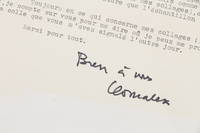
Lettre tapuscrite signée de Léo Malet à son ami le photographe Bruno de Monès
s. l. Paris: S. n. 1983. Fine. S. n. s. l. Paris 1983 21 x 29.50 cm une feuille Typed letter dated June 29 1983 signed by Léo Malet to photographer Bruno de Monès in which the writer thanks his photographer: "". multipliant autour de moi les images de ma ""petite chérie"" que j'éprouve le besoin de vous envoyer encore un bouquin."" "". multiplying around me the images of my 'little darling' that I feel the need to send you another book."" and takes the liberty of asking him for information about a glue and black paper he uses to create his collages often of pornographic inspiration. At the end of the typed letter on letterhead from his Châtillon address Léo Malet adds a handwritten ""Bien à vous. Léon Malet."" ""Yours truly. Léon Malet."" Central fold marks inherent to mailing. S. n. unknown
Référence libraire : 82998
|
|
|
Antonio TORRES
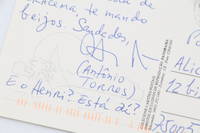
Carte postale autographe signée adressée à sa traductrice en français Alice Raillard
Coimbra 1995. Fine. Coimbra s. d. circa 1995 14.50 x 10.50 cm une carte postale Autograph postcard dated and signed with 8 lines entirely written in Brazilian Portuguese by the writer Antonio Torres addressed to the translator of his works into French Alice Raillard from Brazil. ""14.7.99 Oi Alice. Daqui terra de Iracema te mando beizos. Saudades. Antonio Torres. E o Henri Està d "" ""14.7.99 Hi Alice. From here land of Iracema I send you kisses. Miss you. Antonio Torres. And Henri Is he okay"" unknown
Référence libraire : 83045
|
|
|
Lawrence DURRELL
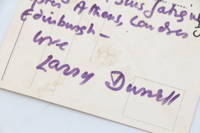
"Si tu es libre de me joindre. faites moi signed"" Autograph postcard signed by Lawrence Durrell from Edinburgh to Jani Brun
Edimbourg Edinburgh 1980. Fine. Edimbourg Edinburgh 4 octobre 1980 10 x 14.50 cm une carte postale une enveloppe Suggestive autograph postcard signed by Lawrence Durrell addressed to Jani Brun written in violet felt-tip pen on the verso of a reproduction of a sculpture representing a satyr envelope attached. ""Buttons dear. J'arrive mardi pour deux nuits à Paris - au Royale. Si tu es libre de me joindre. faites moi signed. Suis fatigué après Athens Londres Edinburgh! Love. Larry Durrell."" ""Buttons dear. I arrive Tuesday for two nights in Paris - at the Royale. If you are free to join me. let me know. Am tired after Athens London Edinburgh! Love. Larry Durrell."" After many years spent in Greece Egypt and Rhodes the traveling writer Lawrence Durrell was forced to flee Cyprus following popular uprisings that led the island to its independence from the British crown. Rich only with a shirt and a typewriter but crowned with the success of his novel Bitter Lemons of Cyprus Les citrons acides he arrived in France in 1956 and settled in the Languedoc village of Sommières. In the ""Tartès house"" his large dwelling surrounded by trees he wrote the second part of his work his monumental Avignon Quintet devoted himself to painting and received his illustrious friends including the couple Henry Miller and Anaïs Nin violinist Yehudi Menuhin London publisher Alan G. Thomas and his two daughters Penelope and Sappho. Among the olive trees and under the Mediterranean sun he met in the mid-1960s the young and vivacious ""Jany"" Janine Brun a thirty-something woman from Montpellier of devastating beauty who worked at the Antiquities department of the Sorbonne in Paris. She was nicknamed ""Buttons"" in memory of their first meeting where the young woman wore a dress covered with buttons. Henry Miller also fell under the charm of ""Buttons"" praising her beauty and eternal youth in exceptional unpublished letters. The three companions spent memorable Parisian evenings of which we keep precious autograph traces through their epistolary exchanges. Recommended by Durrell she made numerous trips notably to England from where she received extensive correspondence from the writer as well as original works of art signed with his artist pseudonym Oscar Epfs. unknown
Référence libraire : 83025
|
|
|
Georges AURIC
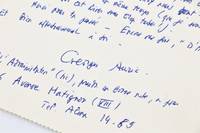
Lettre autographe signée adressée à son ami Carlo Rim à propos notamment de la reprise d'Iphigénie en Tauride de Christoph Willibald Gluck
Paris: S. n. 1965. Fine. S. n. Paris 17 octobre 1965 14 x 19.50 cm une feuille Autograph letter dated and signed by Georges Auric addressed to his friend Carlo Rim 23 lines in blue ink on letterhead of the Réunion des théâtres lyriques nationaux et du théâtre de l'Opéra de Paris in which he asks for his friend's indulgence as he is overwhelmed with work: ""Pardonne-moi si je ne t'ai pas répondu encore : tu peux imaginer sans trop de peine ce qu'est devenue mon existence ! . je viens d'avoir à préparer la reprise d'Iphigénie en Tauride - opéra des plus nobles et que ""notre"" public n'avait pas eu l'occasion d'écouter depuis 1931 "" ""Forgive me if I haven't answered you yet: you can imagine without too much trouble what my existence has become! . I have just had to prepare the revival of Iphigénie en Tauride - one of the noblest operas and one that ""our"" public has not had the opportunity to hear since 1931""; a revival in which Georges Auric places great hope: "". En tout cas je veux espérer que nous dépasserons les deux répétitions de 1931. "". In any case I want to hope that we will exceed the two performances of 1931."" He also rejoices in the diversity of projects that occupy him thus transcending styles and periods: ""Glück Iphigénie : nous sommes fichtrement loin de Vincent Scotto. Mais je franchis allégrement siècles et styles pour te dire combien je suis heureux de me trouver dans ce ""comité d'honneur"" associé aux respectables et déjà vieux amis dont tu connais les noms ! "" ""Gluck Iphigénie: we are damn far from Vincent Scotto. But I cheerfully leap across centuries and styles to tell you how happy I am to find myself in this 'honorary committee' associated with the respectable and already old friends whose names you know!"" Folds inherent to mailing. Carlo Rim was a Provençal writer author notably of ""Ma belle Marseille"" a caricaturist a filmmaker: ""Justin de Marseille"" ""L'armoire volante"" ""La maison Bonnadieu"" and was notably the friend of Fernandel Raimu and Marcel Pagnol but also of Max Jacob and André Salmon whom he met in Sanary. S. n. unknown
Référence libraire : 83133
|
|
|
Antonio TORRES
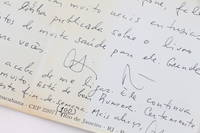
Lettre autographe datée et signée adressée à sa traductrice en français Alice Raillard
Rio de Janeiro 1994. Fine. Rio de Janeiro 7 juillet 1994 21 x 28 cm une feuille une enveloppe Handwritten letter dated and signed entirely written in Brazilian Portuguese from writer Antonio Torres addressed to the translator of his works into French Alice Raillard from Rio 17 lines in black ink. Fold marks inherent to mailing envelope included. A press clipping included by Antonio Torres and attached with a paper clip which has left a shadow on the handwritten letter. unknown
Référence libraire : 83085
|
|
|
Robert de MONTESQUIOU
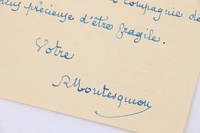
Lettre autographe signée de Robert de Montesquiou remerciant son bienveillant correspondant
s. l.: S. n. 1921. Fine. S. n. s. l. 26 octobre 1921 18 x 21 cm une page Grateful autograph letter dated and signed by the dandy count 14 lines written in blue ink probably addressed to his friend the critic Henri Lapauze. ""Mon cher ami ne doutez pas que je ne sache dans cet aimable spirituel et bienveillant article faire la part du critique intelligent qui l'a rédigé et celle du fidèle ami qui l'a inspiré. L'acte de donation en faveur de votre musée vous portera mon remerciement. La statuette est de cire. je l'espère cependant durable et l'avalanche de roses que vient décrire si poétiquement Alexandre lui promet une compagnie délicate elle aussi plus précieuse d'être fragile. Votre RMontesquiou. 26 Octobre 1921."" ""My dear friend do not doubt that I know how in this amiable witty and benevolent article to distinguish between the part of the intelligent critic who wrote it and that of the faithful friend who inspired it. The deed of donation in favor of your museum will bear my thanks. The statuette is made of wax. I hope however that it will be durable and the avalanche of roses which Alexandre describes so poetically promises it delicate company also more precious for being fragile. Yours RMontesquiou. 26 October 1921."" Fold marks inherent to envelope insertion three letters having slightly smudged. S. n. unknown
Référence libraire : 83149
|
|
|
Robert de MONTESQUIOU
Lettre autographe signée de Robert de Montesquiou adressée à son bibliographe
s. l.: S. n. 1921. Fine. S. n. s. l. 26 octobre 1921 18 x 21 cm une page Autograph letter signed on bristol board by the dandy count 17 lines written in black ink probably addressed to his friend and bibliographer the critic Henri Lapauze. ""Cher monsieur et ami je vous recommande ma bibliographie que j'ai hâte de lire de votre main qui voudra joindre à la bonne grâce de l'écrire celle de me l'adresser. Je compte aussi sur vous pour recommander le livre à M. Paul Perret à qui j'ai demandé un entretien d'accord avec M. Meyer - et dont j'attend la réponse. Merci d'avance et mes meilleurs souvenirs. Cte R. de Montesquiou. 23 novembre."" ""Dear sir and friend I recommend to you my bibliography which I am eager to read from your hand which will wish to add to the good grace of writing it that of addressing it to me. I also count on you to recommend the book to M. Paul Perret to whom I have requested an interview in agreement with M. Meyer - and from whom I await the response. Thanks in advance and my best regards. Count R. de Montesquiou. 23 November."" S. n. unknown
Référence libraire : 83152
|
|
|
Robert de MONTESQUIOU
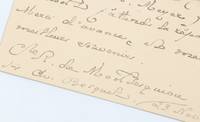
". cette carte toute seule vous parlera de mon chagrin trop grand pour que j'en puisse moi-même parler et pour que je puisse m'en taire."" Autograph letter signed by Robert de Montesquiou
s. l.: S. n. 1920. Fine. S. n. s. l. s. d. 1920 22.50 x 18 cm une page recto-verso Autograph letter signed by the dandy count 39 lines written in black ink probably addressed to his friend and bibliographer critic Henri Lapauze about the sadness that overwhelms him after the disappearance of a mutual friend. To honor his memory Robert de Montesquiou requests an editorial favor from his correspondent. Fold marks inherent to the envelope placement water damage causing two letters of the word Reuilly to blur in the upper left corner of the letter. ""Neuilly My dear friend cette carte toute seule vous parlera de mon chagrin trop grand pour que j'en puisse moi-même parler et pour que je puisse m'en taire. Vous aurez assisté au dernier éclat de ce foyer chaleureux et généreux brûlant brûlé d'intention mot illisible . Je vous demande de vous souvenir que mon pauvre ami se fit une fête d'être le premier à me mettre en relation avec votre aimable femme. Cette pensée nous sera un lien pour moi très fort. Je n'oublierai jamais non plus qu'une de ses joies finales lui vint des paroles prononcées par vous sur mon livre. C'est vous dire que l'insertion intégrale et textuelle de la note discrète dont le texte est ci-joint à la place hélas ! marquée dans la nécrologie fera de moi une fois de plus votre obligé. Robert de Montesquiou. 10 juillet."" ""this card all alone will speak to you of my grief too great for me to be able to speak of it myself and for me to remain silent about it. You will have witnessed the last brilliance of this warm and generous hearth burning burned with intention illegible word. I ask you to remember that my poor friend made it a celebration to be the first to put me in touch with your kind wife. This thought will be a very strong bond for me. I will never forget either that one of his final joys came from the words you spoke about my book. This is to tell you that the complete and textual insertion of the discreet note whose text is attached in the place alas! marked in the obituary will make me once more your obliged. Robert de Montesquiou. July 10."" S. n. unknown
Référence libraire : 83165
|
|
|
Robert de MONTESQUIOU
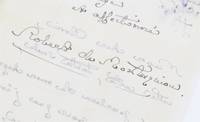
". Mais mon Mont-Blanc décrit par vous reprend ses proportions !."" Autograph letter signed by Robert de Montesquiou
s. l.: S. n. 1920. Fine. S. n. s. l. s. d. 1920 27.50 x 18 cm une page Autograph letter signed by the dandy count 18 lines written in black ink probably addressed to his friend and bibliographer the critic Henri Lapauze thanking him for his vigilance and for having corrected an error concerning one of his texts. Traces of folding inherent to mailing light creases in the left margin of the letter. ""Neuilly Dear friend thank you for your vigilant benevolence. I appreciate it all the more as the same newspaper which brought me a new flood of it represented my client to me elsewhere in the form of a very vast Perrichon! .But my Mont-Blanc described by you regains its proportions! All is in order and I am your affectionate. Robert de M. 27 Nov."" S. n. unknown
Référence libraire : 83256
|
|
|
Robert de MONTESQUIOU
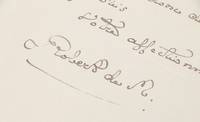
"L'épithète de ""métallique"" appliquée à votre voix sans insister sur la richesse du timbre et la noblesse de la vibration m'apparaît bien loin de ce que me dictaient mon sentiment et ma pensée. Je ne voulais que lui faire figurer l'accent mâle en regard du contralto qu'il me plaisait de lui juxtaposer en plus."" Autograph letter signed by Robert de Montesquiou apologizing to his correspondent for having unintentionally and clumsily offended him about his voice
s. l.: S. n. 1908. Fine. S. n. s. l. 14 juin 1908 22.50 x 18 cm une page Autograph letter signed by the dandy count 52 lines written in black ink on tracing paper addressed probably to his friend and bibliographer the critic Henri Lapauze. ""Neuilly Mon cher ami je crains de vous avoir mal dit en hâte et en proie à de cruels mouvements ce que je ressentais fort bien et que par suite je devais exprimer mieux. L'épithète de ""métallique"" appliquée à votre voix sans insister sur la richesse du timbre et la noblesse de la vibration m'apparaît bien loin de ce que me dictaient mon sentiment et ma pensée. Je ne voulais que lui faire figurer l'accent mâle en regard du contralto qu'il me plaisait de lui juxtaposer en plus. Ce que je voulais sous-entendre aussi dans cette supposition d'une résultante en ce carnet du chant alterné de nos causeries c'est l'hommage qu'il nous est toujours agréable de voir rendre aux dignes objets de notre attachement et que j'aimais vous offrir sous la forme du mien désormais double sans cesser d'être un. Robert de M. P.S. : voilà ce que je tenais à vous dire et que des graves préoccupations autour de la santé de mon pauvre Iturri m'ont fait écourter un peu. Je m'occupe mot illisible et vous avertirai vous renseignerai. 14 juin"" ""My dear friend I fear I told you badly hastily and prey to cruel emotions what I felt quite well and which consequently I should have expressed better. The epithet 'metallic' applied to your voice without insisting on the richness of the timbre and the nobility of the vibration appears to me very far from what my feeling and my thought dictated to me. I only wanted it to represent the masculine accent in comparison with the contralto that I was pleased to juxtapose to it in addition. What I also wanted to imply in this supposition of a resultant in this notebook of the alternating song of our conversations is the homage that it is always pleasant for us to see rendered to the worthy objects of our attachment and that I liked to offer you in the form of mine henceforth double without ceasing to be one. Robert de M. P.S.: that is what I wanted to tell you and which serious concerns around the health of my poor Iturri made me cut short a little. I am taking care illegible word and will warn you inform you. June 14"" Traces of folds inherent to postal use. S. n. unknown
Référence libraire : 83324
|
|
|
Robert de MONTESQUIOU
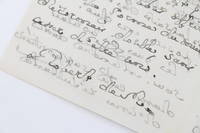
Lettre autographe signée de Robert de Montesquiou évoquant la voix métallique de son bienveillant correspondant
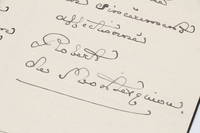
s. l.: S. n. 1908. Fine. S. n. s. l. 13 juin 1908 24.50 x 17 cm une page Autograph letter signed by the dandy count 37 lines written in black ink addressed probably to his friend and bibliographer the critic Henri Lapauze. ""Neuilly Mon cher ami laissez-moi vous donner ce beau nom. C'est avec une vive et charmante émotion que je lis les belles et ""braves"" louanges dont vous voulez bien honorer ma personne et mon oeuvre. Il me plaît de penser que votre précieux éloge résulte d'une collaboration doublement sympathique et dans laquelle auprès de votre timbre métallique résonne l'accent le plus doux de l'aimable femme dont le talent m'était connu mais dont la première minute de causerie m'a révélé la compréhension et le sentiment. En attendant de vous le redire de vive voix merci donc à vous deux et de votre bien affectionné Robert de Montesquiou."" ""My dear friend allow me to give you this beautiful name. It is with a lively and charming emotion that I read the beautiful and ""brave"" praises with which you are pleased to honor my person and my work. I am pleased to think that your precious praise results from a doubly sympathetic collaboration and in which alongside your metallic tone resonates the sweetest accent of the amiable woman whose talent was known to me but whose first minute of conversation revealed to me her understanding and feeling. While waiting to tell you this again in person thank you therefore to both of you and from your very affectionate Robert de Montesquiou."" Fold marks inherent to posting. S. n. unknown
Référence libraire : 83329
|
|
|
Robert de MONTESQUIOU
Lettre autographe signée de Robert de Montesquiou recensant ses donations notamment une statuette de TroubetzKoÿ considéré comme le Rodin russe à diverses institutions
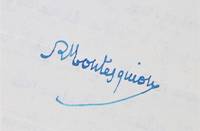
s. l.: S. n. 1921. Fine. S. n. s. l. 11 octobre 1921 17.50 x 21 cm une feuille Autograph letter signed by the dandy count 14 lines written in blue ink addressed to his friend and bibliographer the critic Henri Lapauze notably mentioning a work by Ingres in his possession also thanking his correspondent for his always lucid and benevolent critiques regarding him. ""Cher ami envoyez-moi je vous en prie comme nous en sommes convenus le schéma de ma donation au Petit-Palais de ma grande statuette par TroubetzKoÿ et du portrait par Arthur Chaplin de Mademoiselle Ehrmann artiste lorraine élève d'Hébert morte en 1918 ayant légué le portrait par elle de sa mère au Musée de Nancy et dont le portrait pareillement dû à son pinceau de Mademoiselle Favart figure au Foyer de la Comédie Française. Vous me ferez aussi grand plaisir en m'adressant votre bel article sur d'Annunzio et si vous la retrouvez la note des journaux sur mon don à la Bibliothèque de Versailles. Cher ami j'ai été heureux de vous revoir. RMontesquiou. 11 oct 1921."" ""Dear friend please send me as we agreed the outline of my donation to the Petit-Palais of my large statuette by TroubetzKoÿ and of the portrait by Arthur Chaplin of Mademoiselle Ehrmann Lorraine artist and student of Hébert who died in 1918 having bequeathed the portrait she painted of her mother to the Museum of Nancy and whose portrait similarly by her brush of Mademoiselle Favart is displayed in the Foyer of the Comédie Française. You would also give me great pleasure by sending me your beautiful article on d'Annunzio and if you find it the newspaper note about my gift to the Library of Versailles. Dear friend I was happy to see you again. RMontesquiou. 11 Oct 1921."" Fold marks inherent to postal delivery. S. n. unknown
Référence libraire : 83348
|
|
|
BALTHUS
Lettre autographe signée adressée à Henriette Gomès
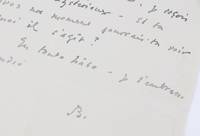
Chassy 1954. Fine. Chassy 4 Janvier 1954 21 x 27 cm une feuille une enveloppe Autograph letter signed by Balthus addressed to gallery owner Henriette Gomès. 7 lines envelope included. Cross folds inherent to mailing a small tear to left margin of the letter not touching text the ink having faded. ""Chassy mardi the r and d having smudged Ma petite Henriette je reçois ce papier mystérieux - si tu trouves un moment pourrais-tu voir de quoi il s'agit En toute hâte - Je t'embrasse et André. B."" ""My little Henriette I receive this mysterious paper - if you find a moment could you see what it's about In great haste - I embrace you and André. B."" ""During the summer of 1952 Balthus found a château in the Nièvre between Autun and Avallon which he decided to rent and where he settled in the spring of the following year. The means were provided by his dealers Henriette Gomès Pierre Matisse and with them a collective of collectors including Maurice Rheims Alix de Rotschild and Claude Hersent. They paid him a pension in exchange for his latest paintings which they divided among themselves. The château was severely deteriorated and Balthus lived there modestly in continual restoration work. He had for company to help him settle in and ensure a presence when he went to Paris the poet Léna Leclercq met through Giacometti. The latter remained until spring 1955. Meanwhile Balthus had begun a love affair with his niece by marriage Frédérique Tison daughter from a previous union of his brother Pierre's wife."" Fondation Balthus unknown
Référence libraire : 83349
|
|
|
Robert de MONTESQUIOU
Lettre autographe signée de Robert de Montesquiou concernant un article qu'il entend faire publier
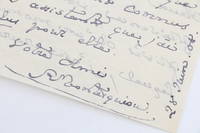
s. l.: S. n. 1908. Fine. S. n. s. l. 28 juin 1908 31 x 19.50 cm une page Autograph letter signed by the dandy count 40 lines written in black ink on tracing paper addressed probably to his friend and bibliographer the critic Henri Lapauze. ""Neuilly Dear friend the impossibilities that deprived me of your twice precious presence have also deprived you of a moment which I dare believe was one of those that would have moved you. And no doubt all the more I do not say! in revealing to you you sense it well. but in making you better know a character of sentiment curiously associated with the character of verve that you received the other day. If you judge it appropriate and can do so without difficulty would you publish in full the enclosed note having it preceded by a few lines that your good grace and good taste will inspire you I did not think that mention would be made of this intimate ceremony. But since it was not so it pleases me that the names be known to the attendees that I wanted for it. Your friend RMontesquiou."" Creases inherent to folding for mailing. S. n. unknown
Référence libraire : 83323
|
|
|
Robert de MONTESQUIOU
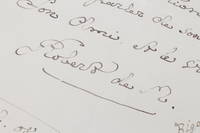
Lettre autographe signée adressée à Henri Lapauze évoquant leurs amitiés et inimitiés dans le monde des lettres et des arts : "". Si je n'ai pas lu votre critique de mon livre en revanche j'ai pris connaissance de celle que vous avez consacrée à l'aimable jeune homme qu'il s'agissait de punir pour avoir dit trois fois ; au cours d'un dîner : Marie Murat. peut-être aurait-il suffi de lui donner à copier septante fois sept fois. ""
Artagnan: S. n. 1908. Fine. S. n. Artagnan 1908 20.50 x 26.50 cm 7 feuillets recto Autograph letter signed by the dandy count 68 lines written in black ink on seven folios recto probably addressed to his friend and bibliographer the critic Henri Lapauze: ""Artagnan My dear friend the interesting review which I would very much like to know. has escaped me. Can you send it to me; or at least a date indication that would allow me to find it As for what you write to me about my ""social successes"" you don't think the first word of it fortunately for us! - otherwise you would start by ""not speaking to me"" as Favre used to say; and you would be quite right. Well! in all things one must consider not only the end but the true and the false the good and the bad the authentic and the counterfeit as I believed I could write even about snobbery! When it comes to letters - even more so to ladies of letters on no point does this difference stand out with such clarity. - who knows this better than you No once again we must not and this is very important let the mockeries of what we know how to do prevent us from manifesting ourselves. That would play too well into the hands of the monkeys who already have enough coconut trees as it is. For this reason I believed I should offer the noble Engadin larches the favor of hearing me. And their murmur did not reproach me for it. I am going to write to a certain Lady of letters in the good sense of the term to speak to her about her beautiful book. Your friend and hers Robert de M. Sept 08. Via Vic-Bigorre Hts Pyr. P.S.: urgent Only you can affirm to me with sufficient guarantee that Liem is still alive as I believe and wish to affirm in an article which being in press requires the information without delay. When you are reconciled with an etcher whom you do not like I will offer you for an engraving exhibition a portrait of me by him which at least you will love. If I have not read your critique of my book on the other hand I have taken note of the one you devoted to the amiable young man whom it was necessary to punish for having said three times during a dinner: Marie Murat. perhaps it would have been enough to make him copy seventy times seven times. In any case you will have been harsh. The crime deserved it. Perhaps also one day you will speak ill of me although that seems unlikely to me. But what I can affirm is that. it will not be for that! ."" Fold marks inherent to envelope mailing. S. n. unknown
Référence libraire : 83382
|
|
|
Robert de MONTESQUIOU
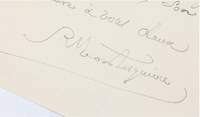
"Ne soyez pas effrayé par l'importance physique de ce document elle ne vient que de la grosseur des caractères. L'étendue n'en demeure pas moins normale."" Autograph letter signed by Robert de Montesquiou addressed to Henri Lapauze about the republication of one of his works
s. l.: S. n. 1907. Fine. S. n. s. l. 21 mai 1907 25.50 x 20 cm une feuille Autograph letter signed by the dandy count 22 lines written in pencil addressed to his friend and bibliographer the critic Henri Lapauze: ""Neuilly Cher ami voici ce que je vous envoie d'accord avec Monsieur Schmoll qui m'en a téléphoné ce matin. Ne soyez pas effrayé par l'importance physique de ce document elle ne vient que de la grosseur des caractères. L'étendue n'en demeure pas moins normale. J'ajoute que les pièces ont été choisies parmi les transformées et remaniées comme elles le sont d'ailleurs à peu près toutes. Il serait désirable que cette publication eut lieu demain pour ne pas retarder l'apparition du volume. Dans ce cas j'enverrais ce soir pour la correction. La place sera celle que vous voudrez pourvu que ce soit en première page ou ""cheval"" - Votre femme m'a écrit une lettre délicieuse son éloge coule de source. Bien à vous deux. R. Montesquiou 21 mai 07."" Avec la mine de son crayon Robert de Montesquiou a trop appuyé en traçant un trait en dessous de son patronyme ce qui a occasionné un petit trou. ""Neuilly Dear friend here is what I am sending you in agreement with Monsieur Schmoll who telephoned me about it this morning. Do not be frightened by the physical importance of this document it only comes from the size of the characters. The extent nonetheless remains normal. I add that the pieces have been chosen among the transformed and reworked as they are moreover almost all of them. It would be desirable that this publication take place tomorrow so as not to delay the appearance of the volume. In this case I would send this evening for correction. The placement will be whatever you wish provided it is on the front page or ""cheval"" - Your wife wrote me a delightful letter her praise flows naturally. Best to you both. R. Montesquiou May 21st 07."" With the lead of his pencil Robert de Montesquiou pressed too hard while drawing a line under his surname which caused a small hole. Fold marks inherent to being placed in an envelope. S. n. unknown
Référence libraire : 83361
|
|
|
Robert de MONTESQUIOU
"J'ajoute que tout semble se disposer pour le succès de mon entreprise. Et vous connaissez assez les lois humaines mondaines et polémiques pour savoir que le tapage de presse accueillant ici les étrangers un peu notables ajoute à la curiosité de l'auditoire."" Autograph letter signed on a series of lectures given in New York
New York: S. n. 1907. Fine. S. n. New York 4 février 1903 13.50 x 17.50 cm deux feuillets recto-verso Autograph letter signed by the dandy count 54 lines written in black ink on two leaves recto-verso addressed to his friend and bibliographer the critic Henri Lapauze: ""4 février Westminster hôtel New-York Cher monsieur et ami j'ai le plaisir de vous adresser ci-joint une copie manuscrite du salut d'ouverture qui servira de prélude de bienvenue à la première de mes conférences dont la date est fixée à demain. J'espère que vous ferez bon accueil à cet envoi de l'absent et le publierez en bonne place. Les documents ci-joints vous aideront à faire rédiger les lignes explicatives dont je vous demande d'accompagner l'article. Merci à vous à Mr Galdemar et à Sem pour son irrésistible dessin du Gaulois grandement fêté ici. Souvenir bien sincèrement affectueux. Comte Robert de Montesquiou. Je tiens à ajouter que je suis heureux de vous donner la primeur de ce document en témoignage et souvenir de nos bons rapports. J'ajoute que tout semble se disposer pour le succès de mon entreprise. Et vous connaissez assez les lois humaines mondaines et polémiques pour savoir que le tapage de presse accueillant ici les étrangers un peu notables ajoute à la curiosité de l'auditoire. J'espère ne pas trop la décevoir et ceci est le secret de demain. J'ai énuméré dans les pages que je vous adresse les raisons qui m'ont dicté le choix du sujet de ma première conférence. Je n'y reviens pas."" ""February 4th Westminster hotel New-York Dear Sir and friend I have the pleasure of sending you herewith a manuscript copy of the opening greeting which will serve as a welcome prelude to the first of my lectures the date of which is set for tomorrow. I hope you will give a good reception to this missive from the absent one and publish it in a prominent place. The enclosed documents will help you have written the explanatory lines I ask you to accompany the article with. Thank you to Mr Galdemar and to Sem for his irresistible drawing of the Gaulois greatly celebrated here. Most sincerely affectionate regards. Count Robert de Montesquiou. I want to add that I am happy to give you the exclusive rights to this document as testimony and remembrance of our good relations. I add that everything seems to be arranged for the success of my enterprise. And you know well enough the human worldly and polemical laws to know that the press commotion welcoming rather notable foreigners here adds to the audience's curiosity. I hope not to disappoint it too much and this is tomorrow's secret. I have enumerated in the pages I am sending you the reasons that dictated my choice of subject for my first lecture. I will not return to this."" Small pin holes that held the two leaves together. S. n. unknown
Référence libraire : 83363
|
|
|
Robert de MONTESQUIOU
Lettre autographe signée adressée au journaliste et critique littéraire du Gaulois Henri Lapauze
s. l.: S. n. 1900. Fine. S. n. s. l. s. d. circa 1900 11 x 14 cm une feuille Autograph letter signed by the dandy count on a closed pneumatic card of 14 lines written in black ink addressed to his friend and bibliographer the critic Henri Lapauze: ""Cher monsieur il est bien convenu que vous rappelez n'est-ce pas nos fêtes de lundi dans votre numéro de ce soir par un petit entrefilet invitant et signfiant avec l'heure du départ et les attractions etc. Merci et bon sentiment. Cye R.de M."" ""Dear sir it is well understood that you will remind is it not our Monday festivities in your issue this evening with a small inviting and meaningful paragraph with the departure time and attractions etc. Thank you and good feelings. Cye R.de M."" S. n. unknown
Référence libraire : 83373
|
|
|
Robert de MONTESQUIOU
Lettre autographe signée adressée à Henri Lapauze et concernant la réédition de l'un de ses ouvrages
s. l.: S. n. 1908. Fine. S. n. s. l. 4 février 1908 21.50 x 28 cm une feuille Autograph letter signed by the dandy count 22 lines written in black ink addressed to his friend and bibliographer the critic Henri Lapauze: ""Neuilly Indeed dear friend you would give me great pleasure by continuing to point out to your readers the faithfulness of word & the good conduct of this edition which encounters more and more the serious reception to which I hope it is entitled by showing more clearly what those titles that have become famous contained a little confidence and which want to deserve to be so after a more mature examination. And if you insist on the poor passiflora of which your wife speaks to me so eloquently and elegantly in a letter that would be a very beautiful 'art criticism' this will delight at the same time a luminous shadow and my chiaroscuro. Robert de M. 4 February 08."" Fold marks inherent to envelope placement. S. n. unknown
Référence libraire : 83360
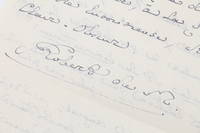
|
|
|
Robert de MONTESQUIOU
Lettre autographe signée de Robert de Montesquiou adressée à Henri Lapauze
s. l.: S. n. 1920. Fine. S. n. s. l. s. d. circa 1920 25.50 x 20 cm une feuille Autograph letter signed by the dandy count 27 lines written in blue ink addressed to his friend and bibliographer the critic Henri Lapauze: ""Neuilly Dear friend thank you for your note. I am going to see Coppée again. When you speak again you of my book you will please me of course if this accords with your views first by recalling that it is dedicated to Barrès then by observing if not admiring what is rare in the spectacle shall we say the example given by an artist who has proven himself and publishes his eleventh volume books in which there are things without ever having cared about anything other than the esteem of those who please him; by a man who below this list of works which is requested of him by a recent questionnaire then encountering the word rewards followed by a question mark has the happiness and perhaps the honor of having to leave this useless line blank or at least to populate it with this word from Flaubert: ""One must be quite modest to be able to be honored"" Your proud friend RMontesquiou. 10 June."" Traces of folds inherent to the envelope. S. n. unknown
Référence libraire : 83358
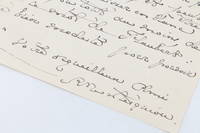
|
|
|
Thierry MUGLER
Carnet personnel de Thierry Mugler contenant des dessins et aphorismes autographes originaux Personal notebook of Manfred Thierry Mugler containing original autograph drawings and aphorisms.
2012. Fine. Supermanfred man of style s. d. ca 2012 15.50 x 21.50 cm relié Black cloth binding. A white star made by Mugler in corrector fluid on the first cover. Fifteen pages of the notebook filled in by the fashion designer: - The first page in neon blue felt-tip pen with the word ""Yes"" as and large exclamation mark ending with the iconic Mugler star. - A double page with the word ""white"" enhanced with corrector fluid and in capital letters on a black felt-tip background in orange the words ""Indehain"" and ""TRIBE"" with a drawing depicting a sun several notes in black ballpoint pen: ""Aelino Rock-Elektro"" ""DJ"" ""Syath Choreographie"". - A double page with a wonderful drawing of a naked Black woman with voluminous pink hair and on the left with a black ballpoint pen the words ""Super NOVA MAMA"" with star enhanced with purple marker. - A double page with three lines in green red and purple markers: ""- La Perle de l'Afrique. / RIEN QUI BOUGE !!! / Le chic des mains de Paris !"" - The Pearl of Africa. / NOTHING THAT MOVES!!! / The chic of the hands of Paris! The last exclamation point ends with a star. - Several drawings of stars and perfume bottles sketches in pencil. - A list of names in pencil opposite some of them the letter ""G"" in blue marker the mention ""Kab"" in red marker and a spiral in orange marker. - A double page with a drawing of a perfume bottle and a planet with a phallus on it; above several lines in blue purple orange green and red markers with the following text: Alice se perdit dans Brocéliande et se fit courser par le centaure Manfred.et ses dangereux attributs.Pauvre petite fille riche.Ce n'est pas le luxe qui va la sauver. Ombres d'arbres sous la lune ""EN TRAVERS"" CQFD. Testosterone et innocence.la Belle et la Bête !!! Rugissement furieux de métal.Perforation du Tympan et l'Hymen.L'HISTOIRE DU MONDE !"" Alice got lost in Broceliande a forest in Brittany and was chased by the centaur Manfred.and his dangerous attributes.Poor little rich girl.It's not luxury that will save her. Shadows of trees under the moon ""IN THE WAY"" QED. Testosterone and innocence.Beauty and the Beast!!! Furious roar of metal.Tympanum and Hymen perforation.THE HISTORY OF THE WORLD! - A double page in pencil with a sketch of a pole dancer with her head upside down in the left margin; with a text around it: ""Strip Tease intello : laide pas laide. Qui suis je Oui !. Je suis belle. Non ! Je suis laide. Regardez moi ! Non ne me regardez pas ! Voyez moi ! Aimez moi ! BAISE MOI !!! VAS T'EN ! Reviens. Folle. Pas folle. Grand Corps Malade Fabien"" Strip Tease nerd: ugly not ugly. Who am I Yes !. I am beautiful. No! I am ugly. Look at me ! No don't look at me! Look at me! Love me! FUCK ME!!! GO AWAY! Come back. Crazy. Not crazy. Grand Corps Malade Fabien"" French singer Grand Corps Malade whose real name is Fabien wrote a song for the designer's music-hall show Mugler Follies - A pencil note: ""Acte Vente Chelsea AT 92"". Thierry Mugler sold his penthouse in New York's Chelsea neighborhood in 2012. The personal archives of Manfred Thierry Mugler are exceedingly rare. Clear pictures upon request hardcover
Référence libraire : 83423
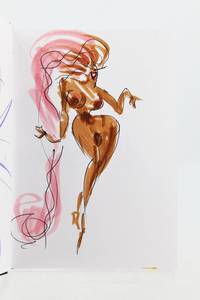
|
|
|
Maurice BARRES
Lettre autographe signée adressée à madame Léon Daudet
s. l.: S. n. 1905. Fine. S. n. s. l. s. d. 1905 13.50 x 21.50 cm un feuillet recto-verso Autograph letter signed by Maurice Barrès addressed to Madame Léon Daudet 39 lines in black ink on a four-page folio. Fold marks inherent to postal mailing. ""Chère madame J'avais espéré voir Léon et peut-être aussi vous-même en Provence et ce que je rêve vous faire connaître ce beau site de Mirabeau. Du moins j'y ai votre conversation écrite si claire rapide souple intéressante ces pages pas fabriquées mais jaillissantes et si aimables ! Je vois que je ne vous déplairais en vous disant que je vous apparente à celle de madame Millet. Robinel que j'ai tant lue quand j'étais enfant parce qu'elle était un des livres de notre maison et que je vous tiens pour sa cousine mais une dame de Paris auprès d'une importante fermière et puis aussi mais cette fois je vous choquerai. Je vous rapproche des livres de Michelet dont la ""mare-polémiste"" sait bien les élans et le goût. Au milieu de ses foules il a bien marqué comment l'homme d'action a besoin de la campagne française. Nul doute que vous n'ayez guère le petit malade mais comment vous a-t-il surpris si brusquement et réduit à une intervention chirurgicale dans les deux heures vous qui surveillez et qui défiez dans vos flots d'eau chaude et savonneuse les microbes farouches Excusez moi cette taquinerie que je regrettais bien profondément si je ne pensais si je n'étais pas sûr que vous êtes hors de souci. Au revoir chère madame amitiés de ma femme pour vous et pour Léon et bien respectueusement vôtre Barrès. Mirabeau jeudi."" ""Dear Madam I had hoped to see Léon and perhaps you as well in Provence and what I dream of to introduce you to that beautiful site of Mirabeau. At least I have your written conversation there so clear rapid supple interesting these pages not manufactured but springing forth and so amiable! I see that I would not displease you in saying that I relate you to that of Madame Millet. Robinel whom I read so much when I was a child because it was one of the books of our house and whom I consider you her cousin but a Parisian lady beside an important farmer's wife and then also but this time I will shock you. I bring you close to Michelet's books whose ""mare-polemicist"" well knows the impulses and taste. In the midst of his crowds he clearly marked how the man of action needs the French countryside. No doubt that you hardly have the little patient but how did he surprise you so suddenly and reduce you to surgical intervention within two hours you who monitor and defy in your streams of hot soapy water the fierce microbes Excuse me this teasing that I would deeply regret if I did not think if I were not sure that you are beyond worry. Goodbye dear madam regards from my wife to you and to Léon and most respectfully yours Barrès. Mirabeau Thursday."" S. n. unknown
Référence libraire : 83471
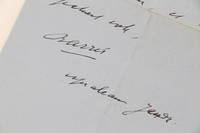
|
|
|
Alphonse DAUDET
Lettre autographe à un membre du groupe littéraire d'Alphonse Daudet sans doute Émile Zola
1880. Fine. s. d. circa 1880 - une feuille Letter written in ink on Vergé paper without date or address. An old handwriting indicates the letter was addressed to Zola information that can not be verified. Daudet relates the impression that the publisher Georges Charpentier left him during a dinner. The importance of the friendly group formed by the writers of the time is here particularly pregnant: "" I want to write him a word to propose to come with us five "". Presumably written after the death of Jules Goncourt probably in the 1880s as suggested by the use of the only surname Goncourt the letter evokes a cold between Goncourt and Charpentier: "" Goncourt may not be delighted; but he is too well brought up to let him see . "" unknown
Référence libraire : 63497

|
|
|
Joris-Karl HUYSMANS
« ah ! le foutu Dieu ! » Autograph letter signed to Camille Mauclair
Paris 1894. Fine. Paris 8 février 1894 10.60 x 13.50 cm un feuillet remplié Autograph letter of Joris-Karl Huysmans signed to Camille Mauclair 44 lines written in black ink 3 pages on a folded sheet handwritten correction of the author. Two restorations using strips of paper in high and low fold of the letter the second band very slightly affects a word of the text a fold inherent in the enveloping of the letter. A long and beautiful letter in which all Huysmans' respect and interest are shown for the writings of the young Symbolist generation. Both author and literary critic Huysmans embodies a central figure for young poets like the 22-year-old Camille Mauclair who sends him one of his first poetic collections: "" The chapter on the symbol is perfect ; it is certainly the first time that we explain and with such lucidity we put things back in place. "" Heart of the symbolism and the poetic fiber of Huysmans the music of the language is particularly honored both in the lyrics and in the author's writing: "" the pieces on death on sensuality are woven into the most vivid language . and the fine writer who found the cold and ethereal absentee who wrote such sentences: ""we strive to determine our true ghost in the tumult of appearances "". "" Introduced by the mention of the myth of Narcissus Symbolist figure par excellence the letter shows the philosophical questions that underlie the movement. « Narcissus is God - It is not very beautiful to contemplate the soul . It is true that you in a melancholy return on the vanity of being have shown in a vibrant page the actors of ourselves as we are. The mystical evocations direct to Satan and more ambiguous to God echo the literary conversion of Huysmans who in 1894 prepares the writing of En Route the first part of his trilogy during direct ""black book"" that is there : ""Ah! the damn God! Really that makes me dream of a literature that feeds less his Satan as you say to a literature of humility! "" Accustomed to digressive theoretical reflections on literature Huysmans concludes his letter with: "" At bottom I am stupid to quibble over ideas because in short all the ones we express and that we will make are already in d ' other times and they are more or less new depending on whether they are more or less forgotten but what is not done before you what you own is the way to coat them. And that's where I admire you wholeheartedly because those are your sentences. "" unknown
Référence libraire : 63596
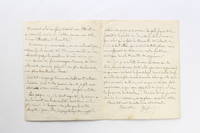
|
|

 Recevoir par e-mail
 Télécharger en PDF
 Flux RSS
 Lien permanent


