HIPPOCRATE.Livre Rare Book
6 398 résultats
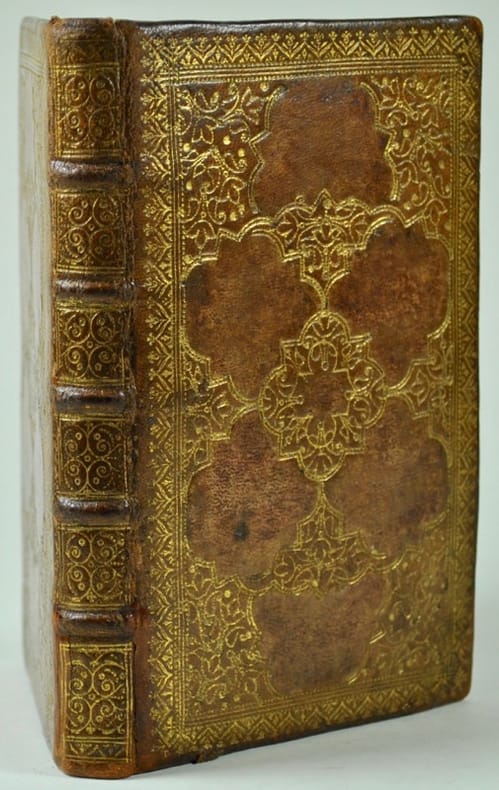
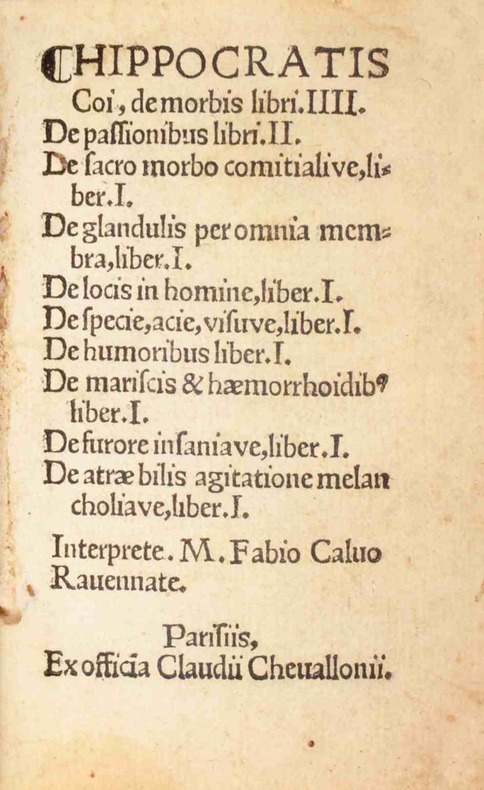
1529réf. 12206Paris, Claude Chevallon, 1529. In-16 de 232 ff., veau marbré, dos lisse orné, pièce de titre en maroquin rouge (reliure du XVIIIe siècle).
1924réf. 105142Berlin Der Sturm 1924 253x192mm Berlin, Der Sturm, décembre 1924, 253x192mm, 60p. numérotées de 177 à 233, , cousu sous couverture illustré d'un bois de Moholy Nagy. (105142)
1664réf. 44641La Haye, Chez Jean & Daniel Steucker, 1664. In-12 de (2)-252-(104) pp., galuchat, fermoirs et coins en argent (reliure de l'époque).
1669réf. 44642Se vendent à Charenton, Antoine Cellier, 1669. In-32 (88 x 55 mm) de (304) ff., musique notée, maroquin brun, grand décor doré de style fanfare avec fers filigranés, encadrement de roulette et filets dos à nerfs orné, tranches dorées (reliure de l'époque).
1649réf. 15312Paris, Jean Henault, 1649. In-12 (98 x 151 mm) de (106) ff. gravés recto-verso en taille-douce, maroquin fauve, plats ornés de compartiments de filets droits et courbes, fers filigranés et points dorés, dos orné de même, roulette sur les coupes, tranches dorées (reliure de l'époque).
1656réf. 42642A Paris, chez J. Hénault, 1656. In-12 (155 x 104 mm) de (106) ff. gravés recto-verso en taille-douce, maroquin rouge, dos orné à nerfs, triple filet doré et motifs d'angle sur les plats, tranches dorées, fermoirs (reliure de l'époque).
1745réf. 0030241745 Fontenoy [recueil A], Paris [recueils C à Y], Bruxelles [recueil Z], sans nom d'éditeur, 1745-1762. Vingt-quatre parties reliées en douze volumes in-12 (106 X 174 mm) basane fauve, dos cinq nerfs ornés, caissons dorés, dentelles dorées en queue et tête, pièce de titre maroquin ocre, coupes filetées, tranches rouges (reliure de l'époque). Tome I : titre imprimé en rouge, IV (avertissement), un feuillet de table, 224 pages - titre imprimé en rouge, un feuillet (avertissement et table), 222 pages ; Tome II : IV (dont titre imprimé en rouge & avertissement), 2 feuillets de table, 208 pages - titre imprimé en rouge, 247 pages, 2 feuillets de table ; Tome III : titre imprimé en rouge, 265 pages, 3 feuillets de table - titre imprimé en rouge, II (avertissement), un feuillet de table, 195 pages ; Tome IV : titre imprimé en rouge, 248 pages, 1 feuillet de table, (1) - titre imprimé en rouge, 236 pages, 1 feuillet de table ; Tome V : titre imprimé en rouge, 209 pages, 1 feuillet de table - titre imprimé en rouge, 210 pages, 3 feuillets de table ; Tome VI : titre imprimé en rouge, 235 pages, 2 feuillets de table & avertissement - titre imprimé en rouge, 235 pages, 2 feuillets de table ; Tome VII : titre imprimé en rouge, 227 pages, 5 pages non chiffrées (table) ; titre imprimé en rouge, 226 pages, 1 feuillet de table ; Tome VIII : titre imprimé en rouge, 219 pages, 2 feuillets de table - titre imprimé en rouge, 216 pages, 1 feuillet de table ; Tome IX : titre imprimé en rouge, 226 pages, 1 feuillet de table - titre imprimé en rouge, 214 pages, 1 feuillet de table ; Tome X : titre imprimé en rouge, 235 pages, 1 feuillet de table - titre imprimé en rouge, 256 pages, 2 feuillets de table ; Tome XI : titre imprimé en rouge, 239 pages, (1) page de table - titre imprimé en rouge, 219 pages, 4 pages de table non chiffrées ; Tome XII : titre imprimé en rouge, 210 pages, 3 feuillets de table - titre imprimé en rouge, 197 pages, (3) pages de table.
1928réf. 22835DEVAMBEZ 1928 1 Annuaire du luxe à Paris, Hommage des grandes maisons françaises, Paul Poiret fondateur. Paris, Devambez, 1928, in-4, reliure toile éditeur ocre titrée noir et argent, (Magnier Relieur).
réf. 18559A Paris, Chez la Veuve Estienne et Fils, 1741. 3 volumes. (8), xxvii, (1), 544 pp., (545)-1140 numbered columns; (4) pp., 1772 numbered columns; (4) pp., 1316, 684 numbered columns. Folio. Contemporary marbled calf, spines gilt with raised bands, red labels with gilt lettering. Kress 4584; Goldsmiths 7819; not in Einaudi; not in INED. Jacques Savary (1622-1690) was for some time director of the French Royal Domains, and later became general business agent to the Duke of Mantua. He had such sound notions about commerce and was so successful in his operations that Colbert appointed him in 1670 in the "Conseil de la Reforme", which was to reform and refine the rules of commercial practice. The "Commercial Code" of 1673 resulting from it was called after him "Code Savary". He was then also pressed to write down and publish all his commercial knowledge, which pressure led to the publication of the famous Le parfait Négociant (1675). It taught everything a merchant should know, but only his left papers revealed to the world the immense and universal knowledge on commerce Savary possessed. The dictionary was immensely successful and covers all aspects of commerce and trade as well as legal and historical matters. Deals among others with: trading cities throughout the world, their manufactures, operation of foreign trade, trading companies (including a short history of the South Sea Company), banking (including an account of John Law's Bank), bookkeeping, etc. etc. The dictionary was the first of its kind to appear in Europe, and has furnished the principal part of the material for most of the dictionaries that were to follow. The project was sponsored by the French government who justly considered that such a dictionary, if well executed, would be of national importance. Hence a considerable, and indeed the most valuable portion of the work is compiled from memoirs sent to the author, by order of government, by the inspectors of manufactures in France and by the French consuls in foreign countries (see: McCulloch, p. 61). The dictionary is preceded, in volume one, with an elaborate, long (upto column 544) separate essay on the "État général du commerce de l'Europe" (and followed by the other continents Africa, Asia and the Americas). - Very small damage to head of spines of volumes 1 and 2.
réf. 26145A Paris, Chez la Veuve Estienne et Fils, 1741. With nice head- and tailpieces. 3 volumes. (8), xxvii, (1), 544 pp., (545)-1140 numbered columns; (4) pp., 1772 numbered columns; (4) pp., 1316, 684 numbered columns. Folio. Contemporary marbled calf, spines gilt with raised bands, red labels with gilt lettering, red edges, joints, head and foot of spine and some corners repaired. Kress 4584; Goldsmiths 7819; not in Einaudi; not in INED. Jacques Savary (1622-1690) was for some time director of the French Royal Domains, and later became general business agent to the Duke of Mantua. He had such sound notions about commerce and was so successful in his operations that Colbert appointed him in 1670 in the "Conseil de la Reforme", which was to reform and refine the rules of commercial practice. The "Commercial Code" of 1673 resulting from it was called after him "Code Savary". He was then also pressed to write down and publish all his commercial knowledge, which pressure led to the publication of the famous Le parfait Négociant (1675). It taught everything a merchant should know, but only his left papers revealed to the world the immense and universal knowledge on commerce Savary possessed. The dictionary was immensely successful and covers all aspects of commerce and trade as well as legal and historical matters. Deals among others with: trading cities throughout the world, their manufactures, operation of foreign trade, trading companies (including a short history of the South Sea Company), banking (including an account of John Law's Bank), bookkeeping, etc. etc. The dictionary was the first of its kind to appear in Europe, and has furnished the principal part of the material for most of the dictionaries that were to follow. The project was sponsored by the French government who justly considered that such a dictionary, if well executed, would be of national importance. Hence a considerable, and indeed the most valuable portion of the work is compiled from memoirs sent to the author, by order of government, by the inspectors of manufactures in France and by the French consuls in foreign countries (see: McCulloch, p. 61). The dictionary is preceded, in volume one, by an elaborate, long (upto column 544) separate essay on the "État général du commerce de l'Europe" (and followed by other essays on the continents of Africa, Asia and the Americas). Ooii -Vviv in volume three with a wormtrack in the upper outer blank margin.
1574réf. 44648Anvers, Christophe Plantin, 1574. In-8, 392-99-(13) pp. (sign. A-Z a b , A-G ), index, vélin doré souple à recouvrement, double filet doré, cartouche central à motifs d'entrelacs, écoinçons, dos lisse orné de doubles filets formant caissons, tranches dorées, traces de lacet (reliure de l'époque).
réf. 46400138, Paris, Les Marges, 1928; in-4, maroquin rouge, décor géométrique avec deux bandes mosaïq. de platine et un jeu de filets dorés, large encadr. int. de mar. rouge avec encadr. listel platine et fil; dor., doublé et gardes de faille argent, doubles gardes, tr. dor. sur témoins, couv., étui.(Marot-Rodde). Superbe réalisation typographique en rouge et noir. Ornements, bandeaux et culs-de-lampe dessinés par B. Grosser. Imprimé sur les presses de Ducros et Colas pour la Société de Bibliophilie Les Marges. Tirage limité à 359 exemplaires. Un des 51 exemplaires numérotés en romain sur vélin d'Arches, celui-ci spécialement imprimé pour Louis Barthou. Très élégante reliure de Madame Marot-Rodde qui exerça à Paris entre 1920 et 1936. Elle avait appris la reliure avec Ch. Chanat et P. Ruban. Fléty 121.- Voir aussi Crauzat III pp 137-139 qui consacre une importante notice à cette artiste d'une grande perfection technique.- Vrain. Catal. Reliures de femmes 54 à 61. Ex-libris L. Barthou.
1853réf. LL 603TYPOGRAPHIC SPECIMENS OF THE VATICAN PRINTING HOUSE. Folio 342x255 mm; original cloth with title impressed in gold on upper cover; half-title leaf title-page leaf printed in blue red and gold within a triple border as well printed in blue red and gold a leaf with the advice to reader pp. VIII 62 plates and 4 plates containing many samples of fonts text printed in Italian Latin Greek Copic French also with sample of numbers music typographical borders tailpieces etc. last 4 plates: " Campioni dei tratti di penna" so calligraphic samples. Francesco Salviucci belonging to a well-known family of Roman typographers director of the Typography of the "Reverenda Camera Apostolica" describes a vast sample of the printing characters present in the typography preceded by a brief excursus on typographic art in general. In addition to the characters there are various friezes and engravings including the image of a steamship probably the first of the Papal State. Maggs cat. n. 509; Books on Printing Part II Books From Famous Presses 15th To 20th Century. Tipografia della Rev. Camera Apostolica hardcover
1690in-8 (mm 204x145), ff. 4, bella cartonatura decorata settecentesca. Il primo foglio ha una bellissima xilografia a mezza pagina (mm 86x112) raffigurante probabilmente Carlo Magno in trono circondato dai suoi Paladini, il tutto entro bordura geometrica. Varie furono tra XVI e XVII secolo le versioni in versi della saga di Liombruno, alcune analoghe a questa, altre più estese. Questo testimone appartiene alla tradizione di quella in 48 ottave, che si apre con "Signori, intendo che per povertade / molti nel mondo son mal arrivati / hanno perduto la lor libertade / la povertá sí forte gli ha cacciati" e termina con l'ottava che inizia con "E cosí stettero insieme allegramente / infin che visson, con perfetto amore". Ma le varianti testuali sono notevoli rispetto ad altre reperite, non solo per il lessico ma anche per intere frasi sostituite. La probabile prima edizione di questo testo anonimo è del 1525. Esiste anche una versione in prosa di questa fiaba che ha per protagonista un pescatore con vari figli e madonna Aquilina, una fata con poteri magici. Forse l'unico esemplare noto di questa tarda ma preziosa edizione, che reca inusualmente un esplicito colophon sul frontespizio "In Palermo, per Pietro Coppula 1690". Il Coppola ebbe una stamperia prestigiosa e editò alcune tra le più ricche edizioni del Seicento palermitamo; stupisce che si sia dedicato ad imprimere questa effimera edizioncina popolare. Il bellissimo legno copia con fedeltà un'altra xilografia cinquecentesca già apparsa in alcune placchette precedenti, sicuramente ne "le valorose prove segli Arcibravi Paldini" del 1580. In buono stato di conservazione malgrado il margine inferiore sia rifilato, con perdita di mezza riga in A1r e di una intera riga in A8v. Le altre pagine invece sono complete anche del richiamo. L'angolo inferiore esterno di A8r non fu stampato a causa di un foglio piegatosi nel torchio. Sulla prima sguardia timbro della biblioteca del fondatore del British Institute di Firenze, Walter Ashburner (1864-1936), professore ad Oxford e grande bibliofilo. . Sander 3980-3991 descrive alcune edizioni con illustrazioni variate tra Cinquecento e Settecento..
First edition, 3 vols., 4to (270 x 185 mm), [6], vi, [2], ccxxv, [1], 410, [2]; [4], 535, [3]; [4], 544, [4]pp., with half-titles, ONE OF 50 LARGE PAPER COPIES, 37 engraved plates (without the 'Presentation in the Temple' plate which was not ready at publication and occurs in only a very few copies and the 'Portrait of Los Rios' which Windle & Pippin suggest is an extra-illustration), also without the engraved portrait of Dibdin by Henry Mayer, numerous woodcuts engraved vignettes, several printed in red or blue, some mounted, some light spotting and offsetting as usual, marbled endpapers, contemporary full blue-green morocco, decorated in gilt with interlacing geometrical design on the covers, richly tooled gilt morocco doublures, flat spines lettered in gilt direct, all edges gilt, spine slightly faded, corner of lower board of vol. II bumped, some slight edge-wear to bindings otherwise a handsome set. A fine copy of the rare large paper issue of the author's most lavish publication and the high water of Dibdinian Bibliomania. Jackson 40; Windle & Pippin A28.
1925réf. 15487ABBerlin, -, 1925. Kalligrafisch gestaltetes Doppelblatt in Ledermappe und Schuber., Abbildung 1|Abbildung 2|Abbildung 3
1931réf. 25353TOLMER 1931 1 Paris, Tolmer, 1931, petit in-4, broché, cartonnage éditeur noir et jaune sous étui, couverture en couleurs illustrée.
1654réf. 42819Imprimés au Chasteau de Richelieu, A Paris, Pierre Le Petit, Henry Le Gras,, 1654. Petit in-8 (139 x 85 mm) de (8)-211-(5) pp. (sig. ã4, A-O8, feuillet blanc L8).[DESMARETS DE SAINT-SORLIN (Jean)]. Le Combat spirituel ou de la perfection de la vie chrétienne, traduction faite en vers par J. Desmarets. Imprimés au Chasteau de Richelieu, A Paris, Pierre Le Petit, Henry Le Gras, 1654. Petit in-8 de (8)-57 pp. (A-C8, D5).Les deux pièces reliées en 1 vol. petit in-8, maroquin rouge, dos lisse orné, encadrement de roulettes dorées sur les plats, filet doré sur les coupes, dentelle intérieure, tranches dorées (relié vers 1810).
1605réf. 40266Limoges, Jacques Barbou, 1605. In-16 de 130 pp. chiffrées 30 par erreur (sign A-H8, I1), trigramme IHS sur le titre, vélin souple (reliure de l'époque).
1558réf. 40083Toulouse, [Guyon Boudeville, pour] Antoine André, 1558. Petit in-4 (18 x 14 cm) de (12)-321-(1) pp. (sign. aa6, A-Z4, AA-QQ4, RR5), demi-chagrin rouge, dos à nerfs, non rogné (reliure du XIXe siècle).
1654réf. 42470Imprimé au Chasteau de Richelieu, Paris, Pierre Le Petit et Henry Le Gras, 1654. In-16 (140 x 90 mm) de (8)-57 pp. vélin souple, titre manuscrit sur le dos et le premier plat (reliure de l'époque).
1911LIMITED EDITION OF 306 COPIES. RARE large, ornate edition of Dante Alighieri's 'Divine Comedy', published on the alleged 700th anniversary of the Comedia. The text is heavily annotated, and is prefaced by the Italian poet Gabriele D'Annunzio. The edition features numerous woodcuts and text decorations reproduced from the 15th-century Venice edition of the Comedia. This exemplar is not numbered, meaning it is probably one of the first 6 copies. 415x310mm. XI+524 pages. Brown cloth Hardcover, masterfully restored from a damaged and partially missing cover. Cover corners bumped. Pages wavy with somewhat rough edges. Pages slightly yellowing. [SUMMARY]: In spite of the damage to cover it has previously sustained, this rare and impressive edition of a great literary masterpiece has been restored and is in good condition. PLEASE NOTE: This item is overweight. We may ask for extra shipping costs.
1645in-12, (130x75 mm), pp. 413, (15), legatura coeva in piena pergamena floscia. Con due frontespizi figurati e 147 vignette (di mm 35x50 ca.) silografiche n.t., alcune più volte ripetute, iniziali ornate e finalini. Pregevole edizione della Vita e delle Favole di Esopo nella traduzione italiana a cura del piacentino Giulio Landi, apparse rispettivamente per la prima volta presso i Giolito nel 1545, e a Venezia, Bariletto, 1569 (DBIt 63, pp. 385-389). Edizione figurata di eccezionale rarità - come tutte quelle di Esopo, di estrema deperibilità in quanto date in lettura ai bambini; nessun esemplare di questa edizione torinese è censito in biblioteche pubbliche italiane. Inoltre appare straordinario sottolineare che i legni sono gli stessi utilizzati nell'edizione latina apparsa a Biella presso Mondella nel 1549 e 1550 (Bersano Begey, II, 913-14). Queste deliziose matrici xilografiche, dall'indubbio sapore popolare, sopravvissero per oltre cento anni e vennero riutilizzate in questa edizione in volgare. Buon esemplare (antiche note di possesso ms. al titolo e in fine ''Gioanni Pietro Reynaudo'').. Manca a Michel-Michel, a B.M.STC Italian XVII secolo, al Canavesio, Tipografia del 600 in Piemonte..
réf. 26159Paris, Jorry, Lambert et Duchesne, 1758. Text printed within woodcut border. [ii] (series title dated 1763), xxii, [ii], 244, 88; 48 (the pagination of the six supplements is continuous) pp. 8vo in 4s. Finely bound in late nineteenth century crushed blue morocco, spine in compartments, gilt-lettering directly to spine, tooled with theatrical mask to spine and to all four corners of upper and lower board, upper edge gilt, gilt dentelles, partly uncut, a fine copy. Grand-Carteret (Almanachs Français) 192; Dufour, Bibliographie de Paris, p. 395; Soleinne, IV, 283; OCLC locates a number of copies of the main work, but only Dutch Royal Library, Lyon and Bibliotheque Nationale for the full complement of supplements. First edition, very rare with all six supplements present, of this detailed account of French theatre up to the middle of the eighteenth century. The supplements, which were published separately over the course of six years, are very rarely present. Here they are collected with a general title page, dated 1763, published 'at the expense of the author', and bound in a fine 'theatrical' binding. The Tablettes dramatiques are a most valuable source for the history of French theatre, covering first the history of the theatre, the history of the foundation of specific theatres, an inventory of plays performed or printed for the period 1552 to 1752, with critical commentary, and finally a biographical dictionary of authors and actors. The supplements generally follow the same format and give information on new plays, a performance calendar for the period in question, details of ballets, and biographical information on new emerging actors. A fascinating overview of French or more specifically Parisian theatre history, documenting the transition from medieval theatre to the highly organised and politicised drama up the middle of the eighteenth century.The chevalier de Mouhy (1701-84), was a playwright and prolific author on the theatre, he also published an Histoire du theatre français depuis son origine jusqu'en 1780.
réf. 015681Kalamazoo Michigan: Rarach Press 1989. Hardcover. Fine. No. 30 of 38 copies signed by the artist/publisher Ladislav Hanka. In a multi-textured binding by Jan Sobota stamp-signed on rear doublure covers of sueded calfskin printed with original etchings flat spine of brown catfish leather turn-ins and headbands covered in eel skin beige pigskin doublures covered with original etchings leather hinges. In an encapsulated pigskin slipcase covered with etchings beige linen pull-off spine with brown morocco label. With 16 etchings of flora and fauna by Ladislav Hanka. 333 x 248 mm. 13 1/8 x 9 3/4''. A fine copy. This is a handsomely-produced book arts collaboration celebrating the natural beauty of Kalamazoo County Michigan featuring a memorable binding by Czech master binder Jan Sobota. After studying with Karel Silinger in Pilsen and at the School for Applied Arts in Prague and then working in Switzerland Sobota came to the United States where hespend 15 years mostly working at Southern Methodist University. He returned to Loket Czech Republic in 1997 where he founded the Sobota family bookbinding studio and helped to organize the Society of Czech Bookbinders becoming its first president. He has won numerous awareds for his innovative and often whimsical work which has been exhibited worldwide. The present volume is equal parts inventiveness and elegance. Book artist and publisher Ladislav Hanka b. 1952 earned degrees in biology and zoology before receiving his MFA in printmaking and his background in the natural sciences obviously infuses his art which focuses on the flora and fauna of forest and lakes. This volume's collection of prose and poetry inspired by the natural landscape is enhanced by Hanka's dramatic etchings of twisted bare-limbed trees fossils and insects. The letterpress work was done by Amy Bollinger on heavy handmade paper. Rarach Press hardcover