Villette (Charles-Michel de).Livre Rare Book

6,366 results
1786ref. 44364À Londres [Montargis, Claude Lequatre], 1786. In-16 de (8)-156 pp., (20) ff. d'échantillons de papier, maroquin vert, dos lisse orné, pièce de titre en maroquin vert, roulette dorée d'encadrement sur les plats, tranches dorées (reliure de l'époque).
1523ref. 44374Cologne, Eucharius Cervicornus pour Gottfried Hittorp, s.d. , (1523). In-8 de 139-(13) ff., (sign. a-s8, *8), table, titre à encadrement gravé, bois gravé, caractères grecs et romains.ÉRASME. Parabolarum, seu Similium liber elegantissimus. Argentinae, apud J. Knoblouchum (Strasbourg, Johann Knobloch) 1521. 103-(5) ff., (sign. A-O8), titre à encadrement gravé, caractères italiques.ÉRASME. Opus de conscribendis epistolis, quod quidam & mendosum & mutilum ediderant, recognitum ab authore, & locupletatum. Argentorati (Strasbourg) Knobloch, 1522. 178 (i.e. 180) ff., (sign. A-Y8, Z4), titre à encadrement gravé, caractères italiques.3 pièces reliées en 1 vol. in-8 (105 x 170 mm), peau de truie sur ais de bois biseautés, décor estampé à froid à encadrement de motifs floraux et animaliers, dos à trois nerfs, titre manuscrit au dos, deux fermoirs (reliure de l'époque).
1844ref. 161724Macau: Presbyterian Mission Press 1844. A revolutionary method to compose Chinese texts for printing First edition of this catalogue of 22841 characters issued in the year of the Presbyterian Mission Press's founding in Macau. Of the 500 copies printed we have located 5 in institutions British Library American Antiquarian Society Princeton Theological Seminary Yale and Rostock. The Presbyterian Mission Press was established in Macau in 1844 by Walter M. Lowrie 1819-1847 the son of the secretary of the American Presbyterian Mission and a future member of the group that produced the Delegates' translation of the Bible into Chinese. Lowrie was aided by Richard Cole a professional printer sent from the US with presses and matrices. The press used both matrices for whole characters devised from those invented by Samuel Dyer and divisible type where type representing commonly recurring parts of characters could be combined to form complex logograms. The characters in this catalogue are arranged by constituent elements in 214 columns. In 1845 the press moved to Ningbo and then to Shanghai in 1860 where it operated for many years as the Meihua shuguan. Quarto 310 x 240 mm. Mid-20th-century red morocco by Albert Oldach of Philadelphia raised bands spine and boards gilt light brown endpapers substantial remains of original front wrapper laid down on bound-in leaf. Recent bookplate of Whitehead Library; ex-Presbyterian Historical Society Philadelphia with its ink stamp on front free endpaper and couple of pencilled pressmarks internally. A few losses to leaves caused by brittleness of paper repairs including lining or strengthening of several leaves: a good copy requiring careful handling but rare in any condition. hardcover
1535ref. 42543Lyon, Denys de Harsy, 1535-1536. In-4 gothique de CXXV-(11) ff. (sign. A-R8), 4 feuillets liminaires manuscrits, maroquin brun janséniste, dos à nerfs, frise dorée intérieure, tranches dorées sur marbrure (Chambolle-Duru).
1517ref. 41471Paris, Jehan Petit, (1517 ca). In-16 gothique (87 x 119 mm) de (259) ff. (sign. A-Z , a-i , k ), veau fauve glacé, dos orné à nerfs, pièces de titre en maroquin fauve et vert, triple filet doré d'encadrement sur les plats, filet et frise dorées intérieures, tranches dorées (Petit succr de Simier).
1477in-4 (mm. 178x112), ff. 85 (su 90, mancando: f1, h1, h6, i5-6), legatura cinquecentesca in pergamena floscia, titolo e note tipografiche mss. al dorso. Car. tondo, lettere-guida per le iniziali, nella prima metà del volume le iniziali sono dipinte in rosso. E' Il quarto libro impresso a Torino, dai torchi del prototipografo Giovanni Fabri. Terza edizione dell'opera – che segue la prima del 1474 di Giovanni Filippo de Legnamine e quella romana di Giovanni Schurener del 1476 – ma con l'aggiunta dello stesso Fabri di notizie su Piemonte e Savoia. Le ultime 4 pagine danno notizie su Amedeo IX (secondo Duca di Savoia) prima a Vercelli "in sua dilecta and speciosa Vercellarum civitate" e poi a Torino "urbe primaria", nonché delle virtù che l'erede Filiberto, morto misteriosamente a 17 anni, avrebbe palesato "si deus optimum longiorem prestaverit vitam". L'aggiornamento parla in fine di Carlo il Temerario e della morte di Galeazzo Sforza. Il Fabri aveva stampato nel 1474 un "Breviarium Romanum" e nel 1476 la "Practica nova iudicialis". Dopo aver licenziato due edizioni a Caselle, ritornò a Torino nel 1477 con la celebre "Summa Lacticiniorum" di Pantaleone da Confienza e la presente "Chronica". L'arrivo in città sembrò segnare l'inizio di un nuovo periodo di vivace attività, perché entro pochi mesi apparvero anche i primi Statuti Sabaudi curati da Pietro Cara. Però dal maggio 1478 a fine marzo 1482, quando fu terminata di stampare l'Expositio Psalmorum del Torquemada, comparvero solo sei edizioni, "quantità assai modesta, che trova giustificazione nella povertà di mezzi e in parte forse anche nella scarsa propensione per la lettura e lo studio delle genti subalpine, alle quali sembra debbano esser riservati prevalentemente libri scolastici e volumetti di pietà e devozione" (Rinaldo Comba, Il basso Medioevo e la prima età moderna, 1975). Colophon al f. (90 r.): "Cronica Martini finit: Divo philiberto ac Sabaudorum sub duce magnanimo. Taurini; foris ac pressit: and aere: Iohannes Fabri: quem civem linoni alta tulit. Anno Mcccc.lxxvii. Die vero xxiii. Augusti". In buono stato di conservazione, malgrado le mancanze ed aloni d'umido agli ultimi 6 ff., strappo all'angolo inf. esterno dell'ultimo f., che riporta conti a penna al verso bianco; questo esemplare, con ex- libris ''Del Conte della Trinità'' (il balio Francesco Luigi Costa) eseguito all'acquaforte da Stagnon, e del Conte Andrea Bocca, fu venduto all'asta Bocca del 2.V.1932, poi dalla Libreria Hoepli e notificato nel 1960, venne poi de-notificato nel 1973. Rarissimo cimelio tipografico torinese, di cui sono noti una decina di esemplari, quasi tutti incompleti compreso quello del British M.; l'unico certamente completo e solo in USA è conservato all' Huntington Library.. D.Rhodes, Giovanni Fabri tipografo del xv secolo in Torino ed in Caselle, 1975, pp. 101-110. Goff R189; HC 10859; Pell Ms 7721 (7626); IGI 8359; BMC VII 1053; GW M18341. Cosentini, Incun. Piemontesi n.19..
1658In -4°, due parti in un volume, antiporta figurata incisa, due tavole incise a piena pagina di cui una con ritratto dell’autore. Testo corredato da centinaia di vignette, testatine, iniziali e finalini istoriati calcografici; diverse illustrazioni incise (I) legato con “Poesie liriche toscane”, inc. di Giovanni Battista Bonacina, Etienne Picart su disegni di Gregorio Tomasini; legatura in piena pergamena coeva semirigida, fioriture e lievi macchie di umidità e bruniture su alcune carte (in particolare pp. 89-92), segni di restauro su alcune carte. Molto raro, questo libro è uno degli esempi più impressionanti della produzione barocca italiana: sconosciuto ai compilatori della Bibliografia Romana: Boffito nomina il primo frontespizio inciso come registrato da Le Blanc, ma aggiunge che per loro un esemplare sarebbe stato introvabile. Prima edizione delle due opere, rilegate assieme e pubblicate postume, probabilmente è un omaggio a Cesarini stampato in tiratura limitata. L’autore è un cugino di Federico Cesi, studioso di legge e filosofia e appassionato di astronomia e matematica. Amico di Galileo e membro dell’Accademia dei Lincei, sollecitò Galileo a scrivere Il Sggiatore. I versi qui contenuti sono dedicati ciascuno a personaggi illustri dell’epoca (molti di loro membri dell’Accademia). Rossetti 1824 Very rare, this is one of the most impressive examples of Italian baroque book production: It was not known to the compilers of the Bibliografia Romana: Boffito mentions the first engraved title page as registered by Le Blanc, but it adds “We couldn’t find the edition”. First edition of the two works, issued together and posthumously published, with a life of the author included. This was probably a memorial to Cesarini published in a small number of copies. The author was a cousin of Count Federico Cesi and, after studies in law and philosophy, developed a passionate interest in mathematics and astronomy. He was friend of Galileo and Ciampoli and a member of the Accademia dei Lincei. He went on to urge Galileo to write Il Saggiatore. The verses here contained, latin and italian, are each dedicated to a notable contemporary (many of these were members of the Accademia).
1538ref. 15510Paris, Pierre Vidoue, 1538. In-8 gothique (145 x 90 mm) de (111) ff. (sign. A-N8 O7), maroquin rouge, dos lisse orné, triple filet doré d'encadrement sur les plats, roulette intérieure, tranches dorées (reliure du XVIIIe siècle).
1611ref. 16494Chambéry, Geoffroy Dufour, [1611]. In-12 de (6)-219 pp., 1 f.bl., maroquin rouge, dos à nerfs, dentelle intérieure, tranches dorées sur marbrure (Hardy).
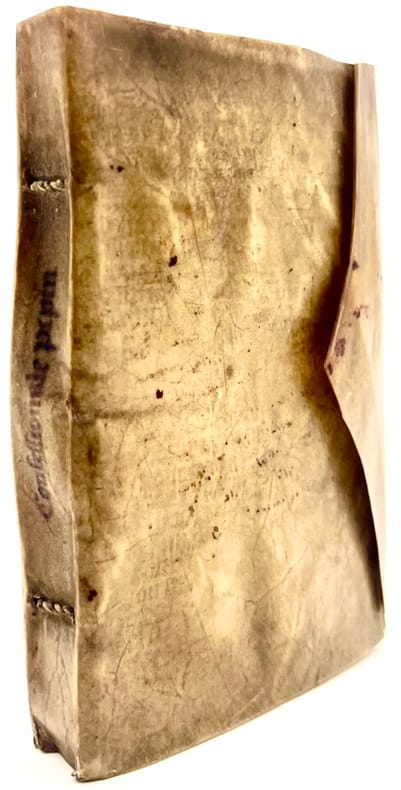
1534ref. 43491Paris, Claude Chevallon, 1534. Petit in-8 gothique à deux colonnes (110 x 160 mm) de (224) ff. le dernier blanc (sign. A-Z8, AA-EE8), lettrines historiées, texte rubriqué, vélin souple avec rabat en forme de portefeuille, titre manuscrit en long (reliure de l'époque).
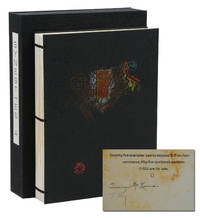
ref. 140941961New York: Granary Books 1992. Signed Limited First Edition. Fine. First edition. An artist's book containing drawn and painted images by Timothy C. Ely set against text written by Terence McKenna with typography by Philip Gallo. From a limited edition of only 75 copies signed by McKenna and Ely. Of those 75 there were 55 numbered copies and 20 hors commerce copies lettered G-Z and this is copy letter O. Pages printed letterpress on Rives BFK in pairs on single leaves wrapped around and pasted onto thick card stock and adorned with original watercolor paintings by Ely; sewn binding with brass rods securing textblock to black embossed paper-covered boards with decorative brass piece affixed to upper board housed in original black cloth chemise case with printed paper title label to spine. Fine. In 1991 McKenna visited an exhibition at Granary Books featuring Ely's work and this collaboration would result. A fantastic push and pull of Gallo's refined typography set against Ely's abstract watercolor offering a visual landscape for the eye to wander perfectly paired with McKenna's text on broad themes such as art language history and nature. Granary Books unknown
ref. 140941961New York: Granary Books 1992. Signed Limited First Edition. Fine. First edition. An artist's book containing drawn and painted images by Timothy C. Ely set against text written by Terence McKenna with typography by Philip Gallo. From a limited edition of only 75 copies signed by McKenna and Ely. Of those 75 there were 55 numbered copies and 20 hors commerce copies lettered G-Z and this is copy letter O. Pages printed letterpress on Rives BFK in pairs on single leaves wrapped around and pasted onto thick card stock and adorned with original watercolor paintings by Ely; sewn binding with brass rods securing textblock to black embossed paper-covered boards with decorative brass piece affixed to upper board housed in original black cloth chemise case with printed paper title label to spine. Fine. In 1991 McKenna visited an exhibition at Granary Books featuring Ely's work and this collaboration would result. A fantastic push and pull of Gallo's refined typography set against Ely's abstract watercolor offering a visual landscape for the eye to wander perfectly paired with McKenna's text on broad themes such as art language history and nature. Granary Books unknown books
1928ref. 104584BBKöln, DuMont, 1928. 8°. 111 S. u. 18-seitiges Foto-Leporello mit zahlr. mont. Abb. (20,5 x 235 cm.). Hellroter OKart. mit Deckeltitel. [8 Warenabbildungen]
1924ref. 8546Paris, Les Cent Bibliophiles, 1924 ; in-4 ; plein maroquin aubergine, dos à cinq nerfs, plats décorés et mosaïqués de trois larges compositions horizontales de fleurs stylisées "à l'égyptienne" : celle du haut, sur fond de maroquin mastic, succession de petites et grandes fleurs de maroquin mandarine, bleu-nuit et vert-sapin encadrée d'un listel vert foncé et d'un filet doré ; celle du milieu, alternance de fleurs et feuilles de couleurs violet, parme et vert-sapin, interrompue en son centre par un grand cercle de maroquin mastic dans lequel sont mosaïquées les lettres du titre en vert foncé, qui se chevauchent, le tout entouré d'un listel vert foncé et filet doré ; enfin, celle du bas présente une série de fleurs et feuilles à plat, soulignée d'une double rangée de points mandarine, toujours sur le même fond mastic et encadrée du même listel vert foncé et filet doré.Le décor du second plat, à l'identique mais sans le cercle-titre ; double filet doré sur les coupes, tranches ébarbées et dorées ; contreplats doublés de maroquin havane orné, en encadrement, d'un listel de maroquin aubergine entrecoupé de carrés dorés, triple filet doré, gardes de brocard de soie pourpre, couverture et dos conservés, étui bordé (reliure de Noulhac d'après une maquette de Madeleine Noulhac) ; (8) ff. (3 blancs, justification du tirage, faux-titre au verso frontispice, titre, faux-titre au verso, gravure hors-texte, gravure hors-texte), 215 pp., (8) ff. (table, achevé d'imprimer, Les Cent Bibliophiles, 2 bl.). ; 147 bois dessinés et gravés en couleurs de Louis Jou dont 9 hors-texte et 3 lettrines.
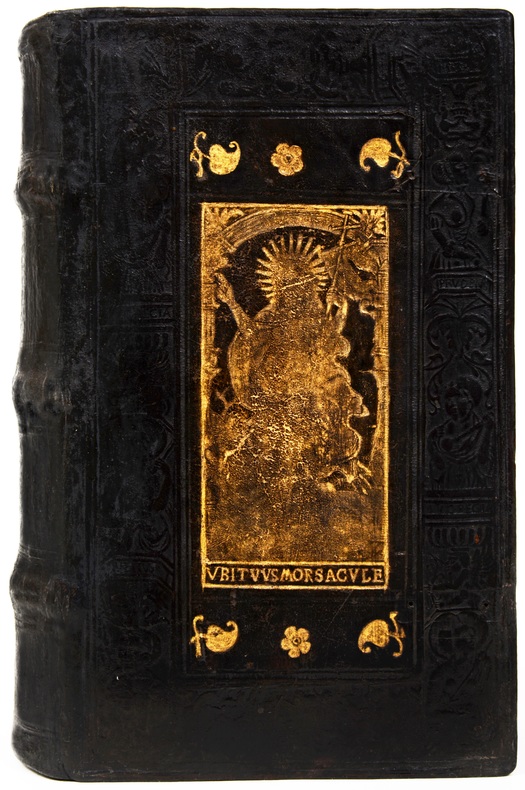
1538ref. 15643Bâle, Thomas Platter, 1538. In-8 grec (170 x 100 cm) de (8)-382-(2) ff., maroquin noir estampé, dos à trois nerfs (reliure de l'époque).
1927ref. 18838ABParis, Arts et métiers graphiquees, 1927 - 1939. 31 : 24 cm. Mit vielen, teils farbigen, teils montierten Tafeln und Abbildungen. Farbig illustrierte Origiginal Umschläge, in Leinendecken und Leinen-Schubern. Nummer 1 - 68 (alles) in 11 Schubern.
1936ref. 31691New York: The American Jewish Joint Distribution Committee 1936. Hardcover. First Edition. 6 x 9in. 123pp. Bound in full crushed red morocco. Spine with five raised bands and six gilt decorated compartments. Gilt ruling marbled endpapers and dentelles. Initialed by the author Paul Baerwald on the fourth endpaper. A completely singular publication and binding with no other recorded copies of the text itself presented to Paul Baerwald from the American Jewish Joint Distribution Committee or JDC. In 1932 Baerwald became the Chairman of the JDC and would serve as such through the rise of the Nazi Regime the escape expulsion and attempted extermination of the Jewish people in Europe and the entirety of World War II. He supervised all of the JDC's philanthropic and rescue work throughout this period by sending funds to Europe and elsewhere even heroically risking the organization itself by sending borrowed monies from New York banking institutions. In 1938 he became a member of President Roosevelt's Advisory Committee on Political Refugees to expand the work of the JDC to the largest possible scale. The true humanitarian impact of Baerwald's efforts are inestimable. Most profoundly throughout the 1930s and leading up to the U.S. entry into WWII Baerwald delivered public and private orations informing the American public for the first time as to the persecution of the Jewish people in Europe while passionately advocating for any type of assistance. These speeches make up the text of the present volume and represent the earliest pleas for United States intervention and assistance on behalf of the Jewish people. In 1945 Baerwald was named Honorary Chairman of the JDC where he then instituted policies which aided over half a million refugees to reach Israel. FINE in Near Fine felt lined clamshell case. The book itself is flawless. The slipcase with marginal shelf rubbing of the edges otherwise remains Fine. As pictured. The American Jewish Joint Distribution Committee hardcover
1568In-4, 6 ff., 194 pp., (1) ff., frontesipizio figurato inciso e 36 tavole a piena pagina incise su rame, colophon con registro e data 1569 in fine; legatura in piena permamena molle coeva. Bellissimo esemplare genuino.
1531ref. 43504Paris, Philippe Le Noir, sans date, (1531). Petit in-4 gothique (130 x 187 mm) de 75-(6) ff. [sign. A8 B-Q4 R6], table, vélin à petit rabats, dos muet, traces de lacet (reliure de l'époque).
1582ref. 15603Paris, Imprimé Par Jean Le Blanc pour Julien Duval, 1582. Petit in-8 gothique de (108) ff. [aaaa8-oooo8]. 2 grand bois portent les initiales JLB (pour Julien Le Blanc) et 30 petites vignettes sur bois la plupart signées JLB. Imprimé en rouge et noir. Nombreuses initiales ornées. Les Quinze Effusions du tres precieux sang de nostre sauveur et redempteur Jésus-Christ. S.l.n.d. [Paris, Jean Leblanc, 1585]. Petit in-8 gothique de (8) ff. [A8]. 9 grands bois in texte portant les initiales JLB. Initiales ornées. La Vie de Madame Sainte Marguerite, vierge et martyre avec son oraison. Imprimé à Paris par Jean Leblanc, 1585. Petit in-8 gothique de (8) ff. [A8]. Vignette sur bois au titre. Les 3 pièces reliées en 1 vol. petit in-8 (11 x 7 cm), maroquin rouge, triple filet doré en encadrement sur les plats, dos lisse orné, pièces de titre en maroquin vert, dentelle dorée sur les tranches et filet doré sur les coupes, signet de soie bleue, tranches dorées (reliure du XVIIIe siècle).
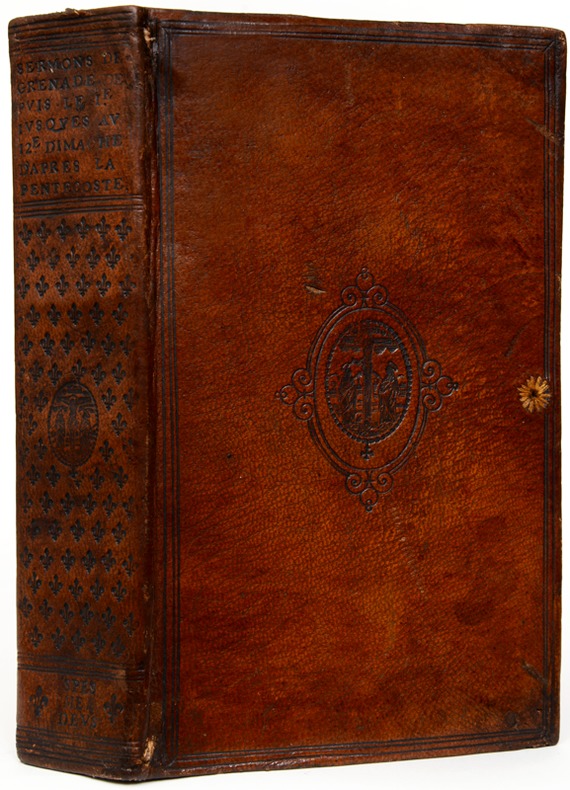
1585ref. 39802Paris, Guillaume Chaudiere, 1585. In-8 réglé (11 x 18 cm) de (8)-399-(13) ff. (sign. a8 A-Z8 Aa-Zz8 AAa-EEe8 FFf4), maroquin souple brun, dos lisse semé de fleurs de lys orné d’un médaillon ovale figurant la Crucifixion, titre et devise royale « Spes mea Deus » en pied de dos, médaillon de la Crucifixion répété sur les plats, triple filet à froid d’encadrement, oeillet de fil ocre, tranches dorées (reliure de l'époque).
ref. 15691Paris, Enguilbert I, Jean I et Geoffroy I de Marnef (impr Philippe Pigouchet), 1491. In-8 gothique (143 x 100 mm) de (96) feuillets, maroquin brun, dos a 5 nerfs, quadruple filet d'encadrement et fleurons aux angles a froid sur les plats, tranches dorées (reliure du XIXe siècle).
1580ref. 5531Venice: Alessandro Gardano 1580. THIRTEENTH EDITION first printed in 1548. All editions are rare. Hardcover. Fine. Bound in 18th c. paste-paper over boards with a slim red morocco spine light wear to boards and spine upper joint starting corners bumped. A very nice copy preserving earlier endpapers with a 17th c. ownership inscription and a calligraphic flourish. The volume is overall very fresh with just a very light stain to the inner margin of the first few leaves light soiling to the title with two early ownership inscriptions and last leaf some scattered marginal soiling and a few small stains on two leaves. Illustrated throughout with 101 pages of woodcut alphabets and writing examples. An influential writing manual by the Franciscan friar and writing master Vespasiano Amphiareo who practiced and taught calligraphy in Florence before moving to Venice around 1518. In the introduction to the first edition of his book 1548 he tells us that he had already been practicing his craft for thirty years. The book showcases Amphiareo's "bastarda del frate" script which combined elements of the mercantile and chancery hands to produce a more fluid form that would serve the needs of both the chancery scribe and the merchant as well as non-professional letter writers. As the author writes in his dedication to Prince Francesco Donato the Doge of Venice "Having through my own art and industry newly devised a form and a character of handwriting called bastarda which like a mystical body of nature partakes of many styles of writing it seems to me that it may be equally suited to the chancery scribe because it is somewhat elongated and graceful and useful to the merchant because it is cursive and swift; and therefore to every other sort of person." The book first appeared in 1548 and went through no fewer than 18 editions-with the addition of two new scripts after 1572-up to the year 1620. In addition to the writing examples which occupy 101 pages Amphiareo includes instructions for making black blue red and gold inks; as well as instructions for making and holding a pen. Amphiareo's was the first writing book in oblong format designed to better reflect the dimensions of writing paper rather than the vertical format used by printers. In his letter to the reader Amphiareo explains how he developed his script: "For many years I had it in mind to find a form of letters so easy and quick that both chancery clerks and merchants could write it readily and that would fully serve them for letters and for keeping books. This inclination of mine was greatly spurred on by men of outstanding intellect in Florence at the time when I was pursuing my usual occupation in that most illustrious city. "There a certain mercantile letter with heavy strokes was in use not very unlike the Venetian mercantile. Since it was difficult and slow both to write and to learn I set myself to study and sharpen my wits so much that I adapted certain bodies and certain strokes of the one and the other letter. In the judgment of men of understanding my idea turned out gracefully. This letter which I named the Bastarda del Frate was so welcome and so praised that in the said city of Florence fathers would not have their sons learn any other letter. This proved a success both for them and for me since they learned to write with the highest excellence and I drew no small profit from it. Because my intention is to share with all the world the skill that God has given me and I cannot be bodily in more than one place I have had this present little book engraved at incredible expense to myself." In addition to the bastarda chancery and mercantile hands Amphiareo includes "a number of gothic hands: bollatica francesca rognosa etc. all in appropriate texts; a number of alphabets: ornate roman capitals signed in interlaced ciphers of the sort expounded by Palatino followed by a set of decorated roman capitals made up of twisted boughs or logs; a handsome set of gothic entrelac initials two to the page decorated with putti heads and the like; a decorated gothic set also two to the page; a set of simplified geometrically constructed minuscules round gothic based on Fanti's; and roman inscriptional outline capitals against horizontally ruled squares. "Amphiareo's choice of format was also a significant change. The books of his predecessors from 1514 until his own had all been vertical octavos apart from Tagliente's one perhaps abortive experiment in this format in 1525. Their layouts were modeled on book practice. Amphiareo's format showed off to best advantage his layouts inspired not by book pages but by epistolary practice. The letter of his day was generally written on a wide short sheet of paper or vellum folded after writing to produce an envelope - somewhat on the order of today's airletter form turned sideways. Amphiareo's pages suggest this shape quite successfully."Morison "On Some Italian Scripts of the XV and XVI Centuries" in "Selected essays on the history of letter-forms in manuscript and print" Vol. 2 Ch.8 p. 89 ff. Alessandro Gardano hardcover
1580ref. 5531Venice: Alessandro Gardano 1580. THIRTEENTH EDITION first printed in 1548. All editions are rare. Hardcover. Fine. Bound in 18th c. paste-paper over boards with a slim red morocco spine light wear to boards and spine upper joint starting corners bumped. A very nice copy preserving earlier endpapers with a 17th c. ownership inscription and a calligraphic flourish. The volume is overall very fresh with just a very light stain to the inner margin of the first few leaves light soiling to the title with two early ownership inscriptions and last leaf some scattered marginal soiling and a few small stains on two leaves. Illustrated throughout with 101 pages of woodcut alphabets and writing examples. An influential writing manual by the Franciscan friar and writing master Vespasiano Amphiareo who practiced and taught calligraphy in Florence before moving to Venice around 1518. In the introduction to the first edition of his book 1548 he tells us that he had already been practicing his craft for thirty years. The book showcases Amphiareo's "bastarda del frate" script which combined elements of the mercantile and chancery hands to produce a more fluid form that would serve the needs of both the chancery scribe and the merchant as well as non-professional letter writers. As the author writes in his dedication to Prince Francesco Donato the Doge of Venice "Having through my own art and industry newly devised a form and a character of handwriting called bastarda which like a mystical body of nature partakes of many styles of writing it seems to me that it may be equally suited to the chancery scribe because it is somewhat elongated and graceful and useful to the merchant because it is cursive and swift; and therefore to every other sort of person." The book first appeared in 1548 and went through no fewer than 18 editions-with the addition of two new scripts after 1572-up to the year 1620. In addition to the writing examples which occupy 101 pages Amphiareo includes instructions for making black blue red and gold inks; as well as instructions for making and holding a pen. Amphiareo's was the first writing book in oblong format designed to better reflect the dimensions of writing paper rather than the vertical format used by printers. In his letter to the reader Amphiareo explains how he developed his script: "For many years I had it in mind to find a form of letters so easy and quick that both chancery clerks and merchants could write it readily and that would fully serve them for letters and for keeping books. This inclination of mine was greatly spurred on by men of outstanding intellect in Florence at the time when I was pursuing my usual occupation in that most illustrious city. "There a certain mercantile letter with heavy strokes was in use not very unlike the Venetian mercantile. Since it was difficult and slow both to write and to learn I set myself to study and sharpen my wits so much that I adapted certain bodies and certain strokes of the one and the other letter. In the judgment of men of understanding my idea turned out gracefully. This letter which I named the Bastarda del Frate was so welcome and so praised that in the said city of Florence fathers would not have their sons learn any other letter. This proved a success both for them and for me since they learned to write with the highest excellence and I drew no small profit from it. Because my intention is to share with all the world the skill that God has given me and I cannot be bodily in more than one place I have had this present little book engraved at incredible expense to myself." In addition to the bastarda chancery and mercantile hands Amphiareo includes "a number of gothic hands: bollatica francesca rognosa etc. all in appropriate texts; a number of alphabets: ornate roman capitals signed in interlaced ciphers of the sort expounded by Palatino followed by a set of decorated roman capitals made up of twisted boughs or logs; a handsome set of gothic entrelac initials two to the page decorated with putti heads and the like; a decorated gothic set also two to the page; a set of simplified geometrically constructed minuscules round gothic based on Fanti's; and roman inscriptional outline capitals against horizontally ruled squares. "Amphiareo's choice of format was also a significant change. The books of his predecessors from 1514 until his own had all been vertical octavos apart from Tagliente's one perhaps abortive experiment in this format in 1525. Their layouts were modeled on book practice. Amphiareo's format showed off to best advantage his layouts inspired not by book pages but by epistolary practice. The letter of his day was generally written on a wide short sheet of paper or vellum folded after writing to produce an envelope - somewhat on the order of today's airletter form turned sideways. Amphiareo's pages suggest this shape quite successfully."Morison "On Some Italian Scripts of the XV and XVI Centuries" in "Selected essays on the history of letter-forms in manuscript and print" Vol. 2 Ch.8 p. 89 ff. Alessandro Gardano hardcover books
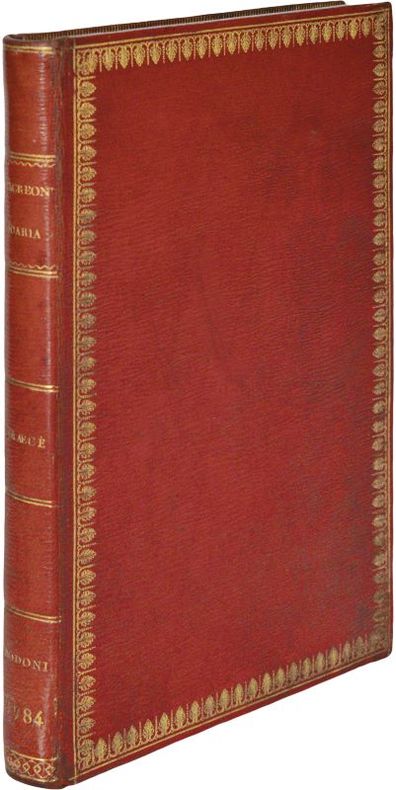
1784ref. 0041201784 Parmae [Parme], Ex Regio Typographeio [Bodoni], 15 septembre 1784. Petit in-quarto (170 X 246 mm) maroquin rouge à grain long, encadrement de dentelle et filet dorés sur les plats, dos lisse fileté, titre doré avec en queue la date d'impression et la mention «Bodoni», chainette dorée en queue, coupes et coiffes filetées, tranches dorées (Reliure de l'époque); (7) ff. dont titre, LXXXII-103 pages, (1) page d'achevé d'imprimer. Deux ex-libris gravés collés sur le premier contreplat.