1528 resultados
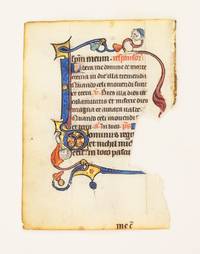
ref. ST16985GFrance first half of 14th century. 110 x 82 mm. 4 3/8 x 3 1/4". Single column 12 lines in a gothic book hand. Rubrics in red line enders in pink and blue with gold accents each leaf with one or more one-line initials in blue with red penwork or gold with blue penwork some leaves with one two-line initial painted blue filled with either decorative shapes or INHABITED BY A HUMAN HEAD all on a gold ground one side of each leaf WITH A FULL BORDER composed of pink and blue tendrils accompanied by spikey gold decoration and gold accents often terminating in ivy leaves and incorporating EXTRAORDINARILY CHARMING EXAMPLES OF MARGINALIA INCLUDING ANIMALS HUMANS AND HYBRIDS. ◆Vellum slightly soiled and with a few minor imperfections one leaf with a little offsetting in one corner each leaf with a small area excised by a former owner affecting marginalia and a few words of text but each leaf with at least two fully intact examples of marginalia and on the whole the leaves quite clean the colors very bright and the gold sparkling. Though diminutive in size these leaves contain enormously appealing marginal decoration in the form of humans animals and hybrid creatures inventively incorporated into the lively borders in manners that range from adorable to bizarre. Especially popular in Flanders Northern France and England during the 13th and 14th centuries marginalia such as these comprise some of the most memorable and entertaining images to be found in any Medieval manuscripts. Despite being found largely in religious books such as Psalters and Books of Hours the images are often strange humorous or even outrageous and they provide us with consistent delight. Being by definition outside of the central text or miniature the margins seem to have been a place where illuminators felt more at ease to experiment resulting in highly imaginative and unique artistic expressions. The present specimens come from a fragmentary manuscript with many leaves either missing or rendered defective where portions of the vellum were cut away as here. Fortunately these leaves each retain at least two excellent examples of marginalia including a very alert hare hybrids with the heads of humans and the bodies of two-legged beasts humans emerging from the border tendrils to help hold up initials a human head with a wizened beard and a stylized hat incorporated into the border and a trumpeter blowing into a long instrument accented with gold. Though fragmentary in appearance these leaves present an excellent opportunity to acquire fine examples of marginalia at an affordable price. For additional leaves from this same manuscript at different price points please check our website. unknown books
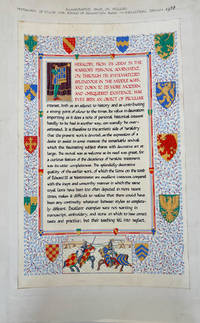
1928ref. 120551928. Original illuminated large manuscript page on vellum comprising a central panel of calligraphic text in red and black ink with a miniature of a young herald surrounded by a decorative border of larger armorial shields set within a stylised foliate background in blue red green and gilt with a fine miniature of a knight’s tournament at the foot. 41 x 25.5cm. Mounted on card with ink title to the head: “Illuminated page on vellum. / Testimony of study for Board of Education Exam in industrial design 1928.” In very good condition.WITH: Two further pencil drawings by the same artist the first of an elderly gentleman the second of a classical sculpture measuring 57.5 x 38cm and 56 x 39cm respectively each signed “Bate” and dated 1927. The pencil drawings have a few short tears to the edges otherwise they are in very good condition. A fine example of 1920s illumination hardcover
1610ref. 72551610 Francoforti, Nic. Hoffmanni1610 [16]-678-[2 bl.] pp. 237 gravures sur bois d'après Virgil Solis (1514-1562). Marque de gravure sur bois sur le titre. Imprimé en 2 col. avec les textes grecs et latins. Reliure en parchemin illustré d'un manuscrit d'époque avec enluminures !!! tres beau à regretter un petit manque sur la première de couverture, dos bon état , quatrième de couverture bon état . Première édition, "Wichtigste Anthologie der humanistischen und nachhumanistischen Sammlungen und Neuentdeckungen, mit einem umfangreichen Anmerkungsapparat des Neveletus ("Notae") in fünf Abschnitten als Anhang, in denen ausser den Fabeln des Abstemius jede Sammlung einzeln kommentiert wird." (Bodemann). (Bodemann). Neveletus est à l'origine de cette édition réimprimé la collection d'Accursius, qu'il enrichira de 136 fables . La Fontaine y puisera son univers ...
ref. 26563Paris, Ferroud, 1911 In-8? , 16.6x24.1 cm., 266 pp., belle edition illustree du classique de Balzac. Les 26 compositions d'Auguste Leroux - en texte et hors texte, dont un frontispice - ont ete gravees sur bois en couleurs par Florian, Froment et Duplesses. Relie demi-maroquin havane a coins, signee par Laurent Peeters - Anvers. Filet dore cernant les plats de pap., dos orne, dos a 4 nerfs et finnement fleuronnes dores (decor floral), tete doree, couverture imprimee d'editeur. Tirage limite. Tirage de 1200 exemplaires dont 1020 exemplaires sur velin d'Arches numerotes de 181 a 1200.
1965ref. 015774Veilhes G.P. [Gaston Puel] 1965 In-12 En feuilles, couverture à rabats <
ref. 14481Exposition sur la règle de Monsieur S. Augustin pour gens de religion composée passe plus de quattre cens ans par Hugues de S. Victor trèsrenommé docteur en la Sainte escripture chanoine régulier de Paris. Traduite de latin en nostre langue vulgaire par Sulpice Du Pré prestre et chanoine de l’église cathédrale de S. Aumer. A Douay de l’imprimerie de Jean BOGART l’an 1589. .In 32 reliure époque, plein vélin à recouvrement, titre manuscrit à la plume. Titre avec vignette d’imrimeur, LX, épistre-préface- table des chapitres. 137 pages, XXVIII Brief répertoire pour plus aysement trouver les sentences plus remarquables contenues dans cette exposition. Bel ex libris gravé. Bon exemplaire. Rare édition Douaisienne. Hugues de Saint Victor prestigieux professeur au XIIème siècle au sein de la congrégation de Saint Victor fondé par Guillaume de Champeaux. Il a donné une importante synthèse des règles de Saint Augustin sur la vie canonniale
2008ref. 016415Bernard-Gabriel Lafabrie 2008 In-4 En feuilles, couverture
1866ref. 6662Wien, H. Martin, 1866-1870. In-folio de[6]-40-[2]p., titre gravé et 68pl., en feuilles, non relié. Quelques feuillets salis (poussière) et rare rousseurs pour la partie texte, les illustrations sont très belles.
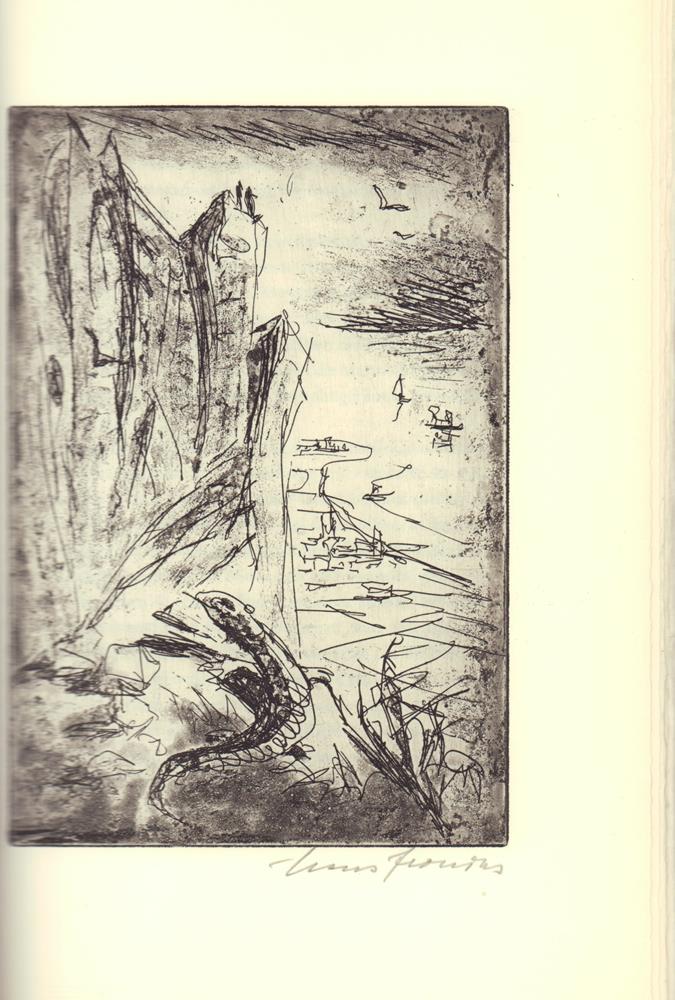
1968ref. 67812Stuttgart, Ernst Klett, (1968). 117 S., 1 Bll. Mit 10 ORIGINAL-RADIERUNGEN. 4to (27 x 19 cm). OHPgt. mit goldgeprägtem RTitel in OPp.-Schuber.
1712ref. 51528Frankfurt / Main, Ex Officina Zunneriana, apud Johannem Adamum Jungium, 1712. 1 w. Bl., Titel in Rot-Schwarz-Druck, 43 Bll. (Praefatio, Prodromus, Index decisionum), 1516 [i.e.1514] S., 74 Bll. (Index). Mit 1 Kupfer-Titel-Vign., gestochen von E. [Elias?] Müller. Folio. Pgt. d. Zt.
1574ref. 1124921574 Genevae (Genève), Apud Eustathium Vignon (Eustache Vignon), 1574, 1 volume in-4 de 180 x 250 mm environ, (12) ff. (page de titre, Epistola, Praefatio), 440 pages, écrit en latin avec un sens de lecture de la gauche vers la droite mais texte imprimé et paginé de la droite vers la gauche. Plein vélin souple d'époque au dos muet, traces de lien. Reliure en état d'usage (quelques taches sur les plats et une étiquette papier collée sur le plat supérieur, un coin plié), tampon de bibliothèque répété, annotations à l'encre pages 40-41-57-59, légères traces de mouillures aux coins d'une dizaine de feuillets, plus importantes sur 7 feuillets (p.195 à 208), discrets trous de vers, déchirure marginale sans atteinte au texte p. 304. Bel état pour cet ouvrage d'érudition rare.
ref. 7766Leyde, Severin, [1697]. In-12 (168 x 132 mm), 28 pp., 264 pp., 6 ff. n. ch. Vélin rigide, titre à l’encre au dos, feuillets brunis (reliure de l’époque).
ref. 90552Hamburgi, Christian HEROLD, 1750, 2 volumes grand in-folio de 265x405 mm environ, tome I : (2) ff., faux-titre, titre, xxix (dedicatio, praefatio), 1 portrait pleine page du traducteur Johannes Albertus Fabricius, 767 pages, (2) ff., tome II : (1) f., faux-titre, titre (2) ff. (ad lectorem), 1 portrait pleine page de Hermanus Samuel Reimarus, pagination de 770 à 1708 (pagination continue), impression sur 2 colonnes par pages du texte grec avec traduction latine en regard, plein velin crème d'époque avec décor à froid sur les plats, titres manuscrits sur le dos, tranches finement mouchetées de rouge et brun. Mors abimés, erreur de pagination dans le tome II (1619 à 1626, répétition des chiffres mais texte cohérent et complet)un tampon ancien sur les pages de titre, rousseurs légères et pages brunies. Texte en grec et en latin.
2020ref. 016158Saint-Loup en Loir-et-Cher Les Bibliophiles de France 2020 en feuilles, couverture rempliée, chemise et étui éditeur.
1692ref. 000920Amstelaedami Wetstenium 1692
1919ref. 014037Paris René Kieffer 1919 In-12 Broché, couverture rempliée
1957ref. 016081Paris Falaize - Georges Fall 1957 En feuilles, couverture illust
1920ref. 003244Paris La Sirène 1920 sous boite de l'éditeur Broché Ed. originale
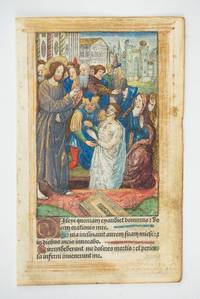
1520ref. ST12778-0887cParis: Gilles Hardouyn ca. 1520. 177 x 110 mm. 7 x 4 1/4". Single column 33 lines in an attractive gothic type. With hand-illuminated initials and a FULL-PAGE MINIATURE DEPICTING THE RAISING OF LAZARUS ILLUMINATED IN COLORS AND GOLD BY A CONTEMPORARY HAND. See Hilary Maddocks "A Book of Hours by Anthoine Vérard" University of Melbourne Collections issue 16 2015 pp. 19-20. One quarter-inch repair to the center of the leaf which on the recto slightly affects Lazarus' neck and on the verso affects three letters which have been neatly touched up a handful of small chips to the paint the architectural border somewhat rubbed in the lower right corner mild soiling to the margins; not without flaws but a richly and carefully colored leaf that is still pleasing. Richly painted and amply highlighted with brushed gold this leaf from a printed Book of Hours includes a large miniature depicting the raising of Lazarus. Christ stands arm extended in benediction over the newly reawakened Lazarus who gazes up at him standing upright in his grave. A crowd looks on with a well-dressed man crouched in front of the grave apparently having helped Lazarus to stand. Our illuminator has enhanced the drama of the moment with the rosy cheeks of the bystanders emphasizing Lazarus' deathly pallor and with Jesus' shimmering robe distinguishing him from the crowd. The faces and folds of cloth are delicately shaded and the minutely detailed lines of gold carefully applied stylistically tying this printed leaf to the fully hand-painted Books of Hours that printed versions were slowly replacing during the early years of the 16th century. The composition seems to come from a suite of illustrations designed by illuminator Jean Pichore fl. 1490-1521 done for the printer Gilles also Gillet Hardouyn. Gilles Hardouyn (?) unknown
1520ref. ST12778-0887cParis: Gilles Hardouyn ca. 1520. 177 x 110 mm. 7 x 4 1/4". Single column 33 lines in an attractive gothic type. With hand-illuminated initials and a FULL-PAGE MINIATURE DEPICTING THE RAISING OF LAZARUS ILLUMINATED IN COLORS AND GOLD BY A CONTEMPORARY HAND. See Hilary Maddocks "A Book of Hours by Anthoine Vérard" University of Melbourne Collections issue 16 2015 pp. 19-20. One quarter-inch repair to the center of the leaf which on the recto slightly affects Lazarus' neck and on the verso affects three letters which have been neatly touched up a handful of small chips to the paint the architectural border somewhat rubbed in the lower right corner mild soiling to the margins; not without flaws but a richly and carefully colored leaf that is still pleasing. Richly painted and amply highlighted with brushed gold this leaf from a printed Book of Hours includes a large miniature depicting the raising of Lazarus. Christ stands arm extended in benediction over the newly reawakened Lazarus who gazes up at him standing upright in his grave. A crowd looks on with a well-dressed man crouched in front of the grave apparently having helped Lazarus to stand. Our illuminator has enhanced the drama of the moment with the rosy cheeks of the bystanders emphasizing Lazarus' deathly pallor and with Jesus' shimmering robe distinguishing him from the crowd. The faces and folds of cloth are delicately shaded and the minutely detailed lines of gold carefully applied stylistically tying this printed leaf to the fully hand-painted Books of Hours that printed versions were slowly replacing during the early years of the 16th century. The composition seems to come from a suite of illustrations designed by illuminator Jean Pichore fl. 1490-1521 done for the printer Gilles also Gillet Hardouyn. Gilles Hardouyn (?) unknown books
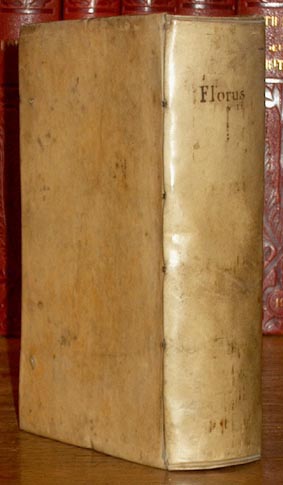
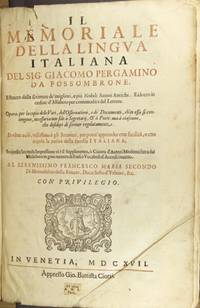
1617ref. 43152Venetia: Apresso Gio. Battista Ciotti 1617. Seconda impressione two parts in one folio pp. 12 609 1 8 236; a6 A-2N8 2O-2p6 †4 A-O8 P6; V4 of the first section missigned R4 with manuscript cancellation; woodcut printer's device initials and head- and tail-pieces; title page printed in red and black; text in double columns; full contemporary vellum soiling calf bands manuscript spine title and ornamentation; vertical hatch marks to upper cover edges quite rubbed and worn; endpapers supplied title page edges rather ragged minor worming to preliminaries else textblock mostly very good. Small period manuscript paper label "Ad usum A.M.L. Parm." mounted to bottom of title page. Zaunmüller p. 209. OCLC does not locate any copies in the United States. Apresso Gio. Battista Ciotti unknown
1617ref. 43152Venetia: Apresso Gio. Battista Ciotti 1617. Seconda impressione two parts in one folio pp. 12 609 1 8 236; a6 A-2N8 2O-2p6 †4 A-O8 P6; V4 of the first section missigned R4 with manuscript cancellation; woodcut printer's device initials and head- and tail-pieces; title page printed in red and black; text in double columns; full contemporary vellum soiling calf bands manuscript spine title and ornamentation; vertical hatch marks to upper cover edges quite rubbed and worn; endpapers supplied title page edges rather ragged minor worming to preliminaries else textblock mostly very good. Small period manuscript paper label "Ad usum A.M.L. Parm." mounted to bottom of title page. Zaunmüller p. 209. OCLC does not locate any copies in the United States. Apresso Gio. Battista Ciotti unknown books
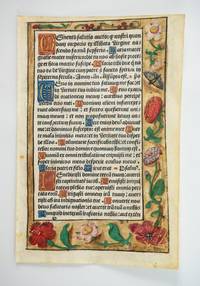
ref. ST20972b-cParis: Nicolas Vivien early 16th century. 197 x 130 mm. 7 3/4 x 5 1/8". Single column 28 lines gothic typeface. Ruled in red two one-line initials and two three-line initials painted in gold on red or blue ground and A LOVELY ANIMATED FULL PAINTED BORDER done by hand with trompe-l'oeil flowers one leaf also with a moth on painted gold ground. Top margin a little small light soiling to vellum borders with a couple superficial scratches and tiny smudges but in excellent condition overall. These beautifully embellished leaves from a printed Book of Hours demonstrate the enduring demand for manuscript illumination in the incunabular period and beyond. While the text here was completed on a printing press the initials and borders were done entirely by hand adding luxury and luster to otherwise unadorned pages. Although these leaves likely belonged to a Book of Hours printed in Paris possibly an edition printed for Nicolas Viven in or around 1503 the trompe-l'oeil style seen in the borders was particularly popular among Flemish and Netherlandish illuminators of the period. Because of the artist's use of subtle shading to indicate shadows the large blossoms here seem to pop off the page and one of the leaves contains a delicate little moth--attracted perhaps by the gleaming painted gold ground. Nicolas Vivien(?) unknown
ref. ST20972b-cParis: Nicolas Vivien early 16th century. 197 x 130 mm. 7 3/4 x 5 1/8". Single column 28 lines gothic typeface. Ruled in red two one-line initials and two three-line initials painted in gold on red or blue ground and A LOVELY ANIMATED FULL PAINTED BORDER done by hand with trompe-l'oeil flowers one leaf also with a moth on painted gold ground. Top margin a little small light soiling to vellum borders with a couple superficial scratches and tiny smudges but in excellent condition overall. These beautifully embellished leaves from a printed Book of Hours demonstrate the enduring demand for manuscript illumination in the incunabular period and beyond. While the text here was completed on a printing press the initials and borders were done entirely by hand adding luxury and luster to otherwise unadorned pages. Although these leaves likely belonged to a Book of Hours printed in Paris possibly an edition printed for Nicolas Viven in or around 1503 the trompe-l'oeil style seen in the borders was particularly popular among Flemish and Netherlandish illuminators of the period. Because of the artist's use of subtle shading to indicate shadows the large blossoms here seem to pop off the page and one of the leaves contains a delicate little moth--attracted perhaps by the gleaming painted gold ground. Nicolas Vivien(?) unknown books
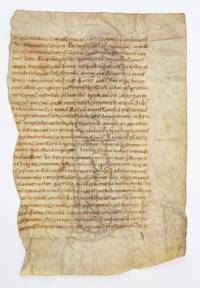
ref. ST19350-006Germany 12th century. 272 x 185 mm. 10 3/4 x 7 1/4". Single column 28 lines in a late Caroline hand. ◆Leaf trimmed irregularly along one side about 18 lines lacking a letter or two vellum a bit wrinkled and worn text a little faded in places but still very presentable and the text almost entirely legible. Penned in a pleasing and very legible late Caroline hand this leaf has sustained very little loss and is remarkably well preserved for having been previously reused as binding scrap. Although the text includes several abbreviations that are commonly found in proto-gothic scripts the hand also shares a number of similarities with the Caroline minuscule that dominated Western Europe scribal hands in earlier periods including a long "s" with the shaft on the line and the use of the ampersand as a general abbreviation for the letters "et" occurring anywhere in a word. The text here comes from Pope Gregory the Great's "Moralia" conceived as a commentary on the book of Job and begun when Gregory was just a young papal envoy to Constantinople. It is a guide to the Christian life written in simple direct language which transforms the thought of Augustine into a practical manual of behavior. unknown