3 868 résultats
1777réf. 50342London England: Printed for W. Strahan J. F. & C. Rivington Et Al. As New. Hardcover. FREE UPGRADE to Courier/Priority Shipping Upon Request – – IN STOCK AND IMMEDIATELY AVAILABLE FOR SHIPMENT - Text block unmarked. 788 pages index. Frontispiece portrait of Locke -- with a bonus offer-- . 1777. Printed for W. Strahan, J. F. & C. Rivington Et Al hardcover
2003réf. 903284Cumberland Rhode Island U.S.A.: Yale Univ Pr. New. Paperback. FREE UPGRADE to Courier/Priority Shipping Upon Request - IN STOCK AND IMMEDIATELY AVAILABLE FOR SHIPMENT - BRAND NEW FLAWLESS COPY NEVER OPENED - 384 pages -- DESCRIPTION: Among the most influential writings in the history of Western political thought John Locke's Two Treatises of Government and A Letter Concerning Toleration remain vital to political debates today more than three centuries after they were written. The complete texts appear in this volume accompanied by interpretive essays by three prominent Locke scholars. Ian Shapiro's introduction places Locke's political writings in historical and biographical context. John Dunn explores both the intellectual context in which Locke wrote the Two Treatises of Government and A Letter Concerning Toleration and the major interpretive controversies surrounding their meaning. Ruth Grant offers a comprehensive discussion of Locke's views on women and the family and Shapiro contributes an essay on the democratic elements of Locke's political theory. Taken together the texts and essays in this volume offer invaluable insights into the history of ideas and the enduring influence of Locke's political thought. -- with a bonus offer--; 520-locks; Locke John; Shapiro Ian LOCK Two Treatises of Government and a Letter Concerning Toleration POLITICAL SCIENCE EARLY WORKS 1800 Among the most influential writings in the history of Western political thought John Locke's Two Treatises of Government and . 2003. 0300100183 . Yale Univ Pr paperback
2001réf. 127469Princeton University Press. New. Hardcover. FREE UPGRADE to Courier/Priority Shipping Upon Request - -- . 2001. 0691050600 . Princeton University Press hardcover
2003réf. 12710Ewing New Jersey U.S.A.: Princeton Univ Pr. New. Paperback. FREE UPGRADE to Courier/Priority Shipping Upon Request - IN STOCK AND IMMEDIATELY AVAILABLE FOR SHIPMENT - Flawless -- with a bonus offer--; 012710; MANET EDOUARD 1832 1883 ART . 2003. 0691114846 . Princeton Univ Pr paperback
2016réf. 116154Ohio University Press. New. Hardcover. FREE UPGRADE to Courier/Priority Shipping Upon Request - IN STOCK AND IMMEDIATELY AVAILABLE FOR SHIPMENT - IN STOCK AND IMMEDIATELY AVAILABLE FOR SHIPMENT - Flawless copy brand new pristine never opened - -- with a bonus offer--; Series In Continental Thought . 2016. 0821421751 . Ohio University Press hardcover
1997réf. 14234Scranton Pennsylvania U.S.A.: William Morrow & Co. New. Hardcover. FREE UPGRADE to Courier/Priority Shipping Upon Request - IN STOCK AND IMMEDIATELY AVAILABLE FOR SHIPMENT - Flawless -- with a bonus offer--; 014234; EASTWOOD CLINT 1930 MOTION PICTURE . 1997. 068815462X . William Morrow & Co hardcover
réf. 56524Cambridge At the University Press. As New. Hardcover. FREE UPGRADE to Courier/Priority Shipping Upon Request – – IN STOCK AND IMMEDIATELY AVAILABLE FOR SHIPMENT - AS NEW THE TEXT BLOCK IS PRISTINE CLEAN UNMARKED AND IN EXCELLENT CONDITION - - 309 pages. -- with a bonus offer-- . 1953. 0521056004 . Cambridge At the University Press hardcover
2015réf. 125730Gallery. New. Paperback. FREE UPGRADE to Courier/Priority Shipping Upon Request - IN STOCK AND IMMEDIATELY AVAILABLE FOR SHIPMENT - Flawless copy brand new pristine never opened. -- with a bonus offer-- . 2015. 186982797X . Gallery paperback
2008réf. 77417Pennsylvania State Univ Pr Txt. New. Paperback. FREE UPGRADE to Courier/Priority Shipping Upon Request - IN STOCK AND IMMEDIATELY AVAILABLE FOR SHIPMENT - Flawless copy brand new pristine never opened -- Text in English. 40 pp. With 27 ills. 28 x 22 cm. -- with a bonus offer--; Manet and Friends accompanies an exhibition of the same name organized by the Palmer Museum of Art in memory of Manet scholar and Penn State distinguished professor of art history George Mauner who passed away in 2004. The catalogue focuses on the printmaking milieu of Paris during the 1860s and early 1870s when Édouard Manet produced the majority of his graphic works. Seventeen of Manet's etchings and lithographs are discussed as are an equal number of prints by several of his colleagues and associates including Flix Bracquemond Alphonse Legros and Marcellin Desboutin. Nancy Locke's feature essay examines Manet's prints in light of the French concept of les moeurscustoms habits or manners but also ethicsabout which mid—nineteenth—century writers and artists were deeply concerned. In discussing the confrontational manner in which Manet regularly posed his subjects Locke speculates on how the viewer might have been expected to respond to such portrayals. The catalogue entries were written by Patrick McGrady. . 2008. 0911209670 . Pennsylvania State Univ Pr (Txt) paperback
2006réf. 89518University of Texas Press Distribution . New. Hardcover. FREE UPGRADE to Courier/Priority Shipping Upon Request - IN STOCK AND IMMEDIATELY AVAILABLE FOR SHIPMENT - Flawless copy brand new pristine never opened -- 104 pp. ; 52 ills. 46 col. . -- with a bonus offer--; This provocative book which accompanies an exhibition of the same name explores the forces that bifurcate our society along gender lines. In its quest for balance--or at minimum an understanding of where cultural imbalances exist--Finding Balance draws upon literary discourse and the works of eleven internationally acclaimed artists: Jim Baker Robert Brinker Monica Chau Linda Girvin Jody Guralnick Pamela Joseph Charmaine Locke Brad Miller Brian Reid Barbara Sorensen and James Surls. The twenty-six featured works range from traditional ceramics to lenticular photography. The critical essays by James Surls Charmaine Locke and noted author and scholar Leonard Shlain evoke a series of questions: Has the gender imbalance of our era been resolved What are the implications of a patriarchal society on contemporary culture What role does the artist play in advancing discourse and reconciliation Curator Surls has selected artists whose works are evocative in their diversity of scale medium and motivation. Collectively they expand the boundaries of the conscious and unconscious equalizing the balance of opposite forces. . 2006. 097874070X . University of Texas Press (Distribution) hardcover
1965réf. 81615Library. As New. Hardcover. FREE UPGRADE to Courier/Priority Shipping Upon Request - IN STOCK AND IMMEDIATELY AVAILABLE FOR SHIPMENT - AS NEW THE TEXT BLOCK IS PRISTINE CLEAN UNMARKED AND IN EXCELLENT CONDITION - - - Corresponds to ASIN: B000KHHZKG. Reprint of the 1934 edition. 16 828 2 pp. index 8vo. -- with a bonus offer-- . 1965. Library hardcover
2003réf. 62594Museum. New. Hardcover. FREE UPGRADE to Courier/Priority Shipping Upon Request – – IN STOCK AND IMMEDIATELY AVAILABLE FOR SHIPMENT - Flawless copy brand new pristine never opened -- Text in French English and Italian with portions in French and English only. 192 pp. With 60 ills. 41 col. . 25 x 17 cm. -- with a bonus offer-- . 2003. 2551217555 . Museum hardcover
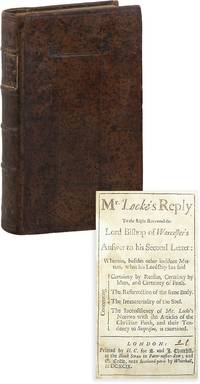
1697réf. PCKLeLOC34London: Printed by H.Clark for A. and J.Churchill and Edw. Castle 1697. 1697. 8vo. pp. 2 p.l. 227 1ad. complete with half-title. paneled calf antique narrow strip from blank upper margin of title cut away; some light foxing. First Edition Second Issue. BOUND WITH: LOCKE John. Mr. Locke's Reply to the Right Reverend the Lord Bishop of Worcester's Answer to his Letter Concerning some Passages Relating To Mr. Locke's Essay Of Humane Understanding: In A Late Discourse of his Lordships In Vindication of the Trinity. 8vo. pp. 2 p.l. 174 1 leaf 7 1errata 2ads. complete with half-title. upper portion of last leaf of ads cut away; some light foxing. London: Printed by H.Clark for A. and J.Churchill and E.Castle 1697. First Edition. In 1696 deist John Toland published his Christianity not Mysterious a work professing to be a strict theological application of Lockean philosophy. It drew immediate response from Edward Stillingfleet Bishop of Worcester who in his Vindication of the Doctrine of the Trinity attacked Toland and Locke alike and charged Locke with disallowing mystery in human knowledge. A heated controversy ensued Locke responding with a Letter and two Replies the second of which appeared in 1699. Wing L2749 & L2754. NCBEL II 1837. Christophersen pp. 37-41. Rand I 342. 1st Edition. Hardcover. Very Good. London: Printed by H.Clark, for A. and J.Churchill and Edw. Castle, 1697. Hardcover
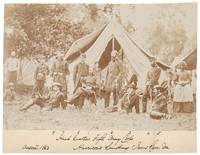
1862réf. 627309James River VA 1862. Unbound. Near Fine. Albumen photograph mounted on cardboard. The photograph is approximately 7¾" x 5" the cardboard mount is approximately 7¾" x 6". Some toning else near fine. The photograph is captioned "Head Quarters Fifth Army Corps August 1862 Harrison's Landing James River VA." There are numbers under the photograph likely referring to a corresponding list of the names of the individuals shown list not present. The U.S. National Archives holds a copy of this same photograph which is where we obtained the names of the individuals shown: Gen. Fitz John Porter Major Joseph Kirkland Colonel Locke Captain Mason Major Charles McMillen Captain John F. McQuade Major Montieth and Colonel Norton. Seated in a chair at center is Gen. Fitz John Porter who participated in the Battle of Gaines' Mill the Battle of Malvern Hill and the Second Battle of Bull Run among others. The Fifth Army Corps typically referred to as V Corps was part of the Union Army of the Potomac. This photo was taken shortly before they left Harrison's Landing which is where the men rested after the brutal Seven Days' Campaign. They left on August 14 1862 and their stay was less than pleasant. The website Emerging Civil War writes: "For the common soldiers of the Army of the Potomac leaving Harrison's Landing was a blessing. The historian of the 2nd New York Infantry described the ordeal as follows: 'The occupation of this point Harrison's Landing had been a terrible experience for the army and the Troy regiment suffered with the rest. The excessive heat bad water poor food constant exposure and lack of rest or recreation added to the disgusting experiences at Fair Oaks had rendered many of the men useless as soldiers having caused a large number of chronic disease. No less than 108 members of the regiment who but a short time before had been in perfect health were transported to hospitals the majority of them finally being discharged for disability.'" Looking at this photo you would never know the men were so miserable; three lounge in the grass one with his binoculars resting on his knee Gen. Porter sits comfortably in a chair the rest of the men are standing but appear at ease; flanking the soldiers are two African Americans the woman appears to be a servant or cook but the man may be wearing a military uniform. A very nicely executed photo of the Fifth Army Corps. at their encampment at Harrison's Landing James River VA in August of 1862. unknown
1862réf. 627309James River VA 1862. Unbound. Near Fine. Albumen photograph mounted on cardboard. The photograph is approximately 7¾" x 5" the cardboard mount is approximately 7¾" x 6". Some toning else near fine. The photograph is captioned "Head Quarters Fifth Army Corps August 1862 Harrison's Landing James River VA." There are numbers under the photograph likely referring to a corresponding list of the names of the individuals shown list not present. The U.S. National Archives holds a copy of this same photograph which is where we obtained the names of the individuals shown: Gen. Fitz John Porter Major Joseph Kirkland Colonel Locke Captain Mason Major Charles McMillen Captain John F. McQuade Major Montieth and Colonel Norton. Seated in a chair at center is Gen. Fitz John Porter who participated in the Battle of Gaines' Mill the Battle of Malvern Hill and the Second Battle of Bull Run among others. The Fifth Army Corps typically referred to as V Corps was part of the Union Army of the Potomac. This photo was taken shortly before they left Harrison's Landing which is where the men rested after the brutal Seven Days' Campaign. They left on August 14 1862 and their stay was less than pleasant. The website Emerging Civil War writes: "For the common soldiers of the Army of the Potomac leaving Harrison's Landing was a blessing. The historian of the 2nd New York Infantry described the ordeal as follows: 'The occupation of this point Harrison's Landing had been a terrible experience for the army and the Troy regiment suffered with the rest. The excessive heat bad water poor food constant exposure and lack of rest or recreation added to the disgusting experiences at Fair Oaks had rendered many of the men useless as soldiers having caused a large number of chronic disease. No less than 108 members of the regiment who but a short time before had been in perfect health were transported to hospitals the majority of them finally being discharged for disability.'" Looking at this photo you would never know the men were so miserable; three lounge in the grass one with his binoculars resting on his knee Gen. Porter sits comfortably in a chair the rest of the men are standing but appear at ease; flanking the soldiers are two African Americans the woman appears to be a servant or cook but the man may be wearing a military uniform. A very nicely executed photo of the Fifth Army Corps. at their encampment at Harrison's Landing James River VA in August of 1862. unknown books
1940réf. 85641Washington: Associates in Negro Folk Education 1940. 1st ed. Hardcover. Very Good. frontis color numerous black & white illustrations and two pages in color 124 4 125-222p. Recent quarterbinding marbled boards attractively backed in leather. 31 cm. Horizontal crease as usual on frontis. Other internal soiling and wear but generally sound. No jacket. When we got this book the binding was beyond repair. We had the binder preserve and mount a small piece less than the size of a business-card of the original endpaper on which Locke had INSCRIBED this copy to Dorothy Maynor the talented singer and founder of the Harlem School of the Arts. The three panels of the Amistad Murals done on canvas by Hale Woodruff and located in Savery Memorial Library at Talladega College in Talladega Alabama are illustrated in color on the center pages of the unnumbered four page section which is found after page 124. These mural panels were unveiled in 1939 just a year before publication of this book. The unnumbered Amistad Murals section may have been a last minute addition to the book. The section is described on the Contents page as facing page 124. We don't know whether it was present in all copies of the 1940 edition. Associates in Negro Folk Education hardcover
1940réf. 85641Washington: Associates in Negro Folk Education 1940. 1st ed. Hardcover. Very Good. frontis color numerous black & white illustrations and two pages in color 124 4 125-222p. Recent quarterbinding marbled boards attractively backed in leather. 31 cm. Horizontal crease as usual on frontis. Other internal soiling and wear but generally sound. No jacket. When we got this book the binding was beyond repair. We had the binder preserve and mount a small piece less than the size of a business-card of the original endpaper on which Locke had INSCRIBED this copy to Dorothy Maynor the talented singer and founder of the Harlem School of the Arts. The three panels of the Amistad Murals done on canvas by Hale Woodruff and located in Savery Memorial Library at Talladega College in Talladega Alabama are illustrated in color on the center pages of the unnumbered four page section which is found after page 124. These mural panels were unveiled in 1939 just a year before publication of this book. The unnumbered Amistad Murals section may have been a last minute addition to the book. The section is described on the Contents page as facing page 124. We don't know whether it was present in all copies of the 1940 edition. Associates in Negro Folk Education hardcover books
1699réf. 89830London: Printed by H.C. for A. and J. Churchill.and C. Castle 1699. First Edition. Small octavo 19cm. Contemporary mottled calf with morocco gilt-stamped spine label; boards paneled in blind; 452pp plus Errata. Expertly rebacked preserving entirety of original spine; title page slightly darkened else very fresh internally complete and virtually free of foxing. A highly attractive copy in a very early binding. The final installment in Locke's ongoing contretemps with Bishop Stillingfleet which was launched with Stillingfleet's Discourse in Vindication of the Doctrine of the Trinity 1696 in which he accused Locke of denying the mysteries of Christianity and promulgating a Materialist philosophy. Lockes first Reply to the Bishop came in 1797; it was answered producing a second Reply - and then yet another Answer with Locke getting in the last word with the current Reply not long after which Stillingfleet died. As it were a philosophical coup de gras; a consequential text and a useful explication in Locke's own words of his epistemological system. PFORZHEIMER 608. ESTC R32483. Printed by H.C. for A. and J. Churchill...and C. Castle unknown
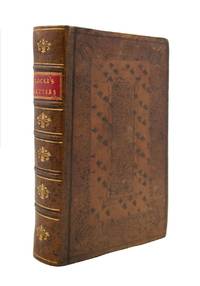
1708réf. 69391London: A. and J. Churchill 1708. Full Description: LOCKE John. Some Familiar Letters Between Mr. Locke and Several of his Friends. London: A. and J. Churchill 1708. First edition. Octavo 7 3/8 x 4 1/2 inches; 187 x 112 mm. 4 540 pp. Some of the letters are in English and others in Latin. Contemporary full speckled paneled calf very neatly rebacked to style. Spine with red morocco spine label lettered in gilt. Top edge dyed brown others speckled red. Board edges tooled in gilt. Some old ink noted on front endpapers. Small loss to the upper corners of the free endpapers. A small neat ink stamp on bottom margin of title-page. Internally the book is very clean. Overall a very good. copy. Housed in a full green cloth clamshell with morocco spine label. According to Attig this collection of letters was probably assembled by Peter King and Anthony Collins. It contains Locke's correspondence with the Molyneux brothers among others. "This collection on letters in unusual for the reason that unlike the customary practice it contains both sides of the correspondence. It should also be observed that the manuscript letters of Thomas and William Milyneux to Locke here published are in this collection. The printer used the originals for copy and they still bear his marks." Pforzheimer 611 "William Molyneux 1656-1698 was an Irish experimental philosopher and politician who played a major role in the intellectual life in seventeenth-century Dublin. He became Locke's friend and correspondent in 1692 and was probably Locke's philosophicallymost significant correspondent. Locke approached Molyneux for advice for revising his Essay concerning Human Understandingas he was preparing the second and subsequent editions. Locke made several changes in response to Molyneux's suggestions; they include major revisions of the chapter 'Of Power' 2.21 the addition of the chapter 'Of Identity and Diversity' 2.27 and the addition of the so-called Molyneux Problem 2.9.8. Molyneux repeatedly requested that Locke develops his views on morality. Additionally their correspondence turned to questions concerning education and Molyneux's keen interest in the topic likely prompted Locke to publish Some Thoughts Concerning Educationin 1693. Moreover Molyneux drew on Locke's anonymously published Two Treatises of Governmentin his The Case of Ireland's Being Bound by Acts of Parliament in England Stated which was first published in the spring of 1698. Molyneux revealed Locke's authorship of Two Treatisesagainst Locke's will yet their friendship continued until Molyneux's untimely death in October 1698." Locke and William Molyneux Ruth Boeker: University College Dublin. Attig 807. Pforzheimer 611. Yolton 346. HBS 69391. $2000. A. and J. Churchill unknown
1699réf. 89830London: Printed by H.C. for A. and J. Churchill.and C. Castle 1699. First Edition. Small octavo 19cm. Contemporary mottled calf with morocco gilt-stamped spine label; boards paneled in blind; 452pp plus Errata. Expertly rebacked preserving entirety of original spine; title page slightly darkened else very fresh internally complete and virtually free of foxing. A highly attractive copy in a very early binding. The final installment in Locke's ongoing contretemps with Bishop Stillingfleet which was launched with Stillingfleet's Discourse in Vindication of the Doctrine of the Trinity 1696 in which he accused Locke of denying the mysteries of Christianity and promulgating a Materialist philosophy. Lockes first Reply to the Bishop came in 1797; it was answered producing a second Reply - and then yet another Answer with Locke getting in the last word with the current Reply not long after which Stillingfleet died. As it were a philosophical coup de gras; a consequential text and a useful explication in Locke's own words of his epistemological system. PFORZHEIMER 608. ESTC R32483. Printed by H.C. for A. and J. Churchill...and C. Castle unknown books
1708réf. 69391London: A. and J. Churchill 1708. Full Description: LOCKE John. Some Familiar Letters Between Mr. Locke and Several of his Friends. London: A. and J. Churchill 1708. First edition. Octavo 7 3/8 x 4 1/2 inches; 187 x 112 mm. 4 540 pp. Some of the letters are in English and others in Latin. Contemporary full speckled paneled calf very neatly rebacked to style. Spine with red morocco spine label lettered in gilt. Top edge dyed brown others speckled red. Board edges tooled in gilt. Some old ink noted on front endpapers. Small loss to the upper corners of the free endpapers. A small neat ink stamp on bottom margin of title-page. Internally the book is very clean. Overall a very good. copy. Housed in a full green cloth clamshell with morocco spine label. According to Attig this collection of letters was probably assembled by Peter King and Anthony Collins. It contains Locke's correspondence with the Molyneux brothers among others. "This collection on letters in unusual for the reason that unlike the customary practice it contains both sides of the correspondence. It should also be observed that the manuscript letters of Thomas and William Milyneux to Locke here published are in this collection. The printer used the originals for copy and they still bear his marks." Pforzheimer 611 "William Molyneux 1656-1698 was an Irish experimental philosopher and politician who played a major role in the intellectual life in seventeenth-century Dublin. He became Locke's friend and correspondent in 1692 and was probably Locke's philosophicallymost significant correspondent. Locke approached Molyneux for advice for revising his Essay concerning Human Understandingas he was preparing the second and subsequent editions. Locke made several changes in response to Molyneux's suggestions; they include major revisions of the chapter 'Of Power' 2.21 the addition of the chapter 'Of Identity and Diversity' 2.27 and the addition of the so-called Molyneux Problem 2.9.8. Molyneux repeatedly requested that Locke develops his views on morality. Additionally their correspondence turned to questions concerning education and Molyneux's keen interest in the topic likely prompted Locke to publish Some Thoughts Concerning Educationin 1693. Moreover Molyneux drew on Locke's anonymously published Two Treatises of Governmentin his The Case of Ireland's Being Bound by Acts of Parliament in England Stated which was first published in the spring of 1698. Molyneux revealed Locke's authorship of Two Treatisesagainst Locke's will yet their friendship continued until Molyneux's untimely death in October 1698." Locke and William Molyneux Ruth Boeker: University College Dublin. Attig 807. Pforzheimer 611. Yolton 346. HBS 69391. $2000. A. and J. Churchill unknown books
1722réf. 4938Paris, Étienne Ganeau, 1722. 1722 2 vol. in-12° (163 x 102 mm) de: I. [6] ff. (titre, préface, approbation, privilège); 378 pp.; [3] ff. (table); II. [4] ff. (titre, table); 316 pp. Plein veau granité dépoque, dos à nerfs orné, titres et tomaisons de maroquin rouge, filet à froid encadrant les plats, roulette dorée sur les coupes, tranches jaspées de rouge. (Rares rousseurs ou tâches).
1720réf. 41467London, J. Bettenham, 1720. 8vo. Nice contemporary English Cambridge-style full calf binding with five raised bands and gilt title-label to spine. Neat minor repair to extremities. A bit of overall wear, but a nice and tight copy. Internally nice and clean with only some occasional soiling that is very light. Engraved title-vignette (36 - i.e. title-page + dedication), XXIV (i.e. ""The Character of Mr. Locke"" by Peter Coste), (2 - i.e. contents), 362, (18 - i.e. index), (4 - i.e. errata + advertisements) pp. + one plate (""The Solar System"").
1706réf. 51322London, Printed for W.B. and J. Churchill, 1706. 8vo. Nice contemporary brown full calf, very neatly rebacked. Title-page and second leaf strengthened at fore-margin. A bit of brownspotting to last quire, otherwise very nice. (4), 336 pp.
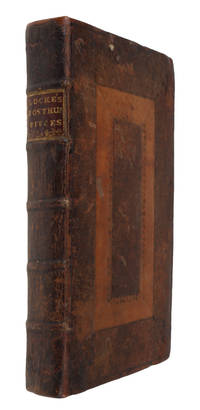
1720réf. 41467London J. Bettenham 1720. 8vo. Nice contemporary English Cambridge-style full calf binding with five raised bands and gilt title-label to spine. Neat minor repair to extremities. A bit of overall wear but a nice and tight copy. Internally nice and clean with only some occasional soiling that is very light. Engraved title-vignette 36 - i.e. title-page dedication XXIV i.e. "The Character of Mr. Locke" by Peter Coste 2 - i.e. contents 362 18 - i.e. index 4 - i.e. errata advertisements pp. one plate "The Solar System". First edition of this important collection of hitherto unpublished works by Locke containing the first printing of his unique work on Natural philosophy "The Elements of Natural Philosophy" as well as first printings of other important works. Assisted by Anthony Collins in 1720 the journalist Pierre Desmaizeaux brought out a new collection of Works and pieces by John Locke that had not previously been published. This collection "A Collection of Several Pieces" came to play a great role in the Locke scholarship not least in recent times and not least because it contains the first printing of his "Elements of Natural Philosophy"The "Elements of Natural Philosophy" constitutes Locke's main work in natural philosophy and it is a work that pas puzzled Locke scholars and readers ever since its appearance. The work seems to need some further explanation; at a firsthand glance it doesn't look very much like Locke - the greatest of the English philosophers who has so frequently been accused of not understanding the exact sciences and who even encouraged the youth not to learn these but to educate themselves in superficial and useful party-conversation. Thus numerous attempts have been made to establish the influence that resulted in this educational work of natural science. The two dominating answers to the question of influence are now: Newton and Descartes. It now seems to be fairly commonly recognized that Newton a personal friend of Locke even contributed directly to the work. "When Locke himself at the end of his life came to compose a treatise on natural philosophy for a pupil we have reason to believe that he obtained the advice and help of the most brilliant scientist of the century his close friend Isaac Newton. As we shall see this unique educational work itself "The Elements of Natural Philosophy" belies the myth of Locke the scientific smatterer." Axtell Locke Newton and the Elements of Natural Philosophy p. 244. However Descartes influence also seems to be obvious; "The influence of the "Principles" by Descartes is also obvious in Locke's posthumously published "Elements of Natural Philosophy". There is a striking similarity in the order of exposition although there are also considerable differences: Locke carefully eschewed Descartes' "a priori" metahpysics of nature. We find him rather emphasizing the essential role of experience. For example Locke introduced Newtonian universal gravitation as follows:. Thus according to Locke empirical support was necessary to establish the law of nature. Although the exposition looks quite similar to Descartes' "Principles" the "Elements" in fact contain several anti-Cartesian remarks in favour of the experimental philosophy." Aoki Descartes and Locke on the Nature of Matter. In: Hutton and Schuurmann edt. Studies on Locke p. 77."Elements of Natural Philosophy" was printed in no less than nine times during the 1th century and appeared in both Russian and French during the 18th century as well.The present "Collection of several Pieces" furthermore included a collection of letters from Locke to Anthony Collins "Remarks upon some of Mr. Norris's Books." "Some Thoughts concerning Reading and Study for a Gentleman." and "Rules of a society." all printed here for the first time as well as an English translation of Coste's Eulogy "The Character of Mr. Locke" originally published in French in 1705 and reprints of "The fundamental Constitutions of Carolina" and "A Letter from a person of Quality."."Remarks upon some of Mr. Norris's books." is the third of Locke's replies to Norris. "Some thoughts concerning reading and study for a gentleman" constitutes Locke's reply to Samuel Bold's question on behalf of a parishioner on how to create a course of reading and study. "Rules of a Society" constitutes the rules that Locke set up for a small group of friends who met once a week to discuss "useful Knowledge" and to promote "Truth and Christian Charity". Throughout his life Locke created several of these "societies" one of which led to his "An Essay Concerning Human Understanding" another one being "The College" in London after the Revolution. hardcover