LOCKE, JOHNBiblio.com

3 868 résultats
1706réf. 51322London Printed for W.B. and J. Churchill 1706. 8vo. Nice contemporary brown full calf very neatly rebacked. Title-page and second leaf strengthened at fore-margin. A bit of brownspotting to last quire otherwise very nice. 4 336 pp. First edition of this influential collection of Locke's posthumous works in which we find the first printing of his highly important "On the Conduct of Understanding" takes up the larger part of the volume namely pp. 1 - 137 which he himself considered of the utmost importance. He had actually intended it to be the final and largest chapter of his "Essay" his seminal magnum opus which constitutes "the first modern attempt to analyze human knowledge" PMM 164 but he did not completely finish it before his death 1704 and it thus didn't make it into the fourth edition of the "Essay" where Locke had planned to make it the greatest part and the concluding chapter. "In 1697 Locke had written to Molyneux: "I have lately got a little leisure to think of some additions to my book the Essay against the next edition and within these few days have fallen upon a subject that I know not how far it will lead me. I have written several pages on it but the matter the farther I go opens the more upon me and I cannot yet get sight of any end of it. The title of the chapter will be Of the Conduct of the Understanding which if I shall pursue as far as I imagine it will reach and as it deserves will I conclude make the largest chapter of my Essay." Locke #847 vol. 6:87 The new chapter was intended as a new final chapter to be added to the 4th edition 1700 Locke #231 but Locke did not complete it. It was published in 1706 by King and Collins and has often been reprinted independently with other works by Locke or with Bacon's Essays." Attig Locke Bibliography Pennsylvania State University.Before his death Locke had left instructions for his literary executors Anthony Collins and Peter King. These instructions mentioned four works which did not see publication in his life-time but which he felt deserved publication among these were "On the Conduct of the understanding" "Seeing all things in God" and "A Discourse on Miracles" which were all published for the first time in the present collection of "Posthumous Works". As will be seen from the title-page the collection also contained the unfinished "Fourth letter for toleration" some notes for a biography of the first Earl of Shaftesbury and an English translation of "Méthode nouvelle de dresser un recueil". All these posthumous works were included in the collected edition of Locke's "Works" from 1714 as well as in all subsequent editions. The work of the greatest consequence included in this collection is no doubt "Of the Conduct of Understanding" which takes up more than a third of the volume. It became one of Locke's most read and popular works; during the 18th century alone it was printed no less than 8 times and is now as it were considered a most important part of Locke's writings and an essential part of all collections of Locke's works. It was first published separately in 1754. unknown
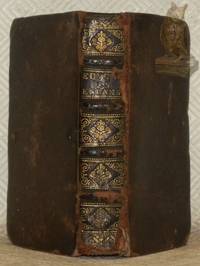
1699réf. 117837Amsterdam : Chez Jaques Menassion 1699. Traduites de l’anglois de Jean Locke par CosteNouvelles instructions pour l’education des enfans. Amsterdam Chez Jaques Menassion1699 150x90mm 9 ff. Avertissement - Préface du traducteur - Indice du Contenu des Sections - 484 pages bandeaux reliure plein veau avec titre fleurons fleurs de lys et caissons ornés dorés au dos à quatre faux-nerfs. Coiffe inférieure abimée. Charnière supérieure fendue. Intérieur propre. Barbier III-574. Troisième traduction française de Coste.Revue Dix-septième siècle 2011/4 n.° 253 article L’oeuvre des premiers traducteurs français de John Locke : Jean Le Clerc Pierre Coste et David Mazel : “Locke ne semble pas avoir trouvé que les commentaires ajoutés par Coste dans la préface de la traduction de ses Thoughts concerning Education étaient déplacés ; au contraire il trouva son conseil à propos de la nécessité de bien maîtriser sa langue maternelle si perspicace qu’il décida de l’insérer non pas dans le paratexte mais dans le texte même de l’édition anglaise revue et augmentée qui suivit ce dont Coste ne fut pas peu fier. Le transfert culturel eut donc un effet boomerang. En d’autres termes l’adaptation culturelle à laquelle Coste fut contraint de procéder pour traduire Some Thoughts concerning Education en français fut ensuite adoptée par l’auteur anglais pour son texte source qui fut ainsi enrichi de l’idée du traducteur français”. “dans l’avertissement à la deuxième édition française de De l’education des enfans Coste signala qu’au rang des “articles tout nouveaux” dont Locke avait grossi la version originale de l’œuvre figurait le sien sur l’importance d’une bonne maîtrise de sa langue maternelle il précisa également que le texte original avait gagné en exactitude. . À en croire Coste c’est grâce à lui et à son travail de traduction que Locke en vint à “exprimer en Anglois quantité d’endroits d’une manière plus précise & plus distincte qu’il n’avoit fait dans les trois premières Éditions de son Livre””. For shipments to the U.S.A. with a value exceeding 800 USD VAT is not included. Please contact us via our website if needed. Chez Jaques Menassion unknown
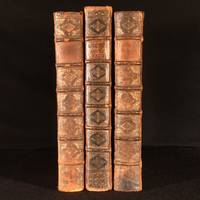
1727réf. 52007Printed for Arthur Bettesworth at the Red Lion in Pater-noster-Row and three others 1727. 3 vols. folio with engraved portrait frontispiece and engraved sepulchral plate neat uniform nineteenth-century inscription on blank preliminaries one blank preliminary in first volume poorly trimmed small marks on last two leaves of text of third volume; attractively and firmly rebound in twentieth-century oatmeal hessian brown leather backs with raised bands second and fourth compartments lettered and numbered in gilt a remarkably well-preserved bright crisp clean copy. The engraved frontispiece is by Vertue after Kneller. Third edition of Locke's collected works following those of 1714 and 1722. 'John Locke is the most influential philosopher of modern times. His influence in the history of thought on the way we think about ourselves and our relations to the world we live in to God nature and society has been immense. His great message was to set us free from the burden of tradition and authority both in theology and knowledge by showing that the entire grounds of our right conduct in the world can be secured by the experience we may gain by the innate faculties and powers we are born with' Chappell p. 252. ESTC T115711; Yolton 365A another issue only says Parker's name in the imprint. Vere Chappell The Cambridge companion to Locke 1994. Printed for Arthur Bettesworth at the Red Lion in Pater-noster-Row [and three others], hardcover
réf. L3 box816 a128vThe Correspondence of John Locke The Clarendon Edition of the Works of John Locke In Eight Volumes Complete Eight Volumes. Edited by E. S. de Beer. Published in 1976 - 1989 by Oxford University Press at The Clarendon Press. Hardcover complete 8 volumes total 6129 pages. Volume 1: Introduction; Letters Nos. 1-461. ci707 pages. Published in 1976. Volume 2: Letters Nos. 462-848. vii805 pages. Published in 1976. Volume 3: Letters Nos. 849-1241. vii801 pages. Published in 1978. Volume 4: Letters Nos. 1242-1701. ix804 pages. Published in 1979. Volume 5: Letters Nos. 1702-2198. vii800 pages. Published in 1979. Volume 6: Letters Nos. 2199-2664. vii798 pages. Published in 1981. Volume 7: Letters Nos. 2665-3286. vii798 pages. Published in 1982. Volume 8: Letters Nos. 3287-3648. Locke's Will; Addendum: Additional Letters; Appendix I: Locke's Portraits; Appendix II: Distribution Lists for Copies of Locke's Books; Appendix III: Unprinted Items in B.L. MSS Locke c. 3-23. ix462 pages. Published in 1989. Oxford University Press, at The Clarendon Press. hardcover
1933réf. 140945023New York: Harmon Foundation Incorporated 1933. First edition. First edition. 56 pp. Bound in publisher's illustrated stapled self-wraps. Near Fine with light wear to wraps. A rare catalogue of African American art with a short essay "The Negro Takes His Place in American Art" by Alain Locke. Exhibiting artists include Malvin Gray Johnson Richmond Barthe Sargent Johnson Lois Mailou Jones Samuel Albert Countee William Arthur Cooper James A. Porter and Hale A. Woodruff. Harmon Foundation Incorporated unknown books
réf. elala48388vo. pp. 2 p.l. 227 1ad. complete with half-title. contemporary paneled calf rebacked & recornered endpapers preserved. armorial bookplate of Sir Henry Seton Bart. ownership entry on title of James Hood dated 1728. First Edition Second Issue State III. BOUND WITH: LOCKE John. Mr. Locke's Reply to the Right Reverend the Lord Bishop of Worcester's Answer to his Letter Concerning some Passages Relating To Mr. Locke's Essay Of Humane Understanding: In A Late Discourse of his Lordships In Vindication of the Trinity. 8vo. pp. 2 p.l. 174 1 leaf 7 1errata 4ads. complete with half-title. London: Printed by H.Clark for A. and J.Churchill and E.Castle 1697. First Edition First Issue. In 1696 deist John Toland published his Christianity not Mysterious a work professing to be a strict theological application of Lockean philosophy. It drew immediate response from Edward Stillingfleet Bishop of Worcester who in his Vindication of the Doctrine of the Trinity attacked Toland and Locke alike and charged Locke with disallowing mystery in human knowledge. A heated controversy ensued Locke responding with a Letter and two Replies the second of which appeared in 1699. Yolton 248B.III & 249. Wing L2749 & L2753. Pforzheimer 604 & 606. NCBEL II 1837. Christophersen pp. 37-41. Rand I 342.> London: Printed by H.Clark, for A. and J.Churchill and Edw. Castle, 1697. hardcover
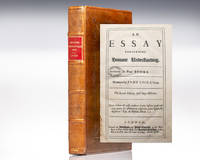
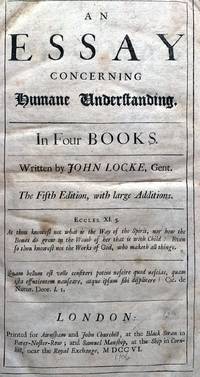
1706réf. 149827London: Printed for Awnsham and John Churchill at the Ship in Cornhill near the Royal Exchange 1706. Fifth edition with large Additions. Full dark brown speckled calf with with panelled onlay of tan calf decoratively edged with blind rolls and decorations red calf spine compartment titled in gilt plain endpapers. Inked name to front pastedown and with handsome engraved portrait of John Locke adhered to front pastedown inked notations to lower margin of title page overall a clean wide-margined and handsomely restored copy. Restoration by Glenn Fukunaga. Large quarto. xliv 604pp. Pp. 259-262 mis-paginated 260 261 255 263 but with catchwords correct and no text lacking. Pagination 285-344 lacking but once again catchwords indicate not text lacking. 14" x 9.25. A foundational work of Enlightenment philosophy Locke's Essay first published 1690 reshaped the intellectual landscape of Europe and the Americas by rejecting innate ideas and grounding all human knowledge in sensory experience. With his doctrine of the mind as a tabula rasa Locke challenged traditional metaphysics laying the groundwork for empiricism and influencing thinkers from Hume to Jefferson. His nuanced treatment of personal identity language and the limits of human understanding offered a blueprint for liberal political thought and the modern scientific method. First editions and early issues are cornerstones of any serious collection of philosophy or political theory prized both for their historical impact and enduring relevance to debates on human reason. Printed for Awnsham and John Churchill, at the Ship in Cornhill, near the Royal Exchange unknown
1801réf. PCKeLOCK36London: Printed for J.Johnson G.G. & J.Robinson. 1801. 1801. 10 Volumes. 8vo. engraved frontis. portrait. folding table. contemporary mottled calf gilt backs several joints partly cracked or with neat repairs. armorial bookplate of the Earl of Charlemont & ownership entry dated Dublin 1802. Tenth Edition; a reprint of the ninth edition of 1794 9 volumes which added A History of Navigation and A Catalogue and Character of Books of Voyages and Travels. Christophersen p. 89. Rand I 341. NCBEL II 1836. cfPrinting and the Mind of Man 164. Palgrave p. 633. Hardcover. London: Printed for J.Johnson, G.G. & J.Robinson., 1801. Hardcover
1688réf. 5037Amsterdam Wolfgang, Waesberge, Boom & van Someren 1688 in-12 pleine reliure Amsterdam, Wolfgang, Waesberge, Boom & van Someren, 1688. 14 x 8 cm, in-12, (12) 538 (24) pp. - 1 planche dépliante hors texte, 1 figure dans le texte, reliure de l'époque de pleine basane cramoisie, dos à 5 nerfs orné de caissons, pièce de titre, traces de roulette sur les coupes, tranches mouchetées.
1936réf. 140944642Washington D.C.: Associates in Negro Folk Education 1936. First edition. First edition. Signed by Alain Locke on the foreword dated 1937. vi 122 pp. Bound in publisher's stapled wrappers. Very Good wraps a little stained and toned light foxing along edges wear at foot. Called the "philosophical architect" and "ideological genius" of the Harlem Renaissance in this booklet Howard University professor Alain Locke traces the history of art by and about African Americans. Associates in Negro Folk Education unknown
1936réf. 140944642Washington D.C.: Associates in Negro Folk Education 1936. First edition. First edition. Signed by Alain Locke on the foreword dated 1937. vi 122 pp. Bound in publisher's stapled wrappers. Very Good wraps a little stained and toned light foxing along edges wear at foot. Called the "philosophical architect" and "ideological genius" of the Harlem Renaissance in this booklet Howard University professor Alain Locke traces the history of art by and about African Americans. Associates in Negro Folk Education unknown books
1801réf. 884404London:: J. Johnson C.G. & J. Robinson Etc. 1801. Engraved frontis portrait folding table. Locke's influence on philosophy and government especially those principles espoused by America's founding fathers is immeasurable. This is a beautiful set of Locke's philosophical works in original boards and spine elaborately tooled in gold with red labels and gold lettering. Professionally rebacked. Contents very lightly toned. Ref. Printing and the Mind of Man 164. The Tenth Edition. Very Good. 8vo. 10 Volumes. J. Johnson, C.G. & J. Robinson Etc. hardcover
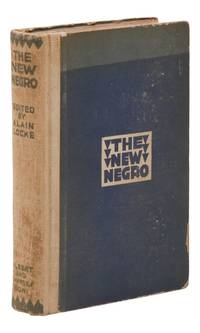
1925réf. 035876NY: Albert and Charles Boni 1925. 1st Edition . Hardcover. Good/No Jacket. Bound in publisher's original blue paper-covered boards over buckram spine cloth lettered in blue. The boards are heavily rubbed with a2 2/3 inch split at the edge of the spine base. The binding is sound. Ex-library with the usual markings. Albert and Charles Boni hardcover
1694réf. 149739London: Printed for Awnsham and John Churchil at the Black-Swan in Pater-Noster Row and Samuel Manship at the Ship in Cornhill near the Royal-Exchange 1694. Rare second edition of this fundamental work in the history of Western thought the first to name Locke as the author and to include the frontispiece portrait of him. Folio bound full paneled calf morocco spine label lettered in gilt elaborated diced stamping to the spine in five compartments within raised bands engraved frontispiece portrait of Locke by P. Vanderbanck after Sylvester Brounower. In very good condition. From the library of the Isle of Wight Institution with stamps to the title page page 175 and verso of final leaf; ownership signature of British missionary Daniel Tyerman 1773-1828 of Newport Isle of Wight dated 1804 to the title page. The second edition of Locke's essay contains a number of important changes and additions to the text. It was the first to name Locke as the author and include the frontispiece portrait of him indicative of the celebrity Locke acquired with the publication of the first edition in 1690. "When Thomas Basset was running out of copies of the first edition in February 1693 he signed a contract with Locke to pay him ten shillings per sheet for additional materials for a new printing. These additions included an expansion of Book I Chap. IV; the chapter on power was almost entirely new; a new chapter 'Of Identity and Diversity' was inserted as 2.27 making chapters 27-31 to be renumbered as 2.28-32; and a discussion was added to 2.9.8. Other numerous additions were made throughout sectional summaries added in the margins and an analytical index supplied" Yolton. "It is Locke's second edition of the 'Essay on Human Understanding' that is the masterpiece we remember; the first 1690 edition did not bear Locke's name nor did it include a number of emendations that finished the work as Locke wanted it" Matthews Collecting Rare Books 97. "Locke was the first to take up the challenge of Bacon and to attempt to estimate critically the certainty and the adequacy of human knowledge when confronted with God and the universe" PMM 164. It is in this work that Locke 1632-1704 lays the foundations of British empiricism and the concept of the mind as a tabula rasa. "Locke summed up the Enlightenment in his belief in the middle class and its right to freedom of conscience and right to property in his faith in science and in his confidence in the goodness of humanity. His influence upon philosophy and political theory has been incalculable" Columbia Encyclopedia. Printed for Awnsham and John Churchil, at the Black-Swan in Pater-Noster Row, and Samuel Manship, at the Ship in Cornhill, near hardcover
1773réf. 119924Amsterdam: no printer 1773. First edition in Italian of one of the most famous and influential works in the history of liberalism the second of Locke's Two Treatises on Government 1690. "'An anonymous translation from the French text of David Mazel probably the 1755 ed." Yolton. The work did not appear again in Italian until 1925. Octavo 183 x 119 mm. Contemporary quarter calf and marbled boards spine ruled and lettered gilt. Ownership stamp "G.G." to title ownership mark "Peyrot" to front pastedown. Spine ends neatly restored; occasional light spotting; a very good copy. Rare: Attig 188; Yolton 59; First Search locates 2 copies only York University Ontario and University of Texas at Austin to which we can add the copy at Yale. hardcover
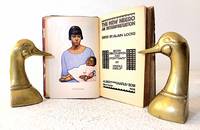
1925réf. 363381New York: Albert and Charles Boni 1925. First Edition. Hardcover. Good. 8vo 8" - 9" tall. Winold Reiss. Is there a reader in "Negro" African-American literature more stuffed with such heavy-hitters verily a Murderer's Row of brilliance Alaine Locke has edited this fine collection and that has been beautifully augmented with the portraits and book decorations of Winold Reiss. This anthology of short fiction literary essays and poetry surveys the moment of African-American and African art criticism experience and literature the opening salvo of the Harlem Renaissance. Alain LeRoy Locke for a long time taught at Howard University in Washington D.C. a leading H.B.C.U. A perfectly serviceable reference copy; nothing fancy but complete and still sturdy bound in now rubbed and scratched illustrated black paper over boards light brown linen cloth-backed. Rubbing to scuffing of tips edges bumping to spine head and foot moderate toning to text-block else a remarkably attractive tightly bound tome. Raspberry and tan illustrated endpapers a stylized "African" man and women a toucan and two cats. Chapter heads and tails. An extremely arresting Madonna and child at frontis. Contributions sometimes multiple by the editor Alain Locke and by Jean Toomer Zora Neale Hurston Claude McKay Countee Cullen Angelina Grimke Langston Hughes W.E.B. DuBois Melville Herskovits Winold Reiss William Stanley Braithwaite John Mathews Bruce Nugent James Weldon Johnson Georgia Douglas Johnson Anne Spencer Angelina Grimke Lewis Alexander Walter White Elise Johnson MacDougold Montgomery Gregory Jessie Fouset J.A. Rogers Paul U. Kellog E. Franklin Frazier W.A. Domingo Kelly Miller Robert R. Moton Cugo Lewis and Arthur A. Schomburg Arturo Alfonso Schomburg. xviii 1 3-446 pp.Member I.O.B.A. C.B.A. and adherent to the highest ethical standards. Additional postage may be required for oversize or especially heavy volumes and for sets. Albert and Charles Boni hardcover
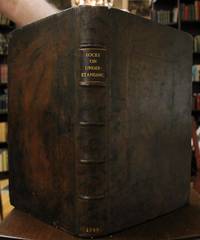
1700réf. B5207London: Awnsham and John Churchil c. 1700. A fine example of this desirable work. Edition: 4th edition with large additions. Binding: Contemporary brown speckled calf boards with blind tooled decorative borders on top and bottom cover rebacked skillfully. Spine in six compartments with gilt text on 2 and 6. Tooled decorations on 1 3 4 5 and 6. Notes: The essay is divided into 4 books within the one volume. John Locke FRS 1632 –v1704 was an English philosopher and physician regarded as one of the most influential of Enlightenment thinkers and known as the "Father of Classical Liberalism". Considered one of the first of the British empiricists following the tradition of Sir Francis Bacon he is equally important to social contract theory. His work greatly affected the development of epistemology and political philosophy. His writings influenced Voltaire and Rousseau many Scottish Enlightenment thinkers as well as the American revolutionaries. His contributions to classical republicanism and liberal theory are reflected in the United States Declaration of Independence. Locke was the first to take up the challenge of Bacon and to attempt to estimate critically the certainty and the adequacy of human knowledge when confronted with God and the universe. In the past similar enquiries had been vitiated by the human propensity to extend them beyond the range of human understanding and to invent causes for what it cannot explain. Therefore Locke’s first task was to ascertain ‘the original certainty and extent of human knowledge’ and excluding ‘the physical consideration of the mind to show how far it can comprehend the universe’. His conclusion is that though knowledge must necessarily fall short of complete comprehension it can at least be ‘sufficient’; enough to convince us that we are not at the mercy of pure chance and can to some extent control our own destiny" Printing and the Mind of Man Size: Small Folio 317x205mm. Illustration: Illustrated with a frontispiece engraving of John Locke. Volume: 4 books in 1 volume Provenance: of William Bell from Ulcombe Kent. References: Attig 228. Grolier 100 English 36. Grolier Wither to Prior 527. Pforzheimer 600. Printing and the Mind of Man 164. Wing L2739. HBS 64538. Pages: P. Blank. Frontis. Title. Dedication 1-4. Epistle to the Reader 1-10. Contents 1-23. 1-438. Index 1-11. Errata. Blank. 91-94 mispag as 93-96 226 jumps to 233 371 mispag as 317 380-381 mispag as 390-391. This is an augmented edition with two new chapters that were not in the previous editions. Category: Book Philosophy; Book Social Sciences; Book Europe United Kingdom; Awnsham and John Churchil hardcover
1751réf. 75999In Firenze: appresso Andrea Bonducci 1751. Tre parti in due volumi di cm. 28 pp. xxxiii 1 189; xxiii 1 316 1 di tabelle; 116 che contengono il "Saggio sopra il giusto pregio delle cose la giusta valuta della moneta e sopra il commercio dei Romani" del Pagnini. Nel primo volume è presente la grande tabella molte volte ripiegata: "Tavola della bontà peso e valuta della maggior parte delle Monete correnti d'Oro e d'Argento del Mondo formata dal Cavaliere Isacco Newton verso il principio del presente Secolo.". Frontespizi in rosso e in nero al primo riproduzione del recto e del verso di una moneta romana. Dedica a stampa dei curatori a Emanuel de Richecourt. Legatura d'attesa strettamente coeva in cart. alla rustica con titoli manoscritti ai dorsi. Solo un paio di alconi limitati a poche carte e qualche segno d'uso ai dorsi ma complessivamente esemplare genuino e molto marginoso in barbe e stampato su carta di ottima qualità. Rara prima edizione in volgare dei "Several Papers Relating to Money Interest and Trade" lockiani nascenti dalla fusione di "Some Considerations of the Consequences of the Lowering of Interest and Raising of the value of Money" 1692 e delle "Further Considerations concerning Raising of the Value of Money" 1695. L'edizione pubblicata a Firenze e curata da Giovan Francesco Pagnini e da Angelo Tavanti la traduzione si fonda sulla raccolta in-folio dei "Works" lockiani del 1710 si situa nel fertile terreno del movimento riformatore toscano. "Locke is one of the economists who have been able to apply their principles to practical politics during their own lifetime. The influence of his political and educational writings. on economics though indirect is very important" Palgrave II pp. 631-636. Il "Saggio sopra il giusto pregio delle cose" del Pagnini figura in edizione originale. In esso l'economista toscano "dimostra che la moneta è soggetta alle stesse leggi del prezzo a cui vanno soggette le altre merci"; "il suo valore è indipendente dall'arbitrio degli uomini. La fatica per produrla la quantità l'offerta e la domanda sono gli elementi del suo prezzo" Pecchio. Nel saggio sono utilizzati come fonti oltre a Locke Petty Montesquieu Saint-Pierre Mably Mirabeau Cantillon. Palgrave cit. Cossa p. 41 n. 116. Higgs p. 115. Einaudi 3476. Attig 507. Kress Italian 275. Yolton 164. Sul saggio del Pagnini: Dal Pane La questione del commercio dei grani nel Settecento in Italia I n. 228. Graziani Storia critica della teoria del valore in Italia pp. 120-121. appresso Andrea Bonducci unknown
1925réf. 140947630New York: Albert and Charles Boni 1925. First Edition. Good. First edition first printing. xviii 446 pp. Bound in publisher's blue paper-covered boards over buckram spine cloth lettered in blue. Good with moderate rubbing and toning to covers mottling to front cover boards exposed at edges. Dust-soiling and light staining to upper edge of textblock dampstaining to endpapers pencil inscriptions to front endpapers and half-title. First two leaves clipped at the lower corner contents toned with occasional foxing binding exposed at multiple places. Lacking jacket. A serviceable copy. A landmark African American anthology featuring stories essays and poetry by the leaders of the Harlem Renaissance movement: Langston Hughes Zora Neale Hurston James Weldon Johnson Countee Cullen Claude McKay Jean Toomer and more. Albert and Charles Boni unknown
1925réf. 140947630New York: Albert and Charles Boni 1925. First Edition. Good. First edition first printing. xviii 446 pp. Bound in publisher's blue paper-covered boards over buckram spine cloth lettered in blue. Good with moderate rubbing and toning to covers mottling to front cover boards exposed at edges. Dust-soiling and light staining to upper edge of textblock dampstaining to endpapers pencil inscriptions to front endpapers and half-title. First two leaves clipped at the lower corner contents toned with occasional foxing binding exposed at multiple places. Lacking jacket. A serviceable copy. A landmark African American anthology featuring stories essays and poetry by the leaders of the Harlem Renaissance movement: Langston Hughes Zora Neale Hurston James Weldon Johnson Countee Cullen Claude McKay Jean Toomer and more. Albert and Charles Boni unknown books
1706réf. 17416London: Printed for Awnsham and John Churchill 1706. FIFTH EDITION. Index bound after Contents and before text. Contemporary full-paneled calf panels blind-stamped on front and rear boards edges partially rubbed with corners reinforced rebacked; interior excellent. Fifth edition containing expansions of all four books. This edition includes the final textual changes by Locke though it was published posthumously. It was also the last edition printed in folio format. Locke’s 1632-1704 famous work of empirical philosophy deals with the fundamental issues of how we think perceive and express ourselves through language logic and religion. All later editions were based upon this 1706 printing. Printed for Awnsham and John Churchill unknown
1706réf. 17416London: Printed for Awnsham and John Churchill 1706. FIFTH EDITION. Index bound after Contents and before text. Contemporary full-paneled calf panels blind-stamped on front and rear boards edges partially rubbed with corners reinforced rebacked; interior excellent. Fifth edition containing expansions of all four books. This edition includes the final textual changes by Locke though it was published posthumously. It was also the last edition printed in folio format. Locke’s 1632-1704 famous work of empirical philosophy deals with the fundamental issues of how we think perceive and express ourselves through language logic and religion. All later editions were based upon this 1706 printing. Printed for Awnsham and John Churchill unknown books
1751réf. 126250Florence: Andrea Bonducci 1751. Rare first edition in Italian of Some Considerations of the Consequences of the Lowering of Interest and Raising the Value of Money 1692 and Further Considerations concerning Raising the Value of Money 1695. It is the only early translation of Locke's papers on money based on the folio Works of 1740 and is furnished with extensive footnotes by the translators Giovanni Pagnini and Angelo Tavanti. It is issued here with a treatise by Pagnini appended at the end of the second volume. Locke's writings had a major influence on the then-ongoing Italian monetary debate. Economic unrest in Italy in the middle of the 18th century led to several publications on monetary theory. In the aftermath of the Succession Wars the possibility of devaluing currency to boost economic growth was considered a proposal which raised questions about Italy's move towards a commercial society and out of feudal systems. Most of the Italian writers opposed devaluation of the currency who cited Locke's similar arguments in the English recoinage crisis of the 1690s; the only major detractor was Galiani. Pagnini and Tavanti published the work in translation in the belief that Locke's ideas of sound money were relevant to the situation. "By publishing Locke's works on money in Italian Pagnini and Tavanti made available to an Italian audience a structured version of what had originally been a few long letters written to give advice on a specific issue that belonged to late seventeenth-century English politics. Yet in the following decades Locke's letters had risen to fame abroad where a myth had been formed of Locke as the defender of an honest commercial order of humankind. If Locke's letters contained a general message about commercial politics the work by Pagnini and Tavanti was supposed to bring it out" Stapelbroek p. 13. The appended treatise by Pagnini describes commercial society as one based on trust and peace; by devaluing the currency a government is undermining this society. 2 vols bound in 1 quarto 245 x 179 mm. Titles printed in red and black engraved vignette to first title large folding table at end of vol. Modern half vellum and plain paper boards new spine labels. Boards lightly marked small ownership stamp to first title and one or two minor stains; a crisp clean copy. Attig 507; Kress Italian 275; Yolton 164. Koen Stapelbroek "The Devaluation Controversy in Eighteenth-Century Italy" in History of Economic Ideas vol. 13 no. 2 2005. hardcover
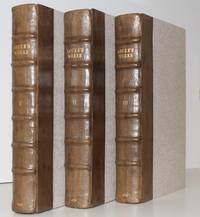
1417réf. 956F16London: John Churchill and Sam. Manship; Awnsham Chirchill 1714-1722 . First edition. Leather. Good. 13.5" by 9". Not Stated. The complete collected works of Enlightenment philosopher John Locke with the first and third volume present in the first edition and with volume II present in the second edition. The 1714 first edition of volumes I and III and the 1722 second edition of volume II.Complete in three volumes.Volume I illustrated with an engraved frontispiece and engraved funerary epitaph. Collated complete.The collected works of English philosopher physician and Enlightenment thinker John Locke frequently referred to as the 'Father of Liberalism' and recognised as one of the first of the British empiricists.Essays and writings on numerous subjects - including a discussion of interest letters concerning toleration and the reasonableness of Christianity - are included in these volumes alongside his posthumous works and a number of personal letters. With a lengthy index to the rear of each volume. Volumes I and III present in the 1714 first edition ESTC T128627.Volume I with the collation: A2 a2 A-H2 I2 A-F2 a-g2 B-4G4 4H2. Collated complete.Volume III with the collation: A2 1 B-R2 S-5A4 5B-5E2. Collated complete.Volume I includes 'An account of the life and writings of John Locke Esq; The third edition enlarged' London: printed for J. Clarke and E. Curll 1714 and 'The remains of John Locke Esq; . Publish'd from his original manuscripts' London: printed for E. Curll 1714 as called for.Volume II present in the 1722 second edition. ESTC T128551With the collation: A4 B-4P4 4Q-4S2. Collated complete.Former owner's inscriptions to volume II and III title pages.Present here are first edition volumes of the works of one of the most important and enduring figures of Western philosophy.Locke's philosophy of mind is viewed as the origin of modern conceptions of personal identity and the psychology of the self influencing the work of later philosophers such as Rousseau Hume and Kant. In full panelled calf bindings with gilt detailing to back strips. Volumes I and III lacking spine labels. Small losses of calf to back strip heads and tails with rubbing to back strips joints and board perimeters. Volume I joints starting with front board a touch tender and rear board firmly held. Front board of volume III starting with board firmly held. Joint heads of volume II starting with boards firmly held. Volume II lacking endpapers. Internally firmly bound but with title page and following leaf of volume II detached and loosely inserted. Former owner's inscriptions to volume II and III title pages. Pages bright with instances of light handling marks to each volume. Faint tide marks to heads of leaves of 'An account of the life and writings of John Locke' and 'The remains of John Locke' in volume I and light tide marks to heads of ten leaves to the rear. Very light tide marks to tail of each leaf of volume III and to fore edges and heads of pages 173 onwards. Marginal ink annotations and instances of underlining to pages 13-21 of volume III. Good John Churchill, and Sam. Manship; Awnsham Chirchill hardcover
In-4 (243 x 201 mm), demi-veau fauve de l'époque à petits coins, dos à 5 nerfs surlignés de filets gras dorés, pièce de titre de veau blond, tranches mouchetées, (4), xvi, (2), 540 p., (16) p. d'index et colophon, (1) f. d'errata, titre rouge et noir, grande vignette de titre emblématique gravée par O. de Fries. Première édition collective des oeuvres de Leibniz. Elle contient l'édition originale de 'Nouveaux essais sur l'entendement humain' qui occupe la majeure partie du volume (p 1-496), avec la 'Théodicée' l’un des deux seuls ouvrages majeurs que Leibniz parvint à compléter. Composé en 1703 pour n’être publié qu’en 1765 dans ce recueil, l’ouvrage se présente comme une réfutation systématique de 'l'Essai sur l'entendement humain' de John Locke sous forme d’un dialogue imaginaire entre deux personnages: Philalète qui défend la position empiriste empruntée à Locke et Théophile qui soutient l'option rationaliste à l’aide des arguments forgés par Leibniz. Commentant son Essai, Leibniz déclara: "j’ai fort médité moi-même sur ce qui regarde les fondements de nos connaissances (…). De toutes les recherches il n’y a point de plus importante, puisque c’est la clef de toutes les autres". L’édition a été publiée sur les manuscrits originaux par l’érudit allemand Rudolf Erich Raspe et préfacée par Abraham Gotthelf Kaestner, mathématicien, professeur à l'université de Göttingen. Contient: Nouveaux essais sur l'entendement humain - Examen du sentiment du P. Malebranche que nous voyons tout en Dieu contre J. Locke - Dialogus de connexione inter res et verba, et veritatis realitate -- Difficultates quaedam logicae - Discours touchant la méthode de la certitude et de l'art d'inventer pour finir les disputes (…) - Historia et commendatio linguae charactericae universalis (…). (Müller, 'Leibniz-Bibliographie', 2155. River, 472. Stojan, 56. Yolton, 'John Locke, a Reference Guide', C.1765-4). Bel exemplaire, très frais, grand de marges, très bien relié à l’époque.