552 Ergebnisse
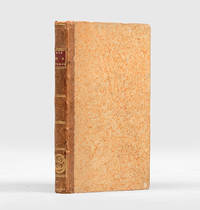
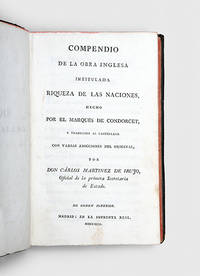
1792Best.-Nr. 164946Madrid: en la Imprenta Real 1792. THE FIRST APPEARANCE OF ADAM SMITH IN SPANISH First Spanish translation of Condorcet's summary of Smith's Wealth of Nations the first appearance of any of his work in Spanish prior to the complete translation by J. A. Ortiz in 1794. The translator of the present summary is the young marqués de Casa Carlos Martinez de Yrujo y Tacón 1763-1824. "This is a translation of the Roucher/Blavet condensation of Wealth of Nations in the Bibliothèque de l'homme publique. to which Condorcet lent his name. The translator restores to the text a summary of Smith's Digression on the Bank of Amsterdam WN IV iii. b 479-88 a five-line qualification of the argument for free trade. The criticism of Catholic clergy is omitted." Tribe. Octavo 174 x 108 mm. Contemporary tree sheep flat spine ruled and decorated in gilt red morocco label marbled endpapers red edges. 19th-century ownership inscription to front free blank leaf extremities lightly rubbed one corner slightly worn; a crisp clean copy in fine condition. Palau 59126; Tribe 47. This edition not listed in Goldsmiths' Kress or Vanderblue. unknown
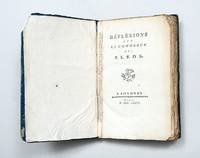
1776Best.-Nr. 83886London: No Printer 1776. Uncommon first edition of Condorcet's Thoughts on the corn trade. Appointed secretary to the Académie des Sciences in 1773 for his work in mathematics Condorcet "soon won the friendship of Turgot by whom his attention was turned towards political economy. Under the inspiration of Turgot he wrote various articles or works among others Les Réflexions d'un laboureur de Picardie à M. N. auteur prohibitif à Paris 1775; and Les Réflexions sur le commerce des bleds 1776 two writings directed against M. Necker that auteur prohibitif who had brought out May 1775 his work Sur la législation et le commerce des grains." Palgrave. Octavo 212 x 134 mm pages 2 title xvi 2 errata 221. Contemporary blue marbled paper boards paper spine label lettered by hand. Front board and upper outer corner of the first 100 pages gnawed title page with closed tear to the gutter partly repaired with tape to verso; a very good copy uncut with generous margins. INED 1178. Not in Goldsmiths' Kress Mattioli or Sraffa. See Palgrave's Dictionary of Political Economy 1925 I p. 386. hardcover
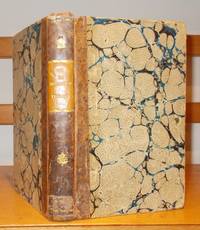
1786Best.-Nr. 013838London: no publisher 1786. Book measures 19.5x12.5.cm. 42991pp. Bound in period or early quarter calf marble boards gilt tooling leather title label. Binding rubbed worn chipped on head of spine. Internally library cancellation stamp on free endpaper no other library marks staining to title and about 10 pages. Some occasional minor spotting pencil underlining or minor annotations. Pages in good clean condition. ~A good copy. Quarter Calf. Good Plus. 8vo. [no publisher], Hardcover
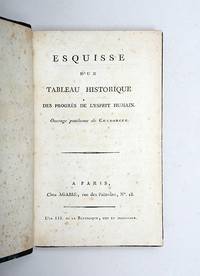
1795Best.-Nr. 161166Paris: chez Agasse l'an III de la République 1795. History as progress First edition of the finest and most durable expression of the ultimate perfectibility of man perhaps the clearest and boldest statement of the enlightenment belief in progress demonstrating "man's progressive emancipation first from the arbitrary domination of his physical environment and then from the historical bondage of his own making" Encyclopedia of Philosophy II 184. Condorcet wrote the work in 1794 while in hiding from Robespierre's agents having voted against the execution of the king. Captured by the state he was found dead the next day presumed to have taken his own life to escape the guillotine. His manuscript was published the next year. "In the Esquisse. Condorcet traces the history of man through epochs the first three covering his progress from savagery to pastoral community and thence to the agricultural state. The next five span the growth of civilizations and knowledge down to Descartes and the ninth describes the revolution of Condorcet's own lifetime from Newton to Rousseau. The prophetic view of the tenth epoch shows Condorcet at his most original. He forecasts the destruction of inequality between nations and classes and the improvement intellectual moral and physical of human nature" PMM. Octavo 193 x 119 mm. Early 19th-century blue quarter roan smooth spine lettered and tooled in gilt blue mottled sides brown speckled edges. Front pastedown with early 20th-century bookseller's label of Emile Nourry of Paris and bookplate of Caroli Michel. Light rubbing to binding corners worn spotting to contents marginal loss to foot of G2 not affecting text a few peripheral nicks very good. Printing and the Mind of Man 246; En français dans le texte 196; Martin & Walter 1 8083; Quérard II p. 269. unknown
1780Best.-Nr. 136971No place no publisher 1780. First edition of Condorcet's attack on the corps of engineers responsible for France's major canal building projects. Turgot looking to finish the large and ambitious Picardy and Burgundy canal systems placed Condorcet in charge of experimental research on canals. "Condorcet's research was instrumental in demonstrating the flaws in existing proposals for the tunnels for the new canals whose design would have made it impossible for boats to pass through. In the course of the demonstration a whole new branch of physics was invented. Apart from technical issues Condorcet also soon found himself immersed in research of a more sociological nature in Flanders and Picardy on the impact of the new canals on local communities. This resulted in an angry report to Turgot published in 1780 as the Mémoire sur le canal de Picardie in which the corps of engineers and the inadequacies of their professional training were strongly criticized" Williams p. 21. Octavo 194 x 120 mm. Disbound. Contemporary note of Condorcet's authorship to title page. Slight loss at bottom fore corner of pp. 11-14 not near text contents clean; very good. David Williams Condorcet and Modernity 2004. unknown
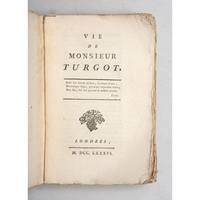
1786Best.-Nr. 126469London: no publisher 1786. From the library of Empress Joséphine True first edition of Condorcet's life of Turgot Gerits's Edition A; a superb copy from the library of Empress Joséphine de Beauharnais with her Bibliothèque de la Malmaison stamp on the title page and her initials to the spine. This work together with Dupont de Nemours's biography is the chief contemporary account of the renowned financial reformer and friend of the physiocrats. It contains in a footnote Condorcet's early attempt to apply mathematics to economics. On pp. 178-184 he discusses the various mathematical ways "in which indirect taxation could be replaced by direct taxation and the effects of such a change" Theocharis p. 65. Condorcet 1743-1794 secretary to the Académie and a prolific author was a strong supporter of Turgot who had attempted to implement physiocratic ideas as the French finance minister from 1774 to 1776. The present work seeks to vindicate Turgot's thought and work and is a powerful defence of Enlightenment economic ideas. "Contrary to what is suggested by the title this book was not a biography but rather an exposé of Turgot's educational political and economic ideas. In fact Stanley Jevons has called it one of the earliest works on 'économie pure'" Gerits. Seven editions of Condorcet's Vie de Monsieur Turgot appeared within two years making it one of the best-selling works of economics of its day. The first four editions all bear a London imprint dated 1786 though Gerits notes that it seems that all but Edition A were printed in France. Octavo 202 x 125 mm. Contemporary speckled quarter calf smooth spine ruled in gilt with red morocco label monogram "JB" gilt-tooled to penultimate compartment paste paper sides red silk bookmarker. Bibliothèque de la Malmaison stamp to title page. Spine ends and corners a touch worn a few light spots to title leaf scattered marginal pencil marks; a notably fresh and crisp copy beautifully bound. Einaudi 1217; Goldsmiths' 13128; Kress B.1032; Sraffa 1062 "first edition first issue". Anton Gerits "Condorcet's Vie de Monsieur Turgot" Harvard Library Bulletin 3 4 Winter 1992-93 pp. 35-37; Reghinos D. Theocharis Early Developments in Mathematical Economics 1961. unknown
1786Best.-Nr. 83882London: no publisher 1786. One of four printings of 1786 Gerits's edition D with no Avis de l'éditeur and no errata and the misprints corrected: "Contrary to what is suggested by the title this book was not a biography but rather an exposé of Turgot's educational political and economic ideas" Gerits. This work together with Dupont de Nemours's biography is the chief contemporary account of the renowned financial reformer and friend of the physiocrats. It contains in a footnote Condorcet's early attempt to apply mathematics to economics. On pp. 178-184 he discusses the various mathematical ways "in which indirect taxation could be replaced by direct taxation and the effects of such a change" Theocharis Early developments in mathematical economics p. 65. Condorcet 1743-1794 was secretary to the Académie and was a prolific author. Although more celebrated for his studies in philosophy literature and politics "his mathematical treatment of probabilities and his discussion of differential equations and finite differences show an ability which might have put him in the first rank had he concentrated his attention on mathematics" W.W. Rouse Ball A Short Account of the History of Mathematics p. 388. Octavo 214 x 135 mm. Contemporary papier dominoté wrappers paper spine label hand-written in black ink. Short closed tear to pages 245-246 neatly repaired without loss occasional light spotting; a very good uncut copy in an attractive decorated paper wrapper. Kress B.1033. Gerits: "Condorcet's Vie de Monsieur Turgot" in Harvard Library Bulletin. unknown
1774Best.-Nr. 127684Paris: Chez Couturier père 1774 but 1775. First edition of Condorcet's defence of the free trade of grain. Turgot's liberalisation of the grain trade in 1774 coinciding with bad harvests and rocketing prices led to a fierce pamphlet war between proponents of the mercantilist and free trade schools of thought. Condorcet had written the present tract prior to Turgot's enactment of the policy perhaps to anticipate it but the work was not published until April 1775 in the midst of the troubles and the month before the outbreak of bread riots in Paris. Condorcet would elaborate his ideas further in his 1776 treatise Réflexions sur le commerce des bleds the year in which Turgot was dismissed and liberalisation of the grain trade scaled back. Octavo 181 x 118 mm. Recent marbled boards black calf label. Half-title present. Some offsetting from type a few minor creases discreet repair to tear on p. 8 else a very good copy. INED 1171 bis; Kress 7003. Williams Condorcet and Modernity p. 19. hardcover
1790Best.-Nr. 127340Paris: Imprimeur de l'Assemblee Nationale 1790. First edition of Condorcet's critique of the assignats. Condorcet was Inspector of the Coins from 1775 to 1790 and had consequently participated in the great monetary debates of the reign of Louis XVI. Partly invigorated by these debates he was a fierce opponents of the assignats an opposition which would be vindicated as their value plummeted. Octavo 189 x 121 mm. Recent marbled boards red morocco label to spine. A few foxing marks but generally clean. A very nice copy. hardcover
Best.-Nr. DADAX0521044642New unknown
Best.-Nr. SONG286744148XUsed: Good unknown
1795Best.-Nr. 59131BBParis, Chez Agasse. L'an III. (i.e. 1795). 8°. VIII S., 389 S. Halblederband der Zeit mit rotem goldgeprägtem Rückenschild und wenig Rückenvergoldung.
1987Best.-Nr. LCI-6342Romantin, Editions Martinsart 1987 1 in -4 Pleine reliure de velours de soie de coton, couleur vert émeraude. 375 [p.p] Une édition somptueuse du texte fondateur de la pensée progressiste. La reliure en velours vert émeraude, couleur de l'espérance et du savoir naissant, souligne la noblesse du projet de Condorcet. Un objet de bibliothèque d'une grande élégance, alliant la douceur du toucher à la force du texte.Édition de prestige du testament philosophique de Condorcet. L'ouvrage est magnifiquement revêtu d'un velours de coton vert émeraude, offrant une texture soyeuse et une profondeur de teinte exceptionnelle. Ce choix de matériau, à la fois noble et délicat, fait de ce volume une pièce de collection remarquable, illustrant parfaitement l'optimisme des Lumières.Reliure : Velours de coton d'une grande fraîcheur, poil intact et non écrasé. Couleur émeraude vibrante.Dos : Dos non fendu, volume bien ferme.Intérieur : Impeccable, sur papier de qualité supérieure.
Best.-Nr. 17931Fontenay, ENS, 1989, 171 pages.
Best.-Nr. 597728Paris, Brissot-Thivars, 1822. In-16, cartonnage de l'époque, pièce de titre rouge, filets et titre dorés, tranches vertes, couverture conservée, XXIII-480 pp.
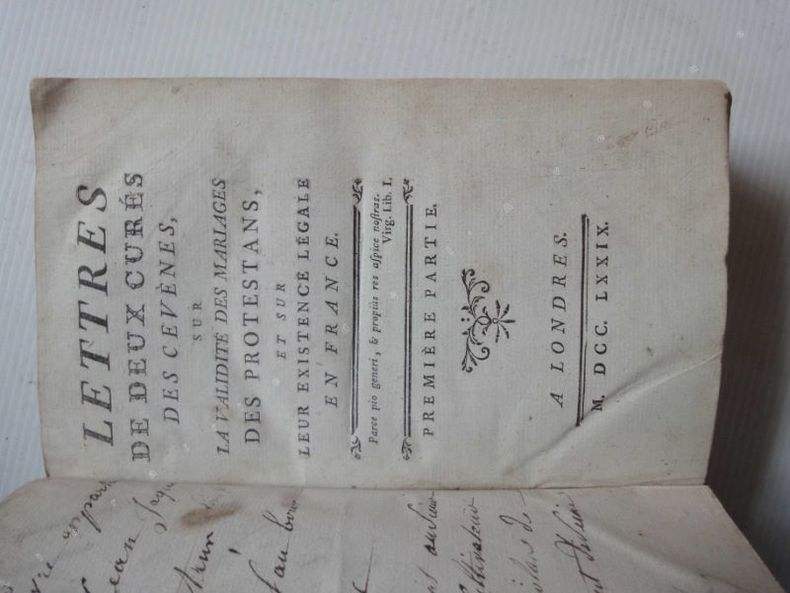
1784Best.-Nr. 16473Londres, sn, 1779 1784 In-8 plein veau brun, dos lisse, caissons ornés, 231- 120 pp. & 115- 105 pp. Dos passé, anotations manuscrites en pages de garde. Bon exemplaire.
2000Best.-Nr. 80121Klincksieck 2000 In-8 broché 23,6 cm sur 15,2. 80 pages. Bon état d’occasion.
Best.-Nr. 140500Paris, Boulard, s.d. (1791) in-8, 12 pp., dérelié.
Best.-Nr. 224055S.l., 1788 2 vol. in-8, 196 pp., 54 pp. ; 328 pp., 106 pp., avec 7 tableaux dépliants hors texte, veau fauve marbré, dos lisses cloisonnés et fleuronnés, pièces de titre et de tomaison brique et vertes, encadrement de simple filet à froid sur les plats, simple filet doré sur les coupes, tranches rouges (reliure de l'époque). Nombreux ff. roussis.
Best.-Nr. 225979Paris, Chez Baudouin., (1790) in-8, 4 pp., dérelié.
Best.-Nr. 229192Paris, Ponthieu, 1824 2 vol. in-8, XII-363 pp. et 390 pp., broché. Rousseurs.
Best.-Nr. 229537À Paris, Chez Masson et fils, 1822 in-8, VIII-440 pp., broché, couv. papier marbré de l'époque
Best.-Nr. 230246Milan, Imprimerie italienne et française, an VI (1798) in-8, viij pp., 384 pp., pp. 387-389, demi-chagrin fauve, dos à nerfs orné de guirlandes dorées et de filets et fleurons à froid (rel. de la fin du XIXe). Coiffes très frottées.
Best.-Nr. 238334Paris, chez les marchands de nouveautés, an XII - 1804 in-8, [2] ff. n. ch., 168 pp., dérelié. Mouillures en début d'ouvrage.
Best.-Nr. 238398Paris, Imprimerie des sourds et muets, s.d. (1791) in-8, 22 pp., dérelié.