[EHON] AnonymousABAA

1793ref. 899051793. EHON. TOBA-E SANGOKU-SHI. 3 Vols. Osaka Kawachiya Kihei and Kawachiya Eisuke Kansei 5 1793. 25.8 x 18.5 cm. Original dark blue covers string-bound Japanese style fukuro toji with the pink printed paper title labels. A nice 18th century edition of this work in good impression. Originally published in the 1720's. Though the artist is unnamed several candidates have been mentioned including Ooka Shumboku. 18th century editions of Toba-e books are becoming increasingly uncommon. In a custom clasped chitsu case. The covers are worn but overall a good copy of this book. An excellent example of the somewhat madcap humor of the Toba-e genre. With a bookseller's advertisement at the end which indicates this edition of the book was part of a series of Toba-ehon brought out by the same publisher - SANGOKUSHI OGI NO MATO and TOBA GURUMA. unknown books
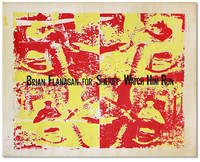
ref. 19730N.p. Chicago: 1969. Original silk-screened poster in three colors 23" x 29". Professionally backed on archival tissue; minor toning at margins still Near Fine. Brian Flanagan b. 1946 was a member of both SDS and the Weathermen and directly connected to the fatal Greenwich Village apartment explosion in which three Weathermen were killed while preparing for a bomb attack on Fort Dix Flanagan had reputedly left the apartment briefly for more supplies. This rare poster promotes Flanagan's parodic write-in campaign for Mayor of Chicago during the Days of Rage. Following a fateful run-in with City Attorney Richard Elrod on the streets of Chicago in which Elrod was left with a broken neck and partial paralysis Flanagan was tried for attempted murder and inciting mayhem. He was eventually acquitted on all charges but the case became a cause celebre for the Weathermen and other radical left groups. An extremely ephemeral piece likely produced in tiny quantities and posted even less. unknown books
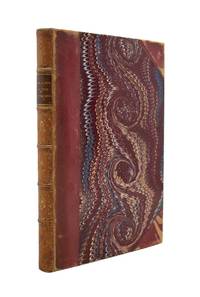
1790ref. 69478London: J. Parsons 1790. Full Description: ANONYMOUS. Authentic Memoirs Memorandums and Confessions. Taken from the Journal of His Predatorial Majesty the King of the Swindlers. London: J. Parsons n.d.c.a. 1790. First edition. Octavo 8 x 5 inches; 204 x 125 mm. viii 184 195-300 1 errata 1 blank pp. With skips in pagination but collates complete. Although the final leaf reads "End of the First Part" no second part is known. This Journal covers the years 1780-1784. Contemporary half calf over marbled paper boards. Spine stamped in gilt. Brown leather spine label lettered in gilt. Top edge gilt. Marbled endpapers. Some minor rubbing to boards along edges and joints. Title-page repaired along inner gutter margin. Some light toning throughout. Previous owner's old ink signature on title-page. Overall very good. This journal by the anonymous "King of the Swindlers gives a detailed account on the various scams and swindles in which the subject was implicated. Most of names in the text being lightly disguised. According the the introduction by the publisher "This singular miscellany fell into the Editor's hands through the carelessness of its owner who left it on the seat of a hackney coach. He was instantly succeeded by a lady who took possession of his journal and after satisfying her own curiosity gave it to the Editor; earnestly recommending the exposure of its contents for the information and benefit of the community. Tue mere possession under these circumstances did not in the Editor's opinion authorize his publishing or justify his retaining it: he therefore advertised the manuscript -offering to resign it to the bearer of any memorandum or confession agreeing in substance and character with the original ; and declaring his determination if not claimed in a given time to prepare it for the press and to publish it as soon as possible. Having thus satisfied every punctilious consideration and no claim being made; he hath fulfiled his promise and discharged his duty to the public by promulging its contents." HBS 69478. $1500. J. Parsons unknown books
1651ref. 302281Venice: Presso li Guerigli 1651. hardcover. very good. 290 pages all rather fine and clean blue edges. Thick tall 8vo copper engraved illustration on title page engraved decorative chapter initials and tail pieces. Full vellum lightly soiled hand-lettered title on spine. Small ex-libris on inside front cover. Venice: Presso le Guerigli 1651. First Edition. Scarce. Presso li Guerigli unknown books
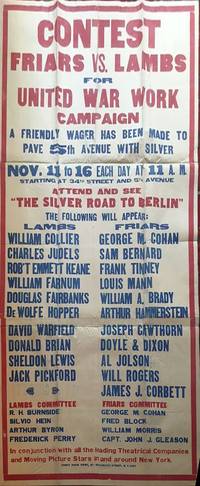
ref. 261819New York: Carey Show Print. Poster. Page measures 85 1/2" x 40". This large scale World War I poster features patriotic red white and blue fonts to underscore its message. The Friars and the Lambs two organizations operating at the time of the War and still today participated in fundraising contests for the United War Work Campaign or UWWR. That 1918 campaign was charged with raising $170000000 to help demobilize the army and maintain morale in the final few years of the war. The campaign was a success and was at the time recognized as the largest fundraising event in history. This poster is a wonderful vestige that illustrates the willingness of all different organizations to demonstrate their devotion to the nation's troops. It is in very good condition and is creased at the folds as issued. Scarce. Carey Show Print unknown books
1797ref. 19586Paris: Le Clerc 1797. FIRST AND ONLY EDITION. Engraved frontispiece in first volume. Partially printed on blue paper. Contemporary russet calf- backed marbled boards spines gilt marbled endpapers. An excellent copy. First and only edition of this rare treatise on the controversial subject of suicide. The anonymous author hopes to shed more light on this cultural taboo. He begins by providing statistics of suicides that have been announced in France 500 suicides in 6 years or 20000 suicides in the last century which he believes are consistently underreported by families and newspapers due to public and religious shame. The author sets forth examples to support his conclusion that suicides are a systemic problem in French society as illustrated by Madame L’s suicide a woman with a seemingly happy life who drowned herself in the river. He claims her death to be a combination of boredom with life disgust at her needs and mood swings brought on by dramatic novels. Our author disagrees with contemporaneous scholarly and popular opinions on suicides and concludes the first part with a historiographical critique of literature including Dubois Delaunay’s Dissertation sur le Suicide Jean Henri Samuel Formey’s Mélanges philosophiques M. Funck’s commentary on Johan Robeck’s 1672–1739 theological interpretation of suicide and Jean Dumas’s Traité du suicideou du meurtre volontaire de soi-même. The author defines fourteen causes of suicide including disgust at the satedness of life loss of property a feeling of humiliation an unfortunate or ill-fated passion the abuse of the pleasure of the senses envy or jealousness anger guilt of crimes fear and terror belief in suicide as just and deserved punishment madness and cruel fanaticism. A rich section of discursive notes fills the second half of the second volume. Le Clerc unknown books
ref. 140943566No Place: No Publisher 1970. 4.25" x 5.5" single-sided handbill flyer. Good horizontally creased missing triangular chips at corners wrinkled toned. No other copies located in commerce or in institutional collections such as University of Washington's Vietnam War Era Ephemera Collection. A scarce piece of propaganda from the American anti-Vietnam War movement demanding the freeing of the protestors that would become famous as The Seattle Seven. On February 17 1970 the Seattle Liberation Front organized a protest of about 2000 people against the imprisonment of the Chicago Seven including Black Panther Bobby Seale converging on the Seattle federal courthouse. About 200 protestors chanting "Free Bobby!" attacked the building with rocks and paint and were reputedly tear-gassed by Seattle Police. Eight protestors would later be indicted: Jeff Dowd Michael Abeles Joe Kelly Michael Lerner Susan Stern Roger Lippman Chip Marshall and Michael Justesen. Jutesen skipped town and was never found so the group became known as The Seattle Seven. Most of the charges would eventually be dropped. Jeff Dowd though would become a film producer and later gain cult fame as an inspiration for "The Dude" in The Coen Brothers' 1998 film The Big Lebowski. Hence The Dude's lines "Ever heard of the Seattle Seven That was me. Well me and six other guys." One was actually a lady but otherwise the reference was quite real. [No Publisher] unknown books
1725ref. 019172London: J. Darby 1725. Hardcover. Margins shaved not affecting text. Trivial wear. About Fine. Duodecimo 3-1/4" x 5-1/2" in a lovely unsigned binding of full dark green morocco leather with gilt floral decorative devices with small white morocco onlays the spine with five raised bands gilt lettering and decorations gilt dentelles scarlet silk endpapers and doublures all edges gilt; 119 1 pages. Wood-engraved frontispiece. A translation of the anonymous French text LE COMTE D'ESSEX HISTOIRE ANGLOISE printed in Paris in 1678 and first published in English in 1680. This edition of a sensational account of Elizabeth's love life seems to be just as scarce. J. Darby hardcover books
1780ref. 265361780. Pastel on laid watermarked paper. The sheet retains signs of having been stretched as these types of portraits typically were. Dampstain upper right corner tear lower right corner otherwise excellent condition. A strikingly well done portrait of a successful European gentleman with piercing eyes. Pastel portraits were popular in Europe Great Britain and America during most of the 18th century especially in the 1770s and 80s. They provided a more rapid way of rendering a likeness in bright colors that didn't yellow. This was a golden age for portrait painting which exemplified the optimistic views of the Enlightenment: a sitter was not ashamed to show his or her wealth contentment or character. Our self -assured subject looks directly at the viewer with piercing eyes calm practical not likely to be fooled. It is an astounding accomplishment; we feel that this was exactly how he was. The artist allowed himself or herself there were a number of excellent female pastel portraitists particularly in France to be subject entirely to what was seen and sensed about this strong indomitable personality. Baetjer & Shelly Pastel Portraits. Images of the 18th Century. Metropolitan Museum of Art 2011. unknown books
ref. 39762San Francisco CA: Hermes Free Press 1972. Very Good. San Francisco CA: Hermes Free Press 1972. First Edition. Slim folio 37cm; publisher's grey stitched wrappers printed in brown yapp edges; 12pp. Minor edge wear to wrapper margins textblock very lightly cockled from exposure to damp else Very Good and sound. The title page continues "Being the Assignment of Same to the Honorable Senators Lawmakers of the United States Government toward the Preservation of Life and Spirit of these Lands. This Investiture Proclaimed in Grace Cathedral at the Autumnal Equinox 1971." The work assigned specific endangered plants and animals to each U.S. Senator. Originally housed in printed manila envelope lacking from this copy. One copy was mailed to each U.S. Senator. Interestingly the Morgan bibliography of Ginsberg and the McNeil bibliography of Snyder only make reference to the appearance of this work in different serials but not this separate edition. OCLC locates four copies as of September 2025 at Cal Tech Utah State Monash and UCSD. Hermes Free Press unknown books
1825ref. 30459Paris: Bossange Frères 1825. Very Good -. Paris: Bossange Frères n.d. ca. 1825. Presumed First French Edition. Oblong octavo 14.5 x 23 cm; publisher’s pictorial lilac paper-covered boards adorned with vignettes of two young girls one skipping rope the other playing badminton; iii4-134pp.; six leaves of hand-colored aquatint plates. Ex-library with the early 20th-century gift bookplate to front free endpaper “From the books in the Children’s Room / A memorial to Nathaniel Thayer 1898–1927” with Nathaniel Thayer’s personal bookplate on facing front pastedown marred by deaccessioned rubber-stamps otherwise free of library markings. Margins quite scuffed and rubbed with rather extensive chipping and exposure of boards beneath front joint starting to crack but holding else a Good to Very Good copy in this striking publisher’s binding contents fresh and sound. Attributed to the German author Philipp Joseph Schalbacher Journal de Christine adopts the form of a pedagogical study made by the father of two young children a boy of five and a girl of four whom he observes without too much interference "knowing full well that in order to bring oneself to their level of childlike personhood one must avoid wielding over their inclinations any tyrannical constraint" from the Preface our translation. The publisher's binding beautifully encapsulates this spirit the upper cover repeating an image adorning the title page depicting two young girls jumping rope and playing badminton—education which permits pleasure and sport while also encouraging good behavior and piety. Exceedingly uncommon institutionally with three copies of this edition only as of August 2024 all separately catalogued—at Texas A&M the Morgan and the BNF. Princeton adds a copy of the 1837 reprint edition. While this work arises periodically on the market we find no copies in this lovely variant of the publisher's binding. Bossange Frères unknown books
1803ref. 22802London: T. Gardiner 1803. Second edition. Hardcover. Modern three quarter maroon morocco and lilac cloth. Teg. 5 Vols. Fine. 379 306 383 353 479 pages. 21 x 13.5 cm. 15 folding maps and plans. Lord Lynedoch Thomas Graham 1st Baron Lynedoch a Scottish aristocrat politician and British Army officer immersed himself in a military and later political career during the French Revolutionary Wars and the Napoleonic Wars. Detailed accounts of the various campaigns including Names of Officers killed wounded and missing. The one Preface appears in the final volume in which the author extends his apology for the difficulties in translating some French terms to English and the high cost the engravings to produce the maps which "very much advance the price of this volume." Scattered light foxing more notable where the placement of maps meet the text page. Bound by New York Cooperative Society. T. Gardiner hardcover books
1823ref. 14740POPULAR TALES AND ROMANCES OF THE NORTHERN NATIONS Simpkin Marshall & Bohte 1823 first edition 3 volumes near fine bound in 3/4 leather and marbled boards with matching marbled page edges and raised gold-gilt decorated spines. Seventeen tales of the supernatural taken from European sources apparently mostly German. Contains the well known female vampire story WAKE NOT THE DEAD as well as the tales THE BOTTLE IMP THE SORCERORS THE ENCHANTED CASTLE ELFIN-LAND THE HOARD OF THE NIBELUNGEN THE VICTIM OF PRIESTCRAFT et.al. An important early grouping. Illustrated. Simpkin, Marshall & Bohte hardcover books
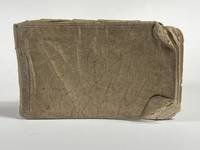
1915ref. 4227France Belgium England 1915. Good. Oblong 8vo. Small "Walker's Service Notebook" 154 x 94 mm lined 26 pages filled with neat entries in pencil and pen final page of diary loose the remaining portion of the notebook i.e. about 2/3 blank. Original limp cloth covers worn. § Extraordinary manuscript diary of an anonymous British soldier beginning April 12th 1915 and ENDING ABRUPTLY IN THE TRENCHES AFTER A GAS ATTACK. The final entry was dated December 19th 1915 which was THE FIRST DAY PHOSGENE GAS WAS USED AGAINST BRITISH SOLDIERS. The short diary is rich in detail of life at the front. The anonymous soldier belonged to the 49th West Riding Division which had a large number of gas casualties when soldiers in reserve lines did not receive a warning in time to put on their helmets. A study by British medical authorities arrived at a figure of 1069 gas casualties 120 of which were fatal. It is very possible that the present manuscript was written by one of those men. It seems probable that with access to the right regimental records the identity and fate of the soldier could be learned and his story told in full; however even as an anonymous diary the interest and poignancy of this personal record is clear. The events recorded span just nine months. On April 12th the soldier leaves Edenthorpe near Doncaster and crosses the channel to Le Havre that evening "packed like herrings" and accompanying horses and wagons. Over the next few months he records laying lines opening signal offices handling horses towns and villages visited billets and meals injuries regiments encountered names of comrades and O.C.s shelling rain and mud. He sees the Northumberland Hussars the Indian Corps and Royal Horse Artillery. On May 9th he records the Battle of Aubers Ridge: "Off duty at 7am. Attack began at 5am by Artillery. Signal thro' during day showed heavy losses in E. Lancs Lincolns. 13th London and other Batts. Had coffee in Fleurbaix and then to bed in barn. Off duty 3pm. Attack still proceeding without much impression on our line. French said to be doing well. At night we have the two windows in our Signal Office made up with corrugated iron & sandbags." For the entry dated May 12th our author notes that the name of the Division has been "altered to the 49th" thereby confirming the identity of his Division. On May 24th: "The Allamands dropped about 6 shrapnel in our vicinity." From a period of steady work and periodic pleasures "had tea & cakes at a patisserie & and then back after buying some books" "glorious day" the situation deteriorates with the weather "torrential rain dugouts leaking & 18" water on my floor". They move to Chateau de Trois Tours and on July 13th there is "rather an exciting night" with a bombardment from 7.30 to 10.30. On the 14th "The whole place is being encircled by barbed wire & trenches & the furniture is being moved out of the chateau." On the 15th "At 12.45pm about 12 shells fell round the chateau made a dive for the Signal Office Billy Edwards & Gus Harris wounded in thigh and ankle." They were shelled again on the 16th. On December 1st he travels back to Sheffield on leave returning on December 8th. The company are now holed up near Ypres at Hospital Farm the name given to a farm building used as a dressing station. The final entry reads "Dec 19th 'S.O.S.' Gas attack 5.30 am things lively until 8.30am. 146 & 148 des. 148 soon repaired from chateau". The cemetery at Hospital Farm contains 115 Commonwealth burials of the First World War. On the significance of the 19 Dec. 1915 battle at Wieltje Belgium northeast of Ypres see the long Wikipedia entry "German Phosgene Attack of 19 December 1915." The diary contains many clues that could help identify our writer in military records. It is not certain that he was one of the first British casualties to Phosgene gas but it seems tragically likely. As it stands the final entry in the diary marks an important milestone in the war: phosgene gas would eventually be responsible for about 85% of the 90000 deaths caused by chemical weapons during World War I. unknown books
1921ref. 189766New York: The Society 1921. Hardcover. VG- scuffing and light soiling to boards signed presentation copy age toned end pages text and bw illustrations are clean and clear binding is secure. Peach paper over boards; white title block with black lettering on front cover; 50 pp illustrated in bw throughout. Contents include: Certificate of Incorporation; Members of the Societe Anonyme Inc.; Annual Report; Exhibitions; Lectures; Publication of Pamphlets; Report on Newspaper and Magazine Publicity; Treasurer's Report; Program of the Work for the Season 1921-1922; Committees and Membership; By-Laws; Reference Library. The Society hardcover books
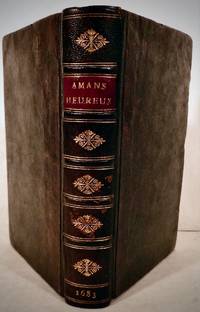
1683ref. 18928Paris: Chez Claude Barbin 1683. First edition. leather_bound. Contemporary brown calf rebacked in late19th century matching morocco. Near fine. 165 pages 2 A8-L8. 18 x 12 cm. Twenty-eight etched plates including 3 part title plates each part containing eight tales of the "Happy Deceived Unfortunate Lovers"; a precursor to later romantic novels. This copy bound sequentially -- Trompez Malheureux Heureux. Includes a six page catalogue of books in English printed for William Cademan which references this title and its availability in English. Pasted to inside front cover a Parke-Bernet Gallery 1949 announcement of the Frederick M. Hopkins Sale conceivably a provenance for this title. Plates and text clean general title rehinged raised bands spine panels richly gilt red leather spine label printed in gilt. Chez Claude Barbin unknown books
1710ref. 1200341710. First Edition. SLAVERY ANONYMOUS. A True State of the Present Difference Between the Royal African Company and the Separate Traders. London: No publisher 1710. Slim octavo period-style full tan sheep gilt red morocco spine label raised bands; pp. 40. $1650.First edition of this argument against providing a monopoly over the British slave trade to the Royal African Company with tipped-in diagram of one of the Royal African Company's forts.This work attempts to highlight the irregularities of the business practices of the Royal African Company and to argue for the superiority of open trade in Africa particularly as a means of supplying slaves to the American plantations. Founded in 1660 by the royal Stuart family and the City of London the Royal African Company was founded to exploit natural resources like gold along the west coast of Africa. While the Royal African Company did participate heavily in the gold trade the majority of their income came from slave-trading. The Royal African Company was part of a concerted effortÑfully elaboration in the Navigation ActsÑto establish dominance in the slave trade since the Dutch had been the leading slave-traders prior to the Restoration. To that end the Royal African Company established a brutal and highly efficient slave-trading system eventually providing more slaves to the West Indies than any other company or state. The slaves were branded with the initials of the company or its longtime governor the Duke of York. Children were included in the transports. Between 1662 and 1731 the Company transported approximately 212000 slaves a fifth of whom died enroute. While the Company formally gave up slave-trading in 1731 they remained involved in the trade of ivory and gold dust industries dependent on labor exploitation and slavery. Goldsmiths 4605. Kress 2677. Early ink underlining and marginal notations.Small paper repair to diagram text and diagram trimmed close affecting portion of imprint and scattered catchwords not affecting readability. A very good copy. hardcover books
ref. 004614Quarter Calf. Wood Boards. Very Good. Could this be an unabashed gay celebration from the Thirties Here with a single exception only men are presented and in two images with a suggestion of intimacy and elsewhere with a constructivist-style muscularity that somehow also brings to mind Tom of Finland the pioneer in depicting hyper-masculine muscle men among them sailors and dock worker-types the specific subject matter of this unpublished unfinished manuscript. And the one exception with a woman in the illustration depicts what could be depicted as dissention between the muscular man and the diminutive girlfriend. N.d. circa 1930. Folio. 33 by 24 cm. 4 9-35 pp. The songs represented here include "Whiskey for My Johnny" "Paddy Doyle" "Across Western Ocean" "Poor Old Joe" "One Day More" "Banks of the Sacramento" "Blow the Man Down" "Captain Kidd" "It's Time for us to Leave Her Johnny" and a few songs without the title written in. Even with the gaps in illustration title or text the work delivers a strong punch and there is absolutely nothing tentative or sketchy about what is present. This was done by someone with a clear vision and testament to that is that the leaves are a Normandy Vellum France paper which is both a heavy and luxuriant stock. The paper was in common use between 1915 to 1925 anchoring our dating. However we believe the aesthetic is late twenties to early thirties. Also included are two separate sheets with three pages of pencil sketches with some red watercolor employed in one of the drawings for the artwork presumably that did not get entered into the book. unknown books
1749ref. 136504London: Henry Lintot 1749. hardcover. Three tables 32 372pp. 4to full contemporary calf raised bands gilt-lettered spine label; corners bumped top of hinge starting. London In the Savoy: Printed by Henry Lintot for Daniel Browne 1749. Scarce. Very Good . Not in Halkett & Laing. Henry Lintot unknown books
ref. 005171Cloth. Very Good. Imaginative whimsical verse and illustrations of an upper crust rabbit Pollux and his frivolous cares and activities. N.d. early 20th century and World War One era. Oblong 4to 24.5 by 30 cm. 21 pp. and leaves of original pen and ink and watercolored drawings. Each page has a mounted illustration with inked verse next to it poking fun at Pollux's dress his vanity his helplessness his manners etc. Other characters include Jenkins card players a pining woman all of whom are rabbits. While we do not know the identity of the cartoonist the level of work is plausibly professional with details rendered meticulously. The various verses and illustrations are somewhat loosely linked -- there isn't so much a continuous narrative as much as an overarching archness. The artist and versifier is shooting arrows at the idle nobility. Also included are 10 additional cartoons on separate sheets only one of which involves Pollux and only two with colored watercolors. These additional cartoons including the one with Pollux relate to the First World War. From these and the album proper we can infer that the artist was of a more left leaning sensibility. unknown books
1790ref. 4138London: Published by Robert Sayer 1790. Hand-coloured mezzotint. State vi/viii. A remarkable portrait of Lord Grosvenor's Pangloss by the master equine painter George Stubbs. George Stubbs is considered to be one of the greatest English painters. His ingenious animal and sporting pictures remain unrivalled in their passionate depiction of emotion and their commitment to naturalistic observation. Stubbs was briefly apprenticed to the painter Hamlet Winstanley a relationship that quickly ended leaving the young artist to his own education. In contrast to contemporary academic theory Stubbs attached great importance to the belief that art should imitate nature not the work of other artists. He spent years carefully studying human and equine anatomy so that he could truthfully represent natural form and movement. A result of this study was his famous Anatomy of the Horse which details with beautiful engraving the various elements of a horse's anatomy from skeletal form to muscular definition. By the 1760's Stubbs had developed a considerable reputation as a sporting artist and had attracted a number of distinguished patrons. Continuing in search of innovation Stubbs began experimenting with a myriad of different mediums becoming accomplished in both enamels and printmaking. Through arduous application he became a talented mezzotint engraver and worked with ease in both soft ground and etching techniques. Stubbs' masterful paintings inspired some of the greatest engravers of the day to reproduce his work for publication including his own son George Townly Stubbs who reproduced with faithful accuracy the sublime emotion inherent in his father's exquisite works. Stubbs was elected Director of the Society of Artists and a Royal Academician and today his prized paintings are housed in some of the finest museums in the world. Stubbs was often commissioned to paint accurate portraits of specific racehorses for proud aristocratic patrons who wished to highlight their horses' racing success. This practice is expertly exemplified with this magnificent print of Pangloss Lord Grosvenor's beloved horse. Pangloss was foaled in 1755 and named after a character in Voltaire's Candide; little is known about Lord Grosvenor's horse apart from the fact that his racing career was ended by a broken leg. This print was the second of a series of engraved horse portraits begun by the publisher Ryland in 1771 and extended by Robert Sayer in 1777. Although the inscription on the print establishes Stubbs as the painter the painting has not been identified making this print extremely intriguing since it is the only record of Stubbs' lost work. Lennox-Boyd George Stubbs 20 vi/viii; Gilbey Life of George Stubbs no.39; Siltzer The Story of British Sporting Prints p.270. Published by Robert Sayer unknown books
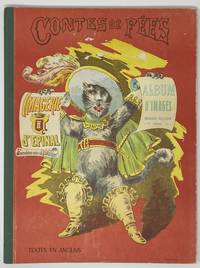
1888ref. 1464Epinal France: Imagerie D'Epinal 1888. Boards. Very good . HUMOR RACIST CARICATURE. Folio; 56pp; pages numbered 1-60 printed recto only on very thin paper stock lacking pp15 16 17 and 19-SEE NOTE BELOW; red pictorial boards on front rear has green and white patterned boards green cloth shelf-back; "Printed expressly for the Humoristic Publishing Company Kansas City Mo." on the foot of each page; cartoon-style hand-colored lithographed illustrations; light scuffing to boards at edges and bumped corner age-toned paper fragile 3pp with closed tears extending into text: 9&10 from fore-edge and 31 from bottom; very good plus. OCLC only locates two copies in English at Yale and Princeton and two in France in French. Although the cover title is in French the cartoon text is all in English. Published in France by the old and revered Imagerie D'Epinal founded by the Jean-Charles Pellerin family in 1796 and continuing today it was printed for the Humoristic Publishing Company in Kansas City Missouri. Famous stories and tales many moralistic are included in comic strip form one story to a page. Included are: William Tell Little Tom Thumb Little Red Riding Hood and Cinderella. Fifty-six hand-colored cartoons printed one side only. Overstreet states that "All copies known only have 50 of the 60 known of these broadsheets." And "All known copies were collected with sheets 15-20 23 24 47 and 48 missing." In this volume pages 15 16 17 and 19 only are lacking. Overstreet 366. Imagerie D'Epinal unknown books
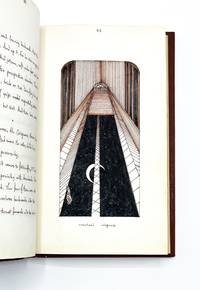
ref. 43982n.p.: n.p. 1970. Near fine. Enigmatic and disquieting collection of six short stories and one 90-page novella neatly and distinctively handwritten and illustrated in brown ink. The material veers in tone from the parodic to the surreal to the philosophically melancholic; the style incorporates a recondite vocabulary "the pyral tarantism of being in the world" and a single consistent insistent voice alternating long unpunctuated Joycean streams of frantic consciousness with brief and airless sentence fragments. A perpetual undercurrent of violent sexuality surfaces as much in the settings and scenery as in the events: a car crash; a game of human chess; a blazing furnace; a slaughterhouse. The table of contents gives titles for each work but no author's name; the bookplate with initials "A. J." offer the only clue to the item's creator or owner. The authorial narration steps out of its queasy dreamtime now and then to comment on itself "It would appear that this is the whim of the authors" or to focus on a concrete and precisely dated image: "Week-end Traffic" catalogs automobile makes and models in obsessive parodic almost Ballardian detail - a 1931 Alfa-Romeo; a '28 Lombard a Triumph Scorpion - and characters offer each other Passing Cloud cigarettes. But for the most part settings are as hard to place as the book itself. Character names are almost but not quite real: Nish Rogoze Valetta Fedor Shad. Illustrated with line drawings in brown pen presumably also by the writer with occasional accents in black and brief captions taken from the scenes they illustrate. The execution is skilled but careful often quoting other artwork as in the illustration to the final story "Communication" whose subject is the Breughel painting Dulle Griet; we see a copy of Brueghel's scene through the latticework of a window. Other illustrations appear to be carefully composed from copies or multiple tracings giving something of the effect of a Max Ernst collage - particularly the images of a horse-headed woman and a lion-headed man perhaps an intentional quotation from Une Semaine de Bonte. A Piranesi-esque interior gives way to a crowned woman in 20th century corset and garter belt: the Queen. Although a precise date cannot be given this book bears the stamp of a London bindery which operated as Bailey Bros. until a name-change in the 1970s and references in the text place its composition after the 1930s; we estimate the date of production to be circa the late 1960s to early 1970s - though its private library feel perhaps hints at a possible earlier creation. Bizarre and unsettling yet also the product of an original voice. In short: a singular artist's book of unique vision. Original red morocco with raised bands and decorative gilt stamping to spine. Top edge gilt. Black and gold patterned endpapers. 205 pages. Bookplate taped to ffep; brown geometric design with designer initials ACW at lower right and "Ex Libris AJ". Gilt stamping to lower edge of back cover below paste-down: "BOUND BY BAILEY BROS. LTD." Slight chipping to leather at inside rear hinge. Light edgewear and rubbing. n.p. unknown books
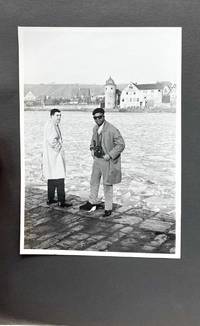
1959ref. 40770Schweinfurt Germany: n.p. 1959. Contents near fine housed in very good album. Affectionate photo album memorializing the mostly harmless exploits of an Army coterie of proto-Beatniks stationed in peacetime Europe and making the most of it. Photo album of a young man in the most fortunate of midcentury micro-generations coming of draft age after the war in Korea and before the American war in Vietnam: able to treat their tour of duty as a lark an adventure; an excuse to drink Bavarian beer and go to motorcycle shows; wear Converse and coke-bottle glasses and sign each other's good-bye cards like an affectionate graduating class. This album records the work and play of soldiers and locals in and around U.S. Army Garrison Schweinfurt: home to several thousand U.S. soldiers and personnel in the years after 1945 and clearly remembered with great affection by those lucky enough to see no combat a little adventure and a lot of hanging out. A good decade younger than the iconic Beats who wrote the formative texts and dreamed the formative dreams for their disciples and imitators the soldiers pictured here are just the right age to be formed by the late '50s popular notion of carefree bohemian youth so sternly corrected by the Beat originals in question: The "foul word Beatnik" wrote Ginsberg is nothing but a "journalistic sneer." Kerouac meanwhile expressed a dour miserablism over the whole business: "Nothing can be more dreary than coolness . a kind of sociological coolness soon to become a fad up to the mass of middle class youth." Well: they were both right but they were both over 30 by then. The Beat ethos and vestiges of a Beat aesthetic could not be contained; as the album proves even in barracks even under Army discipline and orders the youth with their shabby blazers and glasses of absinthe-substitute knew what cool was. Shot by a remarkably skilled amateur photographer or photographers with a fine eye for composition the photographs are technically accomplished with a fine sense of contrast and a keen sensitivity to the opportune moment. At a uniformed military exercise he captures some curious civilian onlookers; out in the surrounding town he takes sensitive candid photos of an impish local toddler strangling her brother. More than this though is the tone of bohemian youth captured both real and aspirational. The heart of the album documents a core group of friends: smoking wearing sunglasses indoors drinking Pernod taking photos reading French newspapers. Throughout the photographer finds time to hunt beauty: men silhouetted against a bleak sky; a young and grim-faced pregnant woman gazing at a leafless tree; cynical children clambering over tank; and of course European women. A captivating series of moments as perfectly framed as any film still. 11'' x 16''. Original oblong photo album lacking original string ties otherwise intact. Paper label mounted to front cover: "Schweinfurt - 1959 / Boudreaux Kites" in pen. 36 album leaves laid in each with black and white photographs mounted to rectos and versos and intact spiderweb tissue guards. Bayonet receipt card for a Francis C. Welch mounted beneath a portrait photo. One greeting card also mounted to first leaf and one additional large 10'' x 8'' photograph laid in. 181 photographs in total. Wear and some warping to album cover; interior leaves largely unaffected. Photos fine. n.p. unknown books
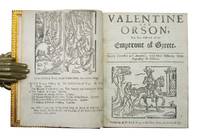
1700ref. 69536London: Printed by A.M. for E. Tracy at the Three Bibles on London-Bridge 1700. RIVIÈRE & SON. . Valentine and Orson. The Two Sons of the Emperour of Greece. Newly Corrected and Amended; With New Pictures Lively Expressing the History. London: Printed by A.M. for E. Tracy at the Three Bibles on London-Bridge 1700. Full Description: ANONYMOUS. RIVIÈRE & SON binder. Valentine and Orson. The Two Sons of the Emperour of Greece. Newly Corrected and Amended; With New Pictures Lively Expressing the History. London: Printed by A.M. for E. Tracy at the Three Bibles on London-Bridge n.d.c.a. 1700. Early English translation of the French prose romance "Valentin et Orson" the original of which was written between 1475-1489. Small quarto 7 1/8 x 5 9/16 inches; 181 x 141 mm. 1-181 3 table pp. Date is from ESTC. With an initial advertisement leaf and three final contents pages. With an advertisement at foot of Z4. In this edition the text is set in roman letter another edition has the text set in black letter. With a half-page woodcut on title-page a half-page woodcut on advertisement leaf/frontispiece and fourteen additional woodcuts in the text. Bound by Rivière & Son in full red morocco. Spine ruled in blind and lettered in gilt. Gilt dentelles. Board edges doubled ruled in gilt. All edges gilt. Front outer hinge repaired. Endpapers browned around the edges. Neat paper repair to preliminary advertisement leaf with a few letters supplied. Neat paper repair to lower corner of G4 affecting a few letters supplied in facsimile. Two tiny neat repairs in the text on I3 just touching a few letters. paper repair in the lower margin of Y4 touching a few letters. Half-inch closed tear to lower margin of H4 just touching the catchword on the verso. Three previous owner's bookplates to front pastedown including Justin G. Schiller's custom bookplate designed by Maurice Sendak on front pastedown. Overall a very good copy in a handsome binding "'Valentine and Orson' is a medieval French romance that became a popular English chapbook tale. Middle Dutch Low German German and Old Swedish versions suggest that the original verse version is an early-14th-century French text called 'Valentine and Nameless.' It first appeared in French prose with the author listed as Jac. Maillet in 1489 and was translated into English around 1502 by Henry Watson who added many plot details including a helpful dwarf magician and a dragon. Versions vary considerably in content as well as length: from Purfoot on it was stripped of sexual misdemeanors and Catholicism. The tale also appeared in verse and play forms which helped extend its popularity into the 19th century" Elaine Ostry in The Oxford Encyclopedia of Children's Literature. ESTC R34690 HBS 69536. $2000. Printed by A.M. for E. Tracy at the Three Bibles, on London-Bridge unknown books