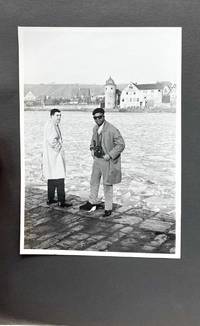
1959ref. 40770Schweinfurt Germany: n.p. 1959. Contents near fine housed in very good album. Affectionate photo album memorializing the mostly harmless exploits of an Army coterie of proto-Beatniks stationed in peacetime Europe and making the most of it. Photo album of a young man in the most fortunate of midcentury micro-generations coming of draft age after the war in Korea and before the American war in Vietnam: able to treat their tour of duty as a lark an adventure; an excuse to drink Bavarian beer and go to motorcycle shows; wear Converse and coke-bottle glasses and sign each other's good-bye cards like an affectionate graduating class. This album records the work and play of soldiers and locals in and around U.S. Army Garrison Schweinfurt: home to several thousand U.S. soldiers and personnel in the years after 1945 and clearly remembered with great affection by those lucky enough to see no combat a little adventure and a lot of hanging out. A good decade younger than the iconic Beats who wrote the formative texts and dreamed the formative dreams for their disciples and imitators the soldiers pictured here are just the right age to be formed by the late '50s popular notion of carefree bohemian youth so sternly corrected by the Beat originals in question: The "foul word Beatnik" wrote Ginsberg is nothing but a "journalistic sneer." Kerouac meanwhile expressed a dour miserablism over the whole business: "Nothing can be more dreary than coolness . a kind of sociological coolness soon to become a fad up to the mass of middle class youth." Well: they were both right but they were both over 30 by then. The Beat ethos and vestiges of a Beat aesthetic could not be contained; as the album proves even in barracks even under Army discipline and orders the youth with their shabby blazers and glasses of absinthe-substitute knew what cool was. Shot by a remarkably skilled amateur photographer or photographers with a fine eye for composition the photographs are technically accomplished with a fine sense of contrast and a keen sensitivity to the opportune moment. At a uniformed military exercise he captures some curious civilian onlookers; out in the surrounding town he takes sensitive candid photos of an impish local toddler strangling her brother. More than this though is the tone of bohemian youth captured both real and aspirational. The heart of the album documents a core group of friends: smoking wearing sunglasses indoors drinking Pernod taking photos reading French newspapers. Throughout the photographer finds time to hunt beauty: men silhouetted against a bleak sky; a young and grim-faced pregnant woman gazing at a leafless tree; cynical children clambering over tank; and of course European women. A captivating series of moments as perfectly framed as any film still. 11'' x 16''. Original oblong photo album lacking original string ties otherwise intact. Paper label mounted to front cover: "Schweinfurt - 1959 / Boudreaux Kites" in pen. 36 album leaves laid in each with black and white photographs mounted to rectos and versos and intact spiderweb tissue guards. Bayonet receipt card for a Francis C. Welch mounted beneath a portrait photo. One greeting card also mounted to first leaf and one additional large 10'' x 8'' photograph laid in. 181 photographs in total. Wear and some warping to album cover; interior leaves largely unaffected. Photos fine. n.p. unknown books
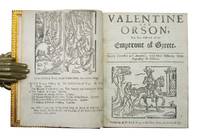
1700ref. 69536London: Printed by A.M. for E. Tracy at the Three Bibles on London-Bridge 1700. RIVIÈRE & SON. . Valentine and Orson. The Two Sons of the Emperour of Greece. Newly Corrected and Amended; With New Pictures Lively Expressing the History. London: Printed by A.M. for E. Tracy at the Three Bibles on London-Bridge 1700. Full Description: ANONYMOUS. RIVIÈRE & SON binder. Valentine and Orson. The Two Sons of the Emperour of Greece. Newly Corrected and Amended; With New Pictures Lively Expressing the History. London: Printed by A.M. for E. Tracy at the Three Bibles on London-Bridge n.d.c.a. 1700. Early English translation of the French prose romance "Valentin et Orson" the original of which was written between 1475-1489. Small quarto 7 1/8 x 5 9/16 inches; 181 x 141 mm. 1-181 3 table pp. Date is from ESTC. With an initial advertisement leaf and three final contents pages. With an advertisement at foot of Z4. In this edition the text is set in roman letter another edition has the text set in black letter. With a half-page woodcut on title-page a half-page woodcut on advertisement leaf/frontispiece and fourteen additional woodcuts in the text. Bound by Rivière & Son in full red morocco. Spine ruled in blind and lettered in gilt. Gilt dentelles. Board edges doubled ruled in gilt. All edges gilt. Front outer hinge repaired. Endpapers browned around the edges. Neat paper repair to preliminary advertisement leaf with a few letters supplied. Neat paper repair to lower corner of G4 affecting a few letters supplied in facsimile. Two tiny neat repairs in the text on I3 just touching a few letters. paper repair in the lower margin of Y4 touching a few letters. Half-inch closed tear to lower margin of H4 just touching the catchword on the verso. Three previous owner's bookplates to front pastedown including Justin G. Schiller's custom bookplate designed by Maurice Sendak on front pastedown. Overall a very good copy in a handsome binding "'Valentine and Orson' is a medieval French romance that became a popular English chapbook tale. Middle Dutch Low German German and Old Swedish versions suggest that the original verse version is an early-14th-century French text called 'Valentine and Nameless.' It first appeared in French prose with the author listed as Jac. Maillet in 1489 and was translated into English around 1502 by Henry Watson who added many plot details including a helpful dwarf magician and a dragon. Versions vary considerably in content as well as length: from Purfoot on it was stripped of sexual misdemeanors and Catholicism. The tale also appeared in verse and play forms which helped extend its popularity into the 19th century" Elaine Ostry in The Oxford Encyclopedia of Children's Literature. ESTC R34690 HBS 69536. $2000. Printed by A.M. for E. Tracy at the Three Bibles, on London-Bridge unknown books
1674ref. 002378London: Printed by J. C. for Thomas Basset at the George in Fleet Street near Cliffords Inne 1674. First Edition. Very good. First edition; 6 3/4 x 4; pp. 8 1-250; 3/4 polished calf and marbled boards; rebacked; spine in 5 panels with raised bands and gilt decorations; engraved printer's device to title page verso; engraved vignette at beginning of first chapter; thin rubbed line along hinge of title page obscuring the first letter of the title; period brown-ink smudge and a small puncture to upper corner of title page; edges of first few leaves a bit brittle with several small nicks; two bookplates to endpapers - the first that of Colonel Robert Coleman Hall Brock 1861 - 1906 - prominent lawyer financier and scientist; the second that of Thomas Mitchell - possibly Scottish Lieutenant Colonel Sir Thomas Livingstone Mitchell 1792 - 1855 - surveyor and explorer of Southeastern Australia; a third period signature to bottom of last page; overall in very good condition. Called one of the earliest British scholarly histories of Russia written the book's authorship had been attributed to several figures including John Merrick Chief Agent of the English Muskovy Company. In fact the work was written by Sir Roger Manley 1626 - 1688 - soldier translator and author. Despite writing about the Time of Troubles without allegedly ever travelling to Russia Manley still produced a secondary source of great historiographical interest. Loewenson Leo. Sir Roger Manley's History of Muscovy: The Russian Impostor 1674. The Slavonic and East European Review vol. 31 no. 76 1952 pp. 232240. ESTC R22560 Wing M75 Printed by J. C. for Thomas Basset, at the George in Fleet Street, near Cliffords Inne hardcover books
1662ref. 1381629London: s.n. 1662. First Edition. Hardcover. Small Quarto 2 pp. 5 - 134 2. In Good condition. Later three-quarter calf and marbled paper boards with significant wear to leather on spine lacking spine label. Boards are detached. Moderate wear to leather on boards light wear to edges and significant wear and chipping to leather along spine. Text block has moderate plus age toning to speckled edges significant age toning to front and back free end pages along edges moderate age toning to pages throughout interiorly and occasional ink marginalia in a seventeenth century hand. The bottom inch of page 131/132 has been torn away impacting the last four lines of text on both pages. An eight-line ink inscription appearing to be in an 18th century hand appear on the errata page "From the Printer to the Reader." listing errors found in the text. Text complete despite pagination. EH Consignment. References: ESTC R21850; Sabin 98500. Henry Vane 1613-1662 emigrated from England to New England in 1635. A member of the most radical wing of the Puritans he was elected governor of Massachusetts in 1636 but returned to join the Long Parliament in 1637. Vane's stay in Massachusetts was tempestuous and he returned to England in 1637 to become a member of the Long Parliament though his interest in New England continued. After the Restoration he was imprisoned for two years convicted of treason and executed. The present text authored by a partisan in favor of Vane includes the speech Vane intended to give from the scaffold but was barred by the court. The speech argues for parliamentary sovereignty and other radical political ideas that proved influential among American colonists. 1381629. Special Collections - Downstairs. [s.n.] hardcover books
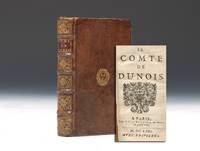
1752ref. 859861752. First Edition. ANONYMOUS. Le Comte de Dunois. Paris: Chez Lois Billaine 1671. 12mo contemporary full dark brown speckled calf elaborately gilt-decorated spine covers with the arms of the House of Bourbon-PenthiÂvre raised bands red morocco spine label. $2200.First edition of this novel preceded by a dedicatory letter to the Duchess of Nemours this copy finely bound in contemporary calf-gilt with the arms of Louis-Jean-Marie de Bourbon Duke of PenthiÂvre son of the Count of Toulouse Grand Admiral of France and a renowned book collector.Louis-Jean-Marie de Bourbon was the son of Louis Alexandre de Bourbon and his wife Marie Victoire de Noailles; he was also a grandson of Louis XIV of France and his mistress Madame de Montespan. In 1733 at the age of six he was made a field marshal and the next year a lieutenant general. In 1740 he received the Order of the Toison dÕOr from the king and in 1742 the Order of the Holy Spirit. He served in the military under his maternal uncle the Duke of Noailles and fought brilliantly at Dettingen in 1743 and Fontenoy in 1745. PenthiÂvre was one of the wealthiest men of his day and probably the richest in France. He was known to be very charitable. Bibliographers variously attribute authorship of Le Comte de Dunois to Mme. Desjardins Mme. de Villedieu Comtesse Henriette de Murat or to Pierre dÕOrtigue de VaumoriÂre. Later engraved armorial bookplate of the House of Rochefoucauld.Expert restoration to corners and spine ends. A lovely volume in excellent condition with noble provenance. hardcover books
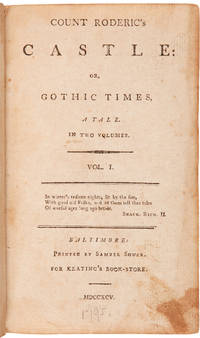
1795ref. 62704Baltimore: Printed by Samuel Sower for Keating's Book-Store 1795. Uncommon American Edition of a Rare Minerva Gothic Novel The first Baltimore printing of this gothic novel first published by the Minerva Press in the UK in 1794 with a second edition appearing the following year. There was also a Philadelphia printing in 1795 Bristol B9069 ESTC W37628 priority unknown. The narrative is set in medieval Lombardy and follows the trials and tribulations of the virtuous Rhinaldo and his beloved Isabel. Rhinaldo's father Count Roderic has been murdered and his throne seized by the usurper Astolpho who has imprisoned Isabel. The story of Rhinaldo's struggle to win back his birthright and save Isabel includes many of the traditional elements of the Gothic novels of the Romantic era including of course a castle complete with dungeon and vengeful spectre. Count Roderic's Castle was well-received by early readers with an 1807 French translation and new editions in the UK in 1840 and 1846. A modern edition with an introduction by Hannah D. Hudson appeared in 2017. Both Minerva Press editions are quite rare with only three copies of the first and two of the second located in ESTC. ESTC locates copies of this Baltimore printing to only six institutions: the American Antiquarian Society Harvard the Library Company of Philadelphia New York Public Library the Library of Congress and the University of Pennsylvania while ten holdings of the New York printing are reported. 12mo. Contemporary sheep spine gilt gilt leather label. Shallow losses at spine ends unobtrusive scrape to rear board. Moderate foxing and some soiling to outer leaves else a good sound copy of an uncommon cheaply printed book. ESTC W37627. EVANS 28486. BLOCK p.49. SUMMERS p.286. BLEILER 1978 p.6. BLAKEY p.164. hardcover books
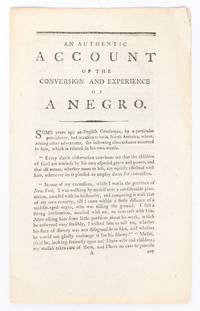
1795ref. 7213London: T. Wilkins 1795. First British edition. First separate edition. Measuring 205 x 120mm and complete in 4 pages. A Fine example. Scarce in all formats it was first printed in Vermont in 1793 and also contained a"faithful narrative.towards Polly Davis" one copy survives at AAS; soon after an edition was released from Maine containing "a poem on Christian Experience" only two copies survive both at NYPL. The present first British edition is also the first separately printed edition recorded by ESTC at only 9 libraries. It has come to auction on only five occasions with the present being the only example currently in trade. An Authentic Account records a brief encounter between a white Englishman and an enslaved Black man on a plantation in New York. Focusing their dialogue on the word of God and on salvation the white narrator asserts that the two men could find common ground as "children of God.equally effectual with him" despite their diametrically opposed positions within the social power structure. "Neither the color of his body nor the condition of his present life could prevent him from being my dear brother in our dear saviour." Despite this argument for the spiritual equality of men of all races the white narrator in An Authentic Account never questions nor seeks to subvert a power structure that would empower him while violently debasing Black people. Rather he passively participates in the Evangelical attitude so common of the era which considered enslavement an opportunity for saving the souls of uncivilized peoples who otherwise could not access the word of God. It was a position which abolitionist Evangelicals including William Wilberforce and Hannah More would decry as the height of hypocrisy in their own work during the period calling upon Christians not only to see Black people as spiritual equals but also as humans deserving equal liberty and dignity. ESTC T224026. T. Wilkins unknown books
1839ref. NF3369RAILROAD GUIDE FROM LONDON TO BIRMINGHAM. CONTAINING PICTURESQUE HISTORICAL LEGENDARY AND STATISTICAL SKETCHES OF ITS VICINITY WITH A MAP AND ILLUSTRATIONS Joesph Thomas / Simpkin Marshall and Co. 1839 236 pages some wear and a bit of cloth loss to the spine extremities and fore edge corner tips some soiling to the cloth boards else a good to very good copy with the gold-gilt pictorial stamping of train engine and conductor on front cover still fairly bright. Illustrated in both color and black & white with all maps and folding plates present as called for. Very scarce. One institutional holding noted only that in a library in Bern Switzerland. No copies have been at auction that I could locate for at least the last 35 years. Joesph Thomas / Simpkin, Marshall, and Co., hardcover books
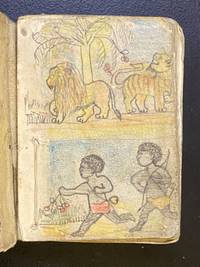
1920ref. 4211s.l. Germany or Austria s.d. late 19th or early 20th century. Poor. 64mo 70 x 55 mm. Homemade binding cloth spine loosening front cover perished; back cover: board covered with glazed paper present on the pastedown inside detaching but the glazed paper on the outside is torn away. VERY WORN see the 44 IMAGES on our website the back cover becoming unstable but all the leaves are attached. Preserved in a fine cloth case which is perfectly fitted to allow the manuscript to be correctly removed and completely protected. HIGHLY CURIOUS LILLIPUTIAN ALBUM CONTAINING JUVENILE DRAWINGS OF THE MOST UNLIKELY ASSEMBLAGE OF UNDER-REPRESENTED PEOPLES NAMELY AFRICANS NATIVE AMERICANS AND ABORIGINAL AUSTRALIANS ALL DEPICTED IN THEIR NATIVE HABITATS AND INDIGENOUS ATTIRE. We have never encountered a manuscript such as this one either in permanent collections on in the trade. Our album contains 41 colored drawings and b/w sketches on 35 leaves with a number of blanks bound in. They include: AFRICANS: 28 drawings and b/w sketches including hunting scenes some on horseback; nude and partially clothed Africans; African landscapes with lions tigers and great birds some devouring each other; an African child being saved from a tiger by an angel; and a man and woman dancing in a garden; three Africans cultivating grapes; several Africans fighting and much more. Some of the drawings feature palm trees and rounded huts. The caption on one of the drawings reads "In die Jagt" sic. NATIVE AMERICANS: 9 drawings and b/w sketches including hunting scenes with the hunters in full headdress with feathers; in one of the drawings a group of three men are in combat with a tiger who leaps from a large tree. Interestingly some of the drawings likewise feature palm trees. The caption on one of the drawings reads "Zweiter Theil vom dem Ameriganer oder Idianer." ABORIGINAL AUSTRALIANS: 4 drawings and b/w sketches the most remarkable being a scene of two men seated beneath a tree a large dinosaur bird flies immediately above and in the sky a peaceful sun sees all. The caption on one of the drawings reads "Dritter Theil von dem Australiener." GNOME: 1 b/w sketch. The gnome wears a backpack and carries a gnarled walking stick his conical hat bearing a heart-shaped ornament in the background a laughing sun peers over the horizon. That Parts II and III have a divisional title suggests that there were one or more leaves at the beginning of Part I as well now no longer extant. Nonetheless this is a fascinating little children's manuscript and remains A REMARKABLE SURVIVAL. CATALOGUER'S NOTE: We are grateful to Dr. Claudia Bubenik for helping us transcribe the juvenile German inscriptions. unknown books
1923ref. 333325New York: Société Anonyme Inc 1923. 2nd printing. 8 pp. 8vo. Side-stapled printed wrappers with some toning and bump to top corner which has caused small bit of loss to cover and first leafe. 2nd printing. 8 pp. 8vo. First published in 1920 Dreier's collection 1951 lists the book as being from 1920 making it the first ever Société Anonyme publication but says that it is out of print and notes 2nd printing 1923. Collection of the Société Anonyme p. 218; OCLC records only two copies: Yale and Wellesley Société Anonyme, Inc unknown books
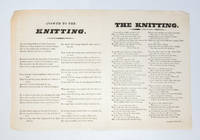
1820ref. 5877Bury: Birchinall Printer 1820. First edition. Near Fine. Broadside measuring 245 x 380mm and printed to verso only; the layout and placement of the imprint suggest that this piece was meant to be folded down the center with The Knitting appearing first and Answer appearing at rear. A very nearly Fine example with just a bit of creasing at the corners and faint offsetting along the left margin. Unrecorded by the Bodleian Library of Broadside Ballads or by OCLC the typeface suggests that it was produced toward the end of W. Birchinall's operations 1806-1829. A common thread connecting the Birchinall broadsides recorded by OCLC is the sensational depictions of 19th century true crime -- from the murder of Mary Booty in 1806 to the execution of Thomas South and his companions in 1816 to the burglary trial of James Philips and John Wade in 1822. The Knitting and Answer to the Knitting stand apart from these in a number of ways. Not only are they not sensationalizing identifiable local activities using names and dates clearly within their titles they take a more literary and satirical tone in relating young Susan's education in "knitting" and her resulting pregnancy and rejection by the shepherd Johnny. The Knitting focuses not only on Johnny's seduction but even more so on Susan's public exposure to gossip and social rejection as a result of his refusal to marry her. The text's serious warning to young women -- that whether right or wrong they will ultimately be blamed for the outcomes of unwed sex -- is undercut however by the followup Answer. Unlike The Knitting which opens with a more formal communal overture "come all ye pretty maidens fair" Answer creates a more private conspiratorial tone with its "It's of a young damsel as I have heard say." Lured into gossip by the narrator readers hear how Johnny returns to Susan after being required to pay child support for their son; how he secretly confesses his love in order to lure Susan again into a tryst; and how the couple's intercourse in a grove is a source of humor with Johnny's lovemaking resembling "a man that had fits". Unlike The Knitting's widely shared community knowledge and its use of gossip to warn young women and curb their sexual behavior Answer depicts how gossip spreads individual to individual with the narrator having heard this story from an unnamed friend and then sharing it with the reader among men to warn them against getting caught for their indiscretions. A research rich piece and the only known copy further work could be done on the physical object its typography and its printer. On a literary level further analysis could be done on how the pairing connects to other call-and-response poems such as the 17th century Passionate Shepherd to His Love and The Nymph's Reply and to the pastoral tradition. On a social history level further study could connect the work to 19th century gossip helping historians to understand how the practice of gossip differed in groups of various genders or classes especially surrounding sexuality and shame. Near Fine. Birchinall, Printer unknown books
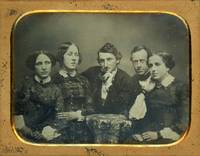
1850ref. List2204N.p. 1850. Half plate daguerreotype in case image measuring 4 7/8 x 3 1/2 inches. Some difficult-to-see scratches to the plate the most offensive across the left eye of Burritt excellent condition overall. Near Fine. A large daguerreotype of Elihu Burritt and a group of friends taken circa 1850 during the height of his career as a peace advocate. Burritt organized a series of international peace conventions during this period. He would later shift his focus to abolition supporting Free Labor Produce Associations and founding the National Compensated Emancipation Society. We are not able to identify the other subjects in the photograph. unknown books
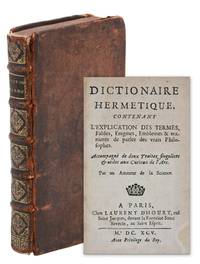
1695ref. 140949515Paris: Laurent d'Houry 1695. First edition. Very Good. First edition two books in one volume. Bound in alternating eights and fours in duodecimo format. xii 219 119 pp. Bound in full contemporary calf laced in boards gilt tooling to spine all edges speckled red. Very Good with chipping to corners and head and tail of spine cracking and discoloration to leather; front joint cracked but holding. Light toning to contents dampstaining to endpapers and to margins of first 30 and last 100 or so pages not very noticeable. Inscriptions in various hands to endpapers catalogue clippings tipped to front pastedown and small chip to lower corner of pp. 1/2. Duveen p.528. A glossary of alchemical terms combined with a treatise on "the tripart preparation of gold and silver." The anonymously authored Dictionaire Hermetique is generally attributed to the prolific medical and metaphysical writer William Salmon 1644-1713. He was more of a compiler than a theorist and a list of authors on whose work he drew is included in the preliminary pages of this volume. The second book erroneously dated 1595 instead of 1695 on its separate title page comprises the first French translations of two treatises previously published in Latin. The first deals with the transmutation of base metals into gold and silver the second with the method of creating a Philosopher's Stone. The author is Gaston DuClo named here as "Gaston le Doux dit de Claves" due to a publisher's misunderstanding a French lawyer and chemist whose experiments impressed his contemporaries and who is named in Robert Boyle's 1661 Skeptical Chymist. Laurent d'Houry unknown books
1803ref. 021561London: Tegg and Castleman 1803. First Edition. Hardcover. Pages toned with scattered soiling and foxing pencil notes on endpapers; binding Fine. Modern calf-backed orange paper boards 4-1/8" x 7"; 72 pages. Frontispiece engraving by I. Taylor after a design by W. M. Craig. Scarce Gothic fiction employing Phantasmagoria developed in the late eighteenth century from the earlier magic lantern: illusionistic exhibitions and public entertainments in which "specters" were produced through the use of a magic lantern. One should not underestimate the horror felt by those whose vision not trained by photography or the cinema revealed to them spiritual entities that one could seemingly touch. According to an article by Terry Castle CRITICAL INQUIRY 15.1 Autumn 1988: page 39 A number of literary works of the period contain episodes in which magic lanterns are used to deceive credulous would-be ghost-seers. Friedrich Schiller's fragment DER GEISTERSEHER 1789 translated into English as THE GHOST-SEER; OR THE APPARITIONIST 1795 is the best known of such works. See also the anonymous Gothic tale PHANTASMAGORIA: OR THE DEVELOPMENT OF MAGICAL DECEPTION London 1803." Scarce early horror fiction. Tegg and Castleman hardcover books
1781ref. 291930London: MacGowan 1781. hardcover. very good. 2 Volumes. 33 engraved maps & plans 3 folding & 28 engraved plates. Thick 4to unpaginated text in double columns. Full contemporary calf. Heraldic bookplate in each volume. London: MacGowan 1781. Scarce. Well-worn and joints cracked but attractive and overall very good. The work contains numerous entries for North American battles of the Seven Years' War American Revolutionary War &c. including Annapolis Royal Beauséjour Brandy-Wine Lake Champlain Charlestown Fort Frontenac Louisbourg Fort Necessity Fort Niagara Penobscot Fort Pitt Quebec Saratoga Ticonderoga New York &c. Appended are an essay on fortification. MacGowan unknown books
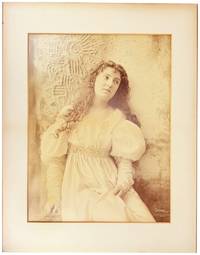
1894ref. 50061Columbus OH: Baker's Art Gallery 1894. Very Good. Columbus OH: Baker's Art Gallery 1894. Original large format silver gelatin photograph 52.5x40.5cm glued down to slightly later card mount 70.5x55.5cm. Card mount toned and a bit dust soiled. The image a Very Good or better bright example. Oversized and sadly unattributed artistic portrait photograph very much in the style of the pre-Raphaelites depicting a melancholy young woman with long flowing curly hair in a puffy white gown leaning against a crumbling decorative stone wall and chipped canvas. The photograph has fairly extensive paint touch-ups made by the studio to the woman's dress and hair providing detail so that the photograph could be reproduced as a halftone engraving by another Columbus-based artisan the Terry Engraving Company. An example of the Terry reproduction was featured in The Inland Printer Vol. XIII p. 348. While the photograph coincides with the 1894 Broadway production of "Cinderella" the woman in the photograph is not the play's star Ellaline Terriss though she has borrowed her hair-do. Baker's Art Gallery unknown books
1830ref. 1727431830. ANONYMOUS. Le Savant de huit ans suivi du Petit Coloriste. iv 96 pp. illustrated with 10 woodcuts of which 6 are hand-coloured. Oblong 8vo 92 x 114 mm. bound in contemporary sheep. Lille: Blocquel 1830. A charming little children's book on the practical aspects of arts and sciences. There are text illustrations of charts for drawing in proportion printed music and many definitions of arts and trades. The second half is taken up by an introduction to colour information on simple and composite colours some of which are illustrated on the title. The coloured plates including the title surrounded by fourteen colour samples illustrate painter sculptor engraver copperplate printer letterpress printer and finally bookbinder. Some rubbing and light wear the binding otherwise in fine condition with bright interior. Very rare with OCLC listing only Princeton Newberry Morgan Library. Not in Gumuchian. unknown books
ref. 005298Full Vellum. Very Good. N.d. but late 18th century after the publication of the original work in 1760 published in Venezia by Remondi. Large 8vo 25 by 20 cm. 25 pen and ink pages of illustration. These begin with the elaborate pen and ink Baroque title page with architectural decoration followed by page showing drawings of hands a second title with what we presume the one more fully original work by the copyist of seraphs holding up drapery with the title and a woman painter working before an easel and other illustrative decoration a broken sculpted head on the ground etc. Then 23 pages of pen and ink nude male studies the figures very Michelangelo-esque in the musculature and their overall sculptural quality. We would speculate that this copyist was in fact a woman based on the second title illustration. This particular illustration is delightful if the human figure itself doesn't have quite the polished execution of the copied material. Inked title on the vellum spine. The vellum is quite soiled. Otherwise the paper within is of high quality and clean. unknown books
1649ref. 19048Paris: Claude Morlot 1649. FIRST EDITION. Crude woodcut on the title of two hands one holding a globe the other a compass. Recently sewn into old wrappers. Old marginal notations. Fresh. First edition a curiously accurate pamphlet of astronomical predictions. By tracking the movements of 48 constellations reconciled with the ages of the earth’s quadrants the anonymous author predicted the French Revolution the expansion of the Turkish empire the Gold Rush and the rise of the “Two Americas” as a global power. He also warns of a comet “with the head of an elephant and the tail of a dragon” destroying Jerusalem as punishment for wars and idolatry. This title has been overlooked by the standard bibliographies of the Americas. OCLC locates 4 copies in the U.S. BYU Kansas Harvard Newberry. Moreau I: 136 no. 430; Dorbon 157. Claude Morlot unknown books
1686ref. 19573Liege but Antwerp: Louis Montfort 1686. FIRST AND ONLY EDITION. Eighteenth-century marbled boards later reinforced spine; old library shelf labels on the spine and pastedown. In good condition. Only edition an ethics guide for angry people. The text begins by describing anger and listing its causes then expounds on its effects for the angry person and society in general. For example one who is angry distances himself from God is prone to foolish and irrational behavior and is unable to love others. The anonymous author then offers advice for ridding oneself of anger: recognize your anger as a burden read the Bible curse the Devil etc. The book concludes with a list of prayers to God and the Saints for controlling and eliminating anger. OCLC records no copies outside Europe; STC Netherlands 402258312; not in Barbier. Louis Montfort unknown books
1825ref. 6770Connecticut: n.d. 1825. Unusual American watercolor measuring approx. 12.5" x 14.5" 315 x 363mm. several small breaks in the paper professionally repaired on verso mild waterstain enters from top margin a few other small minor defects but generally a good example. Remarkably similar to a picture by John William Hill entitled "Circular Mill King Street New York 1823" another unusually-shaped mill also in brown ink and green watercolor which was done when Hill was twenty one and derivative of the watercolor painting he probably learned from British trained artists including his father John Hill and William G. Wall. , n.d. unknown books
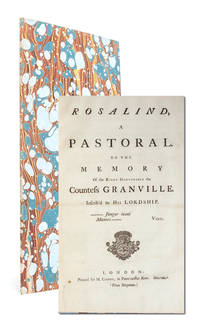
1745ref. 4023London: Printed for M. Cooper in Pater-Noster Row 1745. First edition. Fine. Recent marbled card wrappers. Bookplate of J.O. Edwards to front pastedown. Folio measuring 195 x 310mm and collating 7 1: complete. Pro-Patria watermark as called for. Internally a wide margined and fresh copy with a slight central fold across the title page and small paper repair to the inner margin of same page not affecting text. An exceedingly scarce work in praise of a woman who generated feminist shockwaves in her all too brief life ESTC lists only five known copies. It has never before appeared at auction and the present is the only one on the market. An anonymous poetical tribute to the Lady Sophia Fermor whose writing had already placed her among England's intellectual elite and whose two years' marriage to John Certeret second Earl Granville additionally placed her within London's political power center before her early death at age 24. Hailed by Lady Mary Wortley Montagu as having "few equals in beauty or graces" ODNB she was also the thinly veiled author of the revolutionary feminist tract Woman Not Inferior to Man or A Short and Modest Vindication of the Natural Right of the Fair Sext to a Perfect Equality of Power 1739. Released before her marriage with the by-line of "Sophia a Person of Quality" and predating Wollstonecraft's Vindication of the Rights of Woman by nearly half a century the book was a sensation. Pointing to unequal access to education and unfair treatment under the law as the only reasons for women's cultural inferiority Lady Sophia "exhorted all my sex.to betake themselves to the improvement of their minds and.shew our selves worthy.Let us shew them by what little we do without aid of education the much we might do if they did us justice" Woman Not Inferior. Her marriage was a companionate and loving one both gossiped about and admired. And her loss to puerperal fever in 1745 was felt widely. The present work was a tribute to Lady Sophia's irreplaceability. Though on the surface fixated on her external beauty the verses constantly recall women of Ovid and Shakespeare whose uniqueness stemmed from their interior strength and their ability to move others to action. The pastoral emphasis and the name Rosalind immediately evoke Shakespeare's headstrong and outspoken heroine from As You Like It who escaped the injustices of men by dressing and acting as one to protect herself and her best friend. In the poem Rosalind's disappearance to the land of the shades away from her husband Albino's gaze references Eurydice whose life and death inspired Orpheus' powerful songs. And the narrator's pleas for owls and nightingales to quiet themselves harken to stories of female anger and revenge notably Philomela who surived brutality to take her vengeance. The result is something more learned and serious a celebration of a complex woman who could have given more if only she had more time. ESTC T45227. Fine. Printed for M. Cooper in Pater-Noster Row unknown books
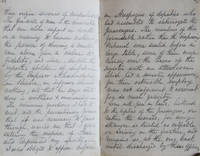
ref. 3063712mo 68 manuscript pages plus blanks and 8 pages of notes bound in contemporary embossed leather backed flexible stiff wraps entries written in English in pencil in a clear and legible hand. The journal is an excellent highly literate well written account of the author's impressions of Russian society and his keen observations on all aspects of life in Russia which the author refers to as "the Empire of Fear." The diarist who describes himself as a Russian prince is anonymous although he identifies his companions. He takes a business trip to the part of Russia which is now in present day Poland. The purpose of his trip was to draw up a statement of account for the manufactory of Messrs Palin & Dunlop in Nowogrodek. Afterwards he visits the different silk and cotton manufactories in the town and also the place where Russe serge cloth is manufactured. The book only mentions business in passing. Mostly the author is concerned with describing the people and the regime of the country. Sample Quotations: "Wednesday April 24 1872 Left Windermere at 8.15 a.m. for Preston meeting at the latter place Thomas Hatch Margaret Hatch; James Ainscough; and Robert Sale proceeded from thence to Hull via Leeds arriving at 4.40 p.m. Went to Foreign Consulate for colltn of Passports; thence Granville Temperance Hotel. Left the Humber Dock Wall by steamship Cyclone at 10.50 same evening for Hamburg…" After a rough passage our author and his party arrived in Hamburg after passing through customs they left Hamburg by rail at 11:30 a.m. for Perleburg making several stops along the way they arrived in Berlin shortly before 9 p.m. and stayed overnight at the Café Imperial. They departed Berlin by rail the next morning and arrived at the border of Poland that afternoon: "… on the boundary line of Poland where we first encountered the numerous annoyances travelers of all descriptions are subjected to and to which even Russian Princes like myself were obliged to submit during our transit through the Custom House but on arriving at Warsaw I had the mortification of seeing them released in three minutes whilst I had to struggle with every species of trickery for the space of three hours. At four o'clock we succeeded in penetrating that land which is blessed with all the amenities attached to Russian Government which was announced by the Russian Eagle floating over the miserable apology for a building yclept the Groche Custom House Groche being a town of some dozen or so of dilapidated wooden erections which serve not only as shelters but also as dwellings and of which the Customs House is chief Winding by the banks of the river Vistula … the line threaded by the river bank to Nieszawa which seemed to be a busy place for the shipment of sundry descriptions of goods and merchandize; some loading for others unloading from the Baltic; we next came to Bobrownik another port of the same river & from whence two canals diverge; after this we reached Biskepia; where we stayed upwards of 20 minutes and then proceeded to Wyrzogrod at which place we left the Vistula on the right & proceeded by way of Biaski & Takrodzin and reaching Warsaw at 9.20 p.m. at which place a multitude of little superfluous precautions engender a population of deputies and sub-officials each of whom acquits himself with an air of importance and a rigorous precision which seems to say though everything is done with much silence "Make way I am one of the members of the grand machine of state." Such members acting under an influence which is not in themselves in a manner resembling the wheel-work of a clock are called men in Russia! I say Russia though I am in reality speaking of Poland which is virtually and tyrannically a part and portion of the Great Empire. The sight of these voluntary automata inspires me with a kind of fear: there is something supernatural in an individual reduced to the state of a mere machine. If in lands where the mechanical arts flourish wood and metal seem endowed with human powers under despotisms human beings seem to become as instruments of wood. We ask ourselves what can become of their superfluity of thought And we feel ill at ease at the idea of the influence that must have been exerted on intelligent creatures before they could have been reduced to mere things. In Russia I pity the human beings as in England I feared the machines: in our own country England the creations of man lack nothing but the gift of speech; in Russian Poland the gift of speech is a thing superfluous to the creatures of the state. These machines clogged with the inconvenience of a soul are however marvelously polite it is easy to see they have been trained to civility as to the management of arms from their cradle. But of what value are the forms of urbanity when their origin savours of compulsion The free will of man is the consecration that can alone impart a worth or a meaning to human actions; the power of choosing a master can alone give a value to fidelity; and since despite the reported abolition of serfdom by the Emperor Alexander in Russia an inferior chooses nothing all that he says and does is worthless & unmeaning – The numerous questions I had to meet and the precautionary forms that it was necessary to pass through warned me that I was entering the empire of Fear and depressed my spirits. – I was obliged to appear before an Areopagus of deputies who had assembled to interrogate the passengers. The members of this formidable rather than the imposing tribunal were seated before a large table; some of them were turning over the leaves of the register with an attention which had a sinister appearance for their ostensible employ was not sufficient to account for so much gravity. Some with pen in hand listened to the replies of the passengers or rather the accused for every stranger is treated as culpable on arriving on the frontier and remains so at the very least until discharged by these officious notables; during the scrutiny six or a dozen ragged men half covered with sheepskins the wool turned within and the filthy skin appearing without will appear from time to time at the entrance to satisfy their curiosity by a prolonged and vulgar stare at the luckless beings undergoing the ordeal of officious examination. These arrivals and departures though they did not accelerate our matters at least gave me leisure to reflect on the species of filthiness peculiar to the people of the north who for the most part are shut up within doors and have a greasy dirtiness which appears to me far more offensive than the neglect of a people destined to live beneath the open heaven & born to bask in the sun. The tedium to which these Russian formalities condemned us gave me also an opportunity of remarking that the great lords of the country were little inclined to bear patiently the inconveniences of public regulations when those regulations proved inconvenient to themselves. "Russia is the land of useless formalities" they murmured to each other – but in French that they might not be overheard by the subaltern employès. I have retained the remark with the justice of which my own experience has only too deeply impressed me. As far as I have been hitherto able to observe a work that should be entitled The Russians judged by Themselves would be severe. The love of their country is with them only a mode of flattering its master; as soon as they think that master can no longer hear they speak of everything with a frankness which is the more startling because those who listen to it become responsible. It was a perfect relief to the tortured mind to find the sic such things as gags were not in use as it allowed me to expound a number of invectives which might have brought me into no end of trouble had my hearers been even possessed of an inadequate knowledge of the English language. The cause of all our delay was at length revealed. The chief of chiefs the director of the directors of the custom-house again presented himself: it was this visit we had been waiting so long without knowing it. At first it appeared as if the only business of the great functionary was to play the part of the man of fashion among the few ladies who had been subjected to the same indignities as those of the sterner sex. He reminded one of their rencontre in a house where the lady had never been; he spoke to her of balls she had never seen: but while continuing to dispense these courtly airs our drawing room officer of the customs would now and then gracefully confiscate a parasol stop a portmanteau or recommence with an impartable sang froid the researches already conscientiously made by his subordinates. In Russian administration minuteness does not exclude disorder. Much trouble is taken to obtain unimportant ends and those employed believe they can never do enough to show their zeal. The result of this emulation among clerks and commissioners is that the having passed through one formality does not secure the stranger from another. It is like a pillage in which the unfortunate might after escaping from the first troop may yet fall into the hands of a second & a third. The chief turnkey of the empire having at length concluded his scrutiny graciously permitted us to depart at about half past twelve and time being an object I thought it desireable not to chance the accommodation offered for the night in a city where I had already been subjected to a sufficiency of inconveniences & in opposition to the desires of those under my charge I determined to proceed at the earliest chance which occurred and accordingly on the morning of the 28th Sunday we moved from the neighbourhood of the city of Warsaw at a little past four o'clock and at half past seven reached a large and apparently prosperous town called Praga…" Our writer and his party stopped in Praga for about 40 minutes where excellent coffee but detestable food were procured. They resumed their journey and passed Misorent and Kamienezyk a small town on the river Narew. They then reached "a long straggling town" with the"somewhat short name of Nur" on the River Bang. Then the large village of Wysokie and afterwards the town of Surasz an extensive manufacturing place twelves miles further they reached Boralystok and at length arrived at Gradnau where the party stopped for the night at the Hotel de Coulon: "… and found it to be under the management of a degenerate French innkeeper. The house was nearly full at that time owing to the marriage of a Duchess which was about to take place; indeed the landlord appeared almost annoyed at being obliged to receive other guests … gave himself little trouble to accommodate us… Having seen their immediate wants attended to I joined the company at the Table d'hote which consisted of a mixture of Russians Poles French Spaniards and a couple of Englishmen and curiously enough not a single lady was present – Amongst those natives of High blood were a Prince & two young Counts. The first named is of an illustrious family and may be taken as a fair specimen of the general swelldom of the country. He is as I was informed the only son of a very rich individual and a character worthy of observation. The tavern is his empire: it is there that he reigns eighteen hours out of the twenty-four; on that ignoble theatre he displays naturally & involuntarily noble & elegant manners; his countenance is intellectual and extremely fascinating; his disposition is at once amiable and mischievous; many traits of rare liberality & even touching sensibility are recounted of him. He is remarkably well informed; his mind is quick and endowed with great capacity; his wit is unequalled but his language and conduct are such as would not be tolerated elsewhere except in the most depraved society. Profligacy has impressed upon his contours the traces of a premature decay; still these ravages of folly not of time have been unable to change the almost infantile expression of his noble and regular features … In no other land could a man be found like the young Prince Leuchtenberg but there are more than one such here. He is surrounded by a group of young men his disciples and competitors who without equaling him in disposition or in mind all share with him a kind of family resemblance it may be seen at the first glance that they are and only can be Russians. It is for this reason that I am about to give some details connected with their manner of life … But I know not or rather fear how to begin; for it will be necessary to reveal the connection of these libertines not with women of the town but with the youthful sisters of religious orders – with nuns whose cloisters as it will be seen are not very securely guarded. It may be asked why lift a corner of the veil that shrouds scenes of disorder which ought to remain carefully covered Perhaps my passion for the truth obscures my judgment but it seems to me that evil triumphs so long as it remains secret whilst to publish it is to aid in destroying it and since these incidents may at some future time be submitted to the scrutiny of the public this one particularly is noted here as a memorandum; besides I have resolved to draw a picture of this country as I see it – not a composition but an exact and complete copy from nature. … As for the man whom I select for a specimen of the most unbridled among libertines he carries his contempt of opinion to the extent of desiring me to describe him as I see him. A story of the death of a young man killed in the convent of - by the nuns themselves he told at the full table d'hôte before several grave and elderly personages employès and placemen who listened with an extraordinary patience to this and several other tales of a similar kind all very contrary to good manners. The story in question … relates to a young man who after having passed an entire month concealed within the convent of - began at last to weary of his course of happiness to a degree that wearied the holy sisters also… whereupon the nuns wishing to be rid of him but fearing the scandal that might ensue should the sic send him to die in the world concluded that it would be better to make an end of him themselves. No sooner said than done – The mangled remains of the wretched being were found a few days after at the bottom of a well. The affair was hushed up. …As I have imposed upon myself the duty of communicating the ideas that I have hurriedly formed of this land I feel called upon to add to the picture already sketched a few minor specimens of the conversation of the parties already referred to. One boasted of himself & his brothers being the sons of the footmen and the coachmen of their reputed father; & he drank and made the rest drink to the health of all his unknown parents. Another claimed the honour of being brother on the father's side of all the waiting maids of his mother. Many of these evil boasts are no doubt made for the sake of talking: but to invent such infamies in order to glory in them shows a corruption of mind that proves wickedness to the very core – wickedness worse even than that exhibited in the mad actions of these libertines. According to them the wives of the middle classes are no better than the women of rank. During the months that their husbands go to the fair of Nijni the officers of the neighboring garrisons take care not to leave the vicinity of the deserted wives. This is the season of easy assignations. The ladies are generally accompanied to the place of rendezvous by some respectable relation to whose care their absent husbands have confided them. The goodwill and silence of these family duennas have also to be paid for. Gallantry of this kind cannot be excused as a love affair there is no love without bashful modesty – such is the sentence pronounced from all eternity against women – who cheat themselves of happiness and who degrade instead of purifying themselves by tenderness. The defenders of the Russians pretend that the women have no lovers; I agree with them other term must be employed to designate the friends whose intimacy they seek in the absence of their husbands. … Scarcely was I installed in my abode for the night than overcome by fatigue I lay down wrapped in a rug on an immense leather sofa & slept profoundly during – 3 minutes. At the end of that time I awoke in a fever and in casting my eyes upon the rug what a sight assailed them! – a brown but living mass: things must be called by their proper names – I was covered I was devoured with bugs in a place too where I was obliged to remain imprisoned with the enemy and the war was consequently more sanguine. … A Russian waiter appeared. I made him understand that I wished to see his master. The master kept me waiting a long time and when he at length did come & was informed of the nature of my trouble he began to laugh & soon left the room telling me that I should soon become accustomed to it for that it was the same everywhere in Russia. … The town generally is not of a prepossessing appearance; a few yards only to the rear of the inn I came to a guard house full of Cossacks whose stiff bearing and severe gloomy air would impart to foreigners the idea of a country where no one dares to laugh even innocently. In the neighbourhood of the canal wharves all was busy with life whilst a few drowskas were already slowly traversing the streets the drivers dressed in the costume of the country The singular appearance of these men their horses and carriages struck me more than anything else on this my first view of a Russian town or city. The ordinary costume and general appearance of the lower classes by which I mean the workmen coachmen small trades people is as follows – On the head is worn either a cap formed somewhat in the shape of a melon or a narrow brimmed hat low crowned & wider at the top than the bottom. This headdress slightly resembled a woman's turban. It becomes the younger men. Both young & old wear beards. Those of the beaux are silken and carefully combed; those of the old and careless appear dirty and matted. Their eyes have a peculiar expression strongly resembling the deceitful glance of the Asiatic. … The movements of the men whom I met were stiff and constrained; every gesture seemed to express a will which was not their own. The morning is the time for commissions and errands and not one individual appeared to be walking on his own account. I observed very few good-looking women and heard no girlish voices; everything was dull and regular as a barrack. There are scarcely any buildings worthy of note in this busy mart except the Kremlin a building which is indigenous to every Russian town of importance. … Shortly after 9 0'clock we took our departure from Gradnow through a dead flat & muddy district stopping only at 3 insignificant towns or large villages viz: Goja Perschevelka & Onlekha; and about a couple of miles from the last named we reached Novogrodek a large manufacturing town and here terminated our journeying by rail though we were still 21 miles distant from our destination Novogrodka and in order to accomplish this distance I succeeded after some difficulty in securing a team of horses & a rude description of dray minus springs with driver for the sum of half Impl or about 16/1 English in this rude machine we were conveyed at the risk of our necks owing to the badness & unevenness of the road in a trifle under two hours; and shortly after 4 o'clock I presented myself Mssrs Palin and Dunlop's manufactory along with T. Hatch…Mr. Hebden the manager was greatly surprised to see us as he had not been apprised of our coming: though a letter had been forwarded from Manchester a fortnight previously to inform him of our coming but owing to the irregularity of the Russian postal arrangements it had not been delivered although it arrived safely on the following morning." "Tuesday April 30th 17th Russian I arose early finding Novorogodka in every way an exact repetition of my first nights experiences in the great Muscovite nation. I have often in my travels had reason to remember the sagacious observations of Pestalozzi the great practical philosopher the preceptor of the classes before Fourier & the St. Simonians. According to his observations on the life of the lower orders of two men who have the same habits of life one will be dirty the other clean. … Among the Russians there reigns a high degree of sordid negligence it seems to me they must have trained their vermin to survive the bath. Notwithstanding my ill humour I went carefully over the interior of the patriotic convent of the Trinity… This is one of the principal convents in the empire and at this season of the year is much sought by pilgrims even from the most remote parts of the country. All the names of note in Russian history have taken pleasure in enriching the convent which overflows with gold pearls and diamonds. … Czars Empresses nobles libertines and true saints have vied with one another in enriching the treasury of Novogrodka. Amid so many riches the simple dress and the wooden cup of St. Sergius shine by their very rusticity. … The convent would have furnished a rich booty to an enemy; it has not been taken since the fourteenth century. It contains nine churches. The shrine is of silver gilt; it is protected by silver pillars and canopy the gift of the Empress Anne. The image of St. Sergius is esteemed miraculous. Peter the Great carried it with him in his wars against Charles XII. Not far from the shrine under shelter of the virtues of the hermit lies the body of the usurping assassin Boris Godounoff surrounded by many of his family. The convent contains various other famous but shapeless tombs… The number of monks is now only one hundred… Notwithstanding my persevering request they would not show me the library. "It is forbidden" was always the answer. This modesty of the monks who conceal the treasures of science while they parade those of vanity strikes me as singular. I argue from it that there is more dust on their books than on their jewels. …" "… The town of Novogrodka is an important entrepot for the interior commerce of Russia. By it Petersburg communicates with Persia the Caspian & all Asia. The Volga that great national & moving road flows by the town which is the central point of the interior navigation of the country – a navigation wisely directed much boasted of by the subjects of the Czar and one of the principal sources of their prosperity. It is with the Volga that the immense ramifications of canals are connected that create the wealth of Russia. The town of Novogrodka is like all other provincial towns in the empire vast in extent and appears empty. The streets are immensely broad the squares very spacious and the houses in general stand far apart. The same style of architecture reigns throughout. The painted and gilded towers which are numerous shine at a distance and gives the idea of a place resplendent with wealth and the town altogether presents a picturesque appearance…. Notwithstanding it's commercial importance the town is empty dull and silent. From the height of the terrace is to be seen the yet more empty dull & silent surrounding country with the immense river its hue a somber iron-grey its banks falling straight upon the water and forming at their top a level with the leaden-tinted plain here and there dotted with forests of birch & pine. The soil is however as well cultivated as it is capable of becoming; it is boasted of by the Russians as being with the exception of the Crimea the richest & most smiling tract in this empire. The primitive droshky is to be seen in this town. It consists of a little board on four wheels entirely concealed under the occupant and looks as though the horse were fastened to his person… The females generally go barefoot. The men most frequently wear a species of sandal made of rushes rudely platted which resembles those of antiquity. The leg is clothed in a wide pantaloons the folds of which drawn together at the ankle by a little fillet are covered with the shoe. This attire is precisely similar to the Scythian statues of the Roman sculptors. Upon a long float of timber I observed several men descending the course of their native Volga they managed to guide the raft skillfully the while singing a Russian melody in the vague plaintive strain peculiar to the country. On reaching near to where I stood they wished to land which they eventually did and passed close before me without taking any notice of my foreign appearance; without even speaking to each other. The Russian peasants are taciturn and devoid of curiosity; I can understand why: what they know disgusts them with all of which they are ignorant. To a certain point the want of a charitable disposition in the Russians towards strangers appears to me excusable. Before knowing us they lavish their attentions upon us with apparent eagerness because they are hospitable but they are also easily wearied. In welcoming us with a forwardness which has more ostentation than cordiality they scrutinize our slightest words they submit our most insignificant actions to a critical examination; and as such work necessarily furnishes them with much subject for blame they triumph internally saying "These then are the people who think themselves superior to us!" …" "… One of the peculiar laws relating to strangers in this country is that on entering the empire in addition to answering the multitudinous and frivolous questions put as to your object &c it is also necessary to mention if the visit or stay on Russian soil is to extend over five days for if so it will be found necessary for the foreigner to advertise not less than twice at intervals of three days his intention of departure in the local newspapers stating the precise time of leaving &c. Also to make an affidavit to the Governor of the province that all debts are duly discharged a note to that effect is given by the Governor for the moderate sum of half a rouble 1/6 ¾ in exchange for his autograph this is then countersigned by the sub-governor who also expects a tipfor his condescension. No one can leave Russia under any pretence until he has forwarded all his creditors of his intention in the manner above quoted. This is strictly enforced unless at least you pay the police to shorten the prescribed time and even then the insertion must be made once if not twice. No one can obtain post horses or a railway ticket without a document from the authorities certifying he owes nothing. … The Russian police so alert to torment people is slow to help or enlighten them when they have recourse to its aid in doubtful situations…" "… It will by this be seen how the subaltern agents of the Russian police perform their duties. These faithless servants gained a double advantage by selling the body of the murdered woman; they obtained a few rubles & they also concealed the murder which would have brought upon them sever blame if the noise of the event had got abroad. …" "… I safely reached Warsaw shortly before 9 at night and entered a Russian or I might perhaps more properly call it a Polish coffee house adjacent to the Railway. … Here I determined to take up my quarters for the night. The waiters were dressed in white shirts girded round the middle and falling like a tunic over loose white pantaloons. The teas served was excellent so is the coffee & liqueurs at this establishment but it is served with a silent solemnity very different from the gaiety which suffuses houses of entertainment in our own country. … About ten o'clock I sallied forth into the city without guide or companion strolling at hazard from street to street. I first traversed several long and wide streets laid out with great regularity. It was only at this time that the sun sank and the moon rose. The turrets of the convents the spires of the chapels the towers the battlements and all the irregular and frowning masses of buildings were swathed with wreaths of light … my eyes were filled with the dust of the streets kept in continual motion by the number of vehicles moving about at a gallop in all directions. It was not until 12 o'clock that I repaired to my lodgings where I slept soundly happily without the aid of the multitudinous bugs which I had experienced previously in Russia." books
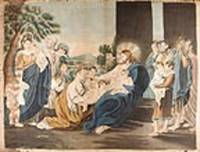
1820ref. 147671820. Watercolour heightened with india ink on wove paper some discoloration noticable on the front in the margins. On the verso framing directions in pencil with a title "Christ Blessing Little Children" and a name perhaps the owner Mrs. Pollard. Christ sits with five apostles standing behind Him and blesses seven children attended by five women; a bearded man stands behind them. unknown books
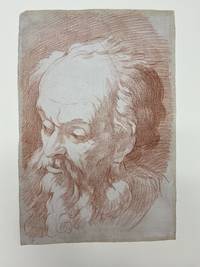
1600ref. 2751Venetian School. Sanguine drawing. 17th century. Size. With a watermark in the middle of the right eye. Margins: 10 x 7. books