[Schnurre; in:] Eli L. BerkovitsAntiquariat.de
3663 risultati
1962rif. 14187Ner-Tamid-Verlag, Frankfurt am Main, 1962. 80(2) Seiten, OBroschur m. OU, Besitzervermerk: "Wolfdietrich Schnurre, Schüler: gekauft 1962 studiert 1985". Zahlreiche Anmerkungen und Unterstreichungen mit Bleistift im Text. Lose beigelegt ein gefalteter DIN A4 Notizzettel gleicher Schrift (datiert 1.5.85). 2. Auflage. Die Erstauflage erschien 1935 im Jüdischen Buch-Verlag Erwin Löwe, Berlin und wurde gleich nach Erscheinen verbrannt. Der Einband am Rand mit (Brand?)Flecken. Gutes Exemplar. Sehr selten. Very rare. Good copy. "Wolfdietrich Schnurre (* 22. August 1920 in Frankfurt am Main; ? 9. Juni 1989 in Kiel) war ein deutscher Schriftsteller. " (aus: Wikipedia). Büchner-Preis 1983.
1985rif. EEzz6213bWien, Hochschule für angewandte Kunst 1985. 4°. 375 S., zahlr. Abb. im Text, obrosch., sehr gut erhalten Erschienen anlässlich der Ausstellung "Die verlorenen Österreicher 1918-1938" an der Hochschule für angewandte Kunst, Wien, eine der richtungweisenden Ausstellungen des Hauses, organisiert von dessen bedeutendstem Rektor seit 1945, Oswald Oberhuber. Mit Beiträgen von Elisabeth Freundlich, Gabriele Koller, Gloria Withalm, Manfred Wagner, Friedrich Achleitner, Gerda Buxbaum, Alexandra Suess u. Joana Radzyner zu den Bereichen Exil, Literatur, Malerei, Bildende Kunst, Architektur, Musik, Darstellende Kunst.
1941rif. 4177[Amsterdam], Pantheon, [1941]. XVI S., 1 Bl., 117 S. Mit 1011 Abbildungen. Gr.-8°. Original-Leinwand.
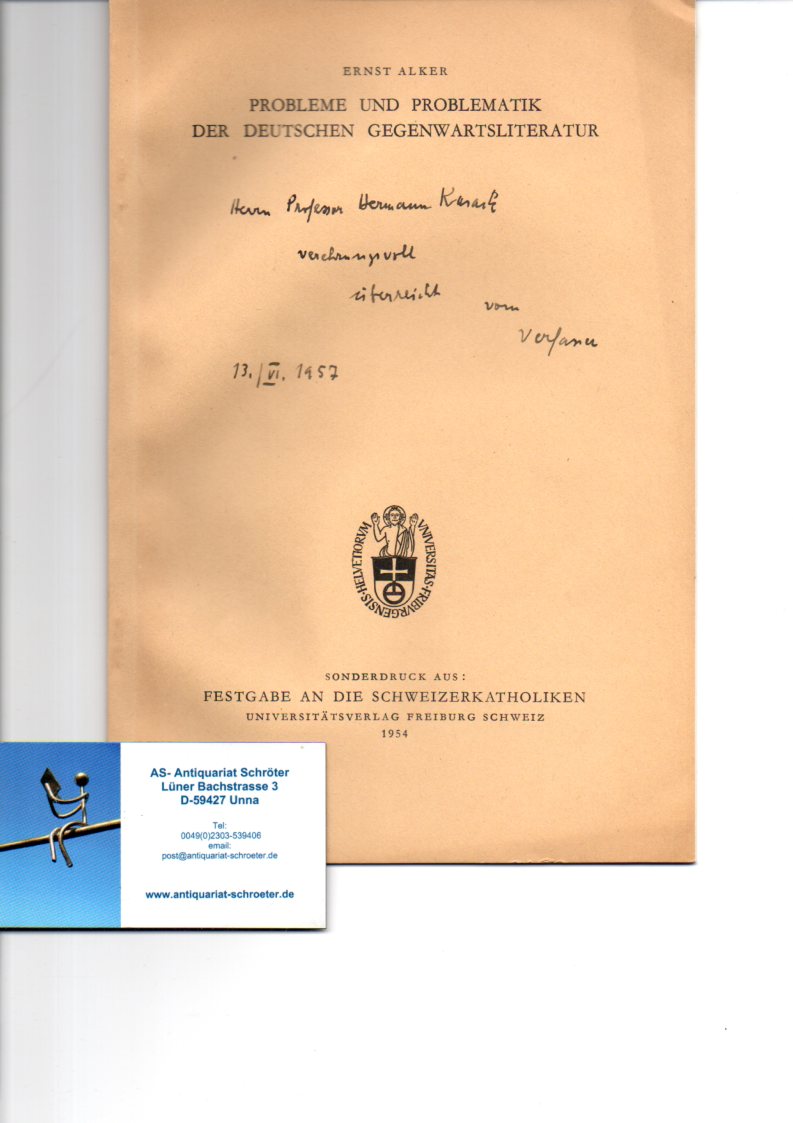
1954rif. 10768Universitätsverlag, Freiburg/Schweiz, 1954. Seiten 392-408, OBroschur, auf dem Umschlag eine handschriftliche Widmung des Autors für Kasack ("Herrn Professorr Hermann Kasack verehrungsvoll überreicht vom Verfasser 13./VI. 1957".). Das Exemplar stammt aus der Bibliothek von Professor Doktor Hermann Kasack. Kasack war u.a. Cheflektor im S. Fischer Verlag (später Suhrkamp Verlag). Gutes Exemplar. With a handwritten dedication by the author to Mr Kasack. Good copy.
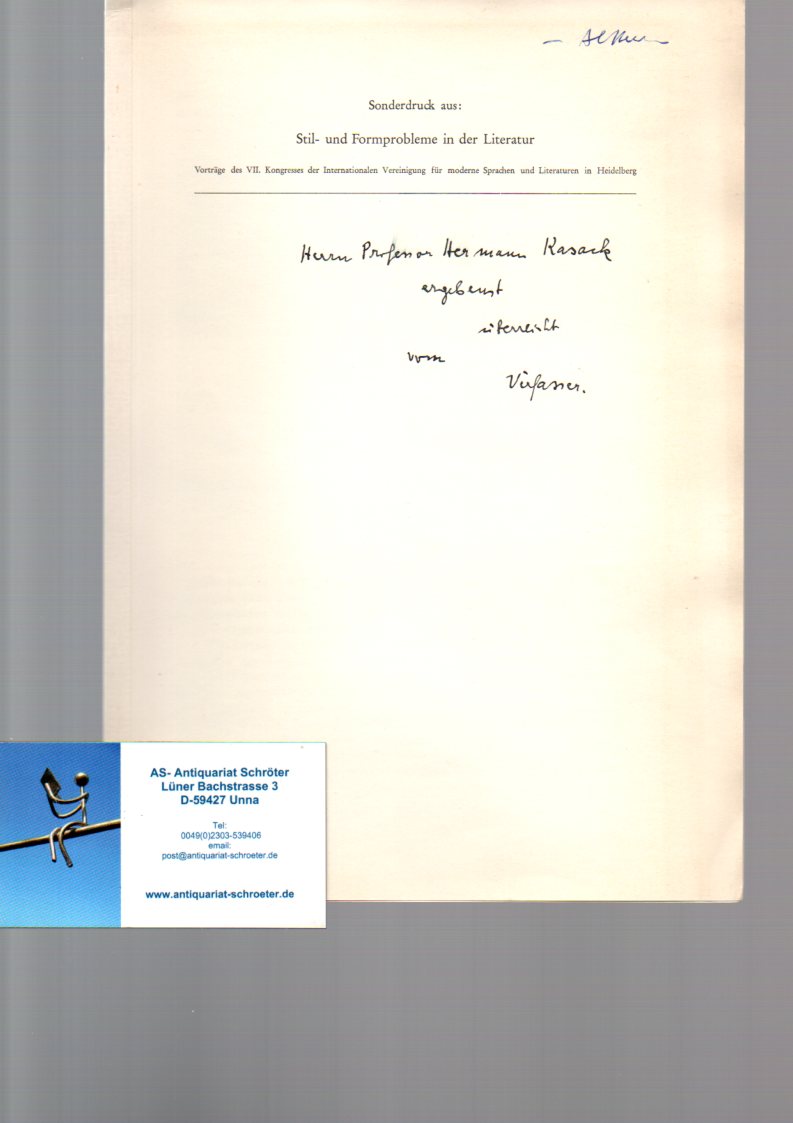
rif. 10767in Heidelberg, Vortrag, o.J. Seiten 453-458, OBroschur, auf dem Umschlagsblatt eine handschriftliche Widmung des Autors für Kasack ("Herrn Professorr Hermann Kasack ergebenst überreicht vom Verfasser".). Am oberen Titelblattrand die Signatur von Alker. Das Exemplar stammt aus der Bibliothek von Professor Doktor Hermann Kasack. Kasack war u.a. Cheflektor im S. Fischer Verlag (später Suhrkamp Verlag). Leichte Wischspuren der Widmung. Gutes Exemplar. With a handwritten dedication by the author to Mr Kasack. Good copy.
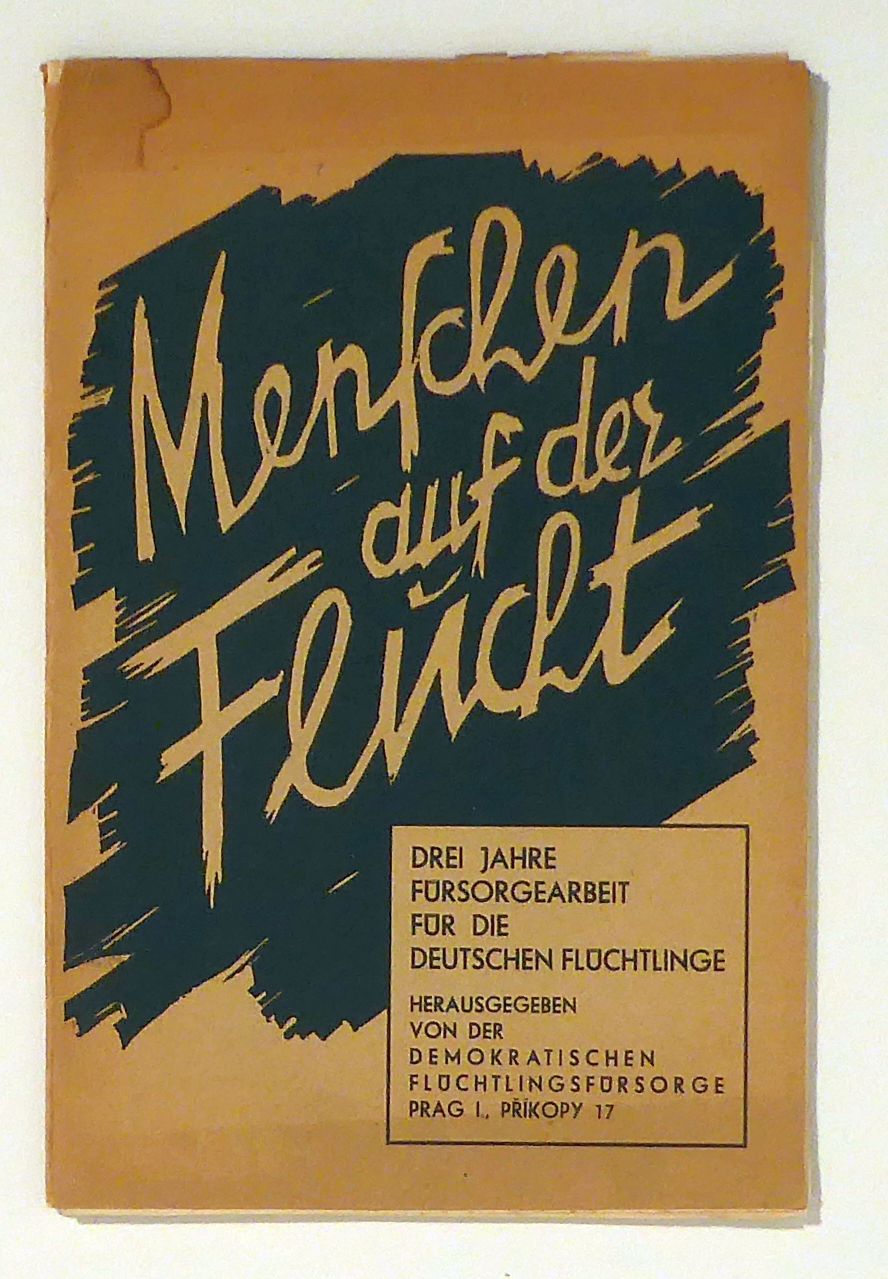
1936rif. 87962Prag-Karlin, Neumann, [1936]. 31, [1] S., Or.br. mit Klammerheftung, gr.8°. Deutsches Exilarchiv 2029. Der Text erschien anonym, geschrieben hatte ihn Kurt Richard Grossmann. Mit einem Vorwort von Siegfried Neumann, Vorsitzender der Demokratischen Flüchtlingsvorsorge, in tschechischer und deutscher Sprache und einem "Ruf and die Welt von James G. Macdonald, gerichtet an den Generalsekretär des Völkerbundes. Beigelegt zwei Spendenaufrufe der Demokratischen Flüchtlingshilfe in Prag aus dem Jahre 1936 in deutscher Sprache. Unterzeichnet von Kurt [Richard] Grossmann, ehemaliger Generalsekretär der Deutschen Liga für Menschenrechte. Brief und Unterzeichnung gedruckt, der Text in einer Schreibmaschinenschrift. Softcover Umschlag gebräunt, oben mit kleinem Feuchtigkeitsrand.
1983rif. 16656Munich: Edition Text Kritik 1983-2010. Together 28 octavo volumes. Original printed card wrappers. Condition uniformly fine - free of markings or significant wear. Texts entirely in German. A complete run through 2010 of this important annual publication devoted to German Exile Literature primarily of the Thirties and Forties. Each yearbook is an edited volume of essays on a particular theme as follows: 1- Stalin und die Intellektuellen :: 2- Erinnerungen ans Exil kritische Lektüre der Autobiographien nach 1933 :: 3- Gedanken an Deutschland im Exil :: 4- Das jüdische Exil :: 5- Fluchtpunkte des Exils :: 6- Vertreibung der Wissenschaften :: 7- Publizistik im Exil :: 8- Politische Aspekte des Exils :: 9- Exil und Remigration :: 10- Künste im Exil :: 11- Frauen und Exil. Zwischen Anpassung und Selbstbehauptung :: 12- Aspekte der künstlerischen inneren Emigration :: 13- Kulturtransfer im Exil :: 14- Rückblick und Perspektiven :: 15- Exil und Widerstand :: 16- Exil und Avantgarden :: 17- Sprache - Identität - Kultur :: 18- Exile im 20. Jahrhundert :: 19- Jüdische Emigration zwischen Assimilation und Verfolgung Akkulturation und jüdischer Identität :: 20- Metropolen des Exils :: 21- Film und Fotografie :: 22- Bucher Verlage Medien :: 23- Autobiografie und Wissenschaftliche Biografik :: 24- Kindheit und Jugend im Exil - Ein Generationenthema :: 25- Ubersetzung als transkultureller Prozess :: 26- Kulturelle Räume und asthetische Universalität :: 27- Exil Entwürzelung Hybridität :: 28- Gedachtnis des Exils Formen der Erinnerung. Edition Text + Kritik unknown books
1942rif. 56320Indianapolis: Bobbs-Merrill 1942. First American Edition. Octavo 21cm. Brick-red cloth decoratively titled in yellow on spine and front cover; dustjacket; red top-stain; 251pp. Tight straight and unmarked with topstain even and unfaded; Near Fine. In the original pictorial dustwrapper unclipped priced $2.50 at base of front flap lightly rubbed at extremities; Very Good. A late work by the Viennese Jewish author best-known for his classic children's story Bambi 1923. The current work was written from exile in Switzerland following Hitler's annexation of Austria. Bobbs-Merrill unknown books
1983rif. 16656Munich: Edition Text Kritik 1983-2010. Together 28 octavo volumes. Original printed card wrappers. Condition uniformly fine - free of markings or significant wear. Texts entirely in German. A complete run through 2010 of this important annual publication devoted to German Exile Literature primarily of the Thirties and Forties. Each yearbook is an edited volume of essays on a particular theme as follows: 1- Stalin und die Intellektuellen :: 2- Erinnerungen ans Exil kritische Lektüre der Autobiographien nach 1933 :: 3- Gedanken an Deutschland im Exil :: 4- Das jüdische Exil :: 5- Fluchtpunkte des Exils :: 6- Vertreibung der Wissenschaften :: 7- Publizistik im Exil :: 8- Politische Aspekte des Exils :: 9- Exil und Remigration :: 10- Künste im Exil :: 11- Frauen und Exil. Zwischen Anpassung und Selbstbehauptung :: 12- Aspekte der künstlerischen inneren Emigration :: 13- Kulturtransfer im Exil :: 14- Rückblick und Perspektiven :: 15- Exil und Widerstand :: 16- Exil und Avantgarden :: 17- Sprache - Identität - Kultur :: 18- Exile im 20. Jahrhundert :: 19- Jüdische Emigration zwischen Assimilation und Verfolgung Akkulturation und jüdischer Identität :: 20- Metropolen des Exils :: 21- Film und Fotografie :: 22- Bucher Verlage Medien :: 23- Autobiografie und Wissenschaftliche Biografik :: 24- Kindheit und Jugend im Exil - Ein Generationenthema :: 25- Ubersetzung als transkultureller Prozess :: 26- Kulturelle Räume und asthetische Universalität :: 27- Exil Entwürzelung Hybridität :: 28- Gedachtnis des Exils Formen der Erinnerung. Edition Text + Kritik unknown
1942rif. 56320Indianapolis: Bobbs-Merrill 1942. First American Edition. Octavo 21cm. Brick-red cloth decoratively titled in yellow on spine and front cover; dustjacket; red top-stain; 251pp. Tight straight and unmarked with topstain even and unfaded; Near Fine. In the original pictorial dustwrapper unclipped priced $2.50 at base of front flap lightly rubbed at extremities; Very Good. A late work by the Viennese Jewish author best-known for his classic children's story Bambi 1923. The current work was written from exile in Switzerland following Hitler's annexation of Austria. Bobbs-Merrill unknown
1979rif. LFA-126735776Revue trimestrielle publiée par des Pères de la Compagnie de Jésus : 128 pages, format 155 x 220 mm, brochée, bon état
1779rif. List3711London 1779. Autograph letter signed Joseph Green to Boston merchant Samuel Eliot. Folded letter datelined "London Mar. 26th 1779" with "Rec'd 22nd Decr. 1779" docket on top flap. 7 x 9 ¼ inches 3pp. Some repairs with archival tape folded small tears at some folds. Excellent. A thoughtful Revolutionary-era letter written by Joseph Green the Boston clergyman poet satirist and wit whose verses made him one of the best-known literary figures in colonial New England. A graduate of Harvard College and member of Boston's mercantile elite Green maintained friendships with figures including Mather Byles and Benjamin Church. He is known for his satirical poetry and as a signer of the 1773 attestation supporting Phillis Wheatley's authorship of Poems on Various Subjects Religious and Moral. A Loyalist during the American Revolution and named in the 1778 Massachusetts Banishment Act Green departed Boston in 1775 and spent the remainder of his life in England. The present letter was written only a year before his death in London in 1780. Written during the period of British blockade and privateering that turned the Atlantic into a contested military space the letter survives as a rare example of communication successfully passing between a Loyalist exiled in London and a Boston merchant. Green repeatedly returns to the difficulty of maintaining contact noting that "all means of correspondence seem to be cut off" and explaining that he is able to write only because he has found "a particular friend in whom I can confide." The letter itself written in March and not received until December 1779 provides tangible evidence of the obstacles confronting transatlantic correspondence during the Revolution. Green writes: "Having now an opportunity of writing by a particular friend in whom I can confide I embrace it to let you and our niece know that your Aunt and I are both well and very solicitous to hear of your health and welfare. We think it no small unhappiness to be so far removed from so many of our friends especially at a time when all means of correspondence seem to be cut off; but when we consider what scenes of confusion and distress we have escaped and what repose and quiet we have enjoyed here we ought not to repine. "Notwithstanding we have been so long in Engl'd I have seen nothing of the country and your Aunt next to nothing of the town. I amuse myself in trolling thro' several parts of it where new objects are perpetually presenting themselves; and I am the fonder of this exercise as it contributes to health as well as amusement. "The climate here agrees well with my constitution. I enjoy better health than I did at home & my friends tell me I am younger. But I know better than to believe them in this because I think if I was to go about it I could prove I am near four years older than when I left Boston." Green's remarks describe the reality of transatlantic communication during the Revolutionary War when Loyalists abroad and their friends in America frequently depended upon trusted private carriers rather than regular postal channels. The letter's journey from London to Boston-requiring months to arrive and bearing Eliot's receipt docket of December 22 1779-illustrates precisely the obstacles Green describes. Green continues with observations on one of the great public controversies of wartime Britain the celebrated court martial of Admiral Augustus Keppel following his engagement with the French fleet off Brest. Green describes the intense public reaction and the partisan passions surrounding the affair: "We have had a forced and ostentatious display of joy on acct. of Admiral Keppel's acquittal. He has been try'd by a court martial on a charge brought against him by Admiral Palliser for misconduct in the engagement he had the last summer with the French fleet off Brest. This has been made a party affair and has been carry'd to a most extravagant height. The whole city has been illuminated three or four nights and there have been great rejoicings thro' the Kingdom. But the matter is now pretty well over and Palliser has ruin'd himself by it." Most affecting however is Green's reflection on the increasingly remote prospect of ever returning to Boston. He seems to realize that his exile may be permanent writing that "At the time I left Boston it was uncertain when I should return or whether I should return at all. But the improbability was not so great then as it is now. The door was then shut now it is bolted." Green's letter offers a moving account of Loyalist exile-separation from friends and family with hope for return fading. We find no other records of letters written by Green during this period in commerce or at auction. books
1779rif. List3711London 1779. Autograph letter signed Joseph Green to Boston merchant Samuel Eliot. Folded letter datelined "London Mar. 26th 1779" with "Rec'd 22nd Decr. 1779" docket on top flap. 7 x 9 ¼ inches 3pp. Some repairs with archival tape folded small tears at some folds. Excellent. A thoughtful Revolutionary-era letter written by Joseph Green the Boston clergyman poet satirist and wit whose verses made him one of the best-known literary figures in colonial New England. A graduate of Harvard College and member of Boston's mercantile elite Green maintained friendships with figures including Mather Byles and Benjamin Church. He is known for his satirical poetry and as a signer of the 1773 attestation supporting Phillis Wheatley's authorship of Poems on Various Subjects Religious and Moral. A Loyalist during the American Revolution and named in the 1778 Massachusetts Banishment Act Green departed Boston in 1775 and spent the remainder of his life in England. The present letter was written only a year before his death in London in 1780. Written during the period of British blockade and privateering that turned the Atlantic into a contested military space the letter survives as a rare example of communication successfully passing between a Loyalist exiled in London and a Boston merchant. Green repeatedly returns to the difficulty of maintaining contact noting that "all means of correspondence seem to be cut off" and explaining that he is able to write only because he has found "a particular friend in whom I can confide." The letter itself written in March and not received until December 1779 provides tangible evidence of the obstacles confronting transatlantic correspondence during the Revolution. Green writes: "Having now an opportunity of writing by a particular friend in whom I can confide I embrace it to let you and our niece know that your Aunt and I are both well and very solicitous to hear of your health and welfare. We think it no small unhappiness to be so far removed from so many of our friends especially at a time when all means of correspondence seem to be cut off; but when we consider what scenes of confusion and distress we have escaped and what repose and quiet we have enjoyed here we ought not to repine. "Notwithstanding we have been so long in Engl'd I have seen nothing of the country and your Aunt next to nothing of the town. I amuse myself in trolling thro' several parts of it where new objects are perpetually presenting themselves; and I am the fonder of this exercise as it contributes to health as well as amusement. "The climate here agrees well with my constitution. I enjoy better health than I did at home & my friends tell me I am younger. But I know better than to believe them in this because I think if I was to go about it I could prove I am near four years older than when I left Boston." Green's remarks describe the reality of transatlantic communication during the Revolutionary War when Loyalists abroad and their friends in America frequently depended upon trusted private carriers rather than regular postal channels. The letter's journey from London to Boston-requiring months to arrive and bearing Eliot's receipt docket of December 22 1779-illustrates precisely the obstacles Green describes. Green continues with observations on one of the great public controversies of wartime Britain the celebrated court martial of Admiral Augustus Keppel following his engagement with the French fleet off Brest. Green describes the intense public reaction and the partisan passions surrounding the affair: "We have had a forced and ostentatious display of joy on acct. of Admiral Keppel's acquittal. He has been try'd by a court martial on a charge brought against him by Admiral Palliser for misconduct in the engagement he had the last summer with the French fleet off Brest. This has been made a party affair and has been carry'd to a most extravagant height. The whole city has been illuminated three or four nights and there have been great rejoicings thro' the Kingdom. But the matter is now pretty well over and Palliser has ruin'd himself by it." Most affecting however is Green's reflection on the increasingly remote prospect of ever returning to Boston. He seems to realize that his exile may be permanent writing that "At the time I left Boston it was uncertain when I should return or whether I should return at all. But the improbability was not so great then as it is now. The door was then shut now it is bolted." Green's letter offers a moving account of Loyalist exile-separation from friends and family with hope for return fading. We find no other records of letters written by Green during this period in commerce or at auction.
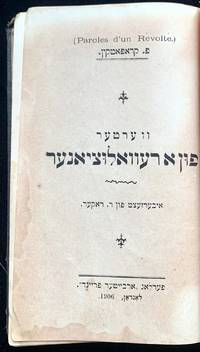
1906rif. 43219London: "Arbayter fraynd 1906. First Yiddish edition. Period boards 8vo xiii 426 pages 19 cm. In Yiddish. Title translates as “Words from a Revolutionary.” Translation of “Paroles d'un re´volte´.” Includes translation of the forewords by the author and Elise´e Reclus. Includes bibliographical references. “During his long exile Kropotkin wrote a series of influential works the most important being ‘Paroles d’un révolté’ 1885; “Words of a Rebel”.Kropotkin’s aim as he often remarked was to provide anarchism with a scientific basis. In Mutual Aid which is widely regarded as his masterpiece he argued that despite the Darwinian concept of the survival of the fittest cooperation rather than conflict is the chief factor in the evolution of species. Providing abundant examples he showed that sociability is a dominant feature at every level of the animal world. Among humans too he found that mutual aid has been the rule rather than the exception. He traced the evolution of voluntary cooperation from the primitive tribe peasant village and medieval commune to a variety of modern associations—trade unions learned societies the Red Cross—that have continued to practice mutual support despite the rise of the coercive bureaucratic state. The trend of modern history he believed was pointing back toward decentralized nonpolitical cooperative societies in which people could develop their creative faculties without interference from rulers clerics or soldiers.” SUBJECTS: Anarchism. OCLC: 19303211. Spine is taped.Tight binding but text block is clean and intact. Good Condition YID-48-40-LXCCGG-’e. London: "Arbayter fraynd unknown
1942rif. 43302London: Liberty Publications 1942. Original Illustrated black-and-white wrappers 8o 15 1 pages. Illustrated throughout with black-and-white photos. Holocaust-era anti-Nazi pamphlet aimed at British trade unionists and sympathizers on the brutal realities of life for Polish laborers under German occupation. Framed as the story of “Jan Kowalski” the Polish equivalent of “John Smith” it traces—hour by hour—a worker’s day under occupation drawn from firsthand reports documents and underground newspapers.The author’s describe the fear forced labor food shortages child abuse suppression of education and collapse of community life under Nazi rule while also noting the resilience of the Polish underground and moments of solidarity between Polish and Jewish workers. James Jeremiah Griffiths 1890–1975 was a Welsh Labour politician trade union leader and the first Secretary of State for Wales.“Liberty Publications established by the Polish Socialist Party PPS specialised in socio-political publications that were aimed at the British left. The board of directors included two British members Jimmy Middleton and Rennie Smith who were appointed ‘to avoid complications with the Home Office’.31 The firm was sponsored by the Polish Ministry of Information through the Polish Social Information Bureau Polska Informacja Spoleczna whose aim was ‘to inform the British people on all questions concerning life in Poland the Polish war effort etc.’” Rzepa “Publishing ‘paper bullets’: Politics propaganda and Polish English translation in wartime London”; https://repository.essex.ac.uk/23813/3/Rzepa%20-%20revised.pdf. OCLC: 3894561. The US Holocaust Museum keeps their copy in their Rare Book Collection. Covers lightly rubbed interior clean and bright. Very Good Condition. Holo2-163-15-LAGGMMMVXECC. London: Liberty Publications unknown
1984rif. 180979Ein Beitrag zur Geschichte der Exilforschung in der Bundesrepublik Deutschland. Für Werner Berthold zum 31. März 1984. Begleitband zur Ausstellung der Deutschen Bibliothek. 2. Auflage. Frankfurt 1984. Mit Abbildungen. 233 S. Or.-Kart.; Rücken mit Gebrauchsspuren, einige Blätter etwas lose. (Sonderveröffentlichungen der Deutschen Bibliothek, 13). - Einige Randanstreichungen
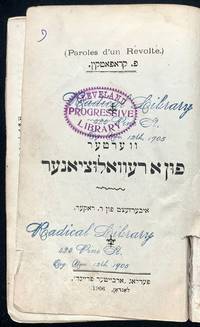
1906rif. 43217London: "Arbayter fraynd 1906. First Yiddish edition. Period boards 8vo xiii 426 pages 19 cm. In Yiddish. Title translates as “Words from a Revolutionary.” Translation of “Paroles d'un re´volte´.” Includes translation of the forewords by the author and Elise´e Reclus. Includes bibliographical references. “During his long exile Kropotkin wrote a series of influential works the most important being ‘Paroles d’un révolté’ 1885; “Words of a Rebel”.Kropotkin’s aim as he often remarked was to provide anarchism with a scientific basis. In Mutual Aid which is widely regarded as his masterpiece he argued that despite the Darwinian concept of the survival of the fittest cooperation rather than conflict is the chief factor in the evolution of species. Providing abundant examples he showed that sociability is a dominant feature at every level of the animal world. Among humans too he found that mutual aid has been the rule rather than the exception. He traced the evolution of voluntary cooperation from the primitive tribe peasant village and medieval commune to a variety of modern associations—trade unions learned societies the Red Cross—that have continued to practice mutual support despite the rise of the coercive bureaucratic state. The trend of modern history he believed was pointing back toward decentralized nonpolitical cooperative societies in which people could develop their creative faculties without interference from rulers clerics or soldiers.” SUBJECTS: Anarchism. OCLC: 19303211. Ex-library with early 19th Century left-wing library markings see photos. Good- Condition YID-48-41-LXCCGG-’e. London: "Arbayter fraynd unknown
rif. DADAX1840184078New unknown
1997Mit zahlreichen Abbildungen.
1984With plates and documents.
1993Mit Abbildungen und Dokumenten.