RAYNAL, Guillaume Thomas.Livre Rare Book
1.554 Ergebnisse
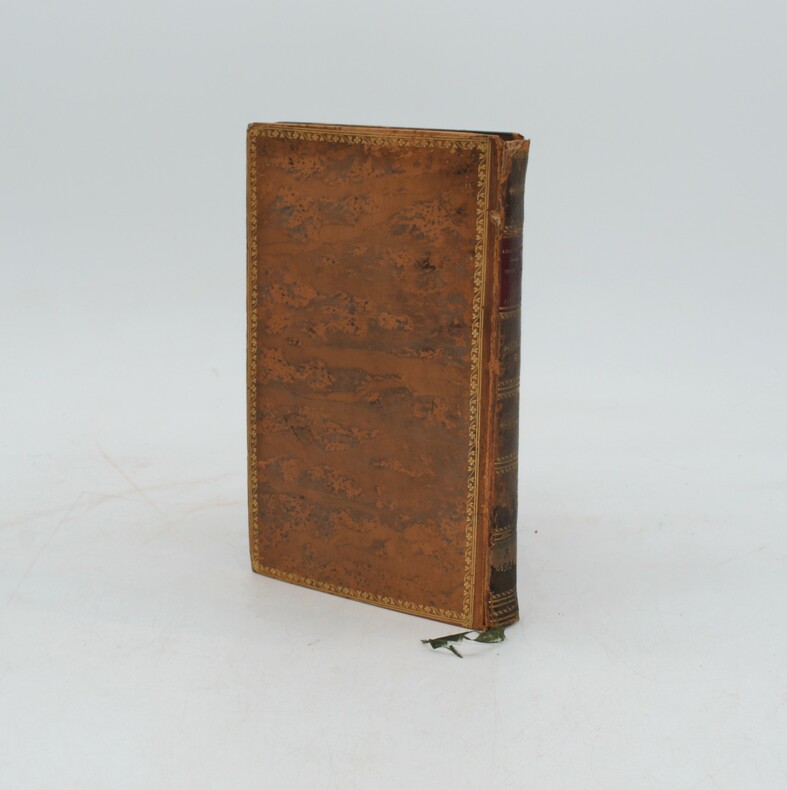
1774Best.-Nr. PHO-2651La Haye & s.l., Gosse & s.e., 1774 (et circa 1780), 8 Volumes. TEXTE : 7 volumes in 8°, XII-585, XII-386, XIII-586, XII-508, XII-407, VI-375 (1), XI-430 pages, chaque volume comporte une gravure en frontispice d'après Eisen et une grande carte dépliante, relié plein veau tacheté époque, dos à nerfs ornés avec pièce de titre rouge et tomaison noire, tranches tachetées bleues, exlibris manuscrit aux titres, quelques coins usés, petits accrocs, reliure en bel état. ATLAS in-4 (29x26cm) de 50 cartes numérotées 1 à 49 (avec une 17 bis.). Exemplaire à grandes marges, demi reliure, dos lisse avec titre (Atlas des voyages de Cook) au dos, tache d’encre au plat et sur la tranche sans atteinte.
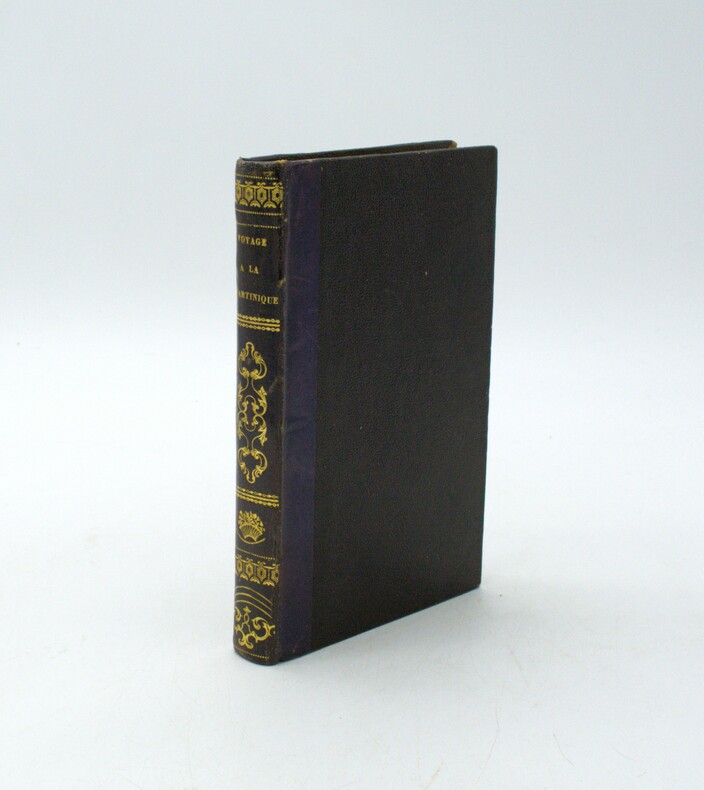
1833Best.-Nr. PHO-614Paris, Firmin Didot frères, 1833. In-8, VII-365pp. Relié plein veau marron époque,liseré fleuri sur les plats, dos orné avec pièce de titre et auteur en maroquin dos orné , plat détaché, cachet de bibliothèque.
1804Best.-Nr. PHO-1919Paris, L. Pelletier, An XII-1804. In-8, (200 x 128) : (2 ff.), VIII, (5)-194 pp., errata. Demi-basane aubergine, dos lisse orné avec titre (reliure de l'époque), timbre sec (Henry Deydier, Aubenas), légères rousseurs.
1824Best.-Nr. 34232Paris Imprimerie de Lachevardière fils 1824 in-8 dérelié
1908Best.-Nr. 2201030038xbvkBlackburn, R. Denham & Co. / Southport, Shackerley Literary Agency; 1908. viii pages incl. foretitlepage, photographic frontispice-plate on glossy paper, titlepage, Dedication, 'Prelude', 'Contents' and prefaces to the first (''Feb. 16th, 1907.'') and this second edition (''Jan. 1st, 1908.''); 92 pages, except the photoplate printed on untrimmed handmade rag-paper throughout. - Publisher's illustrated cardboard-wrapper, titled in red and black, ornamentally framed; 8vo.(ca. 19,5 x 13,5 cm).
1743Best.-Nr. PHO-1218La HAYE ,Jean Neaulme, 1743, deux volumes in 4° (260x210mm) reliés plein veau marbré, dos orné à 5 nerfs, pièce de titre, tranches rouges ,(2 plats détachés),coiffes arasées, coins usés, papier bruni ,Épître à Frédéric roi de Prusse imprimé en rouge et noir, XLIV-414pp./IV-192 pp., à la suite extraits de plusieurs auteurs anciens et autres pièces ,178 pp. ,orné de 12 cartes dont 9 dépliantes et 21 planches dont 5 dépliantes, une planche de musique et un fragment de la célèbre carte de Peutinger , ex-libris de Charles Kettaneh Première édition en français,
Best.-Nr. 208865A la Haye, 1754 in-12, 258 pp., veau brun, dos à nerfs orné, tranches rouges (reliure de l'époque).
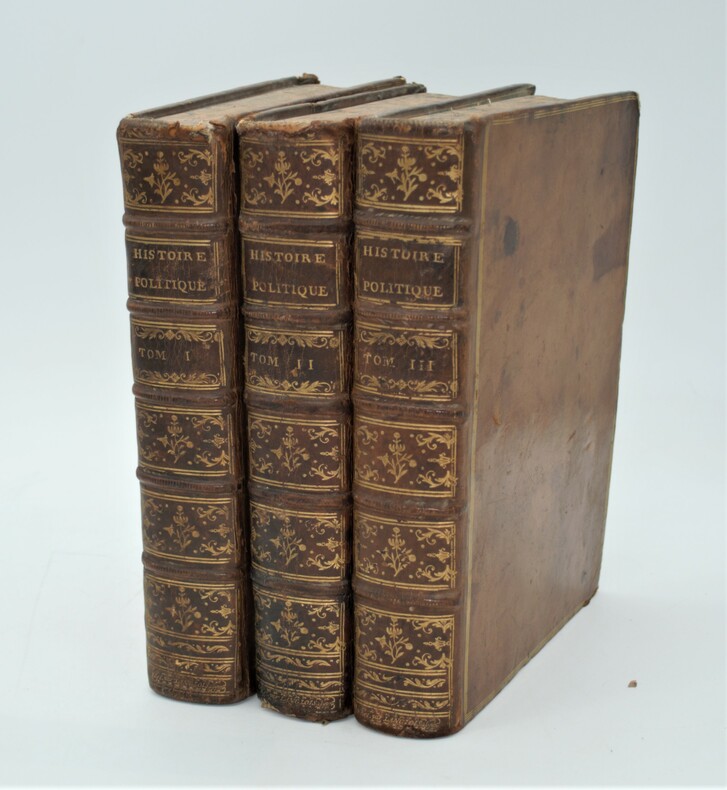
1775Best.-Nr. PHO-1053A Genève, chez les libraires associés, 1775 3 tome in-4 (26 x 20 cm) de (4) -IV-III-VIII-719, (4) -VIII-662 et (4) -VIII-658 pages. L'illustration comprend un portrait de l'Auteur gravé par Legrand d'après Cochin, 7 planches hors texte non signées, 4 cartes repliées aux contours colorés époque et 3 vignettes en-tête de Marillier. , relié plein veau blond, dos à nerfs ornés avec titre, tomaison et « rel. par Langlois à Lyon »en pied, filets sur les plats, tranches marbrées, coins usés, coiffes T1 et 3 un peu usés Première édition publiée au format in-4 établie sur la deuxième édition originale.
1781Best.-Nr. 0042251781 Genève, Pellet, 1781. Dix volumes in-8 (130 X 207 mm) basane fauve marbrée, dos lisse orné à la grotesque de motifs dorés, pièces de titre et de tomaison grenat et vert, coupes ornées d'une guirlande dorée, coiffes filetées, tranches jaspées (reliure de l'époque). Tome I : portrait, XVI pages de faux-titre, titre, avertissement et table, 348 pages, (1) f. d'errata, (2) tableaux dépliants ; Tome II : frontispice, XII pages de faux-titre, titre et table, 378 pages, (1) f. d'errata, (4) tableaux dépliants ; Tome III : frontispice, VII pages de faux-titre, titre et table, 372 pages, (1) f. d'errata ; Tome IV : frontispice, XII pages de faux-titre, titre et table, 308 pages, (1) f. d'errata, (3) tableaux dépliants ; Tome V : frontispice, VII pages de faux-titre, titre et table, 259 pages, (1) f. d'errata, (1) tableau dépliant ; Tome VI : frontispice, XII pages de faux-titre, titre et table, 308 pages, (1) f. d'errata ; Tome VII : frontispice, XVI pages de faux-titre, titre et table, 359 pages, (1) page d'errata, (5) tableaux dépliants ; Tome VIII : frontispice, XII pages de faux-titre, titre et table, 352 pages ; Tome IX : frontispice, VIII pages de faux-titre, titre et table, 262 pages, (1) f. blanc, (1) f. d'errata, (9) tableaux dépliants ; Tome X : frontispice, V pages de faux-titre, titre et table, 348 pages, (1) f. d'errata. Quelques petites restaurations à la reliure.
1845Best.-Nr. PHO-2067Paris, Imprimerie Royale, 1845, 2 volumes in-12 (15x9,5cm), CLXX, 154 pp. 105, (1), 202 pp., demi toile et coins moderne, pièce de titre et tomaison, couverture conservée, coupé en tête, mouillure, cachet répétés.
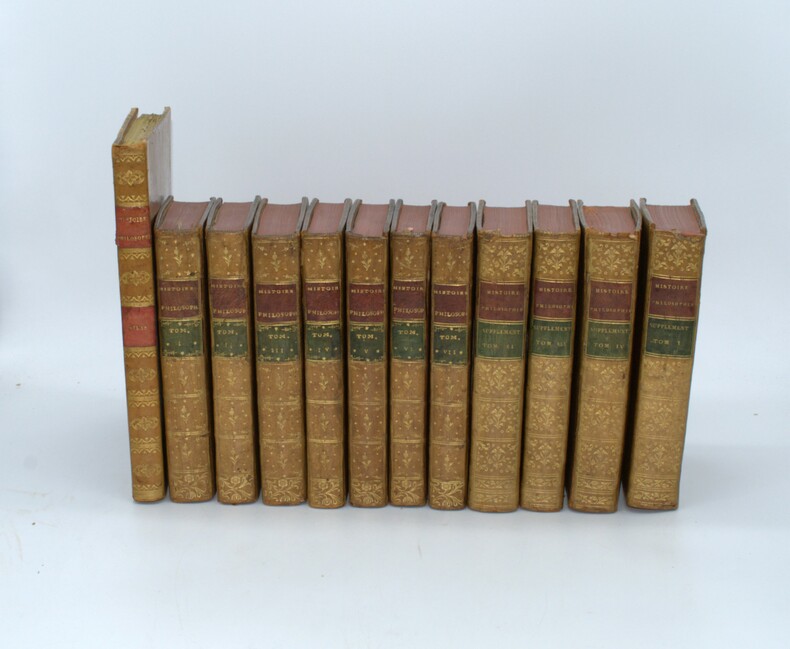
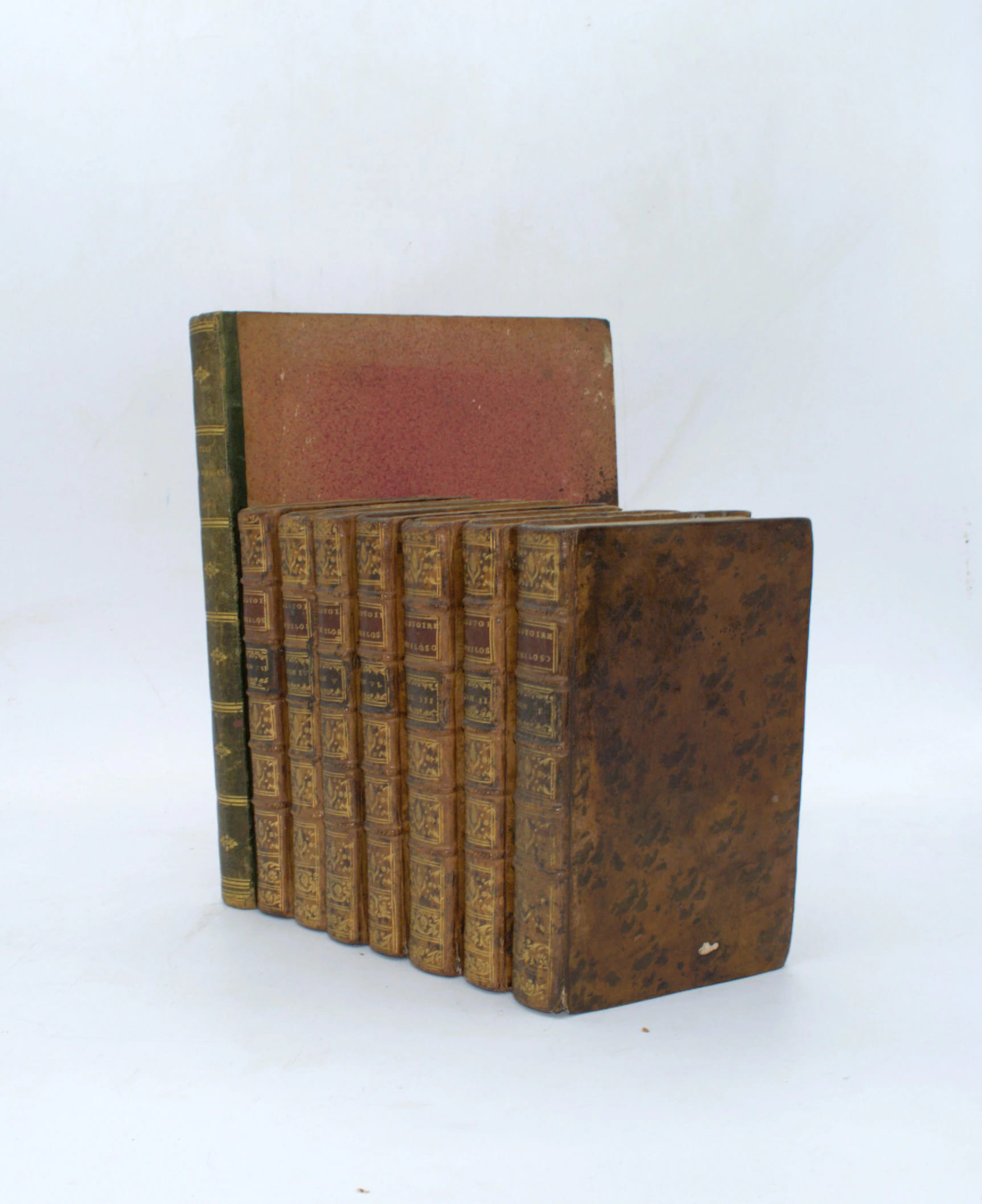
1774Best.-Nr. PHO-1474La Haye, Gosse et s.e., 1774-1781,11 volumes in 8°et 1 Atlas in-4, texte; XII-585, XII-386, XIII-586, XII-508, XII-407, VI-375 (1), XI-430 pages ,chaque volume comporte une gravure en frontispice d'après Eisen et une grande carte dépliante, et pour le supplément; XVI-604pp.,XV-574pp.,XV-492pp.,VIII-434pp.,avec un titre séparé Tableaux pour l’intelligence … 2ff. Et 23 tableaux dépliants ,reliure d'époque en plein veau ,dos lisse ornés,filets aux plats et roulettes à l’intérieur, tranches rouges , quelques coiffes usées, petits trous de ver,un tableau déchiré et son Atlas in-4 , 23pp. Et 50 cartes , relié pleine basane racinée époque, dos lisse avec pièce de titre et tomaison, petits frottements , coins usés
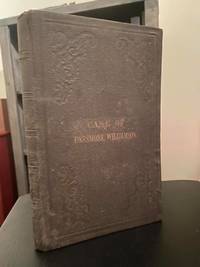
1856Best.-Nr. 218First edition of "the most complete record available" of the controversial Pennsylvania case on fugitive slaves establishing a "precedent set in federal and state courts… and important cause célèbre for the antislavery movement" crucial in asserting a clear path for the following year's Dred Scott decision and provoking a "legal crisis… that led to the Civil War" elusive in original cloth. An overall clean text with soiling on top of pages 1-16 & pgs. 161-191 and contemporary ink marginalia by Strawbridge on a few pages. John Strawbridge is inscribed in old ink on page prior to title page. A book which has become difficult to find in the original cloth. Uriah Hunt & Son hardcover
1860Best.-Nr. 64534Augusta GA: Pritchard Abbott & Loomis 1860. Tall thick 8vo. xv 1 17-908 pp. plus 4 pp. publisher’s ads. Steel-engraved frontisp. 4 steel-engraved frontisp. plates for individual work interspersed. Contemporary full sheep red black & gilt spine labels rebacked w/ original labels laid-back down scuffing edgewear foxing to endpapers some foxing & occasional toning on some leaves tidemark at gutter margin through first few leaves still a VG- copy w/ ownership markings dated April 30 1860 for W.J. Freeman and Frank B. Freeman w/ price indicated as $ 6.00 about $ 250.00 today. First edition of this massive work considered the must-read for all good pro-Southern planters on the eve of the Civil War with the editor in the introduction declaiming the “anarchy and bloodshed in Kansas. . . the existence of the ‘Underground Railroad’ . . . a party in the North organized for the express purpose of robbing the citizens of the Southern States of their property; the almost daily occurrence of fugitive slave mobs. . . attempt to circulate incendiary documents among the slaves in the Southern States. . . and finally the recent attempt to excite at Harper’s Ferry and throughout the South an insurrection and a civil and servile war.” By 1860 slavery was becoming more concentrated in the southern United States fading somewhat from Brazil Cuba Puerto Rico and the Dutch Colonies and even in the U.S. abolitionist efforts had led to the proportions of lsaves dropping in Missouri from 18 to 10 percent of the populace Kentucky to 19 percent and even Maryland down to 13%. This anthology of racist polemics buttressed with the Dred Scott Decision included as one section blindly attempted to argue slavery was a humane and Christian institution justified by scripture and an economic underpinning of the South. Pritchard, Abbott & Loomis, unknown
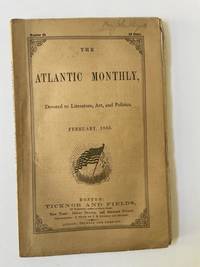
1863Best.-Nr. 158141863. Emerson Ralph Waldo. "Boston Hymn" 1863 printed in the February 1863 issue of The Atlantic Monthly constitutes one of the earliest periodical appearances of his poetic response to President Lincoln's Emancipation Proclamation and stands as a direct literary intervention in the political crisis of slavery and civil war. Written at the request of Boston organizers for the January 1 1863 celebration marking the Proclamation's issuance the poem was first read by Emerson at Boston Music Hall the same day Lincoln's order took effect. In "Boston Hymn" Emerson situates emancipation within a providential and constitutional lineage explicitly aligning the Proclamation with the Declaration of Independence while declaring the abolition of slavery a fulfillment rather than a departure from American founding principles. His verse rejects compensation to enslavers and instead demands justice for the formerly enslaved: "Who is the owner The slave is the owner / And ever was. Pay him." The poem thus places emancipation within a moral economy grounded in restitution and national accountability. Emerson Ralph Waldo. "Boston Hymn." In The Atlantic Monthly; A Magazine of Literature Science Art and Politics. Boston: Ticknor and Fields February 1863. Issue No. 64. The poem appears within the continuously paginated issue pp. 146-272 plus advertisements. Original tan printed wrappers with vignette of the American flag; original advertisements present including pink advertising slip with affixed newspaper clipping; early ownership inscription "Hon. John Boyd" in pencil to front cover. This issue followed closely upon the poem's January 24 1863 appearance in Dwight's Journal of Music placing it among the earliest print disseminations of Emerson's Emancipation commentary in a major national literary periodical. The February 1863 issue appeared at a decisive stage of the Civil War as emancipation shifted Union war aims toward abolition and Black freedom. Emerson already among the nation's most visible intellectuals used the poem to frame Lincoln's executive act as a moral correction to constitutional compromise and as a theological affirmation of human equality. His public reading before approximately 3000 attendees delivered without advance notice of his participation amplified the poem's symbolic force in Boston's abolitionist culture. As printed in The Atlantic Monthly a leading forum for literary and political discourse the text entered national circulation at the moment emancipation became federal policy. Light wear to wrappers; minor age toning; contents complete with advertisements; pink advertising slip present; small penciled ownership inscription to cover. Overall very good condition. A significant Civil War-era periodical issue preserving an early printing of Emerson's poetic defense of emancipation and moral governance. unknown
1863Best.-Nr. 158141863. Emerson Ralph Waldo. "Boston Hymn" 1863 printed in the February 1863 issue of The Atlantic Monthly constitutes one of the earliest periodical appearances of his poetic response to President Lincoln's Emancipation Proclamation and stands as a direct literary intervention in the political crisis of slavery and civil war. Written at the request of Boston organizers for the January 1 1863 celebration marking the Proclamation's issuance the poem was first read by Emerson at Boston Music Hall the same day Lincoln's order took effect. In "Boston Hymn" Emerson situates emancipation within a providential and constitutional lineage explicitly aligning the Proclamation with the Declaration of Independence while declaring the abolition of slavery a fulfillment rather than a departure from American founding principles. His verse rejects compensation to enslavers and instead demands justice for the formerly enslaved: "Who is the owner The slave is the owner / And ever was. Pay him." The poem thus places emancipation within a moral economy grounded in restitution and national accountability. Emerson Ralph Waldo. "Boston Hymn." In The Atlantic Monthly; A Magazine of Literature Science Art and Politics. Boston: Ticknor and Fields February 1863. Issue No. 64. The poem appears within the continuously paginated issue pp. 146-272 plus advertisements. Original tan printed wrappers with vignette of the American flag; original advertisements present including pink advertising slip with affixed newspaper clipping; early ownership inscription "Hon. John Boyd" in pencil to front cover. This issue followed closely upon the poem's January 24 1863 appearance in Dwight's Journal of Music placing it among the earliest print disseminations of Emerson's Emancipation commentary in a major national literary periodical. The February 1863 issue appeared at a decisive stage of the Civil War as emancipation shifted Union war aims toward abolition and Black freedom. Emerson already among the nation's most visible intellectuals used the poem to frame Lincoln's executive act as a moral correction to constitutional compromise and as a theological affirmation of human equality. His public reading before approximately 3000 attendees delivered without advance notice of his participation amplified the poem's symbolic force in Boston's abolitionist culture. As printed in The Atlantic Monthly a leading forum for literary and political discourse the text entered national circulation at the moment emancipation became federal policy. Light wear to wrappers; minor age toning; contents complete with advertisements; pink advertising slip present; small penciled ownership inscription to cover. Overall very good condition. A significant Civil War-era periodical issue preserving an early printing of Emerson's poetic defense of emancipation and moral governance. unknown books
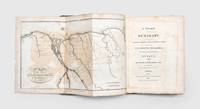
1807Best.-Nr. 177680London: Richard Phillips 1807. First edition of this account of the British colonies within modern-day Guyana. Bolingbroke was a staunch supporter of the Transatlantic slave trade which he discusses in Chapter Five and dedicated this work to the colonial secretary William Windham. Henry Bolingbroke 1785-1855 was a Norfolk merchant who first visited Demerara in 1798. This region had been under the control of the French and Dutch until it was captured by the British in 1796. Bolingbroke remained in the colony until 1805; he then travelled to Surinam in Dutch Guiana to become Deputy Vendue Master in 1807 responsible for public sales and auctions including those of enslaved people. He was one of the 16 MPs who voted against the abolition of slavery in March 1807. In Chapter Five Bolingbroke writes about slavery and what he viewed as its economic importance. In his dedication to Windham 1750-1810 he praised him for relaxing monopoly restrictions and "resisting the abolition of a liberty essential at new settlements of importing additional labourers" p. iii. Quarto pp. xii 400. Folding engraved map. Original green paper-covered boards rebacked modern spine label edges untrimmed. Signature of one George Atkinson on front pastedown a few pencil notes internally. Spine head stabilized boards marked foxing and toning to map and contents two small closed tears to map repaired offsetting to title page: a very good copy. Sabin 6182. hardcover
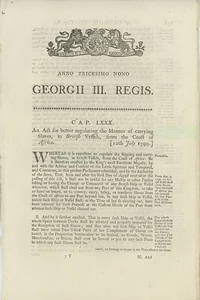
1799Best.-Nr. 28145London: Printed by George Eyre and Andrew Strahan Printers to the King's most Excellent Majesty 1799 1799. ESTC N60288 Lincoln's Inn Library and Wellcome Institute. Fine. 4to disbound paginated 637-652 untrimmed. An act passed by Parliament in the summer of 1799 delineated in 39 paragraphs that regulated the slave trade beginning in August 1800 - an act no doubt intended to placate the growing voices of opposition to the English slave trade. The act stipulates how many slaves could be stowed in a ship by mathematical formula according to the size of the ship but never more than 400; that slaves must be separated from other cargo; and that the space for the slaves "be full and complete perpendicular height of five feet." Nothing is said about their treatment other than that the ship's surgeon was required keep a log of illnesses and deaths of both slaves and crew. Much of the act is taken up with its enforcement and the penalties and fines for violations; it also regulates the conditions and treatment of the crew. The acts of Parliament were usually published separately and later issued in collections of the Public General Statutes; this one was issued as part of the collection of statues Passed in the Thirty-Ninth Year of the Reign of His Majesty King George the Third: Being the Third Session of the Eighteenth Parliament of Great Britain. This copy is disbound from such a volume. (London: Printed by George Eyre and Andrew Strahan, Printers to the King's most Excellent Majesty, 1799) unknown
1842Best.-Nr. 313227Philadelphia: stereotyped by L. Johnson 1842. First edition. 140 pp. 1 vols. 8vo. Original brown ribbed cloth rebacked with original spine laid down titled in gilt. Marginal dampstaining throughout scattered foxing some wear to boards good. First edition. 140 pp. 1 vols. 8vo. First edition of this report of this monumental Supreme Court decision regarding escaped slaves preceding by 15 years and rivaling in importance the Dred Scott case of 1857. "In Prigg the Court identified slavery as a core constitutional commitment with which states could not interfere. In this case the Court struck down northern states' 'personal liberty laws' established to protect alleged fugitive slaves from recapture without due process of law. When the professional 'slave catcher' Edward Prigg tried to remove Margaret Moran an alleged runaway he was unable to meet the burden of proof set out by Pennsylvania's 1826 Personal Liberty Law and failed to obtain the legal certificate permitting him to remove her. When Prigg proceeded to ignore this and removed Moran illegally to Maryland Pennsylvania convicted him of kidnapping. The US Supreme Court however overwhelmingly overturned Prigg's conviction 8-1 and pronounced state laws interfering with the return of alleged runaways a violation of the Fugitive Slave Clause." Beaumont The Civic Constitution 2014 p. 128. Blockson 9905; Dummond p. 140; Sabin 61207 stereotyped by L. Johnson unknown
1842Best.-Nr. 313227Philadelphia: stereotyped by L. Johnson 1842. First edition. 140 pp. 1 vols. 8vo. Original brown ribbed cloth rebacked with original spine laid down titled in gilt. Marginal dampstaining throughout scattered foxing some wear to boards good. First edition. 140 pp. 1 vols. 8vo. First edition of this report of this monumental Supreme Court decision regarding escaped slaves preceding by 15 years and rivaling in importance the Dred Scott case of 1857. "In Prigg the Court identified slavery as a core constitutional commitment with which states could not interfere. In this case the Court struck down northern states' 'personal liberty laws' established to protect alleged fugitive slaves from recapture without due process of law. When the professional 'slave catcher' Edward Prigg tried to remove Margaret Moran an alleged runaway he was unable to meet the burden of proof set out by Pennsylvania's 1826 Personal Liberty Law and failed to obtain the legal certificate permitting him to remove her. When Prigg proceeded to ignore this and removed Moran illegally to Maryland Pennsylvania convicted him of kidnapping. The US Supreme Court however overwhelmingly overturned Prigg's conviction 8-1 and pronounced state laws interfering with the return of alleged runaways a violation of the Fugitive Slave Clause." Beaumont The Civic Constitution 2014 p. 128. Blockson 9905; Dummond p. 140; Sabin 61207 stereotyped by L. Johnson unknown books
1862Best.-Nr. 13270Moulton AL: June 7 1862. 4pp. on a single folded sheet. Old folds moderate staining rubbing and toning edges worn and a bit chipped a few small holes in the body of the text. A well-worn newspaper in good condition. A notable issue of a very rare newspaper from Confederate Alabama with many interesting historical aspects. Most noteworthy is the runaway slave advertisement printed on the last page relating the story of "a black boy who calls himself John" currently held at the jail in Lawrence County Alabama. John claims that his owner Jack Mason of Limestone County "was killed at Corinth on the day of the battle there and that he was endeavoring to return home when arrested." A physical description of John follows and concludes with a notice that "The owner will please come forward pay charges and take him away or he will be disposed of according to law." Other advertisements document various sheriff sales and the dissolution of a local law partnership. The paper also includes informative content on the Civil War including a substantial proclamation by Alabama Governor John Gill Shorter encouraging Alabama men to take the war seriously gather arms to the front and participate as part of the "State Guard." The paper also prints part of a notice from the Charleston Courier arguing that if Confederate currency is not worth real value "then the whole cotton crop of the South will be seized by the invader then Lincoln's recommendation to his Congress will be adopted and enforced and all the lands of the Southern people will be parcelled out among Northern soldiers." There is also a dispatch from Corinth encouraging southerners to identify and send back soldiers absent from duty and other wartime content. The only physical issue we could locate dated April 17 1863 is held at Samford; the remainder of the OCLC records we consulted reported microfilm or digital forms. June 7 unknown
1862Best.-Nr. 13270Moulton AL: June 7 1862. 4pp. on a single folded sheet. Old folds moderate staining rubbing and toning edges worn and a bit chipped a few small holes in the body of the text. A well-worn newspaper in good condition. A notable issue of a very rare newspaper from Confederate Alabama with many interesting historical aspects. Most noteworthy is the runaway slave advertisement printed on the last page relating the story of "a black boy who calls himself John" currently held at the jail in Lawrence County Alabama. John claims that his owner Jack Mason of Limestone County "was killed at Corinth on the day of the battle there and that he was endeavoring to return home when arrested." A physical description of John follows and concludes with a notice that "The owner will please come forward pay charges and take him away or he will be disposed of according to law." Other advertisements document various sheriff sales and the dissolution of a local law partnership. The paper also includes informative content on the Civil War including a substantial proclamation by Alabama Governor John Gill Shorter encouraging Alabama men to take the war seriously gather arms to the front and participate as part of the "State Guard." The paper also prints part of a notice from the Charleston Courier arguing that if Confederate currency is not worth real value "then the whole cotton crop of the South will be seized by the invader then Lincoln's recommendation to his Congress will be adopted and enforced and all the lands of the Southern people will be parcelled out among Northern soldiers." There is also a dispatch from Corinth encouraging southerners to identify and send back soldiers absent from duty and other wartime content. The only physical issue we could locate dated April 17 1863 is held at Samford; the remainder of the OCLC records we consulted reported microfilm or digital forms. June 7 unknown books
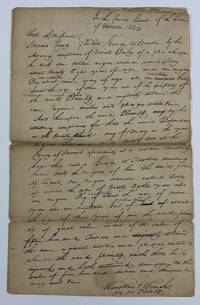
1822Best.-Nr. 4276Howard County Mo 1822. Good. Three documents totaling 3pp. folio the two earliest documents written on each side of the same leaf with an integral blank and attached to the third document with sealing wax each document docketed on verso. Some short separations along folds minor spotting two short tape repairs. A series of three documents recording a case of slave theft in Missouri. The plaintiff in the case George W. Hardin sues a man named Urial Bailey for stealing three slaves from the Hardin estate in Howard County Missouri. The first document is a sworn oath dated May 23 1822 by George Hardin stating that "He was lawfully possessed of the negroes.and that the same were unlawfully taken by Urial Bailey.from his properties and with out his consent within one year last past and that he is now lawfully entitled to the possession of the said negroes." The document is attested by the clerk and signed by Hardin. The second document is executed by Hardin's lawyers on the verso of his oath dated the same day and constitutes an order from the court to the Sheriff of Howard County informing him that "George W. Hardin hath come into the Circuit Court held in the town of Franklin and found sufficient sureties as well as his clamour to prosecute for a certain woman called Dolly about the age of twenty eight years also one negro boy of about the age of nine years named Nathan also one negro girl called Eliza about the age of three years all the property of the said Plaintiff.which a certain Uriel Bailey.hath taken and unjustly detains. You are hereby commanded that the said goods.be delivered to the said George W. Hardin and that.Uriel Bailey appear before the said Circuit Court to be held at the town of Franklin." The third document is executed by Hardin's lawyers on the verso of his oath dated September 1822 and lays out the facts of the case. It reads in part: "George W. Hardin by his Attorney Tompkins & French complains of Urial Bailey that he took the previously named slaves of great value. To wit of the value of fifteen hundred dollars.where fore the said Plaintiff saith that he is injured and hath sustained damages to the value of five hundred dollars and therefore he brings suit." Interestingly in this document Hardin's lawyers refer to the youngest slave Eliza as a "mulatto girl." Docketing on the integral blank attached to the oath and lawyer's document dated May 23 1822 indicate that Hardin was seeking "Replevin Damages" of $500 which the court seems to grant. The motive behind Urial or Uriel Bailey's thefts are not recorded here but the issue of slave stealing was not uncommon and had been going on in the American colonies and the fledgling United States for a long time. According to Timothy F. Reilly in "Slave Stealing in the Early Domestic Trade as Revealed by a Loyal Manservant" published in Louisiana History: The Journal of the Louisiana Historical Association Vol. 55 No. 1 Winter 2004 pp.5-39: "Slave stealing plagued domestic slaveholders as far back as the colonial period when those who would unlawfully deprive a property owner of human chattel were detested as 'Negro jockeys.' Whether operating in the northern or southern colonies a 'man-stealer' lurking about either as a piratical thief or as a high-minded abolitionist was guilty of one of the worst crimes against the sanctity of property. By the 1830s man stealing reached epidemic levels in parts of the South." Despite the seeming prevalence of slave theft for a long period of time in the United States primary source records of court cases are very scarce. unknown
1822Best.-Nr. 4276Howard County Mo 1822. Good. Three documents totaling 3pp. folio the two earliest documents written on each side of the same leaf with an integral blank and attached to the third document with sealing wax each document docketed on verso. Some short separations along folds minor spotting two short tape repairs. A series of three documents recording a case of slave theft in Missouri. The plaintiff in the case George W. Hardin sues a man named Urial Bailey for stealing three slaves from the Hardin estate in Howard County Missouri. The first document is a sworn oath dated May 23 1822 by George Hardin stating that "He was lawfully possessed of the negroes.and that the same were unlawfully taken by Urial Bailey.from his properties and with out his consent within one year last past and that he is now lawfully entitled to the possession of the said negroes." The document is attested by the clerk and signed by Hardin. The second document is executed by Hardin's lawyers on the verso of his oath dated the same day and constitutes an order from the court to the Sheriff of Howard County informing him that "George W. Hardin hath come into the Circuit Court held in the town of Franklin and found sufficient sureties as well as his clamour to prosecute for a certain woman called Dolly about the age of twenty eight years also one negro boy of about the age of nine years named Nathan also one negro girl called Eliza about the age of three years all the property of the said Plaintiff.which a certain Uriel Bailey.hath taken and unjustly detains. You are hereby commanded that the said goods.be delivered to the said George W. Hardin and that.Uriel Bailey appear before the said Circuit Court to be held at the town of Franklin." The third document is executed by Hardin's lawyers on the verso of his oath dated September 1822 and lays out the facts of the case. It reads in part: "George W. Hardin by his Attorney Tompkins & French complains of Urial Bailey that he took the previously named slaves of great value. To wit of the value of fifteen hundred dollars.where fore the said Plaintiff saith that he is injured and hath sustained damages to the value of five hundred dollars and therefore he brings suit." Interestingly in this document Hardin's lawyers refer to the youngest slave Eliza as a "mulatto girl." Docketing on the integral blank attached to the oath and lawyer's document dated May 23 1822 indicate that Hardin was seeking "Replevin Damages" of $500 which the court seems to grant. The motive behind Urial or Uriel Bailey's thefts are not recorded here but the issue of slave stealing was not uncommon and had been going on in the American colonies and the fledgling United States for a long time. According to Timothy F. Reilly in "Slave Stealing in the Early Domestic Trade as Revealed by a Loyal Manservant" published in Louisiana History: The Journal of the Louisiana Historical Association Vol. 55 No. 1 Winter 2004 pp.5-39: "Slave stealing plagued domestic slaveholders as far back as the colonial period when those who would unlawfully deprive a property owner of human chattel were detested as 'Negro jockeys.' Whether operating in the northern or southern colonies a 'man-stealer' lurking about either as a piratical thief or as a high-minded abolitionist was guilty of one of the worst crimes against the sanctity of property. By the 1830s man stealing reached epidemic levels in parts of the South." Despite the seeming prevalence of slave theft for a long period of time in the United States primary source records of court cases are very scarce. unknown books
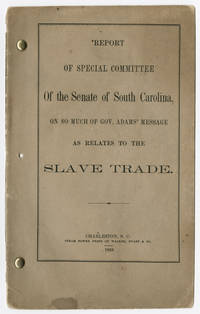
1858Best.-Nr. 53597Charleston. 1858. Report submitted to the South Carolina Senate which concludes that slavery is essential to the agricultural production of the South. Additionally the committee felt that the slave trade helped relieve Africa from "the pressure of a redundant population as might be afforded by emigration in the only form in which its benefits can be extended to them." Original printed wrappers. Spine perished held together with brass tacks; light chipping and soiling. Paper lightly and evenly toned. Good. unknown
1858Best.-Nr. 53597Charleston. 1858. Report submitted to the South Carolina Senate which concludes that slavery is essential to the agricultural production of the South. Additionally the committee felt that the slave trade helped relieve Africa from "the pressure of a redundant population as might be afforded by emigration in the only form in which its benefits can be extended to them." Original printed wrappers. Spine perished held together with brass tacks; light chipping and soiling. Paper lightly and evenly toned. Good. unknown books