Slavery in CubaABAA
1 964 résultats
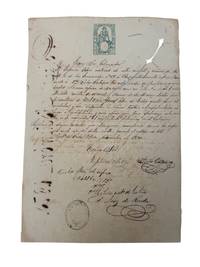
1870réf. 231221870. Slavery Cuba Spanish colonial slave sale manuscript recording the transfer of four enslaved individuals in Cuba in 1870. Produced within the official bureaucratic framework of Spanish colonial governance the document reflects the legal normalization of slavery in Cuba even as abolitionist pressures mounted across the Atlantic world. The document records the sale of four enslaved people described as "criollos" and African-born individuals situating the transaction within a labor system that combined locally born and imported enslaved populations. Created at a time when Spain had formally restricted the transatlantic slave trade but continued to permit slavery itself the manuscript demonstrates the persistence of legalized human commodification and the integration of enslaved labor into the island's economic structure sixteen years prior to abolition in 1886. Official Cuban slave contract documenting the sale of four enslaved individuals to Don Pedro Catasús by Don Enfemia Ochoa for the sum of 1100 pesos on November 29 1870. Single manuscript leaf written in Spanish cursive in black ink measuring 8.25" x 12". A green "50 cs de escudo" revenue stamp is affixed at the top center with a blind embossed Spanish crest at the upper left and a circular black ink government seal impressed at the lower left. Large vertical docketing appears on the verso. A stylized watermark is visible within the paper. The text organizes the enslaved individuals within a standardized transactional structure while the signatures of Enfemia Ochoa Pedro Catasús and A. Díaz de Rada authenticate the exchange and identify participants within the slaveholding economy. By 1870 Cuba remained a central node in the late Atlantic slave system with plantation agriculture especially sugar dependent on enslaved labor despite mounting abolitionist pressure. Although Spain had curtailed official slave imports earlier in the century illegal trafficking persisted into the 1860s and other coerced labor systems including the importation of Chinese indentured workers overlapped with slavery into the 1870s. The presence of both Creole and African individuals in this document reflects the layered composition of the enslaved population during this period. Light toning scattered foxing and edge wear visible. A closed wormhole extends from the upper right margin approximately five inches into the sheet resulting in partial loss of text. Evidence of prior tape reinforcement visible on the verso along with offsetting from previously adjacent material. Overall in very good condition. This document provides named transactional evidence of late-period slavery in Cuba offering concrete material for examining race labor and legal practice within Spanish colonial society. unknown books
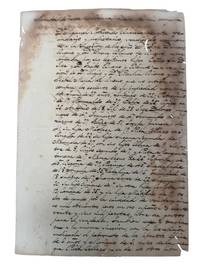
1875réf. 231241875. Slavery Cuba Spanish colonial slave sale manuscript recording the transfer of thirty-eight enslaved individuals in Cuba in 1875 materializing the sheer scale and organization of enslaved labor within the island's plantation economy during the final decade before abolition. The document enumerates a large group of enslaved people including multiple family units with young children demonstrating how slavery functioned as both an economic system and a hereditary condition sustained through the sale and reproduction of enslaved populations. Created eleven years prior to the abolition of slavery in Cuba in 1886 the manuscript documents the continued legality and normalization of large-scale slave transactions despite decades of international pressure and earlier prohibitions on the transatlantic trade offering concrete evidence of how internal markets sustained the institution in its final phase. Official Cuban slave contract documenting the sale of thirty-eight enslaved individuals for the sum of 126000 pesetas formalized before a public notary or legal authority. Single manuscript leaf written in Spanish cursive in black ink on both recto and verso densely filled with names ages and relational identifiers. Measures 8.5" x 12.25". The text lists individuals sequentially including men women and children with repeated references to kinship structures such as mothers with multiple children indicating the sale of family groupings rather than isolated individuals. The script reflects extended passages detailing ownership exclusions and conditions of transfer. A partial watermark of the official coat of arms of Cuba is visible. By 1875 Cuba remained one of the last major slave societies in the Atlantic world with sugar production driving demand for large controlled labor forces. Even after Spain curtailed the official slave trade earlier in the century illegal importation persisted into the 1860s and alternative systems of coerced labor including Chinese indenture supplemented plantation workforces. The scale of this transaction demonstrates the consolidation and redistribution of enslaved labor within domestic markets while the inclusion of children underscores the long-term economic logic of slavery as a self-reproducing system. Moderate toning and foxing concentrated along the edges with numerous small closed wormholes a few affecting portions of the text. Light edge wear present. Overall in good condition. This document provides unusually extensive nominal data on a large enslaved population encompassing the roles of kinship valuation and labor organization in late Spanish colonial Cuba. unknown books
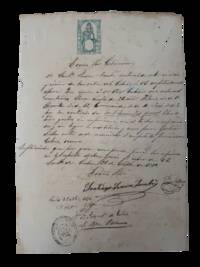
1870réf. 231191870. Slavery Cuba Spanish colonial manuscript documenting the late persistence of slavery in Cuba recording the sale of five enslaved Creole individuals including women and children 1870. Produced within the official bureaucratic framework of Spanish colonial governance the document reflects the legal normalization of slavery in Cuba even as abolitionist pressures mounted across the Atlantic world. The presence of multiple children within the transaction underscores the hereditary nature of enslavement and the commodification of family units offering direct material evidence of how slavery functioned socially and economically in its final decades on the island. Although Spain had formally ended the transatlantic slave trade earlier in the century illegal trafficking and internal slave markets persisted and slavery itself would not be abolished in Cuba until 1886 placing this document within a crucial transitional period marked by reform debates gradual emancipation laws and continued exploitation. Official Cuban slave contract recording the sale of five enslaved individuals identified as "criollos" including one adult woman and four children from Santiago Simón Fambi to Don Pedro Catasús for the sum of 1200 pesos on November 21 1870. Single page manuscript leaf measuring 8.25" x 12". The manuscript is written in Spanish cursive hand in black ink. The upper left bears a blind embossed crest of Spain while a circular black ink government seal is impressed at the lower left partially overlapping the text. The text enumerates the enslaved individuals with ages and names embedding human lives within the formulaic language of sale and valuation while the bold signatures of both seller Santiago Simón Fambi and buyer Pedro Catasús anchor the transaction in identifiable actors within the colonial economy. By 1870 slavery in Spanish Cuba remained central to the island's plantation economy particularly in sugar production which had expanded rapidly in the mid-19th century with industrialized mills and global demand. Enslaved people were primarily forced into agricultural labor under highly regimented and brutal conditions though others were used in urban domestic service skilled trades or as hired laborers generating income for their owners. This document exhibits light toning edge wear and scattered foxing throughout. A closed wormhole extends approximately two inches from the upper right margin inward not affecting legibility of the text. Minor losses and small tears along the edges. Overall in very good condition. Given that this document records a woman and four children the family was likely intended for a combination of field labor and domestic or auxiliary work with the children gradually incorporated into plantation labor as they aged reflecting the system's reliance on both immediate exploitation and the reproduction of enslaved labor over time. unknown books
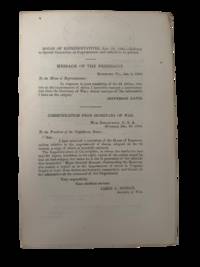
1865réf. 231171865. Civil War Black Military Slavery Virginia Confederate government pamphlet on the impressment of enslaved men for military labor January 1865 one of the clearest bureaucratic efforts to formalize the use of enslaved labor in support of the Confederate war effort. The document responds to a congressional inquiry into the impressment of enslaved people explicitly acknowledging state-directed seizure of enslaved men for military labor. Within the text the Confederate state attempts to regulate this extraction noting limits such as "no more than one out of five male slaves between the ages specified. from any one owner" while simultaneously confirming large-scale requisitions including "5000 slaves from the State of Virginia for service with the army of Northern Virginia." The language reveals both the administrative reach of the Confederate state and its dependence on enslaved labor as a logistical backbone in the war's final phase. Octavo pamphlet measuring 9.5" x 6" 5 pages printed in Richmond Virginia January 1865. Printed for the Confederate House of Representatives and comprising the titled sections "Message of the President" "Communication from Secretary of War" "Resolution of House of Representatives" and "Response of Superintendent of Conscription" with official correspondence dated from December 1864 through January 1865. The exchange includes communications from Brig. Gen. Jno. S. Preston and Major Gen. J. L. Kemper concerning the mechanics of requisition the proportional distribution of impressed labor among slaveholders and errors in previous impressments including the improper inclusion of enslaved people outside the categories prescribed by Confederate authority. While the Confederacy had long resisted arming or formally incorporating enslaved people fearing empowering Black men with weapons and military responsibility would destabilize slavery this document demonstrates a late-war shift toward coercive mobilization framed as "employment" to "increase the efficiency of the army." Additional correspondence from Brig. Gen. Jno. S. Preston and Major Gen. J. L. Kemper details the mechanics of requisition emphasizing proportional seizure across slaveholders and acknowledging prior errors in impressment including the improper inclusion of enslaved people outside prescribed categories. Condition shows light toning minor spotting and edge wear consistent with age; paper remains stable with clear legible text throughout; faint institutional stamp present on front. Overall very good condition. This document underscores how the Confederate war effort relied on systems of exploitation applied to enslaved African American men. unknown books
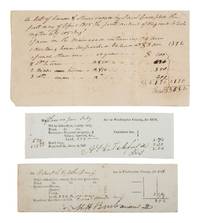
1815réf. 201561815. Manuscript fiscal records from antebellum Virginia documenting the taxation and valuation of enslaved African Americans as property within the legal and economic system of slavery. Dating from 1815 to 1854 the records span nearly four decades and demonstrate the routine bureaucratic mechanisms through which enslaved people were enumerated assigned monetary value and incorporated into county and state taxation alongside land horses clocks and other forms of personal property. The documents provide direct evidence of the administrative infrastructure underlying slavery in Virginia during the decades preceding the Civil War. The earliest record dated April 1 1815 concerns the property of Jacob Campbell and is headed "A list of land & slaves owned by Jacob Campbell the first day of April 1815." An associated receipt provides a particularly stark example of the economic treatment of enslaved people enumerating eight individuals according to gender and age categories and assigning them monetary values totaling $2170. Rather than identifying the individuals as members of families or communities the fiscal record reduces them to demographic classifications and assessed financial values for purposes of property accounting. A later tax receipt for Robert L. Berry and John Berry of Washington County Virginia dated 1848 similarly includes "Slaves" among taxable "Revenue" categories alongside horses clocks and land. The juxtaposition illustrates the legal status imposed upon enslaved African Americans: human beings were entered into the same fiscal accounting system used for other forms of privately held property. The final record a Washington County tax receipt issued to Miss Francis Jane Irby in 1854 includes "Black" titheables among taxable categories together with personal property salary land and a road levy. Virginia's system of tithables had long provided a mechanism for counting certain members of the population for taxation including enslaved African Americans. The terminology and structure of the receipt demonstrate how racial classification was embedded directly within ordinary local fiscal administration. Taken together the records trace the persistence of this system from the aftermath of the War of 1812 through the decade immediately preceding the Civil War. They document slavery not through political argument or retrospective testimony but through the ordinary paperwork of government and property ownership: lists valuations assessments and receipts. Particularly significant is the 1815 valuation of eight enslaved people at a combined $2170 providing direct evidence of the conversion of individual human lives into quantified financial assets. Virginia was central to the development and expansion of slavery in British North America and the early United States. The arrival of Africans at Point Comfort in Virginia in 1619 marked an early and consequential moment in the history of Africans in English North America while slavery subsequently became deeply embedded in the colony and state's economic and legal institutions. By the 1860 federal census more than one-third of Virginia's population was enslaved. Records such as these reveal the administrative dimension of that system: local authorities and property owners routinely recorded enslaved African Americans as taxable economic assets making racial slavery part of the ordinary machinery of government. Group of manuscript fiscal records from Washington County Virginia 1815-1854 ranging in size from approximately 6.75 x 2 inches to standard letter size. Includes the 1815 Jacob Campbell list and associated valuation receipt the 1848 Robert L. and John Berry tax receipt and the 1854 Francis Jane Irby tax receipt. Original folds and creasing minor foxing and a small chip to the lower left corner of one document; docketing on versos. Text remains clear and legible. Overall very good condition. unknown books
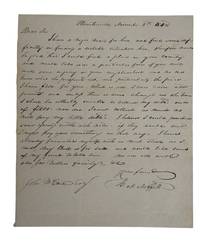
1842réf. 209651842. Slavery North Carolina Letter signed offering a "negro man" to settle debts. Letter signed by "H.M. Moffett" of Huntersville Virginia now West Virginia. Dated November 8th 1842. Measures 9.5" by 7.75". The letter reads in full: "Dear Sir I have a negro man for hire and find some difficulty in finding a suitable situation here therefore would be glad that I could find a place in your country and would take in as a particular favor if you will make some inquiring in your neighborhood and let me know what the prospects are and particularly the price- I have $200 for you which is all I can raise at present and unless their is some change in the times I shall be utterly unable to collect my debts of $1600 now due. I can't collect as much as will pay my little debts. I believe I could purchase some young cattle with notes if they would . I might pay you something in that negro sic. I have already furnished myself with as much stock as I need my Bull is for sale and would like some of my friends to take him. We are all well also Jan sic Millers family - . -- your friend H.M. Moffett." The letter was likely penned by Henry Hiller Moffett second Clerk of Pocahontas county Virginia present day West Virginia. Moffett is listed in the 1850 census with eight enslaved persons. Original folds some minor foxing. Overall very good condition. unknown books
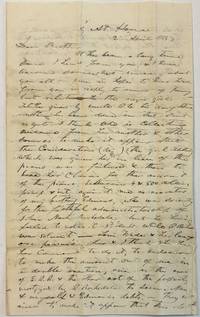
1847réf. 40201Stewartsboro TN 1847. Folio 15" x 12-3/4" sheet folded to 7-1/2" x 12-3/4". 4 pp. Completely in ink manuscript integral address leave bearing Stewartsboro Tennessee April 3 1847 manuscript postal marking. mailing address on last page. The initials of the writer's name are difficult to decipher; this is our best guess. Old folds two short fold splits and a few tiny holes at fold corners. Wax seal remnant with tear at edge loss of a few letters some toning. Good to Very Good. The writer is concerned that Thomas had not responded to his letter "relating to the negro girl Tabitha given by Uncle R. to his daughter- nothing has been done in that suit as yet. I think she is collecting evidence from her mother & other sources to make it appear that the consideration viz the girl Tabitha which was given her in lieu of the piano was a failure & then to base her claim for the amount of the piano between 4 and 500 dollars princp. & int. against me as executor of my brother Edmond who was security for the faithful administrationship of John Nash Barksdale but he having failed to collect sd. debt while R. Barksdale was solvent. Levi Wade & her lawyer are persuading her. . . " He gives Thomas permission to "calculate on receiving a portion of the money for which Paulina sold. . . Negroes have advanced within 3 or 4 months but I fear one diseased as your boy Phil will command but a small price." Dr. Thomas Hill Read 1798-1874 of Tennessee settled in Macon County Illinois in 1831. He was the brother-in-law of Capt. David L. Allen one of the most prominent early citizens having married his sister. Dr. Read became known for his success in the treatment of children's ailments and was considered an expert in cholera infantum. He had a reputation for honesty and was said to have acted as administrator of more estates than anyone else in Macon County. Dr. Read was a member of the Decatur Board of Trustees in 1839 1841 1846 and 1847; County Treasurer from 1845-1846 and County Probate Judge from 1846-1849. John Nash Barksdale 1818-1844 Thomas Read's maternal cousin was born in Tennessee graduated from the University of North Carolina and became a lawyer. He practiced law in Tennessee for a few years and then moved to Columbus Mississippi and entered the law firm of his cousin Gen. William Barksdale. The Columbus bar announced that its members would wear the badge of mourning for thirty days following his death. "Death of John N. Barksdale" Republican Banner Nashville TN Dec. 6 1844 Page 2. Uncle R was likely Randolph Barksdale 1795-1844 Thomas H. Read's maternal uncle and John Nash Barksdale's father. Randolph settled in Tennessee with his father in 1808 and later established his own plantation. He was married three times and became the owner of a large estate and several slaves in Rutherford County Tennessee thanks to the wealth of his first wife. He also owned an estate near Chulahoma in Marshall County Mississippi. unknown books
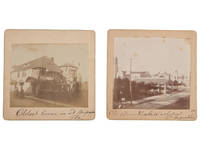
1897réf. 185871897. Albumen photographs of slavery-related sites circa 1890s document physical locations tied to the sale and habitation of enslaved people in the United States and the persistence of those sites in post-Emancipation visual culture. The images include a pavilion in St. Augustine Florida identified in contemporary sources as a site where enslaved Africans were bought and sold a photographic negative depicting outbuildings identified as Mississippi slave quarters and a mounted view of the González Alvarez House a colonial structure associated with early settlement in St. Augustine. Together the photographs provide material evidence of how spaces connected to slavery were recorded labeled and circulated in the late nineteenth century linking architectural survival to the historical memory of enslavement in both the Southeast and the Gulf South. Collection of three albumen photographs. United States circa 1890s. One mounted photograph approximately 3 3/16 x 3 inches bears the ink inscription "Old Slave Market Cathedral St. Augustine Fla." and depicts the waterfront pavilion constructed in the early nineteenth century originally used as a commercial market and identified in local records as a site of slave trading. One photographic negative approximately 3 1/2 x 3 3/4 inches shows three small structures identified as Mississippi slave quarters. One mounted photograph approximately 3 1/8 x 2 5/8 inches is inscribed "Oldest house in St. Augustine Fla. Built in the early 1700s" depicting the González Alvarez House. Mounts and inscriptions indicate a documentary intent linking the images to historically significant sites. By the late nineteenth century sites associated with slavery were being reframed within local historical narratives often presented as landmarks while still retaining traces of their earlier function within systems of forced labor and sale. The identification of the St. Augustine pavilion as a slave market in inscription and record aligns the image with documented urban sites of sale in Spanish and later American Florida while the Mississippi quarters image extends the archive into the plantation landscape of the postbellum South. The grouping provides a concise visual record of how structures tied to enslavement were preserved interpreted and circulated in photographic form decades after abolition. Minor adhesive residue to one mount small tear to negative and light toning and staining to mounts; overall good condition. unknown books
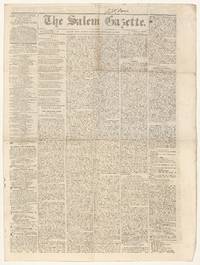
1850réf. 515519Salem Mass: Published by C. Foote 1850. Unbound. Very Good. First edition. Folio. 4pp. Printed self-wrappers. Owner's contemporary ink name on front cover in upper margin. Text is folded lightly creased few spots of faint soiling very good. Text includes: "The Beloved Tune" by Lydia Maria Child three full columns and a thirty-six line announcement about the pending publication of Nathaniel Hawthorne's The Scarlet Letter. Also includes a brief article entitled "Mr. Clay on Slavery" printing extracts from a debate between Senator Clay and General Cass; also prints a three-line announcement about the liberation of fourteen slaves: "Fourteen slaves belonging to Dr. John Casson of Mississippi have been taken to Cincinnati and liberated by their owner. Published by C. Foote unknown books
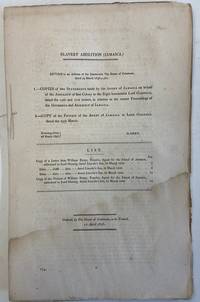
1836réf. 175381836. This pamphlet is a return to an Address of the House of Commons from March 25 1836 whereby the Agent of Jamaica William Burge protests against the unilateral abolition of slavery in the British Empire. Ordered to be printed by the House of Commons in London April 1836. 13 pages. 13" x 8.25" inches. Included within is a copy of three letters from the Agent to Lord Glenelg the British colonial secretary as well Burge's protest to Glenelg. Burge states: He is desirous that His Majesty's Government should understand that this Protest is made not as the performance of a formal act of official duty but from his conviction that the proposed legislation for Jamaica is a direct violation of the constitutional rights of that Colony rights coeval with its establishment and which have hitherto been respected." The Agent was a colonial official who was the official representative of a British colony who was based in London and acted as lobbyists and trade negotiators for the affairs of the colony. While Burge had at other times claimed to "hate" slavery he employs the British analogue of the "states rights'" argument that many moderate politicians in the United States used to signal personal distaste for slavery but to nonetheless protect the institution's existence on the basis of constitutionality. When the institution of slavery died out in the British Empire after 1836 the abolitionist movement in the US gained tremendous momentum despite the protests of our own William Burge's. This piece is overall in very good condition. unknown books
1862réf. 127191862. The Detroit Free Press April 12 1862 reports House passage of legislation abolishing slavery in the District of Columbia one of the first major federal emancipation measures enacted during the Civil War. The bill preceded the Emancipation Proclamation and applied directly to the national capital where slavery remained legal despite Washington's position as the seat of the federal government. The issue records the congressional process behind the measure through detailed debate and proposed amendments preserving contemporary political arguments over federal authority emancipation and slavery during the second year of the war. The Detroit Free Press. Detroit Michigan. April 12 1862. Two pages measuring 19 × 26 inches. The front-page headline reads "The Bill Abolishing Slavery in the District of Columbia Passed the House." Coverage provides a blow-by-blow account of debate among House members and the various amendments considered with the bill concluding "The bill was passed 93 agains 39." The issue also contains local national and international reporting including a section headed "News From the South." Congressional passage placed the District of Columbia on a distinct path toward emancipation before Lincoln issued the preliminary Emancipation Proclamation later in 1862. Because the newspaper records both the vote and the legislative arguments surrounding the measure it documents emancipation as a contested act of federal lawmaking rather than solely as a presidential policy. Small tears at the left margin do not affect the text. A diagonal crease crosses the upper half of the paper and a small piece of yellow tape is adhered to the top margin. Very good condition overall. unknown books
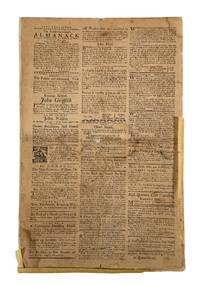
1771réf. 143781771. The Almanack 1771 contains an advertisement offering a fourteen-year-old enslaved Black boy for sale in Boston documenting the commercial trafficking of enslaved children in colonial Massachusetts only five years before the Declaration of Independence. The notice states: "To be sold for want of employment a likely Negro Boy that won't drink rum he is about 14 years old." Its language reduces the unnamed child to age perceived suitability and drinking habits before offering him for sale preserving direct evidence of how slavery entered the ordinary commercial language and newspaper economy of eighteenth-century Boston. A second advertisement relating to slavery appears in the same issue. The Almanack. Boston 1771. Folio newspaper approximately 15 x 10 inches. The sale notice was printed among the newspaper's advertisements rather than as a report or editorial discussion of slavery placing the transaction within the periodical's routine marketplace of property labor and services. Particularly revealing is the seller's stated reason "for want of employment" which explicitly connects the proposed sale of the fourteen-year-old boy to the enslaver's assessment of his economic utility. Slavery remained legal in Massachusetts in 1771 even as the political disputes that would culminate in the American Revolution intensified in Boston. The advertisement predates the 1780 Massachusetts Constitution and the early 1780s freedom suits associated with the effective end of slavery in the Commonwealth. As a Boston notice offering an enslaved child for sale it provides specific evidence that human bondage and its newspaper marketplace formed part of New England life during the generation that articulated revolutionary claims concerning liberty. Overall foxing scattered soiling and several small edge tears; otherwise very good condition. unknown books
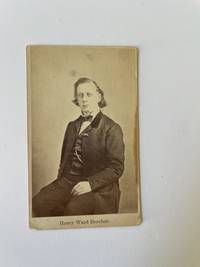
1861réf. 156211861. Beecher Henry Ward circa 1860s carte-de-visite portrait depicts the Congregationalist minister and abolitionist during the decade in which the national conflict over slavery culminated in the Civil War and emancipation. The Library of Congress identifies Beecher as an abolitionist author and Congregationalist clergyman with the bulk of his surviving papers dating from 1840 to 1865. As pastor of Plymouth Church in Brooklyn Beecher opposed the Fugitive Slave Law encouraged resistance to slavery supported Free-State settlers in Kansas and used his pulpit to raise money to purchase enslaved people from bondage. His association with antislavery rifles sent to Kansas also produced the widely used term "Beecher's Bibles." Albumen print carte de visite circa 1860s. 2½ x 4 inches. Sepia-toned image showing Beecher formally dressed and seated presented as a head-and-shoulders portrait. The small photographic format dates from a period when Beecher was nationally prominent as a clergyman and antislavery speaker. His abolitionist activity immediately preceding the Civil War included opposition to the Compromise of 1850 and Fugitive Slave Law and support for antislavery settlement in Kansas; in February 1860 he used Plymouth Church to raise the purchase price required to free a ten-year-old enslaved girl known as Pinky. The portrait dates to the decade in which Beecher's antislavery advocacy became connected to the Civil War itself. At the April 1865 flag-raising ceremony at Fort Sumter following the Union victory Beecher delivered an address condemning slavery after Robert Anderson raised the United States flag over the fort. The carte de visite is in excellent condition. A contemporary photographic portrait of one of the nineteenth century's prominent abolitionist clergymen dating from the period encompassing the Civil War and the abolition of slavery in the United States. unknown books
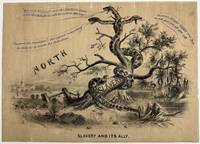
1864réf. 12816N.p. 1864. Lithograph 14.5 x 20.5 inches. Noticeable toning small areas of light discoloration along top margin short closed tear to left edge minor dust-soiling numerous creases and wrinkles. About very good. A dramatic political cartoon issued during the Civil War and satirizing the dangerous influence of those who argue a compromise on slavery or an easy solution to the war. The work was likely issued in the midst of the 1860 but more likely the 1864 presidential election campaign. The central image of the lithograph involves a three-headed snake -- labeled "The People's Party" and emerging from the American "South" personified by a moss-covered swamp -- which is wrapped around the length of a large tree labeled "Slavery." Each snake vocalizes a different misleading message about the issue of slavery and compromise seemingly aligned with political entities such as the Peace Party and the Copperheads. The messages from each snake head read respectively "Extend Slavery over the Northern States and the Rebellion will be over in 60 days;" "Persevere till after election and then we will give you all you ask;" and "'Support the President' - but oppose everything he may do to crush the Rebellion." This latter message indicates the author of the work supported President Lincoln. The North is personified in the background at left by a depiction of the U.S. Capitol Building. The central image of the lithograph carries echoes of the story of the Book of Genesis with the involvement of a deceptive serpent amid the tree of life. The lithograph is signed in the stone at bottom right reading simply "Brooks." Though the work came to us proposing the identify of the artist as Reuben Brooks 1794-1870 we were ultimately unable to confirm this authorship. The lack of an imprint in the lithograph also precludes easy research and identification. In fact the rarity of the lithograph makes it difficult to expound much more about it at all. OCLC reports just a single copy at the Peabody Essex Museum and it is not listed in Weitenkampf or Reilly. Given its rarity and content the present lithograph offers an outstanding opportunity for further research and contextualization. unknown books
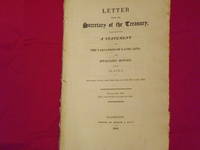
1816réf. 100537Pamphlet formate folio disbound first pamphlet 3 leaves printed on recto only second 7pp. third 6 pages and folding chart. Pamphlet extracted from larger volumne chipping along spine and edges not affecting text second papmple completely disbound paper browned and somewhat dry These pamphlets are rare and represent an important source of information on the numbers and values of slaves in early 19th century America. The first title presents the value assigned to slaves in 11 states including New York. The second lists the number and values of slaves in the various counties in the state of Maryland. The final pamphlet presents real estate values and values on dwellings including slaves in the counties of Pennsylvania. The information in these reports was compiled by Alexander James Dallas 1759-1817 who was the Secretary of the Treasury. Dallas born in Kingston Jamaica settled in Pennsylvania and practiced law there. Eventually he would become Secretary of the Treasury in 1814 when the nation was almost bankrupt. He managed to reorganize the department get the country out of debt created a surplus and even helped promote what would become the Second Bank of the United States. ANB. William A. Davis, books
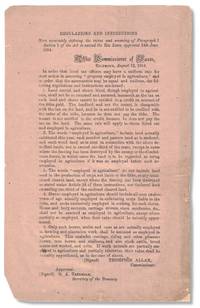
1864réf. 73225Richmond: Treasury Department 1864. Single 8.5" X 5.25" leaf printed on one side. Loss at bottom left corner with a repair to the bottom edge. Darkened overall else an about very good example. Part 4 of the Regulations and instructions states; "Slaves employed in agriculture should include all over twelve years of age actually employed in cultivating crops liable to the tithe and cooks exclusively employed in cooking for such slaves. House and body servants carriage drivers slave mechanics &c. shall not be assessed as employed in agriculture except where partially employed when their value should be rateably apportioned." Signed Thompson Allan Commissioner; Approved G. A. Trenholm Secretary of the Treasury. Parrish & Willingham 2175. Treasury Department unknown books
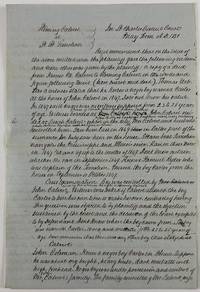
1851réf. 13321St. Charles LA 1851. 31pp. docketed on last page. Original folds minor wear. Very good plus. An intriguing legal document from antebellum Louisiana involving the status of Carter "a dark mulatto from 23 to 26 years of age" whose ownership and/or freedom is being contested. The deposition opens with testimony regarding the last time Carter was seen by the plaintiff's family the Calverts as well as another man named John Coleman both in 1849. The testimony also discusses Carter's ability to hire himself out for work and further testimony from Joseph M. Heddy a "negro trader" who valued Carter at $750 to $800. At this point the plaintiffs rested the case. Further testimony from the defense lays out a detailed argument that Carter was actually the son of a slave named Lucinda who was owned by a man named Isham Harrison who took Lucinda to Illinois 1812. In a one-page addendum the defense asks the Court to instruct the jury that by taking Lucinda to Illinois where Lucinda gave birth to Carter that "the mother by such residence became free and any children born of the mother after the time said Isham took up his residence in Illinois are free.and the defendant is entitled to the verdict." The strategy did not work. The plaintiff won the case and was awarded $800 for Carter. unknown books
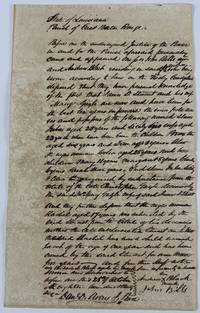
1836réf. 13107East Baton Rouge Parish LA: October 25 1836. 1p. on a single folded sheet integral blank docketed on verso. Old folds moderate toning and foxing short closed tear along one fold line a few small instances of ink burn. Overall good condition. An interesting document of legal testimony involving numerous named slaves in Louisiana in 1836 ranging in age from one year to almost thirty years of age and including seven children. According to the docketing the document is effectively a "Title to Slaves." The deponents were two local citizens John Bills and Andrew Black who had "personal knowledge of the fact that James D. Stuart and his wife Mary Gayle are now and have been for the last ten years & upwards the bona fide owners and possessors of the following named slaves: Juba Aged 25 and Sicily his wife aged 22 to whom have been born the children Braxton aged six years and Dan aged 3 years. Also the negro woman Celia aged 28 years and her children Mary 11 years Margaret 8 years Charley 6 years Sarah three years which slaves Juba Sicily & Celia were acquired by inheritance from the estate of Christopher Gayle. And they further depose that the negro woman Rachel aged 17 years was inherited by the said Stuart from the estate of his deceased mother.and that the said Rachel has now a child named Jacob of the age of one year." The document is signed by Black Bills and the Justice of the Peace Daniel D. Avery. Documents involving slave inheritance of and subsequent ownership by not one but both members of a marriage are exceedingly rare. October 25 unknown books
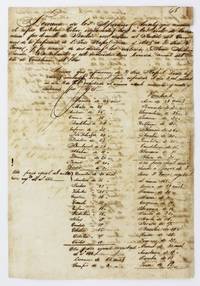
1866réf. 4747Havana: July 10 1866. Good. 3pp. on a bifolium. Separated at fold. Some wear to edge of first leaf cause some minor loss to text. A few scattered tape repairs and reattachments. Some offsetting. A colonial Spanish manuscript slave manifest for the steamship Cristobal Colon carrying dozens of enslaved Africans from Bailen to Partido del Cano both in Cuba. The text at the head reads as follows: "Nomina de los Africano bozales que conducten el vapor Cristobol Colon embarcado hoy a las siete de la mañana por el muelle de Bailen con destino al Partido del Cano unos de la propridad de D. José Rafael Diaz y otros de D. José Garcia y por encargo de sus dueños los custodia D. Juan Antonio Sanchez Bustamante y este individuo tiene biencia annal del Partido de Consolacion del Sur." Bailen is on the southern coast of Cuba north of the Isle of Pines; "El Cano" seems to have been a plantation outside of Havana while Consolacion del Sur is coastal town in the Pinar del Rio region of Cuba. The manifest lists 133 "Africanos bozales" that is slaves who could not speak Spanish in two or three columns separated between men "varones" and women "hembras" - their assigned names are given generally of Christian origin but with some range e.g "Ciforiana" "Liborio" and "Dionisia." Their ages are given one as young as nine several in their late thirties but most in their teens to early thirties. An additional leaf signed from Manila and dated July 10 1866 notes that although 133 people were sent only 115 survived the journey and lists the names of those who perished. July 10 books
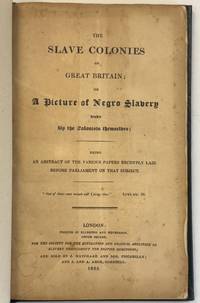
1825réf. 41192London: Printed by Ellerton and Henderson Gough Square for the Society for the Mitigation and Gradual Abolition of Slavery Throughout the British Dominions; and Sold by J. Hatchard and Son Piccadilly; and J. and A. Arch Cornhill 1825. iv 164 pp. Some foxing to first and last few leaves; title and last page toned. Bound in modern dark boards with gilt-lettered title stamped on front cover. Good plus. A second edition issued in 1826. The book reviews developments concerning slavery in each of the British West India colonies: laws for free people of color and for slaves manumissions proposed reforms and objections to reforms trials of alleged rebels and insurgents including the destruction of the Methodist chapel in Barbados and revolts and trials in Jamaica changes in the law punishments inflicted manumissions the slave trade slave unrest. "The reports were called for in order to learn what had been done in the way of effecting amelioration in the colonies. This work brought out by the Society for the Mitigation and Gradual Abolition of Slavery Throughout the British Dominions. . . showing that nothing substantial has been done" Ragatz. It "presents cases of extreme cruelty" id. to slaves in Berbice. Authorship and editorship are attributed to Zachary Macaulay founder and organizer of several antislavery societies and a major force in accomplishing the British Emancipation. He focused on providing a picture of Negro Slavery based on reports of "the colonists themselves." FIRST EDITION. Ragatz 458. Sabin 82063. Not in LCP. Printed by Ellerton and Henderson, Gough Square, for the Society for the Mitigation and Gradual Abolition of Slavery Throughout unknown books
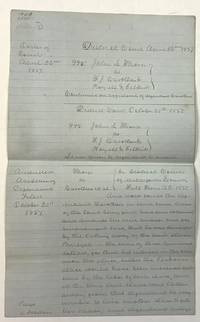
1857réf. 40346Matagorda County Texas 1857. Six pages in neat ink manuscript on lined pale blue legal paper. Fine. The document is probably the record for Carothers' appeal of the Court's judgment in favor of Thorn. The parties having waived a jury trial the Court found in favor of Thorn the Plaintiff. In addition to the failure to pay Thorn for the hire of Taswell Thorn claimed that Carothers had failed to pay $100 rent to Thorn for farming on Thorn's property. Carothers said that the slave Bridget upon whom Carothers had relied for performing work on the property had been "taken away" apparently by Thorn during the term of the agreement. Bridget's absence Carothers said caused his nonperformance and thus excused his failure to pay. The Court disagreed and ordered Carothers to pay the amount of the notes plus costs and interest. unknown books
1789réf. 40544Hempfield Westmoreland County Pennsylvania 1789. Folio leaves folded to oblong 7.5" x 9." Plain wraps with manuscript title detached but present. 44 pp including: 1-title 35 hand-paginated with entries 1-tally page and 1-assessors' certification 6 blank. Toned some splitting along spine folds light chipping at edges. Good. In March 1780 Pennsylvania enacted "An Act for the Gradual Abolition of Slavery" requiring "That all persons as well Negroes and Mulattoes as others who shall be born within this state from and after the passing of this act shall not be deemed and considered as servants for life or slaves; and that all servitude for life or slavery of children in consequence of the slavery of their mothers in the case of all children born within this state from and after the passing of this act as aforesaid shall be and hereby is utterly taken away extinguished and for ever abolished." Persons born in Slavery before the date of the Act would remain as slaves. This inventory of taxable property is a Who's Who of Hempfield Township in western Pennsylvania consisting of an alphabetical list of the heads of households for the township. Each entry includes the number of servants under columns headed "Negro & Mulatto Slaves" or "Negroes"; land by deed warrant or location; improvements; number of horses horned cattle mills stills houses/lots and outlots; and value of the property in pounds shillings and pence. Several entries have "Single Man" written across the first few columns. The total taxable property in this return is £12850.3.9. Five entries have a "1" under the "Negroes" column including: William Perry Esq.; James Guthry who notes F 30; Alexander McDowall; David D.P. Marchant; Christian Rhodabough who notes 1-30. Other entries have an "X" in the "Negroes" column. The assessor is listed on the last page as Robert Flemman; Robert McKee 1771-1850 and Robert Taylor are his assistants. "Hempfield's early settlers were Germans from southeastern Pennsylvania. The name Hempfield was taken from Hempfield Township in Lancaster County which was formed in 1729 as an English place name. Hempfield Township in Lancaster County derived their name from the production of hemp. In 1818 Lancaster County divided Hempfield Township into East and West Hempfield. The settlers from Lancaster County that came to this area gave the same name to our Township where some of the early settlers had resided. Agriculture was the base for the settlers in the early days. The Township was known for the stills and distilleries where farmers refined the substantial grain output." "Naming & Establishing Hempfield Township" accessed at official website of Hempfield Township 25 February 2025. Two notable individuals listed are Henry Aleshouse 1757-1837 and Michael Huffnagle 1753-1819. Aleshouse was Captain of the Continental Army from 1776-1780 and prisoner of war during his service; Major in the Pennsylvania Militia in 1783; member of the Pennsylvania State House of Representatives from 1802-1805 1812-15 1817-1818; and Pennsylvania State Senate from 1819-1826. Huffnagle was prothonotary for Westmoreland County Captain in the 8th Pennsylvania Regiment during the Revolutionary War one of the first lawyers admitted to the Westmoreland County bar Judge of the Court of Common Pleas Clerk of the Court of Quarter Sessions and Clerk of the Orphan's Court and Agent for Forfeited Estates. Of the slave owners Dr. David Marchant Marchand 1746-1809 was a Captain in the American Revolution local doctor and founder of the first hospital west of the Allegheny Mountains; William Perry Esq. 1745-1793 was a sheriff of Westmoreland County from about 1777-1789 Treasurer of Westmoreland County from 1783-1788 County Sheriff in 1779 and Captain of a company of rangers with the Westmoreland Militia. Some of the surnames listed are: Alesworth Aultman Berger Brisby Beer Barnheart Bell Campbell Condon Cough Crookshank Clingahsmith Davison Errit Fullerton Jenkins Kimble McCurdey Russell Robison Shotts Shull Taylor Turner Wagley Waterson Yokey and others. unknown books
1856réf. 33708Philadelphia 1856. 24pp disbound three small binding holes in blank left margin. Two early signatures of Wm. Thompson Shafer on title page. Light spotting throughout. About Good. This scarce pamphlet says the "great issue" is whether "Slavery shall be allowed to overspread a territory of greater extent than that of the whole United States" and "whether the policy of our government is to continue to be that of Slavery Extension or Slavery Restriction." All the power of the presidency is "being used to force the withering and blighting scourge of Slavery upon the National domain." Pursuing this tyrannical course our government "shall lend its aid in striking a deathblow to the freedom of speech the liberty of the press and the security for life personal liberty possession and peace." LCP 4300. OCLC 22829199 4- LCP No. IL U Haverford Detroit Pub. Lib. as of April 2017. unknown books
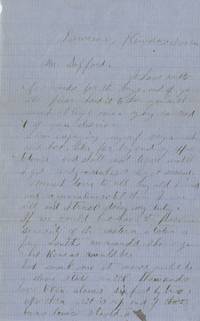
1850réf. List38115Lawrence Kansas Territory 1850. Autograph letter signed "O. S. Hemps" addressed to Mr. Harvey Safford. Two pages measuring 5x 8 inches. With envelope postmarked "LAWRENCE K.T." Letter folded with some discoloration along folds with small chip at top left margin. Near Fine. An excellent Free-State Kansas letter written from Lawrence in which the author reports that he is well and "doing my duty" praises the possibilities of Kansas if only it had "the peace or security of the eastern states" and issues a striking warning regarding the territory's future: "But mark me it never will be a slave state until thousands have taken claims six feet by two. Northern grit is up ." The writer further predicts "amazing times" should officers attempt to enforce the "bogus laws" in Kansas especially if they came "for the prisoners." His language places the letter firmly in the heated political atmosphere of Bleeding Kansas when Free-State settlers and proslavery forces struggled for control of the territory's legal and political future. Full transcription follows: "Lawrence Kansas Nov. 24 Mr. Safford "I have written a few words for the boys and if you will please hand it to them you will much oblige me. You can read it if you desire. I am enjoying myself very much . like far beyond my expectations and shall not leave until I get ready & unless I get scared. Much love to all my old friends and acquaintances. Tell them I am well and I trust doing my duty. If we could but have the peace or security of the eastern states a few months we would show you what Kansas could be. But mark me it never will be a slave state until thousands have taken claims six feet by two. Northern grit is up and if officers should attempt to execute those bogus laws here we should have amazing times of it especially if they should come for the prisoners. "How is Armida these days. I hope she is much better than when I was there. Tell Edwin if I can possibly find time I shall send him a long letter soon. "With much respect I remain your obedient servant O. S. Hemps to Mr. Harvey Safford ." A vivid territorial Kansas letter with unusually direct antislavery language and a memorable declaration that Kansas would not become a slave state without mass bloodshed. . unknown books
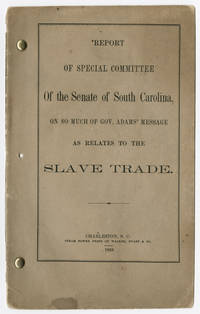
1858réf. 53597Charleston. 1858. Report submitted to the South Carolina Senate which concludes that slavery is essential to the agricultural production of the South. Additionally the committee felt that the slave trade helped relieve Africa from "the pressure of a redundant population as might be afforded by emigration in the only form in which its benefits can be extended to them." Original printed wrappers. Spine perished held together with brass tacks; light chipping and soiling. Paper lightly and evenly toned. Good. unknown books