[Slavery]:ABAA
2 034 résultats
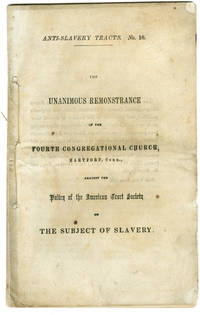
1855réf. 55824New York: American Anti-Slavery Society 1855. Criticizing the American Tract Society for Suppressing Anti-Slavery Works The scarce second printing of what is technically the first edition of this anti-slavery pamphlet printed in New York by the American Anti-Slavery Society from the same "stereotype plates.without alteration" as the edition printed in Hartford earlier the same year. The text focuses on an appeal to the American Tract Society to take a more vocal and concerted stand against slavery. The authors of the text accuse the American Tract Society of "suppression" of anti-slavery sentiment by censorship of certain works it publishes that speak against the institution and an overall sin of "studied and persistent omission" by not itself issuing "a direct condemnation of the most giant iniquity of our land." The text is signed in print at the conclusion by "The Members of the Fourth Congregational Church Hartford Conn." The work was issued as the sixteenth entry in the American Anti-Slavery Society's "Anti-Slavery Tracts." Gathered signatures stitched as issued. Minor edge wear spotting and soiling. Very good. SABIN 30676. unknown books
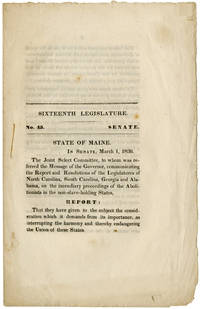
1836réf. 52765N.p. likely Augusta. 1836. Mainers Propose to Not Meddle in the Slave States A rare Maine slip-bill document resolving that the citizens from Maine and other states should not interfere with the issue of slavery in slave-holding states. The legislature writes: "Any interference therefore of a State or the inhabitants of a State with the domestic concerns of another State is dangerous as having a direct tendency to create jealousies between the States and thereby weakening the attachment to the Union which is our only security against domestic dissensions and foreign aggressions." This is a somewhat surprising position for the state of Maine to have taken at the time. Maine came into the Union in 1820 as a free state to balance the admission of the slave-owning state of Missouri. Also Maine opposed the admission of the Republic of Texas in 1836 the same year the present document was printed on the basis of Texas' position on slavery. It is curious that they would take two seemingly opposite positions in the same year. Still the legislature printed the resolution and authorized copies to be sent to the four southern slave-owning states mentioned in the title. Folded sheets stitched. Minor foxing and toning. Very good. Untrimmed. unknown books
1831réf. 40189Washington. 1831. The Society attempted to alleviate the problem of slavery and degradation of free Blacks by establishing a colony for them outside the United States preferably in Africa thereby "separating them WITH THEIR OWN CONSENT from the white race." The Society established the colony of Liberia in 1822 assisting African Americans to resettle there. The colony continued to grow for the next twenty years and Liberia declared itself an independent state in 1847. Not in AMERICAN IMPRINTS. Original cream printed wrappers. Wrappers detached. Contemporary ownership inscription on front cover. Some light foxing and tanning to a few leaves else clean and bright. About good. Untrimmed. unknown books
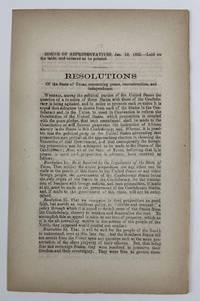
1865réf. 4902Richmond Va.: January 19 1865. Very good. 3pp. printed on a single folded sheet. Minor toning and wear. A defiant screed issued by the Confederate House of Representative in January 1865 printing eight resolutions by the Texas Legislature passed in November 1864 to be presented to the President of the Confederate States should a "re-union" between the Confederacy and the Union occur at the end of the Civil War. Paramount among the Texas House's concerns is their insistence that an amendment be made to the U.S. Constitution that "will forever guarantee the institution of African slavery in the States in this Confederacy." The third resolution prints a familiar refrain in which the Texas House argues that their secession from the Union was not motivated "upon any questions such as the mere preservation of the slave property of their citizens" but rather in order to "preserve their freedom and their sovereignty" i.e. state's rights. Further in this same resolution the Texas legislature warns that they "are still unwavering in their resolution to preserve their freedom and their sovereignty without which all else is valueless." Other resolutions cover trade with foreign powers the South's unfavorable opinion of Abraham Lincoln "a Chief Magistrate with the purpose that he should destroy our liberties in disregard to the Constitution" the South's inability to accept reconciliation with the North and proposes that any end to the Civil War must begin with the U.S. government "making their proposition to the Government of the Confederate States which alone can entertain it." Resolution five contains fiery language cataloguing the "inhumanities of this war" which concludes with an unsurprising but nonetheless eye-opening accusation: "Lying to themselves and pretending to the rest of the world that they are fighting the battle of freedom for four millions of happy and contented negroes they are attempting the enslavement of eight millions of freedmen. With devilish mockery of philanthropy. they have deluded and dragged these negroes from their comfortable homes to use them as screens from our weapons in the day of battle and they have sent them by thousands to painful death by neglect exposure and starvation. January 19 unknown books
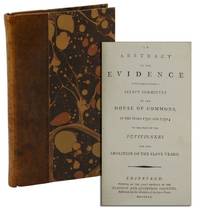
1791réf. 140945477Printed at the Joint Expence of the Glasgow and Edinburgh Societies instituted for the Abolition of the Slave Trade: Edinburgh 1791. First Edinburgh Edition. Very Good. Rare first Edinburgh edition published same year as the London edition of eye-witness testimony on the horrors of the British slave trade containing a very early engraving of the famous large folding plate of slaves packed into the hold of the slave-ship Brookes. The famous engraving is one of the most powerful and influential images in the history of social justice and the fight to abolish slavery. It served as a gruesome test of the Britain's "humane" Slave Trade Act of 1788 also known as Dolben's Act which limited the number of enslaved people that British slave ships could transport based on the ships' tons burthen. Very Good. Small 8vo bound in somewhat recent quarter calf and marbled boards with light fading to the spine. Folding frontispiece map of the west coast of Africa in with 2 x 0.5" loss along one edge neatly restored. Large folding woodcut 16.25 x 15.5" of a slave ship based on the engraving W. Elford published in a pamphlet in London in 1789 is excellent and bright with several repairs made to the verso mending tears. The print now an iconic symbol of the Middle Passage was so visually arresting that William Wilbeforce created a scale model of the Brookes making it a central part of his presentation before the House of Commons. His abolition bill did not garner enough support to pass and it was not until 1807 that England succeeded in abolishing slavery. Edinburgh unknown books
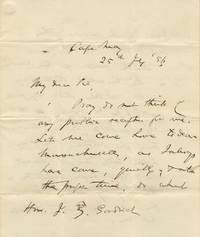
1856réf. List3745Cape May New Jersey 1856. Folded sheet with letter on three of four pages measuring 8 ½ x 7 ¼ inches. Fine condition. In May 1856 Senator Charles Sumner of Massachusetts delivered his incendiary "Crime Against Kansas" speech condemning slavery's expansion into the territories and attacking the architects of the Kansas-Nebraska Act. Three days later Representative Preston Brooks of South Carolina entered the Senate chamber and brutally assaulted him with a cane inflicting injuries severe enough to remove Sumner from public life for years. The attack became one of the defining symbolic episodes of the sectional crisis before the Civil War. Northern newspapers followed his condition closely and his empty Senate seat itself became a political emblem. Written from Cape May only two months after the attack while Sumner remained under physician supervision and uncertain whether full recovery would come quickly-or at all-Sumner writes here to a political ally in Massachusetts describing his physical and mental state: "My dear Sir "Pray do not think of any public reception for me. Let me come home to dear Massachusetts as I always have come quietly & at the proper time do what I can for the cause. This is best. Another reason for this course is the uncertain state of my health. I am still very feeble with such recurring ups & downs that my complete restoration seems sometimes far distant. My physician tells me I cannot be strong before September & then only by entire absence from all excitement. Perhaps not then. "Think of these things; & let us all join to stir Massachusetts in the good work forgetting men & remembering only the cause. "Ever sincerely yours Charles Sumner "P.S. From here I go to the mountains; but my address will be with Rev. Wm. H. Furness Phila. to Hon. J. Z. Goodrich" The letter gives a personal insight into the fallout of one of the most dramatic and violent political events of the antebellum sectional crisis. Sumner would return to politics three years later and the event would galvanize both Southern sympathizers to Brooks who sent him canes as tokens of gratitude and the Northern anti-slavery cause which considered Sumner a martyr. We find two other examples of letters by Sumner discussing the aftermath of the attack in all historical auction records. books
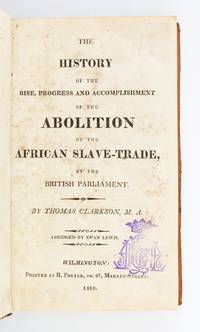
1816réf. ST19567-131Wilmington: Printed by R. Porter 1816. Abridged Edition. 180 x 115 mm. 7 x 4 1/2". 348 pp.Abridged by Evan Lewis. Contemporary tree calf smooth spine with double gilt rules tan leather label with gilt lettering. With one small illustration of a seal in text. Title with crowned monogram stamp in purple ink. Sabin 13486. Calf with significant wear front hinge exposed but the binding very tight; text as expected with varying sometimes noticeable degrees of foxing and browning because of quality of paper. First published in two volumes in 1808 this important work on the history of the slave trade is an "invaluable" resource and "contains much essential autobiographical and other information." DNB The present edition was condensed into one volume in order to "be more generally diffused among the people of the United States" where slavery would not be abolished for another half a century. Thomas Clarkson 1760-1846 was a leading English abolitionist who advocated for an end to slavery world-wide and was an original founder of the Committee for the Abolition of the Slave Trade as well as the pacifist Society for the Promotion of Permanent and Universal Peace. Printed by R. Porter books
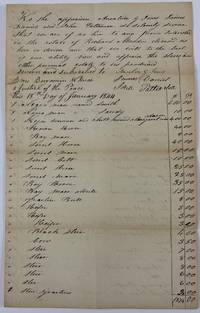
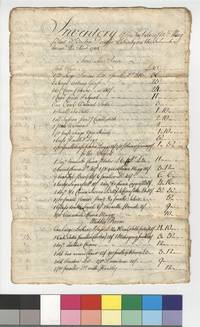
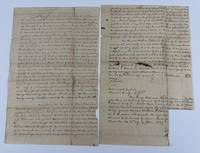
1844réf. 13105St. Genevieve County MO: January 18 1844. 4pp. on a single folded sheet. Original folds minor wear. Very good condition. A sobering manuscript inventory from the estate of Richard Maddin following his death in Missouri in 1843 detailing his "slaves and other personal" property. The inventory begins by listing the enslaved persons by name along with an assignation of value for each of them as such: "1 Negro man named Smith $600. 1 Negro man named Sandy $10. 1 Negro woman and child named Margaret and Jason $400." The inventory then goes on to list the other property beginning with a long list of livestock followed by equipment household goods and so forth. The document is certified and witnessed by a number of local citizens who attest to the "full and perfect inventory of the goods chattles and personal estate" of the deceased Mr. Maddin. The reasoning is unclear why the second listed slave Sandy was worth only $10. January 18 unknown books
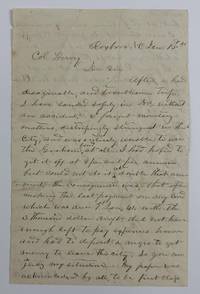
1860réf. 5563Roxboro N.C.: January 15 1860. Good. 2pp. Wrinkled previously folded. A few minor losses at folds not affecting text. Two half-inch closed tears from edges. Light toning and foxing. After arriving in Roxboro North Carolina in mid-January 1860 planter J.C. Barnett writes to his friend and business partner a Colonel Henry to complain about the tight money situation in the state which has forced him essentially to pawn a slave in order to raise cash: "I found monetary matters distressingly stringent in the City and was entirely unable to use the Graham bond at all. I had hoped to get it off at 8 per cent per annum but could not do it at double that amount the consequence was that after making the last payment on my land which was due 1st Jan 61 with the 3 thousand dollar draft I did not have enough left to pay expenses home and had to deposit a negro to get money to leave the city. So you can judge my situation." Furthermore he has other unpaid debts that he hopes to settle with future cotton sales: "I gave R.H. Williams a draft for 93 dollars also Messrs Lea & Cheatham of Louisville one for 111 dollars and owing to the circumstances just mentioned was unable to meet them. You will do me a favor when you see these gentlemen to explain the reason. When you sell my cotton after paying Mr. Batt and yourself the expenses if there is a remainder please apply it to my Louisville and Williams debt. Also Mr. Gratiot has a claim of an hundred dollars. I will write to these gentlemen and tell to apply to you when you sell my cotton." Interesting detail on economic difficulties in the south just prior to the Civil War. January 15 unknown books
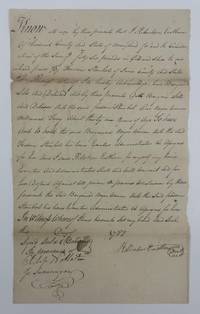
1788réf. 4111Frederick County Md: March 7 1788. About very good. 1p. folio docketed on verso. Old folds short splits along a couple of fold lines minor toning. An impactful manuscript document from the early national period in Maryland formalizing the sale of a slave woman in Frederick County. The sale was made by Robertson Eastburn whose family emigrated from England to Maryland in the early 18th century. The document reads in part: "In consideration of the sum of forty six pounds in Gold and Silver to me in hand and paid by Frederic Strombol.I do hereby Acknowledge have Bargain'd Sold and Delivered and by these presents doth Bargain Sell and Deliver Unto the said Frederic Strombol One Negro Woman named Torry about thirty years of age To Have and to hold the said Bargained Negro woman unto the said Frederic Strombol." Slavery in Maryland lasted over 200 years from its beginnings in 1642 when the first Africans were brought as slaves to St. Mary's City to its end following the Civil War. In 1664 under the governorship of Charles Calvert 3rd Baron Baltimore the Assembly ruled that all enslaved people should be held in slavery for life and that children of enslaved mothers should also be held to the same standard of law. 19th-century American slave sale documents are growing increasingly scarce in the market. March 7 unknown books
1759réf. ST19900Philadelphia and Germantown: Benjamin. Franklin and David. Hall or Christopher Sower 1759-60. 192 x 130 mm. 7 1/2 x 5". 1 p.l. collection title 47 1 71 4 76-168 iv 5-43 1 55 1 64 16 pp. Contemporary blind-ruled sheep nicely rebacked to style raised bands. Verso of front flyleaf inscribed in ink in the recipient's hand: "This Book is the Gift of Mr. Anthony Benezett sic to William Anderson October 14th 1760"; front pastedown with ink inscription: "The holy Book To Be Read"; title page with signature of William Anderson dated 1760; front flyleaf and both free endpapers with additional 19th century owner inscriptions. Miller 730; Smith Friends' Books I p. 240. For "Observations": Sabin 4676; Evans 8542. Boards a little dried and scuffed with a couple of small stains text variably toned because of colonial paper quality perhaps a fifth of the text rather browned dampstaining in the upper margin in the middle part of the volume mostly unobtrusive but darker and extending downward on a few leaves. The texts in the kind of problematic condition expected with early American imprints but the binding much better than is normally seen. This is a presentation copy of an important published collection of Quaker texts that includes four works printed by Benjamin Franklin as well as an early significant abolitionist tract that delivers a powerful condemnation of the slave trade. The collection title page lists nine tracts in total six of which were issued with separate title pages comprising: "An Extract from the Spirit of Prayer" by W. Law; "A Discourse on Mistakes concerning Religion" by Thomas Hartley; "Christ's Spirit or a Christian's Strength" "The Stumbling Stone" "The Doctrine of Baptism" and "The Trial of Spirits" all by William Dell; "The Liberty of Flesh and Spirit Distinguished" by J. Rutty; and "Observations on Enslaving Importing and Purchasing of Negroes &c." followed by "The Uncertainty of a Death-bed Repentance" both by Anthony Benezet. Miller asserts that "the first fifth sixth and seventh had previously been printed by Benjamin Franklin and David Hall all in Caslon type. The remainder had been printed by Christopher Saur who owned no Caslon letter." The volume title also in Calson type is attributed to the press of Franklin and Hall for the same reason. According to Miller Anthony Benezet put together this collection of Quaker material in the spring of 1760 in an edition of 500 copies with the hope of reaching those living "in ye back Parts of Maryland Virginia & N. Carolina . . . and Connecticut." First printed in 1759 Benezet's forceful denunciation of the slave trade is notable for using eyewitness accounts from people actually involved with the trade recounting the horrific practices and conditions that were realities of the system. Citing various lines of scripture Benezet argues that slavery runs contrary to Christian teachings and Mosaic law and that those who purchase and keep slaves bear as much guilt as the traders themselves. Born in France to Huguenot parents Benezet 1713-84 was a Quaker abolitionist educator and writer who became one of the earliest and most outspoken advocates against slavery in colonial America. He emigrated to Philadelphia by way of Rotterdam and London in 1731 where he founded Pennsylvania's first secondary school for girls and later opened one of the first schools to welcome black students. ANB says that "Although Benezet is recognized as the most prolific antislavery propagandist of the eighteenth century throughout his lifetime he supported and wrote about a wide variety of causes and topics including assistance for Acadian refugees temperance peace fair treatment of Native Americans religion educational reform and poor relief." His wife Joyce Benezet d. 1786 née Marriott was a preacher in the faith herself. According to Waldstreicher Franklin maintained a "lifelong friendship with Quaker politicians merchants and scientists. . . . He admired Quakerism because of its affirmation of simplicity frugality anti-slavery and humanitarianism." Franklin also saw the possibility of profit in printing for the considerable Quaker population of his colony. Hall 1714-72 came to Philadelphia from London in 1744 to work for Franklin and became a partner in the firm in 1748. As a considerable mark of his regard for Hall Franklin drew up a contract whereby his partner would over an 18-year period buy him out. It is a further sign of Franklin's regard for Hall that the printer is buried beside Franklin and his wife. As to contemporaneous provenance we can speculate with some degree of certainty that our William Anderson was the person of that name who was a Quaker preacher from Haverford near Philadelphia. His wife Margaret--like Benezet's wife Joyce--was also a preacher and these two husband-and-wife teams are dealt with in Rebecca Larson's "Daughter of Light: Quaker Women Preaching and Prophesying in the Colonies and Abroad 1700-1775" 1999 Appendix 2. . B[enjamin]. Franklin and D[avid]. Hall or Christopher Sower unknown books
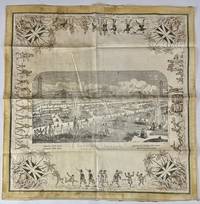
1890réf. 12893N.p. likely London 1890. Lithograph on silk handkerchief approximately 24 x 24 inches with additional lithographed scene printed around the outer margins in brown and blue ink. Previously matted and framed with resultant edge wear and adhesive staining around margins. Old folds some foxing and staining in image area. Overall good plus condition. A very rare and impactful 19th-century British lithograph-on-lithograph the original a view of London's Crystal Palace with the addition of a satirical scene detailing the history of British colonialist activities in Africa. The overall scene is presented in four linear parts one across each mostly blank margin of the Crystal Palace scene; interestingly the two lithographs overlap each other at a few places along the short edge. The scene seems to begin with the part labeled "African Slave Trade" picturing two slave traders leading a chained procession of African slaves men women and children. The next edge is labeled "The Rescue" and shows three British soldiers including one bagpiper freeing the slaves who are pictured free of their chains and dancing and now detaining the two slave traders in chains. The third panel pictures two groups of Africans -- one group running to a rum dealer and another group listening to a man holding a book presumably a missionary preacher. This scene seems to allude to British activities in the West Indies. The final panel labeled "Civilization" is the most varied. It pictures a couple of British railway agents under the banner "Change for Timbuctoo;" a group of African men in Western garb one holding a sign reading "African Times;" an African man riding a bicycle; and a family scene of a man kneeling in front of a seated woman while he kisses her hand and a young man in the background sells matches. How civilized indeed. Each corner of the work is emblazoned with a British lion and the Union Jack amidst a field of African foliage and West Indian palm trees. The scene seems to celebrate the effects of British colonialism while ignoring the country's own history as slaveholders and traffickers the previous century. "The border panels of this printed cotton handkerchief caricature the impact of British colonial policy on Africa. It was probably produced at the end of the 19th century at a period when European colonial rule led to increasing social and political intervention in African societies. It illustrates the rescue of a group of slaves by a British military detachment and their subsequent 'westernization' through the introduction of European goods and commodities." This description comes from the online description of the only other example of this scene we can find which resides at the National Maritime Museum NMM at Greenwich London. The NMM example is printed on a blank cotton handkerchief in brown and red and is slightly smaller on one side than our example. Their dating is likely correct if for nothing else because of the depiction of a chain-driven bicycle which became popular in the UK in the 1890s. unknown books
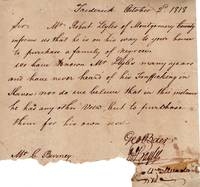
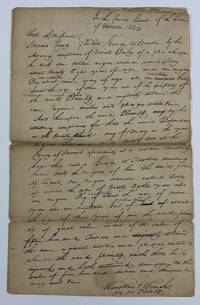
1818réf. 12956Frederick MD: October 2 1818. 1p. docketed on verso. Roughly torn along bottom edge minor foxing and spotting. Good condition. An uncommon document in Maryland slave history in which George Baer the future mayor of Frederick and a few other men attest that another local citizen named Robert Lyles is not a slave trader. The document reads in part: "Lyles is on his way to your house to purchase a family of negroes. We have known Mr. Lyles many years and have never heard of his Trafficking in Slaves nor do we believe that in this instance he has any other view but to purchase them for his own use." Baer served as mayor of Frederick from 1820 to 1823; his correspondent "C. Burney" is perhaps Clotworthy Birney 1765-1845 a farmer and real estate trader living near Taney Town. An unusual Maryland slave document concerning a slave owner who just wants to buy slaves for his own use not traffic in them because that's somehow better. October 2 unknown books
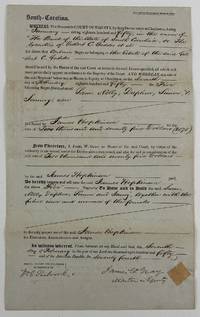
1850réf. 12963Charleston SC: Printed by Walker & Burke February 7 1850. Partially-printed document completed in manuscript 13 x 8 inches. Old folds minor toning and offsetting. Very good. A very rare pre-printed form from antebellum South Carolina designed specifically for documenting the sale of slaves in Charleston in the mid-19th century. The document emanates from the Court of Equity and directs the estate of Gilbert C. Geddes to sell five named slaves to James Hopkinson for $2075. The names of the slaves are Sam Nelly Daphne Simon and Jenny. The document is signed by James W. Gray Master in Equity in the case of "Bank of the State of South Carolina vs. the Executrix of Gilbert C. Geddes et al" and by William E. Seabrook as witness. Gray adds a particularly insidious note near the bottom of the document when he writes that Hopkinson is entitled to "have and hold" the aforementioned five slaves "together with the future issue and increase of the females." Geddes 1806-1848 a wealthy Charleston resident owned more than a hundred enslaved people when he died; his father John Geddes served as governor of South Carolina 1818-1820. This is the first example of this document we have seen and a unique record of the transference of five slaves and particularly interesting for granting the new slaveowner the rights to future slave children. Printed by Walker & Burke, February 7 unknown books
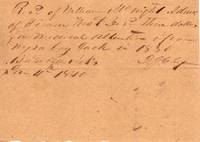
1840réf. 12966Batesville AR: January 11 1840. 1p. 4 x 5.5 inches docketed on verso. Old horizontal fold toning. Very good. An interesting manuscript record of slave care in Arkansas in the 1830s. The short but impactful document reads in full: "Recd of William McNight Admin. Of Hiram West Decd three dollars for medical attention upon negro boy Jack in 1836. Batesville Ark. Jan 11 1840 DJ Chipman." Such documents are increasingly rare in the market and more uncommon than slave sale documents from the same period. Arkansas has just achieved statehood four years before the presetn document was written. January 11 unknown books
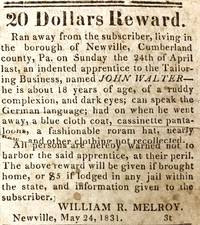
1831réf. 41338Carlisle Pa.: William B. & James Underwood 1831. First edition. Self wrappers. About very good with folds faint dampstain along top part of front page chipped along fore edge with one inch tear at fold. 4 pp. Illus. with small b/w drawings. 18 x 11 inches. 20 Dollars reward for German American runaway apprentice. News on Colonization Societies Liberia Slavery and Commissioners' Sale of unseated lands with names. This issue not at AAS. William B. & James Underwood unknown books
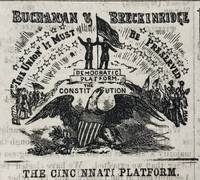
1856réf. 41339New Brunswick NJ: A.R. Speer Chas. P. Atkinson 1856. First edition. Self wrappers. A very good- copy separated leaves small chips at margins. 4 pp. Illus. with 2 in-text b/w engravings. 16 x 11 inches. Reports on the election results of the 1856 Presidential election with the Buchanan and Breckinridge ticket winning plus "The Cincinnati Platform "- including the position of allowing States rights to determine if slavery should be legal. This issue not at AAS A.R. Speer, Chas. P. Atkinson unknown books
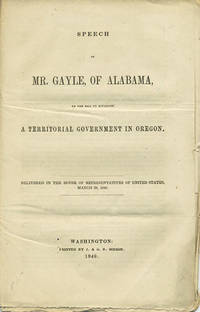
1848réf. 37646Washington D.C.: J. & G.S. Gideon printers 1848. First edition. Removed. A very good unopened uncut and intrimmed copy with a mail fold. 14 pp. 8vo. Against Oregon admittance over the slavery issue: "The position I shall assume and attempt to maintain is that Congress has no power to organize what is called a territorial government by ordinance or otherwise; nor has Congress the power to pass laws for the people of the territories of the United States.The speech of the honorable member from Ohio Mr. Root delivered on the 15th of the present month. That speech breathes nothing but hostility to Southern institutions. It was uttered in a tone of defiance and in such language of menace as left the impression that the honorable speaker thought that empty threats were quite sufficient to intimidate what he was pleased to call “Southern chivalry.What does the gentleman from Ohio mean by this haughty and vainglorious boasting Does he think that the South are to be frightened from their duty to their country and themselves by these empty menaces The proposition to exclude slave labor from the territories of the United States is a proposition to degrade the slave States—to render them inferior to the free States." John Gayle 1792-1859 "was Alabama's seventh governor and also served as a U.S. congressman state legislator and jurist. Gayle was a fervent champion of states' rights and his advocacy laid the foundation for that movement in Alabama in the 1850s and for the realignment of state political parties." Sarah Woolfolk Wiggins: John Gayle Encyl. of Alabama. Sabin 26798. J. & G.S. Gideon, printers unknown books
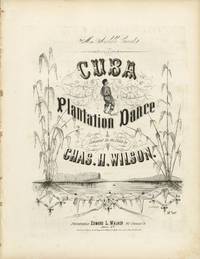
1855réf. List3682Philadelphia: Edward L. Walker 142 Chestnut St. above 6th 1855. Folio sheet music pictorial lithographed cover approximately 13.5 × 10.5 inches. Light edge wear and minor toning; very good with a strong impression of the cover illustration. An antebellum piano dance reflecting the plantation imagery that circulated widely in mid-nineteenth-century American popular music. “Cuba Plantation Dance” was composed by Chas. H. Wilson a little-documented composer whose name appears chiefly in connection with this work and issued in Philadelphia during the early 1850s by Edward L. Walker the predecessor firm to the major publishing house Lee & Walker. A copy is recorded in the Levy Collection at Johns Hopkins which dates the publication to 1855. The cover presents a stylized plantation landscape framed by tall stalks of sugar cane with a small central vignette of a dancing Black figure. The use of Cuban plantation imagery reflects contemporary American fascination with the Caribbean sugar economy and with plantation life beyond the United States. During the 1850s Cuba was one of the largest slave societies in the Atlantic world. By the midcentury the island’s sugar plantations relied on hundreds of thousands of enslaved Africans and the enslaved population of Cuba was estimated at roughly 400000 people in the 1840s–1850s working primarily in the rapidly expanding sugar industry. Although Spain formally agreed to end the Atlantic slave trade in 1820 illegal importations of enslaved Africans into Cuba continued for decades supplying labor for the island’s plantations well into the 1850s. American publishers frequently borrowed such imagery for plantation-themed dance music marketed to the parlor trade. Pieces labeled “plantation dances” or “Ethiopian dances” formed part of the broader culture of minstrel and plantation entertainment. The title page bears a dedication to “Miss Arabelle Conrad” typical of mid-century sheet music addressed to amateur pianists. Along with the aforementioned copy in the Levy collection we find copies at Michigan and Temple. Edward L. Walker, 142 Chestnut St., above 6th unknown books
1738réf. 60003Mary Grosse Phillips Blair 1681-1738. Manuscript Document Estate Inventory Boston Mass. November 3 1738. 8 pp. folio. Mary Blair was widow of Capt. John Phillips and Capt. William Blair merchant. This inventory depicts a lavishly furnished mansion vast real estate holdings and a rich array of items in the shop -- suggesting that Mary Blair continued the mercantile trade after her husband's death in 1736. Also of note are enslaved persons Cato and Monday. Thomas Hancock was one of the administrators of the estate which was valued at over £28232. Another copy of the inventory exists in state records Suffolk County probate case 7223. Fine condition. books
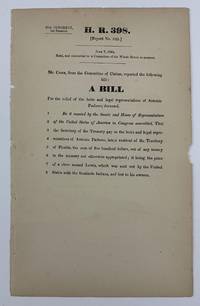
1844réf. 5887Washington DC: June 7 1844. Very good. Broadside 12.25 x 7.75 inches. Light tanning shallow marginal chips and some fraying to left and right edges. An unrecorded slip-bill printing of a House Resolution with a phenomenal back story involving an erudite elusive and resourceful Florida slave. The slip bill authored by Howell Cobb U.S. Representative from Georgia stipulates that the Secretary of the Treasury pay the sum of five hundred dollars to the heirs and representatives of Antonio Pacheco a former resident of Florida the sum "being the price of a slave named Lewis which was sent out by the United States with the Seminole Indians and lost to his owners." That's where the plot thickens. The slave is now known to history as Luis Fatio Pacheco born in 1800 to enslaved parents on the "New Switzerland" plantation in Florida which was surrounded by a mix of Europeans Africans and Native Americans. As such Luis became fluent in several languages including Seminole which later made him a valuable asset. After a conflict with his owner Luis attempted to escape slavery in 1824 by fleeing to Spanish fisheries on Florida's Gulf Coast but he was captured by U.S. military authorities the following year. Skilled as he was in languages and literacy by the military Luis was sold in 1832 to Antonio Pacheco a Cuban merchant. After Antonio's death Luis became the property of Pacheco's widow. When tensions began to ratchet up again between American military forces and the Seminole tribe a U.S. Army officer made a deal to rent Luis from the Pacheco estate at the rate of $25 a month to take advantage of his services as an interpreter. In December 1835 Luis was accompanying a troop detachment led by Major Frances L. Dade in a march to reinforce Fort King near the present-day city of Ocala Florida. Evidently that day Luis was assigned as a scout; he has said to have attempted to warn Dade of a possible ambush by the Seminoles which went unheeded by the commander. The result is today known as the Dade Massacre in which Dade and most of his men were killed. According to the narrative provided by Luis who spoke Seminole he explained to the warriors that he was a slave and successfully pleaded for his life. Luis lived with the Seminoles as a captive for nearly two years before again managing to escape. In September 1837 Luis surrendered to the U.S. Army at Fort Peyton near St. Augustine. Soon after he was accused of collaborating with the Seminoles in the Dade Massacre. In 1841 negotiations between the US government and Seminole leader Coacoochee the Native American leader claimed Luis as his property captured in war. Coacoochee was permitted to take Luis together with other Black Seminoles to Oklahoma for resettlement. This event led to the claim by Anthony Pacheco‘s heirs for restitution of a lost slave. The Joint Committee on Claims approved the claim. Luis's story eventually became a focal point in the abolitionist argument against slavery and in 1858 Ohio representative Joshua R. Giddings published a book portraying Luis as a hero against the system. In any case the question of whether or not Luis betrayed Dade has never been completely resolved. June 7 unknown books
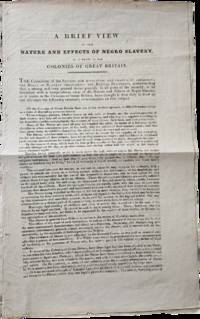
1823réf. List3302London England: Ellerton and Henderson 1823. Three page document measuring 8 ½ x 13 ¼ inches. Folded with some small wrinkles at edges else Near Fine. A document produced by the Society for Mitigating and Gradually Abolishing the State of Slavery throughout the British Dominions better known as the Anti-Slavery Society. The group was founded in London in 1823 by a group of politicians philanthropists and businessmen including William Wilberforce Joseph Sturge and Zachary Macaulay. The document discusses the horrors of enslavement—even unfavorably comparing the British colonies’ conditions with those in the US—and decries the fact that after the 1807 Slave Trade Act essentially nothing more had been done to put “an end to a condition of society which so grievously outrages every feeling of humanity”. We find a single copy of the Ellerton and Henderson edition in physical format listed in OCLC as accession number 83930673. Ellerton and Henderson unknown books
1728réf. 100536Pamphlet 8vo modern full calf in the style of an 18th century Cambridge binding 32 pp.Very slight aging; in excellent condition. This is a rare first edition of a work that presents a complaint by British planters in the West Indies concerning the Assiento or agreement with Spain that gave Britain a virtual monopoly on the African slave trade. This agreement came out of the Treaty of Utrecht which ended the War of the Spanish Succession. This pamphlet indicates that the planters feared as a result of this agreement British slavers might be required to provide African slaves to the Spanish colonies which could result in insufficient numbers available for the West India plantations. The Assiento with Spain would mark the beginning of the Atlantic slave trade as a very powerful economic growth engine. Unfortunately this would translate into millions of Africans being taken from their homes. H. Whitridge books
1839réf. 3013Washington D.C. 1839. Fair. 3pp. Large folio. Separated into six pieces with a very small section of the final attestation lacking altogether. Still highly readable. A wounded but important document. A rare and historically-important document relating to slavery in the District of Columbia which was outlawed on April 16 1862 nearly nine months before the issuance of the Emancipation Proclamation. The present document is an indenture made between William G. Howison and Alexander Hunter Esquire both citizens of Washington D.C. associated with property conveyed to Hunter by the deceased Joseph Birch. In 1824 Birch conveyed to Hunter land "and also a negro man slave for life named Lewis - another named George - two horses - 4 cows - 3 calves." The document indicates that Lewis was subsequently sold for four hundred dollars and George was sold to Birch in his lifetime. Documents recording the movement of slaves within the District especially among two citizens of the city are rare in the market. unknown books
1822réf. 4276Howard County Mo 1822. Good. Three documents totaling 3pp. folio the two earliest documents written on each side of the same leaf with an integral blank and attached to the third document with sealing wax each document docketed on verso. Some short separations along folds minor spotting two short tape repairs. A series of three documents recording a case of slave theft in Missouri. The plaintiff in the case George W. Hardin sues a man named Urial Bailey for stealing three slaves from the Hardin estate in Howard County Missouri. The first document is a sworn oath dated May 23 1822 by George Hardin stating that "He was lawfully possessed of the negroes.and that the same were unlawfully taken by Urial Bailey.from his properties and with out his consent within one year last past and that he is now lawfully entitled to the possession of the said negroes." The document is attested by the clerk and signed by Hardin. The second document is executed by Hardin's lawyers on the verso of his oath dated the same day and constitutes an order from the court to the Sheriff of Howard County informing him that "George W. Hardin hath come into the Circuit Court held in the town of Franklin and found sufficient sureties as well as his clamour to prosecute for a certain woman called Dolly about the age of twenty eight years also one negro boy of about the age of nine years named Nathan also one negro girl called Eliza about the age of three years all the property of the said Plaintiff.which a certain Uriel Bailey.hath taken and unjustly detains. You are hereby commanded that the said goods.be delivered to the said George W. Hardin and that.Uriel Bailey appear before the said Circuit Court to be held at the town of Franklin." The third document is executed by Hardin's lawyers on the verso of his oath dated September 1822 and lays out the facts of the case. It reads in part: "George W. Hardin by his Attorney Tompkins & French complains of Urial Bailey that he took the previously named slaves of great value. To wit of the value of fifteen hundred dollars.where fore the said Plaintiff saith that he is injured and hath sustained damages to the value of five hundred dollars and therefore he brings suit." Interestingly in this document Hardin's lawyers refer to the youngest slave Eliza as a "mulatto girl." Docketing on the integral blank attached to the oath and lawyer's document dated May 23 1822 indicate that Hardin was seeking "Replevin Damages" of $500 which the court seems to grant. The motive behind Urial or Uriel Bailey's thefts are not recorded here but the issue of slave stealing was not uncommon and had been going on in the American colonies and the fledgling United States for a long time. According to Timothy F. Reilly in "Slave Stealing in the Early Domestic Trade as Revealed by a Loyal Manservant" published in Louisiana History: The Journal of the Louisiana Historical Association Vol. 55 No. 1 Winter 2004 pp.5-39: "Slave stealing plagued domestic slaveholders as far back as the colonial period when those who would unlawfully deprive a property owner of human chattel were detested as 'Negro jockeys.' Whether operating in the northern or southern colonies a 'man-stealer' lurking about either as a piratical thief or as a high-minded abolitionist was guilty of one of the worst crimes against the sanctity of property. By the 1830s man stealing reached epidemic levels in parts of the South." Despite the seeming prevalence of slave theft for a long period of time in the United States primary source records of court cases are very scarce. unknown books