COLONIE DE METTRAYLivre Rare Book

2788 resultados
1844ref. 369931844 Petit in-folio oblong (410 x 280 mm), percaline vert bronze éditeur orné de motifs rocaille dorés et à froid, titre doré, 21 lithographies sur fond teinté, dont le titre. [Paris], Imprimerie Lemercier, [1844].
Madrid, por Andrés García de la Iglesia, a costa de Iuan de San Vicente, Mercader de Libros, 1660. Folio; portada a dos tintas reforzada, 4 hs., 594 pp. (i.e. 600), 190 pp., 8 hs. Numerosos errores de paginación. Ejemplar falto de la última hoja, de Tabla. Encuadernación moderna en media tela, fatigada.
1747ref. 381121747 In-12 (165 x 94 mm), plein veau marbré de l'époque, dos à cinq nerfs fleuronnés et cloisonnés, pièce de titre de veau havane, roulette sur les coupes, tranches jaspées, 251, (21) p. dont un faux-titre et deux titres. Rouen, Aux depens de la Compagnie [i.e. Amsterdam, Marc-Michel Rey ?], 1747.
1899No Date (1899) . Cloth; 12mo. 59 pages. Singerman 5648, identifying the date as 1899. Contains six sermons: "Justice and Mercy," "The Day of Memorial " "The Call of Duty," "Repentance, Charity, Prayer," "The Triple Atonement," and "Be Strong " David Philipson (18621949) was a U.S. Reform rabbi .[H]e was one of the first group of rabbis who received their ordination in 1883. After serving as rabbi of Har Sinai Congregation, Baltimore, from 1884 to 1888, Philipson returned to Cincinnati to become rabbi of the B'nai Israel Congregation in 1888, remaining there for the rest of his life. Philipson participated in the conference which drew up the Pittsburgh Platform (1885); he was a rounder of the Central Conference of American Rabbis serving as president in 190709; and he was an influential figure in Hebrew Union College, where he taught for many years, and in the Union of American Hebrew Congregations .He was a member of the board of translators of the Jewish Publication Society for the translation of the Holy Scriptures (1916), an editor of Selected Writings of Isaac M. Wise (1900), and translator of Reminiscences of Isaac M. Wise (1901, 1945). An autobiography, My Life as an American Jew, appeared in 1942 and a volume of occasional writings, Centenary Papers, in 1919. Philipson verbalized and gave a universal dimension to the optimism of the prospering Midwest Jews among whom he lived and, surviving most of its exponents, came to be regarded as a representative spokesman of "classic" Reform Judaism (EJ). SUBJECT(S): Jewish festival-day sermons. OCLC: 9982516. OCLC lists 11 copies worldwide, none at any Ivy League Institution. Cover sunned; some editing marks, mostly in pencil. Bloch & CO. Bookp late affixed to inside front cover. Very good condition. (P-2-61)
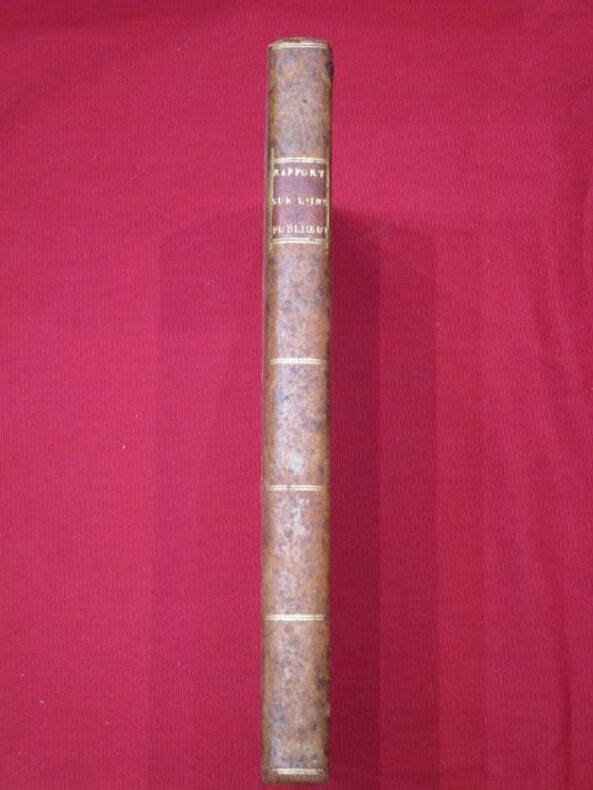
1791ref. 117402Imprimerie Nationale 1791 1 A Paris, De l'Imprimerie Nationale, 1791, 1 volume in-quarto de 195x250 mm environ, page de titre, 216 pages, complet des 9 planches dépliantes. Demi-reliure, dos long portant titres dorés sur pièce de cuir rouge, tranches jaspées. Coiffe de tête et coins arasés, des frottements sur les plats et les coupes, tampons et ex libris, annotations marginales au crayon de papier, rares rousseurs sinon intérieur propre, état général correct.
18661st edition. Original Tooled cloth, 12mo, 307, 55 pages plus two leaves tipped in at end for the Family Record (total of 366 pages). In English, Hebrew and German. Singerman 1949, Goldman 53. The original two volumes of the Minhag America prayer book had both been published in 1857, one with Hebrew-English text (Prayer Book for Public and Private Worship) and the other with Hebrew-German text (Gebet-Buch fur den offentlichen Gottesdienst und die Privat-Andacht). In the 1860s, he took the project up again, issuing a three volume series of his Minhag Amerikathe American Traditionwith the present volume for Yom Kipur (The Day of Atonement), as well as a volume for Rosh HaShanah (the Jewish New year) and a combined Jewish Hymnal and Psalter, all shaped by his view of Reform Judaism in America. This volume thus represents one of the first Reform prayer books for the High Holidays in the United States. Some of the prayers are translated both into English and German. Wise, was a pioneer of Reform Judaism in America and became its acknowledged leader and its institutional architect, organizing the Union of American Hebrew Congregations (1873) , the Hebrew Union College (1875) , and the Central Conference of American Rabbis (1889) . The reforms that he instituted sought to change or adapt Judaism to 19th century America. He was also an organizer and mover in the establishment of the Central Conference of American Rabbis, in 1889. Elected its president, he served until he died. Wise believed in uniting American Jewry and hoped to publish a new American reform prayer book titled "Minhag America. The Machzor presented here is part of this project. (See: Goldman 44). Light wear, about Very Good- Condition, nicer than usuall found. (KH-5-48D)
1883ref. 4333En Cévennes, 1883. Petit in-4 de [28]-112-[6] pages, demi maroquin noir, dos lisse.
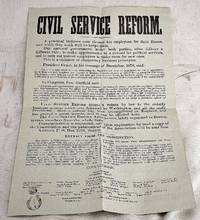
1881ref. 2301150003Civil Service Reform Association Boston Mass. 1881. First Edition. Art Prints & Posters. Very Good. American Civil Service Reform : Massachusetts : Good Governance in the Gilded Age Original Broadside. Sheet in excellent condition. Printed on blue paper. Two folds. Dimensions: 14 1/2 x 21 inches. Small ink stamp on bottom left corner dated 1881. The broadside lays out the principles of good government. It offers quotes from President Grant and Gen. Garfield about the importance of civil service reform; the example of success in England; explains the core reason for the Civil Service Reform Association; a brief view of the Association's constitution; and a list of the principal officers. The Association's President Moorfield Storey and other "Mugwumps" were strongly in favor of anti-corruption / good government reforms advocated by Grover Cleveland and other reformers. "The principles' of the Association were as follows: "That while certain officers of the Government should be in sympathy with the policy of the Administration the routine business should be conducted on business principles; that officers should be appointed on account of fitness for the work to be done and should be continued in office as long as they do that work well' that offices should not be used for partisan purposes; that Representatives are chosen to legislate and their time should not be given to the distribution of patronage; that the adoption of the well-devised system carrying out these principles will insure better administration and better legislation." Also includes a reprinted article on the Association from the New York Times February 19 1881. Civil Service Reform Association (Boston, Mass.) unknown
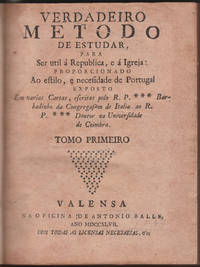
1747ref. 65Valensa Actually Lisbon: Antonio Balle Unknown 1747 Actually 1751. Second Edition. Contemporary calf; rebacked; spine laid down; hinges reinforced. Fair copy; overall browning; headlines on several leaves are gouged out affecting page numbers. Library release stamp on the verso of the first title page. 4to. I: 12 12 - 264 ; II: 4 12 - 243244 pp. A scarce and according to Palau important tract in the development and introduction of modern pedagogical concepts into Spain. The first edition of 1746 was seized and destroyed. The second edition was clandestinely printed see Martins Livros clandestinos . A revolutionary book in opposing the Jesuits and with very interesting comments on the teaching of the sciences medicine jurisprudence literary aesthetics and the education of women. The book generated a considerable polemical literature. Palau citing the first # 360777. Antonio Balle [Unknown] unknown books
ref. 43338Genève, Marc-Michel Bousquet, 1727-28. 6 volumes in-8°, environ 3500p. au total. Reliures plein veau d'époque
1880Very Good Turkish, Ottoman (1500-1928) Original 1/4 leather bdg. Cr. 8vo. (20 x 14 cm). In Ottoman script. [5], [3], 357 p. Subhi Pasha who was the implementer of the reforms and a typical highbrow bureaucrat, appeared in various positions of the Ottoman bureaucracy. He was also father of Hamdullah Subhi Tanriöver, (1885-1966) and first Turkish numismatist. He is also known for his special interest in books and antiquities. Sanayi-i Nefise School (Fine Arts Faculty) and the Müze-yi Humayun (Istanbul Archeology Museum) were established as a result of his efforts. He is brother of Samipasazade Sezai who was the author of the first Turkish novel as well. (Wikipedia). This book is the first volume of the early history of Islam, running from Mohammad to the death of 'Alî; the second volume, which was to continue up to the year 82 AH, has never been published. All published. Özege 6620.; GOW 369. First Edition.
1890Very Good Turkish, Ottoman (1500-1928) Original leather bdg. Large 8vo. In Ottoman script and Arabic. 72 p., 45 tables on 79 p. Islah üt-takvim. [Together with the Arabic translation of Sefiq mansûr Yegen]. Hegira: 1307 = Gregorian: 1890. First Edition. Rare bilingual work on chronology. It advocates an uniform solar Hegira year for all muslim nations. Sarkis 299 & 1950, not in GAL. GOW 378, Tahir III 300. For the author, the well-known diplomat and scholar Ahmed Muhtar Pasa, first high commissioner of the Porte in Egypt, El III 717-718. Not in Özege.
ref. 36681Exeter: s.n. 1788. First edition small 4to 198 x 147 mm 22pp. stitched as issued in original marbled wrappers later typed label on upper wrapper a nice copy. This anonymous author first gives a brief summary of similar Societies established for the same benevolent purpose and then lists the different systems adopted by each of those Societies. Provenance: Neat oval stamp of the Halifax Antiquarian Society on verso of upper wrapper. Unrecorded by ESTC OCLC and JISC. However we have found citations in the following works: Davidson Bibliotheca Devoniensis: A Catalogue of the Printed Books Relating to the County of Devon. 1852. p. 5; Catalogue of the Library of Lord Rolle at Bicton House Devon. 1850. p. 101. [?Exeter: s.n., 1788] unknown
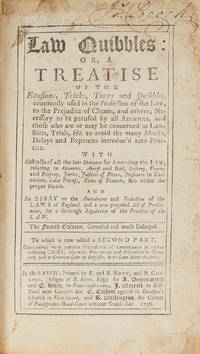
1736ref. 856711736. London 1736. Fourth & final edition. London 1736. Fourth & final edition. A Reform-Oriented Layman's Guide to Law's "Evasions Tricks Turns and Quibbles" Legal Criticism. Law Reform. Great Britain. Law Quibbles: Or A Treatise of the Evasions Tricks Turns and Quibbles Commonly Used in the Profession of the Law To the Prejudice of Clients And Others; Necessary to be Perused by All Attornies And Those Who Are or May be Concerned in Law Suits Trials &c. To Avoid the Many Abuses Delays and Expences Introduc'd into Practice. With Abstracts of All the Late Statutes for Amending the Law Relating to Attornies Arrest and Bail Bribery Forgery and Perjury Juries Justices of Peace Prisoners in Execution Law Process Rents of Tenants &c. Under the Proper Heads. And an Essay on the Amendment and Reduction of the Laws of England And a New Proposed Act of Parliament For a Thorough Regulation of the Practice of the Law. Corrected and much Enlarged. To Which is Now Added a Second part Containing Every Curious Precedents of Conveyances in Extraordinary Cases; Likewise Proceedings and Precedents in Chancery And at Common Law in English; With Law-Notes Thereon. London: Printed by E. and R. Nutt and R. Gosling 1736. viii 132 135 13 72 pp. An Essay on the Amendment and Reduction of the Laws of England bound at rear text complete. Octavo 8" x 4-1/2"; 20.2 x 11.5 cm. Modern quarter calf over marbled boards lettering piece to spine endpapers renewed. Some fading to spine negligible light shelfwear to extremities. Moderate toning to interior occasional light foxing light soiling in a few places light edgewear to first and last several leaves first four leaves reinforced at edges on verso reinforcement just touching text on one page without loss early owner signature of James Pocock to head of title page. A good copy. $650. Fourth and final edition substantially expanded. First issued in 1724 Law Quibbles occupies a distinctive place in the history of English legal literature as a hybrid work combining satire procedural commentary statutory digest practical precedent book and reform tract. The first part presents an alphabetical exposition of procedural stratagems tactical evasions and professional "mysteries" attributed to legal practitioners. Framed for both attorneys and lay litigants it documents contemporary perceptions of delay expense and pr. unknown
1736ref. 856711736. London 1736. Fourth & final edition. London 1736. Fourth & final edition. A Reform-Oriented Layman's Guide to Law's "Evasions Tricks Turns and Quibbles" Legal Criticism. Law Reform. Great Britain. Law Quibbles: Or A Treatise of the Evasions Tricks Turns and Quibbles Commonly Used in the Profession of the Law To the Prejudice of Clients And Others; Necessary to be Perused by All Attornies And Those Who Are or May be Concerned in Law Suits Trials &c. To Avoid the Many Abuses Delays and Expences Introduc'd into Practice. With Abstracts of All the Late Statutes for Amending the Law Relating to Attornies Arrest and Bail Bribery Forgery and Perjury Juries Justices of Peace Prisoners in Execution Law Process Rents of Tenants &c. Under the Proper Heads. And an Essay on the Amendment and Reduction of the Laws of England And a New Proposed Act of Parliament For a Thorough Regulation of the Practice of the Law. Corrected and much Enlarged. To Which is Now Added a Second part Containing Every Curious Precedents of Conveyances in Extraordinary Cases; Likewise Proceedings and Precedents in Chancery And at Common Law in English; With Law-Notes Thereon. London: Printed by E. and R. Nutt and R. Gosling 1736. viii 132 135 13 72 pp. An Essay on the Amendment and Reduction of the Laws of England bound at rear text complete. Octavo 8" x 4-1/2"; 20.2 x 11.5 cm. Modern quarter calf over marbled boards lettering piece to spine endpapers renewed. Some fading to spine negligible light shelfwear to extremities. Moderate toning to interior occasional light foxing light soiling in a few places light edgewear to first and last several leaves first four leaves reinforced at edges on verso reinforcement just touching text on one page without loss early owner signature of James Pocock to head of title page. A good copy. $650. Fourth and final edition substantially expanded. First issued in 1724 Law Quibbles occupies a distinctive place in the history of English legal literature as a hybrid work combining satire procedural commentary statutory digest practical precedent book and reform tract. The first part presents an alphabetical exposition of procedural stratagems tactical evasions and professional "mysteries" attributed to legal practitioners. Framed for both attorneys and lay litigants it documents contemporary perceptions of delay expense and pr. unknown books
1860ref. 46405258s. l. n. d., (vers 1860) ; 2 volumes in-8, demi-chagrin à coins, doubles filets dorés, dos à nerfs orné de fleurons dorés et filets dorés et à froid. (Relié vers 1880) titre, 1 f. bl., XIV pp., 1 f. bl., 503 pp. - 1 f., 147 pp.Traductions de textes allemands sur la vie des papes. Elles sont l’œuvre d’un même traducteur qui n’a pas signé son travail. Texte soigneusement calligraphié.1 - VOIGT (J.) Histoire de Grégoire VII. C’est une traduction résumée de la seconde édition allemande du Hildebrand als Papst Gregorius der Siebente und sein Zeitalter de J. Voigt parue en 1845. La première édition avait paru en 1815, une autre édition a paru à Vienne en 1819, une traductions française par M. Jager a paru en 1838 avec une préface de ce dernier. Il semble que cette préface posait quelques problèmes au pouvoir autrichien qui fit interdire cette édition. Une traduction italienne avec la même préface de Jager a paru à Milan (alors occupée par l’Autriche) sans y être interdite alors qu’elle l’était en Autriche. Johannes Voigt (1786-1863) était un historien et théologien prussien qui enseignait à Königsberg.“Plusieurs histoires de Grégoire VII ont été publiées depuis celle de Voigt (...) celle que j’ai écrite n’est, comme je l’ai déjà dit, qu’un résumé de la seconde édition de l’ouvrage de Voigt, résumé fait, d’ailleurs avant la publication de ces deux derniers ouvrages et destiné à demeurer toujours en manuscrit. Il m’a semblé néanmoins qu’elle pouvait encore, par son exactitude générale et sa brièveté, ne pas manquer complètement d’intérêt pour ceux qui la liraient.” Dit le traducteur dans sa préface.2 - THEINER (A.) - GESTIN (P. de). Histoire du pontificat de Clément XIV. Dans un court texte introductif, l’auteur de la traduction déclare que ce texte est “tiré de l’Histoire du pontificat de Clément XIV, écrite d’après les documents inédits des archives secrètes du Vatican, par le Père Augustin Theiner, prêtre de l’Oratoire, et traduite de l’allemand sous les yeux de l’auteur par Mr. Paul de Geslin, missionnaire apostolique. Cette traduction a été éditée à Paris en trois volumes...” Il s’agit donc, ici aussi, d’un résumé de la traduction.
Londres: Londini, Typis A. G. & J. P. et prostant venales apud Georgium Wells, 1681. 4to. imperial; 2 hs., 749 pp. [i.e. 795 pp., al estar duplicada la numeración de las pp. 401 a 442]. Encuadernación en piel de la época, con lomera nervada y tejuelo.
Petit in-folio oblong (410 x 280 mm), percaline vert bronze éditeur orné de motifs rocaille dorés et à froid, titre doré, 21 lithographies sur fond teinté, dont le titre. Edition originale de cet album conçu lors d'une assemblée générale des fondateurs de Mettray, le 12 mars 1843, "véritable opération de communication" pour promouvoir, sous forme d'une visite en images, la célèbre colonie agricole pour jeunes délinquants fondée Frédéric-Auguste Demetz en 1839. Les planches ont été confiées pour le dessin à Jean-Alexandre Thierry, élève de l'architecte de la colonie Abel Blouet et à Sauvé et Faivre pour la lithographie. L'album comprend le titre dans un encadrement architectural et allégorique, suivi de 20 vues de la colonie et des activités des détenus: vue générale des bâtiments, vue bucolique du village, intérieur et aménagements, salle de classe, réfectoire, dortoir, infirmerie, atelier des cordiers, exploitation de la carrière, horticulture, gymnastique, école de natation, etc. En un siècle (1839-1937), la colonie de Mettray tenta de "redresser" par le travail plus de 17.000 jeunes âgés de 6 à 21 ans, en les arrachant à la prison. Nichée au coeur de la Touraine, l'institution philanthropique sans mur, aux allures de jardin, se transforma rapidement en véritable bagne pour enfants. L'écrivain Jean Genet, y passera près de trois ans et Michel Foucault l'érigera en modèle de l'archipel carcéral. Cf. J. Bourquin et E. Pierre, 'Une visite à Mettray par l'image: l'album de gravures de 1844', in "Sociétés & Représentations", 2004/2 (n° 18), p. 207-216. Cartonnage légèrement frotté, coins émoussés, piqûres et rousseurs, soutenues sur certaines planches.
Datée du 31 décembre 1848, la lettre, dernière de l'année qui s'achève, mentionne la réforme fiscale qui prend effet le 1er janvier de 1849 et met en circulation le premier timbre. Dans son post-scriptum, Léopold Delaire rappelle à son oncle « la taxe des lettres se trouvant réduite uniformément à 20 centimes, à compter du premier janvier, Je vous engage à nous donner plus souvent de vos nouvelles, afin de compenser, dans l'intérêt du Trésor public, la diminution de plus des deux tiers qui va s'opérer dans nos frais de correspondance. J'appose sur cette lettre un des nouveaux timbres qui serviront désormais à l'affranchissement : elle vous parviendra donc franche de port ». La dernière phrase a été rayée d'un trait. Le début de la lettre dresse un bilan sévère d'une année révolutionnaire que Léopold Delaire juge « féconde en tristes et lamentables événements ». Le jeune homme se montre cependant soulagé par l'élection en décembre 1848 de Louis Napoléon Bonaparte. «Grâce à Dieu, elle finit mieux qu'on ne pouvait l'espérer. L'immense majorité obtenue par Napoléon, le petit nombre de voix réparti sur les candidats avoués des hommes du désordre, le triomphe complet du parti modéré qui veut l'ordre, la famille et la propriété assurent au moins le présent et rétablissent la confiance ». Si des troubles peuvent encore survenir, « ils ne sont pas de nature à menacer l'ordre ». Léopold Delaire brosse ensuite le tableau d'une capitale rendue à la vie avec la reprise du commerce,les étrangers peuplant de nouveau les hôtels garnis et les maisons meublées, les voitures de maître se croisant en tout sens dans les rues. Il note que, depuis l'élection du président de la République, les Parisiens qui avaient quitté la capitale début décembre semblent vouloir rentrer. Il commente, pourcentages à l'appui, les résultats des élections dans le département de l'Allier, dont sa famille est originaire, qui recèle « une minorité considérable de gens dangereux », ce qui « est bien surprenant dans un département qui est presque tout agricole ». Léopold Delaire est le fils de Jean Marie Delaire, président de la Cour des Comptes et le petit-fils du général Jean-Pierre-Hugues de Cambacérès. Le destinataire de la lettre est Antoine Delaire, maire de Montaigu-le-Blin, dans l'Allier.
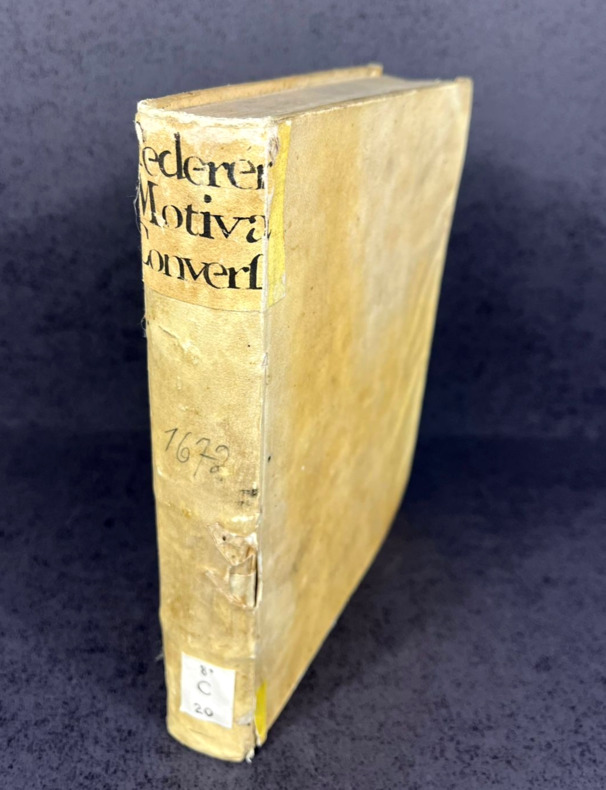
1672ref. 0533Innsbruck, Wagner, 1672. Épais volume in-4 de 160 x 203 mm, 440 (23) pp. Relié plein vélin blanc d'époque. Étiquette d'époque en coiffe, autre étiquette (bibliothèque) plus récente en queue, année d'édition au crayon au milieu du dos. Marque d'ancienne bibliothèque au premier contreplat surmontée d'une référence au crayon. Première garde blanche avec deux inscriptions en latin et allemand. Page de titre principale placée en fin d'ouvrage (!), qui commence par la page signalant la première partie, avec une inscription à la plume en haut de cette page d'ouverture. Rarissime titre polémique anticalviniste. L'auteur, Ioannes ou Johannes Federer (1645-1706), était prêtre jésuite. Professeur et théologien, il s'est fait remarquer en particulier avec "Calvinismus Detectus, & dedoctus", un livre érudit et vigoureux qui condamne le protestantisme calviniste dans les termes les plus fermes. L'auteur y répond à deux lettres calvinistes, l'une du philologue Johann Georg Grævius (1632-1703), converti, l'autre de Johann Jakob Vedrosi (1624-1706). Avec bandeaux, lettrines et culs-de-lampe. Léger manque au dos, petits trous de mite aux toutes premières pages sans aucun autre dégât, deux morceaux de papier vierges collés pour couvrir les tampons du monastère d'origine, sinon intérieur très pur, exempt de rousseurs ou d'annotations. ***************************************************** Innsbruck, Wagner, 1672. Thick in-quarto volume, 160 x 203 mm, 440 (23) pp. Bound in full contemporary white vellum. Contemporary label at the endpaper, another more recent (library) label at the tail, year of publication in pencil in the center of the spine. Old library mark on the front cover surmounted by a pencil reference. First white endpaper with two inscriptions in Latin and German. Main title page placed at the end of the book (!), which begins with the page indicating the first part, with a pen inscription at the top of this opening page. An extremely rare anti-Calvinist polemical title. The author, Ioannes or Johannes Federer (1645-1706), was a Jesuit priest. A professor and theologian, he made a name for himself in particular with "Calvinismus Detectus, & dedoctus," a scholarly and vigorous book that condemns Calvinist Protestantism in the strongest terms. In it, the author responds to two Calvinist letters, one from the philologist Johann Georg Grævius (1632-1703), a convert, and the other from Johann Jakob Vedrosi (1624-1706). With headbands, initials, and tailpieces. Slight loss to the spine, small moth holes in the very first pages with no other damage, two small blank pieces of paper glued to cover the original monastery stamps. Otherwise, the interior is very clean, free of foxing or annotations.
1781ref. STAN0086Ohne Ort (Wien 1781). 2°. 2 nn. Bll. Ungebunden (1 gef. Doppelblatt), altersgemäß vergilbt, schwach stockfleckig, e. Fleck mit minimaler Textundeutlichkeit auf S. 3. Auch 'Untertanenpatent' bezeichnete Amtsdruckschrift, mit welcher Joseph II. per 1. November 1781 die Aufhebung der Leibeigenschaft anordnete. Mit diesem Erlass wurde eine der wesentlichsten Entscheidungen im Zuge der josephinischen Reformtätigkeit getroffen.
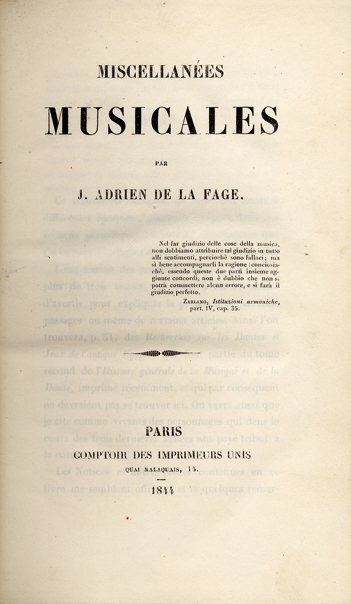
1844ref. 14501Paris, Comptoir des Imprimeurs Unis, 1844 ; in-8 ; plein maroquin bleu-marine, dos à nerfs, titre doré, double filet doré sur les coupes, dentelle intérieure, toutes tranches dorées sur marbrure (Andrieux) ; (8), 526 pp.
Petit in-8, plein cartonnage vélin à la Bradel, titre doré en long, daté en pied (reliure moderne signée Goy), 126 p., (1) f. blanc [sign. a-h8]. Troisième édition dédiée à Henri II (la première date de 1547) de cet ouvrage controversé, analyse critique de "l'Orateur" de Cicéron considéré comme le chef-d'oeuvre et le modèle indépassable des traités de rhétorique. Dans cette critique paradoxale, Pierre de La Ramée qui était pourtant l'un des plus fervents admirateurs de Cicéron, réclame pour la rhétorique comme pour les autres arts une forme plus humaine et plus méthodique. L'ouvrage suscita une tempête et réveilla la haine tenace et durable des ennemis de Ramus: Jacques Charpentier en particulier, peut-être l'un des responsables de son assassinat lors de la Saint-Barthélemy. Caractères italiques, lettrines et belle marque de l'imprimeur gravée au titre. (W. J. Ong, 'Ramus and Talon Inventory', n° 57). Mouillure claire en coin. Très bon exemplaire, frais, grand de marges, bien relié.
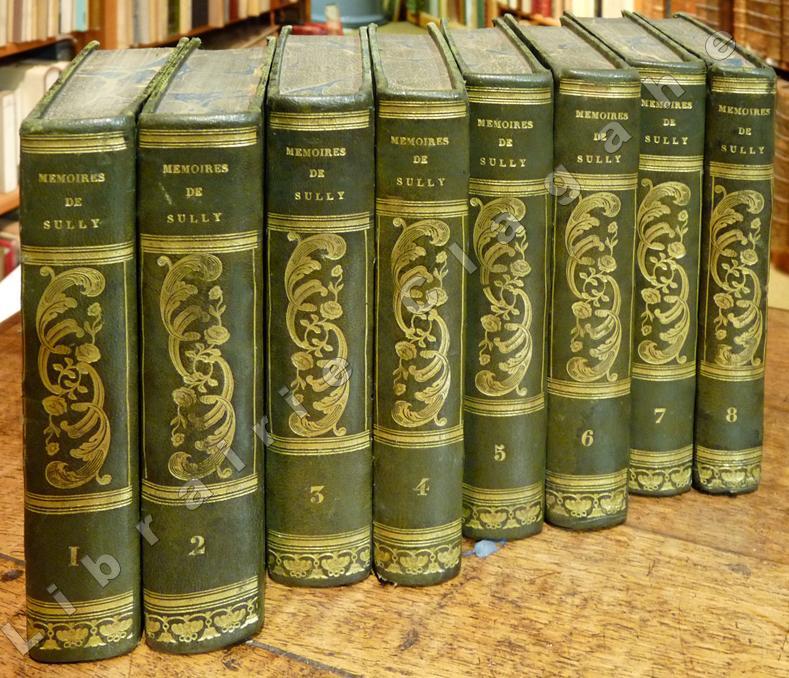
1763ref. 11860Londres, sans nom, 1763 ; 8 tomes in-12 ; demi-chagrin vert-sapin, dos lisses à grand décor de rinceaux et roses dorés, 4 faux-nerfs dorés, palette en queue, tranches marbrées multicolores (reliure du tout début XIXe) ; VIII, LX, 415 ; (4) en tête à chaque volume ; VIII, 560 ; IX, 566 ; VI, 454 ; VIII, 484 ; VI, 477 ; VI, 483 ; VI, 375, (1) pp. ; chaque tome a sa propre table alphabétique ; 2 portraits gravés par Legrand au tome 1er.
1729ref. 2445Folio 333 x 205 mm pp. 2 20 title-page in double ruled border E2 badly crumpled some light browning and a few pages a little dog-eared uncut and stab-sewn as issued: generally a good copy in original state. Issued as a parliamentary paper and ordered to be printed on 20th March 1729 this is one of three reports of the Committee set up to investigate the state of prisons. It was read and presented to the Commons by James Oglethorpe and was probably largely written by him. Oglethorpe was an important pioneer of prison reform whose name deserves to be remembered alongside that of his much better known successor John Howard. The report shows that the Warden of the Fleet Prison disregarding the changes in the statute regarding the Fleet had continued to exercise 'an unwarrantable and arbitrary power' not only by charging exorbitant fees but by loading prisoners with chains in a manner more cruel and unjustifiable than that practised in the Star-Chamber. Money was extracted from prisoners at every opportunity: any prisoners who could not afford to pay for bedding were obliged to sleep on the floor in foul conditions and the warden would not attend to the forms necessary to discharge a prisoner unless he received the fees he demanded with the result that numerous prisoners were kept several years after they should have been discharged. It was Oglethorpe's investigations into the state of prisons and his shocking findings that led him to study the social conditions of his day including unemployment and paved the way for his important Georgia Experiment a policy prohibiting the ownership of slaves in the Georgia Colony see Leslie F. Church Oglethorpe: a study of philanthropy in England and Georgia pp. 9-24. ESTC t44667; Hanson 4022; Goldsmiths 6707 Robert Knaplock, Jacob Tonson, John Pemberton and Richard Williamson