LEFÉVRE, André (1520-1581).MareMagnum

2 761 résultats
Amberes: Antverpiae, ex Officina Plantiniana, apud Balthasarem Moretum & Viduam Ioannis Moreti & Ioannem Meursium, 1619. 4to. menor; 11 hojas, 470 pp., 26 hojas. Encuadernación de época en pergamino, con cejas.
Barcelona, por Rafael Figuerò, a costa de Iayme Batlle Librero, 1698. 4to.; 30 hs., 528 pp., 5 hs. Encuadernación de época, en pergamino.
1745réf. PHO-2483La Haye & Rotterdam, Chez Otthon & Pierre Van Thol, Chez Jean Daniel Beman, 1745-1750, 12 volumes in-8 (20x12,5cm), veau marbré époque, dos à nerfs orné avec tomaison et pièce de titre rouge, tranches jaspées bleues.
1645réf. PHO-2037SL, SE, 1645, in-12 (14x8cm), 427pp., vélin époque, titre au dos, accroc au dos en pied. Illustré d’un titre gravé, texte en latin avec quelques passages en grec et en allemand en caractères gothiques, ex-libris en page de garde « C. Pieters, EQ. » Charles Pieters, probablement le plus grand spécialiste et plus grand collectionneur des édition Elzéviriennes dont les livres ont été vendus vers 1840, avec une annotation « Acheté à la vente de C. Pieters, …. n° 619, 23 mai 1864… » ainsi qu’un texte réfutant en partie la paternité aux presses Elzéviriennes.
1925Very Good Turkish, Ottoman (1500-1928) Paperback. Illustrated covers with portrait of Ismail Hakki Bey and borders. Art-nouveau illustrated borders on frontispiece. Taped and repaired spine. Cr. 8vo. (20 x 14 cm). In Ottoman script. 158, [2] p., musical scores. In contrary of the tradition of Ottoman book printing, this is numbered from right to left. Ismail Hakki Bey was a Turkish composer, musician and educator during the Ottoman Empire. The Society of Ottoman Music was founded by Ismail Hakk' Bey in March 1909 at the flat above the Fevziye Coffehouse. Ismail Hakki Bey, while he was the president and director of the Ottoman Society of Music, applied to the Ministry of Education to have a permit to open a private music school. After the permission was granted, The School of Ottoman Music, (1910-1920), the first private music school in the Ottoman State, was inaugurated on January 5th 1910. This book includes his teachings of solfege and musical scores with scores mostly. Lithograph. Roumi: 1341 = Gregorian: 1925. Second Enlarged Edition. Özege 18193.
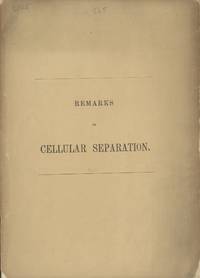
1861réf. BK0164Philadelphia: Publication Committee of the Philadelphia Society for Alleviating the Miseries of Public Prisons 1861. 112 pp. 8vo. Original printed wrappers. Wrappers frayed along spine otherwise near fine internally; very good overall. A defense of the Pennsylvania system of prison discipline advocating the separation of prisoners as a means of moral reform rather than punishment alone. The work was read by appointment before the American Association for the Improvement of Penal and Reformatory Institutions at its annual meeting in New York on November 29 1860 and published the following year by the Philadelphia Society for Alleviating the Miseries of Public Prisons. Foulke was one of Philadelphia's leading nineteenth-century prison reformers and a prominent defender of the system associated with Eastern State Penitentiary in which prisoners were housed separately. By 1860 the practice had become the subject of sustained criticism in the United States and Europe particularly over the psychological effects of prolonged isolation. Foulke takes up those objections at length arguing that cellular separation had been confused with punitive solitary confinement and presenting it instead as a carefully supervised regime intended to encourage reflection and rehabilitation. Foulke engages with Charles Dickens's celebrated attack on the Pennsylvania system after his 1842 visit to Eastern State Penitentiary reproducing and responding to Dickens's account. Published at a time when American penal institutions were becoming an international subject of study and controversy Remarks provides a substantial contemporary statement of the case for one of the country's most influential-and eventually most disputed-experiments in incarceration. . Publication Committee of the Philadelphia Society for Alleviating the Miseries of Public Prisons unknown
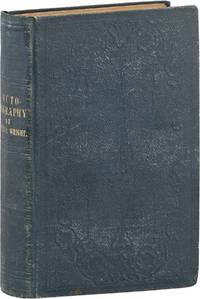
1849réf. 86600Boston: Bela Marsh 1849. First Edition. First printing. Octavo 18.5cm. Publisher's green embossed cloth titled in gilt; pale salmon endpapers; 414pp; mezzotint portrait frontispiece. A quite attractive copy just lightly rubbed to boards with a few scattered spots of foxing to text; solidly Very Good overall and somewhat uncommon thus. A significant if entirely idiosyncratic work in the annals of American radical reform as much a philosophical treatise as an autobiography. American pacifist freethinker feminist and abolitionist Henry Clarke Wright 1797-1870 though little remembered was among the most interesting radical voices of the mid-19th century a defrocked Presbyterian minister who in his adopted role as a "Christian reformer" preached against all established religions and adopted a thoroughly stridently contrarian voice in nearly every field of social reform he touched which was practically all of them. His views opposing established government put him directly in the line of such individualist anarchists as Lysander Spooner and Benjamin Tucker while his opposition to slavery was so uncompromising that he was ejected from the American Antislavery Society in 1837. He remained closely associated with most of the New England radical abolitionist community however especially with William Lloyd Garrison with whom he frequently collaborated. Like most of Wright's commercially-issued works this one was published by the Boston radical publisher Bela Marsh known for disseminating works by fellow abolitionists and freethinkers during the antebellum period. 86600. Bela Marsh unknown
1883réf. 727291883. London 1883. London 1883. The "Annual Blister" of Victorian Law: A Scarce 1883 Reformist Tract on the Deceased Wife's Sister Controversy Marriage Law Reform Association. A Summary of the Chief Arguments For and Against Marriage With A Deceased Wife's Sister. London: Marriage Law Reform Association 1883. 15 1 pp. Octavo 8-1/4" x 5-1/2". Stab-stitched pamphlet in self wrappers. Light toning negligible edgewear light foxing in a few places. $350. Third and final edition. A scarce reformist tract representing one of the most protracted legal and social battles of the Victorian era. The Marriage Law Reform Association was established in 1851 to overturn Lord Lyndhurst's Marriage Act of 1835 which codified the prohibition of marriage between a widower and his sister-in-law. This restriction was rooted in the theological "one flesh" doctrine of affinity which legally equated a wife's sister with a blood sister. The controversy often dubbed the "annual blister" due to its near-yearly debate in Parliament highlighted a sharp class divide; while the wealthy could travel abroad to marry the working classes-who relied on sisters-in-law for domestic stability-were forced into "legalized concubinage." The debate permeated Victorian culture appearing in works ranging from Gilbert and Sullivan's Iolanthe to the novels of Dinah Craik. This edition captures the height of the Association's campaign which eventually succeeded with the passage of the Deceased Wife's Sister's Marriage Act in 1907. Sweet & Maxwell A Legal Bibliography of the British Commonwealth of Nations Vol. 2 p. 224. unknown
réf. 5021in 4 pleine toile verte d’éditeur,Belle plaque polychrome sur le premier plat,de Fernand FAU,avec titre doré. Reliure de POESIN.Titre doré au dos.Faux-titre,titre,84 pages montées sur onglets,40 gravures en couleurs,de Maurice LELOIR,dont 25 pleine-page et 2 double-page.Tranches dorées.Ancienne Librairie Furne.Combet & Cie 1904. Cartonnage très frais.Proche de l’état de neuf
réf. 92091Se vendent à Charenton, par Melchior Mondieres, 1644/ A Genève, Pour Jean Ant. & Samuel de Tournes, 1664, 2 volumes reliés ensemble dans un cartonnage marbré postérieur, Première partie : 9-663 pages, Seconde partie : (4) ff. (titre, epitre), 829 pages(1) f. (errata), cartonnage postérieur marbré avec dos beige portant titres dorés, tranches jaunes. Des rousseurs et pages brunies, nombreuses notes anciennes et passages soulignés, plis sur le dos, frottements sur les angles du cartonnage, sinon bon état.
réf. 92106A Genève, Pour Iean Ant. & Samuel de Tournes, 1666 et 1669, 2 volumes reliés ensemble, in-12 de 165x105 mm environ, (5) ff. (titre, epitre, table), 769-(4) ff.-(titre, epitre, table)-(1) f.-568 pages, cartonnage marbré, dos lisse portant titres dorés sur pièce de titres corail, tranches rouges. Petit defaut de marge dans la première partie p. 549-550, des rousseurs des mouillures des passages annotés en début de volume, frottements sur les angles de la couverture, sinon bon état.
réf. 55209aafParis, Fischbacher, 1885, gr. in-8vo, LV + 148 p., reliure en demi-cuir, fleurons et titre dorés au dos. Bel exemplaire.
1672réf. 17151672 Ed. Jean Lucas, Rouen, 1672. In-4, plein veau époque, dos orné. 41, 71 pages. Vignette gravée sur bois en page de titre. Texte latin et français, traduction par le ministre Allix ou Marc-Antoine de la Bastide, selon les bibliographes. La première partie traite des différents commentaires. La 2ème partie expose le texte original "De Corpore et Sanguine Domini" , avec la mise en français en regard
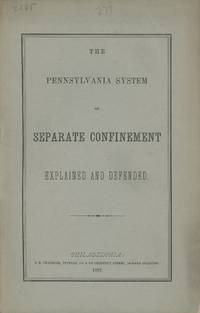
1867réf. BK0168Philadelphia: J. B. Chandler Printer 1867. 116 pp. 8vo. Original printed wrappers. Ex-library with small Massachusetts State Library stamp to title page; otherwise near fine. Very good. A late defense of the Pennsylvania system of prison discipline written as the model developed at Eastern State Penitentiary was increasingly becoming an exception among American prisons. The system kept inmates separated from one another both at work and at rest in contrast to the Auburn system which brought prisoners together for silent congregate labor during the day. Eastern State maintained the separate system from its opening in 1829 into the 1870s despite sustained criticism of its effects and lessened ability to keep prisoners separate in the first place due to overcrowding.1 Published as a defense of the Pennsylvania system of separate confinement the pamphlet appeared after the model associated with Eastern State Penitentiary had already been the subject of decades of criticism in the United States and abroad. The work is generally attributed to Richard Vaux son of the prominent Philadelphia prison reformer Roberts Vaux and himself a longtime advocate of the Pennsylvania system. By the time this edition appeared in 1867 separate confinement had lost ground nationally to the Auburn system of congregate labor making the pamphlet a late statement in defense of a model of incarceration closely identified with Philadelphia and Eastern State Penitentiary. 1 Ashley Theresa Rubin Institutionalizing the Pennsylvania System: Organizational Exceptionalism Administrative Support and Eastern State Penitentiary 1829-1875 PhD diss. University of California Berkeley 2013. . J. B. Chandler, Printer unknown
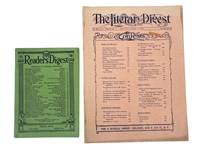
1904réf. 237201904. Two American digest periodicals documenting changes in national public discourse from the Progressive Era through the Great Depression. The earlier issue contains prominent contemporary coverage of the Statesboro Georgia lynching of 1904 reproducing reactions from newspapers across the country and condemning the burning and killing of two Black men by a white mob after the courts had already imposed sentences. The Literary Digest. New York: Funk & Wagnalls Company August 27 1904. Vol. XXIX No. 9 Whole No. 749. Together with The Reader's Digest. Pleasantville New York: The Reader's Digest Association May 1932. Eleventh Year Vol. 21 No. 121. Two illustrated periodicals. The Literary Digest complete in original printed wrappers; the Reader's Digest in original green printed wrappers. The Literary Digest treats the Statesboro lynching as a national disgrace assembling condemnations of the white mob that seized two Black prisoners from lawful custody and burned them alive after their convictions. Its opposition to mob violence is forceful for a mainstream national periodical but the journalism is not racially radical: it condemns lynching chiefly as a collapse of law civilization and public order while reproducing racialized language paternalistic assumptions and comparisons with "Darkest Africa" that reveal the limits of white Progressive reform discourse. The article documents how anti-lynching sentiment could coexist with the racial hierarchies embedded in early twentieth-century American journalism. Other contents also address the Russo-Japanese War Theodore Roosevelt's "Big Stick" politics immigration early automobile culture religion scientific racism and political caricature preserving the mixture of reform journalism racial ideology international reporting and editorial debate that shaped mass-circulation American periodicals at the beginning of the twentieth century. The May 1932 issue captures an American reading public attempting to understand economic collapse mass unemployment and the instability of modern life during the darkest years of the Great Depression. Its condensed articles move from Arthur Pound's courtroom account of bankrupt workers shopkeepers and failed speculators to proposals for canceling international war debts arguments over housing and advertising and criticism of the press's exploitation of the Lindbergh kidnapping. Reports on Japan's campaign in Manchuria cancer research industrial materials telecommunications and labor-saving inventions place domestic economic crisis beside the geopolitical and technological transformations reshaping the interwar world. The two issues document national and international crises into accessible commentary for a broad readership moving from the racial violence imperial politics and reform debates of 1904 to the economic collapse mass media consumer culture and geopolitical instability of 1932. Both remain stapled without annotations or other markings. Completely legible and in overall very good condition with only minor discoloration and scattered creasing or handling use. unknown
1925Very Good Turkish, Ottoman (1500-1928) Paperback. 12mo. (16 x 12 cm). In Ottoman script. 39 p. Ev hanimlarina mahsûs alafranga pastacilik. Therein no definite information about born and death dates of Rabiha Hanim. Her grandfather was Kani Pasha (One of Tanzimat period pashas) grandmother was Russian. Her father Rifat bey who was a diplomat Kani Pasazade Ahmet Rifat bey, (1844-1891), was one the Young Turks according to Mithat Cemal Kuntay (Avrupa'da dokuz Türk ihtilalcisi). Rabiha Hanim's first articles and writings about cookery and recipes appeared in 'Türk hayati' periodical in 1925-26 which published by Selanikli Fazli Necip. She wrote in this periodical for a short time, for the chapter under the title 'Sofra hayati' [i.e. Cuisine life]. This book by her includes 41 recipes of cake and dessert. It's not cataloged in any bibliography related to Ottoman cookery or other. Additionally, she wrote a French edition of this book in 1925 under the title of 'La bonne cuisine Turque, Facile et economique des Mets les plus Usites et Renommesdu Pays (107 recettes)'. Only one copy located in OCLC: 949551637 (Bogaziçi University Library).; Not in Özege.; Kut 34.; Özege Bagis Kitaplari Kat. 3601. First Edition. Extremely rare. This rare book includes 41 pastry recipes with their French names as well as add to their Turkish names. Rabia wrote a cookbook in French printed in 1925 titled 'La Bonne Cuisine Turque' in Istanbul according to Kut.
1703In -4°, pp. (10), 3-376, pergamena con titolo manoscritto al piatto superiore. La provincia è quella francescana di San Juan Bautista, nei pressi di Valencia.
1693réf. PHO-1980Delft, Adrien Beman, 1693-1695. 3 volumes in-4 (5), veau marbré, dos orné, tranches mouchetées (Reliure de l'époque). Coiffes usées, menus défauts aux reliures, manque au dos tome 3, rousseurs. T. 3 : 15ff.-656pp.1f.-(2)- 197pp.-13ff., T. 3, 2e partie : 1f.-628 pp., T. 3, 3e partie : 3ff.-p. 631 à 1019-15ff.-199pp.-23ff.
Madrid, en la Imprenta Real, a costa de Gabriel de Leon, mercader de libros, 1675. Folio; 4 hs. (de 5), 594 pp.,190 pp. Ejemplar falto de las nueve hojas finales de Tabla. Portada con pérdidas y montada groseramente sobre papel. Ejemplar fatigado- Encuadernación en pergamino.
1593réf. 350931593 Petit in-4, plein vélin ancien, dos doublé, (8), 184 p., vignette de titre, bandeaux, lettrines sur fond criblé et sceau du pape Sixtus V gravé sur bois. Romae, Typographia Gabiana, 1593.
Petit in-4, plein vélin ancien, dos doublé, (8), 184 p., vignette de titre, bandeaux, lettrines sur fond criblé et sceau du pape Sixtus V gravé sur bois. Edition originale. A propos du couronnement d'Henri IV roi de France, Ponce de León tente de démontrer, preuves à l’appui, qu'un relaps ne peut régner légitimement. Il fonde sa démonstration sur un très important appareil de sources : Ecritures saintes, décrets des conciles, constitutions de l’Eglise, pères de l’Eglise, Monuments de l'histoire, etc. Très documentée, l'étude est suivie du texte de la déclaration d'excommunication par le pape Sixte V et deux lettres de Grégoire XIV. Humaniste espagnol né à Séville, helléniste réputé, Gonzalo Marín Ponce de León devint archidiacre de la cathédrale de Tolède et camérier de Pie V. (Laurenti, 'Estudios bibliográficos sobre la Edad de oro', n°11. Palau, XIII, 230979. Sources de l'Histoire de France, n°3060). Quelques brunissures et qqs petites gal. de vers. Ex-libris manuscrit et petit cachet de bibliothèque jésuite. Bon exemplaire.
réf. 37812In-12 (100 x 151 mm), broché, cartonnage crème d'attente de l'époque, (8), 133, (1) p., grande vignette de titre gravée. Modena, & in Macerata, Pietro Salvioni, 1615.
In-12 (100 x 151 mm), broché, cartonnage crème d'attente de l'époque, (8), 133, (1) p., grande vignette de titre gravée. Prima edizione della traduzione italiana di francese da Jean Bernardo de la Baffarderie, "ggiuntavi di nuovo una canzone del cavalier Marini in morte di detto Ré". D’abord lié à la Ligue, Pierre Matthieu devint secrétaire du duc de Nemours puis soutint le futur Henri IV. Il contribua à son entrée à Lyon en 1595 et le suivit à Paris où il devint son historiographe officiel. Composé par un familier du roi témoin oculaire des événements qu’il relate, cet ouvrage est riche de nombreux détails alors inédits. Il est cité comme l’une des sources de première main pour l’histoire de l’assassinat de Henri IV (Pour l’édition française cf. Brunet, III, 1532. Sources de l’Histoire de France, 3257. Tchemerzine-Scheler, IV, 635). Manque de papier au dos de la reliure. Très bon exemplaire, très frais, très bien conservé, tel que paru.
1734réf. 18031734 1734 L'Alcoran des Cordeliers. Tant en latin qu'en français. C'est à dire, Recueil des plus notables bourdes & blasphèmes de ceux qui ont osé comparer Saint-François à Jésus Christ ; tiré du grand livre des Conformitez, jadis composé par frère Barthelemi de Pise, Cordelier en son vivant. Nouvelle édition ornée de figures dessinées par B. Picart.Amsterdam, Aux dépens de la Compagnie, 1734. 2 volumes in-8, plein veau d'époque, pièces de titre et tomaison de maroquin rouge, dos lisse orné de fleurons, plats à double filet d'or, coiffes et coins émoussés avec légers manques de cuir. Frontispice, page de titre, [8ff], 396pp ; frontispice, page de titre, 419pp, 19 planches gravées dont une dépliante (soit 21 planches avec les deux frontispices).
1627réf. 21863A Amsterdam, chez J. Wetstein et G. Smith, 1751. 3 forts vol. au format in-4 (252 x 198 mm) de 1 f. bl., 1 frontispice gravé n.fol., 7 ff. n.fol., lxxii - 562 pp. et 1 f. bl. ; 1 f. n.fol. et 644 pp. ; 1 f. n.fol. et 561 pp. Reliures uniformes de l'époque de plein veau marbré havane, plats jansénistes, dos à nerfs ornés de filets gras à froid, doubles caissons d'encadrement dorés, large décor fleuronné doré, semis d'étoiles dorées, pièces de titre de maroquin brun, pièces de tomaison de maroquin émeraude, titre doré, tomaison dorée, palette dorée en queue, filet doré sur les coupes, tranches marbrées.