2 788 résultats
1848Later boards. 8vo. 428 pages, 17 cm. In German. Title translates to "Song Book for Use In Teaching the Mosaic Religion and for the Public and Domestic Worship of the Jews." Reform Hymnal published during the Revolution of 1848. The Königliche Württembergische Israelitische Oberkirchenbehörde was the umbrella organization of the Jewish communities of Württemberg. Württemberg German is a large state encompassing Stuttgart (Wikipedia, 2019). SUBJECTS: Reform Judaism -- Liturgy -- Texts. Hymns, German -- Texts. OCLC lists 6 copies worldwide (OCLC:14755839). Ex-library with usual markings. Title page is lightly soiled and boards are lightly worn. Some pages have damp stains. All contents very good.(GER-55-4)
réf. 65058aafParis, Club du Livre, Philippe Lebaud, 1963, in-4°, richement illustré par volume, reliés éditeur, plein chagrin rouge, fracisque or et noir incrustée, les 3 tranches dorées, étuits bordés.
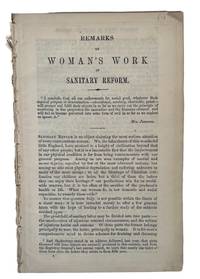
1858réf. 197991858. Powers Susan Rugeley. Remarks on Woman's Work in Sanitary Reform is a circa 1859 pamphlet documenting Victorian women's public health work through the system of sanitary reform revealing how women's domestic educational and visiting labor was framed as essential to national health. Addressed to mothers educators tract distributors and visitors of schools cottages and workhouses the text asks "What can woman do in her domestic and social capacities to remedy these evils" and answers by assigning women authority over household health infant care education and habits. The pamphlet supports research into women's employment Victorian public health sanitary reform feminist social thought and the expansion of women's public roles through reform labor. Powers Susan Rugeley. Remarks on Woman's Work in Sanitary Reform. London: Tweedie circa 1859. 20 pages. 8vo. The pamphlet divides sanitary labor into "the amelioration of injurious external circumstances" and "the reform of injurious habits and customs" identifying the former principally with men and the latter principally with women. Powers argues "It is for woman in her functions of mother housewife and teacher" to change infant management domestic economy education and the habits of women and adds that "It is for her to teach and apply the laws of health in her own provinces where man cannot act." Susan Rugeley Powers was the first secretary of the Ladies' Sanitary Association an organization founded to educate working-class communities on public health; the pamphlet was also connected to the English Woman's Journal and the wider Langham Place reform milieu. The pamphlet demonstrates the process by which sanitary reform converted gendered domestic expertise into organized public health labor giving women a socially sanctioned role in health education before broader access to professional employment. Contemporary holdings appear limited: a dealer record notes four WorldCat copies and three COPAC copies while a University of Wisconsin catalog record identifies a later microfilm version associated with the English Woman's Journal. Slight chipping at binding; pages held together; minor wear. Overall very good. A focused Victorian women's reform pamphlet linking public health domestic authority and early arguments for women's socially necessary work. unknown
1858réf. 197991858. Powers Susan Rugeley. Remarks on Woman's Work in Sanitary Reform is a circa 1859 pamphlet documenting Victorian women's public health work through the system of sanitary reform revealing how women's domestic educational and visiting labor was framed as essential to national health. Addressed to mothers educators tract distributors and visitors of schools cottages and workhouses the text asks "What can woman do in her domestic and social capacities to remedy these evils" and answers by assigning women authority over household health infant care education and habits. The pamphlet supports research into women's employment Victorian public health sanitary reform feminist social thought and the expansion of women's public roles through reform labor. Powers Susan Rugeley. Remarks on Woman's Work in Sanitary Reform. London: Tweedie circa 1859. 20 pages. 8vo. The pamphlet divides sanitary labor into "the amelioration of injurious external circumstances" and "the reform of injurious habits and customs" identifying the former principally with men and the latter principally with women. Powers argues "It is for woman in her functions of mother housewife and teacher" to change infant management domestic economy education and the habits of women and adds that "It is for her to teach and apply the laws of health in her own provinces where man cannot act." Susan Rugeley Powers was the first secretary of the Ladies' Sanitary Association an organization founded to educate working-class communities on public health; the pamphlet was also connected to the English Woman's Journal and the wider Langham Place reform milieu. The pamphlet demonstrates the process by which sanitary reform converted gendered domestic expertise into organized public health labor giving women a socially sanctioned role in health education before broader access to professional employment. Contemporary holdings appear limited: a dealer record notes four WorldCat copies and three COPAC copies while a University of Wisconsin catalog record identifies a later microfilm version associated with the English Woman's Journal. Slight chipping at binding; pages held together; minor wear. Overall very good. A focused Victorian women's reform pamphlet linking public health domestic authority and early arguments for women's socially necessary work. unknown books
1840Roy. 8vo., First Edition, with fine engraved portrait frontispiece and 27 fine engraved portrait plates (all original tissue guards present), some very light and generally inoffensive foxing, a few guards offset as intended; contemporary half calf, marbled boards, gilt back, sprinkled edges, brown endpapers, covers lightly age-marked and rubbed at extremities else a remarkably bright, clean copy with excellent impressions of the plates. Includes (in alphabetical order, and each with a portrait): Bowring, Buller, Buxton, Byng, Codrington, Durham, Ebrington, Grey, Grote, Holland, Hume, James, Lansdowne, Leader, Melbourne, Morpeth, Mulgrave, Palmerston, Roebuck, Russell, Spencer, Talfourd, Thompson, Thomson. Wakley, Warburton and Wyse. An important text in the literature of parliamentary reform in Britain. Though the work is often noted for the excellent likenesses of its plates (the majority engraved by Mote and Hull from work by Hayter and others), it would be a mistake to under-value Saunders' assessments, which comprise a key series of contemporary appraisals of biography, character and achievement not easily found elsewhere. Text by novelist John Saunders (1810-1895); the majority of portraits by William Hayter (1792-1879); Sketch of Parliamentary Reform by William Howitt (1792-1871). VERY SCARCE, ESPECIALLY IN THIS CONDITION.
réf. 208542S.l., s.d. (1771) in-12, 47 pp., basane fauve marbrée, dos lisse cloisonné et fleuronné, pièces de titre et de tomaison [tome V], tranches marbrées (reliure de l'époque). Coins abîmés, plats et dos frottés.
réf. 222094S.l., 1615; petit in-8, 15 pp., demi-toile cerise (reliure moderne). Feuillets roussis.
2 volumes in-4, demi-chagrin de l'époque, dos à 4 nerfs plats ornés de compartiments garnis d'un décor d'encadrement, palettes et filets dorés en tête et pied, tranches mouchetées, xxix, 778 p., (1) p. d'errata et vj, 743, (1) p. Seconde édition revue et augmentée accompagnée de tables rédigées par Berriat de Saint-Prix fils. Les commentaires de Joseph Carnot ont été largement mis à profit lors des révisions libérales du Code pénal instituées par la loi du 28 avril 1832, dans le sens d'un assouplissement du dispositif répressif, en particulier la suppression des peines corporelles, la diminution des peines et l'institution d'une échelle des peines politiques distincte de celles de droit commun. Frère de Lazare Carnot, magistrat juge à la Cour de cassation, l'auteur avait été l'un des membres de la commission chargée de réviser le Code pénal. Il fut élu membre de l'Académie des sciences morales et politiques en 1832. (Camus-Dupin, n° 2327). Ex-libris "G. Demartial" doré en pied. Bon exemplaire, frais, bien relié.
réf. 349082 volumes in-4, demi-chagrin de l'époque, dos à 4 nerfs plats ornés de compartiments garnis d'un décor d'encadrement, palettes et filets dorés en tête et pied, tranches mouchetées, xxix, 778 p., (1) p. d'errata et vj, 743, (1) p. Paris, Nève, 1836.
réf. 3508611 forts volumes in-8, demi-veau de l'époque, dos lisses ornés (quelques petits accrocs). Rouen, 1875-1878
In-8, demi-veau havane de l'époque, dos à 4 faux-nerfs plats ornés d'un jeu de filets dorés, pièces de titre et de tomaison de maroquin bleu, tranches marbrées (petits accrocs à la coiffe sup.), xlvij, 436 p. Edition originale illustrée de nombreux tableaux statistiques. Préfet de police et inspecteur général des prisons de la Seine, Moreau-Christophe entra dans le service actif des prisons après 1830. "Ses livres constituent une mine d'informations" (M. Perrot, ‘L'impossible prison’). La première partie contient le compte rendu d'une importante enquête effectuée sur le terrain à travers l'ensemble de l'institution pénitentiaire française, des maisons de dépôts aux bagnes: Classification, administration, bâtiments, les détenus, régime, etc. La seconde est consacrée à un projet de réformes "morales, matérielles et administratives", dans lequel l’auteur expose sa théorie des 4 systèmes : expiatoire, exemplaire, pénitentiaire et "obviatoire". (Coquelin & Guillaumin, II, 251. P. O'Brien, p. 329). Quelques rousseurs. Une note manuscrite signale que l'ouvrage provient de la bibliothèque de Charles Lucas. Très bon exemplaire, bien relié à l'époque.
In-8, demi-veau havane de l'époque, dos à 4 faux-nerfs plats ornés d'un jeu de filets dorés, pièces de titre et de tomaison de maroquin bleu, tranches marbrées, xix, (1), 499, (5) p. d'errata et table. Edition originale illustrée de nombreux tableaux statistiques. Préfet de police et inspecteur général des prisons de la Seine, Moreau-Christophe entra dans le service actif des prisons après 1830. "Ses livres constituent une mine d'informations" (M. Perrot, ‘L'impossible prison’). (Coquelin & Guillaumin, II, 251. P. O'Brien, p. 329). Quelques rousseurs. Une note manuscrite signale que l'ouvrage proviendrait de la bibliothèque de Charles Lucas. Très bon exemplaire, bien relié à l'époque.
1635réf. 75031635 1635 Genève, imprimé pour Pierre Chouët, 1635. V/981 pages. Ex libris manuscrit. Reliure vélin de l'époque, titre à l'encre au dos
19661st edition. Issue with Singers Photo on cover and lead article being the transcript of an interview with Singer on pages 2-12, which includes 6 additional photos interspersed throughout the text. The Editors note, Isaac Beshevis Singer visited the Cincinnati campus for a week of lectures and dialogue with the teachers and future rabbis of a movement which does not actually forsake Jewishness but has taken out of Jewishness its very essence. Interestingly, Lawrence Kushner, then a rabbinic student, is listed on the masthead of this issue for Photography and New York representative. The Variant ran a total of 8 volumes, 1961-1969, generally appearing 3 times per year. Issued by the student body of the Hebrew Union College, Jewish Institute of Religion. SUBJECT (S) : Jewish college students -- Periodicals. Reform Judaism -- United States. OCLC lists 11 institutions with holdings for at least some of the issues, but it is unclear which are complete. Only one Ivy League Institution (Harvard) lists any holdings at all. Somewhat rare. Very Good Condition (KH-8-64)
Lyon: Lugduni, sumptibus Claudii Landry, 1622. Folio; 6 hs., 246 pp., 5 hs. + 6 hs., 153 pp. (de las que faltan por expurgo inquisitorial las páginas 29/30 y 31/32) 3 hs. + 6 hs., 249 pp., 5 hs. Encuadernación de la época, en pergamino.
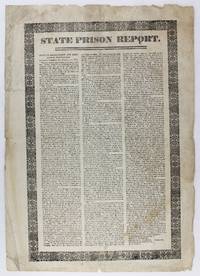
1834réf. 3806Providence 1834. Good plus. Broadside 15 x 10.5 inches printed in three columns within an ornamental border. Old folds short splits along some folds a few small chips moderate dust-soiling and foxing. Untrimmed. A rare broadside disseminating a report from a five-man committee of the General Assembly of Rhode Island recommending penal code reform and the establishment of a state prison in the Ocean State in 1834. The beginning of the report expounds upon the inconsistency of the various legal punishments meted out in county jails. The committee then evaluates different methods of imprisonment in New York Pennsylvania Connecticut and other states concluding as follows: "On the whole the committee are in favor and recommend to the General Assembly the erection of a State penitentiary on the principle of solitary confinement at labor with instruction in labor in morals and religion." The committee hoped this prison reform would "relieve the State from the future support of convicts and may produce a moral reformation in those who may be subjected to its operation." We could locate just one copy of this broadside in OCLC at Brown. unknown
1834réf. 3806Providence 1834. Good plus. Broadside 15 x 10.5 inches printed in three columns within an ornamental border. Old folds short splits along some folds a few small chips moderate dust-soiling and foxing. Untrimmed. A rare broadside disseminating a report from a five-man committee of the General Assembly of Rhode Island recommending penal code reform and the establishment of a state prison in the Ocean State in 1834. The beginning of the report expounds upon the inconsistency of the various legal punishments meted out in county jails. The committee then evaluates different methods of imprisonment in New York Pennsylvania Connecticut and other states concluding as follows: "On the whole the committee are in favor and recommend to the General Assembly the erection of a State penitentiary on the principle of solitary confinement at labor with instruction in labor in morals and religion." The committee hoped this prison reform would "relieve the State from the future support of convicts and may produce a moral reformation in those who may be subjected to its operation." We could locate just one copy of this broadside in OCLC at Brown. unknown books
1972réf. 232591972. Prison and IncarcerationSocial activism Prison reform organizing conference broadside. Attica and San Quentin prison organizing stand at the center of this January 1972 Berkeley conference broadside which opens with a Brecht quote "Slave who is it that shall free you.all of us or none" and declares that "no one in America today is more a slave than the inmates in American prisons." The text ties prison struggle to "class and racial oppression" names the murders at Attica and San Quentin and frames the prison system as a site of beatings drugs "behavior modification" and brain surgery schemes. The conference was held just a few months after the 1971 Attica uprising during which prisoners revolted against inhumane treatment and racial discrimination in a violent struggle that left 39 dead. The conference roster grounds the prison rights moment Bay Area Black liberation featuring figures including Afeni Shakur Fay Stender and former Soledad Prison chief psychiatrist Frank Rundle. "Slave Who Is It Shall Free You . . . All of Us or None." The Struggle Inside. Prison Action Conference. Berkeley 1972. Single-sheet broadside 8.5 x 11 inches for a prison action conference scheduled for January 28-30 in Pauley Ballroom UC Berkeley printed on both sides. Recto features two halftone prison photographs and a dense typed manifesto arguing that prisoner demands had moved "from traditional demands for food and shelter to demands for civil and religious rights and finally to a general challenge to the prison system and the society which fosters it." It announces the conference as "a forum for self education and exploration of potential action to assist the prison movement" with key speakers Afeni Shakur a defendant in the Panther 21 trial Fay Stender a Berkeley attorney with years of prison movement experience and Frank Rundle former chief psychiatrist at Soledad Prison. Verso gives the full three-day program: Friday evening remarks by Stender and Shakur; Saturday sessions on "Medical Repression in Prisons" "Adult Authority and Indeterminate Sentencing" "Economics of Prisons" "Juvenile Reformatories and Detention" and "Prisoners Demands"; and Sunday sessions on "Women in Prison" "Defense of Political Prisoners" "Military Prisons" "Prison-Community Communications" "Prisoners Organizations" "County Jails and Pre-trial Detention" plus a closing "Panel Discussion on Racism." The broadside illustrates the actions and intentions of the Berkeley prison movement at a time when prison rebellion legal defense anti-racist analysis and ex-prisoner testimony were being brought before public audiences in the aftermath of the Attica Uprising. Afeni Shakur's appearance links the handbill to the political world of the Black Panther movement while the inclusion of sessions on women in prison political prisoners juvenile detention county jails and medical repression demonstrate the intersectional goals of the movement and the broadening of post-Attica activism from outrage over one massacre to a larger indictment of prison administration and criminal punishment. Some light staining; otherwise very good condition. A Bay Area prison movement piece that preserves both the rhetoric and the working program of organizing against U.S. imprisonment in the immediate aftermath of the 1971 Attica Uprising. unknown
1972réf. 232591972. Prison and IncarcerationSocial activism Prison reform organizing conference broadside. Attica and San Quentin prison organizing stand at the center of this January 1972 Berkeley conference broadside which opens with a Brecht quote "Slave who is it that shall free you.all of us or none" and declares that "no one in America today is more a slave than the inmates in American prisons." The text ties prison struggle to "class and racial oppression" names the murders at Attica and San Quentin and frames the prison system as a site of beatings drugs "behavior modification" and brain surgery schemes. The conference was held just a few months after the 1971 Attica uprising during which prisoners revolted against inhumane treatment and racial discrimination in a violent struggle that left 39 dead. The conference roster grounds the prison rights moment Bay Area Black liberation featuring figures including Afeni Shakur Fay Stender and former Soledad Prison chief psychiatrist Frank Rundle. "Slave Who Is It Shall Free You . . . All of Us or None." The Struggle Inside. Prison Action Conference. Berkeley 1972. Single-sheet broadside 8.5 x 11 inches for a prison action conference scheduled for January 28-30 in Pauley Ballroom UC Berkeley printed on both sides. Recto features two halftone prison photographs and a dense typed manifesto arguing that prisoner demands had moved "from traditional demands for food and shelter to demands for civil and religious rights and finally to a general challenge to the prison system and the society which fosters it." It announces the conference as "a forum for self education and exploration of potential action to assist the prison movement" with key speakers Afeni Shakur a defendant in the Panther 21 trial Fay Stender a Berkeley attorney with years of prison movement experience and Frank Rundle former chief psychiatrist at Soledad Prison. Verso gives the full three-day program: Friday evening remarks by Stender and Shakur; Saturday sessions on "Medical Repression in Prisons" "Adult Authority and Indeterminate Sentencing" "Economics of Prisons" "Juvenile Reformatories and Detention" and "Prisoners Demands"; and Sunday sessions on "Women in Prison" "Defense of Political Prisoners" "Military Prisons" "Prison-Community Communications" "Prisoners Organizations" "County Jails and Pre-trial Detention" plus a closing "Panel Discussion on Racism." The broadside illustrates the actions and intentions of the Berkeley prison movement at a time when prison rebellion legal defense anti-racist analysis and ex-prisoner testimony were being brought before public audiences in the aftermath of the Attica Uprising. Afeni Shakur's appearance links the handbill to the political world of the Black Panther movement while the inclusion of sessions on women in prison political prisoners juvenile detention county jails and medical repression demonstrate the intersectional goals of the movement and the broadening of post-Attica activism from outrage over one massacre to a larger indictment of prison administration and criminal punishment. Some light staining; otherwise very good condition. A Bay Area prison movement piece that preserves both the rhetoric and the working program of organizing against U.S. imprisonment in the immediate aftermath of the 1971 Attica Uprising. unknown books
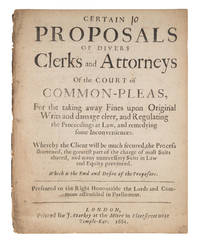
1661réf. 724361661. A Scarce Restoration-Era Pamphlet Proposing Reforms to Court Procedure Law Reform. Great Britain. Certain Proposals of Divers Clerks and Attorneys of the Court of Common-Pleas For the Taking Away Fines upon Original Writs and Damage Cleer And Regulating the Proceedings at Law And Remedying Some Inconveniences. Whereby the Client Will be Much Secured The Process Shortened The Greatest Part of the Charge of Most Suits Abated And Many Unnecessary Suits in Law and Equity Prevented. Which is the End and Desire of the Proposers. Presented to the Right Honourable the Lords and Commons Assembled in Parliament. London: Printed for J. Starkey at the Mitre in Fleetstreet near Temple-Bar 1661. vi 8 pp. Quarto 7" x 5-1/2". Disbound stab-stitched pamphlet. Moderate toning soiling to exterior light browning to margins "10" in early hand to head of title page. $450. Only edition. Produced by a "divers" group of "clerks and attorneys of the Court of Common-Pleas" this pamphlet suggests ways to reform pleading and procedure and reduce the number of lawsuits in the civil and equity courts. This is a scarce title. OCLC locates 6 copies 4 in law libraries Harvard Library of Congress San Francisco Law Library Yale. English Short-Title Catalogue R35481. unknown
1661réf. 724361661. A Scarce Restoration-Era Pamphlet Proposing Reforms to Court Procedure Law Reform. Great Britain. Certain Proposals of Divers Clerks and Attorneys of the Court of Common-Pleas For the Taking Away Fines upon Original Writs and Damage Cleer And Regulating the Proceedings at Law And Remedying Some Inconveniences. Whereby the Client Will be Much Secured The Process Shortened The Greatest Part of the Charge of Most Suits Abated And Many Unnecessary Suits in Law and Equity Prevented. Which is the End and Desire of the Proposers. Presented to the Right Honourable the Lords and Commons Assembled in Parliament. London: Printed for J. Starkey at the Mitre in Fleetstreet near Temple-Bar 1661. vi 8 pp. Quarto 7" x 5-1/2". Disbound stab-stitched pamphlet. Moderate toning soiling to exterior light browning to margins "10" in early hand to head of title page. $450. Only edition. Produced by a "divers" group of "clerks and attorneys of the Court of Common-Pleas" this pamphlet suggests ways to reform pleading and procedure and reduce the number of lawsuits in the civil and equity courts. This is a scarce title. OCLC locates 6 copies 4 in law libraries Harvard Library of Congress San Francisco Law Library Yale. English Short-Title Catalogue R35481. unknown books
1919réf. 21647Genève, Editions Atar, 1915 -1919. Grands in-4 de 77-[3]; 83-[1]; 77-[3] pages, cartonnages décorés et ornés d'une vignette couleurs, titre doré aux dos et aux premiers plats.
[Köln: Coloniae, apud Maternum Cholinum, 1568]. 16vo.; 246 hojas sin numerar. Ejemplar carente de portada. Edición príncipe. Encuadernación de la época, en pergamino, con pérdida de un tercio de la esquina inferior externa del plano superior. Benoist, que había sido confesor de María Estuardo, alcanzó una notable fama como párroco de la iglesia de Saint-Eustache, hasta el punto de ser apodado "el Papa de Les Halles". Regente de Teología en la Sorbona, publicó en 1564 una biblia bilingue en latín y francés y en1588 editó una versión únicamente en francés de la biblia que fue acusada de calvinismo. Expulsado de la Sorbona, fue elegido por Enrique IV como su confesor. Se le deben también dos rarísimos tratados sobre brujería.
1687réf. 10564A Paris, chez Antoine Lambin, 1687. In-16 de [36]-274-[2] pages, plein veau moucheté aux armes (aux 2 plats), dos à 5 nerfs orné de fleurons, encadrement et titre dorés, tranches rouges.
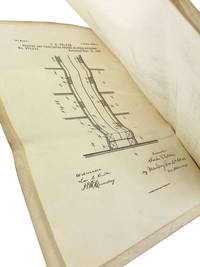
1887réf. 21386Washington: H. Peters 1887. Very Good. Washington: H. Peters 1887. Folio 30.5cm.; ribbon-bound engraved self-wrappers wax-sealed and accomplished in manuscript; 8ll. of photo-engraved plans printed on versos only followed by 3pp. text printed in double columns on rectos only. Previous mail folds extremities a bit chipped and toned ribbons slightly frayed else Very Good internally clean and sound. Signed by Acting Secretary of State D.L. Hawkins and Commissioner of Patents Burton J. Hall. Detailed patent application submitted by the Superintendent of the Chicago Bridewell Prison on September 13 1887. Charles E. Felton ca. 1832-1909 was the prison's longest serving overseer having held the position from its opening in 1872 until his retirement in 1890. Formerly a printer in Buffalo New York Felton entered the field of prison administration through the usual political platforms though he assumed his position in Chicago not through the usual channels but based on his previous experience serving as director of the Erie PA correctional facility. A Democrat and avid duck hunter with a rather unfocussed eye on the mayoralty of Chicago Felton was especially interested in enforcing labor in his prisons as a means of reducing costs and galvanizing individual reformation a position he clung to even past his retirement. The present patent submitted with steel manufacturer Herbert B. Streeter 1833-1919 offered substantial air circulation improvements for prisons "or other structures where the tiers of cells or dormitories have an open hall or corridor without separation by floors or otherwise." Previously the Chicago House of Corrections had just one small ventilating flue leaving the air "absolutely foul and poisonous." The plans depicted here show two foul air flues and one steam-coil heating device per cell as well as additional open air gratings for increased circulation. Though it is unclear whether the patent was ever approved Felton in an address delivered before the Prison Congress four years later complained that the increase in crime rates could be blamed in part on "the comfortable quarters" offered prospective convicted criminals. Also to blame "the present views of the public and acts of legislatures as to systems of prison labor and its ease to the prisoner.the quality of food; their the prisoners' easy access to visitation and the readiness with which a sympathetic public accepts as true the complaints of the prisoners" "Inter Ocean" newspaper October 14 1891. This patent submitted to improve the comfortable prison cells Felton so bemoaned an important document for students and historians of prison reform architecture and engineering. H. Peters unknown