2 761 résultats
réf. ORD-9779Strasbourg. Silbermann. 1834 et 1835 pour les 2 premières (éditions originales). Strasbourg. Schmidt et Grucker. Paris et Genève. Cherbuliez. 1845 pour la troisième qui est un Mémoire servant à l'histoire des premières tentatives faites pour introduire la Réformation en France. 2 ouvrages in-4 et un in-8 dans une reliure in-4 (198 x 250mm) dos lisse veau havane, filets or, plats et gardes papier marbré, (1), 60; (4), 56 et VIII, 244 pages. Ex libris L-H Darnet. Menus défauts mais bon exemplaire.
réf. 346722 ouvrages reliés en un volume in-8, plein vélin de l'époque à petits rabats, lanières de cuir conservées.
2 ouvrages reliés en un volume in-8, plein vélin de l'époque à petits rabats, lanières de cuir conservées. Edition originale de ces deux ouvrages, réfutation des théories exposées par Pierre Du Moulin, pasteur de Charenton, dans 'Les eaux de Siloé pour éteindre le Purgatoire...' (1603) où il niait l'existence du purgatoire. La première réfutation est due à un franciscain portugais, Suarez, confesseur de Henri IV et Évêque de Séez, qui rencontra Du Moulin. Les titres témoignent de la passion qui animait les auteurs et de la violence de cette controverse. (Caillet, 10418 pour le premier. Desgraves, 'Ouvrages de controverse entre catholiques et protestants', n°543 et 503. Pannier, 'L'Eglise réformée de Paris sous Henri IV', p.215 et p. 237). Ex-libris anciens et côtes de société de franc-maçonnerie (petit cachet). Bel exemplaire, très frais, dans sa reliure d'origine.
In-12 (177 x 112 mm), demi-chagrin acajou de l'époque, dos à 4 faux-nerfs orné de compartiments garnis de filets d'encadrement à froid, titre doré, tranches mouchetées, (4), iii, 446 p. Troisième édition augmentée, l'édition définitive, la dernière publiée du vivant de Tocqueville. Elle est accompagnée d'un important appareil d'appendices: comptes rendus d'enquêtes, statistiques, règlements, projets de lois, rapports parlementaires, finances, etc. Couvre notamment les émeutes raciales de New York en juillet 1834, la condition sociale et économique des Noirs, la création du Libéria, la situation tragique des Indiens, etc. Michelle Perrot a utilisé cette édition pour l'établissement du texte dans les "Oeuvres complètes" de Tocqueville (Gallimard, 1984). Bel exemplaire, frais, très bien relié à l'époque.
Venezia: Venetiis, ad Signum Spei, 1551. 8vo.; 12 hs., 368 folios numerados. Encuadernación de época, en pergamino con cejas, con pérdidas en lomera y de un pequeño trozo en plano posterior.
18661st edition. Original Tooled cloth, 12mo, 307, 55 pages plus two leaves tipped in at end for the Family Record (total of 366 pages). In English, Hebrew and German. Singerman 1949, Goldman 53. The original two volumes of the Minhag America prayer book had both been published in 1857, one with Hebrew-English text (Prayer Book for Public and Private Worship) and the other with Hebrew-German text (Gebet-Buch fur den offentlichen Gottesdienst und die Privat-Andacht). In the 1860s, he took the project up again, issuing a three volume series of his Minhag Amerikathe American Traditionwith the present volume for Yom Kipur (The Day of Atonement), as well as a volume for Rosh HaShanah (the Jewish New year) and a combined Jewish Hymnal and Psalter, all shaped by his view of Reform Judaism in America. This volume thus represents one of the first Reform prayer books for the High Holidays in the United States. Some of the prayers are translated both into English and German. Wise, was a pioneer of Reform Judaism in America and became its acknowledged leader and its institutional architect, organizing the Union of American Hebrew Congregations (1873) , the Hebrew Union College (1875) , and the Central Conference of American Rabbis (1889) . The reforms that he instituted sought to change or adapt Judaism to 19th century America. He was also an organizer and mover in the establishment of the Central Conference of American Rabbis, in 1889. Elected its president, he served until he died. Wise believed in uniting American Jewry and hoped to publish a new American reform prayer book titled "Minhag America. The Machzor presented here is part of this project. (See: Goldman 44). Use wear, wear at spine and inside rear hinge, one signiture pulling out, about Good Condition. (KH-5-48DA)
193364 page booklet with two pages of illustrations. Applies economic science to current problems: how to make money circulate; how to abolish usury; how to start consumer buying; how to extend markets; how to raise prices; how to terminate unemployment; how to increase wages; how to secure cheap money; how to reduce business overhead; how to do business on a spot cash basis; how to slash taxation; how to pay off public debts; how to nationalize natural resources; how to provide for old age. Unmarked with moderate wear. Toning to card covers. Binding intact. A sound copy of this fascinating work aimed at helping Canada escape the depths of the Great Depression. Book
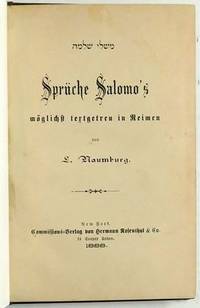
1888réf. 41415New York: Commissions Verlag von Hermann Rosenthal & Co 1888. hardback. 1st edition. Original Cloth. 8vo 88 pages 17 cm. In German with scattered Hebrew. Singerman 3624. Title translates as "The Proverbs of Solomon as true to the Text as Possible in Rhyme." The Book of Proverbs "Mishli Shlomoh" or Solomon's Proverbs is a book in the third section of the Hebrew Bible Ketuvim. Written by King Solomon it discusses values moral behavior the meaning of human life and ethical conduct. Louis Naumurg 1813-1902 "went to America after 1848 and was elected cantor of Reform Congregation Keneseth Israel at Philadelphia Pa. which position he held from 1850 to 1860. In 1865 he was chosen minister of Congregation Rodeph Shalom Pittsburg Pa. During his earlier years in America Naumburg acted as teacher and reader in the synagogue of the Congregation Keneseth Israel of Philadelphia. He prepared a metrical version in German of the Book of Proverbs" this work Cyrus Adler & Josiah Cohen in JE. Naumburg's biography appears in the American Hebrew March 1902. SUBJECTS: Bible. Proverbs -- Paraphrases German. OCLC: 10245073. OCLC-Worldcat lists 7 copies worldwide NYPL JTS Duke Penn Brown Columbia Boston Public None beyond the American East Coast. All Edges Gilt. Spine and endpapers replaced some light staining about Very Good Condition. B AMR-57-21-BRKK-lxe. New York: Commissions Verlag von Hermann Rosenthal & Co unknown
1820réf. 55414London: John Fairburn 1820. First Edition. First printing. Octavo in fours 22cm. In nineteenth-century half brown calf with marbled paper over boards seven double gilt rules to spine with blind ornament in compartments titled in gilt on brown leather spine label all edges sprinkled brown; plain endpapers; iv 480pp. 1944 pencil ownership inscription to rear endpaper. A straight sound copy with minor general wear to boards paper lightly scuffed edges rubbed internally largely clean with one or two pencil marks and small spots of foxing: Very Good. A key text of early nineteenth-century English parliamentary reformers: "a massive compendium of all the abuses electoral ecclesiastical legal" that they "sought to abolish." The book "passed through edition after edition continually augmented with new arguments new reports of abuses and new statistics. . . its emphasis on the need to have practical as well as equitable representation lies at the root of parliamentary democracy" Printing and the Mind of Man p.180. Previously published in installments in 1819; this is the first book edition. PMM296. GOLDSMITHS 23071. KRESS C.638. John Fairburn unknown
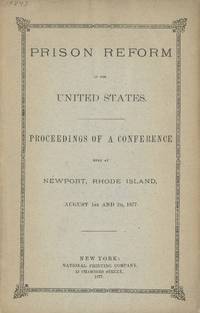
1877réf. BK0163New York: National Printing Company 1877. 8vo 56 pp. Original printed wrappers. "Compliments of Dr. Wines" slip affixed to title page. Near fine with a small tear to front wrapper at seam. Proceedings of an important national conference on prison reform organized around a program prepared by Enoch Cobb Wines the leading American prison reformer of the period. Wines had served as secretary of the New York Prison Association and was instrumental in organizing the landmark National Congress on Penitentiary and Reformatory Discipline at Cincinnati in 1870. The Newport conference met seven years later to formulate a practical system of penal institutions and policies that could be recommended to state legislatures. Much of the pamphlet is devoted to the conference's "Outline Draft of a System of Preventive Reformatory and Penitentiary Institutions and Discipline" which attempted to address criminal justice as a single system extending from childhood through incarceration. Its recommendations begin with compulsory education and institutions for neglected and delinquent children and proceed through reform schools houses of detention women's prisons county jails and state penitentiaries. The conference was particularly severe in its judgment of the existing jail system: "The county jails of the United States numbering about two thousand are with few exceptions schools of vice nurseries of crime and feeders of the penitentiaries. Their construction and management are alike bad; indeed the former is so radically defective as to render any good administration of them impossible." The conference occurred during a period when many of Wines's ideas were beginning to find practical application most notably at Elmira under Zebulon Brockway. Its recommendations ranged from compulsory education and separate institutions for juveniles and women to trained prison officers productive labor improved sanitation and greater state oversight. The "Compliments of Dr. Wines" slip gives this copy a nice association with the man chiefly responsible for both the conference and the program it produced. . National Printing Company unknown
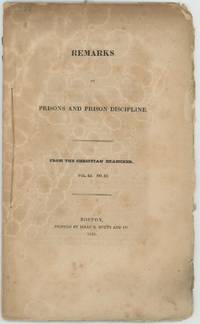
1826réf. BK0167Boston: Isaac R. Butts and Co 1826. 35 pp. 8vo. Original printed wrappers sewn. Wrappers toned and mottled with some edge wear; contents toned. Very good. An early American prison reform pamphlet attributed to Lewis Tappan by Sabin and by Tappan biographer Bertram Wyatt-Brown. Originally appearing in the Christian Examiner it was published separately in 1826 just as the penitentiary was becoming one of the central experiments of antebellum social reform. The essay describes the new system of discipline then being developed at Auburn and other American prisons: prisoners confined separately at night brought together for labor during the day under enforced silence and subjected to regular religious instruction. The arrangement was intended to prevent prisons from becoming schools of crime while replacing indiscriminate punishment with an organized program of labor surveillance and moral reform. The Boston Prison Discipline Society founded the previous year became the principal national advocate of this Auburn system and issued its first annual report in 1826. Its program called for separate cells productive employment religious and common-school instruction and the separation of youthful offenders from adults and habitual offenders.1 Tappan was still a Boston merchant when the pamphlet appeared several years before he became one of the founders of both the New York and American Anti-Slavery Societies in 1833 and later a leading organizer of the defense of the Amistad captives.2 1 Prison Discipline Society Boston Mass. records CC 1 Simmons College Archives Boston MA USA. 2 Lewis Tappan Papers Manuscript Division Library of Congress Washington D.C. https://hdl.loc.gov/loc.mss/eadmss.ms010139. . Isaac R. Butts and Co unknown
réf. 65933. pp. 337-392 AND 617-670. Both disbound from annual volumes the overall stitching retained in excellent condition. For the TWO titles. unknown
1848Later boards. 8vo. 428 pages, 17 cm. In German. Title translates to "Song Book for Use In Teaching the Mosaic Religion and for the Public and Domestic Worship of the Jews." Reform Hymnal published during the Revolution of 1848. The Königliche Württembergische Israelitische Oberkirchenbehörde was the umbrella organization of the Jewish communities of Württemberg. Württemberg German is a large state encompassing Stuttgart (Wikipedia, 2019). SUBJECTS: Reform Judaism -- Liturgy -- Texts. Hymns, German -- Texts. OCLC lists 6 copies worldwide (OCLC:14755839). Ex-library with usual markings. Title page is lightly soiled and boards are lightly worn. Some pages have damp stains. All contents very good.(GER-55-4)
réf. 65058aafParis, Club du Livre, Philippe Lebaud, 1963, in-4°, richement illustré par volume, reliés éditeur, plein chagrin rouge, fracisque or et noir incrustée, les 3 tranches dorées, étuits bordés.
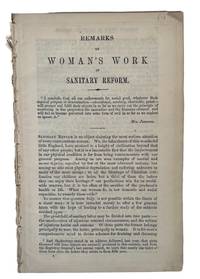
1858réf. 197991858. Powers Susan Rugeley. Remarks on Woman's Work in Sanitary Reform is a circa 1859 pamphlet documenting Victorian women's public health work through the system of sanitary reform revealing how women's domestic educational and visiting labor was framed as essential to national health. Addressed to mothers educators tract distributors and visitors of schools cottages and workhouses the text asks "What can woman do in her domestic and social capacities to remedy these evils" and answers by assigning women authority over household health infant care education and habits. The pamphlet supports research into women's employment Victorian public health sanitary reform feminist social thought and the expansion of women's public roles through reform labor. Powers Susan Rugeley. Remarks on Woman's Work in Sanitary Reform. London: Tweedie circa 1859. 20 pages. 8vo. The pamphlet divides sanitary labor into "the amelioration of injurious external circumstances" and "the reform of injurious habits and customs" identifying the former principally with men and the latter principally with women. Powers argues "It is for woman in her functions of mother housewife and teacher" to change infant management domestic economy education and the habits of women and adds that "It is for her to teach and apply the laws of health in her own provinces where man cannot act." Susan Rugeley Powers was the first secretary of the Ladies' Sanitary Association an organization founded to educate working-class communities on public health; the pamphlet was also connected to the English Woman's Journal and the wider Langham Place reform milieu. The pamphlet demonstrates the process by which sanitary reform converted gendered domestic expertise into organized public health labor giving women a socially sanctioned role in health education before broader access to professional employment. Contemporary holdings appear limited: a dealer record notes four WorldCat copies and three COPAC copies while a University of Wisconsin catalog record identifies a later microfilm version associated with the English Woman's Journal. Slight chipping at binding; pages held together; minor wear. Overall very good. A focused Victorian women's reform pamphlet linking public health domestic authority and early arguments for women's socially necessary work. unknown
1840Roy. 8vo., First Edition, with fine engraved portrait frontispiece and 27 fine engraved portrait plates (all original tissue guards present), some very light and generally inoffensive foxing, a few guards offset as intended; contemporary half calf, marbled boards, gilt back, sprinkled edges, brown endpapers, covers lightly age-marked and rubbed at extremities else a remarkably bright, clean copy with excellent impressions of the plates. Includes (in alphabetical order, and each with a portrait): Bowring, Buller, Buxton, Byng, Codrington, Durham, Ebrington, Grey, Grote, Holland, Hume, James, Lansdowne, Leader, Melbourne, Morpeth, Mulgrave, Palmerston, Roebuck, Russell, Spencer, Talfourd, Thompson, Thomson. Wakley, Warburton and Wyse. An important text in the literature of parliamentary reform in Britain. Though the work is often noted for the excellent likenesses of its plates (the majority engraved by Mote and Hull from work by Hayter and others), it would be a mistake to under-value Saunders' assessments, which comprise a key series of contemporary appraisals of biography, character and achievement not easily found elsewhere. Text by novelist John Saunders (1810-1895); the majority of portraits by William Hayter (1792-1879); Sketch of Parliamentary Reform by William Howitt (1792-1871). VERY SCARCE, ESPECIALLY IN THIS CONDITION.
réf. 208542S.l., s.d. (1771) in-12, 47 pp., basane fauve marbrée, dos lisse cloisonné et fleuronné, pièces de titre et de tomaison [tome V], tranches marbrées (reliure de l'époque). Coins abîmés, plats et dos frottés.
réf. 222094S.l., 1615; petit in-8, 15 pp., demi-toile cerise (reliure moderne). Feuillets roussis.
réf. 349082 volumes in-4, demi-chagrin de l'époque, dos à 4 nerfs plats ornés de compartiments garnis d'un décor d'encadrement, palettes et filets dorés en tête et pied, tranches mouchetées, xxix, 778 p., (1) p. d'errata et vj, 743, (1) p. Paris, Nève, 1836.
2 volumes in-4, demi-chagrin de l'époque, dos à 4 nerfs plats ornés de compartiments garnis d'un décor d'encadrement, palettes et filets dorés en tête et pied, tranches mouchetées, xxix, 778 p., (1) p. d'errata et vj, 743, (1) p. Seconde édition revue et augmentée accompagnée de tables rédigées par Berriat de Saint-Prix fils. Les commentaires de Joseph Carnot ont été largement mis à profit lors des révisions libérales du Code pénal instituées par la loi du 28 avril 1832, dans le sens d'un assouplissement du dispositif répressif, en particulier la suppression des peines corporelles, la diminution des peines et l'institution d'une échelle des peines politiques distincte de celles de droit commun. Frère de Lazare Carnot, magistrat juge à la Cour de cassation, l'auteur avait été l'un des membres de la commission chargée de réviser le Code pénal. Il fut élu membre de l'Académie des sciences morales et politiques en 1832. (Camus-Dupin, n° 2327). Ex-libris "G. Demartial" doré en pied. Bon exemplaire, frais, bien relié.
réf. 3508611 forts volumes in-8, demi-veau de l'époque, dos lisses ornés (quelques petits accrocs). Rouen, 1875-1878
In-8, demi-veau havane de l'époque, dos à 4 faux-nerfs plats ornés d'un jeu de filets dorés, pièces de titre et de tomaison de maroquin bleu, tranches marbrées (petits accrocs à la coiffe sup.), xlvij, 436 p. Edition originale illustrée de nombreux tableaux statistiques. Préfet de police et inspecteur général des prisons de la Seine, Moreau-Christophe entra dans le service actif des prisons après 1830. "Ses livres constituent une mine d'informations" (M. Perrot, ‘L'impossible prison’). La première partie contient le compte rendu d'une importante enquête effectuée sur le terrain à travers l'ensemble de l'institution pénitentiaire française, des maisons de dépôts aux bagnes: Classification, administration, bâtiments, les détenus, régime, etc. La seconde est consacrée à un projet de réformes "morales, matérielles et administratives", dans lequel l’auteur expose sa théorie des 4 systèmes : expiatoire, exemplaire, pénitentiaire et "obviatoire". (Coquelin & Guillaumin, II, 251. P. O'Brien, p. 329). Quelques rousseurs. Une note manuscrite signale que l'ouvrage provient de la bibliothèque de Charles Lucas. Très bon exemplaire, bien relié à l'époque.
In-8, demi-veau havane de l'époque, dos à 4 faux-nerfs plats ornés d'un jeu de filets dorés, pièces de titre et de tomaison de maroquin bleu, tranches marbrées, xix, (1), 499, (5) p. d'errata et table. Edition originale illustrée de nombreux tableaux statistiques. Préfet de police et inspecteur général des prisons de la Seine, Moreau-Christophe entra dans le service actif des prisons après 1830. "Ses livres constituent une mine d'informations" (M. Perrot, ‘L'impossible prison’). (Coquelin & Guillaumin, II, 251. P. O'Brien, p. 329). Quelques rousseurs. Une note manuscrite signale que l'ouvrage proviendrait de la bibliothèque de Charles Lucas. Très bon exemplaire, bien relié à l'époque.
1635réf. 75031635 1635 Genève, imprimé pour Pierre Chouët, 1635. V/981 pages. Ex libris manuscrit. Reliure vélin de l'époque, titre à l'encre au dos
19661st edition. Issue with Singers Photo on cover and lead article being the transcript of an interview with Singer on pages 2-12, which includes 6 additional photos interspersed throughout the text. The Editors note, Isaac Beshevis Singer visited the Cincinnati campus for a week of lectures and dialogue with the teachers and future rabbis of a movement which does not actually forsake Jewishness but has taken out of Jewishness its very essence. Interestingly, Lawrence Kushner, then a rabbinic student, is listed on the masthead of this issue for Photography and New York representative. The Variant ran a total of 8 volumes, 1961-1969, generally appearing 3 times per year. Issued by the student body of the Hebrew Union College, Jewish Institute of Religion. SUBJECT (S) : Jewish college students -- Periodicals. Reform Judaism -- United States. OCLC lists 11 institutions with holdings for at least some of the issues, but it is unclear which are complete. Only one Ivy League Institution (Harvard) lists any holdings at all. Somewhat rare. Very Good Condition (KH-8-64)