2788 risultati
1925Very Good Turkish, Ottoman (1500-1928) Paperback. 12mo. (16 x 12 cm). In Ottoman script. 39 p. Ev hanimlarina mahsûs alafranga pastacilik. Therein no definite information about born and death dates of Rabiha Hanim. Her grandfather was Kani Pasha (One of Tanzimat period pashas) grandmother was Russian. Her father Rifat bey who was a diplomat Kani Pasazade Ahmet Rifat bey, (1844-1891), was one the Young Turks according to Mithat Cemal Kuntay (Avrupa'da dokuz Türk ihtilalcisi). Rabiha Hanim's first articles and writings about cookery and recipes appeared in 'Türk hayati' periodical in 1925-26 which published by Selanikli Fazli Necip. She wrote in this periodical for a short time, for the chapter under the title 'Sofra hayati' [i.e. Cuisine life]. This book by her includes 41 recipes of cake and dessert. It's not cataloged in any bibliography related to Ottoman cookery or other. Additionally, she wrote a French edition of this book in 1925 under the title of 'La bonne cuisine Turque, Facile et economique des Mets les plus Usites et Renommesdu Pays (107 recettes)'. Only one copy located in OCLC: 949551637 (Bogaziçi University Library).; Not in Özege.; Kut 34.; Özege Bagis Kitaplari Kat. 3601. First Edition. Extremely rare. This rare book includes 41 pastry recipes with their French names as well as add to their Turkish names. Rabia wrote a cookbook in French printed in 1925 titled 'La Bonne Cuisine Turque' in Istanbul according to Kut.
1703In -4°, pp. (10), 3-376, pergamena con titolo manoscritto al piatto superiore. La provincia è quella francescana di San Juan Bautista, nei pressi di Valencia.
1693rif. PHO-1980Delft, Adrien Beman, 1693-1695. 3 volumes in-4 (5), veau marbré, dos orné, tranches mouchetées (Reliure de l'époque). Coiffes usées, menus défauts aux reliures, manque au dos tome 3, rousseurs. T. 3 : 15ff.-656pp.1f.-(2)- 197pp.-13ff., T. 3, 2e partie : 1f.-628 pp., T. 3, 3e partie : 3ff.-p. 631 à 1019-15ff.-199pp.-23ff.
Madrid, en la Imprenta Real, a costa de Gabriel de Leon, mercader de libros, 1675. Folio; 4 hs. (de 5), 594 pp.,190 pp. Ejemplar falto de las nueve hojas finales de Tabla. Portada con pérdidas y montada groseramente sobre papel. Ejemplar fatigado- Encuadernación en pergamino.
Petit in-4, plein vélin ancien, dos doublé, (8), 184 p., vignette de titre, bandeaux, lettrines sur fond criblé et sceau du pape Sixtus V gravé sur bois. Edition originale. A propos du couronnement d'Henri IV roi de France, Ponce de León tente de démontrer, preuves à l’appui, qu'un relaps ne peut régner légitimement. Il fonde sa démonstration sur un très important appareil de sources : Ecritures saintes, décrets des conciles, constitutions de l’Eglise, pères de l’Eglise, Monuments de l'histoire, etc. Très documentée, l'étude est suivie du texte de la déclaration d'excommunication par le pape Sixte V et deux lettres de Grégoire XIV. Humaniste espagnol né à Séville, helléniste réputé, Gonzalo Marín Ponce de León devint archidiacre de la cathédrale de Tolède et camérier de Pie V. (Laurenti, 'Estudios bibliográficos sobre la Edad de oro', n°11. Palau, XIII, 230979. Sources de l'Histoire de France, n°3060). Quelques brunissures et qqs petites gal. de vers. Ex-libris manuscrit et petit cachet de bibliothèque jésuite. Bon exemplaire.
1593rif. 350931593 Petit in-4, plein vélin ancien, dos doublé, (8), 184 p., vignette de titre, bandeaux, lettrines sur fond criblé et sceau du pape Sixtus V gravé sur bois. Romae, Typographia Gabiana, 1593.
In-12 (100 x 151 mm), broché, cartonnage crème d'attente de l'époque, (8), 133, (1) p., grande vignette de titre gravée. Prima edizione della traduzione italiana di francese da Jean Bernardo de la Baffarderie, "ggiuntavi di nuovo una canzone del cavalier Marini in morte di detto Ré". D’abord lié à la Ligue, Pierre Matthieu devint secrétaire du duc de Nemours puis soutint le futur Henri IV. Il contribua à son entrée à Lyon en 1595 et le suivit à Paris où il devint son historiographe officiel. Composé par un familier du roi témoin oculaire des événements qu’il relate, cet ouvrage est riche de nombreux détails alors inédits. Il est cité comme l’une des sources de première main pour l’histoire de l’assassinat de Henri IV (Pour l’édition française cf. Brunet, III, 1532. Sources de l’Histoire de France, 3257. Tchemerzine-Scheler, IV, 635). Manque de papier au dos de la reliure. Très bon exemplaire, très frais, très bien conservé, tel que paru.
rif. 37812In-12 (100 x 151 mm), broché, cartonnage crème d'attente de l'époque, (8), 133, (1) p., grande vignette de titre gravée. Modena, & in Macerata, Pietro Salvioni, 1615.
1734rif. 18031734 1734 L'Alcoran des Cordeliers. Tant en latin qu'en français. C'est à dire, Recueil des plus notables bourdes & blasphèmes de ceux qui ont osé comparer Saint-François à Jésus Christ ; tiré du grand livre des Conformitez, jadis composé par frère Barthelemi de Pise, Cordelier en son vivant. Nouvelle édition ornée de figures dessinées par B. Picart.Amsterdam, Aux dépens de la Compagnie, 1734. 2 volumes in-8, plein veau d'époque, pièces de titre et tomaison de maroquin rouge, dos lisse orné de fleurons, plats à double filet d'or, coiffes et coins émoussés avec légers manques de cuir. Frontispice, page de titre, [8ff], 396pp ; frontispice, page de titre, 419pp, 19 planches gravées dont une dépliante (soit 21 planches avec les deux frontispices).
1627rif. 21863A Amsterdam, chez J. Wetstein et G. Smith, 1751. 3 forts vol. au format in-4 (252 x 198 mm) de 1 f. bl., 1 frontispice gravé n.fol., 7 ff. n.fol., lxxii - 562 pp. et 1 f. bl. ; 1 f. n.fol. et 644 pp. ; 1 f. n.fol. et 561 pp. Reliures uniformes de l'époque de plein veau marbré havane, plats jansénistes, dos à nerfs ornés de filets gras à froid, doubles caissons d'encadrement dorés, large décor fleuronné doré, semis d'étoiles dorées, pièces de titre de maroquin brun, pièces de tomaison de maroquin émeraude, titre doré, tomaison dorée, palette dorée en queue, filet doré sur les coupes, tranches marbrées.
rif. ORD-9779Strasbourg. Silbermann. 1834 et 1835 pour les 2 premières (éditions originales). Strasbourg. Schmidt et Grucker. Paris et Genève. Cherbuliez. 1845 pour la troisième qui est un Mémoire servant à l'histoire des premières tentatives faites pour introduire la Réformation en France. 2 ouvrages in-4 et un in-8 dans une reliure in-4 (198 x 250mm) dos lisse veau havane, filets or, plats et gardes papier marbré, (1), 60; (4), 56 et VIII, 244 pages. Ex libris L-H Darnet. Menus défauts mais bon exemplaire.
2 ouvrages reliés en un volume in-8, plein vélin de l'époque à petits rabats, lanières de cuir conservées. Edition originale de ces deux ouvrages, réfutation des théories exposées par Pierre Du Moulin, pasteur de Charenton, dans 'Les eaux de Siloé pour éteindre le Purgatoire...' (1603) où il niait l'existence du purgatoire. La première réfutation est due à un franciscain portugais, Suarez, confesseur de Henri IV et Évêque de Séez, qui rencontra Du Moulin. Les titres témoignent de la passion qui animait les auteurs et de la violence de cette controverse. (Caillet, 10418 pour le premier. Desgraves, 'Ouvrages de controverse entre catholiques et protestants', n°543 et 503. Pannier, 'L'Eglise réformée de Paris sous Henri IV', p.215 et p. 237). Ex-libris anciens et côtes de société de franc-maçonnerie (petit cachet). Bel exemplaire, très frais, dans sa reliure d'origine.
rif. 346722 ouvrages reliés en un volume in-8, plein vélin de l'époque à petits rabats, lanières de cuir conservées.
In-12 (177 x 112 mm), demi-chagrin acajou de l'époque, dos à 4 faux-nerfs orné de compartiments garnis de filets d'encadrement à froid, titre doré, tranches mouchetées, (4), iii, 446 p. Troisième édition augmentée, l'édition définitive, la dernière publiée du vivant de Tocqueville. Elle est accompagnée d'un important appareil d'appendices: comptes rendus d'enquêtes, statistiques, règlements, projets de lois, rapports parlementaires, finances, etc. Couvre notamment les émeutes raciales de New York en juillet 1834, la condition sociale et économique des Noirs, la création du Libéria, la situation tragique des Indiens, etc. Michelle Perrot a utilisé cette édition pour l'établissement du texte dans les "Oeuvres complètes" de Tocqueville (Gallimard, 1984). Bel exemplaire, frais, très bien relié à l'époque.
Venezia: Venetiis, ad Signum Spei, 1551. 8vo.; 12 hs., 368 folios numerados. Encuadernación de época, en pergamino con cejas, con pérdidas en lomera y de un pequeño trozo en plano posterior.
18661st edition. Original Tooled cloth, 12mo, 307, 55 pages plus two leaves tipped in at end for the Family Record (total of 366 pages). In English, Hebrew and German. Singerman 1949, Goldman 53. The original two volumes of the Minhag America prayer book had both been published in 1857, one with Hebrew-English text (Prayer Book for Public and Private Worship) and the other with Hebrew-German text (Gebet-Buch fur den offentlichen Gottesdienst und die Privat-Andacht). In the 1860s, he took the project up again, issuing a three volume series of his Minhag Amerikathe American Traditionwith the present volume for Yom Kipur (The Day of Atonement), as well as a volume for Rosh HaShanah (the Jewish New year) and a combined Jewish Hymnal and Psalter, all shaped by his view of Reform Judaism in America. This volume thus represents one of the first Reform prayer books for the High Holidays in the United States. Some of the prayers are translated both into English and German. Wise, was a pioneer of Reform Judaism in America and became its acknowledged leader and its institutional architect, organizing the Union of American Hebrew Congregations (1873) , the Hebrew Union College (1875) , and the Central Conference of American Rabbis (1889) . The reforms that he instituted sought to change or adapt Judaism to 19th century America. He was also an organizer and mover in the establishment of the Central Conference of American Rabbis, in 1889. Elected its president, he served until he died. Wise believed in uniting American Jewry and hoped to publish a new American reform prayer book titled "Minhag America. The Machzor presented here is part of this project. (See: Goldman 44). Use wear, wear at spine and inside rear hinge, one signiture pulling out, about Good Condition. (KH-5-48DA)
193364 page booklet with two pages of illustrations. Applies economic science to current problems: how to make money circulate; how to abolish usury; how to start consumer buying; how to extend markets; how to raise prices; how to terminate unemployment; how to increase wages; how to secure cheap money; how to reduce business overhead; how to do business on a spot cash basis; how to slash taxation; how to pay off public debts; how to nationalize natural resources; how to provide for old age. Unmarked with moderate wear. Toning to card covers. Binding intact. A sound copy of this fascinating work aimed at helping Canada escape the depths of the Great Depression. Book
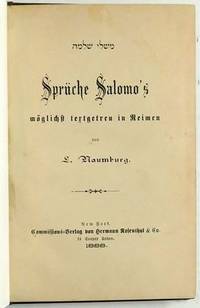
1888rif. 41415New York: Commissions Verlag von Hermann Rosenthal & Co 1888. hardback. 1st edition. Original Cloth. 8vo 88 pages 17 cm. In German with scattered Hebrew. Singerman 3624. Title translates as "The Proverbs of Solomon as true to the Text as Possible in Rhyme." The Book of Proverbs "Mishli Shlomoh" or Solomon's Proverbs is a book in the third section of the Hebrew Bible Ketuvim. Written by King Solomon it discusses values moral behavior the meaning of human life and ethical conduct. Louis Naumurg 1813-1902 "went to America after 1848 and was elected cantor of Reform Congregation Keneseth Israel at Philadelphia Pa. which position he held from 1850 to 1860. In 1865 he was chosen minister of Congregation Rodeph Shalom Pittsburg Pa. During his earlier years in America Naumburg acted as teacher and reader in the synagogue of the Congregation Keneseth Israel of Philadelphia. He prepared a metrical version in German of the Book of Proverbs" this work Cyrus Adler & Josiah Cohen in JE. Naumburg's biography appears in the American Hebrew March 1902. SUBJECTS: Bible. Proverbs -- Paraphrases German. OCLC: 10245073. OCLC-Worldcat lists 7 copies worldwide NYPL JTS Duke Penn Brown Columbia Boston Public None beyond the American East Coast. All Edges Gilt. Spine and endpapers replaced some light staining about Very Good Condition. B AMR-57-21-BRKK-lxe. New York: Commissions Verlag von Hermann Rosenthal & Co unknown
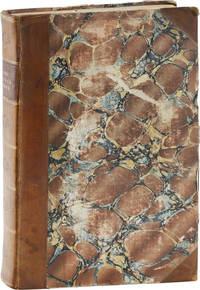
1820rif. 55414London: John Fairburn 1820. First Edition. First printing. Octavo in fours 22cm. In nineteenth-century half brown calf with marbled paper over boards seven double gilt rules to spine with blind ornament in compartments titled in gilt on brown leather spine label all edges sprinkled brown; plain endpapers; iv 480pp. 1944 pencil ownership inscription to rear endpaper. A straight sound copy with minor general wear to boards paper lightly scuffed edges rubbed internally largely clean with one or two pencil marks and small spots of foxing: Very Good. A key text of early nineteenth-century English parliamentary reformers: "a massive compendium of all the abuses electoral ecclesiastical legal" that they "sought to abolish." The book "passed through edition after edition continually augmented with new arguments new reports of abuses and new statistics. . . its emphasis on the need to have practical as well as equitable representation lies at the root of parliamentary democracy" Printing and the Mind of Man p.180. Previously published in installments in 1819; this is the first book edition. PMM296. GOLDSMITHS 23071. KRESS C.638. John Fairburn unknown
1820rif. 55414London: John Fairburn 1820. First Edition. First printing. Octavo in fours 22cm. In nineteenth-century half brown calf with marbled paper over boards seven double gilt rules to spine with blind ornament in compartments titled in gilt on brown leather spine label all edges sprinkled brown; plain endpapers; iv 480pp. 1944 pencil ownership inscription to rear endpaper. A straight sound copy with minor general wear to boards paper lightly scuffed edges rubbed internally largely clean with one or two pencil marks and small spots of foxing: Very Good. A key text of early nineteenth-century English parliamentary reformers: "a massive compendium of all the abuses electoral ecclesiastical legal" that they "sought to abolish." The book "passed through edition after edition continually augmented with new arguments new reports of abuses and new statistics. . . its emphasis on the need to have practical as well as equitable representation lies at the root of parliamentary democracy" Printing and the Mind of Man p.180. Previously published in installments in 1819; this is the first book edition. PMM296. GOLDSMITHS 23071. KRESS C.638. John Fairburn unknown books
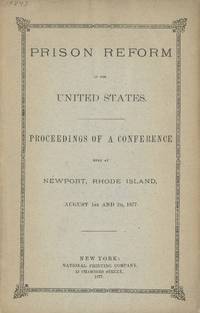
1877rif. BK0163New York: National Printing Company 1877. 8vo 56 pp. Original printed wrappers. "Compliments of Dr. Wines" slip affixed to title page. Near fine with a small tear to front wrapper at seam. Proceedings of an important national conference on prison reform organized around a program prepared by Enoch Cobb Wines the leading American prison reformer of the period. Wines had served as secretary of the New York Prison Association and was instrumental in organizing the landmark National Congress on Penitentiary and Reformatory Discipline at Cincinnati in 1870. The Newport conference met seven years later to formulate a practical system of penal institutions and policies that could be recommended to state legislatures. Much of the pamphlet is devoted to the conference's "Outline Draft of a System of Preventive Reformatory and Penitentiary Institutions and Discipline" which attempted to address criminal justice as a single system extending from childhood through incarceration. Its recommendations begin with compulsory education and institutions for neglected and delinquent children and proceed through reform schools houses of detention women's prisons county jails and state penitentiaries. The conference was particularly severe in its judgment of the existing jail system: "The county jails of the United States numbering about two thousand are with few exceptions schools of vice nurseries of crime and feeders of the penitentiaries. Their construction and management are alike bad; indeed the former is so radically defective as to render any good administration of them impossible." The conference occurred during a period when many of Wines's ideas were beginning to find practical application most notably at Elmira under Zebulon Brockway. Its recommendations ranged from compulsory education and separate institutions for juveniles and women to trained prison officers productive labor improved sanitation and greater state oversight. The "Compliments of Dr. Wines" slip gives this copy a nice association with the man chiefly responsible for both the conference and the program it produced. . National Printing Company unknown
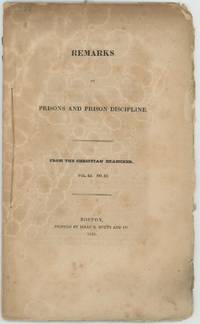
1826rif. BK0167Boston: Isaac R. Butts and Co 1826. 35 pp. 8vo. Original printed wrappers sewn. Wrappers toned and mottled with some edge wear; contents toned. Very good. An early American prison reform pamphlet attributed to Lewis Tappan by Sabin and by Tappan biographer Bertram Wyatt-Brown. Originally appearing in the Christian Examiner it was published separately in 1826 just as the penitentiary was becoming one of the central experiments of antebellum social reform. The essay describes the new system of discipline then being developed at Auburn and other American prisons: prisoners confined separately at night brought together for labor during the day under enforced silence and subjected to regular religious instruction. The arrangement was intended to prevent prisons from becoming schools of crime while replacing indiscriminate punishment with an organized program of labor surveillance and moral reform. The Boston Prison Discipline Society founded the previous year became the principal national advocate of this Auburn system and issued its first annual report in 1826. Its program called for separate cells productive employment religious and common-school instruction and the separation of youthful offenders from adults and habitual offenders.1 Tappan was still a Boston merchant when the pamphlet appeared several years before he became one of the founders of both the New York and American Anti-Slavery Societies in 1833 and later a leading organizer of the defense of the Amistad captives.2 1 Prison Discipline Society Boston Mass. records CC 1 Simmons College Archives Boston MA USA. 2 Lewis Tappan Papers Manuscript Division Library of Congress Washington D.C. https://hdl.loc.gov/loc.mss/eadmss.ms010139. . Isaac R. Butts and Co unknown
1826rif. BK0167Boston: Isaac R. Butts and Co 1826. 35 pp. 8vo. Original printed wrappers sewn. Wrappers toned and mottled with some edge wear; contents toned. Very good. An early American prison reform pamphlet attributed to Lewis Tappan by Sabin and by Tappan biographer Bertram Wyatt-Brown. Originally appearing in the Christian Examiner it was published separately in 1826 just as the penitentiary was becoming one of the central experiments of antebellum social reform. The essay describes the new system of discipline then being developed at Auburn and other American prisons: prisoners confined separately at night brought together for labor during the day under enforced silence and subjected to regular religious instruction. The arrangement was intended to prevent prisons from becoming schools of crime while replacing indiscriminate punishment with an organized program of labor surveillance and moral reform. The Boston Prison Discipline Society founded the previous year became the principal national advocate of this Auburn system and issued its first annual report in 1826. Its program called for separate cells productive employment religious and common-school instruction and the separation of youthful offenders from adults and habitual offenders.1 Tappan was still a Boston merchant when the pamphlet appeared several years before he became one of the founders of both the New York and American Anti-Slavery Societies in 1833 and later a leading organizer of the defense of the Amistad captives.2 1 Prison Discipline Society Boston Mass. records CC 1 Simmons College Archives Boston MA USA. 2 Lewis Tappan Papers Manuscript Division Library of Congress Washington D.C. https://hdl.loc.gov/loc.mss/eadmss.ms010139. . Isaac R. Butts and Co unknown books
1877rif. BK0163New York: National Printing Company 1877. 8vo 56 pp. Original printed wrappers. "Compliments of Dr. Wines" slip affixed to title page. Near fine with a small tear to front wrapper at seam. Proceedings of an important national conference on prison reform organized around a program prepared by Enoch Cobb Wines the leading American prison reformer of the period. Wines had served as secretary of the New York Prison Association and was instrumental in organizing the landmark National Congress on Penitentiary and Reformatory Discipline at Cincinnati in 1870. The Newport conference met seven years later to formulate a practical system of penal institutions and policies that could be recommended to state legislatures. Much of the pamphlet is devoted to the conference's "Outline Draft of a System of Preventive Reformatory and Penitentiary Institutions and Discipline" which attempted to address criminal justice as a single system extending from childhood through incarceration. Its recommendations begin with compulsory education and institutions for neglected and delinquent children and proceed through reform schools houses of detention women's prisons county jails and state penitentiaries. The conference was particularly severe in its judgment of the existing jail system: "The county jails of the United States numbering about two thousand are with few exceptions schools of vice nurseries of crime and feeders of the penitentiaries. Their construction and management are alike bad; indeed the former is so radically defective as to render any good administration of them impossible." The conference occurred during a period when many of Wines's ideas were beginning to find practical application most notably at Elmira under Zebulon Brockway. Its recommendations ranged from compulsory education and separate institutions for juveniles and women to trained prison officers productive labor improved sanitation and greater state oversight. The "Compliments of Dr. Wines" slip gives this copy a nice association with the man chiefly responsible for both the conference and the program it produced. . National Printing Company unknown books
rif. 65933. pp. 337-392 AND 617-670. Both disbound from annual volumes the overall stitching retained in excellent condition. For the TWO titles. unknown