2788 risultati
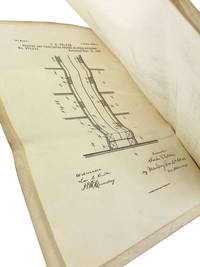
1887rif. 21386Washington: H. Peters 1887. Very Good. Washington: H. Peters 1887. Folio 30.5cm.; ribbon-bound engraved self-wrappers wax-sealed and accomplished in manuscript; 8ll. of photo-engraved plans printed on versos only followed by 3pp. text printed in double columns on rectos only. Previous mail folds extremities a bit chipped and toned ribbons slightly frayed else Very Good internally clean and sound. Signed by Acting Secretary of State D.L. Hawkins and Commissioner of Patents Burton J. Hall. Detailed patent application submitted by the Superintendent of the Chicago Bridewell Prison on September 13 1887. Charles E. Felton ca. 1832-1909 was the prison's longest serving overseer having held the position from its opening in 1872 until his retirement in 1890. Formerly a printer in Buffalo New York Felton entered the field of prison administration through the usual political platforms though he assumed his position in Chicago not through the usual channels but based on his previous experience serving as director of the Erie PA correctional facility. A Democrat and avid duck hunter with a rather unfocussed eye on the mayoralty of Chicago Felton was especially interested in enforcing labor in his prisons as a means of reducing costs and galvanizing individual reformation a position he clung to even past his retirement. The present patent submitted with steel manufacturer Herbert B. Streeter 1833-1919 offered substantial air circulation improvements for prisons "or other structures where the tiers of cells or dormitories have an open hall or corridor without separation by floors or otherwise." Previously the Chicago House of Corrections had just one small ventilating flue leaving the air "absolutely foul and poisonous." The plans depicted here show two foul air flues and one steam-coil heating device per cell as well as additional open air gratings for increased circulation. Though it is unclear whether the patent was ever approved Felton in an address delivered before the Prison Congress four years later complained that the increase in crime rates could be blamed in part on "the comfortable quarters" offered prospective convicted criminals. Also to blame "the present views of the public and acts of legislatures as to systems of prison labor and its ease to the prisoner.the quality of food; their the prisoners' easy access to visitation and the readiness with which a sympathetic public accepts as true the complaints of the prisoners" "Inter Ocean" newspaper October 14 1891. This patent submitted to improve the comfortable prison cells Felton so bemoaned an important document for students and historians of prison reform architecture and engineering. H. Peters unknown books
rif. BK0166Boston: Charles C. Little and James Brown 1847. 203 pp. 8vo. Original printed wrappers. Near Fine. An important contemporary attack on the Pennsylvania system of prison discipline and its use of prolonged cellular separation published during a heated national and international debate over the treatment of prisoners. Gray had served as vice-president of the Boston Prison Discipline Society and for several years chaired the board of directors of the Massachusetts State Prison. The book appeared amid the bitter 1846-47 controversy within the Boston Prison Discipline Society after Charles Sumner challenged the organization's longstanding hostility toward the Pennsylvania system. Sumner's intervention drew attention in Europe and correspondence from Alexis de Tocqueville; Gray answered from the opposing side with the present work. A later account specifically identified Prison Discipline in America as the principal American response taking a stand against the Pennsylvania system.1 Gray's argument rests heavily on comparative evidence from American prisons including statistics from the Massachusetts State Prison at Charlestown and Eastern State Penitentiary at Philadelphia. He regarded the higher rates of insanity and mortality under constant separation as evidence against the system concluding that it tended to "enfeeble the body and the mind." His observations became an enduring part of the literature on solitary confinement and continue to be cited in modern medical and legal discussions of its psychological effects. A particularly nice copy in near fine condition in the original wraps. 1 "RIVAL SYSTEMS OF PRISON DISCIPLINE. Speech before the Boston Prison Discipline Society at the Tremont Temple June 18 1847" in Charles Sumner. His Complete Works Lee and Shepard 1900 digitized by Project Gutenberg accessed October 8 2026 https://www.gutenberg.org/cache/epub/45473/pg45473-images.html. . Charles C. Little and James Brown unknown
rif. BK0166Boston: Charles C. Little and James Brown 1847. 203 pp. 8vo. Original printed wrappers. Near Fine. An important contemporary attack on the Pennsylvania system of prison discipline and its use of prolonged cellular separation published during a heated national and international debate over the treatment of prisoners. Gray had served as vice-president of the Boston Prison Discipline Society and for several years chaired the board of directors of the Massachusetts State Prison. The book appeared amid the bitter 1846-47 controversy within the Boston Prison Discipline Society after Charles Sumner challenged the organization's longstanding hostility toward the Pennsylvania system. Sumner's intervention drew attention in Europe and correspondence from Alexis de Tocqueville; Gray answered from the opposing side with the present work. A later account specifically identified Prison Discipline in America as the principal American response taking a stand against the Pennsylvania system.1 Gray's argument rests heavily on comparative evidence from American prisons including statistics from the Massachusetts State Prison at Charlestown and Eastern State Penitentiary at Philadelphia. He regarded the higher rates of insanity and mortality under constant separation as evidence against the system concluding that it tended to "enfeeble the body and the mind." His observations became an enduring part of the literature on solitary confinement and continue to be cited in modern medical and legal discussions of its psychological effects. A particularly nice copy in near fine condition in the original wraps. 1 "RIVAL SYSTEMS OF PRISON DISCIPLINE. Speech before the Boston Prison Discipline Society at the Tremont Temple June 18 1847" in Charles Sumner. His Complete Works Lee and Shepard 1900 digitized by Project Gutenberg accessed October 8 2026 https://www.gutenberg.org/cache/epub/45473/pg45473-images.html. . Charles C. Little and James Brown unknown books
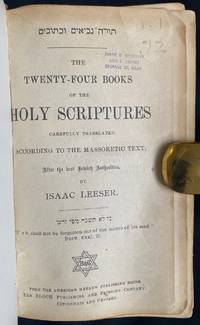
1880rif. 43529Cincinnati & Chicago: From the American Hebrew Publishing House the Bloch Publishing and Printing Company 1880. 1880s Preface is dated 1856. Original Full Leather binding with black & gilt spine label 12mo 2 leaves iii-xii 1243 pages. 17 cm. Title in Hebrew at head of title. Copyright page lists 1853 the copyright date for the first edition of Leeser's original translation of the Twenty Four Books of the Holy Scriptures published in 1854. The present Preface is dated Philadelphia 1856. The 1880s date is based on Singerman 3204 which notes the presence of the "undated 'Advertisement to the London Edition.' Repeated.in undated Bloch editions 1243 p. with acopyright date of 1853." Preceding the 1856 Preface is the undated 4-page "Advertisement to the London Edition" which notes that "This corrected version supplies an admitted want to our times. The so-called Authorized or Anglican version of the Scriptures.betrays great need for revision.Jews who of their own accord introduce the Anglican version into their households and who provide none other for the schools commit a flagrant breach of sacred trust in the abandonment of those for whose safe guidance they are immediately responsible to a helpless ignorance of truth-an ignorance all the more fatal because false interpreataions are obtruded in season and out of season with an unscrupulous object-to procure apostasy i.e. conversion from Judaism.Hence this version accomplished by a learned and conscientious Hebraist i.e. Leeser has found acceptance from all denominations. In the 10-page 1856 Preface Leeser explains in detail the need for his new translation giving many examples from earlier Christian translations of what we would today call "Christian bias." Leeser here acknowledges recent partial Jewish translations noting "Hitherto-at least before the completion of the first edition of this work two years ago-no other translation in the English had been completed by Jews although several had been commenced; for instance Dr. Raphall's and Mr. A. De Sola's and Mr Lindenthal's book of Genesis with Hebrew text and ample notes and Dr. Benische's version with Hebrew text to the end of the Second Book of Kings." OCLC 233529725 locates 4 copies worldwide U Illinois Andrews U Community of Christ MO UPenn of an "1853" edition published in "Cincinnati ; Chicago : from the American Hebrew Pub. House the Bloch Pub. and Print. Co." with 1243 pages and 17 cm high ours is 16 cm. However the OCLC listing notes neither the "Advertisement to the London Edition" nor Leeser's Preface of 1856 both of whose pagination does not affect that of the main text. Such was the enmity between Leeser and leaders of the Reform movement that it would seem surprising that Leeser would authorize a Bloch publication of his bible during his lifetime given that Bloch was owned by Isaac M. Wise' brother-in-law Edward Bloch. Only a year after the date of the preface in our copy Leeser famously printed an "anonymous attack on Wise signed 'Lawyers' in the pages of his Occident shortly after the appearance of Minhag Amerika in 1857. Leesers' anti-Reform rejoinder singled out Bloch & Co. for allegedly keeping its store open on the Jewish Sabbath and closing it on Sunday the Christian Sabbath." Singerman. In our Bloch copy the copyright is still held by Isaac Leeser; It was not until 1888 20 years after Leeser's death in 1868 that "his Bloch's firm obtained the copyright of this popular and frequently reprinted landmark text." Neither Singerman nor Goldman list any edition published by Bloch before 1884. Singerman Nr 1418 and Goldman Nr 13 both list a similar edition 1856 published in Philadelphia by C. Sherman & Son also with the 1856 Preface and identical pagination and physically smaller than the 1853 ed.with a new preface by Leeser." Goldman specifically writes that the "Advertisement to the London Edition" does not appear until an 1865 edition is "published in London in 5625 1865 by Trubner & Co. printed by John Childs and Son. Explaining the need for a new translation in the prefatory 'advertisement' the publisher criticized the standard King James Version authorized by the English Church for being flawed with 'abundant cases of false rendering' and 'propagandist tendencies.' They thus chose to issue Leeser's translation despite the existence of English translations by Christians because "this version accomplished by a learned and conscientious Hebraist has found acceptance from all denominations." This may be a previously unrecorded stereotype reissue of Trubner's London edition by Bloch issued with the 1853 Copyright date the 1856 Preface and the undated Advertisement though its mid-19th Century binding with black leather spine label would not be much later than 1880. Some pencil underlining to Advertisement and Preface with small owner's stamps and pulling as well. Gutter margin at title page is thin and crowds the title page text see photo. Spine reinforced with leather at edges boards show wear especially at corners but a solid Good Condition copy. A rare Leeser variant. B AMR-38-23. Cincinnati & Chicago: From the American Hebrew Publishing House, the Bloch Publishing and Printing Company unknown
1786rif. LFA-126725195Un ouvrage de 459 pages, format 105 x 165 mm, relié parchemin, publié en 1786, A Amsterdam Chez Henry Desbordes, bon état, rare
rif. 39374In-16 (156 x 100 mm), demi-chagrin noir (rel. "Belz, suc. Niedrée "), 15 pages. [Paris], De lImprimerie de Jean Petit (), Jouxte la copie imprimée à Paris par Claude Monstril, 1604.
1791rif. 20133Lyon, chez Rosset et Dombey, 1791 ; in-8 (215 mm), broché ; 60 pp., couverture d’attente bleu collée à une feuille de passe. (sign A-C8, D6).
2 volumes in-12, demi-maroquin rouge cerise de l’époque, dos lisses ornés de compartiments garnis d’un jeu de doubles filets et petits fers spéciaux répétés au centre, titre et tomaison dorés, tranches citron, viii, (2), 462 p. et (4), 422 p., portrait gravé en frontispice. Edition originale. Issu d'une famille de huguenots français réfugiés en Prusse, pasteur, professeur, journaliste, détenteur de la chaire de philosophie puis devenu doyen de l'Académie de Berlin, Johann Heinrich Samuel Formey (1711-1797) occupa une position clef dans l'Europe culturelle de son temps. Spécialiste et introducteur de Christian Wolff en France, défenseur modéré des Lumières, il fournit plusieurs articles à l'Encyclopédie (dont "Dieu") tout en entretenant des rapports parfois difficiles avec Voltaire et les Encyclopédistes. Cet ouvrage contient le recueil de vingt-deux essais philosophiques dont certains avaient paru séparément: la liberté, le sommeil, les songes ("l’un de ses écrits les plus remarquables"), le suicide, l'usure, la matière, le bonheur, les preuves de l'existence de Dieu, "la réformation de la justice", la "physique appliquée à la morale", etc. (Haag, V, p. 144, n° 54. Cf. E. Marcu, 'Un encyclopédiste oublié: J.-H.S. Formey'). Quelques brunissures et petites auréoles éparses. Bon exemplaire, bien relié à l’époque.
In-12, cartonnage marbré à la Bradel, titre doré (reliure signée Laurenchet), [16] feuillets, grande marque de titre sur bois à l’aigle couronné à deux têtes et lettrines historiées. Edition originale et unique. Humaniste et médecin italien mort à Florence, Paolo Giovio (1483-1552), en français Paul Jove, a été l'un des chroniqueurs et historiens les plus réputés de son temps. Il fut ainsi l’un des principaux chroniqueurs des guerres d'Italie et d’Allemagne à propos desquelles il livre ici ses réflexions sous forme de dialogues fictifs entre Arioviste, chef des Suèves et Jules César. Ces "Dialogues" sont suivis d’une lettre à Johann Friedrich I, le Magnanime, Prince Electeur de Saxe (en allemand Johann Friedrich I von Sachsen, der Großmütige) et à Philippe Ier de Hesse (Philipp I, Landgraf von Hessen). La brochure a été imprimée à Cologne (Köln) chez Jaspar von Gennep. (VD16 ZV 6636). Très bon exemplaire, très frais, grand de marges, très bien relié.
1547rif. 331001547 In-12, cartonnage marbré à la Bradel, titre doré (reliure signée Laurenchet), [16] feuillets, grande marque de titre sur bois à laigle couronné à deux têtes et lettrines historiées. S.l. [Köln, Jaspar von Gennep], 1547.
Paris: Parisiis, vaenundantur à Ponceto le Preux bibliopola Universitatis addicto, 1549. 4to. menor; 142 ff., 2 hs. Encuadernación de época, en piel, con gofrados en seco en los planos, con ligera pérdida en el extremo inferior exterior del plano superior.
Köln: Coloniae, excudebat Iaspar Gennepaeus, 1556. 8vo.; 8 hs., 655 pp. Encuadernación de época, en piel con gofrados en seco.
1850rif. 20201Paris, Julien, Lanier et Cie (Le Mans, imprimerie de Julien, Lanier), 1850 ; in-8, demi-chagrin bordeaux, dos lisse à faux nerfs dorés, titre doré (reliure de l’époque) ; X-511 pp.
2 parties en un volume in-8, plein veau, dos à 4 nerfs, plats ornés d'un jeu d'encadrement de filets à froid garnis d'un fleuron en écoinçons (rel. américaine de l'époque - full paneled contemporary american calf), (10), 220 p., (1) f., vi, 76 p., (1) f. errata. Edition originale (First edition) de cet ouvrage, selon A. Burckhardt: "Genève présentée aux Bostoniens". Né à Caen en 1692, Andrew Le Mercier, poursuivit ses études de théologie à Genève et embarqua pour l'Amérique où il devint pasteur à Boston à partir de 1715. The "Political and Geographical account…" has special title page and separate paging. "In 1729, French Protestant minister André Le Mercier worked, along with 13 other ministers, to create the Presbytery of Londonderry in New England. This was the first presbytery in New England and the only colonial presbytery that ever attracted a Huguenot minister (...). For some ministers Le Mercier offered an important bridge between Old and New World religious traditions. In 1732 le Mercier published [this] two-volume work (…). He was the only minister in all of New England with any direct knowledge of ecclesiastical and church practice in Calvin's home city, and he took special care to explain Geneva's parish system to his New England colleagues for whom formal parishes were becoming increasingly important in the eighteenth century" (Jon Butler, 'The Huguenots in America: A Refugee People in New World Society', Cambridge, Mass.: Harvard University Press, 1983, 88). (Cf. A. Burckhardt, in ‘Bull. de la Soc. de l'Hist. du Protestantisme Français’, 1991, p. 613-637. Brinley Sales, 7593. Early American Imprints, I, n°3557. Evans, 3596). Petit manque de papier en marge de la p. 27 de la deuxième partie avec perte de qqs caractères. Quelques rousseurs. Provenance: "Jos. Green, 1732" owner's signatures to title page and "The gift of Mr. Edward Jackson" handwritten from the same hand. Bel exemplaire conservé dans une reliure américaine de l'époque (A very nice early American binding in excellent condition).
rif. 363792 parties en un volume in-8, plein veau, dos à 4 nerfs, plats ornés d'un jeu d'encadrement de filets à froid garnis d'un fleuron en écoinçons (rel. américaine de l'époque - full paneled contemporary american calf), (10), 220 p., (1) f., vi, 76 p., (1) f. errata. Boston, New-England; Sold by S. Gerrish, and other Booksellers, 1732.
rif. 32448Ensemble de 2 ouvrages reliés en un volume in-12 (126 x 70 mm) , plein parchemin ivoire de l'époque.
3 volumes in-8, demi-basane de l'époque (reliures dépareillées, mors frottés, coins émoussés), (4), 508 p.; (4), 462 p.et (4), 237 p. Edition originale de la tête de collection de ce périodique qui se prolongea jusqu'en 1875. Moreau-Christophe cessa de collaborer à partir de la quatrième série. I- 1670-1845. II- 1846-1856. III- 1856-1861. L'une des sources fondamentales pour l'histoire des prisons et de la réforme pénitentiaire. Chaque partie est accompagnée de tables chronologiques et alphabétiques. Moreau-Christophe cessa de collaborer à cet ouvrage à partir du quatrième tome. (Grandin, I, 567). Quelques mouillures en coin d'un volume. Reliures dépareillées, quelques rousseurs. Quelques notes de l'époque manuscrites sur papier libre. Intéressante provenance : tampon sec de la "Colonie du Val-d'Yèvre", colonie agricole pénitentiaire, ouverte en 1847 par Charles Lucas, alors Inspecteur général des prisons, pour accueillir les jeunes prisonniers, les maintenir hors de tout contact avec les prisonniers adultes et les réhabiliter par le travail agricole.
rif. 351913 volumes in-8, demi-basane de l'époque (reliures dépareillées, mors frottés, coins émoussés), (4), 508 p.; (4), 462 p.et (4), 237 p. Paris, Librairie Administrative de Paul Dupont, 1845-1862.
rif. 91721A Lyon, chez Pierre Rigaud, 1608, 1 volume in-12 de 180x110 mm environ, (3) ff., (28) ff. (page de titre gravée, au Roy, dédicace, sommaire approbation et privilège), 736 pages, (23) ff. de table, (3) ff., pleine basane fauve, dos lisse portant titres dorés sur pièce de titre cerise, encadré de filets dorés, encadrements de double filet sur les plats avec un médaillon doré au centre, tranches dorées. Petit défaut p. 323, léger manque de papier dans la marge p. 397 sans atteinte au texte, erreurs de numérotation : 965 au lieu de 665, 978 au lieu 678, la page 699 est suivie des pages 670, 671, 672, 673, 674, au lieu de 700, 701, 7012, 703, 705, rétablissement page 705 jusqu'à la fin, le texte est cependant cohérent sans manque de page (confirmé par les réclames et signatures), petits frottements d'usage sur le cuir, quelques pages brunies, sinon bon état.
1767rif. ZNC-484A la Haye, chez Frédéric Staatman, 1767, 3 volumes in-4°, XLII-448 pages, 502 pages et 361 pages, plein veau marbré, dos à nerfs,caissons ornés de fleurons dorés, trois tranches rouge, manque la pièce de titre du troisième volume.
1755Full Title: "A BRIEF STATE OF THE PROVINCE OF PENNSYLVANIA In Which The Conduct of Their Assemblies for several Years past is impartially examined,and the true Cause of the continual Encroachments of the French displayed, more especially the secret Design of their late unwarrantable Invasion and Settlement upon the River Ohio. To which is annexed, As easy Plan for restoring Quiet in the public Measures of that Province, and defeating the ambitious Views of the French in time to come. In a Letter from a Gentleman who has resided many years in Pennsylvania to his Friend in London. Second Edition." 45 p. [Bound without the half-title]. Small 8vo. Nice late 19th century half leather pamphlet binder, front board detached. Text in unusually fine condition. An in-depth look into Pennsylvania politics at the time of the French and Indian War, and the relationships between the Quakers, Germans and "Menonists", English, French and Moravians in the young colony. "Smith's Brief State with its laments over the capture by the Quakers of the 'ignorant German vote' through the help of their 'hireling printer' (Christopher Saur), and its demand that the Germans be denied the vote 'till they have sufficient knowledge of our language and constitution.'" Howes S-686; Sabin 84590. **PRICE JUST REDUCED! PA 61 L Stk
1676rif. 12501Bern, Georg Sonnleitner, 1676. In-8 de [8]-103 pages, plein vélin (un peu taché), titre manuscrit au dos. Une inscription à la plume au premier contreplat signale que cet exemplaire était pour la cure de Lavigny, cette mention corrigeant un autre nom de cure. Sans les deux derniers feuillets qui sont souvent absents.
1701rif. 26646A Paris, chez Charles Saugrain, 1701. Un vol. au format in-8 (198 x 127 mm) de 10 ff. n.fol. et 475 pp. Reliure de l'époque de plein veau glacé et marbré havane, plats jansénistes, dos à nerfs orné de filets gras à froid, caissons d'encadrement dorés, large décor fleuronné doré, titre doré, palette dorée en queue, roulette dorée sur les coupes, tranches mouchetées.
rif. 188682S.l., s.d. (1771) in-8, 44 pp. demi-basane fauve, dos lisse, pièce de titre cerise, tranches rouges (reliure de l'époque). Coiffes rognées, coins et coupes abîmés.
rif. 16854Paris, Maison et Vaton, 1839. 2 vol. in-8, XII-519 pp., 11 pl. + 574 pp., 17 pl. , maroquin framboise de Raparlier, dos à nerfs, dentelle intérieure dorée, tranches dorées, couverture conservée (dos insolés, 2 gravures presque débrochées au 2nd tome, petite déchirure d'une lettre).