2 133 résultats
2002Fine Fine English Original bdg. Dust wrapper. 4to. (28 x 20 cm). In Turkish. 456 p., color and b/w ills. Saray-i Hümayun. Topkapi Sarayi tarihi, mekanlari, kitabeleri ve anilari ile. A study on Topkapi Ottoman Palace. Arctitecture, memoirs, Ottoman culture, history, harem etc.
1985Very Good Turkish Original b/w painting of a Bosphorus yali -sea-side- by Necdet Çatak. Oblong. 23x27 cm. [Original painting of a Bosphorus yali]. Necdet Çatak graduated from the Faculty of Architecture of Istanbul State Academy of Fine Arts in 1982. His interest and predisposition to painting led him to illustrative painting based on architecture. His love for Istanbul and painting has made him work in nearly 2500 works (some of which are original prints).
2008New English Original bdg. HC. In special slip-case. 4to. (35 x 24 cm). In English and Turkish. 191 p. Color and b/w ills. Istanbul the Phoenix.= Zümrüdüanka Istanbul.
2014As New English Paperback. Pbo. Mint. Demy 8vo. (21 x 14 cm). In Turkish. 223 p. Historical novel on Arap Abdo who was rowdy of Istanbul in the Ottoman Empire Period. Istanbul titreten ünlü kabadayi: Arap Abdo. Belgesel roman.
1989Very Good English Paperback. Pbo. Cr. 8vo. (20 x 14 cm). In Turkish. 159 p. Sevgilim Istanbul.
2008New Turkish Paperback. 4to. (26 x 26 cm). In Turkish. [116] p., many b/w photos and ills. Kuzguncuk fotograf albümü 1. Collected old photographs of Kuzguncuk district of Istanbul.
2016New English Paperback. Pbo. Demy 8vo. (21 x 13 cm). In Turkish. 176 p. Cihângîr'de bir ask ve irfân ocagi. Hasan Burhâneddin Cihângirî ve menâkibnâmesi.
2007Fine English Paperback., Very good., 21 x 15 cm, 166 p., b/w ills. "Heybeliada öyküleri. -Seçmeler-, NEJAT GÜLEN, Adali Yayinlari, Istanbul, 2007" Nejat Gülen'in Heybeliada ile ilgili ani ve öyküleri yazmaktaki esas amaci, Ada tutkusunu, Ada askini tatmin etmekten ibarettir. Hiç eskimeyen ve okuyucuya olaganüstü tad verecek öyküler bunlar.
1996Fine Turkish Paperback. 4to. (28 x 20 cm). In Turkish. 184 p., b/w and color ills. Resimlerle Heybeliada. 1000 copies were printed. All copies were numbered. This Edition is 381 no. (381/1000).
1992Fine English Paperback. Pbo. 4to. (27 x 20 cm). In Turkish. 248 p., b/w and color ills. 1923-1935 Galatasaray tarihçesi. 1935 mezunlari ve 50 yillari. 1481 Galata Saray¿ Enderûn-i Hümâyûnu. 1838 Galata Sarayi Tibbiyesi. 1868 Galata Sara.
1998Fine English Paperback. Pbo. Cr. 8vo. (20 x 14 cm). In English and Turkish. 287, [1] p., b/w ills. Turkish delights: A treasury of proverbs and folk saying.
2001Fine English Paperback. Pbo. Roy. 8vo. (23 x 16 cm). In Turkish. [xiii], 354 p. With Ottoman documents. Osmanli döneminde Istanbul deniz ulasimi ve kayikçilar.
réf. 13828Paris, Le Divan, 1927 : 3 vol. in 12 brochés. XXIV-408 pp. - 453 pp. - XXIV-408 pp. Cachets de bibliothèque (annulés) sur les titres. Très bon état.
1910réf. 227991910 Paris 1910 Letouzet et Ané, éditeurs,grand in8 broché,Octavo. XXVIII + 404pp. rare,bon état
2007New English Paperback. Pbo. Large Roy. 8vo. (27 x 19 cm). In Turkish. Color and b/w ills. 142 p. The ships of Istanbul in the Republic Period, Turkey. Karsidan karsiya.
1998Fine English Paperback. Pbo. Cr. 8vo. (20 x 14 cm). In Turkish. [xvii], 347 p., b/w ills. Abdülhak Sinasi Hisar'in eserlerinde geçmis zaman ve Istanbul. Istanbul in literary works of Abdulhak Sinasi Hisar, (1887-1963). ISTANBUL Constantinople Social life Ottoman / Turkish society TUrkish literature Novel.
1905Very Good French Original two photos (stereoscope and gelatin silver prints). 9x18 cm, 19x25 cm. Rare two photographs of early 20th century Constantinople, "Cimetiere Turc" and "Une Rue a Stamboul" [i.e. Eyup Cemetery and a street (probably from Kandilli)], taken and printed by "Verlag der Neuen Photogr. Gesellschaft A. G., Steglitz-Berlin in 1905. The Neue Photographische Gesellschaft (NPG) was the first and for many years the biggest factory for real photographic bromide printing and the production of real photograph postcards. Arthur Schwarz (1862-1944) founded the company in 1894 in Berlin-Schöneberg, and there were later subsidiary companies in various cities including London, New York, Paris, Vienna, Brussels, and Milan. The company closed in 1921, although the NPG trademark and the postcard department were acquired by E. A. Schwerdtfeger, located first in Berlin and then in Dresden. That business closed with the outbreak of the Second World War. About 1906, the NPG was one of the postcard manufacturers that formed the Verein Photographischer Reproduktions-Anstalten GmbH (P.R.A.) (Association of Institutions of Photographic Reproductions) with headquarters in Berlin and directed by Arthur Schwartz. By 1907, the P.R.A. represented thirteen German and four Austrian publishing companies with the aim to have guaranteed minimum prices and fixed terms and conditions to avoid ruinous competition.
2015New Turkish Original bdg. HC. 4to. (30 x 21 cm). In Turkish. [x], 210 p., color and b/w ills., Ottoman documents. Osmanli Üsküdar'inda toplumsal hayat (18. asir Üsküdar'da müslim-gayrimüslim iliskileri). Social life in the Ottoman Scutari: Muslim and non-Muslim relations in Scutari in the 18th century.
1936Very Good Turkish Original TLS by Nevzat Tandogan. 27,5x18 cm. In Turkish. 1 p. Punching holes on right side folded traces. A fine paper. Dated 30/6/1936. Seven lines. Letter/document sent to H[asan] Resit Tankut, (1891-1980), who was a Turkish historian and statesman when Tankut was a director of TDK (Türk Dil Kurumu [i.e. Turkish Language Society]). The letter says his thanks for Tankut's book titled 'Introduction to Turkish Linguistic Union' that he sent to Tandogan. Tandogan was the fourth mayor and governor of Ankara serving between 1929 and 1946. He committed suicide upon a political scandal he was involved in. Abdullah Nevzat Tandogan was born into a wealthy family in 1894 in Istanbul, then Ottoman Empire. His father was from Sarajevo and his mother from Belgrade. He completed his education at Istanbul Law School, today Istanbul University Faculty of Law. After the Surname Law was enacted in Turkey in 1934, he adopted the family name Tandogan. He was married and had two children. During World War I, he served as an intelligence officer in the Ottoman Army in Istanbul. In the later years of the war, he began a career as a school teacher in Istanbul. In 1918, he entered police service. After serving at leading posts in various police departments, he quit. He became Governor of Malatya in 1925 before he entered politics from the Republican People's Party) (CHP) and was elected into the Grand National Assembly as deputy of Konya in the 1927 general election. On November 4, 1929, he resigned from his parliamentary seat to take office as Governor of Ankara. Serving also as the acting city mayor, he was uninterrupted 17 years long in this position. Tandogan was a civil servant and politician of the single-party era (1923-1945). The political philosophy of the era was understood so as "the government has the authority to determine and to do what is useful and best for the country, knowing better than everyone, especially the folk". Tandogan's political attitude is described best with his words he said to a young man as "We constitute Communism in this country if it is necessary". Tandogan had a dissenting opinion to the 1929 Jansen Plan by German architect and urban planner Hermann Jansen(1869-1945). The plan proposed the integration of green belts and areas within the rapid-growing new capital of the newly established Republic for promoting a healthy urban environment. The realization of Ankara's master plan as different from the Jansen Plan is his practice. In 1945, a murder occurred in Ankara, which became known as the "Ankara Murder" (Turkish: Ankara Cinayeti). Tandogan was accused of intentionally and deliberately covering the murder case, in which Hasmet Orbay, the son of the then Chief of the General Staff Kâzim Orbay, was involved. Tandogan was summoned to court to testify after the case was discussed in a question time in the parliament. It was believed that calling a high-ranked civil servant or politician to the witness stand in a court trial was unthinkable during the single-party era before 1945. The next day, on July 9, 1946, Nevzat Tandogan committed suicide by shooting himself at home with a firearm. The main square in Ankara, which hosted many political party rallies and protests, was named in his honor. In 2012, the city council of the metropolitan municipality changed the square's initial name from "Nevzat Tandogan Square" to "Tandogan Square". A public park in Batikent neighborhood of Yenimahalle, Ankara as well as a street in Kavaklidere neighborhood of Çankaya, Ankara is also named after him.
1939Very Good Turkish Original TLS by Nevzat Tandogan. Oblong: 16,5x20 cm. In Turkish. 1 p. Punching holes on right side folded traces. Dated 9/V/1939. Six lines. Tandogan was the fourth mayor and governor of Ankara serving between 1929 and 1946. He committed suicide upon a political scandal he was involved in. Abdullah Nevzat Tandogan was born into a wealthy family in 1894 in Istanbul, then Ottoman Empire. His father was from Sarajevo and his mother from Belgrade. He completed his education at Istanbul Law School, today Istanbul University Faculty of Law. After the Surname Law was enacted in Turkey in 1934, he adopted the family name Tandogan. He was married and had two children. During World War I, he served as an intelligence officer in the Ottoman Army in Istanbul. In the later years of the war, he began a career as a school teacher in Istanbul. In 1918, he entered police service. After serving at leading posts in various police departments, he quit. He became Governor of Malatya in 1925 before he entered politics from the Republican People's Party) (CHP) and was elected into the Grand National Assembly as deputy of Konya in the 1927 general election. On November 4, 1929, he resigned from his parliamentary seat to take office as Governor of Ankara. Serving also as the acting city mayor, he was uninterrupted 17 years long in this position. Tandogan was a civil servant and politician of the single-party era (1923-1945). The political philosophy of the era was understood so as "the government has the authority to determine and to do what is useful and best for the country, knowing better than everyone, especially the folk". Tandogan's political attitude is described best with his words he said to a young man as "We constitute Communism in this country if it is necessary". Tandogan had a dissenting opinion to the 1929 Jansen Plan by German architect and urban planner Hermann Jansen(1869-1945). The plan proposed the integration of green belts and areas within the rapid-growing new capital of the newly established Republic for promoting a healthy urban environment. The realization of Ankara's master plan as different from the Jansen Plan is his practice. In 1945, a murder occurred in Ankara, which became known as the "Ankara Murder" (Turkish: Ankara Cinayeti). Tandogan was accused of intentionally and deliberately covering the murder case, in which Hasmet Orbay, the son of the then Chief of the General Staff Kâzim Orbay, was involved. Tandogan was summoned to court to testify after the case was discussed in a question time in the parliament. It was believed that calling a high-ranked civil servant or politician to the witness stand in a court trial was unthinkable during the single-party era before 1945. The next day, on July 9, 1946, Nevzat Tandogan committed suicide by shooting himself at home with a firearm. The main square in Ankara, which hosted many political party rallies and protests, was named in his honor. In 2012, the city council of the metropolitan municipality changed the square's initial name from "Nevzat Tandogan Square" to "Tandogan Square". A public park in Batikent neighborhood of Yenimahalle, Ankara as well as a street in Kavaklidere neighborhood of Çankaya, Ankara is also named after him.
2018New English Paperback. Demy 8vo. (21 x 14 cm). In English. 240 p. Rumi therapy: From age of knowledge to age of wisdom. Mankind is rediscovering Rumi. His universal teachings are just as relevant as they were when he wrote them... All of us have much to learn from 13th century poet and scholar. Doctor Nevzat Tarhan explains how the wisdom inherent in Rumi's work, the Masnavi, can be the cure we need for our souls and our psychological wellbeing. Tarhan explains that we must take living wisdom of Rumi as a guide as we navigate our daily lives. He read the Masnavi as a work that treats our hearts and pysches in a manner that is a work that is now accepted by modern psychology. Tarhan's interpretive methods enable us to raise our awareness and see the truth within ourselves. "Rumi will be the one who will show us the way as we transition from the information age to the age of wisdom. He affects the codes within our spiritual programming, activating tenderness within us.".
réf. 5558Recueillis par Jean NICOLAIDES professeur au lycée de Chios.In 12 reliure éditeur pleine toile marron titre doré au dos et sur le premier plat(avec un petit décor de fleur)faux-titre,titre,XXVIII,217 pages,non rogné,Kleinbronn librairie dépositaire Gustave Ficker Librairie internationale 1906 un des exemplaire sur papier vergé(tiré à seulement 200 exemplaire).Contributions au folklore érotique recueillis aux sources orales.Tome 1er.Rare
réf. 89992Paris, Les Belles Lettres, 2005. 15 x 22, 530 pp., broché, couverture à rabats, très bon état.
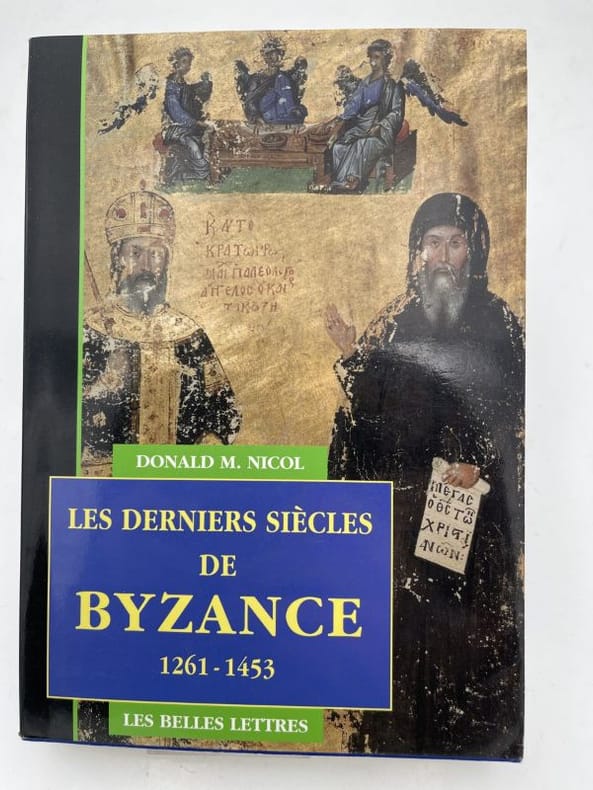
2005réf. 191827Les Belles Lettres Les Belles Lettres, 2005. In-8 broché (21,5 x 15,3 cm) de 530 pages. Sous jaquette illustrée. Collection "Histoire". Traduit de l'anglais par Hugues Defrance. Cet ouvrage constitue une synthèse de référence sur l'agonie lumineuse de l'Empire byzantin, de la reconquête de Constantinople par Michel Paléologue jusqu'à la chute finale face aux Ottomans. Donald M. Nicol y analyse avec précision les luttes intestines des grandes familles, la pression constante des puissances occidentales et l'essor de la puissance turque, tout en soulignant la vitalité culturelle et religieuse de cette période. L'appareil critique comprend des arbres généalogiques, des cartes détaillées et une bibliographie exhaustive. Devenu un classique de l'historiographie byzantine, ce titre sous sa jaquette d'origine est particulièrement recherché par les collectionneurs et les passionnés de l'Orient médiéval. Très bon état
2013New English Paperback. Pbo. 4to. (28 x 23 cm). In Turkish. 311 p. B/w photos. Artamonoff: Bizans Istanbul'u imgeleri, 1930-1947. Edited by Günder Varinlioglu. Artamonoff [Nicolas V.]: Picturing Byzantine Istanbul, 1930-1947. Nicholas V. Artamonoff left behind a photographic puzzle of over one thousand images. He was a student and engineer, who, while studying and living at Robert College in Istanbul, gained an appreciation for the city's history and culture. With his Rollei camera, he captured Byzantine remains, ntering nooks and crannies of fortifications and cisterns. He strolled through the city in the footsteps of architectural historians and archaeologists who explored and uncovered Byzantine Istanbul. his interests were broad: they ranged from imposing churches to the smallest details of architectural sculpture, from bustling marketplaces to the diligent work of lone craftsmen. The abundance of subjects es the Nicholas V. Artamonoff Collection rich and engaging, providing a glimpse into the diverse urban environment in which he lived, and into the versatile photographer he was.