VillehardouinLivre Rare Book

2 103 résultats
réf. ys1777Henri Gautier éditeur Nouvelle bibliothèque populaire Brochure In-12 (12,5 x 19 cm), brochure, 36 pages, sans date, n°469 de la Nouvelle bibliothèque populaire ; quelques petites traces sur les plats, intérieur bien conservé, bon état général. Livraison a domicile (La Poste) ou en Mondial Relay sur simple demande.
Paris, Librairie de Firmin-Didot et Cie, 1882. In-4 ; demi-chagrin rouge, dos à 4 nerfs, plat avec l'écusson du Lycée Henri IV ; faux-titre, fronstipice couleurs et page de titre imprimée en noir et rouge - XXIV pp (préface, notice sur la présente édition, note explicative de la carte, observations sur les culs-de-lampe et autres ornements), 616 pp. Texte original avec la traduction en regard. Edition ornée de lettres intiales et de bordures empruntées aux manuscrits du XIIe et du XIIIe siècle et accompagné d'une carte géographique dépliante en noir et blanc sur fond vert, dressée par Auguste Longnon et gravée par Erhard (en fin d'ouvrage). Planches hors-texte, culs-de-lampe. Bel exemplaire (sans rousseurs).
réf. 16709Paris, Librairie de Firmin-Didot et Cie, 1882. In-4 ; demi-chagrin rouge, dos à 4 nerfs, plat avec l'écusson du Lycée Henri IV ; faux-titre, fronstipice couleurs et page de titre imprimée en noir et rouge - XXIV pp (préface, notice sur la présente édition, note explicative de la carte, observations sur les culs-de-lampe et autres ornements), 616 pp.
1872réf. 6435Paris Firmin-Didot Frères 1872 in-4° Fort xxvj+511 pp, avec la continuation de Henri de Valenciennes. texte original, accompagné d'une traduction par M. Natalis de Wailly. Une carte couleur dépliante, culs-de-lampe et ornements. Dos à 5 nerfs, tête dorée. Dos passé, coins et coupes inférieures frottés, épidermures sur coiffes, nerfs et dos. Intérieur très frais
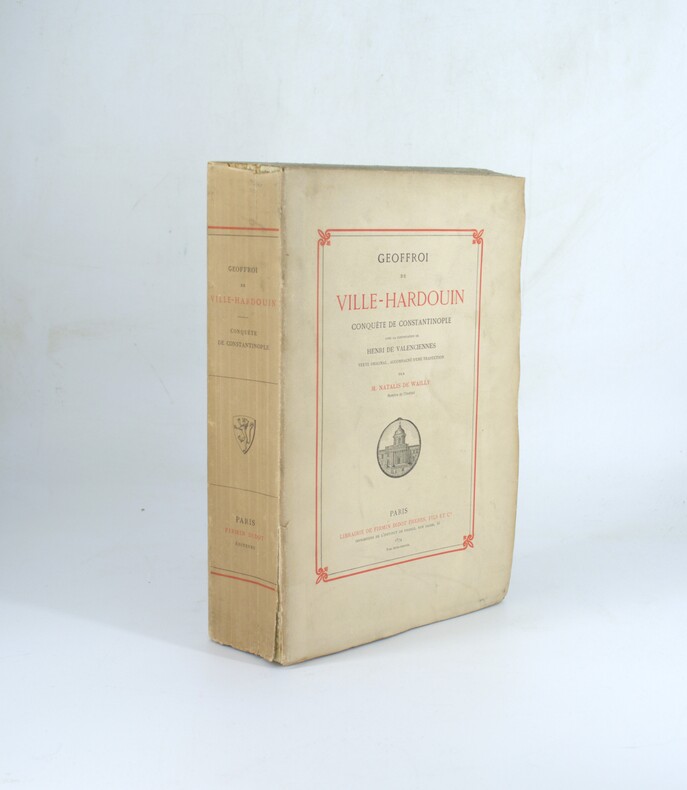
1874réf. PHO-2270Paris, Firmin Didot, 1874. In-4° de xxiv, 616 pp. Frontispice en couleur et 1 carte dépliante. Brochage éditeur. Tirage de luxe à 220 exemplaires sur papier à la forme, celui-ci n° 122. Petite déchirure au dernier plat, petite fente et léger
1790réf. 21667Constantinople, de l’Imprimerie du palais de France, mars 1790 ; in-4°, demi-veau havane, dos à faux nerfs et titre doré (reliure un peu postérieure); XXXII, 462 pp., [1]f. de Faute à corriger.
1960Very Good English Original two b/w photos of Trabzon. 16,5x12 cm. Stamp on verso by Copyright Photograph Victor Glasstone 62, Westbourne Terrace, London". Two rare photographs showing a neighborhood of Trabzon city with women and children in the street, and a Byzantine fortress behind the traditional Greek and Turkish houses of the city.
2013New English Paperback. Pbo. Demy 8vo. (21 x 14 cm). In English. 189 p., ills. Thanks for buggy ride: Memoirs of an Ottoman Jew. The intense autobiography of a cosmopolitan Jew born in Istanbul at the beginning of the 20th century, a time when people from all over the world were converging upon the city, enticed by the allure and diversity of its cultural milieu. The flavor and perfume of this vibrant metropolis pervades the account of his lively youth during which he was educated at local German and English schools. He went on to travel throughout Europe during the 1920s settling in Vienna and later in Italy. With the advent of World War II, Victor moved to London and was engaged by the British Intelligence Corps, where his undercover work took him back again to Istanbul and also to Cairo. The contrasts of these years of espionage and his fulfilling familial life as an antiques dealer in Milan are recounted in this engaging memoir in which the author's broad-minded and cultivated humanity radiates through every page. 100 copies were printed. First Edition. JUDAICA Memoirs Ottoman culture Ottoman society Social history Jewish culture Turkish Jews Constantinople / Istanbul.
1924Abundant black and white illustrations and reproductions of photos. Features: The Hunting of Gonzales - An adventure of Senor Ramon Torres, a Captain of Rurales - the famous mounted police of Mexico; Adrift on an Ice-Floe - Lieut. Commander Fitzhugh Green provides a photo-illustrated account of the amazing fashion in which a primitive Eskimo extricated himself from a predicament which would assuredly spelt death for a white man; An Englishwoman in Upper Egypt - Part II - Winifred S. Blackman's photo-illustrated account of the three winters she spent with the local people of Upper Egypt; Fraser's Price - The tale of an angered railroad engineer; The Three Angleteers - Part V (conclusion) of the trouble and adventures of three English wanderers in Constantinople and Athens; "Remember the Mortons" - A stirring story of an episode in the Matabele rebellion of 1895; Salvage Extraordinary - An Indian planter's account of an odd affair on the Brahmaputra River in Assam, including photo of five elephants pushing a stranded steamer; The Head-Hunters of Sepik - Part III - Beatrice Grimshaw explored the Sepik River of New Guinea and dealt with the local cannibals - article with photos; Where Everyone is Wealthy - The Osage Indians of Oklahoma come up with the strangest ways to divest themselves of their wealth earned from local oil - article with photos; "Grip" and I - Part III - Count Nils Cronstedt spares a condemned bull-terrier which rewards him by saving him multiple times while he served in West Africa as Commander of H.M.S. Heron and Assistant Marine Superintendant in Northern Nigeria; "Old White Face" - Allen Borders of Montana relates a terrifying cougar experience; To Afghanistan in Disguise - Part III - The story of a British officer's remarkable journey - disguised as an Oriental - across a large part of India and finally into forbidden Afghanistan and beyond, living among the natives; "Captain Jed" - a tale of the whalers of New Bedford, MA, involving the "Cap'n Jed" and the "Wanderer" - very few men have ever fought a 'right' whale single-handed and lived to tell the tale; Python and Lion in Nyassaland - after visiting a witch-doctor for poisoning the author is attacked first by a great python, then a lion!; Photo of a Manchurian man 7 feet and 3 inches tall; Photo of a veritable forest of masts at Lowestoft, the Suffolk fishing port, during the height of herring season; and more. 88 pages plus 24 pages of nice vintage ads. Clean and unmarked with light wear. A quality copy of this excellent vintage issue. Book
2015New English Paperback. Pbo. Demy 8vo. (21 x 14 cm). In English. 147 p. Secret connections in Constantinople. This book aims to demonstrate how the Italian nationalist ideas were a catalyst to the creation of national unity and freedom to the Turkish people, prompting a drive for freedom that originated from the élite and moved to the masses in a top-down manner. The conspiracy ideas particularly of Giuseppe Mazzini, one of the greatest figures in the Italian national struggle, gave strong impetus to the birth of the pre-republican Young Turks. Giuseppe Garibaldi permanence in Turkey, his contacts with the Italian Workers Society in Constantinople, his letters and deep connections with Europe disclosed the idea that, the birth of the Turkish Republic, was ideologically supported by Italian Carbonari kinds of associations. In order to illustrate this link, the book observes the role of some eminent delegates of the Italian Workers Association and the Italian Freemasonry in Istanbul/Constantinople and other provinces of the Ottoman Empire.
1851réf. 2262PARIS. LIBRAIRIE ARCHEOLOGIQUE DE VICTOR DIDRON. 1851. IN-4 (25 X 28,5 X 4 CENTIMETRES ENVIRON) DE 316 PAGES, ENTIEREMENT MONTE SUR ONGLET, RELIURE D'EPOQUE 1/2 CHAGRIN NOIR, DOS LISSE ORNE DE FILETS ET DE CAISSONS DORES, TITRE DORE. ILLUSTRE DE 20 PLANCHES HORS TEXTE SOUS SERPENTE. EDITION ORIGINALE. PETITS DEFAUTS EXTERIEURS SANS GRAVITE, SINON BON EXEMPLAIRE.
1903réf. 0056451903 Paris, Hetzel, [1903-1904]. Grand in-8 percaline rouge de l'éditeur ornée de fers spéciaux, titre dans le cartouche, tranches dorées (Engel Rel., d'après une plaque de C. Blancheland). ; (2) ff. de faux-titre (avec frontispice au verso) et titre, 410 pages. Rousseurs au feuillet de titre.
1900Very Good German Original b/w city plan. Atlas folio. (58x47 cm). In German. Folded. [CITY PLAN of BRAILA -IBRAIL-] Stadtplan von Braila. Scale (Masstab): 1/10.000. No cartographer. 33 descriptive articles on bottom-right corner of the plan. Slightly chipped at extremities of paper and soiling. It shows Braila and Donau. Braila (Turkish: Ibrail) is a city in Muntenia, eastern Romania, a port on the Danube and the capital of Braila County. There's some Ottoman manuscript including translations of the German descriptive text on the plan, and also "'Ibrail' sehir plâni" written on verso in Ottoman script. Extremely rare.
1900Very Good German Original b/w city plan. Atlas folio. (58x47 cm). In German. Folded. [CITY PLAN of BRAILA -IBRAIL-] Stadtplan von Braila. Scale (Masstab): 1/10.000. No cartographer. 33 descriptive articles on bottom-right corner of the plan. Slightly chipped at extremities of paper and soiling. It shows Braila and Donau. Braila (Turkish: Ibrail) is a city in Muntenia, eastern Romania, a port on the Danube and the capital of Braila County.
1993Fine English Paperback. Roy. 8vo. (24 x 17 cm). In Turkish. 151, [1] p., b/w ills. Isgal Istanbul'u. [= La Bosphore tant aime]. Translated by Emre Öktem. OTTOMANIA Istanbul Constantinople World War 1 Sultan Vahdettin Invasion British Frech relations Republican Turkey.
1999Fine English Paperback., Very good., 23 x 16 cm, 186 p., b/w ills. "Eski Istanbul barlari, VEFA ZAT, Iletisim Yayinlari, Istanbul, 1999" Geçen yüzyilin balozlarindan "cafe chantan"lara, elit bira bahçelerinden, 'meyhanenin alafrangasi' gazinolara, dansin, müzigin, oryantalle striptizin içkiyle bulustugu bar-pavyonlara, bir zamanlar yalnizca lüks otellerde bulabildigimiz ilk 'modern' barlardan bugün sayilari ve türleri yüzleri bulan restoran-barlara, bir sehrin "eglence" ve "içki" kültürünün renkli, canli bir panoramasi.Yakasindan kirmizi karanfili, mendil cebinden tig örgüsü krem renkli raki kilifini eksik etmeyen, tek parça buzla sogutulmus kilifli kadehinin karsisinda ceketinin dügmesini ilikleyerek adeta saygi durusunda bulunan Ümit Bey'den öglen rakilarini hiç aksatmayan Erol Simavi'ye, barmenlerin muziplik olsun diye içtigi viskinin markasini degistirdiklerini daha ilk yudumda fark eden Orhan Boran'dan, bara Istiklal Madalyasi'ni takarak gelen ünlü Türk casusu Ingiliz Kemal'e barlarin ilginç müdavimleri.Hayatinin büyük bölümünü bar tezgahlarinin kimi zaman arkasinda kimi zaman önünde ama hep yakininda geçirmis Vefa Zat, canli taniklar, hos ve ilginç anektodlar, zaman zamansa "mesleki" ciddiyetle Istanbul'un barlarini anlatiyor. Dönemin popüler kokteyl tarifleriyle tatlandirilan Eski Istanbul Barlari, Hem insanlari hizmetleriyle mutlu etmeye çalisan meslek erbablarina, hem de bar tezgahlarinin önünde içkisini yudumlayan "ehlikeyiflere"e hitap eden kitap.
2004Fine Greek, Modern (post 1453) Paperback. Small. 4to. (26 x 20 cm). In Greek. 171, [2] p., color and b/w ills. [Our trial of Cappadocia. A wandering pilgrimage]. E dikia mas Kappadokia. Ena odoiporiko proskunema. Signed and inscribed by Kekes.
1900réf. VO016Plon-Nourrit, Paris 1900. In-8o, XII-356 pp., 4 héliogravures hors-t. Envoye a Constantinople, il voyaga aussi a Chypre, Syrie et Jerusalem. Rel. 1/2 maroquin contemp., dos a nerfs.
2004lxxx + 583pp., hardcover (editor's green cloth), dustwrapper, 25cm., in the series "Orientalia Lovaniensia Analecta" volume 142, fine condition (as new), text in French (texte en français), ISBN 978-90-429-1541-2, X80283
2004réf. X80283Leuven, Peeters 2004 lxxx + 583pp., hardcover (editor's green cloth), dustwrapper, 25cm., in the series "Orientalia Lovaniensia Analecta" volume 142, fine condition (as new), text in French (texte en français), ISBN 978-90-429-1541-2, X80283
1874réf. pl1959Librairie Firmin-Didot et Cie Relié 1874 Grand in-8 (18.5x28 cm), demi-maroquin rouge à coins, auteur et titre dorés au dos à nerfs orné de dorures, tête dorée, 2e édition, (XXIV)-616-23 pages, une gravure couleurs en frontispice, texte original accompagné d'une traduction par Natalis de Wailly, préface de l'auteur, bandeaux et lettrines en début d'ouvrage, quelques illustrations noir et blanc hors-texte ; coiffes et coins frottés, nerfs un peu frottés, intérieur frais, bon état. Livraison a domicile (La Poste) ou en Mondial Relay sur simple demande.
2001Fine English Paperback., Very good., 24 x 16 cm, 227 p., b/w ills. "Sultan Abdülhamid ve Istanbul'u, VAHDETTIN ENGIN, Simurg, Istanbul, 2001"
1958Fine Turkish Paperback. Cr. 8vo. (19 x 13 cm). In Turkish. 212 p., b/w ills. Istanbul Üniversitesi Iktisat Fakültesi Gazetecilik Enstitüsü Mezunlari Cemiyeti tarihi. First and Only Edition.
1970The beginnings of modern Greek history from the Frankish conquest of Constantinople in the Fourth Crusade of 1204 to the final Turkish conquest. Comprehensive, well documented account by a distinguished Greek historian. 414p.plates. maps. bibliography. index. maps on end papers Book
1949Very Good Armenian Original half bound leather bdg. Large demy8vo. (22 x 15,5 cm). In Armenian. 675 p. Prior to Soviet rule, the Dashnaksutiun had governed the First Republic of Armenia. The Socialist Soviet Republic of Armenia was founded in 1920. Diaspora Armenians were divided about this: supporters of the nationalist Dashnaksutiun did not support the Soviet state, while supporters of the Armenian General Benevolent Union (AGBU) were more positive about the newly founded Soviet state. From 1828 with the Treaty of Turkmenchay to the October Revolution in 1917, Eastern Armenia had been part of the Russian Empire and partly confined to the borders of the Erivan Governorate. After the October Revolution, Bolshevik leader Vladimir Lenin's government announced that minorities in the empire could pursue a course of self-determination. Following the collapse of the empire, in May 1918 Armenia, and its neighbors Azerbaijan and Georgia, declared their independence from Russian rule and each established their respective republics. After the near-annihilation of the Armenians during the Armenian Genocide and the subsequent Turkish-Armenian War, the historic Armenian area in the Ottoman Empire was overrun with despair and devastation. A number of Armenians joined the advancing 11th Soviet Red Army. Afterward, Turkey and the newly proclaimed Soviet republics in the Caucasus negotiated the Treaty of Kars, in which Turkey resigned from its claims to Batumi to Georgia in exchange for the Kars territory, corresponding to the modern-day Turkish provinces of Kars, Igdir, and Ardahan. The medieval Armenian capital of Ani, as well as the cultural icon of the Armenian people Mount Ararat, were located in the ceded area. Additionally, Joseph Stalin, then acting Commissar for Nationalities, granted the areas of Nakhchivan and Nagorno-Karabakh (both of which were promised to Armenia by the Bolsheviks in 1920) to Azerbaijan. From 12 March 1922 to 5 December 1936, Armenia was a part of the Transcaucasian SFSR (TSFSR) together with the Georgian SSR and the Azerbaijan SSR. The policies of the first Soviet Armenian government, the Revolutionary Committee (Revkom), headed by young, inexperienced, and militant communists such as Sarkis Kasyan and Avis Nurijanyan, were implemented in a highhanded manner and did not take into consideration the poor conditions of the republic and the general weariness of the people after years of conflict and civil strife. Such was the degree and scale of the requisitioning and terror imposed by the local Cheka that in February 1921 the Armenians, led by former leaders of the republic, rose up in revolt and briefly unseated the communists in Yerevan. The Red Army, which was campaigning in Georgia at the time, returned to suppress the revolt and drove its leaders out of Armenia. Convinced that these heavy-handed tactics were the source of the alienation of the native population to Soviet rule, in 1921 Moscow appointed an experienced administrator, Alexander Miasnikian, to carry out a more moderate policy and one better attuned to Armenian sensibilities. With the introduction of the New Economic Policy (NEP), Armenians began to enjoy a period of relative stability. Life under the Soviet rule proved to be a soothing balm in contrast to the turbulent final years of the Ottoman Empire. The Armenians received medicine, food, as well as other provisions from the central government and extensive literacy reforms were carried [.] Only one copy is located in OCLC: 782028953 (National Library of Israel - Jewish National Library).