2 090 résultats
1998Fine Turkish Paperback. Cr. 8vo. (20 x 14 cm). In Turkish. 287 p., ills. Bizans'ta günlük yasam: Konstantinopolis Bizans'in mücevheri. [= Everyday life in Byantium]. Translated by Bilgi Altinok. Ills. by Helen Nixon Fairfield.
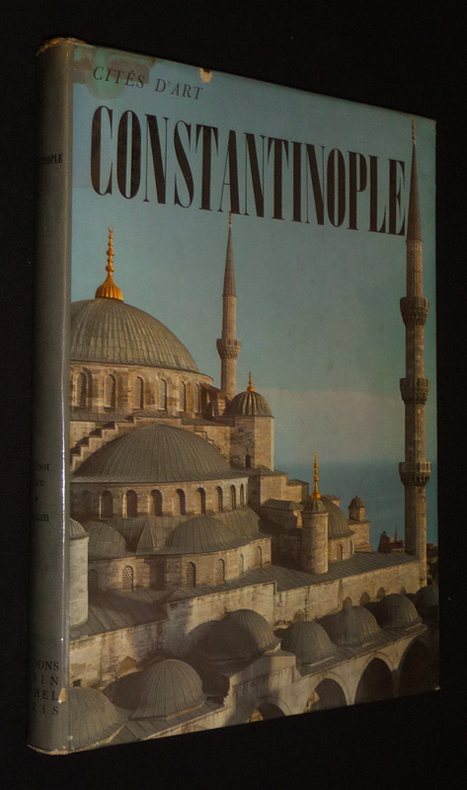
1965réf. mz810Albin Michel Cités d'art Cartonné avec jaquette 1965 In-4 (21 x 28 cm), cartonné avec jaquette, 213 pages ; mouillure sur l'envers de la jaquette (visible au dos en tête et sur l'envers), petites déchirures sur le bord supérieur de la jaquette, assez bon état général. Livraison a domicile (La Poste) ou en Mondial Relay sur simple demande.
1839Very Good Turkish, Ottoman (1500-1928) Original newspaper taken from a volume. Folio. (42,5 x 28 cm). In Ottoman script (Old Turkish with Arabic letters). [5] p. Extremely rare early issue of this first official newspaper of the Ottoman Empire after the proclamation of Reform (Tanzîmât) in 1839, informed Daguerre's new and weird invention ("photography" as it would be called in the 1850s) to the Ottoman peoples and readers. The article reads: "It is the talk of the town, steam engines have been able to run on rails in factories in recent years. Meanwhile, a man carefully focused on his thoughts so much and the craft turned into a strange art, and finally, a coquettish mirror (surface) appeared. This skillful Frenchman named Daguerre drew the lines of objects by reflecting the sunlight with the methods of the different science of art he learned, drew the contours of the objects, and gave 20 years secretly and openly to the formation of this strange art. Finally, he reached the goal and this event won the appreciation and admiration of everyone. This is to say, the image of the object, in the form of a large or small box free from light, is pictured inside by passing through the glass in front of it. In order for the reflected picture to be captured on a surface, some chemicals must be prepared. Daguerre has achieved this mix based on his experience. This substance applied on the plate is called iodine. After the plate is kept in the vapor of the iodine for a few minutes, it is immediately placed in the dark box, and the image passing through the window of the box is pictured for five minutes. Considering that some of the things that should be hidden are captured like this, it will be understood what a valuable invention this is...". In the continuation of the article, it is written that an Englishman named Talbot (Henry Fox Talbot) found the same thing with almost the same processes (!), but Daguerre had taken pictures before. Takvim-i Vekâyi was the first fully Turkish-language newspaper. It was launched in 1831 by Sultan Mahmud II, taking over from the Moniteur ottoman as the Official Gazette of the Ottoman Empire. With the beginning of the Tanzimat reform period, Takvim-i Vekayi produced versions in multiple language editions. It ceased publication in 1878, resuming in 1891-2, before being closed again. It resumed in 1908 until around 1922. In the 1831-1878 period it published a total of 2119 issues - an average of slightly less than one a week.
2015New English Paperback. Pbo. 4to. (30 x 22 cm). In Turkish. 90 p., ills. Istanbul camileri I-II. First edition in 1962. Mosques of Istanbul. 2 volumes in 1.
1942Very Good English Modern cloth bdg. 4to. (29 x 21 cm). In Turkish. Offprint. 209 - 212 pp., 9 b/w plates. Architectural ornamental characters of Sultanahmet Mosque. Sultanahmed Camiinin tezyini hususiyetleri.
1953Very Good Turkish Original bdg. Folio. (35 x 25 cm). In Turkish. [viii], 38 p., 68 plates. Topkapi Sarayinda Fatih Sultan Mehmet II'ye ait eserler.
1946Very Good Turkish Paperback. Cr. 8vo. (20 x 14 cm). In Turkish. 126, [2] p. Türk topçulugu ve kaynaklari (Nizamiceditten evvel ve sonra). First Edition. Rare. History of Turkish / Ottoman gunnery and its sources.
2017New Turkish Original bdg. HC. 4to. In Turkish with Ottoman documents. 1140 p., with CD. Osmanli yer adlari. [= Ottoman names of places]. A study on Ottoman onomastics.
1943Fine German Paperback. Roy. 8vo. (23 x 16 cm). Preface in German and Turkish, text in Turkish. [xv], [1], 60 sayfa. Extremely rare. First and Only Edition. Çalgili kahvelerdeki külhanbey edebiyati ve nümuneleri.= Moritaten und Vierzeiler türkischer Plattenbrüder. Prep. by Robert Anhegger - Walter Ruben - Andreas Tietze. ISTANBUL Constantinople Social life Turkish literature Turkish folklore Ottoman society.
1920Very Good Swedish Paperback. Roy. 8vo. (24 x 17 cm). In Swedish. 196-203 pp. Ett Svenskt forskningsinstitut I Konstantinopel. [Separatum -Ur Ymer- Tidskrift Utgiven av Svenska Sallskapet för Antropologi och Geografi Arg. 1920, H. 2-3. A Swedish research institute in Constantinople.
2005As New English Paperback. Pbo. Mint. Cr. 8vo. (20 x 14 cm). In Turkish. 232 p. Patriarchate history in Turkey. Baslangiçtan günümüze patrikhane dosyasi.
2013New English Original bdg. HC. 4to. (29 x 22 cm). In Turkish. With a CD. 311, [9] p. Many b/w ills. Arif Sentürk. Kumanova'dan Zeytinburnu'na bir Rumeli delikanlisi. Sözlü tarih çalismasi. With CD. Musical scoers by Mithat Arisoy.
1923Very Good English Paperback. Pbo. Cr. 8vo. (19 x 13 cm). In Ottoman script. 101, [1] p., 1 b/w plate. Nasrüddin Sah ve Babiler. A study on Nasiruddin Shah, (1831-1896), was the King of Persia from 17 September 1848 to 1 May 1896 when he was assassinated. He was the son of Mohammad Shah Qajar and Malek Jahan Khanom and the third longest reigning monarch in Persian history after Shapur II of the Sassanid dynasty and Tahmasp I of the Safavid Dynasty. Nasser al-Din Shah had sovereign power for close to 50 years and was also the first Persian monarch to ever write and publish his diaries. Naser al-Din was in Tabriz from Qajars tribe when he heard of his father's death in 1848, and he ascended to the Sun Throne with the help of Amir Kabir. Naser al-Din had early reformist tendencies, but was dictatorial in his style of government. With his sanction, some Babis were killed after an attempt on his life. This treatment continued under his prime minister Amir Kabir, who even ordered the execution of the Báb - regarded as a manifestation of God to Bábí's and Bahá'ís, and to historians as the founder of the Bábí religion. Unable to regain territory lost to Russia in the early 19th century, Naser al-Din sought compensation by seizing Herat, Afghanistan, in 1856. Great Britain regarded the move as a threat to British India and declared war on Persia, forcing the return of Herat as well as Persia recognition of the kingdom of Afghanistan.
1985Very Good English Paperback. Pbo. Cr. 8vo. (20 x 14 cm). In Turkish. 72 p. Süleymaniye Camii. Yapilisi ve özellikleri. Turkish Edition of 'Süleymaniye Mosque. Its contruction and charasterictics'.
1995Very Good English Paperback. Pbo. Cr. 8vo. (20 x 14 cm). In Turkish. 32, [14] p., color plts. Süleymaniye Mosque. Its contruction and charasterictics.
2009New English Original bdg. Hc. 4to. Fully color ills. 204 p. In Turkish. Mosques of Beshiktas (Istanbul). Geçmisten günümüze, dünden bugüne Besiktas camileri. Edited by Hadi Esenboga.
2011New New English Istanbul'un kitabi. Fatih vol 1., Suleyman Faruk Goncuoglu, Fatih belediye baskanligi, Ist., 2011. Mint. Original bdg with dust wrapper. 4to. (32 x 25 cm.). 569, [1] p. B/w and color ills. In Turkish. A heavy volume. Istanbul's history, Fatih. Istanbul'un kitabi: Fatih. Vol 1.
2012New English Original bdg. 4to. (32 x 23 cm). In Turkish. Many b/w and color ills. 296 p. Denizcilerin karargâhi Kasimpasa. [= Sailors' headquarters: Kasimpasha]. "Kasimpasa is one of the oldest residential areas in Istanbul with a strong naval tradition. The ships of Sultan Mehmed II sailed into the Golden Horn from the quarter. After the Fall of Constantinople Kasimpasa flourished. By the 16th century it contained the principal dockyards of the Ottoman Empire, home to 120 ships. As the Empire declined, the yard became neglected. By the 19th century the Ottoman fleet was ineffective as a military power, and much of the neighbourhood was destroyed by fire. Today, the old arsenal is a repair dock serving cargo ships, ferries and a small shipping line. The Turkish Naval High School was founded in 1773 to teach geometry and navigation to naval and civilian merchant captains on board a galleon anchored at Kasimpasa. The Turkish Naval Academy was housed in Kasimpasa from 1838 to 1850. Following the Armistice of Mudanya, the former Ottoman Ministry of the Navy (Bahriye Nazirligi) building in Kasimpasa became the headquarters of the Istanbul Naval Command on 14 November 1922. During the riots of 1955, Greek dwellings in Kasimpasa were attacked and looted. (From Wikipedia)". OTTOMANIA Istanbul Constantinople Military history Navigation Urban history.
2003Fine English Paperback. Pbo. Roy. 8vo. (23 x 16 cm). In Turkish. [xiv], 282 p. Istanbul Ermeni okullari. Armenian schools in Istanbul (Constantinople).
2016New English Original cloth bdg. In publisher's special box. 4to. (28 x 21 cm). In Turkish. 2 volumes set: (1621 p.), color ills. Historical tombstones of Zeytinburnu. Full inventory of tombstones with translations of their calligraphic inscriptions. Zamani asan taslar: Zeytinburnu'nun tarihî mezar taslari. 2 books set in special box. Enlarged Second Edition.
2012New New English Paperback. Pbo. Dust wrapper. Roy. 8vo. (24 x 16 cm). In Turkish. 180, [7] p. Ills. 100 important calligraphers from Istanbul. Istanbul'un 100 hattati. Edited by Esra Erkal, Ömer Osmanoglu.
2011New English Paperback. Pbo. Demy 8vo. (23 x 14 cm). Mint. 96 p., 43 b/w and color ills., 2 maps (1 folding). In Turkish. Seyyâh-i Âlem Evliya Çelebi.
2014New English Paperback. Pbo. Roy. 8vo. (24 x 16 cm). In Turkish. 434 p., color and b/w ills. Oral history transcripts with the residents of the Kagithane district of Istanbul. Sözlü tarih görüsmeleriyle Kagithane. Kimler geldi, kimler geçti.
1999New English Paperback. Oblong 4to. (31 x 31,5 cm). In English. [xx], [2], [1] p., 99 color plts. 'A treatise on roses' presents a selection of 99 rose drawings gathered from old Turkish manuscripts, book bindings, ornaments on plaster, stone and wood, tiles and various other sources dating from the middle of sixteenth century to the end of nineteenth century.'.
réf. wx389Sébah & Joaillier Cartonné In-4 (36,5 x 31,5 cm), format à l'italienne, dos en cuir, percaline chagrinée sur les plats biseautés, titre et décor doré (tour de Galata et tour de Léandre) au premier plat dont les bords sont biseautés, croissant de lune et étoile entourés de lauriers dorés au quatrième plat, sans date (circa 1888), 10 photographies sur papier albuminé, montées à la manière d'un leporello sur des panneaux en carton fort de 34 x 30,5 cm reliés par un morceau de toile pour former un panorama d'Istanbul d'environ 3,47 mètres de long ; mors légèrement fendus en queue, quelques épidermures sur le cuir au dos et sur les bords du premier plat, quelques traces sur les plats, zones décolorées au quatrième plat dont le cartonnage est un peu incurvé, par ailleurs assez bel exemplaire. Livraison a domicile (La Poste) ou en Mondial Relay sur simple demande.