2 103 résultats
1996Fine English Paperback. Roy. 8vo. (24 x 17 cm). In English. 202 p., b/w ills. Post peripheral flux. A decade of contemporary art in Istanbul. History of contemporary art and exhibitions in Istanbul.
réf. GF20747Eau-forte originale en couleurs (coloris d'époque) - Format 26 x 17 cm environ - vers 1845 - Avec une Notice biographique de 10 pages (en feuilles) par T. HADOT-
2006Fine English Paperback. Pbo. Roy. 8vo. (23 x 16 cm). In Turkish. 77, ills., [42] b/w and color plts. Polonezköyü. Translated to Turkish by Yesim Santepe.
2014New New English Original bdg. Dust wrapper. 4to. (30 x 29 cm). In English. 204 p., ills. Polonezköy: The eagle under the crescent and star. The culture array of Polonezköy expanding from Nazim Hikmet to Gencer, from Franz Liszt to Atatürk, from Gustave Flaubert to Pierre Loti, from Chopin to Czeslaw Milosz, from music to literature- is exposed by the book and photographs of the artist Akgün Akova. Artist Akgün Akova has got over five thousand photographs depicting Turkey and over four hundred articles about the country that appeared in magazines like Voyager, Skylife and National Geographic etc. The book titled 'The Eagle beneath the Crescent and Star: Polonezköy' by Akgün Akova aims at showing the meaning and importance of a tiny village in Istanbul that serves European culture and world peace. Founded in 1842 in Beykoz, Istanbul, the village Polonezköy established a strong bond between Turkey and Poland. This project is about a book and a photograph exhibition to be held in Istanbul and in Warsaw to tell about artists that relate to Polonezköy along with their stories. Within the scope of this project, Polonezköy will be told as a symbol of peace, friendship and fraternity between the peoples of Turkey and Poland all through a wide array of names such as Nazim Hikmet, Leyla Gencer, Franz Liszt, Atatürk, Gustave Flaubert, Pierre Loti, Chopin and Czeslaw Milosz. The story of Polish originated people living in Polonezköy will be examined through history, poetry, literature, music, photography and other lines of art.
2010New New English Original bdg. Dust wrapper. Oblong 4to. (29 x 30 cm). In English. 204 p., ills. Polonezköy: The eagle under the crescent and star. The culture array of Polonezköy expanding from Nazim Hikmet to Gencer, from Franz Liszt to Atatürk, from Gustave Flaubert to Pierre Loti, from Chopin to Czeslaw Milosz, from music to literature- is exposed by the book and photographs of the artist Akgün Akova. Artist Akgün Akova has got over five thousand photographs depicting Turkey and over four hundred articles about the country that appeared in magazines like Voyager, Skylife and National Geographic etc. The book titled 'The Eagle beneath the Crescent and Star: Polonezköy' by Akgün Akova aims at showing the meaning and importance of a tiny village in Istanbul that serves European culture and world peace. Founded in 1842 in Beykoz, Istanbul, the village Polonezköy established a strong bond between Turkey and Poland. This project is about a book and a photograph exhibition to be held in Istanbul and in Warsaw to tell about artists that relate to Polonezköy along with their stories. Within the scope of this project, Polonezköy will be told as a symbol of peace, friendship and fraternity between the peoples of Turkey and Poland all through a wide array of names such as Nazim Hikmet, Leyla Gencer, Franz Liszt, Atatürk, Gustave Flaubert, Pierre Loti, Chopin and Czeslaw Milosz. The story of Polish originated people living in Polonezköy will be examined through history, poetry, literature, music, photography and other lines of art.
2014New New English Original bdg. Dust wrapper. 4to. (30 x 29 cm). In Polish. 204 p., ills. Polonezköy: The eagle under the crescent and star. The culture array of Polonezköy expanding from Nazim Hikmet to Gencer, from Franz Liszt to Atatürk, from Gustave Flaubert to Pierre Loti, from Chopin to Czeslaw Milosz, from music to literature- is exposed by the book and photographs of the artist Akgün Akova. Artist Akgün Akova has got over five thousand photographs depicting Turkey and over four hundred articles about the country that appeared in magazines like Voyager, Skylife and National Geographic etc. The book titled 'The Eagle beneath the Crescent and Star: Polonezköy' by Akgün Akova aims at showing the meaning and importance of a tiny village in Istanbul that serves European culture and world peace. Founded in 1842 in Beykoz, Istanbul, the village Polonezköy established a strong bond between Turkey and Poland. This project is about a book and a photograph exhibition to be held in Istanbul and in Warsaw to tell about artists that relate to Polonezköy along with their stories. Within the scope of this project, Polonezköy will be told as a symbol of peace, friendship and fraternity between the peoples of Turkey and Poland all through a wide array of names such as Nazim Hikmet, Leyla Gencer, Franz Liszt, Atatürk, Gustave Flaubert, Pierre Loti, Chopin and Czeslaw Milosz. The story of Polish originated people living in Polonezköy will be examined through history, poetry, literature, music, photography and other lines of art.
2019New English Paperback. Demy 8vo. (21 x 14 cm). In English. 512 p. Political representation of minorities in Greece and Turkey: Nationalism, reciprocity and Europeanization. What influences the political representation of minorities? Does a non-core group pursue a certain pattern of collective political behavior, or does it have the ability to alter it through struggle with other groups by calculating the existing opportunities and restrictions? This book addresses these important questions by focusing on the history of political representation of the Muslim-Turkish minority in Greece and the Greek-Orthodox minority in Turkey, two communities whose rights are linked to each other via the "reciprocity principle" written in the Lausanne Treaty, signed by two countries that have long-lasting conflicts. Drawing on presentation of related political history, systematic coding of parliamentary debates and works, minority and mainstream newspapers, and elite interviews, the author analyzes and explains ignored linkages between institutions, bilateral relations between Greece and Turkey, and the role of external factors that enable or constrain minority communities access to political life. This study which adopts a historical institutionalism approach and, by integrating theory of both comparative politics and international relations, shows how the minority groups political participation and the effectiveness of their representation has been determined by the triangle of the two states choice of nationalism, reciprocity and Europeanization policies, mainly argues that internal factors such as groups capability for competition and institutional features of the political system in the host-state mostly override states bilateral relations with the kin-state and international factors. As a result, for the Greek and Turkish case, the host-states generally pursue the policy of state-controlled involvement of their minorities in the political life, where the existence of the threatening kin-state and minority groups strong demographic features lead to avoidance of full assimilation and exclusion from political representation.
Very Good English Paperback. Pbo. Large Cr. 8vo. (19.5 x 13.5 cm). In French. 233, [7] p., b/w plts. Plaisir d'Istanbul. Ills. by Bedri Rahmi Eyüboglu.
2018New German Paperback. Demy 8vo. (21 x 14 cm). In German, Latin and Turkish. 251 p., ills. Pius 2: Papa epistola ad Mahumetem.= Papa 2: Pius'un Fatih Sultan Mehmet'e mektubu. [With German, Turkish and Latin texts].
2017Fine French Original bdg. HC. 4to. In French and Turkish. 168 p., ills. Pierre Loti et les silhouettes de Hassan: Portraits avant La II. Constitution.= Pierre Loti ve Hasan silüetleri: II. Mesrutiyet öncesi portreler. The novelist Julien Viaud, famous for his nickname Pierre Loti, is a traveling maritime officer. At the end of the 19th century and the beginning of the 20th century, he makes seven trips to Istanbul. In 1903, at the age of 53, Pierre Loti takes over Le Vautour, the first station ship to the French Embassy in Istanbul, during his fifth trip to Turkey. In the same period, Hasan signed cartoons start to circulate in Istanbul.The person who is hiding under Hasan is actually Robert de Guiroye, a naval officer. This person was then assigned to the auxiliary ship "La Mouette" (Seagull) under the command of Pierre Loti. It is thought that this officer made drawings on this ship in the evening after having spent a long time in important social clubs such as Cercle d'Orient, Pera Palas Ballroom, Tepebasi Theater. Who is actually Hasan / Who is the real Hasan? The answer to this problem is in the exhibition and detailed catalog. Let's see if they can help bring Hasan's identity to light. The "Pierre Loti and Hasan Silhouettes" exhibition is made up of documents obtained as a result of years of research by numerous collections and valuable collector Sayen Erol Makzume, who has vast knowledge of Hasan's lithographs in the early 20th century. The exhibition contains texts, cartoons and in-depth information, and sheds light on the transition period of Turkey after the Second Constitutional Monarchy.
2018New English Paperback. 4to. (28 x 23 cm). In English and Turkish. 223 p., b/w and color ills. Picturing a lost empire: An Italian lens on Byzantine art in Anatolia, 1960-2000.= Yitik imparatorlugu resmetmek: Italyan merceginden Anadolu'daki Bizans sanati, 1960-2000. The editors of the book are Livia Bevilacqua and Giovanni Gasbarri, researchers from Sapienza University, who are also the curators of the exhibition. Besides Bevilacqua's and Gasbarri's contribution, the book features articles by prominent Byzantine art historians Engin Akyürek, Claudia Barsanti, Alessandra Guiglia, Antonio Iacobini, Andrea Paribeni, Lorenzo Riccardi and Enrico Zanini. It focuses on the travels in Istanbul and Anatolia undertaken by Italian historians of Byzantine art during 1960-2000.
2013New English Paperback. Pbo. 4to. (28 x 20 cm). In English. 356 p. B/w and color ills. "Photography in the Ottoman Empire 1839-1923 provides an account of the history of photography in the Ottoman Empire between the years 1839-1923, an important though neglected field in the history of an early photography. The sultans of the Ottoman Empire traditionally shaped the arts of their day, and their enthusiastic reaction to the discovery of photography was to be crucial in the development of photography in the Empire. This third edition of the book published by YEM Publications has been updated and enlarged to incorporate new information gathered over the years and many new photographs that have been added to my archive. I have made sure that the revised text comprises the latest information available on the subject. Many nation states were created in the former Ottoman territories in Europe, Asia and Africa. I have not included the individual photographic histories of these countries but endeavoured to focus primarily on photography within the present boundaries of the Republic of Turkey. A list of photographers who worked in the Ottoman Empire has been provided to assist all those who are interested in the history of photography in Turkey and the Middle East. The names of photographers that I have come across in documents written in Ottoman Turkish script have been given as spelt. The first two editions treated the story of photography in the Ottoman Empire from the announcement of its discovery in 1839 up to 1919, but this new edition has been extended up to the year 1923 when the Turkish Republic was founded. Researching the history of photography is an unending task requiring a lifetime's dedication."
1995Very Good Very Good English Original bdg. Dust wrapper. 4to. (34 x 24 cm). In English and Turkish. 271 p., b/w ills. Photography in the Ottoman Empire (1839-1919).= Osmanli Imparatorlugu'nda fotografçilik (1839-1919). Photography in the Ottoman Empire provides an account of the history of photography in the Ottoman Empire between the years 1839-1919, an important though neclected field in the history of an early photography. The sultans of the Ottoman Empire traditionally shaped the arts of their day. Their enthusiastic reaction to the discovery of photography was to be crucial to the development of photography in the Empire. First Edition.
1989Fine English Paperback. Pbo. 4to. (30 x 21 cm). In English and Turkish. 155 p., b/w ills. Photographer Ali Sami, 1866-1936.= Fotografçi Ali Sami, 1866-1936. "Ali Sami (Aközer) is born in Rusçuk in 1866, and moves to Istanbul. Because his family is registered in the Beylerbeyi quarter of Üsküdar, Ali Sami is also called Üsküdarli Ali Sami. He graduates from the Mühendishane-i Berri-i Hümayun in 1866 and becomes a teacher of painting and photography at the school. He is employed in the Ottoman army, and he is also a teacher of phography at the palace and for many years gives lessons to Prince Burhaneddin Efendi. In 1889 he becomes an aide to Abdülhamid II. As a military photographer, he is assigned by Abdülhamid II to accompany German Emperor Wilhelm II during his visit to the Ottoman Empire when he travels from Istanbul to Jerusalem in 1898, and presents an album of this journey to the sultan. After the constitutional monarchy is proclaimed, he becomes a painting teacher at Trabzon High School, and passes away in 1936 in Istanbul". (Source: From Konstantiniyye to Istanbul: Photographs of the Anatolian shore of the Bosphorus from the mid XIXth century to XXth century). Contents: - The World Discovers Photography - Turkish Art and the Effect of the Industrial Revolution on the Ottoman Empire - Photography in the Ottoman Empire - The Imperial School of Engineers - Ali Sami Bey - Album - Captions to Photographs.
1897réf. 237507Constantinople 1897. 10 x 7-3/4 inches. Mounted. Slightly faded. 10 x 7-3/4 inches. Photo/Wh/2/up unknown books
1897réf. 237507Constantinople 1897. 10 x 7-3/4 inches. Mounted. Slightly faded. 10 x 7-3/4 inches. Photo/Wh/2/up unknown
1823réf. 30930C. H. F. Hartmann. Good with no dust jacket. Hardcover. Books rebound in brown marbled boards. Gilt bands and lettering to spines. Ex-library copy with usual stamps. Spines has some edgewear with colour flecking off in places. Corners edgeworn. Some foxing. Ink initials to inner covers.; V1: XII 316 pp. ; V2: 317-750; 2 Volumes in 1 COMPLETE; 1-2; 750 pages . 1823. C. H. F. Hartmann hardcover
1651réf. 21700London: Robert Daniel 1651. First edition. leather_bound. Contemporary Cambridge style full brown calf lacking spine label. Very good. 393 pages plus 5 leaves: Index Rerum & Verborum & Index Scripturarum. 32 x 21 cm. Translated and edited by Richard Montague. Parallel text in Latin and Greek. He is recognized in the Eastern Orthodox Church as St. Photios the Great viewed as the most important intellectual of his time - "the leading light of the ninth-century renaissance" and a central figure in both the conversion of the Slavs to Christianity. Considered by some scholars as only one of many Byzantine scholars of Armenian descent. Text generally clean and fresh. Armorial bookplate hinges cracked but firm woodcut device on title leaf Ddd browned minor marginal worming not affecting text errata. Lacks first blank free endpaper. BRUNET Vol. IV p.623. WING P2136. Robert Daniel unknown books
1651réf. 21700London: Robert Daniel 1651. First edition. leather_bound. Contemporary Cambridge style full brown calf lacking spine label. Very good. 393 pages plus 5 leaves: Index Rerum & Verborum & Index Scripturarum. 32 x 21 cm. Translated and edited by Richard Montague. Parallel text in Latin and Greek. He is recognized in the Eastern Orthodox Church as St. Photios the Great viewed as the most important intellectual of his time - "the leading light of the ninth-century renaissance" and a central figure in both the conversion of the Slavs to Christianity. Considered by some scholars as only one of many Byzantine scholars of Armenian descent. Text generally clean and fresh. Armorial bookplate hinges cracked but firm woodcut device on title leaf Ddd browned minor marginal worming not affecting text errata. Lacks first blank free endpaper. BRUNET Vol. IV p.623. WING P2136. Robert Daniel unknown
1985réf. 45063B. G. Teubner. Very Good with no dust jacket. Hardcover. Scholar's name to ffep A. R. Littlewood. Foxing/dustsoiling to top of textblock.; Bibliotheca Scriptorum Graecorum Et Romanorum Teubneriana TEUBNER; 3; 182 pages . 1985. B. G. Teubner hardcover
1984réf. 45062B. G. Teubner. Very Good with no dust jacket. Hardcover. Scholar's name to ffep A. R. Littlewood. Light Foxing/dustsoiling to top of textblock.; Bibliotheca Scriptorum Graecorum Et Romanorum Teubneriana TEUBNER; 2; 253 pages . 1984. B. G. Teubner hardcover
1986réf. 45064B. G. Teubner. Very Good with no dust jacket. Hardcover. Scholar's name to ffep A. R. Littlewood. Foxing/dustsoiling to top of textblock.; Bibliotheca Scriptorum Graecorum Et Romanorum Teubneriana TEUBNER; 4; 190 pages . 1986. 3322002772 . B. G. Teubner hardcover
1983réf. 45061B. G. Teubner. Very Good with no dust jacket. Hardcover. Scholar's name to ffep A. R. Littlewood. Light Foxing/dustsoiling to top of textblock.; Bibliotheca Scriptorum Graecorum Et Romanorum Teubneriana TEUBNER; 1; 197 pages . 1983. B. G. Teubner hardcover
1986réf. 45065B. G. Teubner. Very Good with no dust jacket. Hardcover. Scholar's name to ffep A. R. Littlewood. Foxing/dustsoiling to top of textblock.; Bibliotheca Scriptorum Graecorum Et Romanorum Teubneriana TEUBNER; 5; 265 pages . 1986. 3322003337 . B. G. Teubner hardcover
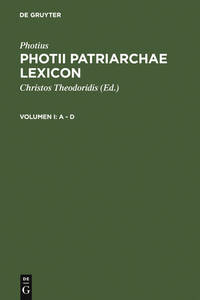
1982réf. 15850Walter De Gruyter & Co. . Very Good with no dust jacket. Hardcover. Scholars' bookplate to inner cover. Slight spine slant. Very minor shelfwear.; Volume 1 Only.; 1; 461 pages . 1982. 3110085305 . Walter De Gruyter & Co. hardcover