336 Ergebnisse
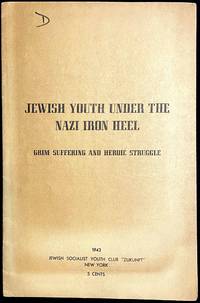
1942Best.-Nr. 43351New York: Jewish Socialist Youth Club 1942. Paper Wrappers. Illustrated by 2 Facimilie Illustrations. 1st edition Original Paper Wrappers 8vo 16 pages another variant we have seen has 15 pages. From the year before the Warsaw Ghetto Uprising an early 1942 report by the American branch of the Bund on Jewish resistance by young people in Eastern Europe. "Hand in hand with the underground organizations of the General Jewish Labor Union and in contact with the organization of the Polish socialists the Youth Union 'Zukunfst' conducts an untiring and ramified activity which is preparing the ground for the open struggle of tomorrow against Hitlerism" p. 13. "Tsukunft or Cukunft or Zukunft Yiddish for future was the youth organization of the General Jewish Labor Union or Bund. It was founded in 1910 and in 1916 it was officially called Yugnt-Bund Tsukunft. Their newspaper was the Yugnt veker. In 1922 the organization changed its name to Yugnt-bund "Tsukunft" in poyln 'Youth Bund "Tsukunft" in Poland'.At the time of the sixth Tsukunft conference in 1936 the last before the outbreak of the Second World War the organization counted with 184 local groups. On the eve of the Second World War the organization had 15000 members. The Tsukunft took part in the Warsaw ghetto uprising as part of the Jewish Fighting Organization" Wikipedia. SUBJECTS: Jewish youth -- Poland. Holocaust Jewish 1939-1945 -- Jewish resistance. World War 1939-1945 -- Atrocities. OCLC: 6871875. Covers toning with pen notation to cover otherwise Very Good Condition B Holo2-139-22A-XAECC-'l. Jewish Socialist Youth Club unknown
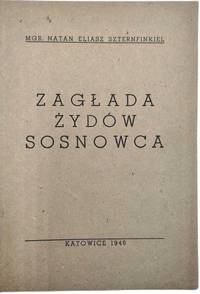
1946Best.-Nr. 43546Katowice: Centralna Zydowska Komisja Historyczna 1946. 1st edition. Original printed paper wrappers 8vo 80 pages. Includes seven photos and fold out map of the Ghetto in Bedzin and Sosnowiec. In Polish. Title translates as "The Extermination of the Jews of Sosnowiec." From the series "Wydawnictwa Centralnej Zydowskiej Komisji Historycznej w Polsce" Nr. 25. Wiener Library I: 1352. Published under the Kolegium Redakcyjne with leadership from Filip Friedman & Jozef Wulf among others. "The Sosnowiec Ghetto German: Ghetto von Sosnowitz was a World War II ghetto set up by Nazi German authorities for Polish Jews in the Srodula district of Sosnowiec in the Province of Upper Silesia. During the Holocaust in occupied Poland most inmates estimated at over 35000 Jewish men women and children were deported to Auschwitz death camp aboard Holocaust trains following roundups lasting from June until August 1943. The ghetto was liquidated during an uprising a final act of defiance of its Underground Jewish Combat Organization ZOB made up of youth. Most of the Jewish fighters perished. Before the war there were about 30000 Jews in Sosnowiec making up about 20% of the town's population. Over the next two years the Germans resettled thousands of Jews from smaller towns to Sosnowiec temporarily increasing the size of the local Jewish community to 45000. By late 1942 Bedzin and nearby Sosnowiec which bordered Bedzin became the only two cities in the Zaglebie Dabrowskie region that were still inhabited by Jews. The city located on the pre-war Polish-German border was taken over by the Germans on the first day of the invasion of Poland. Arrests and beatings among more prominent Jews began the next morning. On 9 September 1939 the Great Synagogue in Sosnowiec was burned. Local Jews were being evicted from better homes and terrorized on the streets. Jewish businesses were plundered by individual soldiers and closed by the Nazis pending confiscation proceedings. Shootings and first mass executions followed soon afterwards. Forced relocations into crowded tenements slowly created a ghetto. Judenrat and the Jewish police were soon established on German orders; the head of the Sosnowiec Judenrat was Moshe Merin Mojzesz Merin in Polish. Food rationing was introduced. The Jews were prohibited from buying anything outside their own community. In the first months of 1940 the Zentrale der Jüdischen Ältestenräte in Oberschlesien Central Office of the Jewish Councils of Elders in Upper Silesia headed by Merin was created in Sosnowiec representing about 45 communities. For a time Merin became infamous as the dictator of the Jews of the Zaglebie region with the power of life and death over local Jews. A labour camp was established for the Jews deported to Sosnowiec from Czechoslovakia to work at the factory of the Shine brothers. Numerous forced labour facilities were established for the locals; making uniforms underwear corsets bags leather handbags and military boots. In 1940 some 2592 German war profiteers arrived in the city. By 1942 their number rose to 10749 settlers constituting 10% of the general population. Ever since the ghetto was established numerous deportation actions were organized by the Germans with the help of the Judenrat and Merin selecting healthy men for slave labor at the camps. Large transfers of Jews took part in May 1500 and June 1942 2000. Around October 1942 - January 1943 the ghetto was moved to the Srodula district. Srodula also bordered the site of the Bedzin Ghetto. At this point about 13000 Jews still lived in Sosnowiec. The creation of the Sosnowiec ghetto ended on 10 March 1943 when it was finally closed off from the outside world. Thousands of Jews were deported from Sosnowiec to Auschwitz in June 1943 during the major deportation action extending to nearby Bedzin. The ghetto was liquidated two months later in August whereas almost all remaining Jews were also deported to Auschwitz. A few hundred Jews remained in the Srodula ghetto which was liquidated in January 1944. Frumka Plotnicka age 29 led the uprising in the Bedzin Ghetto adjacent to SosnowiecThere had been considerable underground activity among the Jews in Sosnowiec and Bedzin Ghetto nearby organized by the youth organizations Ha-No'ar ha-Ziyyoni Gordonia and Ha-Shomer ha-Za'ir. During the final major deportation push in August 1943 the Jewish Combat Organization Polish: Zydowska Organizacja Bojowa ZOB in Bedzin and Sosnowiec staged an uprising against the Germans. The uprising which began on 3 August 1943 was led by Cwi Tzvi Brandes Frumka Plotnicka and the Kozuch brothers. It was the final act of defiance of the local population with no chance of success. Most of the young Jewish fighters perished 400 killed in action fighting the overwhelming German forces. The last Holocaust transport to Auschwitz-Birkenau with Jews forced to bury the dead left Sosnowiec on 15 January 1944. Resistance of the ghetto inhabitants is commemorated by one of the streets in Sosnowiec bearing the name "Street of the Ghetto Heroes" Ul. Bohaterów Getta. There is also Kozuch Brothers square Plac Braci Kozuchów with a ghetto memorial. The Catholic convent of Carmelite Nuns led by Mother Teresa Kierocinska aided the Jews in the ghetto and hiding. Kierocinska was awarded a medal of the Righteous 46 years after her death. She was declared 'heroic in virtue' by Pope Francis in 2013. The Carmelite Sisters run an orphanage at the monastery. They delivered free bread to Jews in hiding send food parcels to Auschwitz and rescued Jewish children by hiding them under false names among the Christian orphans. The convent was frequently inspected by the Gestapo on suspicion of illegal activities."Other local rescuers were later identified by surviving Jews and were named "Righteous Among the Nations." Wikipedia. SUBJECTS:World War 1939-1945 -- Poland -- Sosnowiec Wojewo´dztwo S´laskie Jews. Holocaust Jewish 1939-1945 -- Judenverfolgung Joden. OCLC: 769381.Toning as expected Very Good Condition much better than usually found. B HOLO2-63-36B-XLABBBCCE. Katowice: Centralna Zydowska Komisja Historyczna unknown
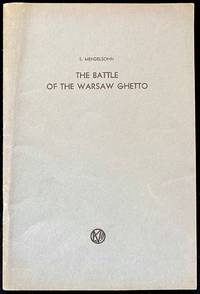
1944Best.-Nr. 4620New York: Yiddish Scientific Institute 1944. Paperback. 1st separate edition. Original Paper Wrappers. 8vo. 28 pages. 23 cm. Wolff #I: 1441. Includes map in black red and white as the full-page center spread. Early report on the uprising: "It is as yet impossible to give a complete picture of the resistance in the Warsaw Ghetto.The material is as yet too scarce. " "This paper was read at the eighteenth annual conference of the Yiddish scientific institute on January 9 1944 .The paper was delivered in Yiddish and is published in the Yivo bleter Journal of the Yiddish scientific institute XXIII 1 January-February 1944." Very good condition. B HOLO2-65-17. Yiddish Scientific Institute paperback
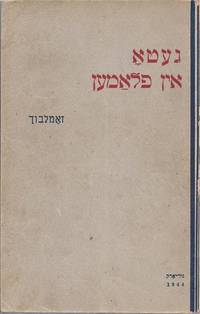
1944Best.-Nr. 40092New York: Nyu-York: Amerikaner reprezentants fun "Bund" in Poyln 1944. Paperback. 1st edition. Original printed paper wrappers 8vo 206 pages. Includes illustrations & facsimiles. 21 cm. In Yiddish. Title translates as "Ghetto in Flames." Early report from the year following the Warsaw Ghetto Uprising published by one of the participating organizations the Jewish Bund. SUBJECTS: Jews -- Poland -- Warsaw. World War 1939-1945 -- Jews. Geographic: Poland -- History -- Occupation 1939-1945. Warsaw Poland -- History -- Warsaw Ghetto Uprising 1943. OCLC: 1227410408. Wear to corwn and foot of spine otherwise Very good Condition. Important. BER-1 HOLO2-98-26A-. Nyu-York: Amerikaner reprezentants fun "Bund" in Poyln paperback
1951Best.-Nr. 34907ABBln., VVN Verlag GmbH. 1951. Erste Ausgabe. 8°. 121 S. 1 Bl., OHalbleinen m. Aufschrift a. Deckel u. Rü., Kopffarbschnitt, ExLibris Hans und Margot Zweig, gut erhalten. 1
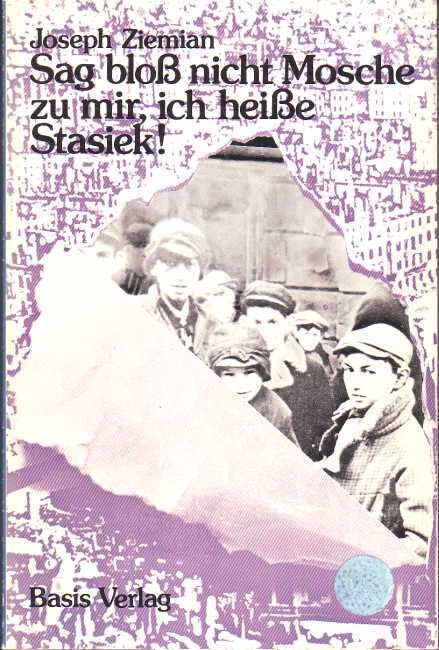
1979Best.-Nr. 305887ABBerlin, Basis Verlag, 1979. 8°. 164 S. mit Fotos. Klappenbroschur. (guter Zustand).
1899pp. xix, 553, (1) [publisher's catalogue]. slightly damp stained and age stained. 12mo. original full green buckram binding, gold lettered spine. extremities slightly bumped. third edition. JUDAICA BOX 4
Best.-Nr. 73091Coll. "10/18" n° 1657, Paris, éd. UGE, 1984, in-12, cartonnage souple, couv. photo coul. éd., 224 pp., traduction par Charles Mauron, revue et annotée par Marie-Brunette Spire, Une série de romans du Dickens juif, ici Les tragédies du ghetto. Très bon état
19578vo., First Edition, with portrait frontispiece, numerous plates and front endpaper street plan; red cloth, gilt back, red top, a very good, bright, clean copy. Classic and valuable eye-witness account of the Warsaw uprising of 1944. Enser, p.469.
19748vo., with plates and endpaper maps; blue cloth, backstrip lettered in silver, a very good, bright, clean copy in price-clipped dustwrapper. Much-needed reissue of the original UK edition of 1958. One of the best (and best illustrated) eye-witness accounts of the Uprising, with useful photographs not easily available elsewhere. The endpapers give a detailed street map of the Ghetto quarter. VERY SCARCE, ESPECIALLY IN THE DUSTWRAPPER. Enser, p.469 (recording the first edition).
Best.-Nr. 500366497Gallimard Sans date. Ce roman de Yannick Haenel retrace la vie de Jan Karski messager de la Résistance polonaise qui en 1942 pénètre clandestinement dans le ghetto de Varsovie pour témoigner de l'extermination des Juifs auprès des Alliés. L'ouvrage mêle documentaire et fiction s'appuyant notamment sur le film Shoah de Claude Lanzmann et le témoignage original de Karski
2007Best.-Nr. 500384600Gallimard 2007 2007. Ce roman de Yannick Haenel retrace la vie de Jan Karski messager de la Résistance polonaise qui en 1942 pénètre clandestinement dans le ghetto de Varsovie pour témoigner de l'extermination des Juifs auprès des Alliés. L'ouvrage mêle documentaire et fiction s'appuyant notamment sur le film Shoah de Claude Lanzmann et le témoignage original de Karski
1963Best.-Nr. 106585AB(Bonn, 1963). 8°. 104 S. Original-Karton. (=Schriftenreihe der Bundeszentrale für Heimatdienst; 32).
in-8, 381 pp., broché sous couverture illustrée. Très bel exemplaire, tres frais [DB-1]
1913Best.-Nr. 3139441Leipzig, Dieterich, 1913. XIV, 377 S. OLwd (lichtrandig, Stempel auf Titelrückseite).
1980Best.-Nr. 2590London, Secker & Warburg 1980. OLn. mit Orig.-Schutzumschlag. 119 (2 w.) n. n. Bl. Mit zahlr. Abbildungen (Dokumente, Photographien, Karten u. Pläne). 4°. An den Ecken stellenweise etwas bestoßen. Gut erhaltenes Exemplar. Mit eigenhändiger Widmung und Unterschrift von Andrzej Wirth für "Walter Jens mit der Erinnerung an die alte Freundschaft Berlin, Juni 1980".
86, (1) p. Original boards (softcover) with title to spine and illustrated title to cover. Boards with some browning and staining, insight slightly worn and in good condition. With dated and signed dedication by the author (forename). With two mounted illustrations.
1968Best.-Nr. 25075BLondon:, Poetow i Malarzy., 1968. 86, (1) p. Original boards (softcover) with title to spine and illustrated title to cover. Boards with some browning and staining, insight slightly worn and in good condition.
1970160 pages. Features: Cover photo of infant wearing brain-monitoring rig; Gorgeous color fashion ads; Nice color ad for Dante rings for men; Saga Mink ad; Corum color watch ad; Betty Friedan - Mother Superior to Women's Lib (Liberation); Who Runs Egypt? - who will take over after Nasser? - photo-illustrated article; Jerome Bruner argues infants are smarter than anyone things; People are finding ways to fail their draft testing; Nice two-page Jules Jurgensen watch ad; Colorful yApre cravats (ties) ad - with ties designed by Herbert Bergheim; Beautiful Monet jewelry ad features necklace and earrings from the Sari Collection; Middle Age Meets the Kid Ghetto in Madison, WI; Tissot Watches; Doc Severinsen appears in Miracord 770H turntable ad; Nice two-page color ad for Buxton handbags; Color ad for Swank "Date-O-Matic" calendar cuff links; Seiko watch ad; Psychedelic Puritan menswear ad; The Blacks Who Work for Nixon; Wild 'crotch' photo centerfold ad by Jack Winter fashions; Armando Ghedini hair goods ad; Gruen watches; Sony TVs; Ethnic fashion photos for women; They Hear the Sound of Silence - deaf infants; Popeye and Olive Oyl appear in color ad for Start instant breakfast; Photos of furniture designed by Aaron Donner; Color ad for Johnny Carson pajamas; Cuesta-Rey cigars; Thom McAn laced boots; Puss'n Boots salmon and tuna cat foods. Average wear. Unmarked. A sound vintage copy Book
1998Best.-Nr. Khe00346München (R. Oldenbourg) 1998 (= Erste Ausgabe). 8°, Orignalbroschur (Paperback ) 117 S., ISBN 3486886886 1
1968A clean, unmarked book with a tight binding. 57 pages. 8 1/4"w x 11 1/4"h. The fictionalized story of a ten year old boy growing up in New York City in the sixties. Illustrated with black and white photos.
2009It is 1595, and the rabbi's son Jacob is frustrated with having to live in the walled ghetto known as Jewish Town. Why can't he venture outside of the gates and explore the beautiful city? His father warns him that Passover is a dangerous time to be a Jew and that the people from outside accuse the Jews of dreadful deeds. But one night, Jacob follows his father and two companions as they unlock the ghetto gates and proceed to the river, where they mold a human shape from the mud of the riverbank. When the rabbi speaks strange words, the shape is infused with life and the Golem of Prague is born. In this breathtaking retelling of a timeless tale, Irene N. Watts's beautiful words are complemented by the haunting black-and-white images of artist Kathryn E. Shoemaker. Book
1946Best.-Nr. MMRM1658Varsovie:: American Joint Distribution Committee 1946. 1946. 8vo. 264 4 pp. 11 black and white photographic plates 50 tables charts index. Original printed wrappers; scotch tape along spine front and rear covers age-darkened first 3 pages including half title and last three blank end-papers are loose. Main body of work remains bound and in good condition. Loose pages have some slight area of extremities missing. Some fading and foxing to pages. Thus wrappers poor but text good to good plus. First edition. SEMINAL WORK IN MEDICAL CLINICAL RESEARCH & A CRITICAL ARTIFACT OF THE WARSAW GHETTO AND HOLOCAUST. Copies of the book are uncommon in part because of the fragile nature of the paper used to publish the report. In the immediate aftermath of World War II paper ink and binding facilities in Europe were scarce. The published report was done with economy in mind and with a rushed sense of needing to reveal to the world what happened. / Six articles report on the clinical research by 28 Jewish physicians and a student intern the 1946 book only records the names of 21 physicians and the student – subsequent research in the 1960s revealed the additional names who conducted the studies on adults and children at the two Jewish hospitals in the Ghetto. Abbreviated biographies of the physicians can be found in The Uses of Adversity: Studies of Starvation in the Warsaw Ghetto by Leonard Tushnet published in 1966. The physicians hoped to study these patients to somehow benefit humanity perhaps in the spirit of the Jewish concept of tikkun olam - to repair the world. The studies were conducted in secret since any scientific research in the Ghetto was prohibited by the Nazi overseers. It is also quite possible that many if not all the clinical physicians believed that granting children and others the status of being a patient would protect them by preventing their transport out of the ghetto to death camps. Theories also suggest that the physicians wanted to preserve a record of the atrocities being committed as well as advance medical research. The studies remain the most comprehensive research of the effects and progression of starvation in part because any contemporary studies would largely be blunted by existing ethical guidelines for informed consent and subject welfare. Contemporary debates about the ethical wisdom of conducting these studies remains contentious. / The Warsaw Ghetto occupied approximately 1.3 square miles 3.4km2 and its population was as much as 500000 men women and children. The Ghetto was a staging area for transporting Polish and Eastern European Jews to the death camps and a locale for starving to death Jews prior to transport. The average daily caloric intake of a resident of the Ghetto was 600 to 800 calories of low-protein food for adults. This amount was calculated by Adolf Eichmann to starve-to-death most of the residents in approximately nine months. The physicians performing the research were no exception to the plan. All were starving as they performed their studies. Equipment for clinical research was smuggled into the hospitals. / Each article in the book is devoted to specific results of these studies. Chapter V offers autopsy results on 710 patients; 492 died of starvation and 218 died of complications of secondary conditions. Chapter VI offers clinical observations of one-hundred adults who died from starvation. Chapter VII offers clinical observations of 40 children who died of starvation. Chapter VIII examines the effects of starvation on the cardiovascular system in adults and children. Chapter IX discusses changes in peripheral blood and bone marrow. Ophthalmic responses to starvation are discussed in Chapter X. Only one doctor engaged in the research Emil Apfelbaum survived the war. He arranged to have the studies smuggled out of the Ghetto to a Polish professor of medicine who released the reports after the liberation of Warsaw. After the war Apfelbaum edited the report for publication by the Joint Distribution Committee. He died a week before the book was published. / Research was performed at the two hospitals in the Ghetto from late February to July 22 1942. On July 22 the hospitals were closed and any patients unable to be transported were summarily executed regardless of age. The attending and clinical physicians were fully aware of the fate awaiting transported patients and in many instances they performed euthanasia on elderly and child patients who were scheduled for transport. Some of the physicians committed suicide rather than face transport. Other physicians accompanied their patients to the death camps providing whatever aid they could. / The studies were smuggled out of the ghetto in a manner befitting a Ken Follet thriller. A Jewish physician Henryk Fenigstein played a crucial role. "Before the war Henryk was a stamp collector. In fact he had one of the largest collections of Polish stamps in the country. One day two SS members arrived at the hospital and told Henryk to come with them to Gestapo headquarters. Of course he was terrified. Jews taken to Gestapo headquarters did not return. On arrival he was taken to the office of a senior officer who told him that he himself was an avid stamp collector. He took out a list and handed it to Henryk. He wondered if Henryk had these stamps and if not if he knew where to procure them. Henryk told him that he had many of the stamps including some of the very rare ones. He told him that he thought he could procure the rest. In order to do this he would need a pass to get out of the ghetto for a few hours each week. And of course the SS officer was welcome to those that he had. The officer agreed and even gave Henryk his phone number in case he needed any help. Thus Henryk Fenigstein a key member of the study team was able to leave the ghetto" 2005 lecture Myron Winick. During such an outing Fenigstein arranged for the smuggling of the reports. A pregnant woman reportedly was used to hide the documents and transport them out of the ghetto. / The supervising physician of the project Israel Milejkowski wrote in his Introduction to the studies that each author refused to allow the Nazis to destroy their work and that through the research and the publication of that research "Nous avons termine nos Recherches et nous les conserverons bien comme c'etait Ton desir. Les paroles immortelles que Tu a jetees "Non omnius Moriar" doivent etre en premier lieu appliquees a Toi! Gloire eternelle a Ta Memoire !" / The research as well as results from the Minnesota Semi-Starvation studies of 1944-1945 continues to benefit the millions of persons facing starvation each year. The participants in the Minnesota study lost an average of 25% of pre-test body weight and the final phase of the study included recovery techniques and methods. The Warsaw studies measured effects until death. This artifact of scientific integrity individual bravery and resistance to oppression is a rare opportunity to truly own a small piece of history illuminating the courage of physicians determined to use their craft to help the world and advance the memory of atrocities. American Joint Distribution Committee, 1946. unknown books
1972Le Scie. Prima edizione. Traduzione di Giacometta Cantatore Limentani. In 8°; pp. 395 con 49 illustrazioni fuori testo; cartonato editoriale con titoli oro al dorso e sovraccoperta illustrata; cucito. CONDIZIONI PIù CHE DISCRETE (segnaliamo la consueta forte ingiallitura delle pagine dovuta alla qualità della carta e lieve sentore di umido).
1973Best.-Nr. 57092Mailand, Mondadori, 1973. Storia degli Ebrei di Roma 395 S. (22x17 cm) Pappband mit Umschlag / gebundene Ausgabe