DALI SalvadorLivre Rare Book
GESMAR (Charles).Livre Rare Book
"Linette".
1923ref. 238991923 Aquarelle, gouache et or sur papier signée en bas à gauche, (1925), 48 x 31 cm.

Librairie Chrétien · Paris, França€ 1.200,00
21.833 resultados
1932ref. 012909Paris Editions des Cahiers Libres 1932 In-12 Broché, couverture rempliée Edition originale
6 volumes in-8, plein veau porphyre de l'époque, dos lisses ornés de compartiments fleuronnés et cloisonnés, plats encadrés de triples filets dorés, coupes filetées, tranches jaspées, 3 frontispices et 22 planches gravées. Première édition collective des oeuvres de Diderot publiée sous l'adresse sans doute fictive de Marc Michel Rey à Amsterdam, alors que ce dernier n'était pas parvenu à un accord avec l'auteur pour l'édition de ses oeuvres (cf. Wilson, p. 515). L'illustration comporte 3 frontispices et 22 planches gravées hors texte. Selon Adams, cette édition aurait été imprimée dans les Pays-Bas autrichiens, alors que pour D. Droixhe ('Diderot et son temps', n° 226): "un des tout premiers recueils des écrits de Diderot, sinon le premier, qu'il est permis de considérer comme liégeois". Elle renferme à côté des oeuvres de Diderot, trois textes qui ne sont pas de lui: 'Code de la Nature' (de Morelly), 'Mémoire pour Abraham Chaumeix' (de Morellet) et 'A MM. les Esprits forts'. (Adams, A2. Tchemerzine-Scheler, II, 957. Cat. expo. B.N., n° 517. Cohen, p. 303). Dorure légèrement passée. Quelques accrocs aux coiffes et quelques rousseurs. Très bon exemplaire, grand de marges, bien relié à l'époque.
1923ref. 238991923 Aquarelle, gouache et or sur papier signée en bas à gauche, (1925), 48 x 31 cm.
1910ref. 222071910 Mine de plomb, sanguine et pastel, signée du monogramme en bas à droite sur papier chamois, (1910). 63.5 x 53 cm., encadrée.
ref. 18265A Paris, chez Prault et Rondonneau, an VII (1799), 1 plein veau marbré, dos orné, roulette sur les coupes, manque de cuir sur le plat inférieur, coiffe supérieure usagée, coins légèrement émoussées. in-8, gravure sous serpente en frontispice ("Bonaparte au Caire"), IV-240 pages ;
1741ref. Theologie-droit-Bonacina-1741Trois tomes en deux volumes in-folio, plein cuir marbré dos à cinq nerfs, caissons ornés, texte en deux colonnes, titres impression rouge et noir, lettrines, bandeaux, culs-de-lampe. Laurent Anisson & Jean Posuel. Lyon. Quelques rousseurs, petite tache d'encre claire sur deux feuillets, petit manque à la coiffe du bas du tome 2, trace d'usage et restauration ancienne à la reliure. Edition (1741) est la dernière grande édition lyonnaise et l’une des plus abouties. Elle vient juste avant l’ultime édition vénitienne de 1754.
1807ref. 19815Paris, Léopold Collin ; La Haye, Immerzeel ; (Imprimerie de la Vve Jeunehomme) 1807 ; 2 tomes in 8, demi veau marbré, dos lisse très décoré et doré, pièces de titre rouge et de tomaison vert-empire ; [4], XVI, 468 pp., 16 pp. de Catalogue ; 520 pp., portrait de Noverre par Guérin, gravé à la manière noire par B. Roger.
ref. 18495Montage d'aquarelle, gouache, mine de plomb et photographies réalisées par Henri Fost et Jenny Carré, sous couverture demi-basane à coins marron, (1935), in-4, dos à cinq nerfs.
1995Pierluigi de vecchi Gianluca colalucci opera completa (la cappella sistina) 4 volumi Rizzoli editore 4 volumi (1-2-3-4) rilegatura in tela con copertina in carta plastificata ottime condizioni con illustrazioni a colori
2 ouvrages reliés en un volume in-8, plein veau marbré de l'époque, dos à 5 nerfs ornés de caissons fleuronnés et cloisonnés, pièce de titre de maroquin bordeaux, filet sur les coupes, tranches rouges. 1- Deuxième édition publiée quelques semaines après l'originale, de ce brûlot qui envenima la "querelle des Bouffons" pour des décennies. "Le résumé des idées de Rousseau sur la musique (...), le plus impitoyable des réquisitoires contre la musique française qui fit scandale (…). En manière de représailles, les musiciens de l'Opéra brûlèrent Rousseau en effigie dans la cour du théâtre" (Catalogue exposition Rousseau, B.N. 1962, n° 116). Rousseau ne critiquait pas seulement l'infériorité de la langue française, mais aussi l'esthétique de l'opéra français de son temps, "le conventionnel des représentations, les airs à roulades sans rapport avec les sentiments, l'apparat ridicule des scènes à machines, les éclats vocaux et les excessives gesticulations des interprètes (…), l'absence d'action dramatique, l'abus d'une mythologie ressassée et la pompeuse niaiserie des livrets" (Cf. Jacques Gheusi, "E. Universalis"). (Bibliothèque Cortot, p. 171. Fétis, 3943. Dufour, 32. Gregory, p.237. RISM B/VI/2 p.734. Sénelier, 120. Tchemerzine-Scheler, V, 529). 2- Edition originale. La réponse de Rousseau à l'article "Genève" qui venait de paraître dans l'Encyclopédie, dans lequel D'Alembert suggérait des réformes pour la ville de Genève: projet pour une "cité philosophe" de liberté politique et culturelle, notamment par la levée de l'interdiction d'un théâtre permanent. Rousseau résume dans sa critique tout ce qu'il dénonçait déjà comme une illusion: "le théâtre comme école de l'hypocrisie, le bel esprit, la civilité telle qu'on la conçoit à Paris sont inconciliables avec les mœurs de véritables citoyens. Ses thèses sur les spectacles ne sont qu'un aspect de sa réflexion sur la modernité: à quelles conditions la république est-elle possible ? Comment lier adéquatement morale, esthétique et politique" (cf. B. Bachefen, ENS éditions). (Gagnebin, V, 1812. Tchemerzine-Scheler, V, 535). Quelques rousseurs éparses. Petit ex-libris raturé et auréoles dans le fond de plusieurs cahiers du 2e texte. Très bon exemplaire, relié à l'époque.
1590ref. 58125Basel, Eusebius Episcopius, 1590. 8°. Mit einigen Holzschn.-Vignetten bzw. -Initialen. 8 Bll., 121 (1) S., 3 Bll.; 319; 232; 120; 287; 531 (1) S., Pgmt.-Bde. d. Zt. m. durchzogenen Bünden, handschriftl. Rückentiteln, Deckel- u. Rückenverg., abgeschrägten Kanten u. dreiseitigem Goldschnitt.
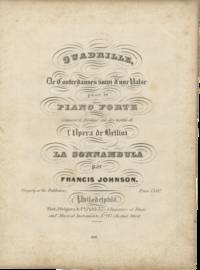
1837ref. List3613Philadelphia: Firth Meignen & Co. Publishers & Importers of Music and Musical Instruments No. 41 Chestnut Street 1837. Seven pages complete including dance figures. Folio sheet music. Very good with scattered foxing and light edge wear. A rare early American operatic dance arrangement by Francis Johnson 1792-1844 widely regarded as the first published Black composer in the United States. Issued circa 1837 this work adapts themes from Vincenzo Bellini's opera La Sonnambula 1831 into a set of quadrilles with concluding waltz arranged for piano forte and structured for social dancing. The internal headings "Pantalon" "Ladies Chain" etc. retain the formal quadrille sequence reflecting the popularity of European ballroom forms in Philadelphia during the period. Johnson a Philadelphia bandleader composer and virtuoso keyed bugle player published approximately seventy compositions over nearly three decades. Active in Philadelphia from at least the 1810s he became one of the city's most sought-after musicians leading ensembles for cotillions public balls military functions and civic celebrations. In 1818 became the first African-American composer known to have sheet music published in the United States. His band performed for elite social events and public commemorations including celebrations for the Marquis de Lafayette's visit to Philadelphia. In 1838 he toured Europe with his ensemble performing in England and reportedly receiving a silver trumpet from Queen Victoria. This piece was composed a year earlier per the Johnson page at Musicalgeography.com six years after Bellini's work. Operatic paraphrases and dance adaptations of fashionable European works were central to Johnson's output. Overall a quite scarce early title from an important composer. We find two copies in OCLC 692295106 at AAS and the William Clements Library. See "Francis Johnson's Compositions - With Sheet Music" https://musicalgeography.org/francis-johnsons-compositions/. Firth, Meignen & Co., Publishers & Importers of Music and Musical Instruments, No. 41 Chestnut Street
1837ref. List3613Philadelphia: Firth Meignen & Co. Publishers & Importers of Music and Musical Instruments No. 41 Chestnut Street 1837. Seven pages complete including dance figures. Folio sheet music. Very good with scattered foxing and light edge wear. A rare early American operatic dance arrangement by Francis Johnson 1792-1844 widely regarded as the first published Black composer in the United States. Issued circa 1837 this work adapts themes from Vincenzo Bellini's opera La Sonnambula 1831 into a set of quadrilles with concluding waltz arranged for piano forte and structured for social dancing. The internal headings "Pantalon" "Ladies Chain" etc. retain the formal quadrille sequence reflecting the popularity of European ballroom forms in Philadelphia during the period. Johnson a Philadelphia bandleader composer and virtuoso keyed bugle player published approximately seventy compositions over nearly three decades. Active in Philadelphia from at least the 1810s he became one of the city's most sought-after musicians leading ensembles for cotillions public balls military functions and civic celebrations. In 1818 became the first African-American composer known to have sheet music published in the United States. His band performed for elite social events and public commemorations including celebrations for the Marquis de Lafayette's visit to Philadelphia. In 1838 he toured Europe with his ensemble performing in England and reportedly receiving a silver trumpet from Queen Victoria. This piece was composed a year earlier per the Johnson page at Musicalgeography.com six years after Bellini's work. Operatic paraphrases and dance adaptations of fashionable European works were central to Johnson's output. Overall a quite scarce early title from an important composer. We find two copies in OCLC 692295106 at AAS and the William Clements Library. See "Francis Johnson's Compositions - With Sheet Music" https://musicalgeography.org/francis-johnsons-compositions/. Firth, Meignen & Co., Publishers & Importers of Music and Musical Instruments, No. 41 Chestnut Street books
1942ref. 62473Philadelphia and New York:: Aberle Inc.; Willard B. Golovin Co. 1942-1943. First edition; No. 187 and 44 of 750 and 500 copies respectively. publisher's spiral-bound stiff wrappers illustrated in color. Both volumes near fine. Folio. Ballet-themed color Illustrations throughout incorporating elaborately presented samples of Aberle Ballet rayon stockings fabric samples of complimentary colors with which to wear them fashion color wheels and sales pitches including the patriotic merit of rayon stockings silk and nylon being unavailable during the war years "so that your charm would continue to inspire and maintain the morale.". Aberle Inc.; Willard B. Golovin Co., unknown
1942ref. 57754Philadelphia:: Aberle Inc. Fall-Winter 1942 and Spring-Summer 1943. First edition limited to 750 and 500 copies respectively. publisher's coil-bound wrappers illustrated in color as issued. Very slight sue to wrappers at corners; extremely attractive. Folio. Ballet-themed illustrations throughout in color by Willard Golovin. Aberle were stocking manufacturers. Each catalogue presents samples of rayon stockings "drawn from new war-born materials". "When Pearl Harbor became a symbol of perfidy you gave up silk." Aberle Inc., unknown
1979ref. 17148JGarden City: Doubleday 1979. First Edition First Printing of his classic ballet novel. Signed and inscribed by the author Edward Stewart inscribed: “For Herbert Ross without whom this book would not have been begun and Nora Kaye without whom it could never have been finished - with thanks Ned Stewart Jan 22 79.” Fine in a lightly used dust jacket. The origin of this novel involved Nora Kaye 1920-1987 who was an American prima-ballerina known for her ability to perform dramatic roles. She was called the Duse of Dance after the acclaimed actress Eleonora Duse. Stewart and Nora Kaye spent extensive time together working on a potential non-fiction ballet book. The book never came to pass but their relationship allowed Stewart access to the highest and most intimate circles of ballet life in New York. Her husband was film director Herbert Ross who suggested Stewart write the novel. Kaye and Ross are mentioned at five places in the text. Acknowledged as one of the top novels ever dealing with the world of ballet. Doubleday unknown
1979ref. 17147JGarden City: Doubleday 1979. First Edition First Printing. Author Edward Stewart’s own personal copy of his classic ballet novel specially bound in a presentation binding. This novel is bound in full orange morocco leather with a beautiful tooled front board depicting a dancing ballerina depicted in red black and extensive gold leaf. The front and rear panels of the book’s dust jacket are bound in. Enclosed in an accompanying cloth slipcase. Fine. The book has a letter of provenance laid in. The origin of this novel involved Nora Kaye-Ross 1920-1987 who was an American prima-ballerina known for her ability to perform dramatic roles. Called the Duse of Dance after the acclaimed actress Eleonora Duse. Stewart and Nora Kaye-Ross spent extensive time together working on a potential non-fiction ballet book. The book never came to pass but their relationship allowed Stewart access to the highest and most intimate circles of ballet life in New York. Acknowledged as one of the top novels ever dealing with the world of ballet. Doubleday hardcover
1925ref. 218871925 Aquarelle et encre de Chine signée au milieu à gauche, (1925), 21.50 x 20 cm (format à vue), 42 x 34 cm, sous verre.
1592ref. 41310Frankfurt a. M., Sigismund Feyerabend, 1592. Fol. Titel in Rot u. Schwarz m. großer Holzschn.-Vignette. Mit einigen Holzschn.-Vignetten bzw. -Initialen u. einer mehrf. wiederh. Holzschn.-Druckermarke. 6 Bll., 658 S.; 2 Bll., 544 S., 71 Bll., Blindgepr. Schweinsldr.-Bd. d. Zt. über Holzdeckeln a. 6 Bünden m. goldgepr. Rückenschild u. dreiseitigem Rotschnitt.
2019ref. SBBIH-2MEQPK2EJ3YVDolman Scott 2019. paperback. Good. Our good condition books are generally good for reading but not for gifting or collecting. They could have imperfections such as creasing fanning inscriptions margin notes yellowing staining on edge or cover or pages bumps scuffs etc etc sometimes multiple of these. It's a wide category that encompasses anything that isn't almost-new down to anything that is slightly better than poor. We would NOT recommend gifting Good books - these should be considered reading copies. Our books are dispatched from a Yorkshire former cotton mill. We list via barcode/ISBN so please note that the images are stock images and may not be the exact copy you receive furthermore the details about edition and year might not be accurate as many publishers reuse the same ISBN for multiple editions and as we simply scan a barcode or enter an ISBN we do not check the validity of the edition data when listing. If you're looking for an exact edition please don't order at least not without checking with us first although we don't always have time to check. We aim to dispatch prompty the service used will depend on order value and book size. We can ship to most countries see our shipping policies. Payment is via Abe only. Dolman Scott paperback
1745ref. 382701745 15 volumes in-8 (169 x 92 mm), plein veau havane glacé de l'époque, dos à 5 nerfs guillochés or, ornés de compartiments fleuronnés et cloisonnés, plats encadrés d'un filet à froid, roulette dorée sur les coupes, pièces de titre et de tomaison de maroquin bordeaux, tranches rouges. Paris, P.G. Le Mercier, et Saillant, 1745-1749.
1925ref. 218851925 Aquarelle et encre de Chine signée du cachet au verso du dessin, titrée à la mine de plomb au verso, (1925), 20.53 x 13 cm (format à vue), 24.2 x 26 cm (format de la feuille).
1921ref. 223021921 1 Gouache et mine de plomb signée en bas à droite, (1921), 31.6 x 22.3 cm, cadre doré.
1950ref. 165121950 Gouache signée en bas à droite, titrée en bas à gauche, 1947, 24.5 x 35 cm.
Penna, acquerelli e biacca Misure: mm 250 x 355 Pittore e scenografo noto per il suo lavoro presso l'Opera Nazionale di Parigi. Studia Pittura e Architettura a Parigi e vince il Prix de Rome trascorrendo tre anni a Villa Medici. La prima esposizione al Salon è del 1844 con un dipinto di paesaggio indiano d'invenzione. Il paesaggio dal vero o d'invenzione è un genere che Chaperon affronterà lungo tutta la sua carriera e dal quale trarrà ispirazione per la produzione scenografica. Dopo aver collaborato con il famoso studio di scenografia di Pierre Luc Charles Ciceri (1782-1868) fonda nel 1864 con Rubé l'atelier "Rubé et Chaperon" e per i successivi 30 anni produce numerose scenografie e decorazioni per teatri in tutta la Francia e Belgio. Nel 1895 lascia l'atelier ma continua a lavorare per teatri e decorazioni di edifici pubblici e privati. Alla sua morte i tre figli proseguirono l'attività. Moltissimi suoi disegni, conservati nei musei francesi, documentano la sua attività. Il disegno è una scenografia per l'opera Le juif errant: un'opera in cinque atti e otto tableaux di Fromental Halévy, su libretto di Eugène Scribe e Jules-Henri Vernoy de Saint-Georges. Il tema è ispirato al romanzo moraleggiante di Eugéne Sue edito nel 1844. L'opera venne rappresentata a Parigi alla Salle Peletier nel 1852 con scarso successo. Presso la Biblioteque Nationale si conserva una scenografia per il primo atto datata 1879. Benché la vicenda si svolga fra il XII e il XIII secolo il disegno propone un elegante interno riccamente arredato nel gusto dell'epoca di Chaperon stesso. Siamo in una splendida sala dall'architettura orientale, probabilmente nel quarto atto, è l'appartamento di Irene, figlia dell'Imperatore d'Oriente. Il disegno è firmato e datato in basso a sinistra: Ch Chaperon 1867. La data non corrisponde alla prima rappresentazione, evidentemente l'autore deve aver lavorato sul soggetto per un altro teatro. Il disegno è applicato lungo i soli margini a foglio d'album sul quale, in grafia coeva, si trovano le indicazioni: (boudoir) Le juif errant julliet 1867. Ottimo stato di conservazione eccetto una minima mancanza in alto a destra nel foglio di supporto.