[FASHION -- LeLONG, Lucien (Designer).]Biblio.com
18 427 résultats
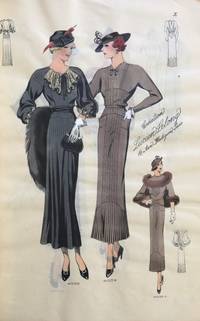
1930réf. 58140Paris Vienna New York et al: Societe Graphique S.A. Editions de Mode Classique Modes Co. Importers of Fashions 303 Fifth Ave. ca. 1930. Folio. 9 x 13 in. IV pp. leaves as V-XX hand-coloured pochoir plates 2 pp. pattern cutting plates. Quarter-embossed gold foil over pink printed softcovers gilt & black decorative lettering minor shelfwear slight bumping to corners rubbing still a VG copy. First edition of this beautifully coloured collection of haute couture Parisian fashion dress designs by Lucien LeLong 1889-1958. Lelong was a contemporary designer alongside Chanel Vionnet Molyneux Lanvin & Patou focusing on designing for cafe society during the 1920’s and 1930’s. These designs emphasize Lelong Schiaparelli and Vionnet’s move towards a more sophisticated and elegant feminine silhouette during the 1930’s with hemlines dropped to mid-calf or close to the ankle soft slim-fitting dresses and backless evening gowns. Classique Modes also distributed other similar pochoir-illustrated fashion design periodicals such as Paris Chic Elite Robes elegantes Iris and others. The final 2 plates No copies in Worldcat. Societe Graphique S.A., Editions de Mode, Classique Modes Co., Importers of Fashions, 303 Fifth Ave., paperback
1927réf. 58104New York: B. Altman & Co. Fifth Avenue July-August 1927. Tall 8vo. 7 x 11 in. 46 pp. Illustrated throughout. Colour-illustrated sofcovers stylish Art Deco cover art of flapper woman in stylish hat with cocktail on ocean liner beach fashions on back cover minor dustsoiling shelfwear minor bumping at couple corners still VG copy. First edition of this nicely printed and quintessential Flapper Era in-house fashion magazine and catalogue for B. Altman. Filled with novelties accessories and designs targeting the young flapper along with encouraging the Negligee for every mood marketing summer vacation items such as cameras photo albums even a portable sun dial. Worldcat locates 3 incomplete and broken run holdings of the Altman Magazine Mint Museum U of RI UVA. B. Altman & Co., Fifth Avenue, unknown
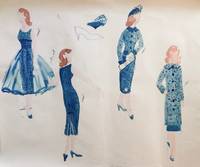
1953réf. 58213Seattle WA: Nancy Paine ca. 1953-54. Twenty-one original fashion design watercolour paintings all oblong folio 9 sized 15 x 12 in.; 12 sized 18 x 15 in. 1 is painted title only many of them signed by Nancy down in lower corner 1 graded and reviewed by teacher several with neat cursive annotations some curling minor edgewear to corners some toning still VG set with the 2nd set retaining the original portfolio cover sheet. These original watercolour fashion designs reflect the 1950’s emphasis on full circle skirts swing skirts pencil skirts tea length dresses and fitted tight waist blouses reflecting the influence of Christian Dior towards increased femininity in the post-World War II era. For the College Coed portfolio our young artist has included designs for Capri pants lingerie fitted wool dresses flowing “poodle” skirts bathing suits tennis outfit ice skating clothing riding outfits and evening wear. The second portfolio incorporates diamond pattern one-piece bathing suits terrycloth robes different evening weather and nighttime negligee. Although young Miss Paine would not go onto becoming a commercial artist she did work as office manager for many years for the Simpson Lumber Company. Nancy Paine, hardcover
1946réf. 57486New York: Lord & Taylor 1946. Tall 8vo. 3 101 4 pp. Double-page frontispiece white crepe-paper Christmas Tree pop-up by The Beistle Co. Illustrated throughout most in black & white 10 colour plates some photographic others a mixed-media effect. Colour-illustrated softcovers wraparound cover art minor shelfwear edgewear at corners light rippling to gutter margin of first couple leaves still a VG copy. First edition of this fashionable post-World War II catalogue celebrating 101 stylish gifts for men women & children following the easing of Wartime restrictions. The impressionistic illustrations were created by the in-house Lord & Taylor artists who were some of the most influential designers during the 1940’s and 1950’s including Dorothy Hood Helen Hall Arnold Hall Jean Karnoff Susan Abbott Betty Offt and Carl Wilson. Many of the 101 items drip with a glamour desired and reflected in post-War film and popular culture and a distinct emphasis on femininity with such items as the “Ermine hug-me-tight” stole Hand-made silk lingerie with French Alencon lace Koret dinner bag the Harem lounging costume by Joseph Whitehead Gloves that go up and up and more. Worldcat locates 1 copy Penn State; See: Keren Ben-Horin July Treasure of the Month: Frances Neady Collection On Pins and Needles July 25 2012. Lord & Taylor, paperback
1941réf. 57736New York: Apparel Arts Esquire Inc. Esquire Building Madison at 46th March 1941. Folio. 10.75 x 14.25 in. 98 pp. Numerous colour plates many double-page colour photographs 23 of 30 fabric samples tipped-in photo illustrations colour photo illustrations. Quarter-blue cloth over colour-illustrated photo boards cover art of divers in swim suits from high dive platforms edgewear rubbing rubbing to corners some dustsoiling still VG- copy. First edition of this World War II-era trade magazine launched in 1931 in the depths of the Great Depression by Weintraub Smart & Gingrich from the Menswear Service Corporation. This issue features illustrations and advertisements by such artists as John Lagatta 1894-1977; Allen for Portis hats the modernist master Paul Rand’s 1914-1996 Summer 1941 poster the iconic fashion illustrator Laurence Fellows 1885-1964 and other mainstays. This installment features advertisements from such menswear brands as Botany Worsted Mills Jockey Manhattan Shirt Co. Dobbs Hats Hickok John Cyril Woolen Co. and even Pittsburgh Plate Glass Co. fashion displays. By the 1940’s the magazine was printed by Esquire Inc. issued 8 times a year continuing in print until replaced by Gentlemen’s Quarterly GQ in 1959. See: Marianne Brown Apparel Arts & Conde Nast May 10 2017. Apparel Arts, Esquire Inc., Esquire Building, Madison at 46th, hardcover
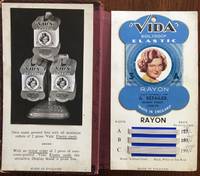
1930réf. 57289Nottingham UK: Vida Mills Jones Stroud & Co. Ltd. ca. 1930. Thick 8vo. 26 pp unpaginated. on thick card stock w/ burgundy linen hinges at gutter margin w/ 113 rayon elastic nylon elastic rubber and silk rayon blend trims 1 silver gelatin frontisp. photo mounted on front pastedown sized 3.5 x 5.5 in. w/ 10 colour-printed & illustrated labels and elastic holders tipped-in numerous printed photographic plates. Quarter-burgundy coloured cloth over simulated alligator boards screw posts at gutter margin minor rubbing slight bumping to corners 1 sample removed still a VG copy. First edition thus of this extraordinary and inventive salesman sample catalogue for elastic trims between the Wars. Horace Jones had invented a specialized braiding machine in 1927 for creating elastics by braiding rubber filaments together with rayon nylon cotton or silk-rayon blends to create a number of different “Elastic” Boil Proof Vida trims. Prior to the widespread introduction of many stretchable and elastic fabrics following World War II Vida Mills products were used shoulder straps for lingerie suspenders both for men and women’s fashions swim trunk and briefs trunk top elastic bands. In addition these were used for car covers bags accessories creating pleats sleeve hems and much more. In addition there are a number of samples included here for durable boot and shoe laces. The coloured and metallic Ric Rac trims were used in costumes uniforms decorative elements on clothing and many other applications. By 1930 the company had deployed 3000 braiding machines generating over 52 million yards of elastic braid annually and in 1940 expanded into manufacturing glass tapes and woven fabrics for electrical installations and industrial Wartime applications. The company still operates today as the Jones Stroud Insulations Ltd. subsidiary of the Krempel Group since 2000. No copies in Worldcat; See: History of Jones Stroud Insulations -- Timeline Krempel 2015; Trade Marks Ordinance Official Gazette Kenya Dec. 4 1956 p. 1315. Vida Mills, Jones Stroud & Co., Ltd., hardcover
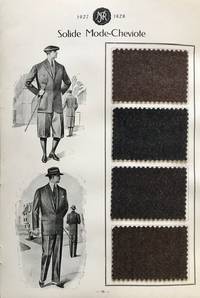
1927réf. 57311Graz Austria: Richard Neurath Kaiserfeldgasse 19 und 21 1927. Two vols. 1st - Folio. 11 x 13.75 in. 45 1 pp. on thick boards. With 246 tipped-in fabric samples of wools wool blends 27 fashion plate illustrations 2 for women’s coats w/ price list and letter to salesmen dated August 1927. Original quarter-black cloth over embossed & decorated boards flaps at fore-edges w/ handle and clasp raised gilt lettering on front cover minor shelfwear rubbing clasp guard repaired & reinforced still VG complete exemplar retaining the original button clasp; together with 4to. 8.25 x 11.25 in. 4 pp unpaginated. w/ 16 additional wool and wool-blend samples tipped-in self-printed covers rounded corners. First edition of this unusually rare fashion salesman sample catalogue for men’s suits and sporting wear during the Roaring 20’s with many of the suits sporting vests while also featured are shooting & hiking suits sportswear and a rich array of fabrics drawing upon English fashion designs. Following World War I there was a concerted move away from starched collars and formal three-piece suits towards soft collars one- or two-button suit jackets and even often worn without a waistcoat. Also featured in this catalogue are many examples of the plus-fours developed out of ordinary knickers these short-legged pants were a baggier version of their predecessors and proved popular for hikers golfers and other outdoors activities. Also featured are winter coat fabrics and designs for women in velour and thick felt twill. The laid-in additional catalogue promoted the latest Loden Merino wool fabrics and thick camel hair woolens. Neurath 1882-1948 operated a successful mail-order tailoring business until the 1938 Anschluss when the Nazi’s annexed Austria and forced the April 10 plebiscite. He survived the War and later died in Tel Aviv Israel in 1948. The building which housed his offices and tailoring facilities in Graz is now the home of the popular Cafe Kaiserfeld. No copies in Worldcat. Richard Neurath, Kaiserfeldgasse 19 und 21, hardcover
1905réf. 56908Chicago IL: American Woolen Mills Co. 1905. Thick elephant folio 17.5 x 21.5 x 3.25 in. 58 pp. printed on thick card stock each mounted on linen hinge. With 6 black & white fashion plates illustrating suit styles of the period with 380 of 400 -- many marked in pencil “O.S.” or Out-of-Stock mounted textile samples in wool wool-silk blends -- all samples clearly marked with prices and availability numerous text illustrations decorative borders printed in colour many showing bucolic scenes of sheep pastures and winter frolics. Black & blue cloth Arts & Crafts gilt lettering & ornament on front cover expertly rebacked and back cover renewed dustsoiling and occasional soiling to some leaves some samples w/ predation and minor loss dampstaining to gutter margin of last few leaves minor loss & damage to last couple leaves still a good copy. First edition of this scarce Progressive-era salesman sample catalogue for Winter season men’s suits overcoats and evening wear. The American Woolen Mills Company also known as the “Progressive Tailors”maintained a huge tailoring operation in Chicago at Union & Washington until the Great Depression employing hundreds of tailors and seamstresses to fill orders. Unlike J.L. Taylor Royal Tailors and many of the other tailoring houses of the period the American Woolen Mills targeted the average white collar clerk or American immigrant salesman and merchant trying to look professional and offered $ 15.00 high class made to measure suits. These catalogues were very expensive to produce and were often issued with minimal company brand names allowing their sales force to target small shops mercantiles and general stores which would have these catalogues on the sales floor for several years. Sales people were directed to simply clip the corners of samples for out-of-stock and discontinued fabrics but they often chose to remove the entire sample in order to not distract potential customers. The catalogue offers invaluable illustrated historical reference for the colours styles and fabrics during the era of Teddy Roosevelt and the Anti-Trust policies even referring to these in their sales pitch by claiming that unlike Trusts which “by combining saves numerous expenses and sticks ALL the savings in its own pocket. . . there is no Trust in the tailoring trade.” They further claim that they remove all middlemen procure woolens directly from the weavers and by avoiding wastes of all kinds that AWM CO. lowers their prices and “it is a public benefit.” The textiles here focus on darker shades and very muted colours along with durable thick fabrics while marketing their double-breasted sacks 3-button frock coats 2-button single breasted suits assorted overcoats and more. No copies in Worldcat; See: Swell Nifty Suit Free! The Household Journal Vols. V No. 8 August 1912 p. 6; Machinists’ Monthly Journal Vol. XVII No. 3 March 1905 p. 282. American Woolen Mills Co., hardcover
1939réf. 56900Chicago IL: Jackman Sportswear Co. Inc. 14 E. Jackson Blvd. 1939. 8vo. 5.5 x 8.5 in. which opens up into 8 pp. Oblong 4to. 11 x 8.5 in. printed in brown on cream-coloured paper w/ numerous illustrations 4 fabric sample swatches tipped-in self-printed softcovers together w/ 3 leaves of price-lists and order forms preserved w/ mailing envelope to Henry Mayer Mahoning Valley Country Club Lehighton PA very slight shelfwear creasing NF. First edition of this scarce sample catalogue for men’s sporting clothes on the eve of World War II. This catalogue offers Raglander Raglan Sport Shirts Tommy Armour Gaucho Raglan golf shirts Jerry Glynn jackets in single-ply gabardine or wool tweed water proof silk shirts for golfers bowling shirts golf gloves Camel cloth caps and more. The famed golfer’s Jerry Glynn reversible golf jackets were taken over and produced by Whitewater following World War II and with elastic back and wind and rain resistance proved popular for decades. Tommy Armour Gaucho Raglan shirts first made their appearance in the 1930s after he had largely retired to Boca Raton FL and golf equipment is still marketed with his name. No copies located in Worldcat. Jackman Sportswear Co., Inc., 14 E. Jackson Blvd., paperback
1995réf. 56987San Francisco CA: Levi Strauss & Co. Publishing 1995. Folio. 313 5 pp. With 100s of illustrations colour plates colour photos large folding plates & pages illustrated endpapers. Quarter-black cloth over illustrated boards cover art of Levi’s brand jean label slight shelfwear rubbing w/ mylar dustjacket minor bumping to foot of spine edgewear still NF/VG- copy inscribed by Downey & McDonough in Sharpie marker on ffep. to Gina “Always sweet always the best-dressed!” First edition signed presentation copy of this lavish pop-culture artist’s book celebrating the advertising and Levi’s jeans worn by miners labor union members field workers protesters and many others for over 150 years. Even includes a photograph of the complete first womenswear outfit produced by Levi Strauss of hiking knickerbockers for that visit to Yosemite. Levi Strauss & Co., Publishing, hardcover
1960réf. 56965Pasadena CA: n.p. ca. 1960. Folio. 14.5 x 20 in. Twelve original gouache paintings on thick artist’s board 10 of them either w/ typed or manuscript labels 1 entitled “Garden Party” written in manuscript at upper fore-edge 8 preserving their cloth fabric swatch samples some w/ designer’s notes trimmings etc. All are preserved in a gray linen clamshell case minor edgewear rubbing wear to corners still a well-preserved fine set of paintings. This nicely executed set of fashion designs were apparently created for a Civil War theatre production in Southern California around 1960 with characters named Florence Bagshot Mrs. Ludley Bagshot Agatha Mrs. W.D.P.S. and Mrs. Forbes. The designs primarily focused on the women characters including one of a nurse standing in costume in gray striped dress apron and cap with Confederate cavalry trooper in kepi astride his horse and hatless officer with sash standing in the background. Many of the designs reflect the colour palate of the early 1960’s with avocado green vivid blues solid brown earth tones and bright nearly neon orange gauze fabrics in the renderings and samples which would not have been common in those combinations during the Civil War era. Still most of the dress designs incorporate the hoop skirts of the period often with crinoline and/or crinoline cage hoop skirts and high collars with ties and ribbons at the neck and trim patterns typical of the period. The design for Florence Bagshot’s bedroom wear incorporates elements of Mid 20th-Century design and sensibilities rather than the more common chemise and sturdy cotton for the 1860’s. The Confederate Nurse design was painted on “Brownie Board Cold Pressed Duncan Vail Co. Los Angeles” which appears in California art supply advertising from about 1960-1963. We were unable to identify the production after an extensive search through contemporary theatre production trade magazines newspapers and other industry publications. n.p., hardcover
1943réf. 56139Newark NJ: A. Hollander & Sons Ltd. ca. 1943. Folio. 10 x 13 in. Sixteen photographic plates printed on thick paper stock preserved in illustrated printed portfolio in blue & white w/ white lettering & illust. on front cover die-cut window showing assorted fashions within tear to lower fore-edge of die-cut window flap minor edgewear slight creasing still VG copy w/ promotional brochure laid-in for Parisian Fur Coat Co. addressed Erb’s Fur Shop in Kelso WA. This scarce promotional advertising portfolio includes printed camera-ready photographs of Hollander Featherlite Persian fur coats from such notable furriers and fashion department stores as L.S. Ayres & Co. Furs by Robert in Detroit Roy H. Bjorkman in Minneapolis featuring a Chinese Mandarin style fur Jordan Marsh Neiman-Marcus Julius Garfinckel & Co. Bonwit Teller and even an image of Marguerite Chapman 1918-1999 former Powers model who starred in Appointment in Berlin and Destroyer 1943. A. Hollander & Co. was founded in 1889 by Albert Hollander who developed processes for creating soft and silky fur coats from less expensive furs and also for developing the “Hollanderizing” cleaning process immortalized in the 1950 Broadway musical Guys & Dolls which involved swirling minks and sable fur coats in drums full of sawdust & chemicals to clean them up for each season. A. Hollander & Sons, Ltd., unknown
1934réf. 56170Omaha NE: Northwestern Fur Company ca. 1934. Two vols. 4to. 15 1; 16 pp unpaginated. with numerous photo and text illustrations diagrams. Self-printed illustrated softcovers both with cover art of stylish young women wearing furs including one in front of an Art Deco screen both with centerfold creases as issued minor shelfwear rubbing still VG set retaining original mailing envelope addressed to A.lbert H.enry McConnell 1861-1939 Payette Valley Silver Fox Farm Fruitland ID formerly of Gunnison CO set up his fruit orchards ranching business and other opportunities in Idaho. First editions of these very rare fur fashion and furrier supply catalogues issued by the Northwestern Fur Co. of Omaha NE including in the first catalogue furs for sale such as chokers scarfs muskrat Northern Seal Hudson Seal Caracul Siberian Squirrel and others. Also included are listings for furriers’ tools and equipment taxidermy work fasteners and more while the second catalogue promotes the complete furrier course offered by the company. Elwood 1875-1947 with two partners Paul F. Greve and R.H. Smith incorporated the Northwestern Fur Company school of taxidermy and the Northwestern Fur Company furs mail order in 1903 and quickly expanded for the succeeding decades. Elwood had previously taught and been director at a trade school in Iowa before moving to Omaha NE and continued as the public face of the mail order company for decades eventually closing down in the 1980s. No copies located in Worldcat; See: Northwestern School of Taxidermy Northwestern Fur Company Nebraska State Historical Society Manuscript Finding Aid RG5451.AM. Northwestern Fur Company, paperback
1955réf. 56299Vienna: Wiener Modellgesellschaft M.B.H. Editions de Mode Fashion Publications 1955. Folio. 9 x 13 in. 23 colour plates in pochoir-inspired hand-coloured style. Printed beige softcovers minor creasing head of spine minor dustsoiling still VG bright copy. First edition thus of this beautifully rendered collection of haute couture summer dress designs issued by the Viennese fashion cooperative in the 1950s. These designs show the decided shift towards elegance and perfectly matched accessories for women during the 1950s with nipped-in waists full-skirted dresses as well as tailored fitted clothes with a hint of playfulness and exuberance inspired by the designs of Cristobal Balenciaga and Hubert de Givenchy as well as the feminine silhouette of Christian Dior. No copies in Worldcat of this issue. Wiener Modellgesellschaft, M.B.H., Editions de Mode, Fashion Publications], paperback
1936réf. 56297Vienna Austria & Paris: Les Editions Leon Claude 4 Rue mayran 1936. Folio. 10.75 x 14.6 in. 4 pp. With 25 colour fashion plates text printed in French English & German. Textured beige softcovers raised & embossed gilt lettering front cover black lettering for Leon Claude minor chipping head & foot of spine edgewear some scuffing still a VG copy w/ the fashion plates in bright condition. First edition of this very scarce and beautifully printed fashion design magazine from the mid 1930s produced by the publishing house which also published fashion publications such as Paris Chic La Coquette and Le Gout Parisien. These designs show the dominant influence of Elsa Schiaparelli’s fashions in the 1930s as she continued Chanel’s idea of comfortable jackets but with the emphasis on beautiful tailoring. The designs here include most in 3/4 length with some sporting shapes and belted jackets as well as fancy wraps made from leopard panther kid-astrakhan Buenos broadtail lamb beaver otter Persian lamb musk mink fox and others. The collars are voluminous and flaring all the way around and the linings are often chosen to complement and match the dresses worn by the models. These 1930s fashions show a dramatic drop in hem lengths the new French beret style hats worn at an angle and designs which inspired the Hollywood glamor look of the era popularized by Joan Crawford Carole Lombard and others. The designs are glamorous and chic with many having geometric patterns and reflecting the Art Deco influence. These fashion designs were issued only to subscribing specialty shops boutiques and fashion enthusiasts at the time with eight different issues on assorted subjects appearing annually. No copies of this issue located in Worldcat. Les Editions Leon Claude, 4, Rue mayran, paperback
1944réf. 56300Nice Paris & Maresille: A La Francaise May 1944. 4to. 78 14 pp. With numerous colour plates colour ads over 100 black & white text illustrations & photos. Colour-illustrated softcovers colour cover art on rear minor shelfwear slight rubbing light spotting to front cover and first couple leaves still VG- bright copy. First edition of this very scarce French fashion and luxury goods magazine published in occupied France a few months before the “liberation of Paris” and the Battle of Marseille. The lavish ads and articles tout the achievements of Parisian fashion designers French artists the cosmetics & perfume industry of Paris theatre productions Nazi-controlled French cinema and more. There are few of these occupied France publications surviving and Worldcat does locate a complete run at the Bibliotheque National. A La Francaise], paperback
1940réf. 56298Vienna Germany & Paris: La Mode Artistique S.A. 4 Rue mayran 1940. Folio. 10.75 x 14.6 in. 4 pp. With 28 colour fashion plates text printed in French English & German. Textured beige softcovers raised & embossed gilt lettering front cover black lettering for La Mode Artistique minor chipping head & foot of spine edgewear some scuffing still a VG copy w/ the fashion plates in bright condition. First edition of this very scarce and beautifully printed fashion design magazine issued in the opening years of World War II following the occupation of Paris in the summer of 1940 originally owned by Leon Claude. The firm had also published fashion publications such as Paris Chic La Coquette and Le Gout Parisien. These fashion designs show the growing restraint and conservatism of Nazi Germany and reflecting the desire by Adolf Hitler to extinguish French influence in European fashion. The designs here include most in 3/4 length with some sporting shapes and belted jackets as well as fancy wraps made from seal kid-astrakhan Buenos broadtail lamb beaver otter nutria ocelot Persian lamb musk mink fox and others. The collars are trimmer and the linings are often chosen to complement and match the dresses worn by the models. These 1940s fashions still show the dramatic drop in hem lengths feathered hats worn by Germans & Austrians and designs which inspired the Hollywood glamor look of the era popularized by Greta Garbo Joan Crawford Carole Lombard and others. These fashion designs were issued only to subscribing specialty shops boutiques and fashion enthusiasts at the time with eight different issues on assorted subjects appearing annually. No copies of this issue located in Worldcat. La Mode Artistique, S.A., 4, Rue mayran, paperback
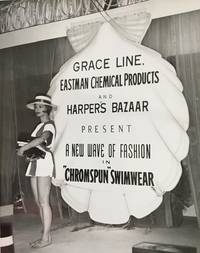
1959réf. 56594New York & Rochester NY: Grace Line Harper’s Bazaar & Eastman Chemical Products subsidiary of Eastman Kodak 1959. 4to. With 33 black & white photographs inserted in mylar sleeves. Recent flexible black vinyl cover portfolio NF exemplar w/ images having bright strong contrast. First edition of this remarkably scarce group of photos advertising the 1959 fashionable swimsuits made from Chromspun acetate yarn developed for textiles by Eastman Kodak in the early 1950s. Discovered while developing cigarette filters the yarn proved durable and elastic enough for swimsuits other apparel home furnishings and other applications. The swimsuits modeled in this show were influenced by and possibly included the very popular Rose Marie Reid line of swimwear which was heavily marketed by Harper’s Bazaar during the 1940s and 1950s and was considered to be the quintessential California swimsuit worn by such stars as Jane Russell and Sandra Dee in the first Gidget movie produced by Columbia in 1959. Represented in these photos are the swimsuits included the strapless bikini princess bubble Baby Doll often with stripes and cover-ups. Although not indicated in the photographs this fashion show was probably held on one of the new Grace Line ocean liners the Santa Rosa which was delivered in 1958 and serviced the Caribbean South America and traveled through The Saint Lawrence Seaway into the Great Lakes. See: Rose Marie Reid Glamour by Design Special Collections Exhibit Brigham Young University 2015-2016; Michael Grace The Grace Line History Cruising the Past Travel and Social History 2009; Jean Was a “Young American Goddess of Paris Couture” Jean Patchett Prose on Genesis 2020. Grace Line, Harper’s Bazaar, & Eastman Chemical Products, subsidiary of Eastman Kodak, unknown
1887réf. 55685New Haven CT & Pittsburgh PA: L. Candee & Co. H. Childs & Co. 1887. 8vo. 28 pp. Decorated title page lithographed illustrations throughout. Embossed & decorated softcovers front cover decorated & illustrated in gilt & burgundy w/ peacock feather above lettering and nicely executed lithograph on back cover of young saleswoman standing next to a rack of rubber boots & shoes for sale minor toning shelfwear very slight tidemark at upper fore-edge front cover still a VG copy. First edition of this nicely printed Victorian catalogue for rubber boots and shoes. The nicely executed lithographs promote the Hip Boots hip waders thigh high sporting boots double thick Pebble Leg Boots and Fairy Boots reminiscent of cowboy boots as well as the rubber Duck or Canvas Boot for hunting. Also included are many different styles and varieties of rubber shoes for women and children including No Heel Imitation Sandals Gossamer Imitation Sandals Buskins with cotton flannel lining Opera Dew Drop Feather Weight and many others. The company also produced tennis rubber soled shoes croquet shoes as well as heavy duty Stalwart Lumbermen’s Shoe intended to fit over logger’s Wool Boots or German Socks. Leverett Candee 1795-1863 obtained early patent rights from Goodyear for manufacturing rubber shoes as early as 1844 and by 1852 had organized the large Candee Rubber Co. factory with the Hotchkiss Brothers in New Haven and Timothy Lester. No copies located in Worldcat; See: Davis The New England States Vol. I pp. 344-346 1897; Joseph Kane Famous First Facts 1950. L. Candee & Co., [H. Childs & Co.], paperback
1910réf. 56013Chicago & Tacoma: Hart Schaffner & Marx; Dege & Milner 1910. Sml. 4to. 32 pp unpaginated. Black & white plates throughout. Colour-illustrated softcovers cover art with initials S.N.A. of young colonial woman carrying basket full of lobsters by two Redcoats slight dustsoiling minor shelfwear still an excellent copy. First edition of this scarce and nicely illustrated catalogue for Hart Schaffner & Marx clothing before World War I. The company was well known for their lavish use of colour lithography in advertising and especially their catalogues. This includes a series of exceptional artwork displaying overcoats formal dress sportswear automobile travel clothes for men and more. These motoring coats were clearly being marketed to young men and college students increasingly taking to the roads during the Brass Era. This copy was printed for the Dege & Milner department store in downtown Tacoma which was operated from 1901-1915 by James H. Dege and his partner William Milner before Dege opened the James H. Dege Co. store. Hart Schaffner & Marx; Dege & Milner, paperback
1906réf. 56017Tacoma WA: Dickson Bros. Co. 1120-1122 Pacific Ave. The Quick Print 1906. 8vo. 42 2 pp. With woodcut-engraved illustrations throughout. Pictorial light green softcovers front cover art rendering of the Dickson Bros. front facade before expansion and young college men wearing suits in Cornell dorm room minor toning to fore-edges minor curling to textblock 1 very small tear still a VG copy. First edition of this exceedingly scarce Washington department store catalogue for the Dickson Bros. Co. which expanded quickly at 1120-1144 Pacific Ave. in Tacoma WA during the first 30 years of the 20th Century. The company flourished by emphasizing ready-to-wear lines of clothing rather than tailored clothing selling Adler Bros. and Stein-Bloch suits and clothing based out of Rochester NY Stetson Hats and more. They also sold heavy denim work clothes such as Keystone railroad overalls and jackets trunks traveling bags boots shoes and more. George Dickson 1851-1935 was an active outdoorsman mountaineer and merchant in Tacoma. No copies located in Worldcat; See: George L. Dikcson’s Narrative Tacomian Jan. 7 1893. Dickson Bros. Co., 1120-1122 Pacific Ave., The Quick Print, paperback
1910réf. 56014New York & Tacoma: Samuel W. Peck & Co.; Dege & Milner 1910. 8vo. 12 pp unpaginated. Colour-illustrated title 7 colour plates text printed in red & blue w/ decorations. Gray pictorial softcovers cover art image of Atlas holding a globe in blue & gilt embossed gilt lettering & decoration fine copy. First edition of this wonderfully illustrated fashion catalogue targeting the young college man in the decade before World War I. This inventive catalogue positions models wearing Sampeck suits in front of the ancient Wonders of the World including the Pharos Lighthouse of Alexandria Pyramids of Egypt Colossus of Rhodes and more. Sampeck clothes were targeted to the virile aggressive young college man competeing with the Hart Schaffner & Marx Varsity line. This copy was printed for the Dege & Milner department store in downtown Tacoma which was operated from 1901-1915 by James H. Dege and his partner William Milner before Dege opened the James H. Dege Co. store. No copies located in Worldcat; See: Daniel Clark Creating the College Man: American Mass Magazines and Middle-Class Manhood pp. 169-170. Samuel W. Peck & Co.; Dege & Milner, paperback
1910réf. 56016New York & Tacoma: Samuel W. Peck & Co.; Dege & Milner Printed by Sherman & Bryan Inc. 1910. Sml. 4to. 16 pp unpaginated. Colour-illustrated borders & plates throughout with artwork reminiscent of children’s book illustrator Virginia Keep. Colour-illustrated softcovers cover art image of boys tossing down apples from a tree fine copy. First edition of this wonderfully illustrated fashion catalogue targeting the young boys in the decade before World War I. The illustrations depict young boys in knickers short coats and capes running carving Jack-o-Lanterns for Halloween playing with a dog and collecting chestnuts. This copy was printed for the Dege & Milner department store in downtown Tacoma which was operated from 1901-1915 by James H. Dege and his partner William Milner before Dege opened the James H. Dege Co. store. No copies located in Worldcat. Samuel W. Peck & Co.; Dege & Milner, (Printed by Sherman & Bryan, Inc.), paperback
1910réf. 56015New York & Tacoma: Alfred Benjamin & Co.; Dege & Milner 1910. 8vo. 16 pp unpaginated. Black & white plates throughout including double-page centerfold pen & ink reminiscent of work of Charles Dana Gibson. Colour-illustrated softcovers cover art of horse-drawn sleigh in the snow slight dustsoiling minor shelfwear still an excellent copy. First edition of this scarce and nicely illustrated catalogue for Alfred Benjamin & Co. fashions for men before World War I. Benjamin Clothes were famed during the opening two decades of the 20th Century for emphasizing their cosmopolitan styling and that they were wholly manufactured and tailored in New York of the highest quality. The plates show well-dressed Benjamin men on the steps of The Met next to the Franz Sigel Statue on Riverside Drive in front of their Brass Era automobile at The Abbey on Lafayette and more. This copy was printed for the Dege & Milner department store in downtown Tacoma which was operated from 1901-1915 by James H. Dege and his partner William Milner before Dege opened the James H. Dege Co. store. No copies located in Worldcat. Alfred Benjamin & Co.; Dege & Milner, paperback
1874réf. 54872Boston: C.F. Hovey & Co. 1874. Folio. 13.5 x 11 in. 36 pp. 1 59 1 leaves. first 36 pp. incorporating title Memorandum pages several ALS letters and invoices on letterhead 8 pp. on graph paper w/ samples incorporated into the text 2 additional leaves of tissue thin manuscript copies from blotter 925 original fabric samples pinned-in glued-in and laid in sized from .5 x .5 in. up to 6 x 13 in. including a myriad of colours tartans plaids flannels silk blends cottons poplin cottons woolens etc. Original plum-coloured factory sample book purchased by Hovey from stationer P.L. Morin Paris who specialized in producing blank scrapbooks for factory sample cards printing & stationery registers w/ label mounted on front pastedown worn rubbing spine perished hinges loosed somewhat shaken still a remarkable unsophisticated exemplar preserved in folding case. This exceptional Victorian fabric sample order book assembled by a buyer for C.F Hovey & Co.’s fall fashion season furnishes an invaluable time capsule of colours textures and preferences in the 1870s. This era in women’s fashion driven by Parisian and other European design houses demanded extraordinary amounts of fabrics with an emphasis on the back of the skirt long trains and fabric draped up into bustles with an abundance of flounces and ruching. More significantly there was a tremendous growth in patterned poplin fabrics bright cotton & silk fabric blends as well as brilliant jewel colours. This order book with hundreds of different samples also offers a fantastic peek into the Victorian obsession with tartans and plaids driven by the mystique and example of Queen Victoria the ever-growing popularity with the historical romances of Sir Walter Scott celebrating the Highlanders and the poetry of Robert Burns. Tartan and plaid patterns were used in gowns dresses shawls veils hats purses and many fashion houses would often choose a particular clan pattern to celebrate and promote in their sales literature. Men’s suits coats and jackets were buttoned high on the chest the woolens became lighter weight and more durable as well of better quality and fashion designers for Hovey & Co. also incorporated rough finish woolens twills and tweeds into their clothing offered for sale. Many of the fabrics were also sold in Hovey & Co. fabric department in assorted lengths as well as ends for uses by Victorian women in home craft projects. Johnson focused on buying in the major wholesale textile dealers and markets of Europe during the 1870s including Stavert Tigomala & Co. one of the largest textile commission houses in Bradford UK; Firth Booth & Co. who specialized in bright cotton poplin plaids tartans wool blends and moire; Chamberlin Donner & Co. of Manchester one of the largest wholesale merchant houses shippers & traders in the British Empire; A. Van Bergen & Co. in Paris France whose beautifully patterned cotton and silk blends and woolens were enhanced by the award-winning dyes of Blanche at Puteaux; Les Fils de Th. Le Grand with wool blends twills and rough finish woolens. The sizes of the orders were remarkable and show the strength of Hovey’s customer base with one pair of invoices showing orders from Firth Booth & Co. totaling £ 7785 or over £ 855000 in present day value. However as evidenced by letter from Charles Kretschmann in Berlin who notes that Johnson in his June 24 1874 visit was “not pleased with the Berlin style of garments for this season and ordered only a very small lot”C.F. Hovey & Co. was founded by Charles Fox Hovey in 1833 as a dry goods merchant and with in a few years became a large department store located on Summer St. Through the years up to his death in 1859 he brought on many partners and was an ardent abolitionist and supporter of women’s rights establishing the Hovey Fund. After his death in 1859 Thomas Mack and Augustus De Puyster took over the running of the company and expansion through the Civil War. Johnson 1839-1927 was a Harvard grad clerk for Hovey & Co. and Civil War Veteran who rose from 1st Lieutenant in Co. H. Massachusetts 44th Infantry to Full Adjutant before mustering out right before Gettysburg. Hovey & Co. survived the massive fire of 1872 by employees soaking all the woolen blankets on the sales counters in water and placing over the roof and windows to protect the building from the flowing cinders expanded into store fronts on Chauncy and Avon Streets and was the first retailer to adopt the policy of requiring monthly payments on credit accounts. See: The History of the House of Hovey 1919; Charles Boston Looking Back at C.F. Hovey’s of Boston Shopping Days in Retro Boston May 6 2011; History of Fashion 1840-1900 Victoria and Albert Museum 2016. C.F. Hovey & Co., hardcover