Antiquariat.de
TRUBBIANI, Valeriano (Macerata, 1937),MareMagnum
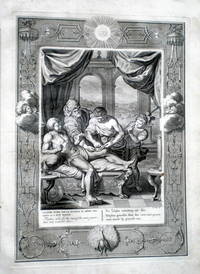
Tecnica del supplizio N.4
Acquaforte Firma a matita. Esemplare 8/100. Cm 50x35. . . Ottimo (Fine). . Tiratura 100. .

Libreria Marini · Italie120,00 €
10 194 résultats
1874réf. 1399DBZürich, o.J. (um 1874). Gr.-8°. 39(1) S. Mit 1 gefl. u. farb. Karte. Orig.-Broschur. + Wichtig: Für unsere Kunden in der EU erfolgt der Versand alle 14 Tage verzollt ab Deutschland / Postbank-Konto in Deutschland vorhanden +
Acquaforte Firma a matita. Esemplare 8/100. Cm 50x35. . . Ottimo (Fine). . Tiratura 100. .
1924- s.d. (1924), 93x78mm, autre. - Tehura. Original proof engraved after the painting "Merahi Metua no Tehamana". Intermediate state for Noa Noa [between 1904 & 1924] | 9,3 x 7,8 cm | one sheet Original proof, likely unique, of this intermediate state of "Tehura", wood drawn and engraved after Paul Gaughin's painting "Merahi Metua no Tehamana" by George-Daniel de Monfreid. Print on fine cream laid paper, annotation by the artist in the left-hand margin. The definitive wood served as the head of chapter VI, "Le Conteur parle", page 81 of the true first edition of Noa Noa published by Crès in 1924, the first illustrated work from Paul Gauguin and a majestic tribute to one of the precursors of modern art. A most important and very first woodcut of Gauguin's masterpiece, engraved by his closest friend and executor, artist George-Daniel de Monfreid, to whom Gauguin offered the painting after two unsuccessful exhibitions. Likely unique proof, part of 17 known test prints from the project to publish prematurely Noa Noa, all made on various fine papers and annotated by the artist. Precious woodcut after Gauguin's masterpiece Merahi metua no Tehamana, showing the painter's wife, his main tahitian model. It is from the original illustrated manuscript of Noa Noa, brought back from Tahiti by Segalen on the artist's death in 1903, that Monfreid began producing this fundamental work from as early as 1904. This is the second version of this "to read and look at" notebook. The first manuscript, written on the return of his first voyage and entrusted by Gauguin to Charles Morice in 1893, responded to a different project. Gauguin had composed only the text, interspersed with blank pages for Morice's poems. But after several years without news, Morice preferred to publish a version entirely rewritten by himself in 1901. Gauguin, therefore, copied his manuscript and illustrated it during his second stay in Polynesia, with sketches, watercolors and collages. This album, that the artist enriched and safely preserved until his death, is preserved today at the Musée d'Orsay. It is, therefore, from this manuscript, the only one illustrated, that Monfreid composed the edition of Gauguin's Noa Noa. However, although Monfreid's publication was forward, it took more than twenty years to complete, in part due to a copyright dispute with Charles Morice who wanted to be co-author of the forthcoming edition and whose poems would eventually be preserved. The result of several years of reflection and work, the 1924 edition is both faithful to the watercolors and woodcut engravings illustrating the precious manuscript, and to the whole of Gauguin's Tahitian work, who died in indifference. Monfreid thus engraves several drawings from the original notebook and enriches it with woodcuts made from other works of which he is the custodian. Some of these compositions combine several paintings, while scrupulously respecting the artist's line, transforming the work into a true journey through the painter's works. The very choice of using wood engraving is a tribute to this technique prized by Gauguin, who, in Pont-Aven, produced 10 woodcuts to illustrate his manuscript between his two Polynesian stays. The intermediate woodcuts, until then unknown, testify to the slow work of composition to restore the artistic richness of Gauguin's work by his most faithful artistic companion and first champion: "When I saw Gauguin for the first time, I was greatly disconcerted by the details of art that radiated from his works as well as from the conversations of this extraordinary man... You immediately felt that he was the Master" (in L'Hermitage, 1903). [FRENCH VERSION FOLLOWS] Epreuve originale probablement unique de cet état intermédiaire de "Tehura", bois dessiné et gravé d'après le tableau Merahi metua no tehamana de Paul Gauguin par Georges-Daniel de Monfreid. Tirage sur vergé crème fin, annotation de l'artiste au crayon en marge gauche. Le bois définitif servira
1924réf. 78250s. d. [1924] | 9.30 x 7.80 cm | autre
1984340x245 mm. 207 pages. Hardcover. Cover slightly yellowing and slightly stained. Rear cover slightly scratched. Cover corners slightly bumped. Cover edges slightly worn. Spine yellowing and slightly stained. Spine edges slightly bumped and slightly worn. Inner cover and few pages slightly stained with no damage to text. Else in good condition. PLEASE NOTE: This item is overweight. We may ask for extra shipping costs.
1731réf. biblio305Amsterdam: Chatelain 1731. Gravure sur cuivreLa feuille = 310 X 460 mm la cuvette = 255 x 352 mm quelques rousseurs en marge image propre Chatelain unknown
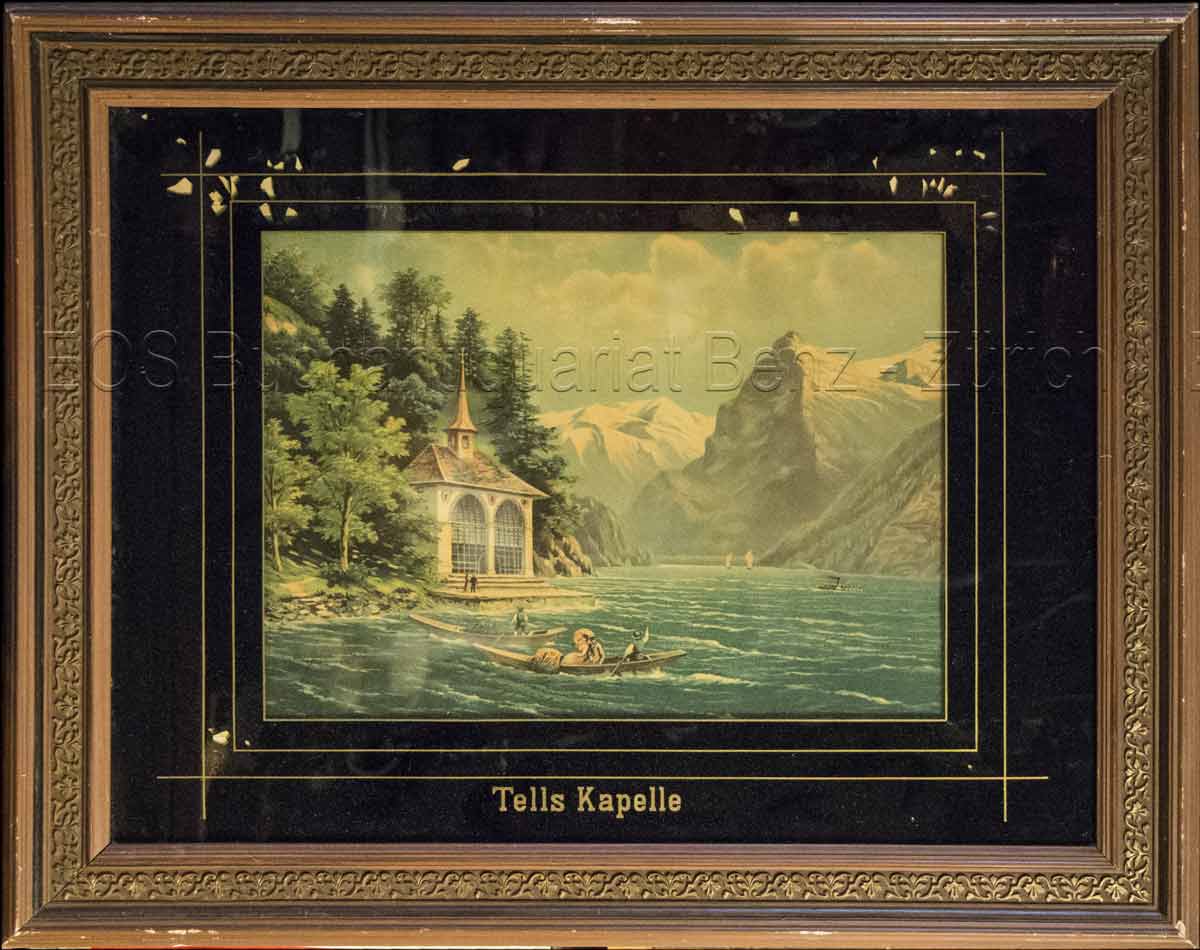
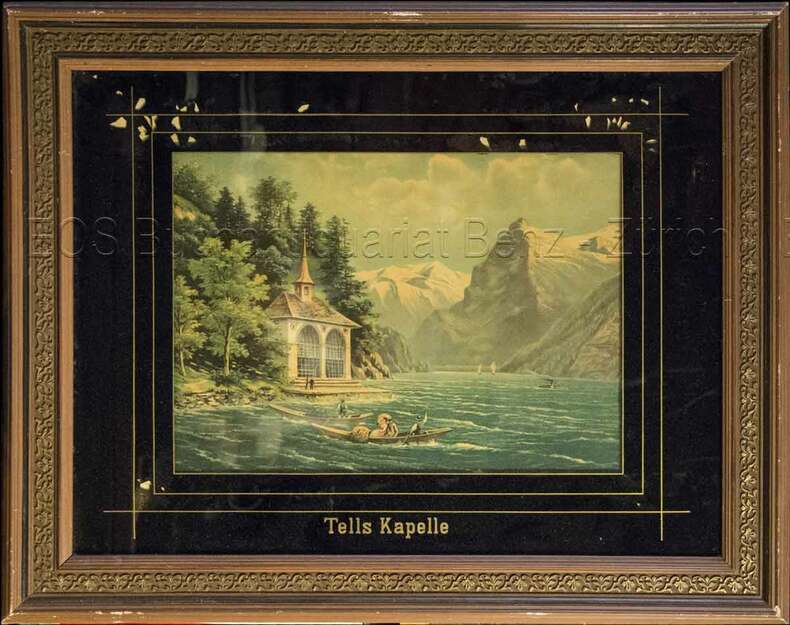
1860réf. 824CG(um 1860). Chromolithographie hinter Glas. Bildausschnitt: 24 x 33 cm. + Wichtig: Für unsere Kunden in der EU erfolgt der Versand alle 14 Tage verzollt ab Deutschland / Postbank-Konto in Deutschland vorhanden +, Abb.
1860réf. 824CG(um 1860). Chromolithographie hinter Glas. Bildausschnitt: 24 x 33 cm.
Ca. 477 x 326 mm (neat line). Etching on paper. Only known specimen of an anonymous copy after Georg Daniel Heumann’s monumental 1735 copper print engraving based on a design by Salomon Kleiner, with additional portraits of Empress Maria Theresa and the later Emperor Joseph II and his wife. This faithful, though qualitatively inferior copy was probably made on the occasion of the wedding of Archduke Joseph of Austria and Princess Isabella of Parma on 6 October 1760 in Vienna. The couple is shown in a double portrait presented by a crowned eagle flying on the right side of the tower. They are opposed by a similarly presented profile portrait of Maria Theresa on the left side. Superimposed, the two medallion-bearing eagles would form the double-headed Habsburg eagle. - Joseph's first and happiest marriage lasted only three years, as Isabella died of smallpox on 27 November 1763 at the age of 21, leaving behind a devastated widower. 1763 is thus the latest possible date for the creation of this beautiful etching. - Good impression with some minor stains and a larger brown stain to the upper left margin.
réf. awd-278Lithographie en couleurs sur Arches justifiée à 100 ex. et signée. Vers 1980 (54,5/80 cm). Bon état.
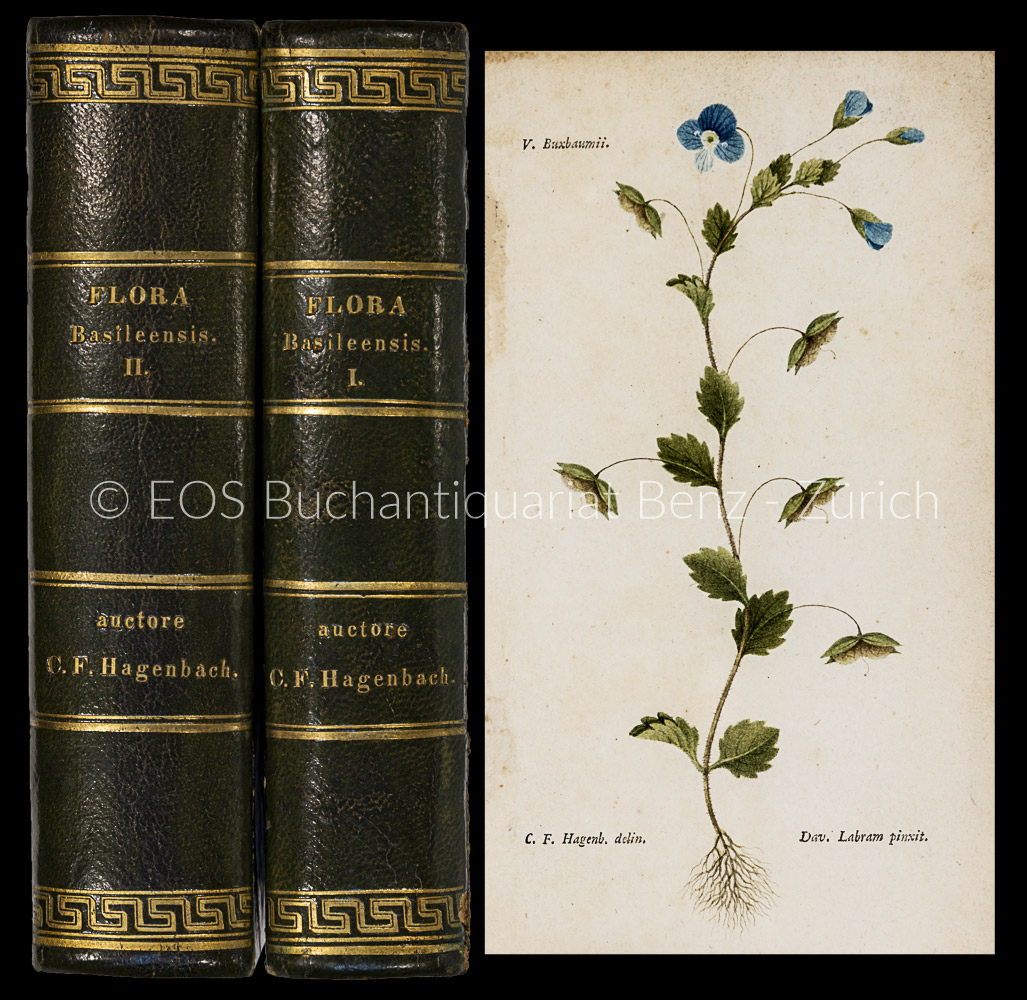
1821réf. 40532DBBasel, J. Georg Neukirch, 1821?1843. 8°. XVIII, 450 S., 1 Bl.; VIII, 537 S; 2 Bl, 220 S. Mit einem gestochenen Portrait im ersten Band, 2 kol. lithograph. Tafeln in Band eins und einer lithograph., kol. Tafel im Supplement von Labram. Grüne Halblederbände aus der Zeit mit klassizistischer Rückenvergoldung. + Wichtig: Für unsere Kunden in der EU erfolgt der Versand alle 14 Tage verzollt ab Deutschland / Postbank-Konto in Deutschland vorhanden +, A|B 2 Bände + Supplement in 2 Bänden. [2 Warenabbildungen]
1821réf. 40532DB2 Bände + Supplement in 2 Bänden. Basel, J. Georg Neukirch, 1821–1843. 8°. XVIII, 450 S., 1 Bl.; VIII, 537 S; 2 Bl, 220 S. Mit einem gestochenen Portrait im ersten Band, 2 kol. lithograph. Tafeln in Band eins und einer lithograph., kol. Tafel im Supplement von Labram. Grüne Halblederbände aus der Zeit mit klassizistischer Rückenvergoldung.
1821réf. 4145BBBasel, J. Georg Neukirch, 1821 u. 1834. 8°. XVIII, 450 (2) S.; VIII, 537 (1) S. Mit 2 kol. gest. Tafeln von Labram. Halblederbände der Zeit mit floraler Rückenvergoldung u. goldgepr. Rückenschildchen. + Wichtig: Für unsere Kunden in der EU erfolgt der Versand alle 14 Tage verzollt ab Deutschland / Postbank-Konto in Deutschland vorhanden + 2 Bände.
1821réf. 4145BB2 Bände. Basel, J. Georg Neukirch, 1821 u. 1834. 8°. XVIII, 450 (2) S.; VIII, 537 (1) S. Mit 2 kol. gest. Tafeln von Labram. Halblederbände der Zeit mit floraler Rückenvergoldung u. goldgepr. Rückenschildchen.
Linoleumgrafia dalla cartella ''Terra tonda africana'' Firma, data e numerazione a matita. Stampatore: Giorgio Upiglio, Grafica Uno, Milano. Stampa su carta Duchene. Timbri a secco dello stampatore e dell'Artista. Esemplare I/VIII. cm 29,7x40 (Foglio cm 38x50). . . Perfetto (Mint). . Tiratura 30 + VIII esemplari. .
Linoleumgrafia dalla cartella ''Terra tonda africana'' Firma, data e numerazione a matita. Stampatore: Giorgio Upiglio, Grafica Uno, Milano. Stampa su carta Duchene. Timbri a secco dello stampatore e dell'Artista. Esemplare IV/VIII. cm 31,4x39,5 (Foglio cm 38x50). . . Perfetto (Mint). . Tiratura 30 + VIII esemplari. .
Linoleumgrafia dalla cartella ''Terra tonda africana'' Firma, data e numerazione a matita. Stampatore: Giorgio Upiglio, Grafica Uno, Milano. Stampa su carta Duchene. Timbri a secco dello stampatore e dell'Artista. Esemplare IV/VIII. cm 29,7x39,7 (Foglio cm 38x50). . . Perfetto (Mint). . Tiratura 30 + VIII esemplari. .
Cartella con 6 acqueforti originali, numerate e firmate (da cm 12,5x18,5 a 23,5x29,5), tirate a braccia con torchio a stella nella stamperia del lanzello. Una poesia di Angelo Mistrangelo. Presentazione di Pierluigi Sacco Botto . Folio (cm 54x39). . . Ottimo (Fine). . Edizione originale di 30 es. numerati. .
2002réf. 012914NY: Two Palms Pess 2002. 1st Edition. Soft cover. Near Fine. Portfolio of reproductions of 12 wood engravings 13 loose sheets with Winter's images on the left side of the sheet and Tallman's writings on the right. Some rubbing to title page else near fine. Two Palms Pess unknown
2002réf. 012914NY: Two Palms Pess 2002. 1st Edition. Soft cover. Near Fine. Portfolio of reproductions of 12 wood engravings 13 loose sheets with Winter's images on the left side of the sheet and Tallman's writings on the right. Some rubbing to title page else near fine. Two Palms Pess unknown books
1780Gestochene Kupferplatte (118:66 mm). Kupferplatte mit zwei Andachtsbildchen: das Minoritenwappen (ein bloßer und ein kuttentragender Arm mit Stigmata vor einem Kreuz, von einem Strick umkränzt) sowie der Hl. Franziskus, kniend und die Stigmata empfangend. Unter der letzteren Darstellung findet sich die Legende, die auf den schon 1221 begründeten Dritten Orden der Franziskaner hinweist.
1924- Lucien Vogel éditeur, Paris 1924-1925, 18x24cm, une feuille. - Original color print, printed on vergé paper, signed in the plate. An original print used to illustrate the Gazette du bon ton, one of the most attractive and influential 20th century fashion magazines, featuring the talents of French artists and other contributors from the burgeoning Art Deco movement. A celebrated fashion magazine established in 1912 by Lucien Vogel, La Gazette du bon ton appeared until 1925, with a hiatus from 1915 to 1920 due to the war (the editor-in-chief having been called up for service). It consisted of 69 issues printed in only 2,000 copies each and notably illustrated with 573 color plates and 148 sketches of the models of the great designers. Right from the start, this sumptuous publication "was aimed at bibliophiles and fashionable society," (Françoise Tétart-Vittu, "La Gazette du bon ton", in Dictionnaire de la mode, 2016) and was printed on fine vergé paper using a type cut specially for the magazine by Georges Peignot, known as Cochin, later used (in 1946) by Christian Dior. The prints were made using stencils, heightened in colors, some highlighted in gold or palladium. The story began in 1912, when Lucien Vogel, a man of the world involved in fashion (he had already been part of the fashion magazine Femina) decided, with his wife Cosette de Brunhoff - the sister of Jean, creator of Babar - to set up the Gazette du bon ton, subtitled at the time: "Art, fashion, frivolities." Georges Charensol noted the reasoning of the editor-in-chief: "'In 1910,' he observed, 'there was no really artistic fashion magazine, nothing representative of the spirit of the time. My dream was therefore to make a luxury magazine with truly modern artists...I was assured of success, because when it comes to fashion, no country on earth can compete with France.'" ("Un grand éditeur d'art. Lucien Vogel" in Les Nouvelles littéraires, no. 133, May 1925). The magazine was immediately successful, not only in France but also in the United States and Latin America. At first, Vogel put together a team of seven artists: André-Édouard Marty and Pierre Brissaud, followed by Georges Lepape and Dammicourt, as well as eventually his friends from school and the School of Fine Arts, like George Barbier, Bernard Boutet de Monvel and Charles Martin. Other talented people soon came flocking to join the team: Guy Arnoux, Léon Bakst, Benito, Boutet de Monvel, Umberto Brunelleschi, Chas Laborde, Jean-Gabriel Domergue, Raoul Dufy, Édouard Halouze, Alexandre Iacovleff, Jean Émile Laboureur, Charles Loupot, Chalres Martin, Maggie Salcedo. These artist, mostly unknown when Lucien Vogel sought them out, later became emblematic and sought-after artistic figures. It was also they who worked on the advertising drawings for the Gazette. The plates put the spotlight on, and celebrate, dresses by seven designers of the age: Lanvin, Doeuillet, Paquin, Poiret, Worth, Vionnet and Doucet. The designers provided exclusive models for each issue. Nonetheless, some of the illustrations are not based on real models, but simply on the illustrator's conception of the fashion of the day. The Gazette du bon ton was an important step in the history of fashion. Combining aesthetic demands with the physical whole, it brought together - for the first time - the great talents of the artistic, literary, and fashion worlds; and imposed, through this alchemy, a completely new image of women: slender, independent and daring, which was shared by the new generation of designers, including Coco Chanel, Jean Patou, Marcel Rochas, and so on... Taken over in 1920 by Condé Montrose Nast, the Gazette du bon ton was an important influence on the new layout and aesthetics of that "little dying paper" that Nast had bought a few years earlier: Vogue. [FRENCH VERSION FOLLOWS] Estampe originale en couleur, tirée sur papier vergé, signée en haut à gauche de la planche. Gravure originale réalisée pour l'illustration d
1924réf. 55198Lucien Vogel éditeur | Paris 1924-1925 | 18 x 24 cm | une feuille
19268vo., First Edition thus, with engraved frontispiece, 40 engravings (a number full-page) and large folding map; elegantly bound in full dark green crushed morocco, sides with gilt frame border, back with raised bands, second and fourth compartments lettered and ruled in gilt, all other compartments tooled in gilt, gilt edges, gilt doublures, hand-made endpapers, ribbon marker, in custom-made marbled slip-case, an elegant copy ideal as a gift or for presentation. navy buckram, gilt back, bevelled boards, gilt top, covers very lightly age-soiled. backstrip sunned (but all gilt wholly legible) else a very good, bright, clean copy. EDITION LIMITED TO 1500 COPIES. Printed from the plates of Macmillan's definitive Wessex Edition and so including both the expanded Preface of 1912 and the episode of the dance at the hay-trusser's (pp.76-79) present there for the first time. See Purdy p.77.
19268vo., First Edition thus, with engraved frontispiece, 40 engravings (a number full-page) and large folding map, neat contemporary signatures on front paste-down; original navy buckram, bevelled boards, gilt back, gilt top, uncut, boards very lightly age-marked, backstrip mildly faded (but all gilt wholly legible), a bright, clean, crisp copy. EDITION LIMITED TO 1500 COPIES. With the trade ticket of Gilbert of Southampton on front paste-down. Printed from the plates of Macmillan's definitive Wessex Edition and so including both the expanded Preface of 1912 and the episode of the dance at the hay-trusser's (pp.76-79) present there for the first time. See Purdy p.77.