Michel, Emile. (Editor).MareMagnum
V. V. StechLivre Rare Book
REMBRANDT. Dessins et Gravures.
réf. ART664M1964 / 39 pages de texte + 55 planches. Relié avec jaquette. Editions Cercle d'Art.

Librairie du Levant · Bayonne, France70,00 €
10 207 résultats
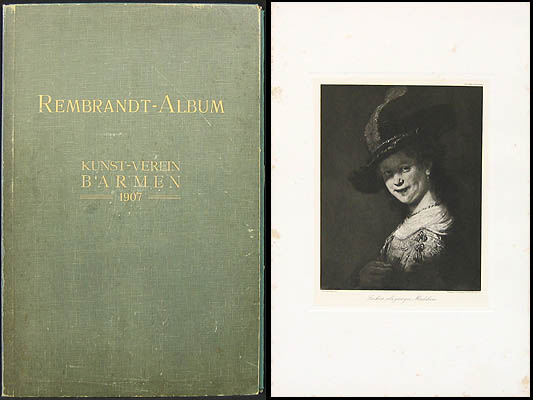
1907pp. 188 + Plus Thirty tipped in color reproductions and 40 high quality Photogravures with descriptions. Decorated half title. First few signatures foxed. Text very faintly beginning to brown at edges. Small folio. Original full cloth binding with paper label. Binding is in poor condition and should be rebound. ART 2
réf. ART664M1964 / 39 pages de texte + 55 planches. Relié avec jaquette. Editions Cercle d'Art.
1906réf. 38304ABBerlin, Meisenbach Riffarth & Co./Kunstverein Barmen, [1906]. Folio. 49 cm. 5 Blatt. Original-Leinenmappe. Maße. 49 x 32,5 cm. Goldgeprägter Deckeltitel.
1967Book shows light wear only to bright red covers with gilt print at front and spine. Binding is solid and square, text/interior is clean and free of marking of any kind with prev. owner's name at front end paper and stamp on title page. 190 pages with 66 illustrations, mostly b&w prints. Dust jacket has small open tears, edge wear. Contents include: Rembrandt and the jews come to Amsterdam, Portraits of jew, Scenes of Jewish daily life, the Bible.
1991This is a very good softcover copy, almost fine, but for a bit of shelfwear to the covers. Spine not creased. Completely clean inside and out. This catalog was prepared to accompany the travelling exhibition, which came to the National Gallery in Washington in the spring of 1992. The show originated in Berlin. The three largest collections of Rembrandt etchings are in Berlin, Amsterdam and London. 40 etchings in the show. All illustrated in black & white. Extensive entries. Bibliography. 11" high X 10" wide, 136 pages. A beautiful copy.
1870réf. 7967Épreuve rognée , sans marges. IFF 32. Béraldi 270. Paris 1870 17,3 x 13,7 cm au trait carré.
réf. 1528140834.Gpaperback. Good. Access codes and supplements are not guaranteed with used items. May be an ex-library book. paperback
réf. 025947262X.Gpaperback. Good. Access codes and supplements are not guaranteed with used items. May be an ex-library book. paperback
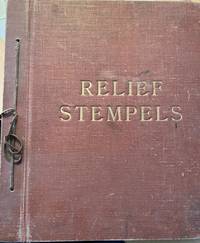
réf. ZZ90526Album 33 x 28 cm with 20 pages of relief stamps. The first 7 pages are filled with monograms stamps thereafter some names and French logo's in relief print. The last pges with address stamps in relief mainly Dutch and many in The Hague Den Haag.Unique collection.Unieke collectie van relief stempels frans en nederlands prachtige monogrammen. 20 pagina's gevuld met relief drukwerk. unknown
réf. 198110 planches, et un dessin originale Pochette in 4, exemplaire d'épreuve contenant dix estampes légendés et numérotés à la main par Jean Bruller, un des trente tirages de têtes sur papier canson n°27.Avec un dessin originale de Jean Bruller.
1921- Lucien Vogel éditeur, Paris 1921, 18x24cm, une feuille. - Original color print, printed on vergé paper, signed in the plate. An original print used to illustrate the Gazette du bon ton, one of the most attractive and influential 20th century fashion magazines, featuring the talents of French artists and other contributors from the burgeoning Art Deco movement. A celebrated fashion magazine established in 1912 by Lucien Vogel, La Gazette du bon ton appeared until 1925, with a hiatus from 1915 to 1920 due to the war (the editor-in-chief having been called up for service). It consisted of 69 issues printed in only 2,000 copies each and notably illustrated with 573 color plates and 148 sketches of the models of the great designers. Right from the start, this sumptuous publication "was aimed at bibliophiles and fashionable society," (Françoise Tétart-Vittu, "La Gazette du bon ton", in Dictionnaire de la mode, 2016) and was printed on fine vergé paper using a type cut specially for the magazine by Georges Peignot, known as Cochin, later used (in 1946) by Christian Dior. The prints were made using stencils, heightened in colors, some highlighted in gold or palladium. The story began in 1912, when Lucien Vogel, a man of the world involved in fashion (he had already been part of the fashion magazine Femina) decided, with his wife Cosette de Brunhoff - the sister of Jean, creator of Babar - to set up the Gazette du bon ton, subtitled at the time: "Art, fashion, frivolities." Georges Charensol noted the reasoning of the editor-in-chief: "'In 1910,' he observed, 'there was no really artistic fashion magazine, nothing representative of the spirit of the time. My dream was therefore to make a luxury magazine with truly modern artists...I was assured of success, because when it comes to fashion, no country on earth can compete with France.'" ("Un grand éditeur d'art. Lucien Vogel" in Les Nouvelles littéraires, no. 133, May 1925). The magazine was immediately successful, not only in France but also in the United States and Latin America. At first, Vogel put together a team of seven artists: André-Édouard Marty and Pierre Brissaud, followed by Georges Lepape and Dammicourt, as well as eventually his friends from school and the School of Fine Arts, like George Barbier, Bernard Boutet de Monvel and Charles Martin. Other talented people soon came flocking to join the team: Guy Arnoux, Léon Bakst, Benito, Boutet de Monvel, Umberto Brunelleschi, Chas Laborde, Jean-Gabriel Domergue, Raoul Dufy, Édouard Halouze, Alexandre Iacovleff, Jean Émile Laboureur, Charles Loupot, Chalres Martin, Maggie Salcedo. These artist, mostly unknown when Lucien Vogel sought them out, later became emblematic and sought-after artistic figures. It was also they who worked on the advertising drawings for the Gazette. The plates put the spotlight on, and celebrate, dresses by seven designers of the age: Lanvin, Doeuillet, Paquin, Poiret, Worth, Vionnet and Doucet. The designers provided exclusive models for each issue. Nonetheless, some of the illustrations are not based on real models, but simply on the illustrator's conception of the fashion of the day. The Gazette du bon ton was an important step in the history of fashion. Combining aesthetic demands with the physical whole, it brought together - for the first time - the great talents of the artistic, literary, and fashion worlds; and imposed, through this alchemy, a completely new image of women: slender, independent and daring, which was shared by the new generation of designers, including Coco Chanel, Jean Patou, Marcel Rochas, and so on... Taken over in 1920 by Condé Montrose Nast, the Gazette du bon ton was an important influence on the new layout and aesthetics of that "little dying paper" that Nast had bought a few years earlier: Vogue. [FRENCH VERSION FOLLOWS] Estampe originale en couleur, tirée sur papier vergé, signée en bas à droite de la planche. Gravure originale réalisée pour l'illustration de La G
1921réf. 54842Lucien Vogel éditeur | Paris 1921 | 18 x 24 cm | une feuille
1793A Londres, chez l'imprimeur J. Smeeton, dans la rue Saint Martin, 1793. In-4 relié plein veau brun, dos lisse à fleurons allégoriques dorés, plats encadrés d'une guirlande de fines branches dorées, gardes de papier marbrés, roulette dorés intérieure, toutes tranches dorées. 38 pages + superbe estampe aquarellée de Antonio Césare de POGGI, dessinateur, peintre d'histoire et éditeur, dépliante au format de 38 x 51 centimètres (40 pouces x 26, mesure du pied d'Angleterre, datée du 25 may 1792, légendes en marge. L'estampe, dessinée sur place en 1783, est d'une très grande finesse, elle a été gravée par Mr. Pouncey, graveur anglais, travail qui a demandé plus de 7 années. En tête d'ouvrage, on trouve la liste des souscripteurs pour l'estampe (Le Roi et la Reine de Grande Bretagne, les noms des Altesses Royales, etc) sur 8 pages, s'en suit un avertissement à la date du 6 mai 1793 de 4 pages, puis "Lettre de Mr. Le Chevalier Foulis, Major de la Place de Gibraltar, sur la SORTIE faite par la Garnison de cette Place le matin du 27 novembre 1781, adressée à M+++.", 10 pages. Ensuite "Description alphabétique de l'Estampe représentant la sortie faite par la Garnison de Gibraltar dans la matinée du 27 novembre 1781", 11 pages . + Un tableau "Disposition et forces du détachement. Brigadier Général Ross". L'ouvrage se termine sur 2 pages de P.S. (post-sciptum), qui contient les remerciements de Mr. de Poggi à ceux qui lui ont apporté aide pour la résalisation de l'estampe. La reliure est un peu frottée, coins émoussés, petits manques de cuir en tête et en queue, l'exemplaire est à grandes marges, ne présente que quelques rousseurs en page de titre sans gravité, l'estampe présente une déchirure sans manque anciennement restaurée avec du papier collant, un petit trou sans manque à une pliure et une tache brune à une pliure en partie supérieure. Le dessin est d'une remarquable finesse. Malgré les petits défauts signalés, cet ouvrage très rare, est en bon état.
1793réf. 123773chez l'Imprimeur J. Smeeton A Londres, chez l'imprimeur J. Smeeton, dans la rue Saint Martin, 1793. In-4 relié plein veau brun, dos lisse à fleurons allégoriques dorés, plats encadrés d'une guirlande de fines branches dorées, gardes de papier marbrés, roulette dorés intérieure, toutes tranches dorées. 38 pages + superbe estampe aquarellée de Antonio Césare de POGGI, dessinateur, peintre d'histoire et éditeur, dépliante au format de 38 x 51 centimètres (40 pouces x 26, mesure du pied d'Angleterre, datée du 25 may 1792, légendes en marge. L'estampe, dessinée sur place en 1783, est d'une très grande finesse, elle a été gravée par Mr. Pouncey, graveur anglais, travail qui a demandé plus de 7 années. En tête d'ouvrage, on trouve la liste des souscripteurs pour l'estampe (Le Roi et la Reine de Grande Bretagne, les noms des Altesses Royales, etc) sur 8 pages, s'en suit un avertissement à la date du 6 mai 1793 de 4 pages, puis "Lettre de Mr. Le Chevalier Foulis, Major de la Place de Gibraltar, sur la SORTIE faite par la Garnison de cette Place le matin du 27 novembre 1781, adressée à M+++.", 10 pages. Ensuite "Description alphabétique de l'Estampe représentant la sortie faite par la Garnison de Gibraltar dans la matinée du 27 novembre 1781", 11 pages . + Un tableau "Disposition et forces du détachement. Brigadier Général Ross". L'ouvrage se termine sur 2 pages de P.S. (post-sciptum), qui contient les remerciements de Mr. de Poggi à ceux qui lui ont apporté aide pour la résalisation de l'estampe. La reliure est un peu frottée, coins émoussés, petits manques de cuir en tête et en queue, l'exemplaire est à grandes marges, ne présente que quelques rousseurs en page de titre sans gravité, l'estampe présente une déchirure sans manque anciennement restaurée avec du papier collant, un petit trou sans manque à une pliure et une tache brune à une pliure en partie supérieure. Le dessin est d'une remarquable finesse. Malgré les petits défauts signalés, cet ouvrage très rare, est en bon état.
réf. 63950Hamburg Berendsohn ca. 1850. . Trachtendarstellung in feinem Altkolorit und mit Eiweißhöhung. Die eindrucksvolle schwarze Uniform mit Schnallenschuhen halblanger Pumphose Jacke Kummerbund hüftlangem Plissee-Umhang gefälteltem weißen Kragen Degen und gepuderter Perücke trugen die Diener zu Leichenbegängnissen.- Gering gebräunt verso kleiner Sammlerstempel Hamburg, Berendsohn, [ca. 1850]. unknown
réf. 63952Eindrucksvolle Szene aus einem Hamburger Leichenbegängnis bei dem dem vierspännigen "Himmelwagen" ein offenen Gefährt auf dem der Sarg zum Friedhof trans portiert wurde sage und schreibe 12 "reitende Diener" - in ihren prächtigen schwarzen Uniformen mit Degen und gepuderten Perücken - zu Fuß folgen. Etwas gebräunt Trockenstempel halb beschnitten kl. Eckeabriß im oberen weißen Rand unknown
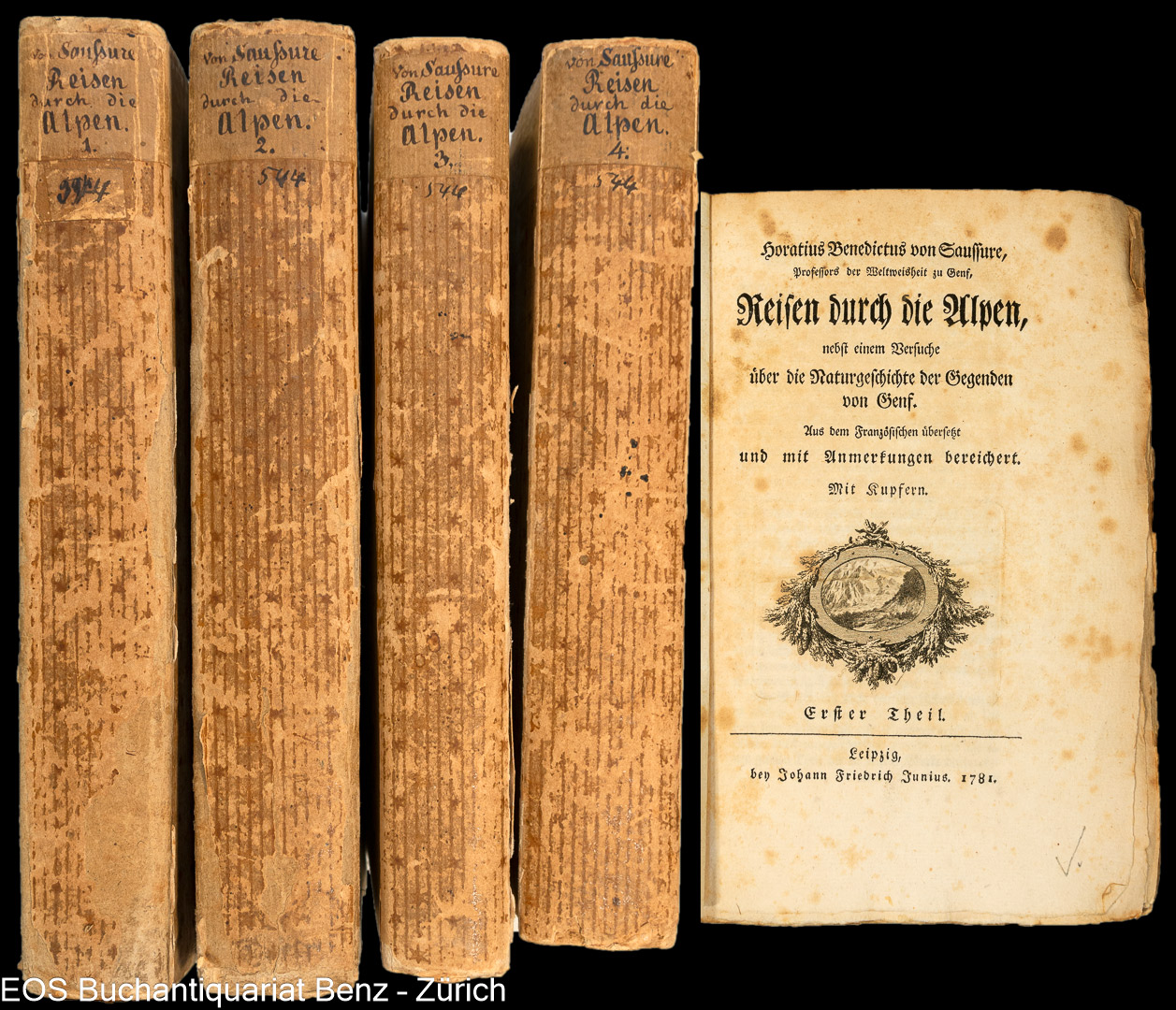
1781réf. 29805ABLeipzig, Johann Friedrich Junius, 1781-1788. 8°. XXVI, (2), 298 S.; X, (2), 327 S.; VIII, 310 S.; (4), 433 S. Mit 2 gef. Karten, 14 (davon 13 gef.) Kupfertafeln. Pappbände der Zeit mit Kleisterpapierbezug und handschr. Rückenschildern. + Wichtig: Für unsere Kunden in der EU erfolgt der Versand alle 14 Tage verzollt ab Deutschland / Postbank-Konto in Deutschland vorhanden +, 29805AB|29805AB_2|29805AB_3 4 Bände. [3 Warenabbildungen]
1781réf. 29805AB4 Bände. Leipzig, Johann Friedrich Junius, 1781–1788. 8°. XXVI, (2), 298 S.; X, (2), 327 S.; VIII, 310 S.; (4), 433 S. Mit 2 gef. Karten, 14 (davon 13 gef.) Kupfertafeln. Pappbände der Zeit mit Kleisterpapierbezug und handschr. Rückenschildern.
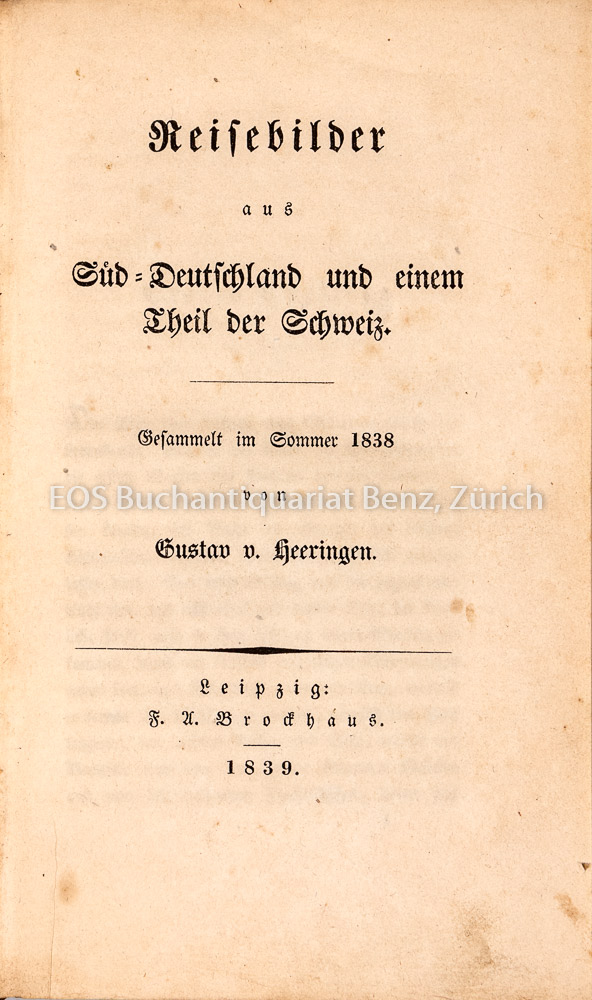
1939réf. 6699CBLeipzig, F. A. Brockhaus, 1939. 8° (4), 374, (1) S. Halblederband der Zeit. + Wichtig: Für unsere Kunden in der EU erfolgt der Versand alle 14 Tage verzollt ab Deutschland / Postbank-Konto in Deutschland vorhanden +, A|B
1939réf. 6699CBLeipzig, F. A. Brockhaus, 1939. 8° (4), 374, (1) S. Halblederband der Zeit.
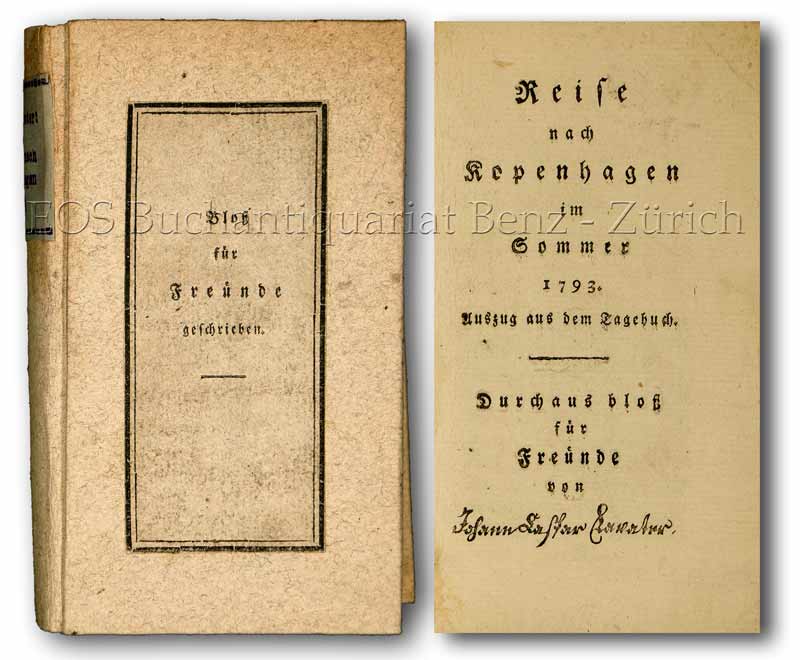
1794réf. 5958CBO.O., o. Dr., (1794). 12°. Titel, (S. 13)-449. Späterer Pappband, Titel der Orig.-Broschur ausgeschnitten und montiert. + Wichtig: Für unsere Kunden in der EU erfolgt der Versand alle 14 Tage verzollt ab Deutschland / Postbank-Konto in Deutschland vorhanden +, Einband und Titelblatt
1794réf. 5958CBO.O., o. Dr., (1794). 12°. Titel, (S. 13)-449. Späterer Pappband, Titel der Orig.-Broschur ausgeschnitten und montiert.
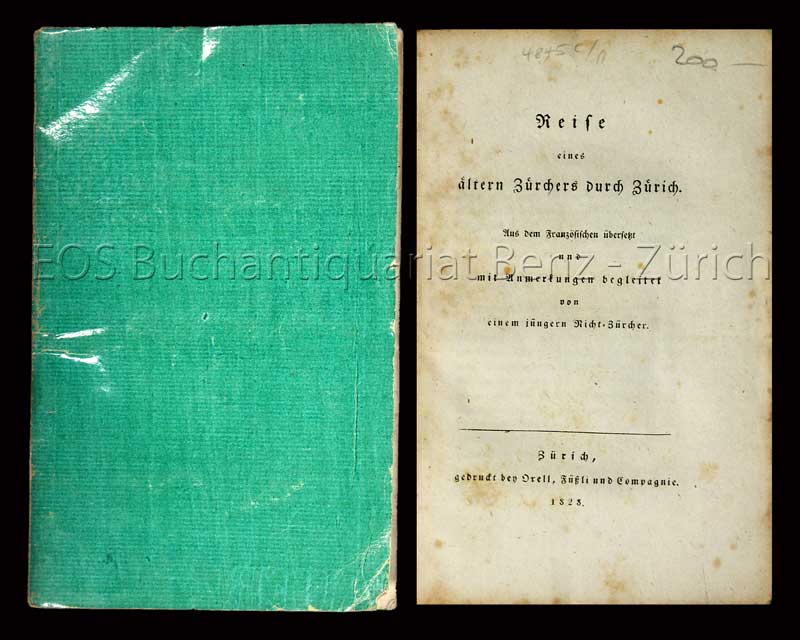
1828réf. 4845CBZürich, Orell, Füssli und Compagnie, 1828. 12°. (2) Bl., 99 S. Broschur d. Zt. aus grünem, lackiertem Papier. + Wichtig: Für unsere Kunden in der EU erfolgt der Versand alle 14 Tage verzollt ab Deutschland / Postbank-Konto in Deutschland vorhanden +, 4845C Einband berieben und zerknittert - fachmännisch restauriert.
1828réf. 4845CBZürich, Orell, Füssli und Compagnie, 1828. 12°. (2) Bl., 99 S. Broschur d. Zt. aus grünem, lackiertem Papier. Einband berieben und zerknittert - fachmännisch restauriert.
1984The standard catalogue raisonnÈ of the lithographs. 112 items reproduced and thoroughly described. Profusely illustrated in color and black & white. From a total edition of 2222 numbered copies, this is one of 1111 WITH TWO ORIGINAL LITHOGRAPHS BY SCHWARZ. Folio. Publisher's laminated boards. FINE AND BRIGHT. Like new, with no defects.