5.791 Ergebnisse
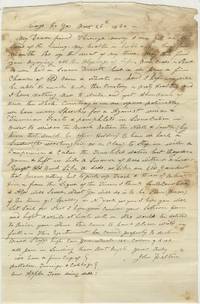
1860Best.-Nr. BK0162Cass County Georgia 1860. Autograph letter signed "John Felton" on lined paper. Possibly written to an S. Slocum with that name verso. 12 x 8 inches. Old folds staining and soiling with chips and short tears at edges; good. An excellent Georgia letter from the first weeks of the secession crisis written twenty days after Abraham Lincoln's election. The writer was almost certainly Captain John Felton 1790-1870 a War of 1812 veteran farmer and longtime Whig who moved to Cass County now Bartow County in 1847. He was the father of future Georgia Congressman William H. Felton and father-in-law of Rebecca Latimer Felton who later became the first woman to serve in the United States Senate. Felton begins with news of poor health drought and the crops before turning to politics: "The whole Country is in an uproar politically we have many Speeches for & Against union & Disunion Tracts & pamphlets in circulation in Order To widen the Breach Between the North & South by those that would be Office Holders. O how we lack a Leader A Washington or a Clay to step in with a Compromise & Calm the Troubled waters but they are gone & left us like a swarm of Bees without a Leader Except Old Beech like a dodo or like an Old Gander that knows nothing but to pick up Trash & throw it Behind Him - from the Signs of the Times I think South Carolina & Ala will secede. What Ga will do is to be Seen." South Carolina seceded less than a month later followed by Alabama and Georgia. Felton's uncertainty about his own state was well placed in Cass County which narrowly elected a delegation opposed to immediate secession; all three of its delegates initially voted against it at the state convention. Felton notes that "This Excitement has caused property to decline" before giving current prices for corn wheat and cotton. He also tells his correspondent that if "the times get Squally in N. York" he hopes he will "Set Sail for what I hope you consider your Southern Home and light awhile at least with us" adding that they would be delighted to receive him. The verso is docketed "S. Slocum"; a Slocum connection to the Feltons is documented as early as 1855-56 when Joseph Slocum was prospecting for copper on what was later recorded as the Felton property.1 1 Joseph P. D. Hull Report on the manganese deposits of Georgia Second report on manganese Index printing company 1919 148. . unknown books
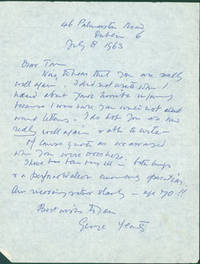
Best.-Nr. 63-4829Dublin Ireland: Georgie Hyde-Lees 1963. Hand-written Letter with original autograph 7" x 9" Single Page Good with tiny marginal tears to top edge creasing.Provenance: Peter Howard Serendipity Books Berkeley. Dublin, Ireland: Georgie Hyde-Lees, 1963. unknown
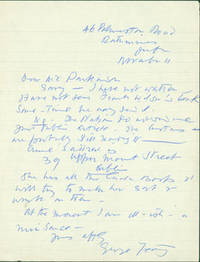
Best.-Nr. 63-4830Dublin Ireland: Georgie Hyde-Lees 1963. Hand-written Letter with original autograph 7" x 9" Single Page Very Good.Provenance: Peter Howard Serendipity Books Berkeley. Dublin, Ireland: Georgie Hyde-Lees, [1963]. unknown
1981Best.-Nr. 220418036Yankee Books 1981-01-01. Paperback. Like New. 8x6x0. ~ Like-NEW Inside and Out! Clean & Crisp Pages. E-mail for more info./pics Yankee Books paperback
1979Best.-Nr. 2279180729014The National Society of Colonial Dames of America in the State of Georgia 1979-01-01. Paperback. Good. Nice looking book has minor edge wear. has light oil stain on rear cover. The National Society of Colonial Dames of America in the State of Georgia paperback
1930Telephone Talk was the glossy bimonthly publication of the British Columbia Telephone Company. It was written by employees for employees to present information of interest to those engaged in the plant, traffic, commercial, operating, accounting and other departments of the service. Each issue is replete with black and white photos and information on topics such as: company, industry and technological news, traffic levels, expansion plans, personnel announcements, publicity and social events, deaths, weddings, lists of exchanges, and more. As such, these issues serve as a vital preserve of rare and fascinating British Columbia history. This volume covers topics including: Twentieth Year of Telephone Talk; P.A.B.X. for Telephone Company in Vancouver; When this magazine was a bab - by the first editor of Telephone Talk; North-west Telephone Company acquires Prince George System; Hard battle for phone men in rough country along Howe Sound; Christmas gale puts 75% of toll lines out of order; cover photo of 20 ton cable reel for use in Fraser River link in Vancouver-Victoria line; Preparatory work on new trans-gulf cable job nears completion; Speeding Aeroplanes can keep in touch with the earth - two; George Gaetz - Victoria 'heavy' gang foreman; Cover photo of woman demonstrating how to use dial phone; Full page photo of cable barge Brico; First section of new trans-gulf cable successfully laid - 6 pages with many photos; New construction in Victoria; Night work required to build line across Ladner Marsh; The Brico succeeds the Iwalani; Heavy Gang Foreman Andrew Bertram (Andy) Jackson; Land portion of new Victoria-Vancouver cable route now complete - 3 pages with many photos; New Traffic Headquarters in the Georgia Building - several photos; Richmond is thriving Neighbour of big coast cities - photos and text; Picture for Telephone Talk obtained via ship-to-shore phone call; Over half of Trans-Atlantic calls are with Great Britain; We can now talk with South America; Nanaimo heavy gang restores Nanaimo-Victoria service; Vancouver can talk to ship on the Atlantic; Wilfred Calman; 5 page illustrated article announcing completion of Vancouver-Victoria cable; B.C.'s first radiotelephone service now open; Second Calgary Circuit provides Windermere Valley connection; Cable to link Europe with North America; New type of conduit being used for underground work; Record load handled by New Westminster staff; Work on Victoria's central office equipment progressing - many photos; Nice cover photo of the Prince Henry, first passenger ship on the Pacific equipped with dial phone system; New type of pay telephone in Vancouver; Burnaby feature - rapidly industrializing; Bob Perry - Blaster - The Lone Canadian; Ruined Burrard Inlet cable to be replaced; Phone service now available to/from a train; Dunsmuir residence in Victoria speaks with London, England; Dials being placed on Victoria phones - 4 pages with photos; Direct coast and Alberta service now available for Revelstoke; Phone men fight fire which takes 5 buildings in Nanaimo; Dial demonstration popular at Victoria Exhibition; John (Jack) C. Miles; Prince George Reconstruction; Many photos of new Plant and Engineering building in Vancouver; Radiotelephone experiments at coast points successful - 6 pages with photos; William Palliser; Powell River System joins phone family; Trans-Gulf cable now in service; The Terminal and Repeater Equipment of the all-cable toll route - 4 pages with photos; Victoria now using new dial system - photos; Nanaimo high span replaced with submarine cable; Building the B.C. link of the Trans-Canada Line; 17,500 mile link connects Vancouver to Australia; and more. Half-leather binding. Average wear. Ink stamp of company executive E.P. LaBelle upon top edge of text else unmarked. Binding intact. Backstrip almost entirely loose. Book
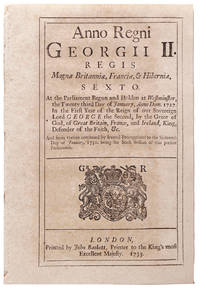
1733Best.-Nr. 319970London: Thomas Baskett 1733. pp. 2 443-455 1 blank. Woodcut seal on the title. Folio. Disbound. Foxing trimmed. pp. 2 443-455 1 blank. Woodcut seal on the title. Folio. This Parliamentary Act authorized a grant of £10000 "for establishing the colony of Georgia in America to be applied toward defraying the charges of carrying over and settling foreign and other Protestants in the said colony" p. 448. The act further authorizes the application of £500000 from the sinking fund to pay off one million South Sea annuities. Not in Sabin Howes Rich Church Streeter or De Renne. Thomas Baskett unknown
1733Best.-Nr. 319970London: Thomas Baskett 1733. pp. 2 443-455 1 blank. Woodcut seal on the title. Folio. Disbound. Foxing trimmed. pp. 2 443-455 1 blank. Woodcut seal on the title. Folio. This Parliamentary Act authorized a grant of £10000 "for establishing the colony of Georgia in America to be applied toward defraying the charges of carrying over and settling foreign and other Protestants in the said colony" p. 448. The act further authorizes the application of £500000 from the sinking fund to pay off one million South Sea annuities. Not in Sabin Howes Rich Church Streeter or De Renne. Thomas Baskett unknown books
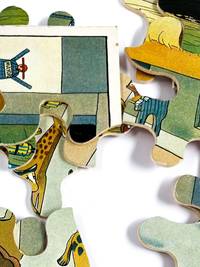
1907Best.-Nr. 32022London / New York: Ernest Nister / E.P. Dutton 1907. Fine in very good box. Charming puzzle adaptation of Greenland's illustrations for Georgia Roberts's THE TOY VILLAGE containing one more puzzle than recorded in the standard Nister reference. 10.25'' x 8''. Five wooden puzzles with color illustrations by Greenland in original publisher's cardboard box with pictorial paste-on. Four puzzles listed in Hunt 108. Illustrated instruction sheet mounted to inside of box lid. Minor wear to puzzles. Moderate wear and scuffing to boxes with tears at corners and repairs to lid. (Ernest Nister / E.P. Dutton) unknown
1907Best.-Nr. 32022London / New York: Ernest Nister / E.P. Dutton 1907. Fine in very good box. Charming puzzle adaptation of Greenland's illustrations for Georgia Roberts's THE TOY VILLAGE containing one more puzzle than recorded in the standard Nister reference. 10.25'' x 8''. Five wooden puzzles with color illustrations by Greenland in original publisher's cardboard box with pictorial paste-on. Four puzzles listed in Hunt 108. Illustrated instruction sheet mounted to inside of box lid. Minor wear to puzzles. Moderate wear and scuffing to boxes with tears at corners and repairs to lid. (Ernest Nister / E.P. Dutton) unknown books
2008Best.-Nr. 1-0439935342Scholastic Paperbacks 2008. Paperback. New. 65 pages. 7.50x5.25x0.25 inches. Scholastic Paperbacks paperback
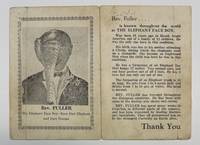
1940Best.-Nr. 5368N.p. likely Georgia 1940. Very good. 4pp. on a single folded sheet. Illustrated portrait. Old folds minor wear and soiling. Former owner's pencil inscription and notations on front and rear covers. A seemingly unrecorded and intriguing ephemeral item presumably handed out during a preaching tour of Georgia around 1940 by an extraordinarily obscure African-American minister who billed himself as "Rev. Fuller The Elephant Face Boy." Very little is recorded about Reverend Fuller; the only mention we could locate occurs in the January 8 1940 edition of The Macon News mentioning Fuller's recent appearance in Dawson Georgia about 120 miles southwest of Macon: "Dawsonites listened to an 'elephant-faced' preacher recently when they were visited by 'the Rev. Fuller a colored preacher born part human and part elephant and known throughout the world.' Fuller is said to be the only of 13 children in his family born in his condition. He has a formation of an elephant ear that hangs 17 inches two normal ears and three eyes but can see out of only one. An elephant trunk formation hangs 24 inches." The present leaflet echoes some of the language in the news article touting Reverend Fuller as "The Elephant Face Boy -- Born Part Elephant and Part Human" mentioning that he is one of thirteen children "born in this condition" and describing the same physical features. Additionally the work states that Fuller was "born 41 years ago in Brazil South America" and that he was born presumably with elephantiasis "due to his mother attending a Circus during which the elephants went on stampede" after which she became "so frightened that when the child was born he was in this condition." The brochure also states that Fuller "eats from 5 to 6 meals daily and drinks from 7 to 10qts. of water" that his "mind is normal" and he has "traveled throughout the European countries.with some of the leading side shows and circus." The text concludes by mentioning that Fuller has "spent many weeks in Hospitals in different parts of the country and has been examined by leading Doctors and Specialists. They all pronounced him to be the strangest Curiosity on Earth alive." Interestingly unlike the newspaper article quoted above the text of the present work does not identify Fuller as someone of African descent. The text is illustrated with a full-page drawing of Fuller on the second page in which about half of his face is obscured. In the illustration Fuller does appear to be of African descent; whether he was born in Brazil of American parents or immigrated to the United States at a later time is unknown. In fact a great deal about Fuller is unknown and the present work provides a wonderful opportunity to dive deeper into the mystery. The leaflet is also interesting for its treatment of Fuller as a medical oddity. No other copies located in trade auction history or institutional records. unknown
1940Best.-Nr. 5368N.p. likely Georgia 1940. Very good. 4pp. on a single folded sheet. Illustrated portrait. Old folds minor wear and soiling. Former owner's pencil inscription and notations on front and rear covers. A seemingly unrecorded and intriguing ephemeral item presumably handed out during a preaching tour of Georgia around 1940 by an extraordinarily obscure African-American minister who billed himself as "Rev. Fuller The Elephant Face Boy." Very little is recorded about Reverend Fuller; the only mention we could locate occurs in the January 8 1940 edition of The Macon News mentioning Fuller's recent appearance in Dawson Georgia about 120 miles southwest of Macon: "Dawsonites listened to an 'elephant-faced' preacher recently when they were visited by 'the Rev. Fuller a colored preacher born part human and part elephant and known throughout the world.' Fuller is said to be the only of 13 children in his family born in his condition. He has a formation of an elephant ear that hangs 17 inches two normal ears and three eyes but can see out of only one. An elephant trunk formation hangs 24 inches." The present leaflet echoes some of the language in the news article touting Reverend Fuller as "The Elephant Face Boy -- Born Part Elephant and Part Human" mentioning that he is one of thirteen children "born in this condition" and describing the same physical features. Additionally the work states that Fuller was "born 41 years ago in Brazil South America" and that he was born presumably with elephantiasis "due to his mother attending a Circus during which the elephants went on stampede" after which she became "so frightened that when the child was born he was in this condition." The brochure also states that Fuller "eats from 5 to 6 meals daily and drinks from 7 to 10qts. of water" that his "mind is normal" and he has "traveled throughout the European countries.with some of the leading side shows and circus." The text concludes by mentioning that Fuller has "spent many weeks in Hospitals in different parts of the country and has been examined by leading Doctors and Specialists. They all pronounced him to be the strangest Curiosity on Earth alive." Interestingly unlike the newspaper article quoted above the text of the present work does not identify Fuller as someone of African descent. The text is illustrated with a full-page drawing of Fuller on the second page in which about half of his face is obscured. In the illustration Fuller does appear to be of African descent; whether he was born in Brazil of American parents or immigrated to the United States at a later time is unknown. In fact a great deal about Fuller is unknown and the present work provides a wonderful opportunity to dive deeper into the mystery. The leaflet is also interesting for its treatment of Fuller as a medical oddity. No other copies located in trade auction history or institutional records. unknown books
1922Best.-Nr. 41210Washington D.C.: Published by the United States Coast and Geodetic Survey 1922. Large folding nautical chart printed on heavy paper stock. Colored. A rare original coastal survey of the border between Georgia and South Carolina including Savannah Bluffton Beaufort Hilton Head Island Port Royal Island Phillips Island Fripp Island Hunting Island Edisto Beach and Parris Island. Established by President Thomas Jefferson in 1807 as the Survey of the Coast the U.S. Coast and Geodetic Survey was the United States' first civilian scientific agency. This agency has followed its mission to survey the U.S. coastline create nautical charts of the coast and help increase maritime safety since its founding and has often played fascinating roles in significant chapters of U.S. history. It served in all theaters of the Civil War in the service of the Union Army and Navy pioneered acoustic exploration in the wake of the sinking of the Titanic and during WWI it worked to detect enemy submarines. In addition this agency worked to survey and produce detailed maps and renderings of the U.S. coast. These nautical survey maps commonly referred to as "T-sheets" provide fascinating insights into the history of the United States coastline which has and will continue to shift. These maps are the most important data source for understanding the physical and ecological characteristics of the U.S. shoreline. The present map is a highly detailed and accurate sea chart of the coastal border of Georgia and South Carolina and an important historical view of the developing states. Published by the United States Coast and Geodetic Survey unknown
1922Best.-Nr. 41210Washington D.C.: Published by the United States Coast and Geodetic Survey 1922. Large folding nautical chart printed on heavy paper stock. Colored. A rare original coastal survey of the border between Georgia and South Carolina including Savannah Bluffton Beaufort Hilton Head Island Port Royal Island Phillips Island Fripp Island Hunting Island Edisto Beach and Parris Island. Established by President Thomas Jefferson in 1807 as the Survey of the Coast the U.S. Coast and Geodetic Survey was the United States' first civilian scientific agency. This agency has followed its mission to survey the U.S. coastline create nautical charts of the coast and help increase maritime safety since its founding and has often played fascinating roles in significant chapters of U.S. history. It served in all theaters of the Civil War in the service of the Union Army and Navy pioneered acoustic exploration in the wake of the sinking of the Titanic and during WWI it worked to detect enemy submarines. In addition this agency worked to survey and produce detailed maps and renderings of the U.S. coast. These nautical survey maps commonly referred to as "T-sheets" provide fascinating insights into the history of the United States coastline which has and will continue to shift. These maps are the most important data source for understanding the physical and ecological characteristics of the U.S. shoreline. The present map is a highly detailed and accurate sea chart of the coastal border of Georgia and South Carolina and an important historical view of the developing states. Published by the United States Coast and Geodetic Survey unknown books
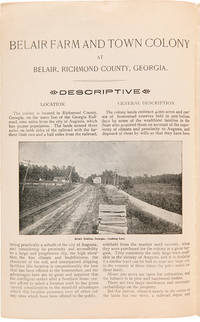
1897Best.-Nr. 55574N.p. likely Augusta GA. ca. 1897. Creating the Suburbs in Georgia in 1897 An uncommon promotional for a small agricultural community developed in Georgia in the last decade of the 19th century. The work touts the "extraordinary suitability of the Belair lands for settlement into a prosperous suburban farm and town colony.surrounded by the most favorable conditions and attractive environments." The Belair Colony was comprised of 4000 acres of land near Augusta and most of the directors of the board were Augusta businessmen. The text includes a description of the area in and around Belair and has chapters on the "Plan of Colonization" and the "System of Farming Recommended." The work has numerous photographic illustrations showing the Belair railroads housing in the area a "famous spring" in Belair local farmlands watermelon and cantaloupe dealers in Augusta the Richmond County Agricultural Society building a cluster of pears grown near Belair the Augusta high school and fields of sugar cane pears peaches and a poultry farm near Belair. The last three pages include samples of the stock application the title bond and one page of promotional text about Augusta. A sample stock certificate is laid in. OCLC records two physical copies of this rare promotional at Augusta University and the University of Georgia. Tall octavo. Original pictorial wrappers. Front wrapper soiled around the edges upper corner of front wrapper chipped. Text a bit tanned but clean. Very good. OCLC 13997010. unknown
1897Best.-Nr. 55574N.p. likely Augusta GA. ca. 1897. Creating the Suburbs in Georgia in 1897 An uncommon promotional for a small agricultural community developed in Georgia in the last decade of the 19th century. The work touts the "extraordinary suitability of the Belair lands for settlement into a prosperous suburban farm and town colony.surrounded by the most favorable conditions and attractive environments." The Belair Colony was comprised of 4000 acres of land near Augusta and most of the directors of the board were Augusta businessmen. The text includes a description of the area in and around Belair and has chapters on the "Plan of Colonization" and the "System of Farming Recommended." The work has numerous photographic illustrations showing the Belair railroads housing in the area a "famous spring" in Belair local farmlands watermelon and cantaloupe dealers in Augusta the Richmond County Agricultural Society building a cluster of pears grown near Belair the Augusta high school and fields of sugar cane pears peaches and a poultry farm near Belair. The last three pages include samples of the stock application the title bond and one page of promotional text about Augusta. A sample stock certificate is laid in. OCLC records two physical copies of this rare promotional at Augusta University and the University of Georgia. Tall octavo. Original pictorial wrappers. Front wrapper soiled around the edges upper corner of front wrapper chipped. Text a bit tanned but clean. Very good. OCLC 13997010. unknown books
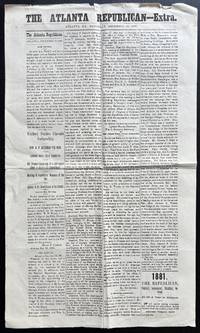
1880Best.-Nr. 5904Atlanta: December 18 1880. About very good. Broadside newspaper extra 19 x 11.25 inches. Old folds and creases a bit wrinkled minor soiling minor fraying and light staining to top edge tiny hole at center crossfold. An extraordinarily rare broadside newspaper extra from the only Republican paper in the state of Georgia to survive the end of Reconstruction. The Atlanta Republican was issued weekly between 1874 and 1886 and was devoted to Republican Party causes during Reconstruction. The present extra issue is a ringing endorsement of Hon. Amos T. Akerman 1821-1880 the Republican nominee to a recent open circuit judgeship in the state. Akerman was a Dartmouth-educated jurist who moved south to practice law. He settled in Georgia in 1850 and true to his surroundings owned several slaves and served as a colonel in the Confederate Army. Following the war Akerman became an advocate for Reconstruction and freedmen's rights served as U.S. Attorney for Georgia and eventually worked as President Grant's attorney general crusading against the first incarnation of the Ku Klux Klan during the early 1870s. Though a Republican in Reconstruction Georgia Akerman remained a largely popular figure in the state. The present broadside documents a meeting by the Atlanta Bar in which they speak glowingly about the "ability learning and integrity" of Akerman praise his "unswerving fidelity to the Republican Party at the most stormy and trying periods of the struggles of the South" and note both his "manly services in the cause of the true national and human and sentiments and principles in the trying days of reconstruction" and "valuable services to the cause of Republicanism during the last fifteen years." The work also mentions Akerman's volunteer services during a supposed "negro insurrection" in Georgia in the mid-1870s in which Akerman's work "resulted in restoring peace and satisfying the impassioned and infuriated whites that there was no insurrection attempted or contemplated." The Bar calls for united support for Akerman and the broadside concludes with an article about a "Committee of Lawyers appointed to press the claims of Mr. Akerman for the Circuit Judgeship." Despite the strong support statewide Akerman was never able to accept the judgeship had it been offered to him; unfortunately he died three days after the issuance of the present newspaper extra. Still the broadside remains an interesting example of the waning though remaining Republican influence in very late-to-post-Reconstruction Georgia. The present newspaper extra is not in the collection of the American Antiquarian Society nor in OCLC but one is apparently located at the University of Georgia's broadside collection. December 18 unknown
1880Best.-Nr. 5904Atlanta: December 18 1880. About very good. Broadside newspaper extra 19 x 11.25 inches. Old folds and creases a bit wrinkled minor soiling minor fraying and light staining to top edge tiny hole at center crossfold. An extraordinarily rare broadside newspaper extra from the only Republican paper in the state of Georgia to survive the end of Reconstruction. The Atlanta Republican was issued weekly between 1874 and 1886 and was devoted to Republican Party causes during Reconstruction. The present extra issue is a ringing endorsement of Hon. Amos T. Akerman 1821-1880 the Republican nominee to a recent open circuit judgeship in the state. Akerman was a Dartmouth-educated jurist who moved south to practice law. He settled in Georgia in 1850 and true to his surroundings owned several slaves and served as a colonel in the Confederate Army. Following the war Akerman became an advocate for Reconstruction and freedmen's rights served as U.S. Attorney for Georgia and eventually worked as President Grant's attorney general crusading against the first incarnation of the Ku Klux Klan during the early 1870s. Though a Republican in Reconstruction Georgia Akerman remained a largely popular figure in the state. The present broadside documents a meeting by the Atlanta Bar in which they speak glowingly about the "ability learning and integrity" of Akerman praise his "unswerving fidelity to the Republican Party at the most stormy and trying periods of the struggles of the South" and note both his "manly services in the cause of the true national and human and sentiments and principles in the trying days of reconstruction" and "valuable services to the cause of Republicanism during the last fifteen years." The work also mentions Akerman's volunteer services during a supposed "negro insurrection" in Georgia in the mid-1870s in which Akerman's work "resulted in restoring peace and satisfying the impassioned and infuriated whites that there was no insurrection attempted or contemplated." The Bar calls for united support for Akerman and the broadside concludes with an article about a "Committee of Lawyers appointed to press the claims of Mr. Akerman for the Circuit Judgeship." Despite the strong support statewide Akerman was never able to accept the judgeship had it been offered to him; unfortunately he died three days after the issuance of the present newspaper extra. Still the broadside remains an interesting example of the waning though remaining Republican influence in very late-to-post-Reconstruction Georgia. The present newspaper extra is not in the collection of the American Antiquarian Society nor in OCLC but one is apparently located at the University of Georgia's broadside collection. December 18 unknown books
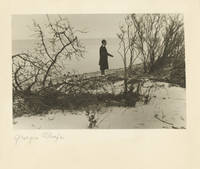
1948Best.-Nr. 162811New York: N.p. 1948. Vintage matte finish photograph of artist Georgia O'Keeffe amidst driftwood on the beach taken at the Fire Island home of photographer George Daniell circa 1948. Captioned by Daniell in manuscript pencil on the recto margin with a PIX agency label affixed to the verso. Yonkers-born photographer George Daniell befriended O'Keeffe in the 1940s. Daniell took many now-iconic portraits of O'Keeffe throughout the ensuing decades many of which are today held by the Georgia O'Keeffe Museum in Santa Fe. From the archive of the PIX Agency an American photo house that acted as an intermediary between émigré photographers as well as those still living in Europe and the American magazine and newspaper market between 1935-1969. 8.5 x 7 inches archivally mounted in a white mat measuring 17 x 14 inches. Faintly and evenly toned else about Fine. N.p. unknown
1948Best.-Nr. 162811New York: N.p. 1948. Vintage matte finish photograph of artist Georgia O'Keeffe amidst driftwood on the beach taken at the Fire Island home of photographer George Daniell circa 1948. Captioned by Daniell in manuscript pencil on the recto margin with a PIX agency label affixed to the verso. Yonkers-born photographer George Daniell befriended O'Keeffe in the 1940s. Daniell took many now-iconic portraits of O'Keeffe throughout the ensuing decades many of which are today held by the Georgia O'Keeffe Museum in Santa Fe. From the archive of the PIX Agency an American photo house that acted as an intermediary between émigré photographers as well as those still living in Europe and the American magazine and newspaper market between 1935-1969. 8.5 x 7 inches archivally mounted in a white mat measuring 17 x 14 inches. Faintly and evenly toned else about Fine. N.p. unknown books
1760Best.-Nr. PHO-12672 ouvrages en un vol. in-12, rel. d'époque, plein cuir marbré ,dorure sur les coupes, dos à 5 nerfs, caissons ornés de fleurons dorés, titre dans une pièce de cuir marron, trois tranches rouges. Rousseurs, mouillures , manque la pièce de titre, coiffe sup. usé et fente intérieure
Best.-Nr. 9781620814253NOVA SCIENCE PUBLISHERS INC
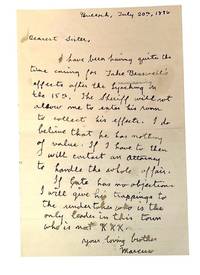
1886Best.-Nr. 954441886. Very Good. Small single sheet. 17 x 11 cm. Handwritten in ink. Single horizontal fold in center with 2 cm. tear on right end. Several individual letters are smeared tears perhaps toward the bottom of the letter. Envelope not present. Text of the letter: "Dearest Sister I have been having quite the time caring for Jake Braswell's effects after the Lynching in the 15th. The Sheriff will not allow me to enter his room to collect his effects. I do believe that he has nothing of value. If I have to then I will contact an attorney to handle the whole affair. If Cate has no objections I will give his trappings to the undertaker who is the only leader in this town who is not KKK. Your loving brother Marcus" Above the word "Lynching" murdering is penciled in. Handwritten in pencil on back and signed in pencil. "Letter to the Hon. Gov. Henry D. McDaniel about Jake Braswell's murder in Bullock Georgia 1886 was Returned un-answered. Marcus." A contemporary newspaper account in an Indiana newspaper reported that Braswell had "horribly mistreated" Dolly Woods a 6 year old white girl who identified Braswell as her assailant after his capture. Braswell reportedly was given the choice of being burned or hanging himself. When he did not follow through on hanging himself Braswell was involuntarily hung and his body riddled with bullets. It is unclear how Marcus and his sister were related or otherwise connected to Braswell. unknown
1886Best.-Nr. 954441886. Very Good. Small single sheet. 17 x 11 cm. Handwritten in ink. Single horizontal fold in center with 2 cm. tear on right end. Several individual letters are smeared tears perhaps toward the bottom of the letter. Envelope not present. Text of the letter: "Dearest Sister I have been having quite the time caring for Jake Braswell's effects after the Lynching in the 15th. The Sheriff will not allow me to enter his room to collect his effects. I do believe that he has nothing of value. If I have to then I will contact an attorney to handle the whole affair. If Cate has no objections I will give his trappings to the undertaker who is the only leader in this town who is not KKK. Your loving brother Marcus" Above the word "Lynching" murdering is penciled in. Handwritten in pencil on back and signed in pencil. "Letter to the Hon. Gov. Henry D. McDaniel about Jake Braswell's murder in Bullock Georgia 1886 was Returned un-answered. Marcus." A contemporary newspaper account in an Indiana newspaper reported that Braswell had "horribly mistreated" Dolly Woods a 6 year old white girl who identified Braswell as her assailant after his capture. Braswell reportedly was given the choice of being burned or hanging himself. When he did not follow through on hanging himself Braswell was involuntarily hung and his body riddled with bullets. It is unclear how Marcus and his sister were related or otherwise connected to Braswell. unknown books