4 155 résultats
19828vo. 23 Pages. SUBJECT (S) : Zionism Poland history; Jews Poland history -- 20th century. SERIES: Spiegel lectures in European Jewish history ; ; 1; Ex library with sticker on spine and no other marks, spine faded, very good condition. (ComHist-9-26)
19828vo. 23 Pages. Paper wrappers. SUBJECT (S) : Zionism Poland history; Jews Poland history -- 20th century. SERIES: Spiegel lectures in European Jewish history ; ; 1; Very good condition. (ComHist-9-26A)
1854réf. 35503624Paris, Garnier, 1854 ; in-12, demi-chagrin vert à grain fin, filets dorés aux bords, dos à 4 nerfs avec filets dor. et à froid, tranches jaspées. (Reliure de l’époque) 368 pp.PREMIÈRE ÉDITION COLLECTIVE. Ce recueil donne - Pologne et Russie. Kosciusko - qui avait paru en 1852. Michelet y prend parti pour la Pologne contre la Russie. - Les Martyrs de la Russie - (histoire de Catya, serve russe ; de l’armée comme supplice, Sibérie, Martyre de Pestel et de Ryleïeff, de l’extermination de la Pologne ; du czar, comme pape et dieu.) - Principautés danubiennes Madame Rosetti - publié d’abord en 1853. Constantin Rosetti fut l’un des chefs du mouvement révolutionnaire valaque. Sa femme fut l’élève de Michelet. - Destin de la Roumanie - Talvart 26A.Bel exemplaire bien relié à l’époque.
1982réf. 11081982. Varsovie éd Interpress 1982 - Cartonné format à l'italienne - 27 cm x 28 cm 165 photos noir et blanc pleine page - Bon état - Introduction de Anna Kaminska - Très belles photos sur les anciens cimetières juifs de Pologne
19501st edition. Paper Wrappers, 8vo, aprox. 48 pages each issue. Monthly, originally beginning with No. 1 (Febru'ar 1941) . 25 cm. In Yiddish. Nrs. 110/111, 239, 240, 311/312 (70th birthday of the Bund, special issue), 317, 327, 384, 386, 387, 394, 395, 433, 435, 436, 476, 592/593, 1978 (Nrs. 10, 11/12) 1979 (Nr 12), 1987 (Nr. 10-"90 yor Bund" special issue). The monthly journal of the Bund in America, here providing its unique Polish Jewish Socialist anti-Zionist perspective. The General Jewish Labour Bund in Lithuania, Poland and Russia (Yiddish: algemeyner yidisher arbeter-bund in lite, poyln un rusland), generally called The Bund or the Jewish Labour Bund, was a secular Jewish socialist party.... founded in Vilnius on October 7, 1897 ..In 1917 the Polish part of the Bund, which dated to the times when Poland was a Russian territory, seceded from the Russian Bund and created a new Polish General Labor Bund which continued to operate in Poland in the years between the two world wars .The Bund sought to unite all Jewish workers in the Russian Empire into a united socialist party, and also to ally itself with the wider Russian social democratic movement to achieve a democratic and socialist Russia. The Russian Empire then included Lithuania, Latvia, Belarus, Ukraine and most of present-day Poland, areas where the majority of the world's Jews then lived. They hoped to see the Jews achieve a legal minority status in Russia. Of all Jewish political parties of the time, the Bund was the most progressive regarding gender equality, with women making up more than one-third of all members. The Bund actively campaigned against anti-Semitism. It defended Jewish civil and cultural rights and rejected assimilation. However, the close promotion of Jewish sectional interests and support for the concept of Jewish national unity (klal yisrael) was prevented by the socialist universalism of the Bund. The Bund avoided any automatic solidarity with Jews of the middle and upper classes and generally rejected political cooperation with Jewish groups that held religious, Zionist or conservative views. Even the anthem of the Bund, known as "the oath" (di shvue in Yiddish), written in 1902 by Sh. An-ski, contained no explicit reference to Jews or Jewish suffering. At the heart of the vision of the future of the Bund was the idea that there is no contradiction between the national aspect on the one hand and the socialist aspect on the other. As a strictly secular organization, the Bund renounced the Holy Land and the sacred language (Hebrew) and chose to speak Yiddish .In its early years the Bund had remarkable success, gaining an estimated 30,000 members in 1903 and an estimated 40,000 supporters in 1906, making it the largest socialist group in the Russian Empire . the Bund was a founding collective member at the RSDLP's first congress in Minsk in March 1898. For the next 5 years, the Bund was recognized as the sole representative of the Jewish workers in the RSDLP, although many Russian socialists of Jewish descent, especially outside of the Pale of Settlement, joined the RSDLP directly .The Bund generally sided with the party's Menshevik faction led by Julius Martov and against the Bolshevik faction led by Vladimir Lenin during the factional struggles in the run-up to the Russian Revolution of 1917 .In the Polish areas of the [Russian] empire, the Bund was a leading force in the 1905 revolution. At that time the organization probably reached the height of its influence. It called for an improvement in living standards, a more democratic political system and the introduction of equal rights for Jews. At least in the early stages of the first Russian Revolution, the armed groups of the "Bund" were likely the strongest revolutionary force in Western Russia. During the following years, the Bund went into a period of decay .The Bund eventually came to strongly oppose Zionism, arguing that emigration to Palestine was a form of escapism. The Bund did not advocate separatism. Instead, it focused on culture, rather than a state or a place, as the glue of Jewish nationalism. . The Bund also promoted the use of Yiddish as a Jewish national language and to some extent opposed the Zionist project of reviving Hebrew. The Bund won converts mainly among Jewish artisans and workers, but also among the growing Jewish intelligentsia. It led a trade union movement of its own. It joined with the Poalei Zion (Labour Zionists) and other groups to form self-defense organisations to protect Jewish communities against pogroms and government troops. During the Russian Revolution of 1905 the Bund headed the revolutionary movement in the Jewish towns, particularly in Belarus and Ukraine ..In 1921, the Communist Bund [in the USSR] dissolved itself and its members sought admission to the Communist Party....Many former Bundists, like Mikhail Liber and David Petrovsky, perished during Stalin's purges in the 1930s. The Polish Bundists continued their activities until 1948. During the latter half of the 20th century the Bundist legacy was represented through the International Jewish Labor Bund, a federation of local Bundist groups around the world .Among the exiled Bundists who went on with Socialist politics in America was Baruch Charney Vladeck (18861938), elected to the New York Board of Aldermen as a Socialist in 1917 [and] 1937 [and] manager of The Jewish Daily Forward Moishe Lewis (18881950)....the father of David Lewis (19091981), a leader of the New Democratic Party in Canada .David Dubinsky (18921982), though never formally a member of the party, had joined the bakers' union, which was controlled by the Bund, and was elected assistant secretary within the union by 1906 ..He later became a member of the Socialist Party of America, helped found the American Labor Party in 1936 and was from 1932 till 1966 the leader of the International Ladies' Garment Workers' Union ..under the name Max Goldfarb, David Petrovsky (18861937) was a member of the Central Committee of the Jewish Socialist Federation of America, a member of the Socialist Party of America, and the labor editor of The Forward (Wikipedia). All Good-Very Good Condition (Y-21-B) Price is per issue.
1862réf. 11171Paris Bureau de la Revue des Deux Mondes 1862 -in-8 demi-Maroquin un fort volume, reliure demi-maroquin cerise grand in-octavo à coins (binding half morocco with corners), reliure d'époque signée "PETIT" successeur de "SIMIER", dos 4 nerfs (spine with raised bands) décoré "or" et à froid (gilt and blind stamping decoration), titre et tomaison frappés "or" (gilt title and volume numbering) dans un encadrement d'un double filet fin "or", triple filets fins "or" en place des nerfs avec un filet à froid de part et d'autre des nerfs, plats décorés or (gilt decoration on the cover) avec 3 filets fins "or" aux mors et aux coins (joints and corners with three gilt line), papier marbré aux plats (cover with marbled paper), toutes tranches lisses (all edges smoothes) peignées (painting edges) rouge et bleu, sans illustrations (nop illustration), 1032 pages, 1862 Paris Bureau de la Revue des Deux Mondes Editeur,
1864réf. 11187Paris Bureau de la Revue des Deux Mondes 1864 -in-8 demi-Maroquin un fort volume, reliure demi-maroquin cerise grand in-octavo à coins (binding half morocco with corners), reliure d'époque signée "PETIT" successeur de "SIMIER", dos 4 nerfs (spine with raised bands) décoré "or" et à froid (gilt and blind stamping decoration), titre et tomaison frappés "or" (gilt title and volume numbering) dans un encadrement d'un double filet fin "or", triple filets fins "or" en place des nerfs avec un filet à froid de part et d'autre des nerfs, plats décorés or (gilt decoration on the cover) avec 3 filets fins "or" aux mors et aux coins (joints and corners with three gilt line), papier marbré aux plats (cover with marbled paper), toutes tranches lisses (all edges smoothes) peignées (painting edges) rouge et bleu, sans illustrations (nop illustration), 1032 pages, 1864 Paris Bureau de la Revue des Deux Mondes Editeur,
1869réf. 11192Paris Bureau de la Revue des Deux Mondes 1869 -in-8 demi-Maroquin un fort volume, reliure demi-maroquin cerise grand in-octavo à coins (binding half morocco with corners), reliure d'époque signée "PETIT" successeur de "SIMIER", dos 4 nerfs (spine with raised bands) décoré "or" et à froid (gilt and blind stamping decoration), titre et tomaison frappés "or" (gilt title and volume numbering) dans un encadrement d'un double filet fin "or", triple filets fins "or" en place des nerfs avec un filet à froid de part et d'autre des nerfs, plats décorés or (gilt decoration on the cover) avec 3 filets fins "or" aux mors et aux coins (joints and corners with three gilt line), papier marbré aux plats (cover with marbled paper), toutes tranches lisses (all edges smoothes) peignées (painting edges) rouge et bleu, sans illustrations (no illustration), 1024 pages, 1869 Paris Bureau de la Revue des Deux Mondes Editeur,
1860Carta geografica del regno di Polonia, nei suoi antichi confini. Confini in coloritura coeva
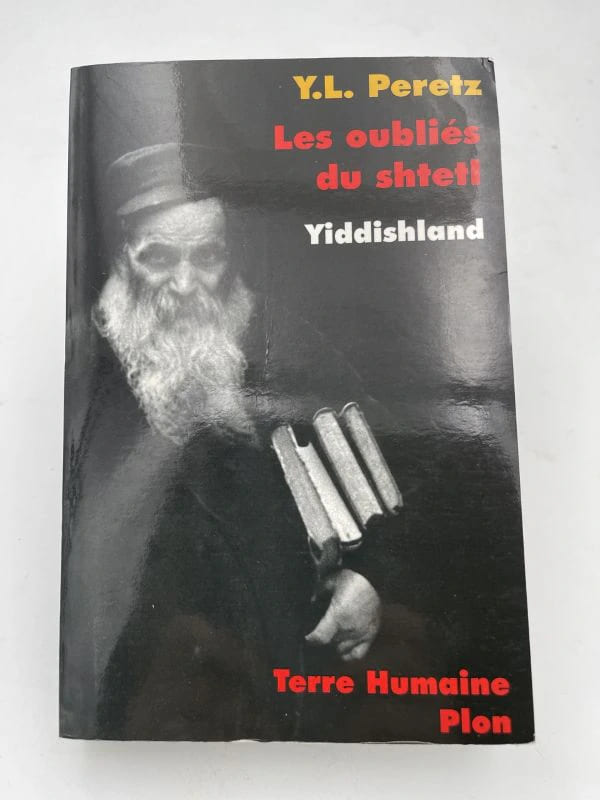
2007réf. 194932Plon Terre Humaine Plon Terre Humaine, 2007. In-8 broché, couverture illustrée. 406 pages. 16 illustrations hors texte, 37 dans le texte,; 1 carte, 3 index, glossaire. Isaac Leib Peretz (1851-1915), écrivain polonais et pionnier de la culture yiddish. Le livre dépeint la vie quotidienne, les traditions, les croyances et les débats intellectuels au sein des shtetl (les petits bourgs juifs d'Europe de l'Est). Il explore les tensions entre la tradition religieuse hassidique ou orthodoxe et la modernité laïque (la Haskala, les idées socialistes du Bund), le tout empreint d'un humour juif et d'une profonde empathie populaire. Traduit, annoté et présenté par Nathan Weinstock, avec une préface de Jean Malauri; Rare édition originale de la traduction du yiddish, annoté et présenté par Nathan et Micheline Weinstock. Très bon état. Rare.
New York: Columbia University Press, 1977. 1st Edition. Cloth, 8vo, xi, 369 pages. Includes illustrations, 24 cm. Includes bibliographical references and index. Includes map and black and white photos. Subjects: Jews -- Poland -- History -- 20th century. Jews -- Poland -- Social conditions. Antisemitism -- Poland. Poland -- History -- 1918-1945. Poland -- Ethnic relations. A classic. Very good condition (Comhist6-3)
New York: 1943. Paper Wrappers, 8vo, 23 pages; 23 cm. Offprint. Reprinted from the Quarterly bulletin of the Polish Institute of arts and sciences in America, April 1943. Includes bibliographical references on pages 19-23. Subject: Jews -- History. Jews -- Legal status, laws, etc. Freedom of religion -- History. Poland -- Ethnic relations. Poland -- History To 1795. Light wear, Very good condition. (Comhist6-11)
New York : Y. Yoseloff, 1965. Cloth, 8vo, 256 pages. Bibliography on pages 243-249. Includes Index, 15 pages of plates. Subjects: Jews -- Poland -- History. Very good condition. (EE-2-8)
1965New York : Y. Yoseloff, 1965. Cloth, 8vo, 256 pages. Bibliography on pages 243-249. Includes Index, 15 pages of plates. Subjects: Jews -- Poland -- History. Dustcover torn on the back. Very good condition. (EE-3-1)
1912Original Wraps. 8vo. 43 pages. 24 cm. First edition. In Yiddish. The People's Speaker; a collection of sermons and speeches. Subjects: Jewish sermons - United States. Jewish sermons, Yiddish - United States. Jewish sermons. Jewish sermons, Yiddish. United States. OCLC lists 14 copies. Wraps soiled, internally clean and fresh. Good + condition. (YID-21-24)
réf. 164990Paris, E. Dentu, 1863 in-8, XX-228 pp., broché sous couverture imprimée de l'éditeur. Dos défraîchi.
réf. 23859LEBIGRE DUQUESNE sd,gr.IN8,demi basane,dos lisse titré,texte à 2 colonnes,frais, 1 Bl. + 31 gravures ht de costumes,en noir, Stahlstichtaf. (cplt.) /II., 494.,bon état,2 ht roussis.
1738Pianta topografica della città
1856Carta geografica telata, piegata editorialmente con coloritura coeva ai confini. Foglio nr 2 con elaborata cornice al margine comprendente il territorio delle città di: Erfurt, Weimar, Jena, Zeitz, Gera, Ronneburg, Rudolstadt, Greiz, Schleiz, Plauen, Hof, Baireuth, Altenburg, Grimitzschau, Glauchau Werdau, Zwickau, Hohenstein, Chemnitz, Dresden, Schirgiswalde, Eibenstock, Litomerice, Prag, Amberg, Regensburg, Ingolstadt, Plzen, Klattau, Taus, Straubing, Pribram, Tabor, Wittingau
1856Carta geografica telata, piegata editorialmente con coloritura coeva ai confini. Foglio nr 3 con elaborata cornice al margine comprendente il territorio delle città di: Luban, Goldberg, Jelenia Gora, Swidnica, Breslavia, Olawa, Brzeg, Dzierzoniow, Zabrowice, Ziebice, Neisse, Klodzko, Gliwice, Bytom, Rybnik, Opole, Kutna Hora, Chrudim, Svitavy, Olomouc, Opava, Brno, Cieszyn, Bielsko-Biala
1856Carta geografica telata, piegata editorialmente con coloritura coeva ai confini. Foglio nr 4 con elaborata cornice al margine comprendente il territorio delle città di: Cracovia, Kielce, Tarnow, Rzeszow, Jaroslaw, Bochnia, Levoca, Nowy Sacz, Krosno, Dynow, Przemysl, Sanok, Sambor
In 16° (cm 10,8 x 18), cartonatura muta coeva, pp (24), 352, bei fregi silografici, esemplare in buone condizioni, bruniture accentuate abbastanza uniformi. Testo in francese, lingua scelta, come dichiara l'A. a causa della sua universalità all'epoca. Prima edizione di questo compendio (redatto schematicamente su più colonne: "Evenemens remarquables sous..., Femmes, Enfans, Mort, Princes contemporains, Ministres d'Etat, Savants et Illustres...") dedicato alla storia polacca, dall'anno 964 fino al 1733. L'A. (esistono altre sue opere sullo stesso argomento) ammette di aver sostenuto grande fatica per elaborare una summa incisiva e nello stesso tempo esauriente non solo di rigorosi fatti storici, ma altresì del ruolo sostenuto da Scienze, Arti, religione cristiana per ogni epoca. Esemplari censiti in COPAC. Barbier I, 16.
1780réf. 11304[1780]. 50 x 44 mm. Altkolorierter Kupferstich, rückseitig kleine Montagereste, minimal gebräunt.
8vo. X, 241 pages. First edition. SUBJECT (S) : Jews - Europe, Eastern - history; Jews - history - philosophy. CONTENTS: For a return to Jewish History; Power and Vulnerability; The Experience of Suffering; The Nerve of Failure; The Rise of Jewish Power; Jewishness: Quality or Circumstance? ; Being a Jewish Person. Has dust jacket. Very good condition. (EE-2-10)
1941Heavy brown stain to front cover & edges and extending into the text of the introductory material and up to page 20 (but easy to read through). Otherwise Good Solid Condition. ; 8vo; 107, 110 pages; 23 cm. In English & Yiddish. This publication offers "The most comprehensive survey of Germany's treatment of Jews and other minorities within Germany, including conditions in concentration camps. " Produced by the Great BritainForeign Office. Contains documents concerning German-Polish relations and the outbreak of hostilities between Great Britain and Germany on September 3, 1939., & the final report by the Right Honourable Sir Nevile Henderson. G. C. M. G. , on the circumstances leading to the termination of his mission to Berlin, September 20, 1939. SUBJECT(S) Geographic: Germany -- Foreign relations -- Poland. Poland -- Foreign relations -- Germany. Great Britain -- Foreign relations -- Germany. Germany -- Foreign relations -- Great Britain. (H-42-6)