LINSCHOTEN, Jan Huygen van (1563 - 1611).Livre Rare Book
9 172 résultats
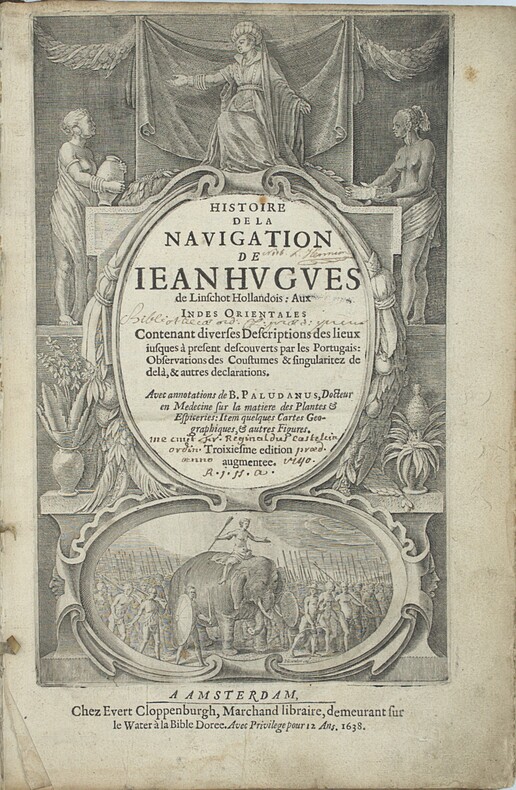
1638réf. PHO-2460Amsterdam : J.E. Cloppenburch, 1638, in-folio, 315 x 220mm, 4pp. (titre, préface, indice des chapitres) 206pp., titre avec des figures allégoriques (Asie, Afrique Europe) et une scène d’un roi sur éléphant, illustré du portrait de l’auteur, 29 (sur 36 ) planches gravées dépliantes à double page et vues de Johann et Baptiste ven Doetecom d'aprés Linschoten , les cartes sont absentes. Titre empoussiéré, quelques taches et mouillures, le dernier feuillet détaché. Reliure en partie détachée du corps de l’ouvrage. Provenance - « Fr. Reginaldus Castelin (?) ordin. 1740 » (ex-libris manuscrit ancien). – L. Hennion (ex-libris manuscrit ancien sur une garde). Bibliographie Sabin, n°20128. Leclerc, n°363. Cordier Japonica, 222. Gay, 260
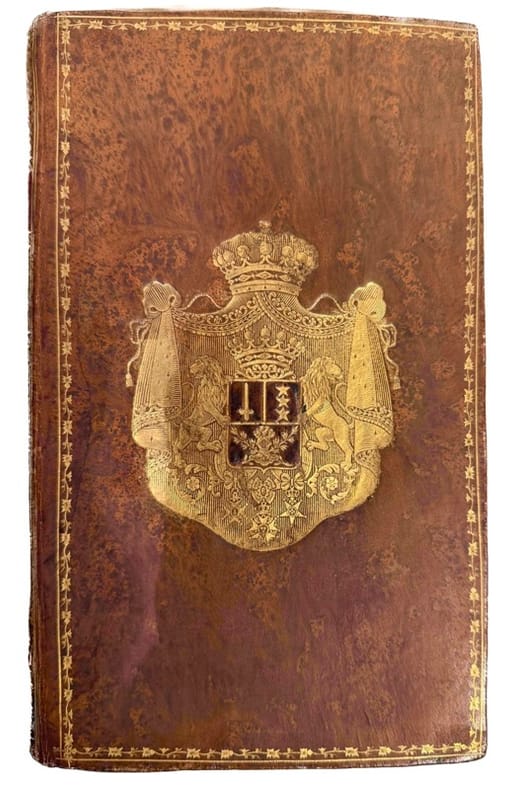
réf. 244020Paris, J. G. Dentu, 1815 in-8, XXII-222 pp., errata, veau fauve granité, dos lisse orné, roulette et filet dorés en encadrement sur les plats, armes au centre, tranches marbrées (reliure de l'époque).
réf. 222956S.l., s.d. (vers 1812) 4 parties en 2 forts vol. in-folio, titre, 623 pp., [2] ff. n. ch. de table ; 147 pp., 345 pp., 405 pp., [5] ff. n. ch. de table, le tout couvert d'une écriture fine, élégante et très lisible (environ 30 lignes par page), avec de nombreuses collettes, quelques illustrations dans le texte, et 12 planches hors texte (dont 5 imprimées, 7 manuscrites), demi-basane fauve granitée à coins, dos lisses ornés de filets et dents-de-rat dorés, pièces de titre cerise, tranches mouchetées de rouge (rel. de l'époque). Charnières en parties fendues, nombreuses épidermures, manques de cuir au vol. II.
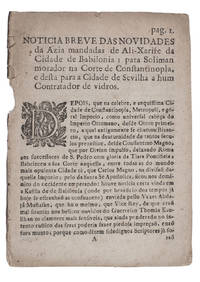
1742réf. I14GSHQ8NCJEColophon: Madrid 1742. 4to 20 x 14.5 cm. heirs of Juan Garcia Infanzon Disbound. With a woodcut initial. 7 1 blank pp. Rare pamphlet satirising several Portuguese notables. According to this pamphlet presented as a fictional letter from "Ali-Charif of the city of Babylon" to "Suliman the Moor at the court of Constantinople" these notables are part of a Turkish regiment that might be sent off to fight "Thomas Kaulikan" Tahmasp Qoli Khan better known as Nader Shah. A follow-up to the pamphlet was published a week later and once again describes the regiment now in a letter "from Mecca to Holland to the city of The Hague" and from there to Cambrai in France" cf. Rossi 2392.Nader Shah was one of the most powerful rulers in Persian history and waged several military campaigns in Afghanistan and India. Although not at war with Portugal his war against the Islamic Mughal Empire in India culminating in the capture of Delhi in 1739 led indirectly to Portugal's loss of its colonial territory in India in the war with the Hindu Marathas 1737-1741.Browned throughout with the spine damaged; a fair copy.l Braga da Cruz Catalogo da collecçaõ de miscelânes V 7066; Porbase 2 copies; Rossi "La Spagna nella 'Livreria do Convento de Nossa Senhora de Jesus' in Lisbona" in: Annali-Sezione Romanza XXIII 1 1981 2391; WorldCat 1 additional copy. unknown
15911) pp. 136, marca tipografica incisa su legno al frontespizio e indicazione di possesso manoscritta, Al frontespizio piccolissima lacuna, timbro a inchiostro sul margine bianco, 2) pp. (8), 164, marca tipografica incisa su legno al front., un capolettera figurato, una tavola incisa su legno nel testo, alcune note manoscritte al margine. Legatura in piena pergamena con titolo in oro al dorso, piatto superiore con piccola lacuna all’angolo, pagine leggermente brunite.Durling 1592-1596
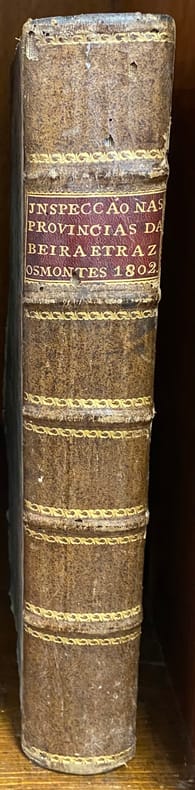
réf. 222952S.l., s.d. (vers 1802) fort vol. in-folio, [2] ff. n. ch., 543 pp., couvertes d'une écriture très régulière et soignée, parfaitement lisible (environ 40-45 lignes par page), [3] ff. n. ch. de table, nombreux tableaux dans le texte, texte réglé au crayon de bois, quelques collettes contrecollées, avec une planche hors texte aquarellée (p. 206), et un tableau à double page également hors texte (p. 322), demi-basane fauve granitée à coins, dos à nerfs orné de guirlandes dorées, pièce de titre cerise, [Inspecçao nas provincias da Beira e Traz os Montes], tranches mouchetées de rouge (reliure de l'époque). Quelques épidermures et manques de cuir à la reliure.
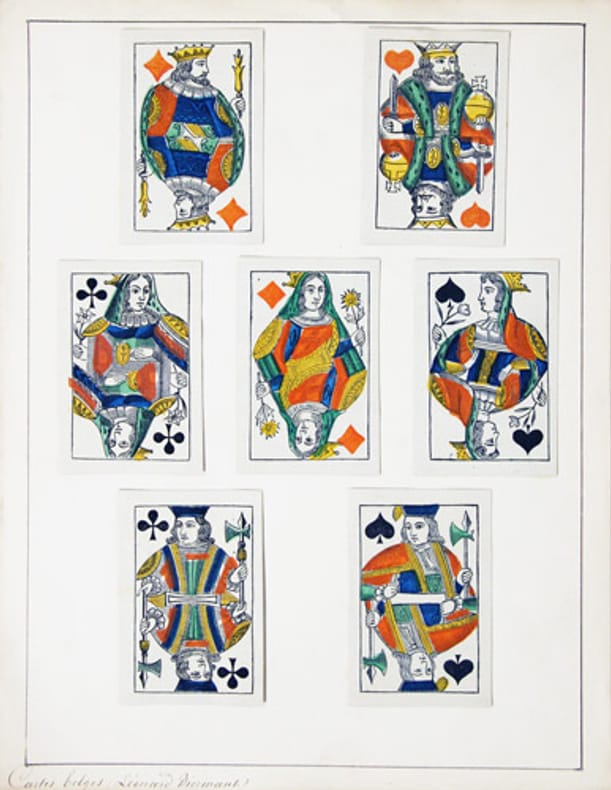
réf. 101137aafin-Folio, cartes, enveloppes etc. proprement montées sur des bristols blancs, souvent avec légendes manuscrites (origine, nom du fabricant), avec quelques brochures, cartes postales, lettres, entre les feuilles.
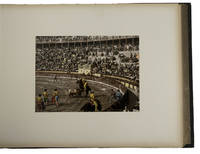
1899réf. ABC_46443Spain 1899. Oblong album 32 x 41 cm. Hauser & Menet and others Half black leather red buckram sides blind-stamped boards title in gold on front board gold-stamped spine marbled endpapers. An album with 58 photographic prints including one tinted varying in size 20.5 x 15.5 to 27.5 x 21.5 cm each on thick paperboard. 58 ll. Album containing 58 photographic prints depicting scenes and sights in Spain and Portugal. Subjects of the prints vary. From the El Escorial the historical residence of the King of Spain to the interior of the cathedral - and former mosque - of Cordoba. The prints also show the exterior and interior of the bullfighting arena in Madrid. 2 of these 3 prints show bullfighting in action. A little more than half of the prints contain captions revealing the location depicted in the photograph such as the scenic views of cities such as Madrid Barcelona and Seville. The subject and/or location of the prints without captions remain unclear but some are very likely sites in Portugal since all of the prints with captions are in Spain.According to the captions the photographs of Seville were taken by E. Beauchy a Spanish photographer from the same city. He photographed the region of Andalusia south Spain at the end of the nineteenth-century. Some prints of Madrid and Barcelona were produced by printers of Spanish graphic art Hauser and Menet in 1896 and 1897.With an Antwerp bookseller's ticket on the front paste-down. The binding shows some minor signs of wear mostly around the spine and corners of the boards. Slight foxing/browning of the outer edges of the paperboard not affecting the photographs some photographs have slightly faded edges which does not interfere with the actual image. Overall in good condition. An album with 58 views of sights in Spain and Portugal. hardcover
1710réf. DIV012in 8 ( 18x 12 cm) 201 Fol / pages 5470 (H) 1710 (c) frontispice gravé ,papier en bel état ,tranches dorés reliure sur haies de bois ,fermoirs métalliques présent . Un plat parfaitement séparé du volume En portugais Very rare 2nd second edition of the only treatise on Hebrew laws and customs written in Portuguese language and printed for the Portuguese Sephardic communities in Northern Europe. Treasure of Jewish Laws that the people of Israel must know and observe composed by Rabbi Hacham Menasseh ben Israel in Amsterdam, 1st edition 1647; and this 2nd edition in 1710. In 8. º (18x12 cm) (v) -201 - (iv) folium. Binding (worn out at edges) contemporary full calf gilt at spine. Engraved frontispiece. Contains title page to Third Part (Of feasts and fasts throughout the year, the people of Israel must know and observe) and the Last part (in which contains all the precepts, rites and ceremonies concerning to a perfect economy dedicated to the very noble and magnificent lords Abraham and Ishak Israel Pereyra). MENASSEH BEN ISRAEL was born in Lisbon in 1604. Very young of age he went to Amsterdam with his father, Joseph ben Israel, and became a disciple of Haham Yshac Uziel. In 1622 he was appointed professor of the Portuguese Jewish community in Amsterdam and, four years later, he founded the first Hebraic typography in Amsterdam; printing small books in Portuguese, Spanish and Hebrew languages. Menasseh had a decisive contribution in reopening England to the Jewish people, closed since the time of King Edward Ist. He went personally to London and had talks with Cromwell who gave him an honorific pension he never profit of. Menasseh died in 1658 after returning from London. He was portrait by Rembrant. Inocêncio VI, 211. 'In a book dealer which trade was new and old books, I found a complete copy of the Treasure. I've never seen another. '
1960réf. 43665ABLissabon 1960-62. Folio (61,5x47,5cm) and 4to (31x24cm). With over 1000 (427 coloured) illustrations of maps on 626 partly fold. plates. Orig. boards with gilt-stamped title to spine and cover.
1790réf. 3401A L'Isle de France, de l'Imprimerie Royale. M. DCC. LXXXX vol.in-8 (17,7 x 12 cm), titre, VIII pp., 140 pp. 12 pp., reliure modeste du dix-neuvième siècle, demi-basane neutre, titre calligrapié sur une étiquette au dos. Détails du contenu : Remarques historiques, VIII pp., Calendrier de janvier à décembre 1790, 48 pp.- Calculs et renseignements astronomiques, tableau dépliant du calcul de longitude suivant M. Willaumez, 18 pp. - Idée de la rade de Port-Louis, Enumération récente des habitans (sic) de la Terre. Statisfiques mondiales. Observations météorologiques au Port-Louis du 1er décembre1788 au 30 novembre 1789. Pronostics Météorologiques, 12 pp. - Idée de l'Isle de France (Historique). Renseignements administratifs. Gouvernement, Armée, Huissiers, Conseil Supérieur créé par Edit du Roi en 1771. Juridiction Royale, Avocats, Notaires, Imprimerie Royale, Clergé de l'Isle de France, Milice Coloniale, etc.,(38 pp). - Idée de l'Isle de Bourbon (Historique). Gouvernement, Armée, Conseil Supérieur par Edit du Roi. Juridiction, Notaires, Bureau des Postes, Soeurs de charité, Milice Coloniale, Paroisse de Saint-Paul, Sainte Suzanne et Saint André, Saint Benoit, Paroisse de Riviere d'abord. - Hygiène, Médecine, liste nominative de Centenaires, Anecdotes. Mesures et Poids divers, etc. (du pied du Roi ou de Paris et des différentes mesures), (23pp.). Arrivées et Départs des vaisseaux du Port-Louis, Isle de France. Depuis le 1er Décembre 1788 jusqu'au 1er Décembre 1789 (exclusivement (10 pp.). (ouvrage complet, en état d'usage, une double page désagrafée). "C'est à peu près entre 1760 et 1770 que l'invention de Gutenberg fit son apparition dans les colonies françaises du Nouveau Monde et de l'Orient dès le XVIème siècle ; il est vrai, des Portugais avaient introduit des presses dans plusieurs des pays lointains. Ce n'étaient là, toutefois, que des presses missionnaires dirigées par des religieux, jésuites principalement et qui ne servirent qu'à la propagation de la foi parmi les infidèles. La production des Presses de l'Ile de France peut se diviser ainsi : les almanachs, les journaux ou gazettes, les publications officielles, etc. Les almanaches qui comptent parmi les premiers "incunables" de l'Isle de France sont d'un intérêt tout particulier. Les annonces, Affiches et Avis divers pour les Colonies des Isles de France et de Bourbon, de Lambert, vécurent jusqu'en 1790. (Références bibliographiques : Auguste Toussaint, Revue Outre-Mers, 1948. Les débuts de l'imprimerie aux Iles Mascareignes).
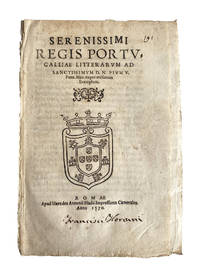
1570réf. 5000917Rome: apud Haeredes Antonii Bladii 1570. In excellent original condition. Small quarto 4 leaves the last blank; woodcut device on title; page numbers in ink from an earlier binding within a volume; in a later plain wrappers binding and a folding case. Extremely rare printed letter from King Sebastian of Portugal to Pope Pius V in which the king asks for more priests especially Jesuits stressing the significance of Portuguese conquests in the Far East in the process detailing the number of ships laden with treasure and trade goods arriving daily in Lisbon. The strategic relationships between the rulers of Portugal and Spain with the papacy were crucial in the discovery and colonisation period. The splitting of the new world enacted by the treaty of Tordesillas left the Portuguese and Spanish eager to exploit any advantage that could be gained and often the evangelisation of pagan natives was used to justify territorial ambitions; it was often in these pious terms that the pope was lobbied for his support. This letter from Sebastian is an excellent example of the sort of lobbying that took place. Donald Lach has written extensively about the nature of the exotic in the East Indies and the Far East describing how these printings often encompass exotic subjects for which monarch and pope both had a taste. In his relations with Pius V's namesake and predecessor for example Sebastian had been asked for and had promised a pair of elephants for the papal menagerie see Lach II 1 150n. The printing of letters and diplomatic orations such as this formed a critical part of the lobbying. Important records of the significance accorded to the new world it seems that they were generally printed in small numbers for limited circulation hence the tiny survival rate of any of these early works with this example particularly uncommon: USTC records five copies four of them in Italy and WorldCat adds another at Yale while the last copy that we can identify on the market was that offered by Maggs Bros in 1935. --- At Sebastian's death fighting the Moors in north Africa the destiny of Portugal changed completely and from then on she would be under Spanish sway. "When at last she found herself again a free and independent state 1640 the sceptre of the Indies had passed irrevocably to Holland and England' Penrose p. 75. Nonetheless Sebastian still occupies a most important position in Portuguese history in which he has been compared with King Arthur or Barbarossa: he was known as the "sleeping king" who would mysteriously return at Portugal's time of great need. 'He would then be known by symbolic names: O Encoberto The Hidden One who would return on a foggy morning to save Portugal; or as O Desejado The Desired. The legend was vigorously promoted through the massive circulation of popular rhymes trovas written by Bandarra. Even as late as the 19th century Sebastianist peasants in the Brazilian sertão believed that the kings would return to help them in their rebellion against the "godless" Brazilian republic.' Wikipedia. Pius V reigned from 1566 to 1572: his reign was largely pre-occupied with the war against the Turks - the battle of Lepanto was won the year after this publication. In 1570 Goa was attacked by the Indian army but the Portuguese successfully defended it. Also in 1570 Sebastian issued orders that the Brazilian Indians used for slavery should be released from captivity. . Provenance: Early ink ownership inscription on title "Francisci Morani" sp. apud Haeredes Antonii Bladii unknown
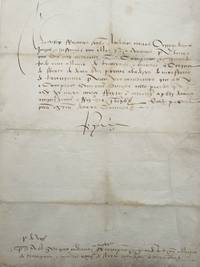
1515réf. 29861515. . Folio 215 × 287 mm. Folded. Tears at foldings with small holes lightly affecting a few words. A tear at the lower half at the right edge with no effect to the text. Otherwise in fine condition. 1 page signed letter on paper in Portuguese. Manuel I King of Portugal’s signed letter to the Female Monastery of Santa Maria de Tarouquela. In his letter Manuel I advising the monastery of Santa Maria of Tarouquela to obey better the Benedictine the rules. “In 1514 we see the first signs of the autophagy process in which this monastery had been involved since the very beginning — an autophagy that resulted from its physical isolation from its size and its intrinsically family-related nature. The Benedictine habit was not even ruling the nuns’ habits anymore as we may infer from the intervention of King Manuel I 1495–1521 who asks the abbess of Arouca from the Cistercian order to put an end to that situation of neglect. The connection to Arouca despite the different rules is probably a result of a geographical proximity that allowed surveillance and after some time the emergence of an almost filial status that was preserved in Tarouquela until its extinction. In fact it is by mentioning the isolated nature of a place “where little was done to serve” God − a location and status that was similar to that of other female institutes Vairão Vila do Conde Vila Cova Vila Nova de Gaia Tuías and Rio Tinto Gon- domar − that the sale king ordered their fusion in a single monastic house to be built in Porto” Machado 2014. Eventually the nuns of Tarouquela were transferred to the convent in Porto in 1536. Literature: Machado R. ed.: Route of the Romanesque Rota do Românico. Lousada: Centro de Estudos do Românico e do Território 2014. p. 194. unknown
1576réf. 64844Antwerpen, Christophe Plantin, 1576. 8°. Mit Holzschn.-Druckermarke a. Titel u. 233 blattgr. Textholzschnitten. 529 S., 7 Bll. (das letzte weiß), Etw. späterer Ldr.-Bd. (17. Jhd.) a. 5 Bünden m. Rückenverg., goldgepr. Rückenschild u. Rotschnitt.
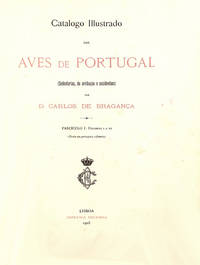
réf. 1105NM001Sedentárias de arribação e accidentaes. Por D. Carlos de Bragança. Faciculo I: Estampas I a 20 Texto em portuguez e francez. Lisboa. Imprensa Nacional. 1903. Seguido de: CATALOGO ILLUSTRADO DAS AVES DE PORTUGAL. Sedentárias de arribação e accidentaes. Por D. Carlos de Bragança. Fascículo II: Estampas 21 a 40 Texto em portuguez e francez. Lisboa. Imprensa Nacional. 1907 In fólio de 32x25 cm. Obra em 2 volumes em um publicados respectivamente em 1903 e 1907. Encadernação da época com lombada e cantos em pele com finos ferros a ouro na lombada e nas pastas. Exemplar apresenta as capas anteriores e posteriores de cada um dos fascículos. Cortes das folhas aparados e carminados apenas à cabeça. Apresenta nas guardas um ex-libris de bibliófilo da época. Cada um dos fascículos ilustra 20 espécies de aves. Estampas pintadas por Enrique Casanova sob orientação do rei D. Carlos e nalguns casos por si aguareladas. Cada estampa/espécie apresenta o nome científico e o nome comum em cinco idiomas diferentes seguido do seu estatuto migratório e abundância fazendo-se também uma referência ao local de captura das aves ilustradas em cada estampa e por vezes a outros locais onde o Rei terá observado ou capturado aves dessa espécie. D. Carlos cedo começou a organizar uma colecção de pássaros por si abatidos e destinados a formar um 'Museu Ornitológico'. Aos 24 anos o Rei começou a escrever a Ornitologia de Portugal que foi corrigindo constantemente com grande rigor científico. Em 1893 com 30 anos de idade decide publicá-la com o título Catálogo Ilustrado das Aves de Portugal entregando a Albert Girard a área científica ficando Enrique Casanova seu professor de desenho responsável pelas estampas. No entanto D. Carlos esteve presente em tudo com o seu saber e a sua arte. A obra destinou-se a ser publicada pela Imprensa Nacional - Casa da Moeda em fascículos ilustrados com 20 estampas cada. O 1º fascículo saiu em 1903 e o 2º em 1907. Dom Carlos I rei de Portugal nasceu em 1863. Ao longo da sua juventude viajou por várias cortes europeias. Numa dessas viagens conheceu Amélia de Orleãs princesa de França e filha primogénita do Conde de Paris. Depois de um breve noivado desposou-a em Lisboa em Maio de 1886. O reinado de D. Carlos foi caracterizado por diversas crises políticas. O rei era dotado de uma grande sensibilidade artística que o levou a dedicar a maior parte do seu tempo a um conjunto diferenciado de actividades destacando-se a pintura a ornitologia estudo das aves e a oceanografia. D. Carlos foi um apaixonado por fotografia sendo o autor de uma grande parte do espólio da família real. O rei foi um pintor de talento com grande capacidade expressiva e uma técnica apurada demonstrando uma profunda sensibilidade na temática marinha. Assinava por vezes as suas obras com o nome 'Carlos Fernando. Recebeu prémios internacionais de instituições como a Sociedade Zoológica de Londres Sociedade Oceanográfica do Golfo de Biscaia ou o Museu História Natural entre outros. Em 1985 foi publicado um fac-simile da obra e foi adicionado um terceiro volume ou suplemento que contém mais 53 estampas de desenhos até então inéditos também de passeriformes no entanto sem qualquer texto. Enrique Casanova foi um pintor espanhol Saragoça 1850 - Madrid 1913 que veio para Portugal em 1880 tornando-se professor de pintura do príncipe D. Carlos e do infante D. Afonso em meados de Maio de 1881 tarefa que se prolongaria até Setembro de 1884. Outros membros da família real foram também alunos de desenho e de pintura de Casanova cujos ensinamentos influenciaram as obras artísticas de D. Maria Pia D. Luís e D. Amélia. Casanova fez parte do círculo restrito da Corte acompanhando-a nas suas viagens e estadias. Enrique Casanova foi um artista polivalente na sua produção cerâmica escultórica pictórica e gráfica. A aguarela foi a técnica mais utilizada na pintura. A sua mestria a técnica e o realismo das suas aguarelas possibilitou que um século mais tarde o Palácio Nacional da Ajuda as tomasse como fonte para a reconstituição das suas salas. No âmbito da ilustração colaborou também com a rainha D. Amélia e com o arquitecto Raul Lino nas ilustrações para o livro O Paço de Sintra 1903. EN Dim.: In folio 32x25 cm. Work in two volumes published in one in 1903 and 1907 respectively. Binding: Contemporary half-calf with gilt tools on spine and boards. Copy with both front and back covers of each booklet. Trimmed red top edges. It has an ex-libris of a contemporary bibliophile on the endpapers. Each booklet contains 20 illustrations of bird species. The prints are painted by Enrique Casanova under the orientation of king D. Carlos and in some cases watercoloured by him. Each print/species has its scientific name and common name in five different languages followed by its migratory status and quantity with reference to the place the birds were captured and sometimes to other places where the King had observed them or captured. D. Carlos started early to organize a collection of birds caught by him aiming to create an Ornithological Museum.At 24 years of age the King started to write the Ornithology of Portugal that he kept correcting with scientific accuracy. In 1893 age 20 he decides to publish it under the title Illustrated Catalogue of the Birds of Portugal handing the scientific part to Albert Girard and to Enrique Casanova his drawing teacher the responsibility of the prints. Nevertheless D. Carlos was always present with his knowledge and art. The work was printed by Imprensa Nacional - Casa da Moeda in illustrated booklets each with 20 prints. The first booklet was edited in 1903 and the second in 1907. D. Carlos I king of Portugal was born in 1863. Throughout his youth he travelled to several European Courts. In one of those travels he met Amelia of Orleans princess of France and first daughter of the Count of Paris. After a short engagement he married her in Lisbon on May 1886. The reign of D. Carlos was marked by several political crises. The king was quite artistic which led to him doing several different activities mainly painting ornithology and oceanography. D. Carlos was also a passionate photographer being the author of the most part of the collection of the royal family. He was also a talented painter very expressive and with a sharp technique showing a profound sensibility in the sea themes. He sometimes signed is works with the name 'Carlos Fernando. He received international awards from different institutions like the Zoological Society of London Oceanographic Society of the Bay of Biscay or the Natural History Museum among others. A facsimile of the work was published in 1985 and it was added a third volume that contains another 53 prints unpublished till then also of birds but with no text. Enrique Casanova Saragoza 1850-Madrid 1913 was a Spanish painter who came to Portugal in 1880 becoming the painting teacher of D. Carlos and Prince D. Afonso in mid-May 1881 a task he would perform until September of 1884. Casanova also taught other members of the royal family and his teachings influenced the artistic works of D. Maria Pia D. Luís and D. Amélia. Casanova was part of the restrict circle of the court travelling with them. He was a versatile artist producing ceramics sculptures paintings and printings. Watercolour was his most used technique in painting. His mastery the technique and realism of his watercolours allowed one century later the National Palace of Ajuda to use them to the restoration of the rooms. As an illustrator he also worked with the Queen D. Amélia and the architect Raul Lino on the illustrations for the book O Paço de Sintra 1903. M-8-D-28 hardcover
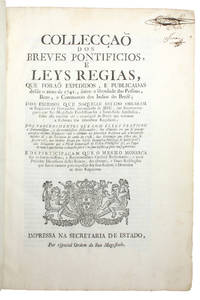
1759réf. ABC_48500Lisbon: Secretaria de estado 1759. Contemporary calf gold-tooled spine marbled endpapers. Folio 21.3 x 30.5 cm. With al large woodcut vignette showing the Portuguese coat of arms on the title page and on one of the divisional title pages and with woodcut decorated initials. A publication of 21 Portuguese documents plus 1 handwritten addition detailing the first stages of the expulsion of The Society of Jesus commonly known as the Jesuits. Published by the special order of King José I of Portugal this book was intended to explain and defend the expulsion citing the Jesuits control over the affairs of the indigenous population of Brazil the "Indios do Brasil" and their alleged involvement in the "horroroso insulto de 3 de Setembro do anno de 1758". This September Insult is a reference to the Távora Affair the attempted assassination of King José I which resulted in the execution of the entire Távora family including Josés mistress Teresa Leonor wife of the heir of the Távoras. Teresa Leonors personal confessor was Gabriel Malagrida a Jesuit missionary who had spent time in Brazil; Malagridas tenuous involvement indeed the Távora as a whole are often considered scapegoats was utilised in anti-Jesuit rhetoric. This copy is of particular interest as a manuscript addition in an elegant contemporary hand has been added to the verso of the title page for document XII the sentencing of the Távoras and presents a copy of the speech made by the Judge of the People to the king: "O Juiz do Povo tem a honra de pedir a N.Ex.a ponha na Real prezença de S. Mag. que oseu justifismo Edital foi lido pelo fiel Povo de Lisboa com muitas lágrimas que todo elle pede justiça contra humatentado de que não há exemplo nage delidade Portuguese e que para avingar espera com impaciência as Reas ordens de S. Mag; pois todo elle dezeja anciozamente derramar até a última gota de sangue pela glória e serviço do Mesmo". Recorded just below is the reply of the King: "Reposta de S. Mag.e. Cu não esperava menos de fidelidade dos meus fiéis Vassalos a quem heide corresponder como bom Rey e Pay".With contemporary manuscript notes in brown ink. Each section with separate pagination and occasionally with a divisional title page bound together as issued. Gentle wear and dampstaining to the last few leaves lacking the back endpapers otherwise bright and clean.l Borba de Moraes I 165. Secretaria de estado, unknown
réf. 177186Lisbonne, Impressao Imperial e real, 1807-1808 146 pièces en un vol. in-4, pagination multiple, demi-chevrette prune, dos lisse orné de filets dorés, coins en vélin (rel. de la Restauration). Un coin inférieur abîmé.
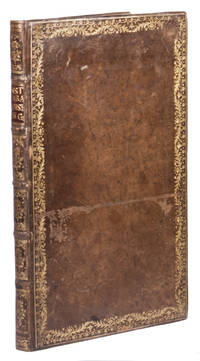
1774réf. ABC_49591Lisbon 1774. Contemporary gold-tooled brown calf with a red morocco title label on the spine lettered in gold an elaborate border on both boards gold-tooled boards edges marbled edges. Folio 34.6 x 22.2 cm. Manuscript on paper written in a neat secretarial hand. Rare contemporary manuscript of a royal letter addressed to the newly appointed Archbishop of Goa and Primate of the Orient the Augustinian hermit Dom Frei Francisco da Assunção e Brito just prior to his departure from Portugal to take up his new post. It outlines a set of ecclesiastic reforms arranged in six instructions. These were part of a series of major reforms introduced by the Portuguese king relating to the governance of the Estado da India: the same day royal instructions were also sent to the Governor and Captain General of Portuguese India D. José Pedro da Câmara regarding military political and economic reforms.The instructions to the Reverendo Arcebispo de Goa were drafted by the Marquês de Pombal Sebastião José de Carvalho e Melo 1st Marquis of Pombal 1st Count of Oeiras 1699-1782. Carvalho was one of the most influential Portuguese statesmen of the eighteenth century: it was during his term as prime minister earlier in the reign of José I that Portugal had abolished slavery both in Portugal itself and in the Portuguese colonies in India but not however in other parts of its empire and that autos-de-fé and the Limpeza de Sangue had been phased out. He had also been largely responsible for having the Jesuit Order expelled from Portuguese domains and he does not conceal his antipathy towards the Order in these instructions to the new Archbishop. Of great interest also are Carvalhos insistence on the removal of any distinction between natives of India and natives of Portugal second and third instructions and his condemnation of the level of censorship imposed by the Inquisition and by the Jesuits fifth instruction.An edited version of the present letter and of the letter dated the same day addressed to Câmara were published much later on in Pangim in 1841. The printed version of the ecclesiastical letter includes neither the index nor the second four-page royal letter which are both present in this manuscript.With a contemporary ownership inscription "Pertence do snr. Dez. Anst. Felis Contreiras." on the second free flyleaf. The edges of the boards are lightly scuffed the boards have been scratched with some loss of material. The bookplate mounted on the second free flyleaf has been cut off the work is lightly browned and foxed throughout. Otherwise in good condition. hardcover
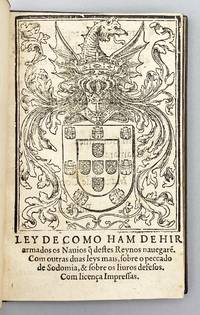
1574réf. 12466Lisbon: J. de Barreira for J. de Espanha 1574. 19th-century plum morocco Riviere & Son; rebacked preserving original spine gilt turn-ins all edges gilt over marble gilt-lettered flat spine. Second edition second recorded copy. THIS REGULATES NAVAL SECURITY SODOMY AND HERETICAL BOOKS. Many of twenty-six articles mandate the arms to be carried on board commercial Portuguese vessels based on their size - types and numbers of cannons spears pikes and harquebuses and the quantity of gunpowder. Other stipulations govern the convoys financial ship-building incentives and WHEN SHIPS SHOULD SAIL TO BRAZIL AND OTHER PORTUGUESE COLONIES. Penalties include a two-year exile in Africa. The next law on the extirpation of sodomy 3p. states incidences were on the rise. To secure prosecutions the identities of accusers and witnesses will be suppressed public proceedings eliminated and a portion of the accused's assets will pass to plaintiffs. The guilty will serve on Portuguese government galleys. The final law 6p. prohibits owning reading printing importing books or shielding those who possess books by Luther Zwingli Calvin Melanchthon and Œcolampad. Punishments range from the partial or full seizure of assets temporary exile to Brazil or Africa or permanent banishment to Brazil or the galleys depending on the number of offenses. Money and manumission if enslaved figure among the incentives offered. In the U.S. only Harvard owns an edition 1571 defective. In good condition small spot on one leaf bookplate of Brazilian lawyer businessman and bibliophile José Mindlin 1914-2010. ¶Maggs Bros. Bibliotheca Americana VI 1928 79 this copy; Horch "Uma Lei de 1571 sobre Livros Defesos" in Inquisição: Comunicações apresentadas ao I Congresso Luso-Brasileiro sobre Inquisição 1989 I: 179-187; see Mott's "Relações Raciais entre Homossexuais no Brasil Colonial" in Escravidão homossexualidade e demonologia 22-5. J. de Barreira for J. de Espanha unknown
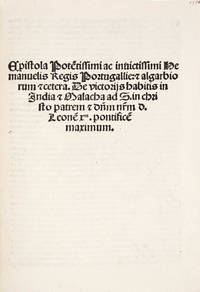
réf. 97381Rome Jacob Mazochius 9th August 1513. . Small 4to 20 x 14.5 cm 4pp. modern full morocco gilt a fine example. Rare. The highly important letter from King Manuel to Pope Leo X announcing the capture of Malacca by Albuquerque a victory which gave Portugal control of the trade routes to South-east Asia and thus access to the wealth of the Spice Islands and the sea route to China. Our copy appears to be from an unrecorded edition. It has the same colophon as the first edition but is printed in smaller type on two rather than six leaves. It is possibly a pirate edition from the same time. Later editions appeared in Vienna and Stassbourg. After the capture of Malacca by the Portuguese under Albuquerque in 1511 which became known in Europe in 1513 King Manuel dispatched letters to Rome informing the Papacy of Portugal's progress. This mattered greatly to Manuel as there was a perceived need to settle the question of demarcation between Spain and Portugal in this area which was important for control of the Spice Islands. Pope Leo X newly elected that Spring was the son of Lorenzo the Magnificent and effectively the leading Medici and ruler of Florence who represented the traditional favourable disposition to Portugal of Florentine merchants. In addition Portugal had a good record in defeating Muslims and thus advancing Christianity. It was no surprise therefore that public celebrations of thanksgiving were held in Rome shortly after news of Albuquerque's victory in Malacca was announced. Lach I 166-167; Streit IV 380-382. Rome, Jacob Mazochius, 9th August, 1513. unknown
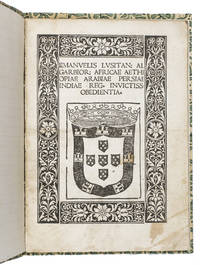
réf. ABC_49338Rome: Marcello Silber 1514. 19th-century decorative paper with a pattern of green flowers. Small 4to ca. 19.5 x 14 cm. With the woodcut coat of arms of King Manuel I on the title page surrounded by a woodcut floral border. First and only edition of an important oration proudly announcing the Portuguese expansions in Africa Arabia and India with special mention of the conquest of Azamor present day Azemmour Morocco in August 1513. The oration was delivered to Pope Leo X 1475-1521 on 20 March 1514 to draw his attention to the latest Portuguese victories. No expenses were spared for this delivery as the oration was accompanied by lavish gifts brought from Asia including "Indian slaves Persian horses two leopards a young panther colourful parrots and a trained elephant . which caused a sensation as it bowed three times before the pope and squirted water from its trunk over the admiring multitude" Lach.The oration was delivered by Diego Pachego dates unknown "an eminent Portuguese jurist who gave the formal orations for his country in 1505 and 1514 on two of the most important occasions when the Portuguese announced to the papacy their progress in Asia" Lach. Pachego was a member of the Portuguese embassy of obedience intended to pay homage to a newly elected pope and hopefully gain his favour. As other countries especially Spain wanted to claim important regions such as the Spice Islands the support of the pope meant these would remain in Portuguese hands. King Manuel I 1469-1521 was highly aware of this so when Leo X became pope in 1513 he was determined that his mission of obedience would be such as had never been seen before. He sent all the riches that his Asian territories had to offer: the finest brocades the most precious metals the rarest gems and the most exotic animals including the white Indian elephant Hanno which was sent directly from India and became the pope's favorite pet. The present oration was also part of this event. It stressed the king's obedience to the pope and itemised his great successes in the East and in Africa. Despite its importance however the oration is quite rare as we have only been able to find 3 other copies in sales records of the past hundred years.The work is slightly browned with brown stains on the title page pp. 5-8 and pp. 13-14 a small hole in p. 5 affecting 1 letter a small water stain in the lower margin throughout. Otherwise in good condition.l BMC Italian p. 483 wrongly dated 1513; Edit 16 56280 12 copies; OPAC SBN CFIE030609 11 copies incl. 1 incomplete; USTC 845977 11 copies; WorldCat 727385121 1088206352 13 copies; cf. Lach Asia in the making of Europe vol. I book 1 pp. 167-168 and vol. II book 2 p. 8. Marcello Silber, unknown
BRUXELLES, Typ. de ML. Weissenbruch - 1868 - Edition Originale - 1/2 Reliure imitation vélin - Dos lisse - Frontispice - 256 pages, dont Généalogie de la famille de Pombal - Bel exemplaire - Envoi rapide et soigné Sebastiao José de Carvalho E Melo, marquis de Pombal (1699-1782) Personnage controversé, deux cents ans après sa mort, il mérite encore qu'on lui consacre une étude approfondie qui puisse aider à l'éclaircissement de son action, aussi bien sur le plan politique que sur le plan humain. Né en 1969 et mort en 1782, son existence traverse, pratiquement, tout le XVIIIème siècle. Ceci explique que l'Historiographie portugaise qui étudie cette époque s'intéresse vivement à la période avant et post Pombal. Presque trente ans de gouvernement pendant lesquels des événements importants sur le plan social, économique, militaire et culturel ont eu lieu, événements avec des mutations, en un sens, radicales, dans les divers domaines ont, forcément, fait de ce personnage l'objet des plus diverses spéculations. En même temps qu'il mettait sur pied des réformes et des innovations, Pombal exerça son gouvernement d'une mais de fer. Il porta préjudice à un certain nombre de familles aristocrates, mais pas à toute noblesse. Il persécuta certains secteurs de l'Église mais pas l'ensemble de l'Église portugaise. Envisageant la partie comme une totalité, certains courants libéraux du XIXème siècle ont fait de Pombal leur héros et le maître de leurs idéologies. Du fait qu'il avait porté un coup aux Jésuites, la croisade anti-jésuite des républicains lui a consacré la plus grandiose statue de Lisbonne. De même, du fait de ces quelques familles puissantes détruites il devint, pour beaucoup, le protecteur de la bourgeoisie et, c'est ainsi que, du début jusqu?à la fin de ce "portrait" on réaffirme le manque d'objectivité qui caractérise, en général, les études sur Pombal. Indépendamment d'avoir été un bon ou un mauvais homme d'État, il fut sans aucun doute un despote, un tyran par beaucoup de ses actions, mais il fut aussi un réformateur et, surtout, le précurseur du Portugal moderne.