La Roche, Frank: [Alaska Photographica]:Biblio.com
1 388 résultats
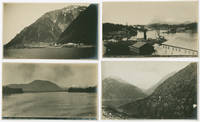
1900réf. 54627Seattle; Skagway. ca. 1900. Alaska circa 1900 A collection of photographs taken by Seattle photographer Frank La Roche. La Roche 1853–1934 a Philadelphia native transplanted to the Northwest established a photography studio in Seattle in 1889. He undertook many trips to Alaska documenting the Klondike Gold Rush at length from 1897 to 1899. This group contains images of Juneau Sitka Fort Wrangell here spelled Wrangle and Taku Glacier. Two images are of Chilkat Tlingit Indians and one photo of the Seymour Rapids in British Columbia is also included. Each is numbered and captioned in manuscript or in print within the negative. Exemplary images from this noted landscape photographer of Alaska and the West. Overall very good. unknown
1900réf. 54627Seattle; Skagway. ca. 1900. Alaska circa 1900 A collection of photographs taken by Seattle photographer Frank La Roche. La Roche 1853–1934 a Philadelphia native transplanted to the Northwest established a photography studio in Seattle in 1889. He undertook many trips to Alaska documenting the Klondike Gold Rush at length from 1897 to 1899. This group contains images of Juneau Sitka Fort Wrangell here spelled Wrangle and Taku Glacier. Two images are of Chilkat Tlingit Indians and one photo of the Seymour Rapids in British Columbia is also included. Each is numbered and captioned in manuscript or in print within the negative. Exemplary images from this noted landscape photographer of Alaska and the West. Overall very good. unknown books
1802réf. PHO-1648Paris, F. Buisson, et Giguen, an X – 1802. 2 volumes de texte in-8° (210x130mm), relié pleine toile époque, dos lisse. XXIV-385pp ; 417pp. et un Atlas In-4, broché, titre sur le plat contenant 14 planches gravées (vues, costumes) et une carte dépliante du détroit qui sépare l'Asie de l'Amérique. Bon exemplaire.
1900réf. 2888Nome Ak: November 1 1900. Very good. 6pp. with original transmittal envelope. Loose octavo sheets. Previously folded; light even tanning. In a slightly hurried but quite legible script. Missouri natives Edwin Sherzer and his brother were two of Nome's first postal workers while they endeavored to develop a dog sledding business on the side. In this content-rich letter from the first year of the gold rush in Nome Sherzer describes his life and pursuits in the Alaska boom town to his fiancée Clara at home in St. Louis. "We have had lots of snow and everything is on runners and everybody riding. The dogs would simply fly over it and we were sitting back on the sled having great fun. You see women all wrapped up in furs seated in a basket sled with a team of 5 or 6 dogs running along with them. I have found it fine sport but my brother says just wait until you get out on the trail and it is work then you won't enjoy it so much." He continues talking up their work prospects with their own sled team and his hopes for their fledgling business: "We have both been working the post office but that only lasted till Nov 1. However we would not have stayed anyway as we have our assessment work to do before January and we can also make more money with our dog team. Four or five persons have tried to buy the dogs from us already and one fellow wanted to hire them but we won't let any of them go as we have a very fine team and have not been keeping them all summer for nothing." He also comments on the adjustments necessary to living in such a remote place: "I suppose everything back home is all excitement over the coming election; up here we don't hear or know anything about it and it will be a long time till we find out who is elected. I ate in one of the restaurants the other day and when they brought things in on china plates I hardly knew what they were and it seemed strange to eat off of them. In the cabin we never wear out coats and they are about the first thing we take off when we come in. Brother remarked the other day what would the folks think if they could see us eating in our shirtsleeves however we have to adapt ourselves to things here and we get so hot over the stove getting supper and working around it is simply impossible to do otherwise." A spirited and descriptive letter concerning life in Nome from a St. Louis native and relative early arrival to the Alaska Gold Rush. November 1 unknown
1900réf. 2888Nome Ak: November 1 1900. Very good. 6pp. with original transmittal envelope. Loose octavo sheets. Previously folded; light even tanning. In a slightly hurried but quite legible script. Missouri natives Edwin Sherzer and his brother were two of Nome's first postal workers while they endeavored to develop a dog sledding business on the side. In this content-rich letter from the first year of the gold rush in Nome Sherzer describes his life and pursuits in the Alaska boom town to his fiancée Clara at home in St. Louis. "We have had lots of snow and everything is on runners and everybody riding. The dogs would simply fly over it and we were sitting back on the sled having great fun. You see women all wrapped up in furs seated in a basket sled with a team of 5 or 6 dogs running along with them. I have found it fine sport but my brother says just wait until you get out on the trail and it is work then you won't enjoy it so much." He continues talking up their work prospects with their own sled team and his hopes for their fledgling business: "We have both been working the post office but that only lasted till Nov 1. However we would not have stayed anyway as we have our assessment work to do before January and we can also make more money with our dog team. Four or five persons have tried to buy the dogs from us already and one fellow wanted to hire them but we won't let any of them go as we have a very fine team and have not been keeping them all summer for nothing." He also comments on the adjustments necessary to living in such a remote place: "I suppose everything back home is all excitement over the coming election; up here we don't hear or know anything about it and it will be a long time till we find out who is elected. I ate in one of the restaurants the other day and when they brought things in on china plates I hardly knew what they were and it seemed strange to eat off of them. In the cabin we never wear out coats and they are about the first thing we take off when we come in. Brother remarked the other day what would the folks think if they could see us eating in our shirtsleeves however we have to adapt ourselves to things here and we get so hot over the stove getting supper and working around it is simply impossible to do otherwise." A spirited and descriptive letter concerning life in Nome from a St. Louis native and relative early arrival to the Alaska Gold Rush. November 1 unknown books
réf. DADAX1566610265New unknown
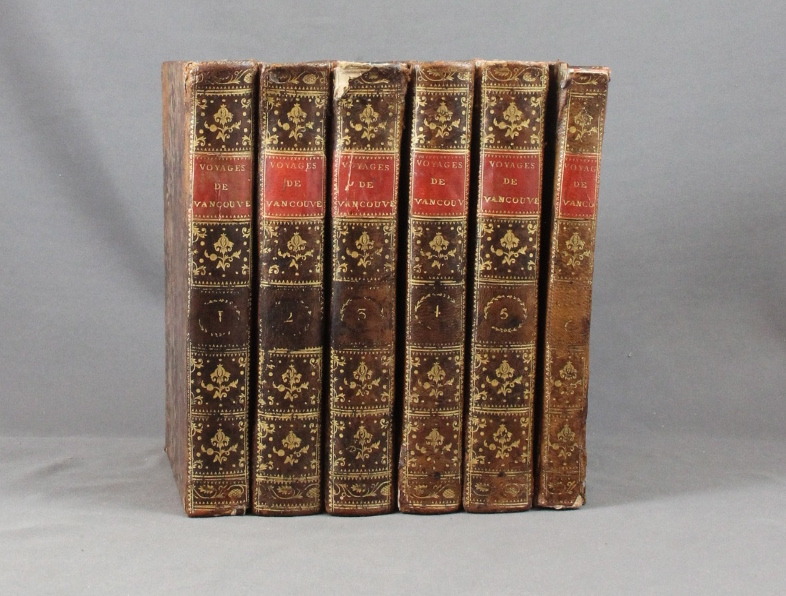
réf. 104239De l'Imprimerie Didot Jeune, An X (1801-1802), 5 volumes +1atlas in-8 de 220x140 mm environ, viij-341 pages - 384 pp., - 381 pp., - 368 pp.,- 438 pp., dernier volume-atlas contenant 17 vues sous serpentes et 9 cartes dont 8 dépliantes, cartonnage de l'éditeur portant titres et tomaisons dorés sur le dos. Feuillets non rognés. Dos insolés, frottements sur les coins et coiffes, petits défauts de marge sur quelques pages sans atteinte au texte, sinon bon état.
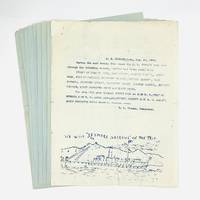
1908réf. 770201908. Significant collection of bulletins clarifying the route of the S.S. Spokane in the summer of 1908. Each is naively illustrated with views from the ship - Sitka Seymour Narrows Taku Glacier Patterson Glacier and Devil's Thumb - as well as Alaska Natives and even baseball. An elegant passenger liner the S.S. Spokane was constructed by the Pacific Coast Steamship Company. The vessel was launch in San Francisco in 1901 and made her first voyage to Seattle in 1902. A year later she had the distinction of transporting President Theodore Roosevelt and his party to Seattle. The Spokane was able to carry nearly 300 passengers at a time including 171 in first class. From these broadsides we learn the S.S. Spokane sailed from the Strait of Juan de Fuca and on to Kasaan Discovery Passage Queen Charlotte Sound and Juneau in August 1908. Three years later the ship was wrecked on an uncharted rock in Seymour Narrows with the loss of two lives. The Spokane was later raised and repaired returning to service in early 1912. Nine broadsides 8 1/2" x 11" or 280 x 215 mm printed on the recto only of the blue or white paper. Old folds with evidence of stapling to the upper left corner and some minor edgewear. unknown
réf. 6293Paris, Didot jeune, an X. 6 volumes in-8 de [4]-VIII-341p., [4]-384p., [4]-381p., [4]-368p., [4]-438p., et un atlas de [4]p., 17 vues et 9 cartes, plein veau moucheté, dos lisses ornés de filets et fleurons dorés, pièces de titre rouge. Reliures un peu malmenées, coiffes frottées, mors un peu fendus, épidermures, auréoles pales à trois volumes, plus présentes dans l'atlas. Chaque première page est frappée d'un large tampon non identifié par votre serviteur.
1868réf. 25042This copy is stamped "THE PRESIDENT" at the top of the front page indicating it belonged to President Andrew Johnson. The President would have read this copy of the act before Congress submitted it to him with some amendments on July 25. The report uses the early variant spelling of "Aliaska" for the territory and peninsula. ALASKA.Newspaper. New-York Tribune July 17 1868. Featuring the terms of the "Aliaska" Bill as passed by the Senate. Copy belonging to President Andrew Johnson. New York: Horace Greeley. 8 pp. 18 x 23¾ in. Excerpts: "Be it enacted &c. That the laws of the United States relating to customs commerce and navigation be and the same are hereby extended to and over all the mainland islands and waters of the territory ceded to the United States by the Emperor of Russia." p1/c2 "And be it further enacted that all the said territory with its ports harbors bays rivers and waters shall constitute a customs collection district to be called 'The District of Aliaska' for which said district a port of entry shall be established at some convenient point to be designated by the President at or near the town of Sitka or New-Archangel and a Collector of Customs shall be appointed by the President by and with the advice and consent of the Senate who shall reside at said port of entry and who shall receive an annual salary of $2500." p1/c2 "That the President shall have the power to restrict and regulate or to prohibit the importation or use of firearms ammunition and distilled spirits into and within said territory." p1/c2 "That until otherwise provided by law the Secretary of the Treasury with the approval of the President shall have power to prescribe such rules and regulations as he may deem proper for the preservation of fur-bearing animals from indiscriminate destruction provided that no special permits shall be granted under this act." p1/c2 Historical Background After suffering defeat at the hands of the British and the French in the Crimean War of 1853-1856 Russia feared losing the Alaskan territory in some future conflict. In an effort to protect Russian interests Tsar Alexander II 1818-1881 determined to sell Alaska. After offering it in 1859 to the United Kingdom Russia negotiated a sale to the United States finalized in 1867. At the time the territory primarily offered fur trading and some natural resources. Americans generally supported the purchase and believed it enhanced American interests in the Pacific though some critics labeled it "Seward's Folly" after Secretary of State William H. Seward who had negotiated the purchase for the United States. Most newspaper editors especially those in California were enthusiastic about the purchase. Notable among the critics was Horace Greeley the editor of this newspaper and a long-time opponent of Seward. The value of the new territory increased dramatically with the discovery of gold fields in 1896. The Senate ratified the Treaty with Russia on April 9 1867 by a vote of 37 to 2. On July 14 1868 the House of Representatives passed a resolution appropriating the $7.2 million necessary to purchase Alaska less than two cents per acre and the Senate approved the resolution with amendments. The House refused the amendments and the resolution went to a committee. The House passed the resolution as revised by the conference committee on July 23 and the Senate passed it the following day. Meanwhile on July 15 Senator Zachariah Chandler of Michigan introduced "An Act to extend the Laws of the United States relating to the Customs Commerce and Navigation over the Territory ceded to the United States by Russia to establish a Collection District therein and for other Purposes" and the Senate passed it on July 16. In the House Representative Elihu B. Washburne of Illinois proposed amendments on July 25 and the House agreed to them. The Senate disagreed with the amendments and this bill went also to a conference committee where the Senate receded from its opposition and the bill passed. President Johnson approved and signed both the joint resolution and the act on July 27 1868. In 1870 Congress followed up its concerns about preserving fur-bearing animals expressed in this law with "An Act to prevent the Extermination of Fur-bearing Animals in Alaska" aimed directly at regulating the killing of fur-bearing seals on Saint Paul and Saint George Islands off the western coast of Alaska north of the Aleutian Islands. Additional Content This issue also includes the Senate confirmation of William M. Evarts 1818-1901 as Attorney General p1/c2 p5/c4; proceedings of Congress including Senate discussion of this bill p1/c3-4; a letter from a special correspondent describing Sitka Alaska p2/c2-3; an editorial nomination of Thomas A. R. Nelson of Tennessee as Secretary of State to succeed William H. Seward "now that Mr. Seward has succeeded in buying Aliaska" p4/c5-6; "base ball" and cricket scores p5/c5; and a report on dozens of deaths from sunstroke during two-week heat wave especially among children p8/c1-3. New-York Tribune 1841-1924 was established as a daily newspaper in 1841 by Horace Greeley 1811-1872. By the 1850s it reached a circulation of 200000 copies making it the largest daily newspaper in New York City at the time. Greeley also published weekly and semi-weekly issues of the Tribune through much of his tenure. The New-York Tribunebecame the dominant Whig and then Republican newspaper in the United States helping to shape public opinion especially as other newspapers often copied its articles and editorials. It was one of the first newspapers in the Union to send reporters and correspondents to cover the military campaigns of the Civil War. Greeley used his newspaper to support many reforms including abolitionism pacifism socialism for a time and feminism. After Greeley's failed campaign as the Liberal Republican candidate for President Whitelaw Reid 1837-1912 assumed control of the Tribune until his death. His son Ogden Mills Reid 1882-1947 acquired the New York Herald and merged the newspapers in 1924. Condition Typical folds and light foxing few slight tears at some of the outer margins and appears to have been bound in a book at one point or someone reinforced the outer fold.
1868réf. 25042This copy is stamped "THE PRESIDENT" at the top of the front page indicating it belonged to President Andrew Johnson. The President would have read this copy of the act before Congress submitted it to him with some amendments on July 25. The report uses the early variant spelling of "Aliaska" for the territory and peninsula. ALASKA.Newspaper. New-York Tribune July 17 1868. Featuring the terms of the "Aliaska" Bill as passed by the Senate. Copy belonging to President Andrew Johnson. New York: Horace Greeley. 8 pp. 18 x 23¾ in. Excerpts: "Be it enacted &c. That the laws of the United States relating to customs commerce and navigation be and the same are hereby extended to and over all the mainland islands and waters of the territory ceded to the United States by the Emperor of Russia." p1/c2 "And be it further enacted that all the said territory with its ports harbors bays rivers and waters shall constitute a customs collection district to be called 'The District of Aliaska' for which said district a port of entry shall be established at some convenient point to be designated by the President at or near the town of Sitka or New-Archangel and a Collector of Customs shall be appointed by the President by and with the advice and consent of the Senate who shall reside at said port of entry and who shall receive an annual salary of $2500." p1/c2 "That the President shall have the power to restrict and regulate or to prohibit the importation or use of firearms ammunition and distilled spirits into and within said territory." p1/c2 "That until otherwise provided by law the Secretary of the Treasury with the approval of the President shall have power to prescribe such rules and regulations as he may deem proper for the preservation of fur-bearing animals from indiscriminate destruction provided that no special permits shall be granted under this act." p1/c2 Historical Background After suffering defeat at the hands of the British and the French in the Crimean War of 1853-1856 Russia feared losing the Alaskan territory in some future conflict. In an effort to protect Russian interests Tsar Alexander II 1818-1881 determined to sell Alaska. After offering it in 1859 to the United Kingdom Russia negotiated a sale to the United States finalized in 1867. At the time the territory primarily offered fur trading and some natural resources. Americans generally supported the purchase and believed it enhanced American interests in the Pacific though some critics labeled it "Seward's Folly" after Secretary of State William H. Seward who had negotiated the purchase for the United States. Most newspaper editors especially those in California were enthusiastic about the purchase. Notable among the critics was Horace Greeley the editor of this newspaper and a long-time opponent of Seward. The value of the new territory increased dramatically with the discovery of gold fields in 1896. The Senate ratified the Treaty with Russia on April 9 1867 by a vote of 37 to 2. On July 14 1868 the House of Representatives passed a resolution appropriating the $7.2 million necessary to purchase Alaska less than two cents per acre and the Senate approved the resolution with amendments. The House refused the amendments and the resolution went to a committee. The House passed the resolution as revised by the conference committee on July 23 and the Senate passed it the following day. Meanwhile on July 15 Senator Zachariah Chandler of Michigan introduced "An Act to extend the Laws of the United States relating to the Customs Commerce and Navigation over the Territory ceded to the United States by Russia to establish a Collection District therein and for other Purposes" and the Senate passed it on July 16. In the House Representative Elihu B. Washburne of Illinois proposed amendments on July 25 and the House agreed to them. The Senate disagreed with the amendments and this bill went also to a conference committee where the Senate receded from its opposition and the bill passed. President Johnson approved and signed both the joint resolution and the act on July 27 1868. In 1870 Congress followed up its concerns about preserving fur-bearing animals expressed in this law with "An Act to prevent the Extermination of Fur-bearing Animals in Alaska" aimed directly at regulating the killing of fur-bearing seals on Saint Paul and Saint George Islands off the western coast of Alaska north of the Aleutian Islands. Additional Content This issue also includes the Senate confirmation of William M. Evarts 1818-1901 as Attorney General p1/c2 p5/c4; proceedings of Congress including Senate discussion of this bill p1/c3-4; a letter from a special correspondent describing Sitka Alaska p2/c2-3; an editorial nomination of Thomas A. R. Nelson of Tennessee as Secretary of State to succeed William H. Seward "now that Mr. Seward has succeeded in buying Aliaska" p4/c5-6; "base ball" and cricket scores p5/c5; and a report on dozens of deaths from sunstroke during two-week heat wave especially among children p8/c1-3. New-York Tribune 1841-1924 was established as a daily newspaper in 1841 by Horace Greeley 1811-1872. By the 1850s it reached a circulation of 200000 copies making it the largest daily newspaper in New York City at the time. Greeley also published weekly and semi-weekly issues of the Tribune through much of his tenure. The New-York Tribunebecame the dominant Whig and then Republican newspaper in the United States helping to shape public opinion especially as other newspapers often copied its articles and editorials. It was one of the first newspapers in the Union to send reporters and correspondents to cover the military campaigns of the Civil War. Greeley used his newspaper to support many reforms including abolitionism pacifism socialism for a time and feminism. After Greeley's failed campaign as the Liberal Republican candidate for President Whitelaw Reid 1837-1912 assumed control of the Tribune until his death. His son Ogden Mills Reid 1882-1947 acquired the New York Herald and merged the newspapers in 1924. Condition Typical folds and light foxing few slight tears at some of the outer margins and appears to have been bound in a book at one point or someone reinforced the outer fold. books
1798réf. PHO-2367Paris, De l’Imprimerie de la République, An VI-An VII [1798-1799]. Texte : 5 volumes in-8 (22,5x14cm), 1f.-CCI-1f.-294pp.-1f., VII-529pp. (3 tableaux dépliants), VIII-474pp.1f. (8 tableaux dépliants), VIII-494pp., XII-559pp.-2ff., relié toile moderne, pièce d’auteur, titre et tomaison, non rogné, mouillure. Atlas : 1 vol. In4° (4) (26,5x22cm), VIII-158pp.-1f., 15 cartes et 1 gravure. Demi veau, titre et tomaison au dos, frottements, coins usés, accroc au dos, charnière fendillée, piqures sur quelques feuillets et cartes, renforcement et réparation sur 1 carte, la carte 15 en fac-similé Rare édition in-8, parue en même temps en format in-4, accompagné de l’atlas correspondant au tome 4 de l’édition in-4.
1900réf. 4544Various locations in British Columbia and Alaska 1900. Very good. 14 leaves illustrated with 111 vernacular sepia-toned photographs between 2.5 x 4.5 inches and 3.5 x 5.5 inches. Mostly mounted four per page. Oblong folio. Contemporary black cloth gilt string tied. Minor edge wear and rubbing. Some edge chipping to a handful of album leaves occasional dust-soiling. With 5pp. typed and numbered list laid in keyed to manuscript numbering beneath each photograph. A phenomenal collection of vernacular photographs taken by an unidentified traveler on a voyage to British Columbia and Alaska around the turn of the 20th century. Most of the photographs were taken from aboard a steamship or from a railroad car when they venture inland but occasionally the compiler includes shots from the ground. The photographs begin with numerous scenic landscapes in and around Nelson Rossland and Victoria British Columbia picturing landmarks such as Kootenay Lake Bonnington Falls the Cascade Mountains and a "Government House" in Victoria. The scene then shifts to Alaska picturing Devil's Thumb various glaciers a wonderful totem in Simpson distant shots of Juneau and Skagway and much more. Once inland the compiler takes pictures of the White Pass Lake Bennet White Horse and more before getting back on a steamship. One particularly interesting image from White Horse shows a pair of businesses set up in tents - Cap. P. Martin's Cigar Store and the Vancouver Hotel. Once back on the steamship the compiler shoots Five Finger Rapids before reaching the "town" of Yukon really just a loose handful of wooden huts. The intrepid traveler lands next in Dawson City where they include at least half a dozen fantastic shots of the settlement and its downtown area. The next series of images in Grand Forks show exterior shots of gold mines called Gold Hill and Eldorado #26 and a sweeping "View of Klondike Valley." The traveler then apparently turned south as the next series of images picture Taku Alert Bay with images of five Totems and the local cemetery and eight views of Fraser Canon. The album concludes with a few shots of the Illecillewaet Glacier Lakes Agnes and Louise and several views in and around Banff. The latter images include one of a bear and two featuring grazing buffalo. An interesting and wide-ranging collection of photographs featuring the untouched majesty of the landscapes of Alaska and the Canadian Northwest mixed with areas already being developed and exploited by human prospectors and travelers. The images are accompanied by an invaluable list of captions which are vital to identifying the locations of the images which appear to emanate from slightly earlier than usual in photographic groups from these areas. unknown
1900réf. 4544Various locations in British Columbia and Alaska 1900. Very good. 14 leaves illustrated with 111 vernacular sepia-toned photographs between 2.5 x 4.5 inches and 3.5 x 5.5 inches. Mostly mounted four per page. Oblong folio. Contemporary black cloth gilt string tied. Minor edge wear and rubbing. Some edge chipping to a handful of album leaves occasional dust-soiling. With 5pp. typed and numbered list laid in keyed to manuscript numbering beneath each photograph. A phenomenal collection of vernacular photographs taken by an unidentified traveler on a voyage to British Columbia and Alaska around the turn of the 20th century. Most of the photographs were taken from aboard a steamship or from a railroad car when they venture inland but occasionally the compiler includes shots from the ground. The photographs begin with numerous scenic landscapes in and around Nelson Rossland and Victoria British Columbia picturing landmarks such as Kootenay Lake Bonnington Falls the Cascade Mountains and a "Government House" in Victoria. The scene then shifts to Alaska picturing Devil's Thumb various glaciers a wonderful totem in Simpson distant shots of Juneau and Skagway and much more. Once inland the compiler takes pictures of the White Pass Lake Bennet White Horse and more before getting back on a steamship. One particularly interesting image from White Horse shows a pair of businesses set up in tents - Cap. P. Martin's Cigar Store and the Vancouver Hotel. Once back on the steamship the compiler shoots Five Finger Rapids before reaching the "town" of Yukon really just a loose handful of wooden huts. The intrepid traveler lands next in Dawson City where they include at least half a dozen fantastic shots of the settlement and its downtown area. The next series of images in Grand Forks show exterior shots of gold mines called Gold Hill and Eldorado #26 and a sweeping "View of Klondike Valley." The traveler then apparently turned south as the next series of images picture Taku Alert Bay with images of five Totems and the local cemetery and eight views of Fraser Canon. The album concludes with a few shots of the Illecillewaet Glacier Lakes Agnes and Louise and several views in and around Banff. The latter images include one of a bear and two featuring grazing buffalo. An interesting and wide-ranging collection of photographs featuring the untouched majesty of the landscapes of Alaska and the Canadian Northwest mixed with areas already being developed and exploited by human prospectors and travelers. The images are accompanied by an invaluable list of captions which are vital to identifying the locations of the images which appear to emanate from slightly earlier than usual in photographic groups from these areas. unknown books
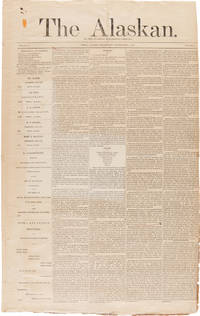
1885réf. 58810Sitka: The Alaskan Publishing Company 1885-1886. Three Early Issues of One of Alaska's First Newspapers Three early issues including the first and second of one of the first newspapers published in the District of Alaska and by far the most enduring of those early printing efforts. Preceded only by the short-lived Sitka Times and Sitka Post in the 1870s The Alaskan ran from this first issue in November of 1885 until 1908. Though preceding the Klondike gold rush proper by over a decade these issues discuss much related to prospecting and mining in addition to local events and politics. From the outset The Alaskan purported to be a strictly non-partisan paper with the admirable goal of "advocacy and defense for the best interests of Alaska and its people." In pursuit of this goal the paper sought circulation stateside and made considerable efforts to impress outsiders correct misconceptions about the territory and to vociferously argue for self-government. Since 1884 Alaska was administered as a District meaning that the governor and most officials were appointed directly by the President. Alaskan citizens were well aware that they had little to no capacity for "home rule" let alone representation in Congress and a number of articles in these issues revolve around that discontent. An article in the second issue for example laments that as there are no counties in Alaska and therefore no elected County Superintendents to administer public schools – everything instead is managed by the directly-appointed Agent of Education. A number of articles reference the native population of Sitka both directly and indirectly. The printer's devil for the Alaskan Publishing Company was apparently a Sitka boy one article praises the cleanliness and infrastructure of the "Indian village" and others describe the industriousness of the "Indian police" and fire brigade local figures or guides and more. Still the search for gold fills much of the space on these pages. Articles wish luck and promise updates on prospecting parties setting out and report on the success or more often failure of others. The lion's share of the mining content however is thanks to the contributions of Nicholas Haley an experienced miner and very early prospector who came to Alaska to hunt for ore in 1872. Hayley's richly detailed and effusive descriptions of gold veins and ledges in the Silver Bay region populate several columns of each issue though reader beware: Haley's experience also taught him how to make the most out of even the worst claims – by courting stateside investors sight-unseen. Haley's outrageously exaggerated articles about the richness of his claims printed with The Alaskan's tacit consent for years convinced many an unsuspecting victim including Governor Swineford himself to spend generously on these largely barren mines. Other articles of note in these issues include a detailed history of Treadwell's Mill in Juneau several lengthy essays give a history of the Presbyterian Mission in Alaska and others discuss the controversies surrounding Alaska's impressive run of short-termed and corrupt early judges. There are also articles that briefly reference the Chinese Problem criticizing Californian alarmism and the Fitz John Porter case's near-conclusion and describe the challenges of getting a printing house up and running in the far north. Advertisements are present in each issue for a variety of products and services including a "billiard saloon" and one advertisement for "PURE BEER" rather daringly printed immediately adjacent to a report of smuggled alcohol seized by customs. The beer is of course offered "EXPRESSLY and EXCLUSIVELY for MEDICINAL MECHANICAL AND SCIENTIFIC PURPOSES." A valuable collection of early Alaska printing and news including considerable details on mining as well as the social and political concerns in pre-Gold Rush Sitka. Small stab holes in inner margin of each issue from prior binding old folds and minor splitting. General edge wear and small closed tears heavier in first and second issues just into edge of text on first leaf of second issue. Occasional contemporary underlining in red ink. Overall very good printed on fragile paper to begin with. Matthew Hunter Making Claims: How 19th Century Sitkans Worked the Gold-Mining Business. 2006 online. unknown
1885réf. 58810Sitka: The Alaskan Publishing Company 1885-1886. Three Early Issues of One of Alaska's First Newspapers Three early issues including the first and second of one of the first newspapers published in the District of Alaska and by far the most enduring of those early printing efforts. Preceded only by the short-lived Sitka Times and Sitka Post in the 1870s The Alaskan ran from this first issue in November of 1885 until 1908. Though preceding the Klondike gold rush proper by over a decade these issues discuss much related to prospecting and mining in addition to local events and politics. From the outset The Alaskan purported to be a strictly non-partisan paper with the admirable goal of "advocacy and defense for the best interests of Alaska and its people." In pursuit of this goal the paper sought circulation stateside and made considerable efforts to impress outsiders correct misconceptions about the territory and to vociferously argue for self-government. Since 1884 Alaska was administered as a District meaning that the governor and most officials were appointed directly by the President. Alaskan citizens were well aware that they had little to no capacity for "home rule" let alone representation in Congress and a number of articles in these issues revolve around that discontent. An article in the second issue for example laments that as there are no counties in Alaska and therefore no elected County Superintendents to administer public schools – everything instead is managed by the directly-appointed Agent of Education. A number of articles reference the native population of Sitka both directly and indirectly. The printer's devil for the Alaskan Publishing Company was apparently a Sitka boy one article praises the cleanliness and infrastructure of the "Indian village" and others describe the industriousness of the "Indian police" and fire brigade local figures or guides and more. Still the search for gold fills much of the space on these pages. Articles wish luck and promise updates on prospecting parties setting out and report on the success or more often failure of others. The lion's share of the mining content however is thanks to the contributions of Nicholas Haley an experienced miner and very early prospector who came to Alaska to hunt for ore in 1872. Hayley's richly detailed and effusive descriptions of gold veins and ledges in the Silver Bay region populate several columns of each issue though reader beware: Haley's experience also taught him how to make the most out of even the worst claims – by courting stateside investors sight-unseen. Haley's outrageously exaggerated articles about the richness of his claims printed with The Alaskan's tacit consent for years convinced many an unsuspecting victim including Governor Swineford himself to spend generously on these largely barren mines. Other articles of note in these issues include a detailed history of Treadwell's Mill in Juneau several lengthy essays give a history of the Presbyterian Mission in Alaska and others discuss the controversies surrounding Alaska's impressive run of short-termed and corrupt early judges. There are also articles that briefly reference the Chinese Problem criticizing Californian alarmism and the Fitz John Porter case's near-conclusion and describe the challenges of getting a printing house up and running in the far north. Advertisements are present in each issue for a variety of products and services including a "billiard saloon" and one advertisement for "PURE BEER" rather daringly printed immediately adjacent to a report of smuggled alcohol seized by customs. The beer is of course offered "EXPRESSLY and EXCLUSIVELY for MEDICINAL MECHANICAL AND SCIENTIFIC PURPOSES." A valuable collection of early Alaska printing and news including considerable details on mining as well as the social and political concerns in pre-Gold Rush Sitka. Small stab holes in inner margin of each issue from prior binding old folds and minor splitting. General edge wear and small closed tears heavier in first and second issues just into edge of text on first leaf of second issue. Occasional contemporary underlining in red ink. Overall very good printed on fragile paper to begin with. Matthew Hunter Making Claims: How 19th Century Sitkans Worked the Gold-Mining Business. 2006 online. unknown books
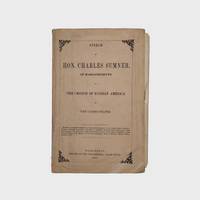
1867réf. 376097Washington: Printed at the Congressional Globe Office 1867. First edition. With the large 24 x 35 in. folding map of Northwest America "second edition May 1867" by A. Lindenkohl not found in all copies. 48 pp. text in double columns. 8vo. Publisher's pink wrappers minor soiling small repaired split at lower front joint. Minor foxing. First edition. With the large 24 x 35 in. folding map of Northwest America "second edition May 1867" by A. Lindenkohl not found in all copies. 48 pp. text in double columns. 8vo. Sumner gives an account of the history of the Alaskan Territory just recently purchased by Secretary of State William Seward from Russia for $7.2 million. Sumner was a strong exponent of the purchase and Seward praised his speech. This example with the large folding map not always present and not issued with all copies of the speech according to Lada-Mocarski - the first map to represent the Alaska Purchase and the first to use the name "Alaska". Howes S1134; Lada-Mocarski 159; Tourville 4391; Wickersham 4128 Printed at the Congressional Globe Office unknown
1867réf. 376097Washington: Printed at the Congressional Globe Office 1867. First edition. With the large 24 x 35 in. folding map of Northwest America "second edition May 1867" by A. Lindenkohl not found in all copies. 48 pp. text in double columns. 8vo. Publisher's pink wrappers minor soiling small repaired split at lower front joint. Minor foxing. First edition. With the large 24 x 35 in. folding map of Northwest America "second edition May 1867" by A. Lindenkohl not found in all copies. 48 pp. text in double columns. 8vo. Sumner gives an account of the history of the Alaskan Territory just recently purchased by Secretary of State William Seward from Russia for $7.2 million. Sumner was a strong exponent of the purchase and Seward praised his speech. This example with the large folding map not always present and not issued with all copies of the speech according to Lada-Mocarski - the first map to represent the Alaska Purchase and the first to use the name "Alaska". Howes S1134; Lada-Mocarski 159; Tourville 4391; Wickersham 4128 Printed at the Congressional Globe Office unknown books
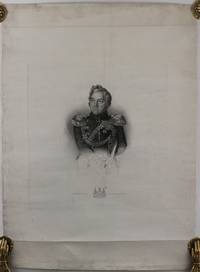
réf. R60Steel engraving print size 39x345 cm on a large sheet 655x485 cm. “B.R. Davies direxit. J. Thomson sculpt.” underneath the image. With an engraved title in Russian and Lazarev’s coat of arms engraved on the lower margin. Blank margins with minor repaired tears creases on the upper and lower blank margins not affecting the images overall a very good print. Official portrait of Admiral Mikhail Petrovich Lazarev 1788-1851 Russian naval officer circumnavigator and the discoverer of Antarctica. The print engraved in England on the special order of the Russian Naval Ministry shows Lazarev in his late years as the Chief of Staff of the Black Sea Fleet since 1832; the Admiral is depicted waist length dressed in uniform with all his regalia and holding a spyglass under his left arm. His name under the portrait is adorned with the coat of arms of Lazarev noble family. ‘‘Lazarev first circumnavigated the globe in 1813-1816 aboard the vessel Suvorov; the expedition began at Kronstadt and reached Alaska. During this voyage Lazarev discovered the Suvorov Atoll. As a commander of the ship Mirny and Fabian Gottlieb von Bellingshausen’s deputy on his world cruise in 1819–1821 Bellingshausen commanded Vostok Lazarev took part in the discovery of Antarctica and numerous islands. On January 28 1820 the expedition discovered the Antarctic mainland approaching the Antarctic coast at the coordinates 69°21’28’’S 2°14’50’’W / 69.35778°S 2.24722°W / -69.35778; -2.24722 and seeing ice-fields there. In 1822-1825 Lazarev circumnavigated the globe for the third time on his frigate Kreyser conducting broad research in the fields of meteorology and ethnography’’ Wikipedia. Later Lazarev took part in the Battle of Navarino 1827 part of the Greek War of Independence 1821-32; was in charge of the naval units of the Baltic Fleet 1830 and became the Commander of the Black Sea Fleet the Black Sea ports and military governor of Sevastopol and Nikolayaev since 1833. unknown
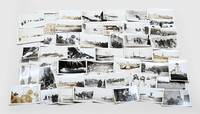
1932réf. 177173Alaska: 1932-3. The first Hollywood film to be shot in a Native American language A collection of behind-the-scenes photographs documenting the production of Eskimo 1933. With a mostly Native American cast it was the first feature film shot entirely on location in Alaska and the first to incorporate the Iñupiat language. Produced over a 17-month period it captured scenes of hunting and daily life with documentary realism. The photographs include images of the cast and crew among them the Iñupiaq lead Ray Mala Lotus Long Peter Freuchen and director W. S. Van Dyke as well as indigenous actors in traditional parkas and mukluks. Also shown are scenes of walrus and moose hunts extras posed in igloos animal processing and film equipment in use. Mala accompanied the Danish Arctic explorer Knud Rasmussen on an expedition from 1921 to 1924 collecting and describing Inuit songs and legends. The following year Mala commenced his career in Hollywood where he worked for almost 30 years. Eskimo later re-released as Mala the Magnificent was directed by Van Dyke and adapted from Freuchen's writings. Depicting encounters between Inuit communities and Western traders the film was not a commercial success. Still it was praised for its realism and awarded the inaugural Academy Award for Best Film Editing. Van Dyke known as "One Take Woody" for his efficient work made several other early sound films including Tarzan the Ape Man 1932 The Thin Man 1934 and San Francisco 1936. 48 silver gelatin prints from 64 x 88 to 87 x 105 mm. portrait and landscape format some stamped "Velox" on the verso others with pencilled numbers. A small number are copy prints. Some a little yellowed or with silver mirroring a few minor surface abrasions: a very good collection. Frank Javier Garcia Berumen American Indian Image Makers of Hollywood 2020; R. Bruce Macdonald Sisters of the Ice 2021. unknown
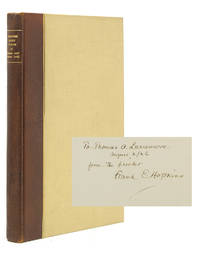
1924réf. 313772Flushing Long Island: Marion Press 1924. Copy #X of 50 copies. Printed at the Marion Press. Inscribed on the colophon page to Thomas A. Larremore April 2/26 from the printer Frank E. Hopkins. Larremore was the bibliographer of the Marion Press. Illustrated with folding map folding view numerous photographic plates and inserted sketch maps. Pp. 103 1 colophon. 1 vols. 8vo. Original quarter brown morocco and cloth titled in gilt. Stamp of Robert Pierce on the front pastedown. Copy #X of 50 copies. Printed at the Marion Press. Inscribed on the colophon page to Thomas A. Larremore April 2/26 from the printer Frank E. Hopkins. Larremore was the bibliographer of the Marion Press. Illustrated with folding map folding view numerous photographic plates and inserted sketch maps. Pp. 103 1 colophon. 1 vols. 8vo. "A very interesting journal with sketch maps and drawings and photographs. Touches much country not before described and goats are discovered near Frances Lake ." - Phillips Streeter: Hunter's narration of his journey "to the Yukon in quest of Frances Lake" is taken from his diary. "Many things that I wrote in the field last summer read queerly today but that may be accounted for by the fact that here on Long Island I am neither tired hungry nor wet. These three things strangely influence the amateur explorer." The author thanks Charles Sheldon of Washington D.C. in the Apologia for giving him the idea to search for sheep at Frances Lake. Hunter retraced some of the 1887 explorations of George M.Dawson published in The Yukon Territory 1898 which collected acounts by Dall Dawson and Ogilvie. Streeter 3627; Phillips p. 190. Larremore The Marion Press no. 183 & pp. 150 & 160; Not in Heller [Marion Press] unknown
1924réf. 313772Flushing Long Island: Marion Press 1924. Copy #X of 50 copies. Printed at the Marion Press. Inscribed on the colophon page to Thomas A. Larremore April 2/26 from the printer Frank E. Hopkins. Larremore was the bibliographer of the Marion Press. Illustrated with folding map folding view numerous photographic plates and inserted sketch maps. Pp. 103 1 colophon. 1 vols. 8vo. Original quarter brown morocco and cloth titled in gilt. Stamp of Robert Pierce on the front pastedown. Copy #X of 50 copies. Printed at the Marion Press. Inscribed on the colophon page to Thomas A. Larremore April 2/26 from the printer Frank E. Hopkins. Larremore was the bibliographer of the Marion Press. Illustrated with folding map folding view numerous photographic plates and inserted sketch maps. Pp. 103 1 colophon. 1 vols. 8vo. "A very interesting journal with sketch maps and drawings and photographs. Touches much country not before described and goats are discovered near Frances Lake ." - Phillips Streeter: Hunter's narration of his journey "to the Yukon in quest of Frances Lake" is taken from his diary. "Many things that I wrote in the field last summer read queerly today but that may be accounted for by the fact that here on Long Island I am neither tired hungry nor wet. These three things strangely influence the amateur explorer." The author thanks Charles Sheldon of Washington D.C. in the Apologia for giving him the idea to search for sheep at Frances Lake. Hunter retraced some of the 1887 explorations of George M.Dawson published in The Yukon Territory 1898 which collected acounts by Dall Dawson and Ogilvie. Streeter 3627; Phillips p. 190. Larremore The Marion Press no. 183 & pp. 150 & 160; Not in Heller [Marion Press] unknown books
1905réf. 3538Copper River Valley Ak 1905. Very good. Forty-five printing-out paper photographs between 3.25 x 3.25 and 4 x 6 inches plus three real photo postcards. Minor wear a few creases occasional light soiling. A unique collection of almost fifty images capturing scenes in and around Copper Center in the Copper River Valley of Alaska in the years after gold was first found there in 1898. The images document pioneers panning for gold running dog sled teams posed in front of early wooden buildings in a bleak snow-covered landscape and more as well as capturing shots of a riverside mill a wooden bridge scenery on the Copper River and the majesty of the surrounding forests. A handful of the images capture pioneer women and children posed for the camera in winter clothing worn to combat the bitter Alaskan winters. One image pictures three men and two dogs standing outside the Hotel Holman an early Copper Center roadhouse that began in a tent but was opened in a wooden structure in 1899; the present image captures the post-1899 wooden structure. The Holman Hotel was established in July 1898 by Copper Center's first resident Andrew Holman in order to provide shelter for prospectors on their way to the Klondike gold fields. Copper Center is located northeast of Anchorage and served as a brief but important way station for gold prospectors in southeastern Alaska; one image here apparently pictures the early riverside settlement or is perhaps an early view of Anchorage. A rare view of Alaskan life in an uncommonly-seen settlement during the first decade of the 20th century. unknown
1905réf. 3538Copper River Valley Ak 1905. Very good. Forty-five printing-out paper photographs between 3.25 x 3.25 and 4 x 6 inches plus three real photo postcards. Minor wear a few creases occasional light soiling. A unique collection of almost fifty images capturing scenes in and around Copper Center in the Copper River Valley of Alaska in the years after gold was first found there in 1898. The images document pioneers panning for gold running dog sled teams posed in front of early wooden buildings in a bleak snow-covered landscape and more as well as capturing shots of a riverside mill a wooden bridge scenery on the Copper River and the majesty of the surrounding forests. A handful of the images capture pioneer women and children posed for the camera in winter clothing worn to combat the bitter Alaskan winters. One image pictures three men and two dogs standing outside the Hotel Holman an early Copper Center roadhouse that began in a tent but was opened in a wooden structure in 1899; the present image captures the post-1899 wooden structure. The Holman Hotel was established in July 1898 by Copper Center's first resident Andrew Holman in order to provide shelter for prospectors on their way to the Klondike gold fields. Copper Center is located northeast of Anchorage and served as a brief but important way station for gold prospectors in southeastern Alaska; one image here apparently pictures the early riverside settlement or is perhaps an early view of Anchorage. A rare view of Alaskan life in an uncommonly-seen settlement during the first decade of the 20th century. unknown books
1840xi, 227 pages. Index. Fold-out map. Signed and inscribed by author to renowned historian William Hickling Prescott inside front board. Upon front free endpaper a subsequent owner (late 1800s) has documented the provenance of this copy and documented Prescott's pencil markings to pages 23 through 27 which deal with Cortes and Mexico. Occasional light markings to contents. Prior owner's mini-bookplate inside front board. Narrow openings along both hinges. Usual library markings. Fold-out map bears several short openings and a tape repair along right edge. Front free endpaper loose but present. Prior owner's signature atop title page. Above-average external wear to brown marbled boards. WHALE 508, TPL 2369, HOWES G-389, RICKS P.112, TOURVILLE 1850, SMITH 3848, WICKERSHAM 4086. Book