1 387 résultats
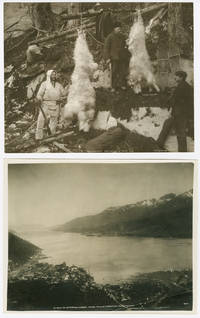
1907réf. 54628Juneau; White Pass. ca. 1907. Two Original Photographs of Alaska by a Noted Pair of Photographers Two attractive original photographs by noted Skagway photography firm Case & Draper. William Case and Horace Draper followed the excitement of the Klondike Gold Rush and went North in 1898. They stayed and worked in partnership from a studio in Skagway until 1907-1908. The first of these photos depicts three armed men on a hillside at White Pass Alaska with two large mountain goats strung up after a hunt. The second is a captivating landscape of Juneau and the Gastineau Channel with the town of Douglas in the distance. Impressive examples from these significant Alaskan photographers. Slight wear at edges. Captioned in negative. Very good. unknown books
1907réf. 54628Juneau; White Pass. ca. 1907. Two Original Photographs of Alaska by a Noted Pair of Photographers Two attractive original photographs by noted Skagway photography firm Case & Draper. William Case and Horace Draper followed the excitement of the Klondike Gold Rush and went North in 1898. They stayed and worked in partnership from a studio in Skagway until 1907-1908. The first of these photos depicts three armed men on a hillside at White Pass Alaska with two large mountain goats strung up after a hunt. The second is a captivating landscape of Juneau and the Gastineau Channel with the town of Douglas in the distance. Impressive examples from these significant Alaskan photographers. Slight wear at edges. Captioned in negative. Very good. unknown
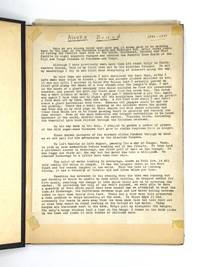
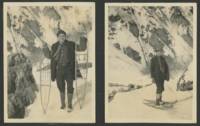
réf. 74398Typescript account of 32 pages accompanied by 31 black and white photographs gathered in a scrapbook album documenting an unidentified Washington’s man’s hiking climbing and sight-seeing adventures in Alaska. Written along the top edge of the first page is “Alaska Bound 1946-1947.” Twenty-three of the onion skin paper pages are scotch taped to the album pages and the final nine pages of the typescript are loose and laid into the back of the string-tied album. The black and white photographs measure 4 ½ x 2 ¾” and are affixed to the album pages with black photo corners. The tape affixed to the pages has oxidized but otherwise overall on very good condition. The unknown author was a crewman on a cargo ship and wrote that he had made more than 150 prior trips to Southeastern Alaska. On this trip his ship set out from Seattle to the Aleutian Islands and made a stop at Anchorage to drop off some dogs for the Army. “As part of the cargo which we were carrying we had on deck sixty-one sled dogs raised in Nebraska” he wrote. “They were supposed to be mostly huskies but in reality were a mixture of almost everything…It was remarked: ‘They are nothing but a darned bunch of Nebraska coyotes.’” Beyond Anchorage the ship’s itinerary included Adak Attu Shemya Whittier and Amchitaka. The narrative covers his experiences on board but is mainly devoted to his shore adventures oftentimes with other members of his crew which include mountain climbing hiking fishing trips and sight-seeing during his free days while cargo is being off loaded. One of his first adventures was a trip to Wasilla and Palmer. “Back in Palmer once more we made the acquaintance of one of the old timers who gave us quite a history of Alaskan mining from the early gold rush days up to the present time” he wrote. “He tried to persuade us to go back into the mountains with him to take pictures of his claims. On the way to Adak he spotted “whale birds” and soon whales were also seen. “During the war whales in these waters were frequently attacked by both bombers and submarines in error” he wrote. “It was it seems difficult to detect the difference between submarines and whales.” In addition to being an avid and skillful storyteller and photographer the diarist had a wide-ranging knowledge and interest in the flora and fauna of the region. During a port stop in Attu he explored Holty Holtz Bay and traveled to the summit of Jarmin Pass where the Japanese once maintained a principal base until it was recaptured by the United States during World War II. “In the foreground and also in the distance some dummy guns and other equipment could be seen scattered about” he wrote. “I followed along the stream and before long came across a few small willow bushes less than three feet in height bravely struggling for existence against the elements. They were located in a thicket of Russian thistles wild cherry tanzzy monk hood and numerous other kinds of vegetation. That was my first glimpse of anything in the form of wood growing in the Aleutians.” On this break he undertook the first of several climbing expeditions – this one of Gilbert Ridge. It was a near catastrophe after the weather turned foggy while he was climbing the jagged peaks made the wrong decision dead-ending against sheer cliffs and fell while back tracking his route. “In that next instant I found myself bouncing over the wet cozy ground like a toboggan over a snowbank…I started flying through space at what seemed to me a mile a minute. In the next instant there was a big swoosh as I cut a path three feet wide and five feet long through a patch of Indian celery Russian thistle and Monk’s Hood and landed with a flop in the creek bed below and that was that.” Although he was fortunate to escape with a sore shoulder and sprained thumb he was soaking wet and faced a long journey back to the ship. The scrapbook is filled with numerous descriptive accounts of his adventures during the journey. The photographs complement the text and include various images of his explorations ranging from Whittier Glacier to two men holding a crippled Bald Eagle a trading store in Wasilla and fishing at Finger Arm. At the end of the trip before returning to Seattle he and his shipmates went into the woods and cut Christmas trees which they delivered to families on the treeless remote Aleutians. unknown
1777réf. Eb911Amsterdam 1777 Amsterdam , 1777 - In8 ( 14x22cm) , demi basane légèrement postérieure , titre doré - 299 pages non rogné - Rousseur éparses .Légère coupure a la carte. Une grande carte dépliante sur les découvertes des Russes dans la Mer Orientale et en Amérique dessinée par Gerardin et gravée par Croisey , représentant les régions du Kamtchatka et de l'Alaska. Par Marbault , d'après Barbier , parfois attribué à Barbé-Marbois ( Grimm, correspondance , 2e partie , IV , pp 185/195) pour ce premier travail sur le commerce en Russie.
1777réf. Eb911Amsterdam 1777 Amsterdam , 1777 - In8 ( 14x22cm) , demi basane légèrement postérieure , titre doré - 299 pages non rogné - Rousseur éparses .Légère coupure a la carte. Une grande carte dépliante sur les découvertes des Russes dans la Mer Orientale et en Amérique dessinée par Gerardin et gravée par Croisey , représentant les régions du Kamtchatka et de l'Alaska. Par Marbault , d'après Barbier , parfois attribué à Barbé-Marbois ( Grimm, correspondance , 2e partie , IV , pp 185/195) pour ce premier travail sur le commerce en Russie.
1898réf. 32865Washington: Government Printing Office 1898. 1898. First edition. 8vo. Salmon-colored printed wrappers 49 pp. map. Large portion of the report deals with more effectually carrying out the law prohibiting the sale of intoxicating liquors in Alaska. Mention is made of a tribe on the Admiralty Island known as the "Hoochinoos" who used to smuggle to the soldiers at Sitka a beverage known as "hoochinoo" and "hooch." "Hooch" was made from a mash of black molasses imported from the Hawaiian Islands. Smuggling and the control of smugglers is of great concern to the law as well as effectively enforcing the laws to protect both saloon keepers and the citizens. The governor further reports on criminal and penal laws land laws population taxable property agricultural development stock raising reindeer fur seals sea otters mining etc. Disasters are included in the report with the mention of the schooner Lady Jane Grey that went down off Cape Flattery with only a few saved. A map of the longitudinal section of workings of the Alaska/Mexican Gold Mine is also present. A fine clean copy. WICKERSHAM 227. Government Printing Office, 1898. unknown
1956réf. z0356Fairbanks: Alaska Constitutional Convention 1956. Scarce original edition of Alaska's proposed state Constitution as established by territorial delegates at the University of Alaska on February 5 1956 later ratified in April of that year; it took effect upon Alaska's admission to the Union in 1959. Stapled pamphlet as pictured; some wear & tanning ink name on front cover & some minor ink marginalia center section 4 pages detached. 56 pages; folding map in rear noting the territory's 24 constitutional electoral districts. . First Edition. Staple Bound Pamphlet. Good. 6" by 9". Alaska Constitutional Convention Paperback
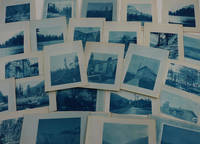
réf. P26Twenty-eight loose cyanotypes ca. 85x11 cm 3 ¼ x 4 ¼ in printed on paper ca. 125x175 cm 5x6 in; one leaf trimmed to fit the image. No captions. All leaves with pencil numbers on verso. One cyanotype with an ink stamp “Keuffel & Esse Co. New York Chicago St. Louis San Francisco” on verso. One cyanotype with a minor staining several slightly faded but overall a very good collection. Rare collection of early western American cyanotypes. Most photos apparently show Northern California and the Yosemite National Park est. 1890. Among them are two photos of the Yosemite Falls and one image of the Yosemite Half Dome rock formation. Ca. fifteen photos show California rivers lakes and forests tourists posing on a boulder or next to their cabin their pack horses &c. Nine photos apparently depict Alaska including three well-executed views of totem poles one of which is covered with carved bear footprints and has a large bear figure on top. Two photos show small railway stations; one with a clearly visible sign “Dawson” possibly referring to the Klondike Mines Railway 1905-1913. The railway operated in 1905-1913 serving gold dredging operations and transporting cargo and passengers between Dawson City and Sulphur Springs. Four photos depict Alaskan glaciers. Overall an unusual collection of early original cyanotypes with the views of California and Alaska. One of photos has the ink stamp of “Keuffel & Esser” – a major American supplier of stationery drawing materials and mathematical instruments since 1867. unknown
1802réf. PHO-1231Paris, F. Buisson, et Giguen, an X – 1802. In-4, broché ,titre sur le plat Atlas seul contenant 14 planches gravées (vues, costumes) et une carte dépliante du détroit qui sépare l'Asie de l'Amérique. Bon exemplaire.
1910réf. 6163Fairbanks Ak.: Huey Foto 1910. Very good. Two original photographs 6 x 8 inches each. Mounted on black card stock. Later fairly extensive manuscript annotations on mount versos. Light wear to mount edges. A bit of soiling and wear at edges of second photograph. A pair of original larger format photographs that depict midnight summer scenes in Chatanika Alaska just north of Fairbanks during 1909 and 1910. The later image credited to Huey and Hyland Foto is captioned "Midnight Ball Game Fairbanks -Vs.- Chatanika. June 19 - 1910" and shows a healthy crowd of spectators and the game in progress with a batter at the plate from a vantage point down the right field line behind first base. The first photograph captioned "Chatanika Alaska July 4th One A.M. 1909" and is credited to Huey alone. It depicts a large crowd of men women and at least three babies arrayed across a large pile of logs and stones a setting which seems to be the same as appears behind home plate and the third base line in the photo of the baseball game. A midnight baseball game in Fairbanks during high summer in Alaska has been a tradition since 1905 or 1906 and has variously been called the "Lights-Out Baseball Game" the "Midnight Sun Game" and the "High Noon at Midnight Classic." Thus in the present photographs we have an early images of Alaskan sports heritage and more generally of late-night summer culture in Alaska during the early-20th century. We find little of Huey and Hyland's photographic work in online records; a small handful of photos held by the Alaska State Library show them to be an operation entirely local to Fairbanks in the first decade of the 1900s. Huey Foto books
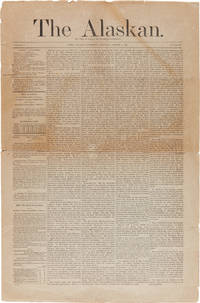
1886réf. 57501Sitka AK: The Alaskan Publishing Company March 6 1886. Early District of Alaska Newspaper A rare issue of this very early Alaskan newspaper with considerable content related to Alaskan district government and political figures early rumblings of gold findings relations with the indigenous Tlingit people and more. Beginning in 1884 the year before the first issue of The Alaskan was published the region was administered as a District meaning that the governor and most officials were appointed by the President and that citizens had little to no capacity for "home rule" let alone representation in Congress. This injustice was acutely felt by Alaskans and several articles in this issue of The Alaskan revolve around that discontent. The first article in the paper contains a printing of the Treaty of Cession of Alaska to the United States by Russia then adds to it that "At this date the 'inhabitants of the ceded territory' have no voice in any legislative body by which the defects in their anomalous 'civil government' can be remedied and no means of acquiring title to a HOME in Alaska." It would not be until the Klondike Gold Rush dramatically increased the population and attention paid to Alaska over a decade later that such provisions would start to be made and not until 1912 that the District became organized as a Territory. Another article describes a mass meeting in Sitka the District capital which called on the President to bring the issue before Congress. Yet another editorial acidly compares Alaska's Organic Act to the Declaration of Independence for it's "purely Jeffersonian" provisions which deny representation and land ownership to its citizens. A humorous but revealing article is also dedicated to Ward McAllister Jr. the first District judge of Alaska. McAllister and his allies were dismissed by President Grover Cleveland on the urging of Agent of Education Sheldon Jackson based on rumors of gross incompetence which may or may not have been exaggerated. The editors of The Alaskan certainly seem to believe them however. Responding to McAllister's father's attempts to have his son reinstated they write: "It is altogether probable that McAllister pere is right in the part of his assertion which claims that idleness was never urged against McAllister fils. Such a charge as that would indeed have been hard to substantiate in view of all the facts. The zeal and energy displayed by McAllister fils in frequent explorations of the steamship route between his legitimate post of duty and a dude club room in San Francisco.or junketing his particular friends at government expense ought to have precluded as it seems to have done the promulgation of any charges affecting his habits to industry.In the expressive vernacular of the native Alaskan he is simply and utterly in all respects save the uses if there be any for which a dandy dude can be utilized cultus - a disgrace by reason of his lamentable ignorance of the law.It is just possible that further persistence on the part of the McAllisters pere and fils may compel the compilation of a brief chapter in the personal biography of the latter which he had much rather not see in print." Other articles describe conditions in the Sitka jail bills currently in Congress the new law for presidential succession a lengthy piece on the history of Montenegro various bits of local news the abolishment of corporal punishment at the Indian Industrial School managed by Jackson who by all accounts treated the students as indentured servants and a number of pieces about Princess Tom a quite wealthy and locally powerful Tlingit woman. There is also an advertisement titled "How to Reach Alaska" by the Pacific Coast Steamship Company which notes that it sales from Portland once a month and offers cabins from San Francisco to Juneau for $70 and several very early mentions of "the Yukon gold fever" which has already "broken out very strong" more than a decade before the start of the Alaska gold rushes en force. Additional advertisements are present for all sorts of goods including one for the Sitka and Juneau Breweries which advertise "PURE BEER" which is of course "EXPRESSLY and EXCLUSIVELY for MEDICINAL MECHANICAL AND SCIENTIFIC PURPOSES" in the legally dry district. A rare piece of early Alaska printing with much interesting content on the social political and cultural goings-on of that District pre-Gold Rush. Not in Ricks or Tourville. 4pp. Folio newspaper. Tanned some chipping and small closed tears to margins. Split entirely along a horizontal fold repaired with tape. Good. unknown books
1904réf. 55454London: Rowland Ward Ltd. 1904. Tall 8vo. xvi 292 pp. plus 2 pp. publisher’s ads. Photo frontisp. 44 photos and plates 1 large folding map in rear pocket. Green publisher’s cloth gilt lettering front cover & spine simulated Zebra skin endpapers minor bumping to corners edgewear slight spotting on the spine still VG copy. First edition of this excellent early account of hunting on the Kenai Peninsula including descriptions of Alaskan Native Americans salmon cannery operations and more. Radclyffe had acquired a permit from the Bureau of Biological Survey with the USDA in order to collect big game specimens for the British Museum and the account was dedicated to a longtime fellow hunter and friend Theodore Roosevelt. The author details his experiences with hunting Alaskan Brown Bears Grizzly Bears Moose Dall Sheep and running afoul of the zealous US Deputy Marshal Sexton a stickler for the new game regulations instituted on the Kenai in 1903 not to mention destroying the distilling operation of Alaskan hunter & miner Andrew Berg. He managed to survive a charging bear sow after being abandoned by his guide as well as the Alaskan courtroom but his companions were not so lucky as the judge ruled that the permit did not extend to the hunting party. Radclyffe returned later to hunt Alaska on the Kenai in August 1910 employing Andrew Berg as his head guide. See: Catherine Cassidy Alaska’s No. 1 Guide: The History and Journals of Andrew Berg 1869-1939 pp. 28-29 38. Rowland Ward Ltd., hardcover
1911réf. 64719New York NY: Dodd Mead & Co. 1911. 8vo. xi 1 514 pp. Frontisp. 3 plates. Olive-gray decorated publisher’s cloth olive-green locked hearts white lettering front cover & spine w/ d.j. embossed illustrated cover art featuring raised embossed gold nugget floating above silhouette grasping hands light shelfwear very minor creasing still a NF/NF copy. First edition of the noted British-Canadian poet’s daring tragedy set against the backdrop of the Klondike Gold Rush the madness of the stampede of gold-seekers to Alaska and the hero’s deprivations struggles and conflicts in the gold fields and finally finding love with an abandoned young Jewish-American woman only to lose her at the end. At the time this was one of the best-selling novels of the Alaska Gold Rush and was later the first “Talkie” movie on the Klondike featuring Harry Carey and Dolores Del Rio released by M-G-M in their short-lived widescreen process with a synchronized musical score and sound effects. Exceedingly scarce in original dustjacket. Dodd, Mead & Co., hardcover
1910réf. 6163Fairbanks Ak.: Huey Foto 1910. Very good. Two original photographs 6 x 8 inches each. Mounted on black card stock. Later fairly extensive manuscript annotations on mount versos. Light wear to mount edges. A bit of soiling and wear at edges of second photograph. A pair of original larger format photographs that depict midnight summer scenes in Chatanika Alaska just north of Fairbanks during 1909 and 1910. The later image credited to Huey and Hyland Foto is captioned "Midnight Ball Game Fairbanks -Vs.- Chatanika. June 19 - 1910" and shows a healthy crowd of spectators and the game in progress with a batter at the plate from a vantage point down the right field line behind first base. The first photograph captioned "Chatanika Alaska July 4th One A.M. 1909" and is credited to Huey alone. It depicts a large crowd of men women and at least three babies arrayed across a large pile of logs and stones a setting which seems to be the same as appears behind home plate and the third base line in the photo of the baseball game. A midnight baseball game in Fairbanks during high summer in Alaska has been a tradition since 1905 or 1906 and has variously been called the "Lights-Out Baseball Game" the "Midnight Sun Game" and the "High Noon at Midnight Classic." Thus in the present photographs we have an early images of Alaskan sports heritage and more generally of late-night summer culture in Alaska during the early-20th century. We find little of Huey and Hyland's photographic work in online records; a small handful of photos held by the Alaska State Library show them to be an operation entirely local to Fairbanks in the first decade of the 1900s. Huey Foto
1886réf. 57501Sitka AK: The Alaskan Publishing Company March 6 1886. Early District of Alaska Newspaper A rare issue of this very early Alaskan newspaper with considerable content related to Alaskan district government and political figures early rumblings of gold findings relations with the indigenous Tlingit people and more. Beginning in 1884 the year before the first issue of The Alaskan was published the region was administered as a District meaning that the governor and most officials were appointed by the President and that citizens had little to no capacity for "home rule" let alone representation in Congress. This injustice was acutely felt by Alaskans and several articles in this issue of The Alaskan revolve around that discontent. The first article in the paper contains a printing of the Treaty of Cession of Alaska to the United States by Russia then adds to it that "At this date the 'inhabitants of the ceded territory' have no voice in any legislative body by which the defects in their anomalous 'civil government' can be remedied and no means of acquiring title to a HOME in Alaska." It would not be until the Klondike Gold Rush dramatically increased the population and attention paid to Alaska over a decade later that such provisions would start to be made and not until 1912 that the District became organized as a Territory. Another article describes a mass meeting in Sitka the District capital which called on the President to bring the issue before Congress. Yet another editorial acidly compares Alaska's Organic Act to the Declaration of Independence for it's "purely Jeffersonian" provisions which deny representation and land ownership to its citizens. A humorous but revealing article is also dedicated to Ward McAllister Jr. the first District judge of Alaska. McAllister and his allies were dismissed by President Grover Cleveland on the urging of Agent of Education Sheldon Jackson based on rumors of gross incompetence which may or may not have been exaggerated. The editors of The Alaskan certainly seem to believe them however. Responding to McAllister's father's attempts to have his son reinstated they write: "It is altogether probable that McAllister pere is right in the part of his assertion which claims that idleness was never urged against McAllister fils. Such a charge as that would indeed have been hard to substantiate in view of all the facts. The zeal and energy displayed by McAllister fils in frequent explorations of the steamship route between his legitimate post of duty and a dude club room in San Francisco.or junketing his particular friends at government expense ought to have precluded as it seems to have done the promulgation of any charges affecting his habits to industry.In the expressive vernacular of the native Alaskan he is simply and utterly in all respects save the uses if there be any for which a dandy dude can be utilized cultus - a disgrace by reason of his lamentable ignorance of the law.It is just possible that further persistence on the part of the McAllisters pere and fils may compel the compilation of a brief chapter in the personal biography of the latter which he had much rather not see in print." Other articles describe conditions in the Sitka jail bills currently in Congress the new law for presidential succession a lengthy piece on the history of Montenegro various bits of local news the abolishment of corporal punishment at the Indian Industrial School managed by Jackson who by all accounts treated the students as indentured servants and a number of pieces about Princess Tom a quite wealthy and locally powerful Tlingit woman. There is also an advertisement titled "How to Reach Alaska" by the Pacific Coast Steamship Company which notes that it sales from Portland once a month and offers cabins from San Francisco to Juneau for $70 and several very early mentions of "the Yukon gold fever" which has already "broken out very strong" more than a decade before the start of the Alaska gold rushes en force. Additional advertisements are present for all sorts of goods including one for the Sitka and Juneau Breweries which advertise "PURE BEER" which is of course "EXPRESSLY and EXCLUSIVELY for MEDICINAL MECHANICAL AND SCIENTIFIC PURPOSES" in the legally dry district. A rare piece of early Alaska printing with much interesting content on the social political and cultural goings-on of that District pre-Gold Rush. Not in Ricks or Tourville. 4pp. Folio newspaper. Tanned some chipping and small closed tears to margins. Split entirely along a horizontal fold repaired with tape. Good. unknown
1880réf. 76162Washington:: Government Printing Office 1880. Second Edition -- With Charts. publisher's lettered cloth. Cloth worn at the spine and extremities but tight and sound; contents apart from the vertical splits mentioned above fine. . Folio. Four charts in pocket at rear of volume. Printed "Compliments" slip of Sheldon Jackson U. S. General Agent of Education in Alaska tipped onto the title page. The collectors of the materials recorded in the Schedules were E. S. Smith assisted by William J. McDonnell Winter 1892 and 1893. There are Aleutian words and phrases recorded in ms. on dozens of pages; and in addition illustrations of a side view and ground plan of a native Western Alaskan house with detailed description; drawings of characteristic features of Eastern and Western Alaskan natives snowshoes boats paddles etc. Two of these illustrated descriptive pages have neat vertical splits not affecting legibility. Government Printing Office, hardcover
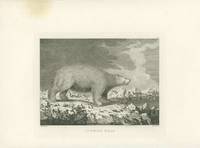
1785réf. 29434London 1785. Copper engraved images of Alaska & Vancouver Island from the folio atlas of Cook's 3rd voyage Pacific Ocean exploration. The plate numbers included are #40 41 48 49. 52 57 & 73. Two images are of Alaskan natives their boats and huts going about their daily lives. Sea Horses refers to seals and the white polar bear is majestic. Two with a corner waterstain one with a slight brown circle in the margin one with marginal foxing. Paper sizes 21.5 x 16.25" and one is 22 7/8 all with wide margins. Some light marginal dusting overall very good condition. unknown
réf. BN369448Eskimomasken aus alaska - édition en allemand Rousselot J l Eskimomasken aus alaska - édition en allemand Rousselot J l Eskimomasken aus alaska - édition en allemand Rousselot J l unknown
1798réf. PHO-2046Paris, De l’Imprimerie de la République, An VI-An VII [1798-1799]. 5 volumes in-8 (22,5x14cm), 1f.-CCI-1f.-294pp.-1f., VII-529pp. (3 tableaux dépliants), VIII-474pp.1f. (8 tableaux dépliants), VIII-494pp., XII-559pp.-2ff., avec 13 cartes en copies, relié toile moderne, pièce d’auteur, titre et tomaison, non rogné, mouillures.
1911Features: Steel Bridge Across Chehalis River at Aberdeen Formally Opened - article with photo; The Panama Canal Route for Canadian Northwest Shipping; Photo of Charles M. Hays, president of the Grand Trunk Railway; Address to General Passenger Agents by Howard Elliott, president of the Northern Pacific Railway (four pages); Brief business biography of George W. Hibbard, General Passenger Agent of the C.M. & P.S., with photo; Bernard N. Baker's Steamship Line a Golden Opportunity; Puget Sound Tugboat Co. on the Columbia River; New Boilers for North Vancouver Ferries; Steamer Maunganui Launched; Review of the Charter Market; Casualties to Pacific Coast Shipping; Modern Aids to Navigation Demanded for Alaskan Waters - article including lengthy list of vessels lost; Excellent illustrated centerfold makes the case for lighthouses in Alaskan waters; Review of Marine Insurance and Shipping Law; Address by president of the San Francisco Merchants' Exchange, Robert Dollar, entitled "The American Merchant Marine As It Affects Our Foreign Commerce" - with photo of Dollar; and more. 44 pages including several pages of nostalgic ads, some illustrated in black and white, featuring local marine and rail interests. Printed upon glossy coated stock. Average wear. Binding intact. Few library markings to front cover. A well-preserved copy of this highly-informative memento of Pacific Northwest transportation over a century ago. 12" x 9". Magazine
1911Features: Reasons Why the Canadian Pacific is So Prosperous; Spokane Rate Decision Eagerly Awaited; Value of Steel Equipment Demonstrated in Wreck of the Crack Milwaukee Train, Columbian on May 30th east of Ralston, WA; Continued Smuggling of Opium into West Coast Ports Aboard Trans-Pacific Steamships; Professional Biography of Joseph H. Young, President of Alaska Steamship Co. - with photo; Contracts Let for Coaling Plants in Seattle and Tacoma - article with two photos; $1 Million Available for Improvements at Moran Shipyards; Record Run Between Puget Sound and Callao by Schooner Wilbert L. Smith; After 20 Years on the Seattle-Tacoma Run, Steamer Flyer is Sold - Feature article with photo; Review of Marine Insurance and Shipping Law; Photo of Steamer Tampico Submerged in Seattle Harbor; Photo of New Boilers for Steamer Charmer built by Commercial Boiler Works of Seattle; Effects of the Panama Canal on Pacific Coast - Oriental Trade; News of Tacoma; Launching of the Titanic - 1/3 page article including photo of the Titanic in drydock with man standing below her massive 100-ton rudder; Charming one-page illustrated ad for The Shasta Limited, "The Finest Train in the West" which connected Seattle with San Francisco; and more. 44 pages including several pages of nostalgic ads, some illustrated in black and white, featuring local marine and rail interests. Printed upon glossy coated stock. Average wear. Binding intact. Few library markings to front cover. A well-preserved copy of this highly-informative memento of Pacific Northwest transportation over a century ago. 12" x 9". Magazine
1917réf. List3507Alaska 1917. Photo album measuring 7 ¼ x 11 ½ inches containing 187 photos 2 unaffixed and five loose real photo postcards with a contemporaneous newspaper clipping. Photos approximately 3 x 4 inches with generally excellent contrast and in Near Fine condition. Overall excellent to Near Fine. A photo album belonging to brothers Ruben 1892–1984 and Daniel 1895–1969 Diener documenting their 1916–1917 journey to the Territory of Alaska. The newspaper clipping reproduces a letter from Dan Diener describing their time there: “I went with an old prospector to try and locate a lost mine. We found it but there was not enough gold to pay for mining it so in that respect our trip was a failure. . I lived in a tent with a small sheet iron stove during all this time and strange as it seems it was fairly comfortable. . One day I walked or snowshoed 30 miles for my mail when the thermometer was 58 below. . But the hardships were sweetened at times with the most beautiful scenery man can imagine.” March 1917 The Dieners’ trip took them to Alaska’s southern coast to Ketchikan Cordova Valdez and Seward. There are some identifiable ships including the Admiral Farragut the Mariposa shortly before its sinking and the wreck of the James Drummond in British Columbia. Subjects include Chief Johnson’s totem pole in Ketchikan erected in 1902 in honor of Chief Gut Wain George Johnson; d. 1938 of the Gaanaxadi clan of the Tongass tribe—a real photo postcard from Kasaan shows many brightly colored totem poles along the shore with dilapidated wooden houses behind them—boats filled with fish outside the Carlisle Packing Company in Cordova and a real photo postcard of a man and dog captioned “READY FOR THE SUMMER TRAIL / SEWARD ALASKA” on the back of which Ruben Dieners has written: “Oct 9 1916. Here you are. This is Judge Hildreth of whom we have written you. Our best friend here and hereafter. We are going prospecting with him next spring. The dog in the picture carry’s fifty pounds. Brother Ruben.” H.H. Hildreth was a district court commissioner in Seward editor of the Alaskan newspaper in Sitka and The Alaska Prospector in Valdez and secretary of the Matanuska Mining Company. The shots of towns show the development of the region: in some an area of forest has been recently cleared and stumps of trees might surround a few small wooden houses or platforms where houses are to be erected; while others show towns with telegraph lines graded dirt roads with sidewalks dense housing and railroad and tram lines. Two shots from Seward show the paved sidewalk of its main street with a hotel and bars and a dog team waiting outside the hardware store. As Dieners wrote they lived in a tent and several photos show the outside of the quarters: two semi-permanent canvas tents next to a wide wooden walkway. Others show men presumably the brothers snowshoeing hiking and riding in a canoe; and of course many are scenery shots of forests waterfalls and snowcapped mountains. Of interest to historians of post-gold rush Alaska. unknown books
1914réf. 5195Various locations mostly in Canada and Alaska 1914. Very good plus. 36 leaves illustrated with 147 vernacular photographs and real photo postcards almost all with manuscript captions written in white pencil. Oblong quarto. Contemporary black textured cloth with "Photographs" in gilt on front cover and with handwritten caption in white pencil reading "1914 July 16 August 31." Minor wear to covers. Contents clean with easily-readable captions. A well-annotated vernacular photograph album assembled by F.A. Patterson of Arlington Heights Massachusetts documenting his or her travels through western Canada and Alaska just prior to World War I. The album opens with a small printed map of North America with the route Patterson took from "Boston to Alaska" between July 16 and August 31 1914. The photographs begin with thirteen leaves featuring scenes in Ontario and Alberta including scenes of Lake Huron St. Mary's River Sault Ste. Marie Winnipeg "Ontario farms" Banff the town wildlife mountain scenes and more Lake Minnewanka Lake Louise Laggan Valley of the Ten Peaks Morain Lake and more. The album then moves westward to British Columbia and other points then northwestward to Alaska for most of the remainder of the album. The westward photos open with scenes of the Illecillewaet Glacier Meeting of the Waters Trail Glacier and other locations in British Columbia. Scenes in Victoria picture various gardens Parliament Hotel Empress Chinese Bell and more. The scenes in Alaska begin with views of Taku Glacier and other scenes in and around Juneau. Other Alaskan images feature Lake Bennett several scenes in White Pass a view toward Skagway abandoned buildings Pitchfork Falls Sitka the harbor a "Russian Greek Church" a view of the town "Old Russian Black House" several totem poles including a "Totem Pole Patch" two angles of an "Old Russian Trading Post" and more. A particularly interesting pair of images of two buildings pictures what is left of Bennett Alaska which is captioned: "Formerly 5000 population. Now 4 houses. One occupied. August 5th 1914." The final few pages of Alaskan images features an Indian Village in Killisnoo and another in Hunter Bay as well as a close-up view of a group of indigenous peoples in Hunter Bay. The last five leaves capture scenes in Salt Lake City Utah and Colorado mostly Pike's Peak and Royal Gorge. unknown books
1941réf. 2368Various locations in south-central Alaska 1941. Very good plus. Eighteen photographs each 6 x 8 inches most signed and titled in manuscript by the photographer. Minor wear. A collection of eighteen beautiful photographs taken by noted Alaskan photographer Maurice L. Sharp featuring various subjects and scenes around south-central Alaska in the late-1930s. The photographs were published in various issues of the Alaska Sportsman between 1938 and 1941. Most of the images are signed and titled by Sharp in the bottom margins or on the verso. The photographs feature subjects and scenes such as "Yukon Boys - Alaska" "Mt. McKinley from Wonder Lake" three images "Harbor Anchorage" "Colonist's Home Alaska" two images "Pioneer's Cabin" "Palmer Alaska" "Gulls" "Northern Lights - Anchorage" "'Leader' Alaskan sled dog" "Sunset Tide" "The Old Cache" two images an uncaptioned image of sled dogs and more. A few of the present photographs were printed by Sharp on textured paper to achieve a different more artistic result to his printed images. unknown books
1922réf. 4725Alcova Wy.; Gulham and Achorage Ak 1922. Very good. Eight autograph letters signed totaling approximately 32pp. All in original transmittal envelopes. Old mailing folds minor wear. A small archive of letters documenting brief bouts of time in the life of a young Massachusetts man working in Wyoming and Alaska in the years during and just after World War I. William Sherman Platt 1896-1969 was born in Troy New York. Throughout his life he worked as a shipper at a lumber yard and eventually as the manager and then proprietor of a coal company by 1950. He served in the military during the latter portion of the First World War but apparently did not serve in Europe. Later at the age of 46 he filled out a draft card for World War II but it is unclear whether he served during the war likely not. The present collection of his letters document two brief snapshots of Platt's life as a young man from about ages eighteen to twenty-six. Platt wrote his earliest five letters from Gate Ranch in Wyoming to his parents back in Leominster Massachusetts. Platt's earliest letter from Wyoming dated July 4 1914 includes his initial reaction to the place and a stark appraisal of the locals: "I think I will enjoy things here very much indeed when I get accustomed to the place & the people. They are for the most part ignorant animals but they all mean well." In his second letter Platt complains about the slowness of the mail then offers an appraisal of the food in Wyoming: "The food is plain but well cooked and palatable and there is always plenty of it." In his third letter Platt describes the road work he was performing in and around Alcova: "Last week myself and two other fellows went down toward Alcova fixing the road. We were fixing up an old wood road for Mr. Schoolmaker to use as an auto road We camped out cooking out or meals and sleeping in our tents. It was very interesting." He describes some of his other work in his penultimate letter from Wyoming on July 30: "You want to know what I am doing. Well I am working. So far I have worked at carpentering surveying irragating sic road building and fence repairing beside hoeing weeds and helping a little with the chores once in a while. I don't know what I may strike yet. I am very busy but it is not what you would call distinctively Western work. I might do it anywhere. Still it is all right." He then provides another impression of the locals in Wyoming: "I have more fun than a little listening to these fellows around here talk. They are mostly old American stock who think that they are as good as anybody and a little better. They have views on all conceivable subjects which they are glad to air on all occasions aided with a copious flow of profanity. They sure are some fun." Platt writes his last letter from Wyoming on August 2 and reports further on his activities reading helping the cook the food again and also discusses his prospects for college which he apparently meant to start soon. He prefers to attend Clark University in Worcester but also mentions staying on the ranch in Wyoming "to learn something about ranch work" until December and then heading home to Massachusetts after going to see San Francisco. Apparently Platt enlisted in the Marines sometime in 1917 as one of his letters is dated September 16 from that year while at Paris Island South Carolina. Platt details his training and "hard labor" in the military. He had apparently left the military for the timber industry in Alaska by 1920 as his final two letters emanate from Chitina Alaska in the Fall of 1920. Platt's first letter is dated October 5 1920 and describes his work in Alaska: "Since I wrote last I have been working in the woods steadily.so long as I stay here. Really the logging here is a joke. The timber is small scattered and almost all rotten at the butt. Today there were 7 of us in the woods and we only got 70 logs short ones at that 12 to 16 ft. I have been climbing the trees all the time and I guess that will be my regular job from now on. It is easy. Most of the limbs are dead and break off." He also describes the short working day his camping rituals his like for malamute dogs and their work eating caribou and more. The present collection also includes two letters from Platt's mother sent to him in Alaska reacting to his activities but largely reporting on events from home. Platt's second and last letter from Alaska dates from January 11 1922 from Anchorage when he writes a friend also named Bill. Platt spends about half of this letter detailing the opportunities for mining in Alaska and describes a trip into the Alaskan interior: "But there is all kinds of mining on all sides of it. For quartz why the Willow Creek District is about the best. There is probably a dozen outfits operating. There is also a few coal mines in operation some at Kenana Healey & Eska Creek and a few other smaller layouts in different places. Summer before last I took a trip in through the Interior but I found it very unsatisfactory. Very expensive to move and the wages wasn't over 5 or 6 dollars a day and board for labor." In addition to his own letters the present group includes a 1917 letter from Platt's grandmother asking him to stay away from the current "awful war" as well as four family letters from the late-19th century. A small but informative group of letters surrounding a young Massachusetts man adventuring in the American West and Alaska in his younger years. unknown books