1395 resultados
1989ref. ZB2800031989. softcover ex library else text clean & binding tight. - If you are reading this this item is actually physically in our stock and ready for shipment once ordered. We are not bookjackers. Buyer is responsible for any additional duties taxes or fees required by recipient's country. Photos available upon request. paperback
1618ref. 49718Washington. 1816-1817. Admitting Mississippi to the Union Three government documents concerning the admission of Mississippi as a state. It includes a census of the population of the territory enumerating both white and black free and slave residents. It also recommends that the territory be split into two regions - "The geographical position of this Territory may render it necessary that its military defences should be more combined than would at all times be practicable in two distinct sovereignties." The result would be the state of Mississippi in 1817 and the separated Alabama Territory. Antique-style half calf and marbled boards. Minor toning. Very good. hardcover
1618ref. 49718Washington. 1816-1817. Admitting Mississippi to the Union Three government documents concerning the admission of Mississippi as a state. It includes a census of the population of the territory enumerating both white and black free and slave residents. It also recommends that the territory be split into two regions - "The geographical position of this Territory may render it necessary that its military defences should be more combined than would at all times be practicable in two distinct sovereignties." The result would be the state of Mississippi in 1817 and the separated Alabama Territory. Antique-style half calf and marbled boards. Minor toning. Very good. hardcover books
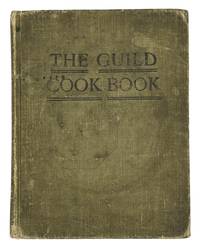
1907ref. 10723Meridian Mississippi 1907. 7 x 5.5" tan cloth with black lettering 111 33 pp including 28 pages of local advertisements at the end. A rare Mississippi community cookbook. According to the foreword the recipes were "gathered from our friends and from other reliable sources" including The Delineator a women's magazine of the period. Many of the recipes are attributed to local women while several recipes submitted by celebrities of the era are attributed to The Delineator; the book also contains three bean recipes "Written expressly for the Junior Guild's Cook Book" by Miles Bradford editor of The Delineator. Other recipes include Gopher Soup Gumbo five recipes and Vegetarian Mince Meat; the book also contains around a dozen recipes for alcoholic drinks including Brandy Punch Whiskey Cocktail Old Fashioned Absinthe Cocktail Coffee Cocktail and Mint Julep. Staining and wear to covers staining/spattering to some pages in good condition overall. hardcover
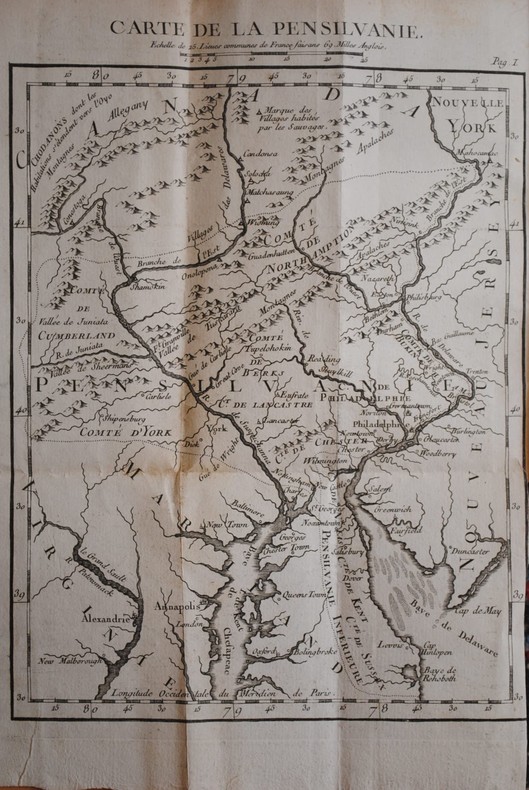
1768ref. 4A-8PARIS, GANEAU (DE L'IMPRIMERIE D' HOURY), 1768. IN-8° (185x115mm), XX - 372 - 2ff., 1 CARTE DÉPLIANTE, FAUX TITRE ET TITRE TACHÉS, PIQÛRES, TRÈS CLAIRE MOUILL. MARG. AU MILIEU DE L'EXEMPLAIRE. BROCHÉ, DOS SALI. UNIQUE ÉDITION DE CET OUVRAGE BASÉ SUR CELUI DU BOTANISTE PEHR KALM POUR L'HISTOIRE NATURELLE ET SUR LE VOYAGE DE GOTTLIEB MITTELBERGER POUR LA PARTIE CONSACRÉES AU QUAKERS. ILLUSTRÉ D'UNE CARTE DÉPLIANTE. UNIQUE FRENCH EDITION OF THIS DESCRIPTION OF PENNSYLVANIA BASED ON THE WORKS OF KALM AND MITTELBERGER. ILLUSTRATED WITH 1 FOLDING MAD. SEWED (FIRST LVS STAINED, FOXING).
1885215 p. Hardcover Ex-library, Very good condition
1952ref. 12938N.p. likely Braxton MS 1952. 24pp. Profusely illustrated. Quarto. Original pictorial wrappers printed in green brown and red. Minor edge wear and foxing to wrappers. Light toning to text. Very good condition. A scarce and wonderfully-informative history of the first forty years of the Piney Woods Country Life School Laurence C. Jones's school for African American youth in Braxton Mississippi. The work is amply illustrated with photographs documenting the life and people of the school since its inception in 1910 to the moment of the pamphlet's publication. There are pages devoted to celebrating notable graduates of the school the "blind and the lame orphans and half-orphans" who've attended "internationally known visitors" "present-day buildings" five pages displaying the "industry" of the school the dairy and farm the "human and material progress" of the school and more. OCLC reports just ten total copies of this vital midcentury history of a notable southern school devoted to African-American youth. unknown
1952ref. 12938N.p. likely Braxton MS 1952. 24pp. Profusely illustrated. Quarto. Original pictorial wrappers printed in green brown and red. Minor edge wear and foxing to wrappers. Light toning to text. Very good condition. A scarce and wonderfully-informative history of the first forty years of the Piney Woods Country Life School Laurence C. Jones's school for African American youth in Braxton Mississippi. The work is amply illustrated with photographs documenting the life and people of the school since its inception in 1910 to the moment of the pamphlet's publication. There are pages devoted to celebrating notable graduates of the school the "blind and the lame orphans and half-orphans" who've attended "internationally known visitors" "present-day buildings" five pages displaying the "industry" of the school the dairy and farm the "human and material progress" of the school and more. OCLC reports just ten total copies of this vital midcentury history of a notable southern school devoted to African-American youth. unknown books
1839ref. 3269Natchez Ms. 1839. Very good. Broadside 13 x 15.75 inches. Printed in four columns; central vertical fold. Light wear and toning. In the present broadside the trustees of Jefferson College announce that they are once again prepared to admit students in 1839 following a reorganization and give their mission statement courses of study faculty list tuition fees and more. The school located in Washington Mississippi just north of Natchez opened in 1811 and was the first college in the Mississippi Territory. In the text of this broadside one can clearly see sentiments and dispositions that would bring the Civil War to fruition. The first two columns are chiefly dedicated to a description fo the new faculty and their skills but also new measures put in place during the reorganization of the school. In place of gymnastics a daily military drill was substituted and a military police was to be established "for the preservation of good order and regularity." The remainder of the broadside descends into sectional paranoia arguing that students must be kept close to home in order for them to maintain allegiance to Mississippi and the South: "At this very moment a formidable content has commenced between the North and the South from the possible results of which the eye of the patriot instantly revolts. It surely becomes us to preserve our children from any influence that might mislead their judgment or weaken their patriotism. To do this effectually we must keep them at home!. Send your sons to other States where they are relased from social bonds you not only cut off these powerful incentives to emulation but you do more and worse you weaken or detach the growing virtues of the heart. and you estrange them from their native land." OCLC locates only a small handful of examples. unknown
1839ref. 3269Natchez Ms. 1839. Very good. Broadside 13 x 15.75 inches. Printed in four columns; central vertical fold. Light wear and toning. In the present broadside the trustees of Jefferson College announce that they are once again prepared to admit students in 1839 following a reorganization and give their mission statement courses of study faculty list tuition fees and more. The school located in Washington Mississippi just north of Natchez opened in 1811 and was the first college in the Mississippi Territory. In the text of this broadside one can clearly see sentiments and dispositions that would bring the Civil War to fruition. The first two columns are chiefly dedicated to a description fo the new faculty and their skills but also new measures put in place during the reorganization of the school. In place of gymnastics a daily military drill was substituted and a military police was to be established "for the preservation of good order and regularity." The remainder of the broadside descends into sectional paranoia arguing that students must be kept close to home in order for them to maintain allegiance to Mississippi and the South: "At this very moment a formidable content has commenced between the North and the South from the possible results of which the eye of the patriot instantly revolts. It surely becomes us to preserve our children from any influence that might mislead their judgment or weaken their patriotism. To do this effectually we must keep them at home!. Send your sons to other States where they are relased from social bonds you not only cut off these powerful incentives to emulation but you do more and worse you weaken or detach the growing virtues of the heart. and you estrange them from their native land." OCLC locates only a small handful of examples. unknown books
ref. DADAX1560258640New unknown
1832ref. 31197Franklin County MS 1832. Folio 7.75" x 12.25". 4 pp folded entirely in manuscript. The writing on either side of the first leaf is visible from the other side but everything is legible. Oneal's Complaint appears on the first two pages and on five lines of page three where it is signed by his lawyer. A nine-line summary of the case in different handwriting is also on page 3. Page 4 contains defendant's scribbled answer by his attorney R.W. Webber; an accounting of the costs incurred in the case; a notation of defendant's verdict; attorneys' signatures; and docketing information. Age toned old folds several small holes along top fold loss of a few words. Signatures of attorneys appear on final page on panel with defendant's answer. Good. John Cade 1788-1839 lived in Franklin County. The parties were probably local farmers. Richard W. Webber c.1798-1843 Cade's lawyer was born in Virginia and settled in Franklin County. A Whig and State representative he ran unsuccessfully for Congress in 1830. He was for a time the editor of the Jackson Independent Journal. JOURNAL OF MISSISSIPPI HISTORY Vol. 7 Page 148; and Volume 21-22 Page 34. unknown
1832ref. 31197Franklin County MS 1832. Folio 7.75" x 12.25". 4 pp folded entirely in manuscript. The writing on either side of the first leaf is visible from the other side but everything is legible. Oneal's Complaint appears on the first two pages and on five lines of page three where it is signed by his lawyer. A nine-line summary of the case in different handwriting is also on page 3. Page 4 contains defendant's scribbled answer by his attorney R.W. Webber; an accounting of the costs incurred in the case; a notation of defendant's verdict; attorneys' signatures; and docketing information. Age toned old folds several small holes along top fold loss of a few words. Signatures of attorneys appear on final page on panel with defendant's answer. Good. John Cade 1788-1839 lived in Franklin County. The parties were probably local farmers. Richard W. Webber c.1798-1843 Cade's lawyer was born in Virginia and settled in Franklin County. A Whig and State representative he ran unsuccessfully for Congress in 1830. He was for a time the editor of the Jackson Independent Journal. JOURNAL OF MISSISSIPPI HISTORY Vol. 7 Page 148; and Volume 21-22 Page 34. unknown books
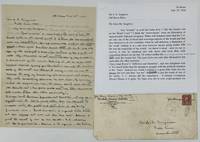
ref. 692124to. Six total pages approximately 1000 words total; accompanied by original mailing envelopes for both addressed by Williams and rough typescripts of the letters. Both letters with old fold lines for mailing but very good. In the first letter Williams criticizes a recent Senate vote on the World Court "I think the reservations were an illustration of unpardonable National arrogance. When will Senators learn that the U.S. are only one of the civilized and sovereign nations of the world . we had the leadership of the world - we threw it away -- . of course neither the Hibernians nor the Klan want even what the Senate did" and of Colonel House's recent book "What Really Happened in Paris" 1921 "I am anxious to learn if I can between the lines just when Wilson realized that House thought himself the President and Wilson his mannikin . I think it was after Wilson returned to Versailles where he had left House locum tenens "in his place"." In the second letter Williams offers a positive take on President Coolidge "he has gone back to Jeffersonianism in some things - notably in tax reduction debt reduction and to more economical and frugal administration though much is to be desired on that score. About 25% of the present Federal Civil Service could be quite dispensed with . his veto of the Populist's 'Farm Relief' legislation . had made him intensely unpopular in Western populistic strongholds"; his thoughts on prohibition "even those to whom it is an 'awful inconvenience' like myself it has recommended itself by the immense good it has done - politically and morally - especially for the Negroes. Many race troubles grew out of drunkenness of one or the other side or both . wise white men fear it and the foolish and poor Darkies can not pay for it. The boot-legger wants cash"; regrets for non-membership in the League of Nations "if for the last six years we had cooperated with Europe to restore economic conditions . so as to give its other members a sense of security and power the world would have been on the road to prosperity and we - especially our farmers - move abundantly and stably prosperous than we are even now . the League can never work with maximum efficiency without us"; and criticism of our policies in the Philippines "they will continue to give the Governor General more power to be greedily exercised until another revolt occurs to be put viciously under foot until no Filipino will dare breathe to another the word 'Independence' and then the Governor General will say 'See we told you so' . mighty few white people will let an inferior race go as long as it profits to best provide them." Williams who was a supporter of silver and an opponent of tariffs became an ardent supporter of Woodrow Wilson and was a leader in the losing effort to join the League of Nations following World War I; Seagrave 1875-1956 was a newspaperman and lawyer in Massachusetts serving as Assistant Attorney General for his home state in the late 1910s and early 1920s and working in Democratic Party politics. For the two letters unknown
ref. 692124to. Six total pages approximately 1000 words total; accompanied by original mailing envelopes for both addressed by Williams and rough typescripts of the letters. Both letters with old fold lines for mailing but very good. In the first letter Williams criticizes a recent Senate vote on the World Court "I think the reservations were an illustration of unpardonable National arrogance. When will Senators learn that the U.S. are only one of the civilized and sovereign nations of the world . we had the leadership of the world - we threw it away -- . of course neither the Hibernians nor the Klan want even what the Senate did" and of Colonel House's recent book "What Really Happened in Paris" 1921 "I am anxious to learn if I can between the lines just when Wilson realized that House thought himself the President and Wilson his mannikin . I think it was after Wilson returned to Versailles where he had left House locum tenens "in his place"." In the second letter Williams offers a positive take on President Coolidge "he has gone back to Jeffersonianism in some things - notably in tax reduction debt reduction and to more economical and frugal administration though much is to be desired on that score. About 25% of the present Federal Civil Service could be quite dispensed with . his veto of the Populist's 'Farm Relief' legislation . had made him intensely unpopular in Western populistic strongholds"; his thoughts on prohibition "even those to whom it is an 'awful inconvenience' like myself it has recommended itself by the immense good it has done - politically and morally - especially for the Negroes. Many race troubles grew out of drunkenness of one or the other side or both . wise white men fear it and the foolish and poor Darkies can not pay for it. The boot-legger wants cash"; regrets for non-membership in the League of Nations "if for the last six years we had cooperated with Europe to restore economic conditions . so as to give its other members a sense of security and power the world would have been on the road to prosperity and we - especially our farmers - move abundantly and stably prosperous than we are even now . the League can never work with maximum efficiency without us"; and criticism of our policies in the Philippines "they will continue to give the Governor General more power to be greedily exercised until another revolt occurs to be put viciously under foot until no Filipino will dare breathe to another the word 'Independence' and then the Governor General will say 'See we told you so' . mighty few white people will let an inferior race go as long as it profits to best provide them." Williams who was a supporter of silver and an opponent of tariffs became an ardent supporter of Woodrow Wilson and was a leader in the losing effort to join the League of Nations following World War I; Seagrave 1875-1956 was a newspaperman and lawyer in Massachusetts serving as Assistant Attorney General for his home state in the late 1910s and early 1920s and working in Democratic Party politics. For the two letters unknown books
ref. PHO-724sl.,sd.(Paris , Estienne Michalet , 1681) 1 volume petit in-4(250x210), reliure pleine basane marron, dos à nerfs orné avec titre, étui bordé(reliure pastiche). Fac-similé de l'édition de 1681, 45 planches cartonnées montée sur onglets, du fameux voyage du père Marquette en Amérique septentrionale avec la carte du Mississippi et la première représentation du lac Michigan , reproduction fidèle du rarissime ouvrage sur le Canada par procédé photographique. Très bel exemplaire , très bien relié et sous emboîtage, ca
1814ref. 26463Mississippi Territory 1814. Broadside injunction oblong 11.5" x 7.25". Printed with names dates and details in manuscript. The signature 'Theodore Stark' appears in the left margin. Theodore Stark was a notary in the Mississippi Territory. Tanned light wear Very Good. This is a rare legal writ from the Superior Court in the early Mississippi Territory. The writ prohibits Morgan from proceeding with a suit to recover possession of a house and lot from Terrell and Isler. Judge Walter Leake from whose court the writ issued became Mississippi's U.S. Senator from 1817-20 and Governor from 1822-1825. The first settler of Mt. Salus he owned at least two dozen slaves according to census reports. Brigadier General Morgan whom the court enjoined from prosecuting the suit would command the 'Brigade of Louisiana and Mississippi Drafted Militia' during the Battle of New Orleans. His co-defendant Edward Turner a lawyer was Aide-de-Camp and private secretary to Governor Claiborne of the Mississippi Territory. Peter Isler who was in possession of the house and lot was a printer to the Mississippi Territory and later to the State. He established the Mississippi Republican newspaper in 1810. Richard Terrell of Adams County is listed in the Mississippi and Territory Census of 1816 as owning twelve slaves. unknown
1814ref. 26463Mississippi Territory 1814. Broadside injunction oblong 11.5" x 7.25". Printed with names dates and details in manuscript. The signature 'Theodore Stark' appears in the left margin. Theodore Stark was a notary in the Mississippi Territory. Tanned light wear Very Good. This is a rare legal writ from the Superior Court in the early Mississippi Territory. The writ prohibits Morgan from proceeding with a suit to recover possession of a house and lot from Terrell and Isler. Judge Walter Leake from whose court the writ issued became Mississippi's U.S. Senator from 1817-20 and Governor from 1822-1825. The first settler of Mt. Salus he owned at least two dozen slaves according to census reports. Brigadier General Morgan whom the court enjoined from prosecuting the suit would command the 'Brigade of Louisiana and Mississippi Drafted Militia' during the Battle of New Orleans. His co-defendant Edward Turner a lawyer was Aide-de-Camp and private secretary to Governor Claiborne of the Mississippi Territory. Peter Isler who was in possession of the house and lot was a printer to the Mississippi Territory and later to the State. He established the Mississippi Republican newspaper in 1810. Richard Terrell of Adams County is listed in the Mississippi and Territory Census of 1816 as owning twelve slaves. unknown books
1871ref. 40107Jackson Miss.: Kimball Raymond & Co. State Printers 1871. Original printed pale green wrappers lightly spotted. Stitched. 67 1 blank pp. Clean text. Very Good plus. Contemporary ownership inscription in pencil "W.H. Bullard." Alcorn 1816-1894 born in Illinois Territory was Governor of Mississippi from March 1870 through November 1871. He was active in Mississippi politics from about 1845. During the Civil War he served as a Confederate. After the War as a "Scalawag" he supported the 14th Amendment and votes for freedmen. Nevertheless he clashed with his new Republican friends by opposing federal intervention against the Klan and federal laws abolishing segregation in public facilities. Alcorn addresses "what remains to be done of the work of reconstruction" thus focusing on "the restoration of our social and material ruin." With tables and data he demonstrates the disastrous economic effects of the War. But his data also give "encouragement to the practicability of educating the great body of our labor to the moral level of freedom." Marriage licenses are up; extreme "sexual license" is down. Preachers teachers schools property ownership and trades for the freedmen are all on the increase. Denouncing vigilantism he says that "A class of lawless violence the most cruel and cowardly proceeds in a few quarters in the person of the masked assassin; and so far has succeeded in evading punishment if not detection." OCLC 28758840 3- Columbia Yale LSU as of June 2024. Not at online AAS. Kimball, Raymond & Co., State Printers unknown
1859ref. 64413Chicago IL: Press and Tribune Print 1859. First edition. 8vo. 203 51 pp. Folding plate tables. "On the question of whether the railroad bridge from Rock Island Illinois to Davenport Iowa was a hazard to the navigation of the Mississippi River" OCLC. "James Ward a St. Louis steamboat owner filed a bill praying that the bridge be declared a nuisance and ordered removed; in 1866 Congress finally passed an act requiring that the bridge be replaced by another half the cost to be paid by the United States" "The Mississippi River: St. Louis' Friend or Foe" by James Lemly Cambridge U. Press online. Drop-title: "District Court United States. Southern District of Iowa. James Ward vs. Mississippi & Missouri Railroad Company." Chicago Ante-Fire Imprints 413: "Not located title from Heartman Cat. No. 187 June 1926 No. 300." OCLC locates eight copies New York Public Yale Chicago History Museum Harvard-Baker Missouri-St. Louis Cincinnati/Hamilton County Public Library of Congress Newberry. Very good. Original printed olive wrappers some soiling lacking rear wrapper rebacked with archival paper. 10747. Press and Tribune Print unknown
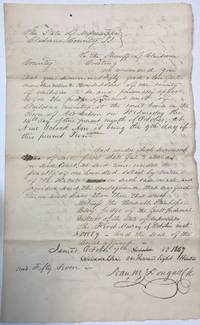
1857ref. 37204Claiborne County MS 1857. 4to. 4 pp entirely in ink manuscript. Signed with a flourish by the Clerk Dan McDougall and the Deputy Sheriff G.R. Girault. Daniel McDougall 1813-1863 born in Schenectady migrated to Port Gibson Claiborne County. He was appointed Clerk of the Claiborne County Circuit Court in 1853 and served as such until his death. Colonel George Rogers Girault c.1815-1857 also of Port Gibson was a farmer owning 11 slaves as of 1850 and was also a County Deputy Sheriff. He died two months after this writ was issued. Stanhope Posey c.1813-1859 full name John Stanhope Posey a Wilkinson County lawyer owned 38 slaves as of the 1850 census. He was elected District Attorney of the Third District of Mississippi in 1839 and a Judge of the First Judicial District Circuit Court in 1845. We don't know who "Everett a Slave" was or what happened to him. We can guess that a jury of slaveholders was not sympathetic to him. unknown
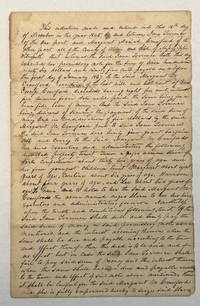
1845ref. 42448Amite County Mississippi 1845. Folio leaf folded to 8" x 12-3/8." Entirely in ink manuscript . Several fold separations with minor effect on one or two letters. Signed on the middle of page two by Jane Torrence with her mark and attested by Barttel W. Smith on 16 December 1845. On page 3 Robert L. Torrence Clerk of the Circuit Court writes that he witnessed the acknowledgement of Jane Torrence. Docketed on page 4. Good plus. Jane Torrence borrowed money from Crawford's Estate Margaret Crawford as the estate's executor. She signed a promissory note obliging her to repay it with 8% interest. She also mortgaged four slaves which mortgage would be released upon payment of the debt. Like other forms of property slaves were involved in all sorts of transactions recognized by law. If Torrence failed to pay her debt the slaves would become the property of Crawford as Executor. unknown books
1857ref. 37204Claiborne County MS 1857. 4to. 4 pp entirely in ink manuscript. Signed with a flourish by the Clerk Dan McDougall and the Deputy Sheriff G.R. Girault. Daniel McDougall 1813-1863 born in Schenectady migrated to Port Gibson Claiborne County. He was appointed Clerk of the Claiborne County Circuit Court in 1853 and served as such until his death. Colonel George Rogers Girault c.1815-1857 also of Port Gibson was a farmer owning 11 slaves as of 1850 and was also a County Deputy Sheriff. He died two months after this writ was issued. Stanhope Posey c.1813-1859 full name John Stanhope Posey a Wilkinson County lawyer owned 38 slaves as of the 1850 census. He was elected District Attorney of the Third District of Mississippi in 1839 and a Judge of the First Judicial District Circuit Court in 1845. We don't know who "Everett a Slave" was or what happened to him. We can guess that a jury of slaveholders was not sympathetic to him. unknown books
1859ref. 64413Chicago IL: Press and Tribune Print 1859. First edition. 8vo. 203 51 pp. Folding plate tables. "On the question of whether the railroad bridge from Rock Island Illinois to Davenport Iowa was a hazard to the navigation of the Mississippi River" OCLC. "James Ward a St. Louis steamboat owner filed a bill praying that the bridge be declared a nuisance and ordered removed; in 1866 Congress finally passed an act requiring that the bridge be replaced by another half the cost to be paid by the United States" "The Mississippi River: St. Louis' Friend or Foe" by James Lemly Cambridge U. Press online. Drop-title: "District Court United States. Southern District of Iowa. James Ward vs. Mississippi & Missouri Railroad Company." Chicago Ante-Fire Imprints 413: "Not located title from Heartman Cat. No. 187 June 1926 No. 300." OCLC locates eight copies New York Public Yale Chicago History Museum Harvard-Baker Missouri-St. Louis Cincinnati/Hamilton County Public Library of Congress Newberry. Very good. Original printed olive wrappers some soiling lacking rear wrapper rebacked with archival paper. 10747. Press and Tribune Print unknown books
1871ref. 40107Jackson Miss.: Kimball Raymond & Co. State Printers 1871. Original printed pale green wrappers lightly spotted. Stitched. 67 1 blank pp. Clean text. Very Good plus. Contemporary ownership inscription in pencil "W.H. Bullard." Alcorn 1816-1894 born in Illinois Territory was Governor of Mississippi from March 1870 through November 1871. He was active in Mississippi politics from about 1845. During the Civil War he served as a Confederate. After the War as a "Scalawag" he supported the 14th Amendment and votes for freedmen. Nevertheless he clashed with his new Republican friends by opposing federal intervention against the Klan and federal laws abolishing segregation in public facilities. Alcorn addresses "what remains to be done of the work of reconstruction" thus focusing on "the restoration of our social and material ruin." With tables and data he demonstrates the disastrous economic effects of the War. But his data also give "encouragement to the practicability of educating the great body of our labor to the moral level of freedom." Marriage licenses are up; extreme "sexual license" is down. Preachers teachers schools property ownership and trades for the freedmen are all on the increase. Denouncing vigilantism he says that "A class of lawless violence the most cruel and cowardly proceeds in a few quarters in the person of the masked assassin; and so far has succeeded in evading punishment if not detection." OCLC 28758840 3- Columbia Yale LSU as of June 2024. Not at online AAS. Kimball, Raymond & Co., State Printers unknown books