1409 resultados
1832ref. 31197Franklin County MS 1832. Folio 7.75" x 12.25". 4 pp folded entirely in manuscript. The writing on either side of the first leaf is visible from the other side but everything is legible. Oneal's Complaint appears on the first two pages and on five lines of page three where it is signed by his lawyer. A nine-line summary of the case in different handwriting is also on page 3. Page 4 contains defendant's scribbled answer by his attorney R.W. Webber; an accounting of the costs incurred in the case; a notation of defendant's verdict; attorneys' signatures; and docketing information. Age toned old folds several small holes along top fold loss of a few words. Signatures of attorneys appear on final page on panel with defendant's answer. Good. John Cade 1788-1839 lived in Franklin County. The parties were probably local farmers. Richard W. Webber c.1798-1843 Cade's lawyer was born in Virginia and settled in Franklin County. A Whig and State representative he ran unsuccessfully for Congress in 1830. He was for a time the editor of the Jackson Independent Journal. JOURNAL OF MISSISSIPPI HISTORY Vol. 7 Page 148; and Volume 21-22 Page 34. unknown books
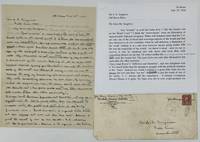
ref. 692124to. Six total pages approximately 1000 words total; accompanied by original mailing envelopes for both addressed by Williams and rough typescripts of the letters. Both letters with old fold lines for mailing but very good. In the first letter Williams criticizes a recent Senate vote on the World Court "I think the reservations were an illustration of unpardonable National arrogance. When will Senators learn that the U.S. are only one of the civilized and sovereign nations of the world . we had the leadership of the world - we threw it away -- . of course neither the Hibernians nor the Klan want even what the Senate did" and of Colonel House's recent book "What Really Happened in Paris" 1921 "I am anxious to learn if I can between the lines just when Wilson realized that House thought himself the President and Wilson his mannikin . I think it was after Wilson returned to Versailles where he had left House locum tenens "in his place"." In the second letter Williams offers a positive take on President Coolidge "he has gone back to Jeffersonianism in some things - notably in tax reduction debt reduction and to more economical and frugal administration though much is to be desired on that score. About 25% of the present Federal Civil Service could be quite dispensed with . his veto of the Populist's 'Farm Relief' legislation . had made him intensely unpopular in Western populistic strongholds"; his thoughts on prohibition "even those to whom it is an 'awful inconvenience' like myself it has recommended itself by the immense good it has done - politically and morally - especially for the Negroes. Many race troubles grew out of drunkenness of one or the other side or both . wise white men fear it and the foolish and poor Darkies can not pay for it. The boot-legger wants cash"; regrets for non-membership in the League of Nations "if for the last six years we had cooperated with Europe to restore economic conditions . so as to give its other members a sense of security and power the world would have been on the road to prosperity and we - especially our farmers - move abundantly and stably prosperous than we are even now . the League can never work with maximum efficiency without us"; and criticism of our policies in the Philippines "they will continue to give the Governor General more power to be greedily exercised until another revolt occurs to be put viciously under foot until no Filipino will dare breathe to another the word 'Independence' and then the Governor General will say 'See we told you so' . mighty few white people will let an inferior race go as long as it profits to best provide them." Williams who was a supporter of silver and an opponent of tariffs became an ardent supporter of Woodrow Wilson and was a leader in the losing effort to join the League of Nations following World War I; Seagrave 1875-1956 was a newspaperman and lawyer in Massachusetts serving as Assistant Attorney General for his home state in the late 1910s and early 1920s and working in Democratic Party politics. For the two letters unknown
ref. 692124to. Six total pages approximately 1000 words total; accompanied by original mailing envelopes for both addressed by Williams and rough typescripts of the letters. Both letters with old fold lines for mailing but very good. In the first letter Williams criticizes a recent Senate vote on the World Court "I think the reservations were an illustration of unpardonable National arrogance. When will Senators learn that the U.S. are only one of the civilized and sovereign nations of the world . we had the leadership of the world - we threw it away -- . of course neither the Hibernians nor the Klan want even what the Senate did" and of Colonel House's recent book "What Really Happened in Paris" 1921 "I am anxious to learn if I can between the lines just when Wilson realized that House thought himself the President and Wilson his mannikin . I think it was after Wilson returned to Versailles where he had left House locum tenens "in his place"." In the second letter Williams offers a positive take on President Coolidge "he has gone back to Jeffersonianism in some things - notably in tax reduction debt reduction and to more economical and frugal administration though much is to be desired on that score. About 25% of the present Federal Civil Service could be quite dispensed with . his veto of the Populist's 'Farm Relief' legislation . had made him intensely unpopular in Western populistic strongholds"; his thoughts on prohibition "even those to whom it is an 'awful inconvenience' like myself it has recommended itself by the immense good it has done - politically and morally - especially for the Negroes. Many race troubles grew out of drunkenness of one or the other side or both . wise white men fear it and the foolish and poor Darkies can not pay for it. The boot-legger wants cash"; regrets for non-membership in the League of Nations "if for the last six years we had cooperated with Europe to restore economic conditions . so as to give its other members a sense of security and power the world would have been on the road to prosperity and we - especially our farmers - move abundantly and stably prosperous than we are even now . the League can never work with maximum efficiency without us"; and criticism of our policies in the Philippines "they will continue to give the Governor General more power to be greedily exercised until another revolt occurs to be put viciously under foot until no Filipino will dare breathe to another the word 'Independence' and then the Governor General will say 'See we told you so' . mighty few white people will let an inferior race go as long as it profits to best provide them." Williams who was a supporter of silver and an opponent of tariffs became an ardent supporter of Woodrow Wilson and was a leader in the losing effort to join the League of Nations following World War I; Seagrave 1875-1956 was a newspaperman and lawyer in Massachusetts serving as Assistant Attorney General for his home state in the late 1910s and early 1920s and working in Democratic Party politics. For the two letters unknown books
ref. PHO-724sl.,sd.(Paris , Estienne Michalet , 1681) 1 volume petit in-4(250x210), reliure pleine basane marron, dos à nerfs orné avec titre, étui bordé(reliure pastiche). Fac-similé de l'édition de 1681, 45 planches cartonnées montée sur onglets, du fameux voyage du père Marquette en Amérique septentrionale avec la carte du Mississippi et la première représentation du lac Michigan , reproduction fidèle du rarissime ouvrage sur le Canada par procédé photographique. Très bel exemplaire , très bien relié et sous emboîtage, ca
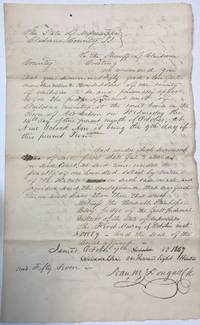
1814ref. 26463Mississippi Territory 1814. Broadside injunction oblong 11.5" x 7.25". Printed with names dates and details in manuscript. The signature 'Theodore Stark' appears in the left margin. Theodore Stark was a notary in the Mississippi Territory. Tanned light wear Very Good. This is a rare legal writ from the Superior Court in the early Mississippi Territory. The writ prohibits Morgan from proceeding with a suit to recover possession of a house and lot from Terrell and Isler. Judge Walter Leake from whose court the writ issued became Mississippi's U.S. Senator from 1817-20 and Governor from 1822-1825. The first settler of Mt. Salus he owned at least two dozen slaves according to census reports. Brigadier General Morgan whom the court enjoined from prosecuting the suit would command the 'Brigade of Louisiana and Mississippi Drafted Militia' during the Battle of New Orleans. His co-defendant Edward Turner a lawyer was Aide-de-Camp and private secretary to Governor Claiborne of the Mississippi Territory. Peter Isler who was in possession of the house and lot was a printer to the Mississippi Territory and later to the State. He established the Mississippi Republican newspaper in 1810. Richard Terrell of Adams County is listed in the Mississippi and Territory Census of 1816 as owning twelve slaves. unknown
1814ref. 26463Mississippi Territory 1814. Broadside injunction oblong 11.5" x 7.25". Printed with names dates and details in manuscript. The signature 'Theodore Stark' appears in the left margin. Theodore Stark was a notary in the Mississippi Territory. Tanned light wear Very Good. This is a rare legal writ from the Superior Court in the early Mississippi Territory. The writ prohibits Morgan from proceeding with a suit to recover possession of a house and lot from Terrell and Isler. Judge Walter Leake from whose court the writ issued became Mississippi's U.S. Senator from 1817-20 and Governor from 1822-1825. The first settler of Mt. Salus he owned at least two dozen slaves according to census reports. Brigadier General Morgan whom the court enjoined from prosecuting the suit would command the 'Brigade of Louisiana and Mississippi Drafted Militia' during the Battle of New Orleans. His co-defendant Edward Turner a lawyer was Aide-de-Camp and private secretary to Governor Claiborne of the Mississippi Territory. Peter Isler who was in possession of the house and lot was a printer to the Mississippi Territory and later to the State. He established the Mississippi Republican newspaper in 1810. Richard Terrell of Adams County is listed in the Mississippi and Territory Census of 1816 as owning twelve slaves. unknown books
1871ref. 40107Jackson Miss.: Kimball Raymond & Co. State Printers 1871. Original printed pale green wrappers lightly spotted. Stitched. 67 1 blank pp. Clean text. Very Good plus. Contemporary ownership inscription in pencil "W.H. Bullard." Alcorn 1816-1894 born in Illinois Territory was Governor of Mississippi from March 1870 through November 1871. He was active in Mississippi politics from about 1845. During the Civil War he served as a Confederate. After the War as a "Scalawag" he supported the 14th Amendment and votes for freedmen. Nevertheless he clashed with his new Republican friends by opposing federal intervention against the Klan and federal laws abolishing segregation in public facilities. Alcorn addresses "what remains to be done of the work of reconstruction" thus focusing on "the restoration of our social and material ruin." With tables and data he demonstrates the disastrous economic effects of the War. But his data also give "encouragement to the practicability of educating the great body of our labor to the moral level of freedom." Marriage licenses are up; extreme "sexual license" is down. Preachers teachers schools property ownership and trades for the freedmen are all on the increase. Denouncing vigilantism he says that "A class of lawless violence the most cruel and cowardly proceeds in a few quarters in the person of the masked assassin; and so far has succeeded in evading punishment if not detection." OCLC 28758840 3- Columbia Yale LSU as of June 2024. Not at online AAS. Kimball, Raymond & Co., State Printers unknown
1859ref. 64413Chicago IL: Press and Tribune Print 1859. First edition. 8vo. 203 51 pp. Folding plate tables. "On the question of whether the railroad bridge from Rock Island Illinois to Davenport Iowa was a hazard to the navigation of the Mississippi River" OCLC. "James Ward a St. Louis steamboat owner filed a bill praying that the bridge be declared a nuisance and ordered removed; in 1866 Congress finally passed an act requiring that the bridge be replaced by another half the cost to be paid by the United States" "The Mississippi River: St. Louis' Friend or Foe" by James Lemly Cambridge U. Press online. Drop-title: "District Court United States. Southern District of Iowa. James Ward vs. Mississippi & Missouri Railroad Company." Chicago Ante-Fire Imprints 413: "Not located title from Heartman Cat. No. 187 June 1926 No. 300." OCLC locates eight copies New York Public Yale Chicago History Museum Harvard-Baker Missouri-St. Louis Cincinnati/Hamilton County Public Library of Congress Newberry. Very good. Original printed olive wrappers some soiling lacking rear wrapper rebacked with archival paper. 10747. Press and Tribune Print unknown
1857ref. 37204Claiborne County MS 1857. 4to. 4 pp entirely in ink manuscript. Signed with a flourish by the Clerk Dan McDougall and the Deputy Sheriff G.R. Girault. Daniel McDougall 1813-1863 born in Schenectady migrated to Port Gibson Claiborne County. He was appointed Clerk of the Claiborne County Circuit Court in 1853 and served as such until his death. Colonel George Rogers Girault c.1815-1857 also of Port Gibson was a farmer owning 11 slaves as of 1850 and was also a County Deputy Sheriff. He died two months after this writ was issued. Stanhope Posey c.1813-1859 full name John Stanhope Posey a Wilkinson County lawyer owned 38 slaves as of the 1850 census. He was elected District Attorney of the Third District of Mississippi in 1839 and a Judge of the First Judicial District Circuit Court in 1845. We don't know who "Everett a Slave" was or what happened to him. We can guess that a jury of slaveholders was not sympathetic to him. unknown
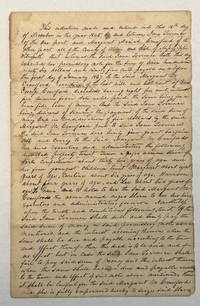
1845ref. 42448Amite County Mississippi 1845. Folio leaf folded to 8" x 12-3/8." Entirely in ink manuscript . Several fold separations with minor effect on one or two letters. Signed on the middle of page two by Jane Torrence with her mark and attested by Barttel W. Smith on 16 December 1845. On page 3 Robert L. Torrence Clerk of the Circuit Court writes that he witnessed the acknowledgement of Jane Torrence. Docketed on page 4. Good plus. Jane Torrence borrowed money from Crawford's Estate Margaret Crawford as the estate's executor. She signed a promissory note obliging her to repay it with 8% interest. She also mortgaged four slaves which mortgage would be released upon payment of the debt. Like other forms of property slaves were involved in all sorts of transactions recognized by law. If Torrence failed to pay her debt the slaves would become the property of Crawford as Executor. unknown
1845ref. 42448Amite County Mississippi 1845. Folio leaf folded to 8" x 12-3/8." Entirely in ink manuscript . Several fold separations with minor effect on one or two letters. Signed on the middle of page two by Jane Torrence with her mark and attested by Barttel W. Smith on 16 December 1845. On page 3 Robert L. Torrence Clerk of the Circuit Court writes that he witnessed the acknowledgement of Jane Torrence. Docketed on page 4. Good plus. Jane Torrence borrowed money from Crawford's Estate Margaret Crawford as the estate's executor. She signed a promissory note obliging her to repay it with 8% interest. She also mortgaged four slaves which mortgage would be released upon payment of the debt. Like other forms of property slaves were involved in all sorts of transactions recognized by law. If Torrence failed to pay her debt the slaves would become the property of Crawford as Executor. unknown books
1857ref. 37204Claiborne County MS 1857. 4to. 4 pp entirely in ink manuscript. Signed with a flourish by the Clerk Dan McDougall and the Deputy Sheriff G.R. Girault. Daniel McDougall 1813-1863 born in Schenectady migrated to Port Gibson Claiborne County. He was appointed Clerk of the Claiborne County Circuit Court in 1853 and served as such until his death. Colonel George Rogers Girault c.1815-1857 also of Port Gibson was a farmer owning 11 slaves as of 1850 and was also a County Deputy Sheriff. He died two months after this writ was issued. Stanhope Posey c.1813-1859 full name John Stanhope Posey a Wilkinson County lawyer owned 38 slaves as of the 1850 census. He was elected District Attorney of the Third District of Mississippi in 1839 and a Judge of the First Judicial District Circuit Court in 1845. We don't know who "Everett a Slave" was or what happened to him. We can guess that a jury of slaveholders was not sympathetic to him. unknown books
1859ref. 64413Chicago IL: Press and Tribune Print 1859. First edition. 8vo. 203 51 pp. Folding plate tables. "On the question of whether the railroad bridge from Rock Island Illinois to Davenport Iowa was a hazard to the navigation of the Mississippi River" OCLC. "James Ward a St. Louis steamboat owner filed a bill praying that the bridge be declared a nuisance and ordered removed; in 1866 Congress finally passed an act requiring that the bridge be replaced by another half the cost to be paid by the United States" "The Mississippi River: St. Louis' Friend or Foe" by James Lemly Cambridge U. Press online. Drop-title: "District Court United States. Southern District of Iowa. James Ward vs. Mississippi & Missouri Railroad Company." Chicago Ante-Fire Imprints 413: "Not located title from Heartman Cat. No. 187 June 1926 No. 300." OCLC locates eight copies New York Public Yale Chicago History Museum Harvard-Baker Missouri-St. Louis Cincinnati/Hamilton County Public Library of Congress Newberry. Very good. Original printed olive wrappers some soiling lacking rear wrapper rebacked with archival paper. 10747. Press and Tribune Print unknown books
1871ref. 40107Jackson Miss.: Kimball Raymond & Co. State Printers 1871. Original printed pale green wrappers lightly spotted. Stitched. 67 1 blank pp. Clean text. Very Good plus. Contemporary ownership inscription in pencil "W.H. Bullard." Alcorn 1816-1894 born in Illinois Territory was Governor of Mississippi from March 1870 through November 1871. He was active in Mississippi politics from about 1845. During the Civil War he served as a Confederate. After the War as a "Scalawag" he supported the 14th Amendment and votes for freedmen. Nevertheless he clashed with his new Republican friends by opposing federal intervention against the Klan and federal laws abolishing segregation in public facilities. Alcorn addresses "what remains to be done of the work of reconstruction" thus focusing on "the restoration of our social and material ruin." With tables and data he demonstrates the disastrous economic effects of the War. But his data also give "encouragement to the practicability of educating the great body of our labor to the moral level of freedom." Marriage licenses are up; extreme "sexual license" is down. Preachers teachers schools property ownership and trades for the freedmen are all on the increase. Denouncing vigilantism he says that "A class of lawless violence the most cruel and cowardly proceeds in a few quarters in the person of the masked assassin; and so far has succeeded in evading punishment if not detection." OCLC 28758840 3- Columbia Yale LSU as of June 2024. Not at online AAS. Kimball, Raymond & Co., State Printers unknown books
1898ref. 40873N.P.: Sentinel and Gazette Steam Press 1851. 1898. 8 1/2" x 5 1/2" in light peach wrappers though missing the front wrapper. 15 pp. Illustrations. Map. Although it eventually became a transcontinental railroad the railroad that became the Milwaukee Road began as the Milwaukee and Waukesha Railroad whose goal was to link the developing Lake Michigan port city of Milwaukee Wisconsin with the Mississippi River. The company incorporated in 1847 but changed its name to the Milwaukee and Mississippi Railroad in 1850 before construction began. A report to the Board of Directors explaining that the railroad is not completed to Waukesha as was expected and offering reasons for the delay in its completion. "Considering our small beginning only a little over one year ago - that we have relied solely on the resources of the people of Wisconsin for the means of prosecuting this enterprise - without seeking foreign aid - with only the small contributions of each of our thousand Stockholders and the credits based on the securities of our city and citizens we have in that time completed the grade of our Road for twenty and a half miles laid the Track and brought into actual use the half of that distance - and will have the whole completed and in successful operation by the middle of February next." Information on estimated and actual costs of the First Division extending the road from Milwaukee to Waukesha. It appears that actual costs far exceeded estimates "but that has been the result of peculiar circumstances under which the work has been performed and by the adoption of a rail of greater weight than that estimated." It was determined that the contractors to whom jobs had been given at lower costs were inexperienced and inefficient resulting in their work having to be re-done. Furthermore the delay was caused by some stockholders not promptly paying the small installment of only 5% every three months thus leaving a deficit. Also a bank in a marsh sunk and had to be built back up. Th cost of constructing the first twenty and 1/2 miles is only $9495 per mile. Report ends with the reassurance that the Road will be complete by February and if weather permits perhaps even earlier. 8 1/4" x 21 1/2" map of the Milwaukee and Mississippi Rail-Road. Map is neatly torn in half at one fold and has 1 1/2 - 2" closed tears to tops of a couple folds. Front wrapper missing along with 3" split to toe of spine and with light wear to the extremities. Sentinel and Gazette Steam Press, 1851]. unknown
ref. DADAX0670495115New unknown
1782ref. PHO-1554Moutard, Paris, 1782. 2 vol. in-8 de 432 pp. et 272 pp. illustré de 10 planches dépliantes, relié plein basane époque, dos lisse avec titre et tomaison (reliures différentes), frottements, coins et coiffes usés, bord des planches usé.
1840ref. 32117New Orleans: E. Johns & Co. Stationers' Hall verso of title page: Printed by T.K. and P.G. Collins Philadelphia 1840. xii 885 pp with the half title. A very clean text with minor exceptions. Bound in worn contemporary sheep hinges starting spine chipped institutional bookplate on front pastedown institutional rubberstamp on title page. Else Very Good. The origins of the State of Mississippi are recounted in the printing of the Cession from Georgia the Act admitting Mississippi into the Union and the Act establishing its northern boundary. The complete set of laws organized by subject and the constitutions of the United States and the State of Mississippi with a detailed Slave Code and other subjects are printed. Jumonville 1156 noting that it is "not a New Orleans imprint". Sabin 33282. OCLC records mostly Kirtas Technologies reprints. E. Johns & Co. Stationers' Hall [verso of title page: Printed by T.K. and P.G. Collins, Philadelphia] unknown
1840ref. 32117New Orleans: E. Johns & Co. Stationers' Hall verso of title page: Printed by T.K. and P.G. Collins Philadelphia 1840. xii 885 pp with the half title. A very clean text with minor exceptions. Bound in worn contemporary sheep hinges starting spine chipped institutional bookplate on front pastedown institutional rubberstamp on title page. Else Very Good. The origins of the State of Mississippi are recounted in the printing of the Cession from Georgia the Act admitting Mississippi into the Union and the Act establishing its northern boundary. The complete set of laws organized by subject and the constitutions of the United States and the State of Mississippi with a detailed Slave Code and other subjects are printed. Jumonville 1156 noting that it is "not a New Orleans imprint". Sabin 33282. OCLC records mostly Kirtas Technologies reprints. E. Johns & Co. Stationers' Hall [verso of title page: Printed by T.K. and P.G. Collins, Philadelphia] unknown books
1941ref. 64396n.p.: n.p. 1941-1945. Oblong 4to. 11.25 x 8.25 in. 78 pp unpaginated. 93 original photos and Real Photo Postcards sized from 2.25 x 3.5 to 6 x 9 in. all tipped-in w/ corners. Original limp suede leather post-binder photo album colour image of USS Mississippi on front cover leather ties some scuffing minor edgewear minor bumping to corners a few images w/ minor creasing still a VG exemplar. This excellent souvenir photo album assembled by an unknown USS Mississippi officer during World War II begins with souvenir RPPC images and photos of Iceland where the battleship voyaged from June to September 1941 escorting convoys to Europe in the North Atlantic. These include two snapshot photos of the crew skiiing in Iceland and spread out on a glacier. After Pearl Harbor the Mississippi was immediately dispatched to the Pacific with four photos showing the Battleship sailing through the Panama Canal a horsedrawn carriage in Panama and the canal. Upon arrival in San Francisco the Mississippi was assigned to escort convoys to Fiji with photos included here showing native huts Fiji Islanders and scenery. Afterwards they returned to Hawaii which is evidenced by snapshot photos of Honolulu hula girls and 5 large pin-up photos 1 bare-breasted hula girl. The USS Mississippi was then assigned to aid in pushing the Japanese out of the Aleutians beginning with shelling Kiska Island on July 22 which resulted in the Japanese withdrawing their forces from the Aleutians by the end of July. The images of Alaska include a series of Real Photo Postcards with images of an Eskimo fisherman and his kayak Northern Eskimo Family a young Eskimo boy Pa-Ruck by F.H. Nowell 1905 Obleka original Inuit Woman of Nome 1907 Eskimo Natives with sled reindeer Alaskan Totem Poles and more. Of particular interest are the series of striking combat snapshots which show battle damaged ships fire control operations loading & unloading of military invasion personnel and starburst shells exploding over a beach landing during combat operations during the invasion of the Gilbert Islands in October 1943 as part of the Marshall Islands Campaign from January through March 1944 and later assisting in the liberation of the Philippines. There is even a photo showing the damage to the Mississippi at the waterline by a Kamikaze plane suicide attack in January 1945. The Mississippi is best remembered as firing the last salvo in history by a US battleship against other warships during the massive naval battle of Surigao Strait. n.p., hardcover
1698ref. PHO-1936Utrecht, Antoine Schouten, 1698. In-12, (35) ff. de titre, épitre, préface et table, 389 pp., veau fauve granité, armes dorées au centre des plats, dos à nerfs orné, pièce de titre maroquin rouge, tranches mouchetées (Reliure de l'époque) ; frottements, coiffes absentes avec petits manques aux caissons, coins élimés, ors du 1er plat ternis, petit manque de papier sans atteinte au texte à un feuillet (pp. 159/160). Exemplaire relié SANS les 3 figures h.-t. et la carte. Exemplaire aux armes d’Usson de Bonac
18083 vols. (328, 292, 310 p.) Hardcover Very good condition, in later maroon cloth Howes A - 352
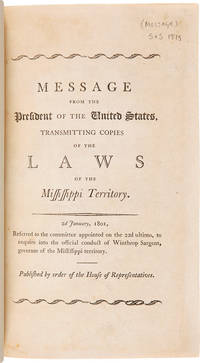
1801ref. 35410Washington. 1801. Early Laws of Mississippi Territory A very early work on Mississippi territorial law printed in Washington in 1801 and containing ten laws that were eventually published "by order of the House of Representatives" after some local controversy over their content. The laws from the second half of 1799 range in subject matter from distempered cattle to divorce. These were added to the twenty-five laws already passed by the territorial legislature. The House of Representatives published this volume to assist in the "enquiry into the official conduct of Winthrop Sargent governor of the Mississippi territory" p.1. Thomas Jefferson removed Sargent from office later that year. Modern half calf and marbled boards spine gilt. Very light foxing. Near fine. SABIN 49519. SHAW & SHOEMAKER 1515. LC MISSISSIPPI. A SESQUICENTENNIAL OF STATEHOOD 1967 60. GOODSPEED 141:351 161:683. hardcover
1801ref. 35410Washington. 1801. Early Laws of Mississippi Territory A very early work on Mississippi territorial law printed in Washington in 1801 and containing ten laws that were eventually published "by order of the House of Representatives" after some local controversy over their content. The laws from the second half of 1799 range in subject matter from distempered cattle to divorce. These were added to the twenty-five laws already passed by the territorial legislature. The House of Representatives published this volume to assist in the "enquiry into the official conduct of Winthrop Sargent governor of the Mississippi territory" p.1. Thomas Jefferson removed Sargent from office later that year. Modern half calf and marbled boards spine gilt. Very light foxing. Near fine. SABIN 49519. SHAW & SHOEMAKER 1515. LC MISSISSIPPI. A SESQUICENTENNIAL OF STATEHOOD 1967 60. GOODSPEED 141:351 161:683. hardcover books
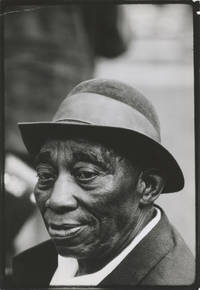
1965ref. 162963Forest Hills NY: Photo-Graphics 1965. Vintage satin finish portrait photograph of influential country blues musician Mississippi John Hurt 1965. Stamp of photographer Bernard Gotfryd on the verso along with annotations in manuscript pencil relating to same. Although Hurt's initial recordings with Okeh Records in the 1920s were commercial failures driving Hurt back into sharecropping he experienced a brief period of renewed interest in the early 1960s after his rediscovery by musicologist Dick Spottswood. He would travel and perform extensively recording for the Library of Congress in 1964 and recording four albums in as many years but would pass away in 1966 of a heart attack. Material recorded by Hurt has been covered by numerous artists including Bob Dylan Gillian Welch Beck Dave Van Ronk Taj Mahal Jerry Garcia and many others. Polish-American photographer Bernard Gotfryd worked as a staff photojournalist for "Newsweek" operating out of New York for over three decades. His photographs serve as a document of American popular culture politics and art in the 1960s and 1970s and his work is today held in the Library of Congress Brooklyn Public Library and the New York Historical Society. From the archive of the PIX Agency an American photo house that acted as an intermediary between emigre photographers as well as those still living in Europe and the American magazine and newspaper market between 1935-1969. 6.5 x 9.5 inches archivally matted in a 11 x 14 inch 8-ply white mat. About Near Fine with a small crease at the top left corner. Photo-Graphics unknown