WITGEEST, Simon [= Willem GOEREE?].Biblio.com
69.742 resultados
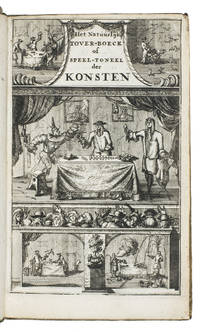
1684ref. ABC_45272Amsterdam 1684. 8vo. Jan ten Hoorn Contemporary vellum with the manuscript title on the spine. With an engraved frontispiece in 5 compartments showing magic tricks and 40 small woodcuts illustrating the various magic tricks in the text. 8 512 24 pp. Rare second edition of a very popular Dutch conjuring book first published also by Jan ten Hoorn in Amsterdam in 1679. It went through many further editions sometimes augmented far into the 18th century. The edition of 1698 mentions 1600 magic tricks tover-konsten instead of the 500 in the present edition. It was also translated into German.Simon Witgeest from Middelburg is almost certainly a pseudonym. The family name does not appear in the www.wiewaswie.nl database until 1818. Witgeest literally means white spirit in Dutch and it probably served to suggest that the recipes were innocent white rather than black magic. Willem Goeree 1635-1711 a Dutch bookseller first in Middelburg and after 1677 in Amsterdam noted above as one of the books sources is often named as the possible author but his known publications books on art theory and practices and Jewish religion and history are aimed at more of a high-brow public.The author states in the preface that the book was meant to shorten wintery nights and gradually the sections on glass drawing and etching were omitted in favor of more magic tricks practical jokes riddles and entertainment with mathematical and astronomical brainteasers as well as small chemical and physics experiments for fun.Binding slightly worn otherwise in very good condition.l John Landwehr Simon Witgeests Natuurlyk tover-boek et alia in: Volkskunde 68 1967 pp. 67-82; Hoogendoorn p. 992 STCN 2 copies; for more about the text: www.dbnl.org/nieuws/nieuws.phpl=2020_01_09. hardcover
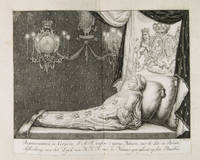
1759ref. 18779The Hague 1759. Large folio ca. 50 x 36 cm. Pierre Gosse junior 19th-century half green morocco a red morocco label on the spine with the title in French lettered in gold marbled endpapers. With 20 engravings each mounted on a double-leaf of heavy paper the text is printed in Dutch and French with a separate title page for each language the engraved coat of arms of Princess Anna on each and 4 decorated woodcut initials. 2 parts in 1 volume. 4 4; 4 27 pp. First edition of two works with illustrations and descriptions of the funeral ceremonies for Princess Anna of Hannover 1709-1759 who was then regent for her son William V Stadtholder of the Dutch Republic. The first work shows the ceremonial mourning chamber with Princess Anna on her death bed. The plates were drawn by Pieter de Swart 1709-1772 one of the most important Dutch architects of the 18th century and engraved by Simon Fokke 1712-1784. The second work shows the funeral procession which took place in Delft on the 23rd of February in 1759 with detailed illustrations of all the heralds riflemen guards etc. that took part in the ceremony. The plates for this work were drawn by artist Paulus Constantijn la Fargue 1729-1782 and also engraved by Fokke. The creators apparently suspected that counterfeit editions of the work might appear as the text at the end of the first work states that only copies signed by the bookseller would be considered real. The present copy is signed.Princess Anna of Hannover duchess of Brunswick-Luneburg was the eldest daughter of George II August later King of England as George II and Wilhelmina Charlotte of Brandenburg-Ansbach. In 1734 she married the Dutch Willem Karel Hendrik Friso 1711-1751 Prince of Orange and Stadtholder of Friesland. When in 1747 her husband became Stadtholder of the Dutch Republic as Willem IV the couple moved from Leeuwarden to The Hague and Anna became highly involved in politics. After the death of Willem IV in 1751 she became regent for her three-year old son the later Stadtholder Willem V. In this position she played a prominent part in the political life of the Republic defending the position of the House of Orange against the republicans.The edges and corners of the boards are somewhat scuffed the boards are slightly rubbed the spine is somewhat discoloured. Otherwise a beautiful copy on heavy large paper with the plates in their original fresh impressions.l Ad 1: Landwehr Splendid ceremonies 233; Lipperheide 2675; Muller 4095; STCN 23024453X 7 copies; Vinet 756; Ad 2: Landwehr Splendid ceremonies 234; Lipperheide 2676; Muller 4097; STCN 230244394 7 copies; Vinet 756bis. ABE CAT Costumes & Uniforms hardcover
1822ref. 1485251822. Rare military appointment signed by ‘El Libertador’ Simón Bolívar as President of Gran Colombia. One page quarto wax seal mostly intact partially printed on Bolivar's presidential letterhead the document is dated May 21 1822 and appoints Miguel Arissmendi as Lieutenant-Colonel. Signed by Bolívar and countersigned by General Bartolome Salom on verso. The final battle in the war of independence Bolívar's decisive victory at Carabobo on June 24 1821 finally secured Venezuela's national independence after years of war against Spain and established the Republic of Gran Colombia. On May 23 1822 a nighttime assault by South American rebel forces was led by General Antonio José de Sucre against the Spanish royalists on the slopes of the volcano Cerro Pichincha near Quito. The following day victory allowed the rebels to occupy Quito and Simón Bolívar was declared the liberator of Ecuador which then became part of the short-lived Republic of Gran Colombia. In very good condition with pinholes along left margin and folds. Accompanied with a portrait of Bolivar. The entire piece measures 8.5 by 12.25 inches. Venezuelan military and political leader Simón Bolívar also known as 'El Libertador' led what are currently the countries of Venezuela Bolivia Colombia Ecuador Peru and Panama to independence from the Spanish Empire in the campaign for the independence of New Granada which began in 1808 and was consolidated with the victory at the Battle of Boyacá on 7 August 1819. Despite a number of hindrances including the arrival of an unprecedentedly large Spanish expeditionary force the revolutionaries eventually prevailed culminating in the victory at the Battle of Carabobo in 1821 which effectively made Venezuela an independent country. Following this triumph over the Spanish monarchy Bolívar participated in the foundation of the first union of independent nations in Latin America Gran Colombia of which he was president from 1819 to 1830. Through further military campaigns he ousted Spanish rulers from Ecuador Peru and Bolivia the last of which was named after him. He was simultaneously president of Gran Colombia present-day Venezuela Colombia Panama and Ecuador Peru and Bolivia but soon after his second-in-command Antonio José de Sucre was appointed president of Bolivia. Bolívar aimed at a strong and united Spanish America able to cope not only with the threats emanating from Spain and the European Holy Alliance but also with the emerging power of the United States. At the peak of his power Bolívar ruled over a vast territory from the Argentine border to the Caribbean Sea. unknown
ref. 89052Original full color illustration of one of comics' most enduring superheroes Captain America. Inscribed by Captain America's co-creator Joe Simon to actor and voice actor Miguel Ferrer "Just thought I'd drop in on Miguel Ferrer Joe Simon." American actor Miguel Ferrer's notable roles include OCP Vice President Bob Morton in the 1987 film RoboCop FBI Agent Albert Rosenfield in the early 90s television series Twin Peaks Eduardo Ruiz in the 2000 film Traffic and the voice of Shan Yu in the 1998 Disney animated film Mulan. In fine condition. Double matted and framed. The entire piece measures 22 inches by 18 inches. A unique association. Created by cartoonists Joe Simon and Jack Kirby Captain America first appeared in March of 1941. Designed as a patriotic supersoldier the fictional superhero became Timely Comics' most popular superhero during the wartime period. Wearing a costume bearing an American flag motif Captain America often fought the Axis powers of World War II using his indestructible shield. Captain America also became the first character to appear outside of comics with the release of the 1944 movie serial Captain America and has since appeared in several other films including the 2018 Avengers: Infinity War. unknown
1757ref. 10919[Paris], sans nom, 1757. In-folio sous cartonnage d'attente, tranches mouchetées. 2 manques au dos, cartonnage frotté, une planche très légèrement tachée. Ex-libris de Frédéric Grant d'Hauteville.
ref. 88415aafParis, de l’imprimerie de J. P. Jacob à Paris chez Deterville et à la Librairie Economique, 1805, gr. in-4to (oblong), page de titre poussiéreuse et renforcée + au total 55 planches gravées, sur le titre pt. timbre rouge ‘Cabinet Topographique du Roi’ et cote ms. (E. 5 / 48), cartonnage du XIXe s. couvert de papier marbré, pièce de titre maroquin rouge au dos. Bel exemplaire.
1859ref. ABC_45580Wiesbaden: C.W. Kreidel 1859. Contemporary decorated red cloth gold-tooled spine new endpapers. Small oblong folio 23 x 30 cm. Suite of 10 steel-engraved views all finely hand-coloured and highlighted with gum arabic tipped onto thick brown leaves with printed decorative borders and captions. Beautifully produced suite of views engraved after the Dutch artist Jan Simon Voddiggel 1820-1862 showing Wiesbaden in Hesse one of the oldest spa towns in Europe celebrated as the "Nice of the North". It includes several views of the old Kurhaus "spa house" built by Christian Zais in 1810 in the neoclassical style the nearby cold-water balneological institution of Nerothal the summer palace of the Dukes of Nassau the "Kochbrunnen" hot spring fountain in downtown Wiesbaden the sepulchral chapel of Duchess Elizabeth of Nassau the Ducal hunting palace and the ruins of Sonnenberg castle. Issued with various titles and as here without a title-page.With an inscription in ink on the first free endpaper to Christine Emma Sanford née Percival 1828-1900 "from her affectionate mother" dated 1 May 1859. Christine Percival had married Edward Ayshford Sanford of Combe Florey Somerset in 1853. Cloth rubbed spine rebacked new endpapers. One plate with an unobtrusive mark another with faint stains at corners from adhesive on the back. Otherwise in good condition. C.W. Kreidel, hardcover
1921ref. 2130Paris, Éditions de la Galerie Simon, 1921. Un volume in-4 (326 x 230 mm) broché, couverture illustrée. Édition originale. 13 BOIS GRAVÉS ORIGINAUX PAR VLAMINCK : COUVERTURE, UN FRONTISPICE À PLEINE PAGE ET 10 GRANDS BOIS ENTOURANT LES POÈMES. Un grand bois illustre également le colophon. Tirage à 112 exemplaires : 10 Japon impérial + 100 sur Hollande van Gelder et 2 pour le dépôt légal. Chaque exemplaire est numéroté au composteur et signé par Vlaminck. Celui-ci 1 DES 10 SUR JAPON IMPÉRIAL signé à l'encre noire par Vlaminck. Note : les exemplaires sur Japon sont très légèrement plus grands que les Hollande. Photographies supplémentaires sur demande. More pictures on request.
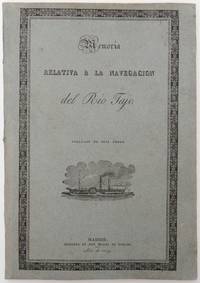
1829ref. 1489Madrid: Imprenta de Don Miguel de Burgos 1829. First edition. Atlas imprint: A Paris: Imp. Lith. de Engelmann & Cie. Lithographes de la Chambre et du Cabinet du Roi 1829. 10 desultorily numbered but complete 11–118 p. Text volume: In publisher’s illustrated wrappers. Atlas: In publisher’s printed wrappers. Lithographed throughout. Text volume: Pastedowns discolored also a few quires. Browning to some quires at print space. Cover artistically restored. In fine condition. Atlas: Wrappers stained. A brown stain to lower left corner of the front cover it affects the first leaves. Pastedowns discolored. Occasional brown spots throughout. Browning to some leaves at the rear. Artistically restored overall in very good condition. First edition. Atlas imprint: A Paris: Imp. Lith. de Engelmann & Cie. Lithographes de la Chambre et du Cabinet du Roi 1829. 10 desultorily numbered but complete 11–118 p. Text volume: In publisher’s illustrated wrappers. Atlas: In publisher’s printed wrappers. Lithographed throughout. 4 I–XII I–IX 1 1–63 1 1–210 p. Extremely scarce documentation of the topographical survey and the design of the navigation on the entire length of the Tagus River. Both volumes in original wrappers. The Napoleonic Wars and the loss of the American colonies resulted in a political turmoil and economic disaster in Spain in the first half of the 19th century. A shift in the economics and the modernization of the country seemed to be the path to overcome the crisis. Among many signs of progress an attempt was to make the Tagus River Rio Tajo the longest river in the Iberian Peninsula navigable by steamships on its entire length from Aranjuez to Lisbon to facilitate the transport of people and goods thus strengthen the country’s internal market. The plan was designed by Francisco Javier de Cabanes 1781–1834 a multitalented Spanish military historian in cooperation with an engineer Agustín Marco-Artu. Although the plan has never been realized the present work shows Cabanes' profound and systematic preparations. The text volume contains a prologue and detailed indexes and the sixty-three pages of the report on the project “Memoria relativa á la navegacion del Rio Tajo” which is divided into twelve sections and the conclusion exposing the advantages and the obstacles of the plan and the possibilities of its realization. This part is followed by the appendix the most extensive part of the book with extraordinary value. It contains a collection of 177 documents related to the plans and survey of the navigability of Tagus from the earliest attempt by Juan Bautista Giovanni Battista Antonelli in 1581–1582 through Luis Carduchi’s and Carlos Simón Pontero’s surveys in 1641 and 1755 to Cabanes’ own survey executed by Agustín Marco-Artu in 1828. The maps of 1641 1755 and the 1828 surveys with short explanations are included in the lithographed atlas. Both volumes are preserved in their original wrappers which is remarkably rare and particularly significant especially in the case of the atlas as the Paris imprint of Engelmann is only indicated on its cover. In many collections the two volumes are bound together thus this information became lost and the lithographed maps are attributed to Miguel de Burgos in Madrid the printer of the text volume. The text tome is bound into blue paper the panels are framed with an ornamental double-rule. The front is illustrated with a steamer the rear panel with naval equipment as an allusion to its content. Ref.: Palau 38563. Bibl.: López Gómez A.: La navegación por el Tajo. El reconocimiento de Carduchi en 1641 y otros proyectos. Madrid: Real Academia de la Historia 1998. pp. 151–152.; Pastrana L.: El proyecto del Brigadier Francisco de Cabanes para navegar el Río Tajo mediante embarcaciones a vapor 1828. Iberoamérica Social: revista-red de estudios sociales IX pp. 178–194. . Imprenta de Don Miguel de Burgos unknown
ref. 3114P., IMPRIMERIE ROYALE, 1843-1847, 7 VOLUMES GRAND IN 4 reliés en PLEIN CHAGRIN BLEU MARINE, dos ornés de caissons dorés, filets dorés sur les plats, frises dorées à l'intérieur des plats, armes impériales dorées sur les plats, toutes tranches dorées (reliures de l'époque), (quelques rousseurs), T.1 : (3), XVpp., 420pp., T.2 : (2), XVIpp., 440pp., T.3 : (4), XIXpp., 381pp., T.4 : (2), XXXIXpp., 552pp., 1 PLANCHE DEPLIANTE, T.5 : (3), Vpp., 540pp., (1-errata), T.6 : (2), VIIpp., 479pp., T.7 : (3), CXCVpp., 691pp.
ref. 10080NORD-SUD. Collection suivie du n° 1 (mars 1917) au n° 14 (avril 1918). Ne manquent donc que les deux derniers numéros (n° 15 et 16) pour le complètement. Les 12 livraisons sont en très bon état. Le n° 13 est bien complet des deux planches hors texte de Georges Braque ; le n° 14 est bien complet des deux planches hors texte de Fernand Léger (ces deux numéros sont les seuls à proposer des illustrations). /// N.B. Le n° 3 est ici dans sa variante optimale, comprenant bien le texte de Pierre Reverdy, " Sur le Cubisme ", suivi de de sa traduction en anglais par Léonce Alexandre-Rosenberg, " On Cubism " (quatre pages, numérotées I à IV, greffées au centre du fascicule). Le " reprint " de Jean-Michel Place reproduit bien ces quatre pages de traduction, manifestement ajoutées postérieurement, mais sans les annoncer au sommaire. Dans le cas de notre exemplaire, cette " augmentation " est mentionnée au sommaire figurant sur la couverture : les exemplaires " ordinaires " annoncent deux textes de Pierre Reverdy (" Matin " et " Une Nuit dans la plaine ") ; notre exemplaire " augmenté " annonce bien " Sur le Cubisme " en plus des deux autres textes. A noter : " Sur le Cubisme " avait déjà paru dans le n° 1 de NORD-SUD, mais sans la traduction de Léonce Rosenberg. /// Une telle collection est aujourd'hui très difficile à réunir.
1954ref. 21470Paris, Chez Grasset, 1954 ; in-quarto tellière broché, chemise-étui moderne ; 140 pp., [2]ff., couverture granitée jaune rempliée, imprimée en noir et chocolat ; page de titre imprimée en noir et vert printemps.
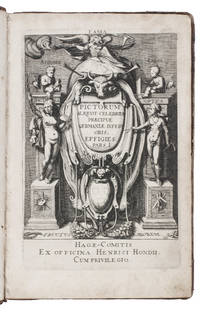
1610ref. 8BNE272U2AXDThe Hague 1610. Folio. Henricus Hondius Contemporary half calf brown sprinkled paper sides. An engraved print series with an architectural title-page with allegorical figures an elaborate architectural cartouche with 3 allegorical female figures a terrestrial globe 2 putti a shield bearing only 3 smaller blank shields a bulls head a winged head and garlands of fruit; an engraved print with three putti tumbling through the air with 2 banderoles each bearing a 4-line verse; a letterpress dedicatory verse with a band of arabesque typographic ornaments above and below; 41 engraved portraits 20 x 12 cm by Hendrik Hondius 9 Robert de Baudous 4 Simon Frisius 23 and Andries Stock 5; and an allegorical closing print a skeleton holding an hour glass and an arrow not in the copy on Google Books. The three plates outside the portraits are all by Hendrick Hondius. With an extra added portrait of Hendrick Hondius engraved by Fredericus Boultats after a drawing by Hondius himself 16.5 x 11 cm; mounted on a blank leaf. 44 engraved ll. plus 1 letterpress leaf. A selection of 41 portraits plus the engraved allegorical title-page and the two other prints from the first edition of Hendrick Hondius's series of portraits of artists from the Low Countries. The complete set which contained 70 portraits appeared in or soon after 1610 the portrait of Jacobus de Geyn is dated 1610. Johannes Janssonius in Amsterdam published a second edition in 1618 with the title Theatrum honoris in quo nostri apelles . imagines. The prints were also sold separately and have no fixed order so the number of portraits and the additional prints included varies from copy to copy. Although there was no fixed order the STCN calls for three parts.The portraits in the complete series fall into three categories: 22 copy Domenicus Lampsonius's series of portraits of artists working before ca. 1500; 26 portray artists active in the sixteenth century and 20 portray contemporary artists.The present selection contains after 1 the engraved title-page H 80 2 the plate with the three putti with banderols 23 x 15 cm; H 81 3 a leaf with the mounted extra added portrait of Hendrik Hondius by Fredericus Boultats after the drawing by Hondius himself with a biographical note in French below 4 the leaf with the dedicatory poem by Hendrick Hondius "Picturae amatoribus admiratoribusque" 41 portraits and the allegorical print 21.5 x 13.5 cm with in the foot margin the motto "Post Funera Vita" Life after death by Hondius H 115 suggesting that the deceased subjects will live on.The present selection appears to deliberately cover artists after ca. 1500 including only one of the portraits after Lampsonius Cornelis Engelbrechtsz by Hondius a borderline case chronologically. It includes 23 of the 26 16th-century artists and 17 of the 20 contemporary artists. It therefore gives a good overview of artists in the Low Countries from ca. 1500 to ca. 1610.In total there are 10 portraits by the famous engraver etcher and publisher Hendrick Hondius 1573-1650 23 by Simon Wynouts Frisius ca. 1580-1629 5 by the pupil of Jacques de Geyn II Andries Stock ca. 1580-1648 and 4 by Robert de Baudous ca. 1574-ca. 1660 although many of the portraits are however signed by Hondius.Some marginal stains the top corner of several leaves damaged and the spine and boards somewhat rubbed but still in good condition.l New Hollstein Hendrick Hondius 80-115 pp. 90-105; Hollstein VII Frisius p. 32; Von Szwykowski 1856 p. 1; Kramm III p. 718; Van Someren 1 211a; Burchard 15. ABE CAT Art History hardcover
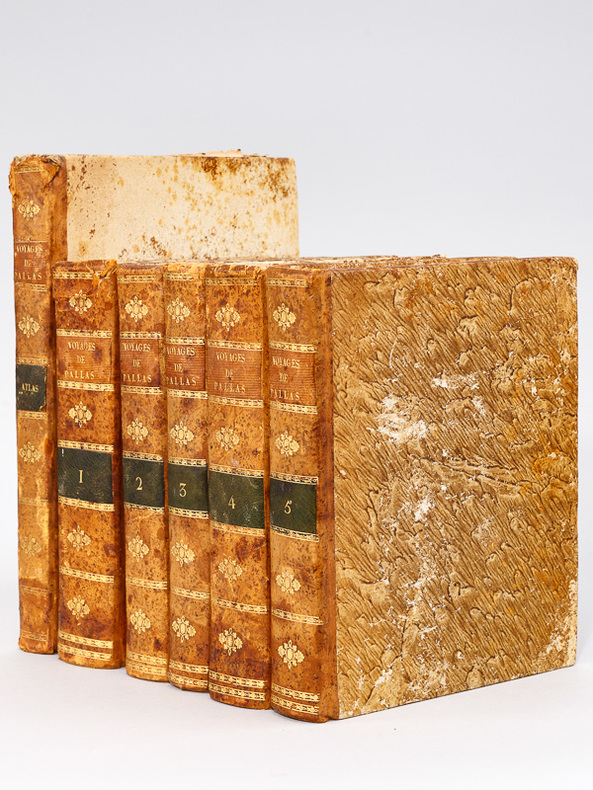
1788ref. 585455 vol. in-4 et un atlas in-folio, reliure de l'époque demi-basane marron, Chez Lagrange, Libraire [ puis : ] Chez Maradan, 1788-1793, Tome I : 2 ff., xxxij-773 pp. et 1 f. (errata) ; Tome II : 2 ff., 550 pp. et 1 f. ; Tome III : 2 ff., 491 pp. avec ; Tome IV : 2 ff., 722 pp. et 1 f. (errata) ; Tome V : 2 ff., 559 pp. ; VI (Atlas format en marges 30,8 x 23,8 cm) : 121 planches en 105 feuillets, ainsi décomposées : pour le tome I, 27 planches sur 29 (manquent les planches 1 et 3) dont carte dépliante de la Contrée qui s'étend le long de la Soka, carte dépliante des Landes situées entre le Volga et l'Oural et carte dépliante du Cours du Jaïk au-dessous de Gourief ; pour le tome II, 16 planches sur 17 (manque planche 1, la planche 3 est en double) dont carte dépliante minéralogique des Monts Ouralsks et carte dépliante de la Contrée qui s'étend le long de la Soka ; pour le tome III, 22 planches sur 22 dont carte dépliante des Monts Altaisk ; pour le tome IV, 35 planches (ou 36, selon la manière dont l'on peut compter, car présence des planches 8-9 et 9-10) dont carte dépliante d'une partie des gouvernements de Tobolsk et d'Irkoutsk ; pour le tome V, 21 planches sur 21 dont carte dépliante des Colonies allemandes sur le Volga dans le territoire de Saratof
ref. H580St. Petersburg Kaiserliche Academie der Wissenschaften 1773-1801. Band 1 in zweiter Auflage. Gr.-4to. XII 504 pp; VIII 744 pp; 760 pp 16 nn Bll Register und Druckfehlerberichtigungen. Halblederbände der Zeit mit Rückenvergoldung ein sehr breitrandiges Set in gutem Zustand. Peter Simon Pallas 1741-1811 war ein deutschsprachiger Naturforscher und Geograph. Er wurde 1767 zum ordentlichen Mitglied der Akademie der Wissenschaften in Sankt Petersburg ernannt und unternahm 1768–1774 und 1793/1794 gefördert durch die Zarin Katharina II. Expeditionen durch Sibirien und das südliche Russische Reich. Am 30. April 1767 wurde ihm die Vorbereitung und Leitung einer von fünf Akademie-Expeditionen anvertraut. Diese fand von 1768 bis 1774 statt und führte ihn vom mittleren Ural über Westsibirien zur kaspischen Senke. Weitere Teilnehmer waren Iwan Bykow Nikita Petrowitsch Rytschkow Nikita Petrowitsch Sokolow sowie Johann Peter Falck und Johann Gottlieb Georgi. Zarin Katharina II. erhoffte sich eine Verbesserung des Ansehens Russlands daher wurden die Reiseberichte schon während der Expedition vorbereitet. Die 1. Auflage erschien als Reise durch verschiedene Provinzen des russischen Reiches 1771 mit einem Umfang von 2000 Seiten. Durch die rasche Verbreitung wurden mehrere Auflagen und Nachdrucke angefertigt sie fanden vor allem Verbreitung außerhalb Russlands. Pallas wurde so schlagartig in der wissenschaftlichen Welt und in den Herrscherhäusern berühmt. Danach stand die Auswertung der Expeditionsdaten und Sammlungen im Mittelpunkt seiner Arbeit. Dies brachte eine Fülle von Veröffentlichungen hervor. Wikipedia. unknown
ref. 13592Paris, Gauthier-Villars, 1864-1884. 20 tomes in-4 reliés en 17 volumes, 39 planches dépliantes hors-texte (certaines en couleurs), quelques figures dans le texte, reliure de l'époque demi-basane, dos ornés (dos frottés, manques à quelques coiffes, rousseurs). Exemplaire du mathématicien Victor Puiseux (1820-1883), un des membres du comité de rédaction de la revue (notes de relieur).
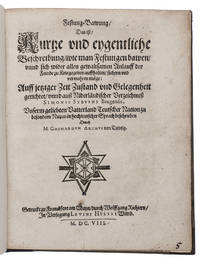
1608ref. I48A877X5NJXFrankfurt am Main 1608. 4to. Wolfgang Richter for the widow of Levinius Hulsius 20th-century grey-brown half calf mottled-paper sides. With a woodcut fortification plan on the title-page and about 30 woodcut illustrations in the text mostly fortification plans and details a woodcut headpiece woodcut decorated gothic initials 3 series and typographic acorns. Lacking the 2 plates and 3 smaller slips with 7 additional woodcut illustrations. 8 132 pp. First German edition of the first Dutch fortification manual with woodcut illustrations by Simon Stevin 1548-1620 which inaugurated a new era in the history of siege warfare. It professionalized military engineering introducing many original ideas and presenting them in lucid vernacular language. The present first German translation made his work accessible to an international audience for the first time though translations had already circulated in manuscript and was followed by a French translation in Stevin's collected mathematical works in 1634. In part through the influence of the present manual the German-language classics of fortification such as Adam Freitag's continued to develop the Dutch school of fortification.The 1594 first edition was illustrated by woodcuts on the integral leaves but for the present edition seven of the woodcut figures were instead printed separately and inserted as 2 folding plates and 3 smaller slips. These are lacking in the present copy though it includes all integral leaves with the complete text and the other 30 illustrations. Quires C E and O are somewhat browned. Otherwise in very good condition and with generous margins occasionally preserving part of a deckle at the foot and fore-edge. The modern binding is in good condition.l Jähns p. 839; Jordan 3600 7 copies; noting only 2 plates; Sloos 8010 noting only 2 plates; VD17 23:252455D 4 copies. unknown
2000ref. DBS-9780122268656Academic 2000. 1st. Hardcover. New. Academic hardcover
2000ref. DBS-9780122268656Academic 2000. 1st. Hardcover. New. Academic hardcover
1555ref. 74799Basel 1555. Folio. 1500-talls mykt helpergamentbind med nyere snorer i brunt skinn. 38 2 blanke 12 677 egentlig 577 2 blanke 1 2 blanke s. Med to treskårne illustrasjoner og tallrike detaljerte treskårne initialer. Io. Hervagium Latin. Klipp i tittelbladet. Notater i eldre hånd. Flere feilpagineringer men teksten er komplettt. Fuktskjolder på enkelte sider. Viktig bok om reiser til Amerika. SJEKK BRUNET OG SABIN. unknown
ref. 124313Second English edition. London John Stockdale 1812. 4to 292 x 230 mm. xxiii i 552 xxxii 525 pp. 52 aquatint and engraved plates of which 43 hand-coloured and 26 folding after G. Geissler. 3 engraved folding maps. Engraved vignettes in text mostly hand-coloured. Finely bound in contemporary half calf. Black morocco labels. Marbled edges. Occasional spotting and a few minor tears. . unknown
1851ref. 288814Munich: University of Munich 1851. unbound. very good. Exceedingly rare partly-printed document signed: 1 page folio Munich August 17 1851 an ornate Graduation Certificate for a student attending the University of Munich Polytechnic School signed 'Prof. Dr. Ohm' as the Royal Ministerial Commissioner for Examinations. Fine dark signature and in very good condition with some tiny tears along the right blank margin. Accompanied by a small black and white portrait of Ohm on a separate sheet. At the time he signed this certificate Ohm was also Extraordinary Professor of Physics at the University of Munich. German physicist and mathematician whose experiments using Alessandro Volta's new electrochemical cell led to his discovery of Ohm's Laws. University of Munich unknown
1851ref. 288814Munich: University of Munich 1851. unbound. very good. Exceedingly rare partly-printed document signed: 1 page folio Munich August 17 1851 an ornate Graduation Certificate for a student attending the University of Munich Polytechnic School signed 'Prof. Dr. Ohm' as the Royal Ministerial Commissioner for Examinations. Fine dark signature and in very good condition with some tiny tears along the right blank margin. Accompanied by a small black and white portrait of Ohm on a separate sheet. At the time he signed this certificate Ohm was also Extraordinary Professor of Physics at the University of Munich. German physicist and mathematician whose experiments using Alessandro Volta's new electrochemical cell led to his discovery of Ohm's Laws. University of Munich unknown books
1935ref. 901F38London: Wishart & Company 1935 . First edition. Cloth. Very Good Indeed/Good Only. 8.5" by 6". None. A signed presentation copy of this very scarce murder mystery by Oswell Blakeston and Roger Burford starring a moustachioed cat. A very scarce signed first edition first impression of this thrilling and unusual tale.The third of four mystery novels written under the name "Simon" the pseudonym of two writers working together Oswell Blakeston - a British writer and artist who also worked in the film industry - and Roger Burford an English poet novelist and screenwriter who also wrote crime fiction as Roger East.With the inscription 'To my friend John Gawsworth' to the title page.Inscribed by Blakeston to John Gawsworth a British writer poet and compiler of anthologies both of poetry and of short stories. Blakeston regularly contributed to Gawsworth's anthologies.In the original price unclipped dust wrapper.With faint but extensive former owner's pencil inscriptions to the front free endpaper and rear flyleaf.A delightfully thrilling and unusual work advertised by the publisher as about 'a cat 'wearing a moustache like an Italian ice-cream merchant's'. The blurb continues: 'When a wealthy lady holds a psychic seance in her country house and invites a police officer on leave-who arrives to find the house completely empty and later discovers her ladyship's manservant dead in a ditch-when the trail leads to a private asylum in charge of a doctor almost as peculiar as his patients and among the clues are a dwarf a clairvoyant a rose that turns into a cigarette'.A very scarce signed first edition. In the publisher's original cloth binding with price unclipped dust wrapper. Back strip a touch age toned otherwise externally excellent. Lower half of dust wrapper back strip lacking with small loss of paper to back strip head. Back strip and rear wrap lightly age toned. Front flyleaf tenderly held to head only. Tape repairs to dust wrapper reverse at folds either side of back strip and to front flyleaf fold. Faint but extensive former owner's pencil inscriptions to the front free endpaper and rear flyleaf. Internally firmly bound. Signed to title page. Pages clean and bright with only the odd spot. Very Good Indeed Wishart & Company hardcover
1758ref. 141839Paris: J. Barbou 1758. full brown leather border stamped in blind on the front and rear boards gilt ornaments on spine title in second compartment five raised bands all edges stained red marbled endsheets. small 8vo. full brown leather border stamped in blind on the front and rear boards gilt ornaments on spine title in second compartment five raised bands all edges stained red marbled endsheets. 1ff.-92 3 -263 pages. Pour éclaircir quelques traits de l"histoire de l'Imprimerie & prouver que Guttemberg n'en est pas l'Inventeur. Two works bound in one. Very rare first edition Bigmore and Wyman p.228. Private bookplate of Jackson Burke on the verso of the front free endpaper. Contemporary boards with some rubbing to the spine and extremities corners a bit worn gilt on the spine is lightly flaking evidence of bookplate removal to front and rear pastedowns. Else a fine copy of this very scarce work. Two works bound together. Complete titles are: Dissertation sur l'origine et les progrès de l'art de graver en bois 1758 and De l'origine et des productions de l'imprimerie primitive en taille de bois 1759. Fournier 1712--1768 was born in Paris and trained as a wood engraver. He later turned to steel engraving. In the first essay Fournier sets out to prove that Gutenberg was not the inventor of the printing press by examining the history of printing. He believes that the technology Gutenberg made popular existed long before the German printer's work. The second volume follows this up with further discussion of the origins of woodcut prints. Fournier wrongly disputes the dating of Mr. De Bure le Jeune concerning the Gutenberg Bible but he is the first with the help of an observation by Gerard Meerman to note the progressive increase in the number of lines per page in the early stages of Bible production. J. Barbou unknown