1.024 Ergebnisse
1973Best.-Nr. 1408488Ithaca: Cornell University Press 1973. Hardcover. Octavo xvii 318 pages. In Good condition with a Fair plus dust jacket. Spine is tan with blue print. Dust jacket is grey with blue and black print; toning to spine peripheral toning slight edge wear blemish on rear panel. Boards in blue cloth; light wear to spine caps and corners. Text block has bookplate on front pastedown. Illustrated: b&w photographs. Inscribed in ink by the author on the front flyleaf. NOTE: Shelved in Netdesk Column Z. 1408488. FP New Rockville Stock. Cornell University Press hardcover books
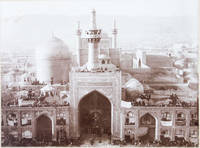
Best.-Nr. PF48Fourteen loose original albumen photographs ca. 171x123 cm 6 ¾ x 4 ¾ in mounted on ornamented cardboards. All photos with period Russian captions on the verso. Photos housed in a folder. Light soiling of the cardboards photos age-toned several photographs with small stains but overall a very good collection of strong interesting photos. Historically important collection of professional albumen photographs mostly documenting Mashhad Iran in the late 19th century and before the 1912 bombardment of the city. At the time Mashhad was a major political and commercial center under the Qajar dynasty. Owing to its proximity to Afghanistan and Russian Central Asia the city became a focal point of the Great Game between Britain and Russia. Following the establishment of the Russian consulate in Mashhad 1889 Russian consular guards Cossack escorts and military advisers appeared in the city to protect Russian subjects. In 1912 amid anti-Russian protests Russian Cossack forces heavily bombarded the city heavily damaging the Imam Reza Holy shrine complex and surrounding areas. As follows from the captions the photographer was of Russian origin and was likely on assignment related to the military interests of the empire in the region. The stiff ornamental mounts suggest that the photos were produced for official or presentation purposes possibly intended for consular archives a government report or as a gift to a high-ranking official. The collection contains 14 photographs of mostly Mashhad including four well-executed early views of the pre-bombarded Imam Reza Holy Shrine. The images show a general view of the crowded shrine the arch and courtyard with horses and an archway guarded by armed soldiers. Another important photo depicts the interior of the nearby Gawhar-Shad Mosque with three Russian soldiers posing on the pulpit. Especially interesting is an image of the British Consulate entrance established in the city in 1889 The consulate was closed in 1911 following the Anglo-Russian Convention of 1907 which divided Persia into spheres of influence. Despite thorough research no other photographs of the consulate have been found online. Other identified photographs from Mashhad include the Persian artillery barracks with cannons in the yard and the entrance to the governor’s palace showing a dozen militaries and civilians posing for the photo. The collection also includes at least two photographs from Afghanistan depicting the crowded “Tehran Gate” with locals in traditional attire passing through and the “New Afghan Gate” with armed soldiers facing the camera. Among four unidentified photographs are “Igda” possibly “Eedgah” Kandahar Aghanistan “Kochan” possibly Kashan Iran the “Ergov” gates and the “Bank Gates” with Kazak soldiers guarding the entrance. Overall historically important collection of professional albumen photographs mostly documenting Mashhad Iran in the late 19th century and before the 1912 bombardment of the city. hardcover
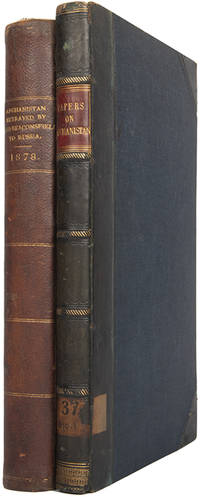
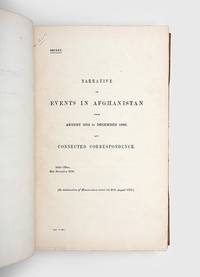
Best.-Nr. 107237London HMSO; Harrison and Sons 1878-1881. . First editions; two volumes containing fifteen works 4to 33 x 21.5 cm; bookplates to pastedowns a occasional small chips to upper margin otherwise internally fine; first volume in half red morocco cloth boards gilt lettering to flat spine minor wear to extremities but otherwise a very good copy; second volume in half blue calf cloth boards gilt spine with gilt morocco lettering piece all edges gilt slight wear a little chipping to head and foot of spine shelf mark to spine otherwise a very good copy; vi 266; ii 27; 17; 37; 6; 9; 87; 14; 8; 31; 4; 14; iv 107; 87; v 165pp. A collection of fifteen works of government correspondence and dispatches charting the British relationship with Afghanistan and by extension Russia from 1863 to 1881 culminating in the Second Anglo-Afghan War. The 'Central Asian Question' the Great Game saw its denouement play out in the Second Anglo-Afghan War and following boundary negotiations in the 1880s and 90s. The letters and despatches contained in these works contain an enormous amount of detail about the politics economics and diplomacy of Britain and Afghanistan in this period in particular the war years of 1879-1881. Important figures such as James Bruce Sir Henry Rawlinson John Lawrence Henry Marion Durand Lord Mayo Robert Napier Edward Bulwer-Lytton Granville Leveson-Gower and Spencer Cavendish all penned or put their name to the letters and despatches in these volumes and reveal the attitudes of the British government at the time. What perhaps stands out the most is the fragility of the British temperament in regards to either real or imagined Russian influence in Afghanistan and the constant shuffling of Amirs in a vain attempt to turn Afghanistan into a puppet state. Although the military actions of the Second Anglo-Afghan War were considered successful by the British Government deposing Yaqub Khan and his brother Ayub Khan from the throne it was also vastly expensive to the tune of nearly 20 million pounds and did not result in any territorial gains or subjugation of the region. The owner who bound the first volume titled the spine 'Afghanistan Betrayed by Lord Beaconsfield to Russia'. This is a strong statement considering Afghanistan preserved its independence and status as a buffer zone following the evacuation of Kandahar and Afghanistan by the British Army. It is an even stronger statement given that the trigger of the conflict Britain's retaliation to Afghanistan hospitality to Russian envoys is widely understood to have been the Viceroy of India Lord Lytton's doing and in direct opposition to orders from Disraeli himself. Perhaps the accusation speaks most to the accentuated fears around Russia and the decline of the influence of the British Empire. London, HMSO; Harrison and Sons, 1878-1881. hardcover
2013Best.-Nr. 5794lMinistry of Defence Singapore. Very Good. Hardcover. 2013. 163 pages. Includes inscription and small badge on front end paper - from the Chief of Army Singapore Armed Forces Major General Ravinder Singh to the Vice Chief of Defence Force - New Zealand Defence Force Major General Timothy James Keating. Includes inscription and small badge on front end paper - from the Chief of Army Singapore Armed Forces Major General Ravinder Singh to the Vice Chief of Defence Force - New Zealand Defence Force Major General Timothy James Keating . . Ministry of Defence (Singapore) hardcover
1878Best.-Nr. 166983London & Simla: 1878-82. Confidential India Office archive revealing British decision-making in the final phase of the Second Anglo-Afghan War An exceptional archive of confidential India Office and Government of India papers this collection offers an unusually detailed view of the diplomatic and bureaucratic manoeuvring that accompanied the final stages of the Second Anglo-Afghan War and the negotiation of Britain's withdrawal. Bringing together Foreign Department memoranda from Simla Cabinet papers printed at the Foreign Office and India Office material that seldom survives outside official files it reconstructs policy formation across two administrations and two continents. Running through the papers is the early career of Reginald Baliol Brett later 2nd Viscount Esher who became private secretary to Lord Hartington in 1878. As Hartington and the new Liberal government sought to reverse Lord Lytton's "forward" policy and disengage from Afghanistan the India Office and the Government of India frequently disagreed over strategy intelligence and the limits of influence. The archive captures these tensions vividly and shows Brett learning to operate as an assertive intermediary whose probing questionnaires marginalia and attempts to synthesize rival views already marked him out as a rising - and at times unsettling - force within the department. The documentary foundation of the dossier lies in A. W. Moore's two major surveys of Afghan affairs annotated by Brett and widely regarded as the most authoritative India Office narratives of the conflict. These are complemented by a sequence of extremely restricted Simla-printed papers and a run of Cabinet memoranda from Thomas Harrison's private press together charting the shift from aggressive frontier ambition to the more pragmatic Liberal policy of withdrawal and the recognition of Abdur Rahman as Amir. High-level submissions by Hartington Ripon and Evelyn Baring illuminate the arguments over the retention of Kandahar and Pishin while the "Aide-Mémoire" on negotiations with Abdur Rahman documents the decisive recalibration of British aims. Other materials probe the immediate crises of the war: memoranda assessing Yakub Khan's responsibility for the Kabul Residency attack; correspondence among Griffin Stewart and Lyall on the deteriorating northern situation; and the substantial "Very Confidential" dossier of Russian correspondence between General von Kaufmann and Shere Ali which exposes the diplomatic pressures of the "Great Game". Operational detail appears in the viceroy's secret telegrams of early 1880 field reports from Kandahar and Kabul Wilson's military sketch of the campaign and manuscript troop returns. Among the most revealing personal items is General Charles Gordon's autograph draft of a letter to The Times opposing the retention of Kandahar heavily revised and ultimately suppressed by Brett who feared it would damage Gordon's standing. His decision and later grief at Gordon's death lend an unexpected human dimension to a collection otherwise dominated by official policy and statecraft. Only a handful of the documents can be traced in institutional collections and few survive in private hands. Gathered here in a coherent sequence with close associations they provide a rare high-resolution record of how British officials interpreted the war navigated clashing doctrines and personalities and ultimately engineered their exit from Afghanistan. A full list of the contents is available on request. Folio 339 x 215 mm comprising 37 printed and manuscript items: full listing with titles paginations and outline content given in the note. Contemporary light olive brown diagonal zigzag-grain cloth boards rebacked and cornered in brownish orange morocco in the mid-20th century red morocco label original moderate bluish green endpapers retained matching linen hinges. Esher armorial bookplate. Cloth starting to lift a little from the edges of spine; contents variably browned margins a little fragile in places with a few consequent chips and splits one title page torn across and neatly repaired with archival tape: overall very good. James Lees-Milne The Enigmatic Edwardian: The Life of Reginald 2nd Viscount Esher 1986. hardcover
Best.-Nr. DADAX389500328XNew unknown
Best.-Nr. DADAX3639478304New unknown
Best.-Nr. DADAX0415621992Routledge 2013-04-23. 1. hardcover. New. 6.50x0.75x9.25. Buy with confidence. Excellent Customer Service & Return policy. Routledge hardcover
Best.-Nr. DADAX0367888866New unknown
Best.-Nr. DADAX1978805993New unknown
Best.-Nr. DADAX1409429644Routledge 2014-01-06. 1. hardcover. New. 6.14x0.56x9.21. Buy with confidence. Excellent Customer Service & Return policy. Routledge hardcover
Best.-Nr. DADAX1760111147New unknown
Best.-Nr. DADAX1783200308New unknown
Best.-Nr. DADAX1138249793New unknown
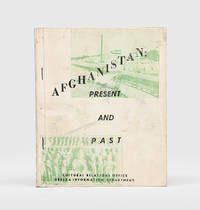
1958Best.-Nr. 180912Kabul: Bureau of Afghan Publicity Cultural Relations Office Department of Press and Information 1958. First edition of this guide to Mohammad Zahir Shah's modernizing state with chapters on politics and diplomacy industry mineral deposits and many other topics. In the year of publication Prime Minister Daoud Khan became the first Afghan to address to the US Congress and President Eisenhower made a formal visit in 1959. Octavo. With 24 photographic halftone plates. Original illustrated card wrappers wire-stitched as issued front cover lettered in black and with green halftone illustrations. Occasional contemporary green ink marks in margin. Covers marked contents evenly toned: very good. unknown
Best.-Nr. DADAX1444787586New unknown
Best.-Nr. SONG177112234XUsed: Good unknown
Best.-Nr. DADAX0897335430New unknown
Best.-Nr. SONG1789140102Used: Good unknown
Best.-Nr. SONG1947279483Used: Good unknown
Best.-Nr. DADAX1409448460New unknown
Best.-Nr. DADAX1138234648New unknown
Best.-Nr. DADAX1472474090New unknown
Best.-Nr. DADAX0367300885New unknown
Best.-Nr. DADAX0415855454New unknown