TAVERNIER (Jean-Baptiste).Livre Rare Book

2 865 résultats
1680réf. 82460Londres Printed by A. Godbid and J. Playford, for Moses Pitt at the Angel in S. Paul's Churchyard 1680 1 vol. relié in-4, demi-veau jaspé à coins, dos à nerfs encadrés de filets dorés, pièce de titre maroquin rouge, plats de papier peigné, non rogné, 1 f. + titre + 10 ff. (avertissement, dédicace, préface, table)+14-[4]-15-46-[4]-47-87+66 pp. Édition originale anglaise (l'originale française parut chez Clouzier l'année précédente) qui contient une description du Tonkin, dérivée des observations du frère de l'auteur, une description du Japon, recueillie auprès de négociants, et une violente attaque contre les agents de la Compagnie néerlandaise des Indes orientales. La première partie, consacrée au royaume du Tunquin (Tonkin), est illustrée de 8 planches gravées dépliantes oblongues. Mais il manque la planche réunissant les cartes du Japon et du Tonkin. Initiales gravées sur bois et ornements en tête de chapitres. Notes manuscrites sur la première page muette (deux citations poétiques en anglais dont une d'Alexander Pope : "If to her share some female errors fall, Look on her face and you'll forget them all") et ex-libris manuscrit au bas de la page d'avertissement "Franceis Stephens book 1721". Cet ouvrage très rare est conservé dans une bonne reliure du début du XXe siècle, mais présente deux restaurations grossières (au premier feuillet de la préface et à la dernière gravure collée qui ne se déplie plus), quelques déchirures sans manque (notamment sur trois des gravures), quelques rousseurs et tâches.
1680réf. 82460Londres Printed by A. Godbid and J. Playford, for Moses Pitt at the Angel in S. Paul's Churchyard 1680 1 vol. relié in-4, demi-veau jaspé à coins, dos à nerfs encadrés de filets dorés, pièce de titre maroquin rouge, plats de papier peigné, non rogné, 1 f. + titre + 10 ff. (avertissement, dédicace, préface, table)+14-[4]-15-46-[4]-47-87+66 pp. Édition originale anglaise (l'originale française parut chez Clouzier l'année précédente) qui contient une description du Tonkin, dérivée des observations du frère de l'auteur, une description du Japon, recueillie auprès de négociants, et une violente attaque contre les agents de la Compagnie néerlandaise des Indes orientales. La première partie, consacrée au royaume du Tunquin (Tonkin), est illustrée de 8 planches gravées dépliantes oblongues. Mais il manque la planche réunissant les cartes du Japon et du Tonkin. Initiales gravées sur bois et ornements en tête de chapitres. Notes manuscrites sur la première page muette (deux citations poétiques en anglais dont une d'Alexander Pope : "If to her share some female errors fall, Look on her face and you'll forget them all") et ex-libris manuscrit au bas de la page d'avertissement "Franceis Stephens book 1721". Cet ouvrage très rare est conservé dans une bonne reliure du début du XXe siècle, mais présente deux restaurations grossières (au premier feuillet de la préface et à la dernière gravure collée qui ne se déplie plus), quelques déchirures sans manque (notamment sur trois des gravures), quelques rousseurs et tâches.
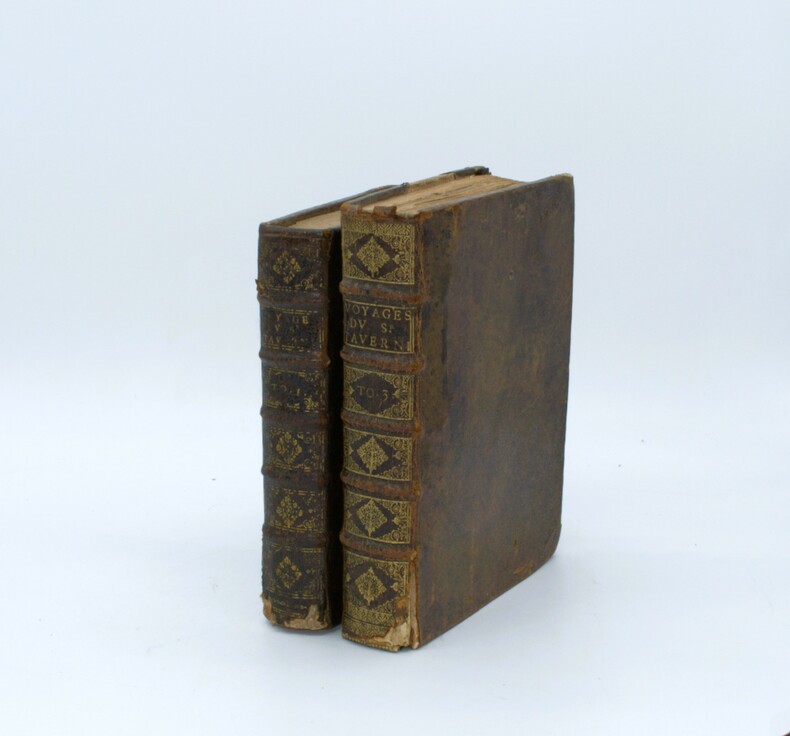
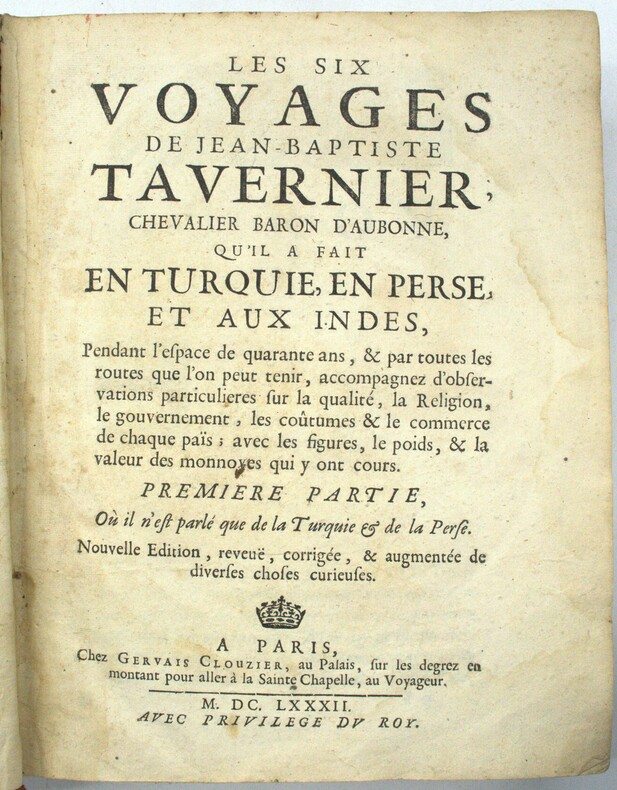
1676réf. PHO-1352A Paris, Chez Gervais Clouzier, 1676-79, 2 volume in-4 (sur 3),30pp.- 698pp.-8pp.-2ff.,8 ff., 72 pp., 1 f., 156 pp.,2 ff., 96 pp. , 1 f., 178 pp., tome 1 ,illustré de 6 planches (7) et tome 3 ; 12 cartes et planches (complet), relié plein veau époque , dos à nerfs ornés avec titre et tomaison , tranches mouchetées , coins , coiffes et coupes usés , début de fente, manque de matière , tome 1 plus petit avec quelques rousseurs , plan d’Erevan coupé court , déchirures aux plis ,réparation carte du Tunquin , manque le tome 2.
1680réf. PHO-1964Paris, chez Gervais Clouzier, 1682-1680, 3 volumes in-4 (246x195mm), 14ff.-636pp., 4ff.-481pp., 8ff.-72pp.-1f.-156pp.-1f.-96pp.-4ff.-1f.-178pp., Illustration : Tome 1 ; 7 planches (6 dépliantes) sur 8, Tome 2 ; 26 planches dont 15 de monnaies, 5 de pierres et 4 gravures dans le texte, Tome 3 ; 2 grandes cartes (Japon, 79x56cm et Tunquin, 56x41cm) et 8 planches dépliantes. Basane époque, dos à nerfs avec titre et tomaison, frottements, griffures et épidermures, Tome 1 ; accroc au plat, coiffe sup. absente, 2 coins usés, rousseurs, mouillure en coin puis en marge, planches avec déchirures sans manque, page 431 déchirée avec manque. Tome 2 ; fente au dos et charnière, coins usés, rousseurs et brunissures, 1 planche déchirée sans manque. Tome 3 ; coins usés, coiffes arasées, carte du Japon volante, déchirure carte du Tunquin, carte du Japon légèrement oxydée, petites rousseurs.
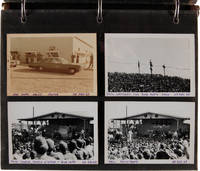
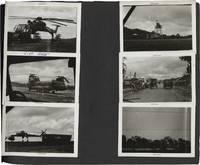
1969réf. 55101Biên Hòa Nha Trang Long Binh and other locations in Vietnam plus Luzon Philippines and Osan South Korea. October 1969 to August 1970. A Soldier's Life in the Vietnam War An exceptional vernacular photograph album by a talented but unknown amateur photographer recording a wide variety of experiences on American Air Force bases in South Vietnam and Asia during peak years of the Vietnam War. The photographer was likely a member of the motor pool or a mechanic as the shots seem to center around truck airplane and helicopter maintenance. Most of the photographs capture scenes on or around the various bases with shots both inside and outside of barracks airplanes including several shots of a U2 spy plane bombed-out equipment and numerous photos of the people and structures in the "Vietnamese Area." A few images capture distant shots of the aftermath of a "rocket attack" on December 12 1969; shortly thereafter the photographer and his friends celebrate Christmas. Some of the more interesting photographs during the photographer's time in Vietnam include "VC Prisoners" "Group of Zips" "Papa-San Working His Rice Paddie" "Vietnamese Guard Tower" "Church on the West Side of Biên Hòa" "Refueling at Phan Rang Run" "Bring the Wounded Out" and several pictures labeled "Buddha Hill" likely the Long Son Pagoda in Nha Trang. Notably and for no obvious reason in two separate images the photographer snaps a picture in a magazine of the famous photograph of Thích Quang Duc the monk who burned himself alive at a busy intersection in Saigon in 1963. Several times the photographer takes a picture of another picture an interesting practice in the context of so many original photographs. A handful of images of the photographer himself can be seen in the album. In a couple of shots he is posed with his pet lizard. Later he and his fellow soldiers adopt a pet monkey who features in several photographs. There are also a healthy amount of aerial images featuring the South Vietnamese landscape notably rice fields villages rivers "bomb craters" and cities among other locations. Also the photographer identifies dozens of fellow soldiers by name throughout the album in both single portraits and in group photos. The album contains numerous shots both black-and-white and in color taken from the crowd and later on the runway during a December 28 1969 U.S.O. show at Long Binh with several images each of Bob Hope Neil Armstrong Connie Stevens Suzanne Charny Teresa Graves Les Brown the Golddiggers and others. One photograph of Neil Armstrong is captioned "Biggest Hit of the Show." This is understandable given the fact that Armstrong landed on the moon just five months before this U.S.O. show. There is also an 8 x 10 photograph of Connie Stevens inscribed to "Ron" either the photographer's first name or an autographed picture he received from a friend. After the U.S.O. show the photographer snaps several closer shots of Bob Hope Connie Stevens and others climbing into cars to leave. In April or May 1970 the photographer was shipped out to Osan Air Base in South Korea. Along the way he spends a couple of days at Clark Air Base in Luzon in the Philippines where he snaps a few shots of the base. By early May he has arrived at the Osan Air Base near Songtan Station in the city of Pyeongtaek South Korea just south of Seoul. He seems to be happy with his appointment at Osan; he captions one photograph "Home Sweet Home" and a few shots of the countryside as "Paradise." Here he also photographs Korean farmers their families villages a marketplace a church a school and other landmarks. The final two images dated in August 1970 show the photographer on an airboat on an unidentified Korean river. Personal photographic records by soldiers in Vietnam are growing ever more scarce in the market. This collection is one of the best we've encountered and most certainly informs the overall record of the war during perhaps its lowest point of public support. 469 black-and-white or color photographs 3½ x 3½ inches to 8 x 10 inches either mounted or laid-in to acetate sleeves almost all annotated in ink on the bottom margin or on the verso. Contemporary three-ring thick quarto-size binder black cloth over boards. Joints partially split some abrading and dust-soiling to covers. Slight fading to some of the color photos. Overall very good. hardcover
Ensemble de 100 volumes broch?s ou cartonn?s.
1827réf. 127501Milan, Imprimerie de l'éditeur 1827 In-folio 35,5 x 25 cm. Brochés, couvertures d’attente, [51-67-36-54] pp., 9-4-5-6 planches sous serpentes. Exemplaires d’une très grande fraîcheur.
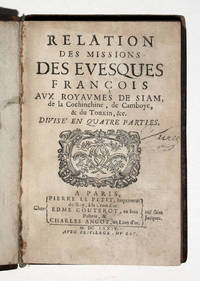
1674réf. 2448 ff. 367 1 pp. Bound in contemporary calf gilt heraldic stamp on covers gilt spine with raised bands worn with joints cracked but sound head foot and corners bumped. Lacking endleaves; illegible ownership inscription on lightly soiled title; very good overall. Rare first edition of this account of the state of Christianity in Thailand Cambodia Vietnam by rivals of the Jesuits. The Société des Missions Etrangères a new apostolic missionary group established in Paris in 1660 was as a society of secular priests who devoted their lives to foreign missions but refrained from taking vows. Under the aegis of the Propaganda Fide the Société des Missions soon became embroiled in conflicts over territory with the Jesuits. As a result of the patriotism of its priests the organization's impact extended beyond evangelicalism into the political realm: in addition to facilitating a series of embassies and treaties it also successfully established a more active trade between Indo-China the Indies and France. This Relation brought fresh information about the condition of the mission in different parts of southeastern Asia between 1666 and 1671. It consists of four parts the first dealing with the mission in Siam and containing descriptions of amongst others Bourbon Island Madagascar and Mozambique the second treating the situation in Cochin-China the third the mission in Cambodia and the fourth being devoted to Tonkin including an account of the work of bishop Lambert de la Motte. Lambert was a member of the Society's first expedition to the Far East which had left Europe in 1660. Fermanel de Favery c. 1632-88 superior and director of the "S'naire pour les Missions Etrangères" signs the dedicatory epistle to Cardinal de Bo' and consequently Streit Lach and Van der Kley ascribe authorship to him. The work was reprinted in 1680 and 1684 and an Italian translation Relatione delle missioni de vescovi vicarii apostolici' alli regni di Siam Cocincina Camboia e Tunkino was published in Rome in 1677 and 1697. Cordier I.826 s.v. Evêques Français; Chadenat 1706 1684 ed.; Satow 46; Streit V.1797; Lach III.i.222ff. Pierre Le Petit, Edme Couterot & Charles Angot hardcover
1933réf. 134089Sn. 1933 In-4 oblong 27 x 41,5, demi-basane verte à coins, 206 tirages argentiques de formats 23 x 17 cm 14 ; 16 x 11,5 cm 104 ; 11 x 7,5 cm 44 ; 8 x 6.5 cm 2. Superbe album réalisé par les services de communication du Gouvernement de l'Indochine et l'Aéronautique militaire d'Indochine à l'attention d'un haut-fonctionnaire. Les 104 pages grises intérieures sont toutes légendées à la gouache blanche par un calligraphe vietnamien. Majoritairement des vues d’Hanoï : les monuments, l’habitat, les rues, des portraits types et des scènes de la vie quotidienne, petits métiers, paysannerie... Une dizaine de vue aériennes 24 x 17 cm réalisées par des photographes embarqués à bord des biplans Potez de l'aéronautique militaire d'Indochine. Elles sont assez exceptionnelles par leur qualité. Vues d’Haïphong, de Moncay, Chapa, Vientiane, Hué, Dakto, Louang Praband, la baie d'Along, les femmes moïs, etc. Deux vues de têtes de pirates décapités.
1954réf. 135183Sn 1954 Deux albums in-folio oblong, 411 & 607 photographies contrecollées en 40 & 50 planches, format divers : ca 6 x 6 à 17 x 24 cm., majorirtairement 8,5 x 11 cm., tirages argentique et mat, près d’une trentaine de retirages. Nombreuses légendes, en pastilles ou en marge de la photographie. Témoignage photographique d’un officier du 1er escadron du 8ème GSAP 8ème RSA en janvier 1953 au long de deux séjours 4 années et des multiples engagements de cette unité d’intervention : opérations Bissextile, Sablé, Porto, Lorraine, Artois-Bretagne, Corse, Mouette, etc. Le “récit” débute à Alger en 1942 sur quelques photographies familiales puis Saumur en 1949, les étapes du voyage : près de 145 vues prédédent son arrivée. Quelques portaits et scènes de groupe, prises d’arme, etc. précèdent le coeur du reportage : les engagements de son peloton sur half-tracks à l’appui de nombreuses vues de combat, ce qui est rare. Des coupures de presses enrichissent le récit, avec quelques correctifs manuscrits. En point d’orgue : l’opération Mouette. Le second album est agrémenté de près de 300 photographies de correspondants de guerre Camus, Corcuff, Ferrai, Varoqui, etc. de format divers et de très belle facture, débordant le cadre du 8ème spahis : opérations du 3ème BPVN, du 8ème BPC opérations Bambou et Hirondlelle, vue célèbre du 2ème classe Lardillier, le 2ème BEP au Laos, etc. Un document emblématique au coeur du conflit, de toute rareté.
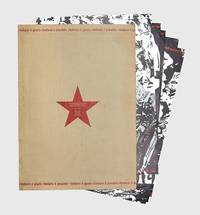
1969réf. 148329Milan: c. 1969. Striking pop art-influenced suite of anti-imperialist propaganda posters published in Milan by the Comitato Vietnam - self-described in their literature as the "sezione italiana del tribunale Russell". The work of a collective comprised of six prominent Italian artists the images carry the theme 'Rebellion is right rebellion is possible' into various theatres of anti-imperialist struggle. Baratella b. 1935 Mariani b. 1936 and Spadari 1938-97 were long-term collaborators and members of the Nuova Figurazione art movement. Amadori 1945- 2015 won the Joan Miró prize in 1972. Spadari's contribution draws on the "solarised" image of Castro in the Cuban Revolution from his work "26 de julio" while in an anti-Vietnam War themed poster similarly treated repeated images of a Vietnamese women are overlain by a Lichtensteinian US fighter jet wheeling away from an explosion from which emerges a Coca-Cola bottle cap with the slogan 'Nixon boia' - Nixon executioner also the title of a song by popular singer-story teller Franco Trincale - and the partially obscured text 'Coca-Cola merda'. Nixon also features on a poster featuring his cartoonish portrait wearing a star-spangled neck-tie while being choked out by several nooses above him a ferociously snarling Black Panther head; while "Africa Rossa/Africa Nera" centres on a photographic image of the clenched first Black Power salute. Baratella based his poster around his painting "Benito Mussolini Storia del fascismo" where "Il Duce's" face morphs into a skull here with the lower part is superimposed with six small portraits of current political leaders including de Gaulle Pompidou Khrushchev and LBJ. The last in the group dramatises the Arab-Israeli conflict with a repeated image of a woman PFLP fighter - Leila Khaled - in keffiyeh and camo fatigues carrying a AK-47 above her a map of Jerusalem. No other set of these traced a couple of examples of individual posters noted institutionally; an excellent evocation of the artistic-political synergies of the period. Six large black and white photomontage posters 700 x 500 mm printed on coated paper each with the repeated slogan 'ribellarsi è giusto ribellarsi è possibile' in red; in the original tan slub-weave linen textured light card portfolio printed in red title to the front panel superimposed on a red five-pointed star. The portfolio a little rubbed and soiled pale damp spots at the spine-fold where there are a few short splits posters show light handling but overall very good. unknown
réf. 162967N.p.: N.p. 1971. Archive of 236 vernacular photographs documenting an African-American serviceman's deployment as a cavalryman with the 228th Aviation Battalion likely at An Khe Vietnam as well as his life back home in the US circa 1969-1971. Includes 180 black-and-white and 56 color photographs housed in two photograph albums. The serviceman in question appears to be Isaac Johnson whose name is written in a caption on one photograph and whose image appears throughout both photograph albums reconfirmed by a page near the end of the first album with the endearing heading "Some of the Woman sic in Johnson's Life . Before Me." The first album contains 153 photographs showing Vietnam and 83 photographs showing friends and family back home in the US most with captions in manuscript ink on the margins. The album's first half documents friends family and events back home including the serviceman's wedding. The second half beginning on the ninth leaf captures what appears to be the soldier's initial deployment in Vietnam showing images of Chinook and Sikorsky helicopters various military vehicles village and base scenes Vietnamese locals and fellow soldiers. Following the Vietnam photographs are two pages containing Johnson's military insignias Vietnamese currency and military payment certificates. The following leaf presents photographs-one of a stereo and two of a young boy likely the soldier's son-alongside two ticket stubs dated August 28 1970 from Baltimore Baseball Club captioned "Darryl's first Baseball Game." The tickets on that date were apparently for the Baltimore Orioles versus the Milwaukee Brewers at Memorial Stadium in Baltimore. The final leaf contains a computer printout of an "A Co 228th ASH Wildcats" insignia and two maps of Vietnam both with An Khe circled. The second photograph album containing the majority of photographs taken in Vietnam presents 128 photographs largely black-and-white images of fellow soldiers at work and leisure as well as barracks structures and equipment Vietnamese locals and girlfriends Chinook helicopters and the Vietnamese countryside. The final two leaves of the album contain 16 photographs of family friends children and a pet cat all in the US. Photographs: 2.5 x 3.5 inches to 5 x 3.5 inches. Very Good plus to Near Fine overall with a few photographs starting to detach from leaves. Green album: 14 x 11 inches. Very Good plus with some light edgewear and rubbing to the corners. Black album: 13.25 x 9.75 inches. Very Good plus with some chipping near the hinge on the front board. N.p. unknown
1631réf. 5335Rome: Francesco Corbelletti 1631. FIRST EDITION. Hardcover. Fine. Bound in early 20th c. stiff parchment ruled in red with elegant pen-work in red and black on the spine. A nice copy perhaps lightly washed. With woodcut arms of the dedicatee Pope Urban VIII with the Barberini arms on p. 3. FIRST EDITION of this important account of Vietnam the first report on Vietnam written by a European. Written from the author's own experiences during his residence in the Nguyễn domains in what is now central and southern Vietnam between 1618 and 1621 the work presents the author's direct observations of the land's geography climate and natural resources; its political administration commerce and social customs including descriptions of indigenous religions; as well as a narrative of the progress of the nascent Jesuit mission. The Italian Jesuit scientist a heliocentrist and supporter of Galileo arrived in Cochinchina in late 1617 or early 1618 when the missionary presence was still in its infancy and marked by uncertainty. Expecting hostility or even martyrdom Borri instead found a courteous reception and went on to spend four productive years in the country. During that time he strengthened the mission established lasting relations with local communities and conducted scientific research. In Chapter 5 he records his predictions and observations of two lunar eclipses and the solar eclipse of 22 May 1621. Although Borri's Relatione contains no sustained Vietnamese text it is among the earliest European works to record Vietnamese Cochinchinese words phonetically in the Latin alphabet-chiefly titles such as Onsaij ông sãi "monk" Omgne ông nghè "court official" and place names like Faifò Hội An and Turon Äà Nẵng. These spellings document early European attempts to capture Vietnamese sounds before the creation of the systematic Romanized script quốc ngữ by later Jesuits such as Alexandre de Rhodes. The book is structured in two parts the first dealing with the geography and culture of Vietnam. BOOK I - The Temporal State of Cochinchina Borri introduces Cocincina Cochinchina the area corresponding roughly to central and southern Vietnam ruled by the Nguyễn lords. He explains the etymology of the name from "Coci" a Japanese term for Annam and "China" and locates the country between Tunchim Tonkin northern Vietnam and Chiampà Champa south-central Vietnam. He praises its fertility mild climate and dense population portraying it as a prosperous and well-governed realm suited for missionary enterprise. He describes a region of temperate weather divided between rainy and dry seasons. The atmosphere he notes is wholesome and pure free from epidemic disease. He admires the regularity of the monsoon winds which bring both agricultural abundance and maritime prosperity. In Chapter 3 Borri offers a lush catalogue of agricultural wealth-rice sugar fruits and aromatic woods like aloes and calambac. Borri likens the fertility of Cocincina to that of Italy itself and emphasizes divine providence in the country's abundance. He observes that the people are skilled in irrigation and land management. In Chapter 4 "Of Elephants and the Abadas" Rhinoceroses Borri turns to fauna describing elephants used in labor and war and the abada rhinoceros found in the forests. He recounts local stories and adds European natural-philosophical reflections presenting the animals as symbols of strength and divine order. An ethnographic portrait follows; Borri comments on the politeness and intelligence of the Cocincinesi Vietnamese their industry and sense of honor. He also notes "superstitious" elements in religion and medicine describing their use of herbal cures and astrological diagnosis. The men wear loose garments; women are modest and industrious. The society he writes prizes civility and filial duty. Chapter 6 - Of the Political and Civil Government The government is structured hierarchically: the Nguyễn lord rules from Sinvuà Huế through governors of provinces such as Quamguya Quảng Ngãi Cacciam Qui Nhơn and Pulucambì Phú Yên. Laws are administered with Confucian-like decorum; justice is swift and often exemplary. The administration balances severity and generosity maintaining peace and prosperity. Chapter 7 describes the Nguyễn ruler's military might and his conflicts with Tunchim Tonkin. The king commands numerous elephants and disciplined troops and Borri marvels at the discipline and courage of the soldiers. He describes the long rivalry between the Nguyễn and Trịnh dynasties as both political and moral warfare. Borri ends Book I with a vivid description of Faifò Hội An and Turon Äà Nẵng flourishing harbors open to Japanese Portuguese and Chinese traders. The openness of the ports makes Cocincina a meeting point of East and West its commercial wealth feeding the royal treasury and preparing the ground for Christian missions. Book II is Borri's account of the Jesuit Mission and the progress -and setbacks- of bringing Christianity to Vietnam. Borri recounts the first entrance of Jesuit missionaries into Turon Äà Nẵng and Cacciam Qui Nhơn. Welcomed by local officials they erect two churches and begin preaching through interpreters. The early success marked by curiosity and goodwill from the people seems to promise a great harvest of conversions. Soon misfortune strikes. Drought and famine are blamed on the Jesuits and persecution erupts. Borri himself is sent from Macao Macau to aid the mission traveling in disguise. Miraculously torrential rains begin at his arrival which locals interpret as proof of divine favor and hostility ceases. The Governor of Pulucambì Phú Yên or Quy Nhơn befriends the missionaries grants them land and builds a church and residence. His protection allows the Fathers to preach publicly and win respect at court. The chapter emphasizes how local authority could shelter fragile missions. Tragedy follows. The Governor dies suddenly of fever while hunting before baptism. Borri mourns him as a noble pagan whose sympathy for Christianity nearly transformed the province. With his death the missionaries lose all support and return to poverty and danger. After three years of hardship in Pulucambì divine providence renews the mission. The wife of an ambassador from Nuoecman Nước Mặn moved by Borri's preaching requests baptism followed by twenty-five of her ladies. She receives the Christian name Orsola Ursula. Later her husband the Ambasciadore Ignatio Ignatius and many courtiers convert marking the first flowering of Christianity among the elite. Borri narrates conversions among scholars and astrologers. One notable case involves a royal astrologer who mispredicted an eclipse that Borri accurately forecast using European astronomy. The accuracy of Jesuit science impresses the court leading several literati to study Christian doctrine and some to convert. There are descriptions of priests and Onsaij Buddhist Clergy being converted to Christianity. A Buddhist monk named Onsaij Ly for instance becomes an exemplary Christian living a pious life preaching publicly and converting others-including learned monks and nobles. Borri interprets this as proof that divine grace can penetrate the highest orders of gentile religion. Borri next surveys native religious systems tracing them to Xaca ÅšÄkyamuni Buddha and noting similarities with pagan errors known to Europe. He divides the sects into philosophers idolaters and astrologers arguing that their doctrines contain echoes of the Gospel distorted by ignorance. Borri describes healings answered prayers and deliverance from storms as proofs of divine favor confirming the truth of the new faith among simple folk. By the time Borri writes Faifò Hội An Turon Äà Nẵng and Cacciam Qui Nhơn all possess flourishing Christian congregations with churches catechists and sacraments. The Jesuits administer baptisms and establish schools creating a stable Christian presence in the kingdom. Chapter 11 - On the Kingdom of Tonkin Borri turns north to Tunchim Tonkin ruled by the Trịnh lords. He sketches its wealth learning and openness to European contact predicting that Tonkin too will embrace Christianity complementing the progress in Cochinchina. In his final chapter Borri concludes with an exalted description of Cochinchina-its beauty healthful climate wealth in gold silk and aromatic woods and the sweetness and liberality of its people. He insists that the land lacks only 'many of God's angels' meaning apostolic missionaries to become a piece of heaven on earth. He contrasts the openness of Cochinchina where foreigners may live freely with the restrictions of China affirming that here the Gospel may flourish without disguise. Further reading: Olga Dror "Phantasmatic Conchinchina" in "Views of Seventeenth-century Vietnam" pp. 23-59. Francesco Corbelletti hardcover
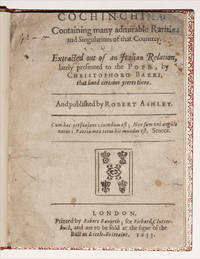
1633réf. 4531London: Robert Raworth for Richard Clutterbuck 1633. Hardcover. Very Good. 4to - over 9¾ - 12" tall. Tastefully bound in ruled red morocco interior gilt dentelles; title-page dusty and trimmed at upper & outer margins; repaired corner of prelims. Otherwise very good. Rare first edition of the first book on Vietnam in English an eyewitness account of the commerce government and cultural life of Cochin-China central Vietnam written by the Jesuit missionary Cristoforo Borri and first published in Italian in 1631.Borri begins by marking the kingdom's boundaries identifying it as a narrow strip of land between Laos and the South China Sea bordered to the north by Tongking and to the south by Champa. A discussion of the kingdom's fertile land and rich natural resources follows emphasizing the abundance of fruits nuts rice fish textiles domestic stock and "all other things requisite for the entertainement of a man's life." Silk is produced in such quantities that "the baser sort of people wear it dayly." Gold and silver mines abound and "the Wood and Timber of this countrey is the best of all the world." Having piqued his readers' curiosity the author goes on to describe Cochin-China's vibrant commercial climate declaring it free of the red tape and bureaucratic hostility that so often greeted European traders in East Asia.Borri's 1631 Relazione a Jesuit missions letter directed at his Catholic superiors and lay readers was already unusual among works in its genre for devoting a substantial part exclusively to non-religious content. Ashley the translator executed further changes of his own in order to render the present work more attractive to Protestant business interests-most notably by omitting the part where Borri testified to the struggle and success of his Jesuit missions particularly the conversion of Pulucambi province. The translation also cheerfully elides two disastrous episodes in recent European trade with Cochin-China: the 1601 massacre of 23 members of an envoy from the VOC and a similar massacre in 1613 of the crew of an English trading vessel. This attempt to coax England's notoriously skittish merchants into commerce with Cochin-China is also borne out by Ashley's choice of dedicatee: Maurice Abbot the newly-elected governor of the British East India Company. According to Pollard and Redgrave the work's last signature is in 3 rather than 4 because the unsigned title-page was printed as the 4th and final leaf.Cristoforo Borri 1583-1632 a Milanese astronomer lived in Cochin-China from 1617-1622 where he learned enough of the language to hear confession. By 1633 two years after its first appearance his Relatione had been translated into French German Dutch and English. This is the first copy to appear on the market since 1988 Christie's sale of John Fleming 11.08.88.STC 1504; Lach.III v. 3 p. 1250-1266; Dror & Taylor Views of 17th C Vietnam pp. 66. Not in Löwendahl who nonetheless records translations in French German and Dutch. Robert Raworth for Richard Clutterbuck hardcover books
1633réf. 4531London: Robert Raworth for Richard Clutterbuck 1633. Hardcover. Very Good. 4to - over 9¾ - 12" tall. Tastefully bound in ruled red morocco interior gilt dentelles; title-page dusty and trimmed at upper & outer margins; repaired corner of prelims. Otherwise very good. Rare first edition of the first book on Vietnam in English an eyewitness account of the commerce government and cultural life of Cochin-China central Vietnam written by the Jesuit missionary Cristoforo Borri and first published in Italian in 1631.Borri begins by marking the kingdom's boundaries identifying it as a narrow strip of land between Laos and the South China Sea bordered to the north by Tongking and to the south by Champa. A discussion of the kingdom's fertile land and rich natural resources follows emphasizing the abundance of fruits nuts rice fish textiles domestic stock and "all other things requisite for the entertainement of a man's life." Silk is produced in such quantities that "the baser sort of people wear it dayly." Gold and silver mines abound and "the Wood and Timber of this countrey is the best of all the world." Having piqued his readers' curiosity the author goes on to describe Cochin-China's vibrant commercial climate declaring it free of the red tape and bureaucratic hostility that so often greeted European traders in East Asia.Borri's 1631 Relazione a Jesuit missions letter directed at his Catholic superiors and lay readers was already unusual among works in its genre for devoting a substantial part exclusively to non-religious content. Ashley the translator executed further changes of his own in order to render the present work more attractive to Protestant business interests-most notably by omitting the part where Borri testified to the struggle and success of his Jesuit missions particularly the conversion of Pulucambi province. The translation also cheerfully elides two disastrous episodes in recent European trade with Cochin-China: the 1601 massacre of 23 members of an envoy from the VOC and a similar massacre in 1613 of the crew of an English trading vessel. This attempt to coax England's notoriously skittish merchants into commerce with Cochin-China is also borne out by Ashley's choice of dedicatee: Maurice Abbot the newly-elected governor of the British East India Company. According to Pollard and Redgrave the work's last signature is in 3 rather than 4 because the unsigned title-page was printed as the 4th and final leaf.Cristoforo Borri 1583-1632 a Milanese astronomer lived in Cochin-China from 1617-1622 where he learned enough of the language to hear confession. By 1633 two years after its first appearance his Relatione had been translated into French German Dutch and English. This is the first copy to appear on the market since 1988 Christie's sale of John Fleming 11.08.88.STC 1504; Lach.III v. 3 p. 1250-1266; Dror & Taylor Views of 17th C Vietnam pp. 66. Not in Löwendahl who nonetheless records translations in French German and Dutch. Robert Raworth for Richard Clutterbuck hardcover