1.482 Ergebnisse
1926Pages 170-252, plus 20 pages of wonderful vintage ads. Many black and white photos and illustrations. Contents include: The Warden of the Marches; Seeds of Fortune; An Elephant-Poacher's Odyssey; Through the Inner Deserts of Arabia - part 2; "Denied Admittance" - an Ellis Island Story; The Shrine or Ordam Padshah; The Two Portraits; A "New Chum" in New Zealand - part 2; The Isles of the Arafura; Cave-Hunting in New Mexico; A Rolling Stone. Bits of clear tape at each end of spine. Unmarked with average wear. Binding intact. A sound copy of this vintage issue. Magazine
193395 pages. Black and white photographic plates. Features: The Oxford University Expedition to Sarawak, 1932; The Japanese South Polar Expedition of 1911-1912; The Administration of the Mandated Territory of New Guinea; A Roman Bridge in the Fens; Geodesy and Geophysics at Lisbon; The Empty Quarter of Arabia; Air Survey by Multiple Lens Cameras. University library bar code upon first page of advertisements, otherwise unmarked with average wear. One-inch chip hanging from backstrip. Binding intact. A sound copy. Book
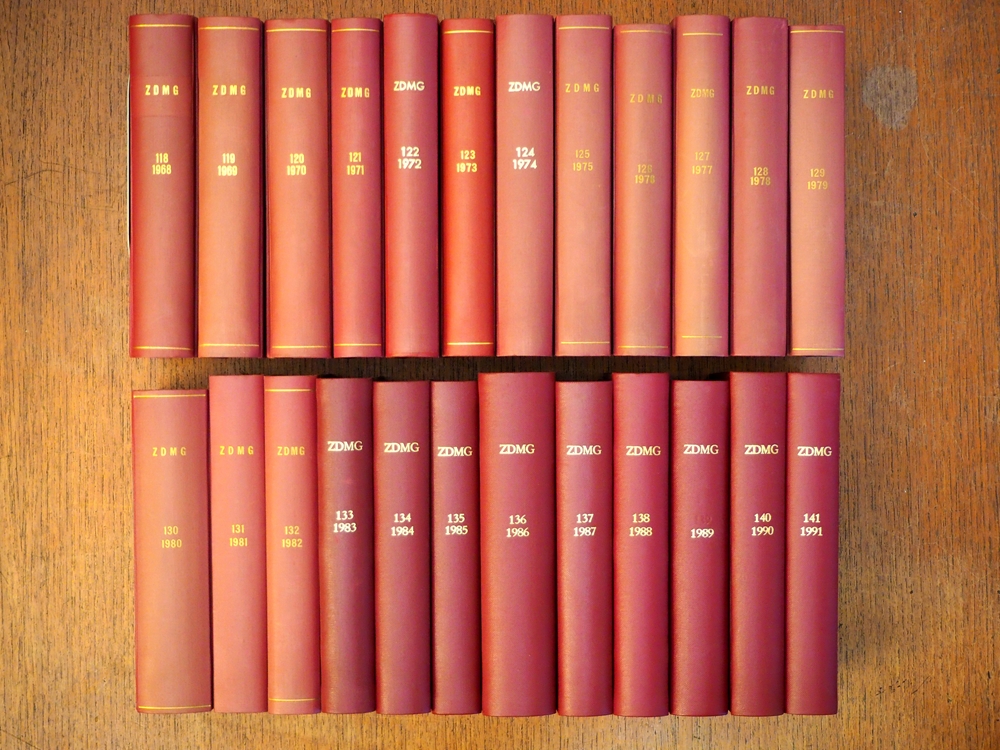
1991Best.-Nr. 43870Wiesbaden, Franz Steiner, 1968-1991. HLn.
1882Best.-Nr. WOC-81Pelerinage au Nedjed, Berceau de la Race Arabe.Ouvrage traduit de l'anglais avec l'autorisation de l'auteur par L. Derome. Contenant 1 carte et 60 gravures sur bois, dessinées par G. Vuillier d'après les aquarelles de Lady Anne Blunt, de 2 tableaux généalogiques.1:Généalogie des IBN Saoud- Émirs du Nedjed.2:Généalogie des IBN Rashid-Émirs du Djebel, Shammar.Paris, Librairie Hachette et Cie,1882. In-8-16x24cm,relié demi chagrin vert,dos à faux-nerfs et orné de caissons dorés, tranches dorées, plat vert avec mention:Prix du 14 juillet 1883,offert par la Ville de Saint Claude.LXVIII,447pp.
1882In-8 p. (mm. 235x142), mz. pelle coeva, dorso a cordoni con fregi e tit. oro, pp. (2),LXVIII,447, con 54 incisioni su legno nel testo, di cui molte a piena pagina, e 1 cartina geografica ripiegata f.t. (completo come da indice). "Edizione originale". Qualche lieve fioritura, altrimenti ben conservato.
1792Best.-Nr. GF319831792 Paris, Briand, 1792. Complet en deux volumes in-8 de 1ff blanc - une page de faux-titre (avec catalogue du libraire au revers de la page de faux-titre du tome 2) +440 et 483 pp pour chacun des volumes + deux cartes dépliantes (un dans chaque volume) - Reliures de l'époque, demi-percaline rouge brique, dos lisses ornés à l'or de faux-nerfs, titre et tomaison. Plats recouverts de papier à la cuve.
18203 volumi, cm. 18, brossura editoriale, pag. XII, 292 (2) più 3 tavole a colori f.t.; 317 più 3 tavole ed 1 carta geografica ripiegata f.t.. Da pag. 109 inizia l'opera "Viaggio al Lago Manasarovar situato nell'Undes provincia del Piccolo Tibet fatto nel 1812 dai Signori Moorcroft e Hearsay dal tomo XII delle Asiatic Researches". Interessante descrizione del viaggio iniziato in India e ricordato per la descrizione del assaggio attraverso le montagne del Kurdistan. Molto interessante anche la relazione del viaggio al lago Manasarovar in Tibet. Manca metà dell'ultima carta con elenco delle tavole al primo volume. Collana "Raccolta de' viaggi più interessanti eseguiti nelle varie parti del mondo, tanto per terra quanto per mare, dopo quelli del celebre Cook...".
Best.-Nr. 13978286Paris: Librairie de Mme Vve Bouchard-Huzard, 1846 in-8, [4]-iv-458 pages. Broché, couverture défraîchie, manques au dos, mouillure dans le coin gauche supérieur du premier plat et des premiers ff ainsi que dans le coin gauche inférieur des derniers ff., qq. rousseurs, non coupé. Ce volume était accompagné de 2 autres volumes traitant de l'Empire assyrien (première partie) et de l'Hindostan et les vallées du Gange (deuxième partie).
Gallimard, Du Monde Entier, 1948, 832 pp., traduites d'après l'édition anglaise par Etiemble et Yassu Gauclère et enrichies de quatre lettres inédites, broché, dos décoloré avec plis et une petite tache, couverture partiellement brunie, un des 156 exemplaires numérotés sur vélin pur fil Lafuma Navarre (n° 25), état correct.
18292 voll. 8°, pp.X-283 (5); 231, br.ed., dorsi rinf. In barbe. Queste Lettere, che videro la luce anonime nel 1802 e col falso luogo di stampa di Filadelfia (Melzi II 121 e Parenti, Diz.dei luoghi di stampa falsi, p.84, Olschki 14342), è dedicata dall'editore Giuseppe Giusti a Domenico Navasques, segretario del duca di Lucca. Brunet VI 28121 cita la 2°ediz. con data Lucca, 1819, forse errata, perchè la nostra dovrebbe essere la 2°ediz., in quanto nella dedica al Navasques, datata 31 ago.1829, Giuseppe Giusti parla di quest' "opera che ora con aggiunte e correzioni favoritemi dalla gentilezza dell'Autore, per mia cura rivede la luce..". Si tratta di 27 lettere (+ la lettera del Lucchesini) di cui 22 sull'India: caste, libri sacri (veda), luoghi di venerazione, culto di animali e alberi sacri, bramini, metempsicosi, culto di Linga o phallo e feste, costumi e teologia della costa del Malabar, Baniani e loro costumi, spedale per animali infermi a Suratte, astrologia giudiziaria, costumi indiani (matrimonio, poligamia,"abbruciarsi delle vedove", ballerine..), astronomia, arti, medicina, architettura e scultura, Parsi o Guebri, musulmani, Compagnia inglese. Le ultime 5 lettere sono dedicate al viaggio in Arabia, Mar Rosso, Giza, Egitto, isola di Stanchio etc.
1932In-8, tela editoriale (con fioriture), pp. XXIX,(3),396,(2), completo di tutte le tavole, i diagrammi, le carte, come da indice, compresa 1 grande carta geografica a colori più volte ripiegata del “South Arabian Desert”. “In the Qara Mountains: ‘Ain ar Rizat - Dhufar - Nejd - Along the southern fringe of the sands - A geographical note on Rub’ Al Khali, etc.”. Solo qualche rara e lieve fioritura, altrimenti ben conservato.
1968Best.-Nr. 225491968. Arabian American Oil Company. Aramco Handbook: Oil and the Middle East revised in 1968 documents the information system through which Aramco explained Saudi Arabia Middle Eastern petroleum and its own industrial operations to an English-language readership. Published while the company remained owned by four American oil corporations the handbook combines petroleum geology corporate history political geography and cultural instruction into a unified account of Saudi modernization under oil development. Its organization reveals how Aramco presented itself as both an industrial enterprise and an interpreter of Saudi society using maps photographs diagrams historical narratives and rules of social conduct to prepare foreign personnel for work in the Kingdom. The volume provides primary-source evidence for research into United States-Saudi relations corporate communication petroleum infrastructure expatriate labor and the production of cultural knowledge within a multinational oil concession. Saudi acquisition of Aramco began during the following decade and reached full government ownership in 1980 placing this edition before the company's transition to Saudi control. Arabian American Oil Company. Aramco Handbook: Oil and the Middle East. Dhahran Saudi Arabia: Arabian American Oil Company July 1 1968. Revised edition. Printed in Haarlem Netherlands by Joh. Enschedé en Zonen. 276 pages. Profusely illustrated with color maps black-and-white photographs and diagrams. Original red cloth stamped in gilt and black; no dust jacket noted. 4to. The handbook is divided into five principal sections addressing the historical background of Saudi Arabia and the Middle East the development of the regional petroleum industry the Aramco venture Saudi government and society and Arab culture and customs. A tribal map identifies numerous communities across the Arabian Peninsula including al-Mutair and al-Murrah while a diagrammatic map of the "Conquest of Najd" traces Ibn Saud's military expansion through arrows and battle annotations. Petroleum sections explain drilling refining transportation and export infrastructure including the Trans-Arabian Pipeline illustrated by parallel lengths of pipe extending across open terrain and accompanied by discussion of the decision to construct substantial portions above ground. Photographic essays show communal dining urban and industrial environments and other aspects of public life. The "Social Etiquette" section introduces such greetings as as-salÄmu ʿalaykum and kayf ḥÄlak presenting cultural instruction as part of the company's management of encounters between expatriate employees and Saudi residents. Bibliographic records confirm the 1968 Dhahran edition as an extensively illustrated corporate reference work on petroleum and the Middle East. The handbook's research value lies partly in the tension between the breadth of its documentation and the institutional perspective governing its interpretation. Its maps and photographs preserve substantial information about infrastructure geography labor social practice and the physical expansion of the Saudi petroleum industry while its text consistently casts Aramco as the principal agent joining Saudi Arabia to global markets. Cultural sections reduce complex regional and social differences to practical guidance for foreign employees and historical narratives place political consolidation and oil development within a corporate account of orderly progress. The volume should therefore be read both as a reference source and as evidence of how an American-owned concession represented its authority during a consequential phase of Saudi economic transformation. Light rubbing affects the boards with slight fraying at the spine ends and minor handling wear to the text-block edges; interior clean and binding sound. Very good. A detailed corporate record of the maps infrastructure historical narratives and cultural instruction through which Aramco explained-and justified-its place in Saudi Arabia's petroleum economy. unknown
1968Best.-Nr. 225491968. Arabian American Oil Company. Aramco Handbook: Oil and the Middle East revised in 1968 documents the information system through which Aramco explained Saudi Arabia Middle Eastern petroleum and its own industrial operations to an English-language readership. Published while the company remained owned by four American oil corporations the handbook combines petroleum geology corporate history political geography and cultural instruction into a unified account of Saudi modernization under oil development. Its organization reveals how Aramco presented itself as both an industrial enterprise and an interpreter of Saudi society using maps photographs diagrams historical narratives and rules of social conduct to prepare foreign personnel for work in the Kingdom. The volume provides primary-source evidence for research into United States-Saudi relations corporate communication petroleum infrastructure expatriate labor and the production of cultural knowledge within a multinational oil concession. Saudi acquisition of Aramco began during the following decade and reached full government ownership in 1980 placing this edition before the company's transition to Saudi control. Arabian American Oil Company. Aramco Handbook: Oil and the Middle East. Dhahran Saudi Arabia: Arabian American Oil Company July 1 1968. Revised edition. Printed in Haarlem Netherlands by Joh. Enschedé en Zonen. 276 pages. Profusely illustrated with color maps black-and-white photographs and diagrams. Original red cloth stamped in gilt and black; no dust jacket noted. 4to. The handbook is divided into five principal sections addressing the historical background of Saudi Arabia and the Middle East the development of the regional petroleum industry the Aramco venture Saudi government and society and Arab culture and customs. A tribal map identifies numerous communities across the Arabian Peninsula including al-Mutair and al-Murrah while a diagrammatic map of the "Conquest of Najd" traces Ibn Saud's military expansion through arrows and battle annotations. Petroleum sections explain drilling refining transportation and export infrastructure including the Trans-Arabian Pipeline illustrated by parallel lengths of pipe extending across open terrain and accompanied by discussion of the decision to construct substantial portions above ground. Photographic essays show communal dining urban and industrial environments and other aspects of public life. The "Social Etiquette" section introduces such greetings as as-salÄmu ʿalaykum and kayf ḥÄlak presenting cultural instruction as part of the company's management of encounters between expatriate employees and Saudi residents. Bibliographic records confirm the 1968 Dhahran edition as an extensively illustrated corporate reference work on petroleum and the Middle East. The handbook's research value lies partly in the tension between the breadth of its documentation and the institutional perspective governing its interpretation. Its maps and photographs preserve substantial information about infrastructure geography labor social practice and the physical expansion of the Saudi petroleum industry while its text consistently casts Aramco as the principal agent joining Saudi Arabia to global markets. Cultural sections reduce complex regional and social differences to practical guidance for foreign employees and historical narratives place political consolidation and oil development within a corporate account of orderly progress. The volume should therefore be read both as a reference source and as evidence of how an American-owned concession represented its authority during a consequential phase of Saudi economic transformation. Light rubbing affects the boards with slight fraying at the spine ends and minor handling wear to the text-block edges; interior clean and binding sound. Very good. A detailed corporate record of the maps infrastructure historical narratives and cultural instruction through which Aramco explained-and justified-its place in Saudi Arabia's petroleum economy. unknown books
1885Best.-Nr. 145461885. Vintage original albumen photograph of a Colonial French Algeria Bedouin Warrior with his camel published circa 1875. Image size: 8.25" x 11." In this image we can see a Bedouin traditionally dressed in a thoab and kufiyya. The warrior is standing in the desert holding the reins of his camel. The camel is saddled with the Bedouin's sword visible on his side flank. In the background is a single fort tower in the bare desert. Overall in very good condition. unknown
1885Best.-Nr. 145461885. Vintage original albumen photograph of a Colonial French Algeria Bedouin Warrior with his camel published circa 1875. Image size: 8.25" x 11." In this image we can see a Bedouin traditionally dressed in a thoab and kufiyya. The warrior is standing in the desert holding the reins of his camel. The camel is saddled with the Bedouin's sword visible on his side flank. In the background is a single fort tower in the bare desert. Overall in very good condition. unknown books
1870Best.-Nr. 146911870. Set of two large vintage albumen prints in sepia tone depicting life in the desert landscape of Aden c. 1870 now Yemen. Both photos depict the rugged landscape and village life typical in this region of the Arabian Penninsula. The first image foreground presents Arab men gathering with their camels around a well in the foreground while a carriage and horse wait at a bridge in the background. The reservoir of Attawila which dominates the image had been designed in medieval times to capture rain water during flash floods for drinking; while the resevoir fell out of use in the 16th century the British colonial forces who occupied and ruled Yemen revived their function in the 19th century. Today the monuments draw tourist attention. The second image shows travelers in motion on a dirt road leading to the city walls set between the precipices of Aden. Defensive ramparts traverse the mountain top. The first image measures approximately 8"x11" and is mounted on a photographer's matt with labels " Aden B.F.R. Rives." The second image measures approximately 7"x10" mounted on blue photographer's matt with label "Aden.- Route conduisant a la ville arabe d' Aden.-" Both overall in very good condition. unknown
1870Best.-Nr. 146911870. Set of two large vintage albumen prints in sepia tone depicting life in the desert landscape of Aden c. 1870 now Yemen. Both photos depict the rugged landscape and village life typical in this region of the Arabian Penninsula. The first image foreground presents Arab men gathering with their camels around a well in the foreground while a carriage and horse wait at a bridge in the background. The reservoir of Attawila which dominates the image had been designed in medieval times to capture rain water during flash floods for drinking; while the resevoir fell out of use in the 16th century the British colonial forces who occupied and ruled Yemen revived their function in the 19th century. Today the monuments draw tourist attention. The second image shows travelers in motion on a dirt road leading to the city walls set between the precipices of Aden. Defensive ramparts traverse the mountain top. The first image measures approximately 8"x11" and is mounted on a photographer's matt with labels " Aden B.F.R. Rives." The second image measures approximately 7"x10" mounted on blue photographer's matt with label "Aden.- Route conduisant a la ville arabe d' Aden.-" Both overall in very good condition. unknown books
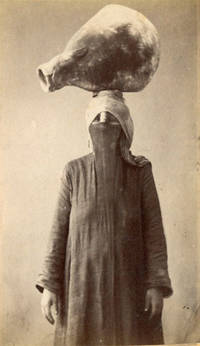
1890Best.-Nr. 142871890. De Michele Luigi woman carrying a water pot circa 1890 records a common form of domestic labor in late nineteenth century Egypt through the commercial portrait photography of the period. The subject stands wearing a face veil and long garments while balancing a large water vessel on her head preserving specific details of dress posture and water carrying practice without identifying the sitter by name. Black and white carte de visite photograph measuring 2 1/2" x 4". The woman is shown full length balancing a large water pot on her head and wearing a veil covering most of the face. The reverse bears the photographer's stamp "Fotografia Egiziana / Luigi De Michele." The studio attribution places the image within the commercial photographic trade that produced portraits and occupational or ethnographic views for local and foreign circulation in nineteenth century Egypt. Images of women carrying water appeared frequently in the photographic market for Egyptian views where photographers often presented daily labor and regional dress as recognizable subjects for travelers and collectors. This example retains a named studio attribution and a clearly defined activity rather than a generic landscape or architectural subject. Excellent condition. A late nineteenth century Egyptian CDV preserving a studio view of women's water carrying labor and dress. unknown
1890Best.-Nr. 142871890. De Michele Luigi woman carrying a water pot circa 1890 records a common form of domestic labor in late nineteenth century Egypt through the commercial portrait photography of the period. The subject stands wearing a face veil and long garments while balancing a large water vessel on her head preserving specific details of dress posture and water carrying practice without identifying the sitter by name. Black and white carte de visite photograph measuring 2 1/2" x 4". The woman is shown full length balancing a large water pot on her head and wearing a veil covering most of the face. The reverse bears the photographer's stamp "Fotografia Egiziana / Luigi De Michele." The studio attribution places the image within the commercial photographic trade that produced portraits and occupational or ethnographic views for local and foreign circulation in nineteenth century Egypt. Images of women carrying water appeared frequently in the photographic market for Egyptian views where photographers often presented daily labor and regional dress as recognizable subjects for travelers and collectors. This example retains a named studio attribution and a clearly defined activity rather than a generic landscape or architectural subject. Excellent condition. A late nineteenth century Egyptian CDV preserving a studio view of women's water carrying labor and dress. unknown books
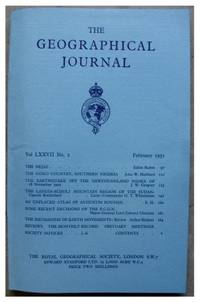
1931Best.-Nr. 145811931. Arabia RUTTER Eldon. The Hejaz. The Geographical Journal. Vol. LXXVII. No. 2. London: Royal Geographical Society 1931. 13 pages including 2 sketch-maps plus photographic plates. In original blue wrappers as issued. This is a captivating account of the Rutter's expedition in Arabia namely the Hejaz at the time a forbidden country to unbelievers concerning all aspects of the Hejaz including its geographical features the territorial disputes and tribal factions as well as the population that inhabits this spectacular region. Mr. Rutter outlines his pilgrimage disguised as a Muhammadan pilgrim through the Hejaz frontier at Halli. An engaging travel account illustrated with a full-page sketch map of the Hejaz showing Mr. Rutter's route to Mecca and Medina an in-text sketch diagram depicting his route from Mecca to At Taif and several amazing photographic plates showing the Kaaba the House of Allah the Great Mosque of Mecca the Prophet's tomb at Medina and Bab es Salaam in the Mosque of Medina. This is a complete issue containing all the ads seldom found in such good and original condition. In very good condition. unknown
1931Best.-Nr. 145811931. Arabia RUTTER Eldon. The Hejaz. The Geographical Journal. Vol. LXXVII. No. 2. London: Royal Geographical Society 1931. 13 pages including 2 sketch-maps plus photographic plates. In original blue wrappers as issued. This is a captivating account of the Rutter's expedition in Arabia namely the Hejaz at the time a forbidden country to unbelievers concerning all aspects of the Hejaz including its geographical features the territorial disputes and tribal factions as well as the population that inhabits this spectacular region. Mr. Rutter outlines his pilgrimage disguised as a Muhammadan pilgrim through the Hejaz frontier at Halli. An engaging travel account illustrated with a full-page sketch map of the Hejaz showing Mr. Rutter's route to Mecca and Medina an in-text sketch diagram depicting his route from Mecca to At Taif and several amazing photographic plates showing the Kaaba the House of Allah the Great Mosque of Mecca the Prophet's tomb at Medina and Bab es Salaam in the Mosque of Medina. This is a complete issue containing all the ads seldom found in such good and original condition. In very good condition. unknown books
1928Best.-Nr. 144801928. Lees G. M. The Physical Geography of South-Eastern Arabia 1928. Original geographical and geological report documenting the British geologist's expeditions through Oman and southeastern Arabia during 1925-1926 including investigations of mountainous and desert regions that had received limited systematic European surveying. George Martin Lees an assistant geologist with the Anglo-Persian Oil Company undertook fieldwork examining the geological formations tectonic structure and physical geography of Oman. His findings were presented before the Royal Geographical Society on January 16 1928 and subsequently published in The Geographical Journal. The report combines geographical surveys with observations on the water supply of Bahrain and the Qatar Peninsula archaeological discoveries of flint implements natural history collections and descriptions of the Mahri and Gara nomadic populations of southern Arabia. Lees G. M. The Physical Geography of South-Eastern Arabia. London: Royal Geographical Society 1928. Original 30-page illustrated report published in The Geographical Journal Vol. 71 No. 5 May 1928. Retained in its original blue printed wrappers with titles on the front and the original advertisements present. Illustrated with four sketch maps and photographic plates. The report examines the physical geography and geological tectonics of southeastern Arabia particularly the mountainous interior and surrounding desert regions of Oman. Lees describes his surveying expeditions geological observations and the geographical characteristics of areas previously imperfectly recorded on European maps. Supplementary material addresses water resources in Bahrain and Qatar the discovery of prehistoric flint implements and collections of birds and insects. His observations concerning the Mahri and Gara tribes include information on the inhabitants of the southern Arabian territories through which his expeditions passed. Lees's investigations preceded the extensive petroleum exploration and geological mapping undertaken across southeastern Arabia during the following decades. His employment with the Anglo-Persian Oil Company placed his geological fieldwork within the early history of commercial interest in the region's subsurface resources while his surveys contributed geographical information on Oman's mountain systems geological formations and interior routes. The archaeological and zoological observations extend the report beyond geology recording evidence of prehistoric human activity and regional wildlife. The original 1928 publication retains its blue wrappers and advertisements and is in very good condition. unknown
1928Best.-Nr. 144801928. Lees G. M. The Physical Geography of South-Eastern Arabia 1928. Original geographical and geological report documenting the British geologist's expeditions through Oman and southeastern Arabia during 1925-1926 including investigations of mountainous and desert regions that had received limited systematic European surveying. George Martin Lees an assistant geologist with the Anglo-Persian Oil Company undertook fieldwork examining the geological formations tectonic structure and physical geography of Oman. His findings were presented before the Royal Geographical Society on January 16 1928 and subsequently published in The Geographical Journal. The report combines geographical surveys with observations on the water supply of Bahrain and the Qatar Peninsula archaeological discoveries of flint implements natural history collections and descriptions of the Mahri and Gara nomadic populations of southern Arabia. Lees G. M. The Physical Geography of South-Eastern Arabia. London: Royal Geographical Society 1928. Original 30-page illustrated report published in The Geographical Journal Vol. 71 No. 5 May 1928. Retained in its original blue printed wrappers with titles on the front and the original advertisements present. Illustrated with four sketch maps and photographic plates. The report examines the physical geography and geological tectonics of southeastern Arabia particularly the mountainous interior and surrounding desert regions of Oman. Lees describes his surveying expeditions geological observations and the geographical characteristics of areas previously imperfectly recorded on European maps. Supplementary material addresses water resources in Bahrain and Qatar the discovery of prehistoric flint implements and collections of birds and insects. His observations concerning the Mahri and Gara tribes include information on the inhabitants of the southern Arabian territories through which his expeditions passed. Lees's investigations preceded the extensive petroleum exploration and geological mapping undertaken across southeastern Arabia during the following decades. His employment with the Anglo-Persian Oil Company placed his geological fieldwork within the early history of commercial interest in the region's subsurface resources while his surveys contributed geographical information on Oman's mountain systems geological formations and interior routes. The archaeological and zoological observations extend the report beyond geology recording evidence of prehistoric human activity and regional wildlife. The original 1928 publication retains its blue wrappers and advertisements and is in very good condition. unknown books
Best.-Nr. 14676Late 19th or early 20th century Koummya Arabic dagger with cast brass scabbard. The scabbard has silver engraved motifs and metal accents. The dagger measures 18" along the curve and has a hand carved wood handle with brass encasement rounding the hilt. The blade is curved sharp and slides securely into the sheath. It shows use but no damage. In good condition. unknown
Best.-Nr. 14676Late 19th or early 20th century Koummya Arabic dagger with cast brass scabbard. The scabbard has silver engraved motifs and metal accents. The dagger measures 18" along the curve and has a hand carved wood handle with brass encasement rounding the hilt. The blade is curved sharp and slides securely into the sheath. It shows use but no damage. In good condition. unknown books