MESOPOTAMIA AND ARABIABiblio.com
1.482 Ergebnisse
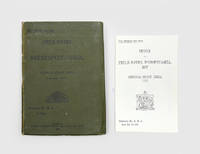
1917Best.-Nr. 192206Calcutta: Superintendent Government Printing India 1917. With the loosely inserted index Second edition significantly expanded and revised from the first of 1915 including updated sections on Al Hasa and Nejd and the rule of the Saud dynasty as well as 22 additional route descriptions in the final section. The 20-page index tucked into the end band was issued only with a subset of copies. The first edition issued in March 1915 went through three small printings in a year but the outbreak of the Arab Revolt and the upswing in the Mesopotamian Campaign necessitated its revision. Chapters discuss history geography populations resources maritime issues and administration while also providing British intelligence on the Ottoman forces. On the "fighting qualities of local Arabs of Mesopotamia" the compilers observe that "for several years the Arabs have been very friendly towards the British and on several occasions prominent chiefs have come forward with suggestions of a British Protectorate" p. 90. The routes draw on a variety of sources including Lorimer reports by captains Shakespear and Leachman the Danish explorer Barclay Raunkiaer Lieutenant Arnold Wilson and recent intelligence supplied by Lieutenant-Colonel L. S. Newmarch Resident and Consul-General at Baghdad. In a reflection of the region's changing geopolitics the list of important personages is reduced from 25 in the first edition to only 11. Octavo. Folding heliozincographed map of Lower Mesopotamia in front pocket 3 folding tables errata slip tipped in facing p. 34; tables in text. With 20-page separate index loosely inserted in rear band. Original green diagonal-grain cloth wallet binding spine and front cover lettered in black. Title page with contemporary pencil ownership inscription of Lieutenant-Colonel Austin Romauld O'Flaherty officer commanding 33 British General Hospital Mesopotamia. General signs of use spine sunned small tidemarks internally short split along fold of map; index volume re-sewn: very good. hardcover
178011 voll. cartonato azzurro della epoca. 10 voll. in-8. un vol. in-4 Atlas. Ritratto inciso 9 frontespizi incisi 50 mappe 23 tabelle ripiegate.Economics india arabia gulf africa america diderot rigobert bonne maps atlas arabic indian travels slavery colonialism Diderot
1678in-4. pp.16,358,4. Perg. Coeva. un legno nel testo con la sorgente del Nilo.
19212 vols., 8vo., Second Edition thus, with fine portrait frontispiece (original tissue guard present), numerous plates (a number in collotype and a number folding), illustrations, maps and plans in the text and large folding coloured map mounted on cloth in pocket at end of first volume, neat contemporary signature on half-title of first volume, small sticker on front paste-downs; original dark green cloth, upper boards blocked in gilt and framed in blind, gilt backs, gilt tops, black endpapers, uncut, a sharp, bright, crisp, near fine copy in unclipped dustwrapper, the wrappers moderately sunned at backstrips. EDITION LIMITED TO 500 COPIES. With the trade ticket of WH Smith of Bournemouth on front paste-down. 'Lawrence had long admired Doughty's classic and was instrumental in getting the second English edition published by the fledgling firm of Jonathan Cape in conjunction with the Medici Society' (paraphrased from O'Brien). VERY SCARCE IN THIS CONDITION, AND ESPECIALLY IN THE DUSTWRAPPERS. O'Brien A013.
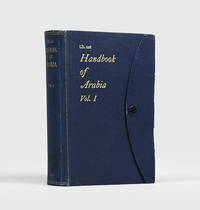
1916Best.-Nr. 192452London: Admiralty War Staff Intelligence Division May 1916. A detailed intelligence handbook the folding maps in excellent condition First edition of this regional survey for the armed services published for official use only and compiled by the Arab Bureau's David Hogarth following his recruitment to naval intelligence in 1915. The four folding maps present Arabia's settlements tribal distribution and orographic and land-surface features. After general physical and social surveys chapters cover Bedouin tribes the Hejaz Asir Yemen Aden and the Hadhramaut Oman the Gulf coast Nejd Jebel Shammar the northern Nefud and Dahanah belts and settled tribes. The appendices comprise a system of transliteration from Arabic to English and an extensive glossary of topographical terms. "The sources from which this work has been compiled include native information obtained for the purpose since the outbreak of the war. This applies in particular to the strength and distribution of the Bedouin tribes and to their political relationships. Recent information from native sources has also been used for parts of the Red Sea littoral such as the little-known region of Asir" preliminary note. Volume II published the following year was concerned with detailed routes. The work was reissued in 1920. Octavo. With 15 photographic halftone plates 4 folding colour maps in end pocket. Original blue cloth flap case metal stud-fastener spine and front cover lettered in gilt. Annotated bookplate of Royal Artillery Institution Woolwich. Shadow from old label on spine fold of front flap splitting at ends and consequently a little fragile ring stain on outer face of folded map another map with small pinhole couple of small splash marks: a very good copy indeed. hardcover
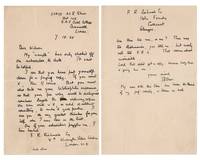
1925Best.-Nr. 0088521925. Letter. This 7 September 1925 autograph letter from T. E. Lawrence "of Arabia" to John G. Wilson "the most famous English bookseller of his time" a critical supporter of the legendary 1926 Subscriber's edition of Seven Pillars of Wisdom and one of the select few to receive a complimentary copy from Lawrence. The letter is noteworthy not only for the association but for timing and content as Lawrence was struggling to fill subscriptions for his magnum opus. your free copy shall be distinguished somehow beyond the ordinary copies I owe you the very greatest thanks for your help The letter is addressed and dated at the top right of the first panel "338171 AC II Shaw Hut 105 R.A.F. Cadet College Cranwell Lincs. 7. IX. 25". Following Lawrence's salutation "Dear Wilson" the letter reads: "My "sample" has only choked off one subscriber to date. It can't be helped. I see you have put yourself down for a paying copy. But you must also lend me your bibliophilic experience so that your free copy shall be distinguished somehow beyond the ordinary copies. We can write in it or add or subtract something to make it quite peculiar. I owe you the very greatest thanks for your help when I was low in the list. One of your subscribers puzzles me. I have booked F. R. Richmond Esq. 8A Kensington Palace Gardens London W. 8. and also F. R. Richmond Esq. Holm Foundry Cathcart Glasgow. Are these two men or one There were two Richmonds you told me: but surely not to F. R.'s. That seems almost incredible. Lord Bute didn't get a copy: because Lady Bute is giving him one:" Following his valediction "yours sincerely" and signature "T E Shaw." there is a postscript: "My move to the Air Force has broken the thread of my proof-correcting & thrown me back." Condition The letter is written in black ink on a single sheet of laid watermarked "ORIGINAL BLACKFRIARS MILL" paper measuring 8.875 x 6.9375 inches folded once to form four 4.375 x 6.9375 inches panels. Lawrence wrote on the first and third of these panels. Condition is very good. The paper is complete with no loss tears or appreciable wear other than an additional horizontal fold from original posting. The paper shows light overall soiling to the first and fourth outer panels and perhaps a faint hint of spotting to the lower front panel. Lawrence's ink remains clear and unfaded. The letter is protected within a clear removable archival sleeve housed within a rigid crimson cloth folder. Lawrence of Arabia During the First World War Thomas Edward T. E. Lawrence 1888-1935 experienced a transformative odyssey as instigator organizer hero and tragic figure of the Arab Revolt against the Ottoman Empire which he began as an eccentric junior intelligence officer and ended as "Lawrence of Arabia. He spent the rest of his famously short life struggling to variously reconcile reject share and repress this indelible experience which was eventually recounted in his magnum opus Seven Pillars of Wisdom. Hiding and writing in the R.A.F. As part of his effort to evade his celebrity in August 1922 Lawrence enlisted in the Royal Air Force first under the name John Hume Ross and later Thomas Edward Shaw a name he used until his death. Hence from that time forward he seldom signed with his original surname. By December 1922 Lawrence had with a close circle of friends decided to produce 100 copies of the Seven Pillars at thirty guineas a copy if so many subscribers can be found. So September 1925 found Lawrence officially Aircraftsman Shaw residing in Hut 105 of the R. A. F. Cadet College at Cranwell trying to both duck and recount the events that had made him so uncomfortably famous. By the time Lawrence wrote this letter to Wilson in 9 September 1925 he was well into the elaborate preparation of and corresponding expenses for his famous Subscribers edition of Seven Pillars of Wisdom. Subscribers were fewer than had been hoped and Wilson was to prove of material help. John Gideon Wilson John Gideon Wilson 1876-1963 was manager of Bumpus bookshop "the most famous English bookseller of his time" and a significant even critical supporter of the famous 1926 Subscriber's edition of Seven Pillars of Wisdom. "Described as 'massively wise and unassumedly learned' this lovable man was endowed with a rare simplicity. In his shop Wilson might be found conversing with the poet laureate or wrapping up the purchase of a schoolboy. His assessment of authors and their books was quick and sure and his advice always valid was freely given to authors publishers and his fellow booksellers." Given his literate and approachable character and his commercial stature it seems no surprise that he and Lawrence found opportunity to collaborate. More than just a friend and subscriber Today when Subscriber's editions of Lawrence's magnum opus routinely command $six-figure sums it is almost prohibitively difficult to imagine any challenge in securing subscribers for the mere 202 copies eventually issued. But at the time Lawrence's expenses in producing the edition to his exacting and lavish specifications were extravagant and for much of 1925 he was genuinely concerned by a lack of anticipated subscriber commitments. It was to Wilson that Lawrence had turned earlier in the year when facing the prospect "that the plans for a thirty-guinea subscription edition had been over optimistic. By mid-March three months after the start of the project only twenty-six subscribers had been found" while estimated costs to produce the edition were proving higher than anticipated. Lawrence wrote to Wilson who was both manager of Bumpus bookshop in London and bookseller to the King asking if Wilson "would like to place twenty copies at the thirty guineas price." Six worrisome months later prospects had improved - due in no small part to Wilson. "By the middle of September" a week after Lawrence wrote this letter to him "Wilson had added a block of subscriptions and the total suddenly jumped to eighty." Bookseller to the King Indeed when completed by the binders in November 1926 Lawrence sent "the very first of these" to the Royal Library at Windsor which "had taken out a subscription" having placed the order through J. G. Wilson. For this copy Lawrence returned the advance cheque writing in advance explanation to Wilson ".it seems improper that Kings should buy and sell among their subjects." Wilson was clearly a trusted figure; in 1928 when Lawrence was collaborating with Bruce Rogers on their famous rendering of Homer's Odyssey Wilson was one of the few trusted early with the knowledge that Lawrence was to be the translator. Following Lawrence's death in 1935 Wilson had a hand in the disposal of Lawrence's personal library from his beloved Clouds Hill cottage. A doubly privileged recipient Ultimately there were only 211 copies of the Subscriber's Edition of which 170 were complete copies 32 incomplete and 9 spoils. No two copies are identical. In addition to various differences in inclusion and placement of the many illustrations each copy was bound differently. Wilson would have a hand in selling an appreciable percentage of the 170 available for sale to subscribers. Speaking to his importance to the edition and as substantiated by this letter Wilson would personally receive not only one of the 32 incomplete copies that Lawrence gifted to friends and comrades from the Arab Revolt but also one of the 170 complete copies. References: Wilson Lawrence of Arabia; ODNB; Richard Knowles Rickaro Books unknown
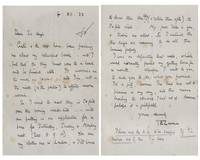
1923Best.-Nr. 0088591923. Letter. This 4 December 1923 autograph letter signed by T. E. Lawrence is noteworthy in multiple respects including: for referencing an important meeting about what would become the Subscribers issue of Seven Pillars of Wisdom; for being written to Lawrences great friend and patron Hugh Trenchard the head and father of the Royal Air Force; for highlighting the contradictions inherent to Lawrences supposedly anonymous enlistment in the R.A.F.; for being signed with Lawrences true name which he had already effectively abandoned. The letter is also replete with Lawrences characteristic liberties with punctuation and grammar which so amusingly belied his remarkable erudition. Curtis & the rest have been pressing me about my reluctant book: and I feel that the thing must come to a head and be finished with. The letter is written entirely in Lawrences hand on the first and third panels of a single folded sheet of 9 x 7 inches 22.86 x 17.78 cm watermarked Waverley Pen Vellum stationery folded once to make four 4.5 x 7 inches 11.43 x 17.78 cm panels. The letter is dated 4 . XII . 23 with the salutation Dear Sir Hugh. The body of the letter reads in full: Curtis & the rest have been pressing me about my reluctant book: and I feel that the thing must come to a head and be finished with. It worries me too much as it is: and Im not in the mood or the position to afford more worries. So I want to meet them in Oxford over the coming week-end . And am putting in an application for a pass for Saturday Sunday & Monday next. Dec. 8.9.10. You see my clothes are in London & Ill have to draw them there before & return them after the Oxford visit. My poor bike is gone & trains are slow. So I estimate the three days as necessary to do all the business properly. I was on defaulters last week which would normally prevent my getting leave for a month. Wherefore I write to you to ask you to do what you promised. Its a pity because Ive tried here not to presume in any way and this means breaking the standard I had set up. However perhaps it is justifiable. Lawrence signed TELawrence below his valediction yours sincerely. A two-line post script underlined follows: Please ask the A. G. to be careful. If Im kicked out of this Im done. Condition Condition is good plus Lawrences ink clear and distinct. The stationery is complete though spotted and with a horizontal and vertical fold bisecting each panel ostensibly from original mailing. Initials at the head of the first panel just below the date are plausibly those of Trenchard. The letter is protected in a clear removable archival sleeve housed within a rigid full blue Morocco goatskin folder with a gilt-printed front cover gilt-ruled turn-ins framing gray paper pastedowns within and an integral printed cardstock insert. Lawrence of Arabia During the First World War Thomas Edward T. E. Lawrence 1888-1935 experienced a transformative odyssey as instigator organizer hero and tragic figure of the Arab Revolt against the Ottoman Empire which he began as an eccentric junior intelligence officer and ended as "Lawrence of Arabia. He spent the rest of his famously short life struggling to variously reconcile reject share and repress this indelible experience which was eventually recounted in his magnum opus Seven Pillars of Wisdom. The Father of the Royal Air Force Father of the Royal Air Force Hugh Montague Trenchard First Viscount Trenchard 1873-1956 began his military career as a dashing cavalry officer full of high Victorian bravado who attracted the notice of his superiors for blunt words boundless energy and stern discipline of men under his command. At forty Trenchard asked for leave to learn to fly at his own expense and then joined the Royal Flying Corps which had been formed only months before. There his age and military experience saw him appointed to the staff and he recognized more quickly than most officers of his age the aeroplane's unlimited military potential. He would be indelibly associated with Britains air service for the rest of his life. Before the end of the First World War Trenchard was both appointed the first head of the new Royal Air Force and knighted. By 1919 Trenchard was created a baronet and was working to secure the foundations of an enduring independent RAF. Trenchard and T. E . Shaw Trenchard and T. E. Lawrence both worked with and for Winston S. Churchill who was respectively Secretary of State for War and Air appointed January 1919 and Colonial Secretary appointed February 1921. Perhaps Trenchards own impetuous inclinations and the experience of being both of and other in British society and institutions facilitated Trenchards friendship with T. E. Lawrence. That friendship proved critical for Lawrence and emblematic of the inherent contradictions between his inescapable fame and his fitful attempts to evade and ignore it. At the beginning of January 1922 Lawrence wrote to Trenchard expressing a wish to join the R.A.F.: Its an odd request this hardly proper perhaps asking you to use your influence to get me past the Recruiting Officer! By July Churchill had released Lawrence from service and in August Lawrence enlisted first under the name John Hume Ross and later Thomas Edward Shaw a name he used until his death. Hence from that time forward he seldom signed with his original surname. Ive tried here not to presume in any way and this means breaking the standard I had set up. However perhaps it is justifiable. As evident in this letter despite his pretensions to anonymity and protestations of humility as an enlisted Aircraftman Lawrence was not above calling in favors from the exalted Trenchard. Lawrences friendship with Trenchard was known to his superiors and often resented. In the case of this letter Lawrence was going over the head of his local superiors to secure a pass in order to attend a meeting about publishing Seven Pillars of Wisdom. In this effort Lawrence was successful; Lawrence did meet in Oxford with Lionel Curtis referenced in this letter D. G. Hogarth and Alan Dawnay on 9 December 1923 where in Lawrences words the four decided to produce 100 copies of the Seven Pillars at thirty guineas a copy if so many subscribers can be found. Curtis was one of Lawrences most trusted friends and it was mainly Curtis and D. G. Hogarth who had persuaded Lawrence to rewrite Seven Pillars after the original manuscript was lost in 1919. Specially bound in R.A.F. blue When Lawrence finally published the famous Subscribers Edition of Seven Pillars of Wisdom in 1926 Trenchard was among the select few gifted a presentation copy Trenchards specially bound in R.A.F. blue. The edition would also be known as the Cranwell Edition because Lawrence was stationed at the Cranwell Cadet College founded by Trenchard when he completed it. References: Wilson Lawrence of Arabia; ODNB; T. E. Lawrence: Correspondence with the Political Elite unknown