1.492 Ergebnisse
1844Due volumi (15x23 cm) di LXXXIII-(2)-357 pp; VI-509-(2) pagine. Due grandi carte geografiche ripiegate (56x41 cm) ognuna nella tasca alla fine dei volumi; tre tavole di iscrizioni ripiegate, l' Hassan Ghorab e sua traduzione a p.350 e 351 del vol II, l'Hasan Ghorab nella versione Wellsted a p. 382 del vol II. Una “vignette plate of Nakab el Hajar" all'inizio del Vol II (invece che prima dell'Appendix). Completo quindi delle due grandi carte geografiche dell'Arabia e delle figure indicate nel “directions for the bonder” a fine opera. Legatura editoriale in piena tela con titoli dorati ai dorsi e fregi a secco ai piatti. Ex libris al retro del piatto. Ottime condizioni. Only edition of this detailed study of place names, tribal geneaologies, and pre-Islamic inscriptions. "An attempt at the proof of the descent of the Arabs from Ishmael" (Ghani).
Best.-Nr. CBS 9783031090479US Edition. New. Brand New! Fast Delivery US Edition and ship within 24-48 hours. Deliver by FedEx and Dhl & Aramex UPS & USPS and we do accept APO and PO BOX Addresses. Order can be delivered worldwide within 6-10 days and we do have flat rate for up to 2LB. Extra shipping charges will be requested if the Book weight is more than 5 LB. This Item May be shipped from India United states & United Kingdom. Depending on your location and availability. unknown
1657Best.-Nr. PHO-1458A Troyes, par Nicolas Oudot, et se vendent à Paris: Chez François Clousier, 1657. in-4; [6ff. (sur 7: feuillet de dédicace en fac-simile), dont titre, portrait légendé de La Boullaye, préface], 558p., [5ff. Table, fautes, privilège du 12 février 1657]; 33 illustrations sur bois dans le texte dont 16 à pleine page. Reliure d'époque en basane brune, dos à nerfs avec titre , coupes , coiffes et coins usés , frottements. un coin déchiré au titre sans atteinte au texte. Mouillure angulaire au premier portrait P. 73 déchirée avec manque de papier ,sans atteinte au texte. P. 165: manque en coin avec perte de qq mots; PP. 173 et 175: déchirures sans perte de texte; P. 234: manque de papier en pied avec perte de quelques mots; taches d'encre pp. 264 ; pp. 460 à 485: petites galeries de vers marginales en pied. Ex-libris manuscrit Dominium Antonium Biguet. Seconde édition
1807in-8 gr., pp. VIII, 196, (4), bella leg. m. pelle coeva con nervi e tit. oro al d. Risguardi in carta color. Testo su due colonne. Macchia di circa 1 cm al margine bianco inf. interno. Belliss. esempl. su carta forte. [208]
17172 parti in 1 volume in-12° (cm. 16,4), legatura coeva in piena pelle con titolo e fregi in oro al dorso (mancanza della cuffia inferiore); tagli spruzzati; pp. [32] 316 [2] XIV 76 [16] in buono stato con 4 tavole illustrative in rame f.t. di cui una ripiegata (accampamento sul Monte Carmelo davanti alla città di Haifa); sporadiche fioriture. Edizione originale postuma del libro di viaggi compiuti nel 1664 in Medio Oriente dal diplomatico marsigliese, edito da Jean de la Roque. Interessante la descrizione delle tribù nomadi. «The first part of this work is an account of d'Arvieux's mission to the Arabs of Mt. Carmel in 1664, together with a general discussion of the customs of the nomadic Arabs. The second part, Description Générale de l'Arabie, has been translated for the first time into French by the editor La Roque from the Arabic of Ismael Abulfeda» [Blackmer 50]. cfr. Atabey 38. Esemplare molto buono.
1697In Folio (mm 340x240); 16 carte non num., pagine 1059, (1); frontespizio in rosso e nero; legatura in tutta pelle coeva con dorso a sei nervi, titolo e fregi agli scomparti, titolo su tassello, tagli spruzzati. Buon esemplare con qualche traccia di usura lieve alla legatura, cuffie restaurate. Internamente ottimo esemplare fresco e marginoso, ma occhiello con un restauro, prime carte con piccola mancanza all'angolo inf. Prima edizione di questa celebre opera fondamentale per la conoscenza del mondo orientale basata sulla immensa bibliografia arabica di Hadji Khalfa (Katip Çelebi), di cui d'Herbelot fece sostanzialmente un ampio compendio aggiungendo però numerose notizie da altre fonti arabe e turche, a stampa e manoscritte. L'opera fu pubblicata postuma, due anni dopo la morte, dall'orientalista Galland. Furono stampate quattro edizioni, l'ultima nel 1781-83. Atabey, 563: "Herbelot spent the last thirty years of his life working on his Bibliothèque orientale, a landmark in Arabic studies which was unfinished at his death and completed and published two years later by the orientalist Antoine Galland in 1697. He knew a range of languages, including Arabic, Turkish, Persian, Aramaic, Syriac, and Hebrew, and was familiar with their literature and history, of which this work forms an encyclopaedia." Brunet II, 664; Zischka 15; Graesse II, 376 First edition, folio, pp. [32], 1059, [1]; title page printed in red and black, woodcut ornaments and initials; full contemporary calf, gilt-decorated spine in 6 compartments, red morocco label in 1. Good general condition, edges somewhat worn, some restorations at spine, short-title reinforced and restored, titlepage and next two leaves with minor defects and small lacks at bottom corner. Based on the immense Arabic bibliography (the Kashf al-Zunun) of Hadji Khalfa (Katip Çelebi), of which it is largely an abridged translation, but it also contains the substance of a vast number of other Arabic and Turkish compilations and manuscripts. Four editions of this encyclopedia on the culture and history of the Near East were printed, the last being 1781-83. Atabey, 563: "Herbelot spent the last thirty years of his life working on his Bibliothèque orientale, a landmark in Arabic studies which was unfinished at his death and completed and published two years later by the orientalist Antoine Galland in 1697. He knew a range of languages, including Arabic, Turkish, Persian, Aramaic, Syriac, and Hebrew, and was familiar with their literature and history, of which this work forms an encyclopaedia." A supplement compiled by Claude de Visdelou was published in 1780. Brunet II, 664; Zischka 15; Graesse II, 376
Best.-Nr. DADAX0873281314New unknown
Best.-Nr. ORD-14610Nouvelle édition soigneusement corrigée & augmentée de quelques notes. Neuchâtel. Société Typographique. 1772. 1773. 6 volumes in-12 (102 x 168mm) pleine basane racinée, dos à 5 nerfs ornés de caissons, pièces de titre maroquin rouge, de tomaisons maroquin brun, gardes marbrées, tranches rouges, 556, 444, 502, 468, 431 et 448 pages. Etiquette de P. Gauvry libraire à Bordeaux. Coiffes lgt arasées, petits défauts d'usage aux reliures sinon beaux exemplaires. Manque le tome VII comme souvent. Rare.
1900Beirut, Damascus, Hama, Bhamdoun: 28 February 1900 - June 1901. Lot of 5 manuscript letters written and signed by Harvard anthropologist Henry Minor Huxley, concerning anthropological work performed for the Howard Crosby Butler Archaeological Expedition to the Middle East, as well as a noteworthy archaeological discovery of an ancient and curious stone inscription, its location guarded with secrecy by the few expedition members having this knowledge. 8vo. double-leafs varying in size. 24 pages combined, each letter signed in the original. Two letters are on hotel stationery. Occasional light creasing, otherwise in very good condition, clean and bright, a fascinating and candid primary source account. Writing to a trusted source, his mother, Huxley's reveals the discovery of an ancient inscription carved into an overturned stone, in a language possibly not yet identified, stating that he took the first photograph of it, and that only a select few expedition members are privy to knowing its location. His commentary on experiences with the local civilians and officials are straightforward and occasionally blunt. Henry Minor Huxley, A.M. accepted the offer to join the American Archaeological Expedition led by American archaeologist Howard Crosby Butler. The first part of the archaeological work took place from mid-October to mid-December 1899, and a second trip was made for continued work from March to June, 1900. In the summer of 1900, he was devoted to acquiring a working knowledge of the vernacular Arabic. Huxley's work, however, involved a broader scope. During this second trip, he was also tasked with the study of physical anthropology, as is apparent in the present correspondence. This work proved so valuable that Huxley, owing to the patronage of New York businessman and archeological enthusiast B.T. Babbitt Hyde, remained for another year to further these anthropological observations, independently. What does not appear to be officially documented in publications, but is highly fascinating, is what Huxley writes in his last letter of the present lot. That is, in June 1901, just prior to returning to America, he alone returned to the site of a stone inscription discovered during the earlier part of the expedition (presumably in 1899), to copy it, photograph it, and turn it back face down so that no others would see it. This would increase the likelihood that he and one other would have a better chance of being the first to decipher it.
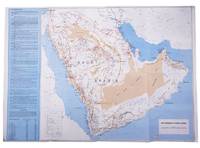
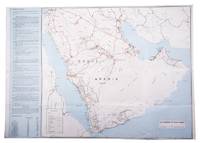
Best.-Nr. L95FAMFT0CG1Karachi Pakistan: printed at Golden block works 1970. Colour-printed folding map 48 x 69.5 cm of the Arabian peninsula scale: ca. 1:5000000 with on the back a city map of Jeddah a plan of the main business quarter of Riyadh a city plan of Dammam a distance table and 8 photographic city views. Folding map of the main roads of Saudi Arabia but depicting the whole Arabian peninsula and including the Sultanate of Oman meaning the present state must have been published in or after 1970. On the left of the map text giving information on the climate Riyadh Jeddah Damman Taif the Akrama water dam Alkhobar the telephone system and the exchange rates. The reverse side of the map includes plans of Jeddah Riyadh Dammam and 8 photographic city views. In very good condition. printed at Golden block works, unknown
1940Best.-Nr. 2608310006Oxford University Press 1940. Hardcover. Very Good. 0x0x0. A beautiful edition designed by Bruce Rogers in the Hesperides Series 1940 printing. Housed in custom made cloth slip case with linen boards. Bound in publisher's cloth. Top edge gilt. Hardcover and dust jacket. Good binding and cover. Light wear. Blind stamp on half title page. 442 pages : illustrations ; 19 cm. This publication is one of the finest creations of legendary American printer typographer and book designer Bruce Rogers 1870-1957 who had read Seven Pillars and believed that Lawrence was the man who "could make Homer live again". Oxford University Press hardcover
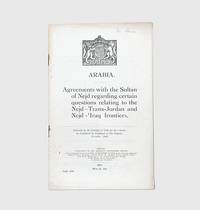
1925Best.-Nr. 163169London: His Majesty's Stationery Office 1925. The confidential nature of Clayton's successive offices necessarily obscured the importance of his achievements First appearance in print first impression of the English text of the Hadda and Bahra Agreements negotiated by Sir Gilbert Clayton and Ibn Saud. The printer's slug records that 1125 copies were printed in January 1926 one month after the agreements were presented to Parliament by Leo Amery the colonial secretary and the future political nemesis of Neville Chamberlain. As Ibn Saud continued to expand his power base in the early and mid-1920s "the turbulent events. precipitated British diplomatic intervention. this led to a series of missions to the Hejaz led by Sir Gilbert Clayton between 1925 and 1928" Leatherdale p. 138. The accords reached in 1925 established a tribunal to rule on frontier disputes and placed limitations on the movements of traditionally peripatetic tribes. On the part of Ibn Saud participation in the agreement was a deliberate diplomatic strategy designed to maintain British neutrality vis-à-vis his broader geopolitical goals. Concerning Clayton M. W. Daly observes that "while colleagues and subordinates such as T. E. Lawrence achieved worldwide fame the confidential nature of Clayton's successive offices necessarily obscured the importance of his achievements" ODNB. Octavo pamphlet pp. 16. Royal coat of arms of the UK on first page. Wire-stitched as issued. Recently pencil ownership signature of one "Mr Simon" on first page. Light toning and creasing rust marks at staples. A near-fine copy of this delicate publication. Clive Leatherdale Britain and Saudi Arabia 1925-1939 1983. hardcover
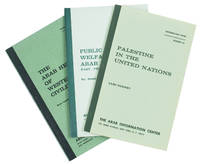
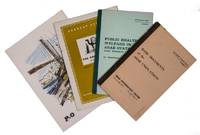
1951Best.-Nr. ABC_45233New York & London: The Arab Information Center 1951. 2 booklets a magazine and a menu all in original publishers wrappers. 8vo. Comprising:1 EL-KHATIB M. Fatallah foreword. Basic Documents of the Arab Unifications. New York Arab Information Center June 1958.2 OMRAN Abdel-Rahim. Public Health & Welfare in the Arab States: Past Present and Future. New York Arab Information Center November 1959. The booklet opens with a history of the Arab contributions to medicine followed by modern statistics.3 WRIGHT Esmond. The Arab World. Current Affairs no. 125. London Bureau of Current Affairs 3 February 1951.4 MENU. P&O menu. On board the S.S. Arcadia Sunday 25 March 1962. Set of four publications two of which by the Arab Information Center in New York. Together with other Arab information centers in various cities in the Americas Europe and Asia the New York office belonged to the Press and information department of the League of Arab states. As well as the monthly newspaper Arab World the office published numerous research reports on various aspects of the individual member states and the Arab world at large. Ad 1: The most important documents concerning the unification of Arab states. These documents include: the Proclamation of the United Arab Republic the Proclamation of the Arab Union the Provisional Constitution of the United Arab Republic the Charter of the United Arab States and the Constitution of the Arab Union.Ad 2: An overview of both the history of Arab medicine and the current state in 1958 of the demographics and healthcare in various states of the League.Ad 3: A short overview of the Arab world.Ad 4: Menu offered during a cruise in the Gulf on board the S.S. Arcadia.The staples in ad 1 somewhat rusted and ad 2 with an owners stamp. All in very good condition.l MacDonald The league of Arab states pp. 135-138. The Arab Information Center, unknown
1951Best.-Nr. L95CCFTRZTEWNew York & London 1951. 3 booklets and a menu. 1 EL-KHATIB M. Fatallah foreword. Basic documents of the Arab unifications.New York Arab Information Center June 1958. 8vo. 43 pp. includes: the Proclamation of the United Arab republic the Proclamation of the Arab Union the Provisional constitution of the United Arab republic the Charter of the United Arab States and the Constitution of the Arab Union.2 OMRAN Abdel-Rahim. Public health & welfare in the Arab states past- present and future.New York Arab Information Center November 1959. 8vo. 32 pp. The booklet opens with a history of the Arab contributions to medicine followed by modern statistics.3 WRIGHT Esmond. The Arab World. Current affairs number 125.London Bureau of current affairs 3 February 1951. 8vo. 19 1 pp. Short overview of the Arab World.4 MENU. P&O menu.On board the S.S. Arcadia Sunday 25 March 1962. 8vo. Menu with on front a coloured illustration of a Dhow in the Arabian Sea. Probably offered during a cruise in the Gulf. unknown
1960Best.-Nr. L95FL4P9FMHFSaudi Arabia 1960. Colour-printed folding map 48 x 69.5 cm of the Arabian peninsula scale: ca. 1: 5000000 with on the back a city map of Jeddah a plan of the main business quarter of Riyadh a city plan of Dammam a distance table and 8 photographic city views. Folding map of the main roads of Saudi Arabia but depicting the whole Arabian peninsula. On the left of the map text giving information on the climate Riyadh Jeddah Damman Taif the Akrama water dam Alkhobar the telephone system and the exchange rates. The reverse side of the map includes plans of Jeddah Riyadh Dammam and 8 photographic city views. Some minor tears at the folds front partly discoloured and browned but otherwise in good condition. unknown
1588Best.-Nr. PHO-2120Paris, Hierosme de Marnes & la Veuve Guillaume Cavellat, 1588. Petit in-4 (21,6 × 15,5 cm), [12] ff., 468 pp., [1] f. (achevé d’imprimer, marque de l’imprimeur au verso). Basane fauve mouchetée du XVIIe siècle, dos à cinq nerfs orné, titre doré, tranches mouchetées, reliure un peu usée, frottements et épidermures, petit manque au dos, charnière fendillée, très légères rousseurs, infimes trous de vers marginaux.
1852Best.-Nr. X114460Göttingen, Dieterichschen Buchhandlung 1852 Complete in 2 parts in one physical volume, [4] + [82] + [106] pp. (containing resp. 24 and 27 genealogical tables), in oblong (23x32cm.), solid modern amateur hardcover (marbled boards, spine in cloth), pages are clean and bright, good condition, [N.B. The "Register" to this work, published in 1853, is not included], weight: 1kg., X114460
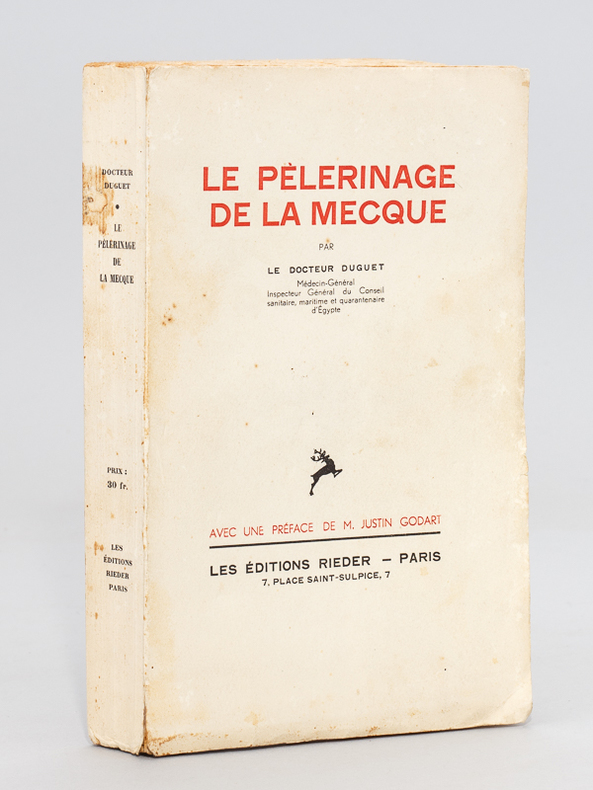
1932Best.-Nr. 57680Par le Docteur Duguet, Médecin Général, Inspecteur général du Conseil sanitaire, maritime et quarantenaire d'Egypte, avec une préface de Justin Godart, exemplaire su tirage ordinaire, 1 vol. in-8 br., Les Editions Rieder, 1932, XII-337 pp. avec 8 planches hors texte (16 photos de pèlerins et de Médine, La Mecque, Mina et Arafat)
1932Par le Docteur Duguet, Médecin Général, Inspecteur général du Conseil sanitaire, maritime et quarantenaire d'Egypte, avec une préface de Justin Godart, exemplaire su tirage ordinaire, 1 vol. in-8 br., Les Editions Rieder, 1932, XII-337 pp. avec 8 planches hors texte (16 photos de pèlerins et de Médine, La Mecque, Mina et Arafat) Edition originale, enrichie d'un envoi autographe signée de l'auteur. Cet important ouvrage évoque dans une première partie le pèlerinage au point de vue religieux et social (histoire, obligations religieuses, les caravanes, le chemin de fer du Hedjaz, l'automobile, la voie maritime, les cérémonies religieuses, la visite à Médine, les pèlerinages Chiites) ; dans une second partie, le docteur Duguet évoque le point de vue sanitaire : les pèlerinages d'avant 1866, la grand épidémie de choléra de 1865, les différentes conférences internationales autour du choléra et les diverses épidémies, les pélerinages de 1905 à 1914, puis de 1914 jusqu'à 1924 et la chute du roi Hussein. Enfin, dans une troisième partie, il évoque le Hedjaz moderne (Ibn Séoud et les Wahabites), les pélerinages de 1925 à 1930 et la politique sanitaire nécessaire dans le Hedjaz. Etat très satisfaisant (couv. un peu frottée avec deux taches en dos et second plat, rouss. parfois fortes). Un ouvrage majeur pour l'histoire du pèlerinage à La Mecques mais aussi pour l'histoire des conférences sanitaires internationales, qui se sont dès l'origine fortement intéressé au risque épidémique qui y était lié. First edition, signed by the author. This important work evokes in a first part the pilgrimage from the religious and social point of view (history, religious obligations, the caravans, the Hedjaz railway, the automobile, the seaway, the religious ceremonies, the visit to Medina, Shiite pilgrimages) ; in a second part, doctor Duguet evokes the health point of view : pilgrimages before 1866, the great cholera epidemic of 1865, the various international health conferences and the various epidemics, pilgrimages from 1905 to 1914, then from 1914 until 1924 and the fall of King Hussein. Finally, in a third part, he discusses modern Hedjaz (Ibn Séoud and the Wahabites), pilgrimages from 1925 to 1930 and the necessary health policy in Hedjaz. Fair condition (cover a little rubbed with two spots on the back and second cover, foxing). A major work for the history of the pilgrimage to Mecca but also for the history of international health conferences, which from the outset were very interested in the epidemic risk associated with the hajj. Français
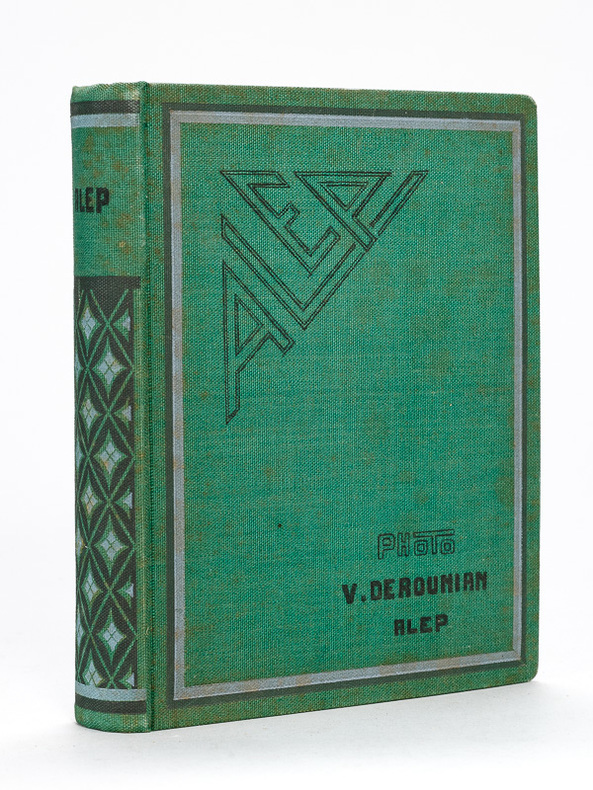
1930Best.-Nr. 552451 album pleine toile verte, format 21,5 x 18 cm, avec 22 photos format 17 x 11 cm, circa 1918-1937, Vartan Derounian
18102 voll. in 8, pp. XXVI + 434 + (2); X + 474 + (2) con 8 tavv. f. t. inc. all'acquaf. e acquarellate e 9 tabelle. Scritta a penna all'occhiello. M. pl. coeva (dorso reataurato). Prima edizione di una delle piu' importanti grammatiche della lingua araba. De Sacy fu uno piu' importanti orientalisti del suo tempo. Una seconda edizione fu pubblicata nel 1831.
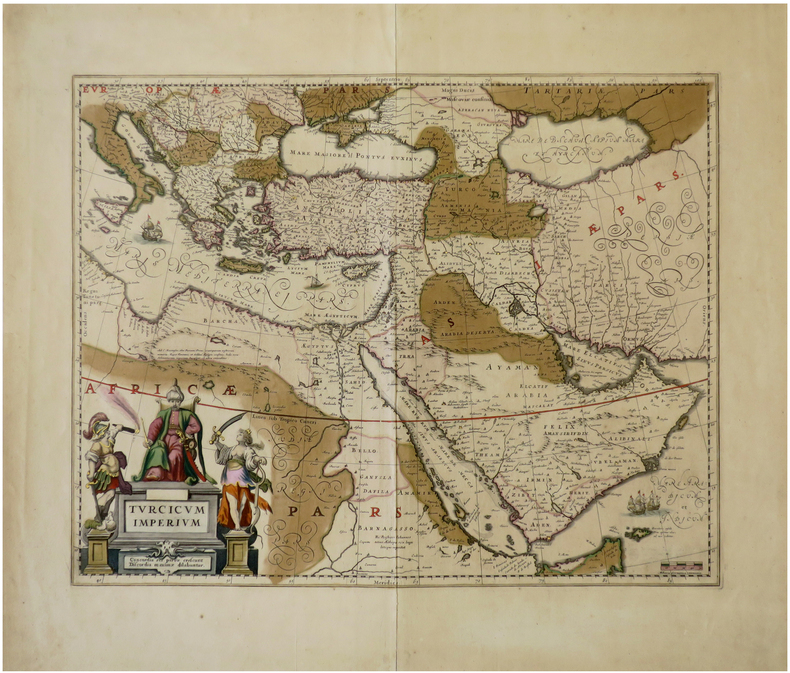
1640Best.-Nr. LBW-6792[Amsterdam, circa 1640]. 410 x 517 mm.
1882Very Good Turkish, Ottoman (1500-1928) Original Ottoman cloth bdg. Cr. 8vo. (20 x 14 cm). In Ottoman script (Old Turkish with Arabic letters). 293 p., 17 b/w plates and 1 folding map, and 1 folding linguistic table (including alphabets used in India such as Sanskrit, Brahmi, Devanagari and their pronunciations in Latin and Arabic alphabets). Slightly loosed spine, skillfully repaired a part of the spine, fading and chipped on the board's extremities, slight stains on the plates. Overall a good copy. Extremely rare (with a map and the plate at the end of the book) first edition of this eye-witness travel account of the Indo-Islamic culture during the British Raj in the late 19th century, by the Hamidian period Turkish ambassador and scholar Sirvanî (1831-1890), who had written and translated three geographical books as well. Sirvânî completed his travel memoirs on his return from India to Constantinople, where he was sent as an ambassador by Sultan Abdulhamid II between 1877-1879. The narrative of his journey begins with the landing in India from Constantinople by ferry. He describes the splendid and fascinating British Indian cities, regions, and buildings such as Bombay, Poona, Dakkan, Udaipur, Baroda, Ajmer, Jaipur, Amber Fortress, Allahabad, Benares, Calcutta, Jaipur, Lucknow, Agra, Alexandre, Delhi, Nepal, Racputana, Indor, Sind, Bundelkhand, Datia, Chatarpur, Bina, Mihr, Bihar, Bengal, Ceylon, Aligarh, Sirhind, Lahore, Kashmir, Dekkan, Orissa, Avrang, Bijapur, Malia, Khandesh, Gujarat, Hugli, Madras, Maisur, Jehlam, Sialkot, Rawalpindi, Nevshar, Mardan, Swat (now in Pakistan), Beloojistan, Peshawar, Afghanistan, Kabul, Ghazna, Kandahar, Herat, Badakhshan, etc. This first-hand travel account offers an invaluable insight into the customs of Indian peoples living in the region as well as the onomastics and ethnography of India and Afghanistan. He met Sayyid Ahmed Khan, who was the founder of the Aligarh University which was famous as the Aligarh School (founded in 1877) among the Indian people. The Aligarh Movement was the push to establish a modern system of education for the Muslim population of British India, during the later decades of the 19th century. The work includes a large chapter of Mecca, where Sirvânî stayed for a long time. He gives detailed information on the Islamic pilgrimage (Haj) and the Arabian Peninsula in this chapter. OCLC 19769728, 1030091889 (Six copies worldwide).; Ihsanoglu, pp. 269-270.; Özege 7654.; Karatay I, 268.; TBTK 1438.

1906Very Good Turkish, Ottoman (1500-1928) Original wrappers. Foolscap 8vo. (17 x 12 cm). In Ottoman script (Old Turkish with Arabic letters). 152 p. Roumi: 1324 = Gregorian: 1906. Taken from a volume including multiple books. Spine is restored. A very good copy. First and only edition of this early and extensively rare book including a first-hand account of the topography and descriptions of Hejaz, Mecca, and other parts of Arabian Peninsula such as Taif and Yemen by Sadiq Sherif, who was the first person to take photographs of Mecca, Medina, and the Hajj in 1880 and 1881 as well. Sadiq Sherif was the grandson of Serif Abdulmuttalib, the Emîr of Mecca. This book written by Sherif was dedicated to 'the Progress and Union Society' [i.e. Ittihad ve Terakki Cemiyeti]. The book describes the way of administration and territorial division of Hejaz after giving some information of its geography, borders, tribes and natives, mountains, rivers, crops and products, and animals of this Ottoman 'vilâyat' [i.e. province]. Sherif gives detailed information on how and when the Ottoman Empire ruled Hejaz, the location of Mecca city, its borders, physical and social geography, crops in Mecca and around, its flora, fauna, demographic structure, 'nahiyes', Kâba's construction, and its history, sacred places around, Masjid-i Haram and other masjids, cemeteries, mountains, gifts by Ottoman caliphs to Kaba, 'Taif' area, people who were 'Emîr' of Mecca from the period of Mohammad, Wahhabism and its birth, etc. At the last, Sherif gives place to his personal letter (layihâ) including 49 articles. The letter was about the reforms that Hejaz needs and it was sent to the Ottoman 'sadâret' [i.e. prime ministry]. (Source: History of geographical literature during the Ottoman Empire, Edited by Ihsanoglu). Muhammad Sadiq Sherif Bey was the first person to take photographs of Mecca, Medina, and the Hajj in 1880 and 1881. Sadiq Bey trained as a military engineer after completing his studies in Cairo and at the École Polytechnique in Paris. It is not known when, or from whom, Sadiq Bey learned to take photographs but it was most probably through one of the resident photographers in Egypt. In 1861, prompted by the need to carry out more extensive military land surveys of the area between Wajh and Medina, Sadiq Bey made his first journey to Arabia. He took a camera along with his surveying equipment and took his very first photographs of Medina. In a series of articles published in the Egyptian Military Gazette in 1877, he refers to his early photography at Medina describing the use of a 'photographia'. Sadly, however, none of the photographs from this first journey has survived. In 1880 he was appointed as the treasurer of the Mahmal, the ornate cloth to cover the Ka'ba brought each year on a special litter to Mecca. He accompanied the Mahmal to Medina and Mecca from September 1880 until January 1881. Again equipped with his camera, he succeeded in producing the series of photographs that are now considered some of the earliest known photographs of the region, those of the Ka'ba, taken under great secrecy. Sadiq Bey published various accounts of his travels in Arabia in military journals, through the Emiry Grand Press in Cairo, but the 1880/81 series of photographs appear to have been issued separately for wider distribution through the Société Khédiviale de Géographie. The society's secretary, Dr. Frederic Bonola, advertised sets of photographs for sale. In January and April 1880 Sadiq Bey gave a talk and report to the society on his earlier 1861 expedition, and on 20 May 1881 he presented a report on his recent journey to Mecca; detailed accounts were published in the society's bulletins, numbers 9/10 and 12. (Source: Christie's). Özege 11888.; Karatay, TM II: 695.; MKAHTBK, II: 991.; OCLC 248374684 / 4082352.
1858Large Folio, measuring 56cm x 39cm (15.5 inches x 22 inches). Original printed wrappers. Text is in Italian. [6], 72, [2] pages, plus 7 engraved plates, 5 of which are double-page. Wrappers chipped at extremities, occasional foxing, otherwise in very good condition. Scarce valuable resource on Ptolemaic Egypt. A scarce account, rarely seen in original wrappers, Pieralisi's treatise is a noteworthy study of the late Hellenistic Nile Mosaic of Palestrina, which depicts Ptolemaic Egypt and dates to circa 100 B.C. The author, Don Sante Pieralisi, was a librarian of the Barberini Library in Rome with access to many early scholars' works. The mosaic's history and construction are described, followed by a presentation of some early and compelling theories of interpretation and dating, by such scholars as Barthelemy, Antonio Nibby, Carlo Fea, and Cassiano dal Pozzo (secretary to Francesco Barberini who was largely responsible for its restoration). Much history of ancient Egyptian life can be drawn from the mosaic scenes, including the Nile's yearly flooding, Nubian hunters, mythical or extinct creatures, Egyptian-Roman trade, contrasts between peasant dwellings and palatial life, the rise of magnificent walled cities guarded by Egyptian soldiers, etc. Remarkable engravings reproduce details of the historic masterpiece. The celebrated Nile mosaic dates to circa 100 B.C. during rule of the Ptolemaic Dynasty, the last dynasty of Ancient Egypt (305 BC to 30 BC) and forms an interesting connections between ancient Egyptian and Roman civilizations, and the its essence of its design has, for several centuries, been the center of much speculation. Shortly after publication, the observations by Don Sante Pieralisi accompanied the mosaic on display in the Palazzo Barberini, where it had been placed by Prince Barberini after restoration mid-seventeenth century. Equally interesting is a chapter dedicated to the Rosetta Stone, the ancient stele decree issued at Memphis, also during the Ptolemaic dynasty. The author relates details of the French expedition to Egypt which uncovered it in 1799, and the controversial repossession and transfer to England following the Capitulation of Alexandria. He further presents important details of the temples of Apis, Serapis, and Venus at Memphis, other hidden tombs of Memphis, and pertinent Egyptian rulers.