BEUCLER, Chef de BataillonLivre Rare Book

1.492 Ergebnisse
1924Best.-Nr. 56436Par le Chef de Bataillon Beucler, VIe C.A., 12e D.I., 18e R.T.A., 1 brochure in-4 agrafée, Metz le 15 Novembre 1924, 41 pp.
1924Par le Chef de Bataillon Beucler, VIe C.A., 12e D.I., 18e R.T.A., 1 brochure in-4 agrafée, Metz le 15 Novembre 1924, 41 pp. Rare document, évoquant la propagation de l'Islam depuis les origines (les débuts de l'Islam, la religion, orthodoxes et schismatiques), son expansion (Ommeyades et Abbassides, Entrée du Turc dans l'Islam, chute de Byzance), son orientation (L'Islam entre les mains des Arabes : civilisation arabes et mysticisme ; L'Islam entre les mains des Turcs : Origines et Yassak) puis enfin sa place dans le monde actuel. Bon état pour ce curieux document Français
1750In folio (59x73 cm il foglio); esemplare in fine coloritura coeva ed in ottime condizioni di conservazione. Testo in francese in cartiglio. Magnifica e vivida tiratura di questa celeberrima carta del territorio egiziano che si sviluppa lungo il corso del fiume Nilo, con parte del territorio dell’Arabia Saudita, dell’Etiopia e Abissinia e del territorio di Suez con ben presente il Mar Rosso con anche evidenziate le profondità. La carta fu stampata dal successore e cognato del grande cartografo Matthaus Seutter (sposò una delle figlie di Seutter), il cartografo, editore ed incisore Tobias Conrad Lotter (1717 - 1777). Lotter, si formò alla bottega di Matthaus Seutter per il quale lavorò. Alla morte di Seutter ne rilevò l’attività che portò avanti fino al 1777 anno della sua morte. L’attività passo poi al figlio, Matthias Albrecht Lotter. Tobias Conrad fu uno dei più apprezzati cartografi del settecento. Il carta si ispira ai dati riportati dal gesuita R. Pere Sicard, da Alphonse Mendez, Emanuel L’Ameyda, Pierre Pays e di altri celebri missionari e studiosi gesuiti. Esemplare in ottime condizioni di conservazione ed in bella coloritura coeva. Esemplare in ottime condizioni di conservazione.
1926Best.-Nr. 144231926. Gröber Karl. Two Views of the Mosque at Mecca 1926. Pair of original copperplate photogravures depicting the Masjid al-Haram the Sacred or Grand Mosque in Mecca Islam's holiest city and the destination of the annual Hajj pilgrimage. The mosque surrounds the Kaaba toward which Muslims worldwide turn in daily prayer. Published in 1926 the illustrations date from the early period of Saudi rule over Mecca following the city's conquest by Abdulaziz Ibn Saud in 1924. The two views record the mosque from ground-level and elevated perspectives preserving photographic documentation of the sacred precinct before the extensive architectural expansions of the later twentieth century. Gröber Karl photographer. Two Views of the Mosque at Mecca. 1926. Two original copperplate photogravures after photographs by Gröber published in the first edition of a 1926 book containing his text and photographic illustrations. Each sheet measures approximately 8.25" x 10.25" with a printed area of approximately 6.25" x 8.25". The first photogravure presents a ground-level view of the mosque recording its architecture from within the surrounding urban setting. The second provides a bird's-eye view of the mosque showing the sacred complex from an elevated perspective. Both illustrations reproduce the tonal gradations and architectural details of the original photographs through the copperplate photogravure process. The illustrations were published during a decisive period in the modern history of Mecca. Following the collapse of Ottoman authority in the Hejaz during the First World War the city came under Hashemite rule before its capture by Ibn Saud in 1924. In 1926 Ibn Saud assumed the title King of the Hejaz incorporating Mecca into the expanding Saudi state. The paired views record the mosque's architectural setting during this transition preceding the major expansion and redevelopment campaigns undertaken from the mid-twentieth century onward. Both original photogravures are in excellent condition presenting complementary perspectives of the Grand Mosque as reproduced in 1926. unknown
1926Best.-Nr. 144231926. Gröber Karl. Two Views of the Mosque at Mecca 1926. Pair of original copperplate photogravures depicting the Masjid al-Haram the Sacred or Grand Mosque in Mecca Islam's holiest city and the destination of the annual Hajj pilgrimage. The mosque surrounds the Kaaba toward which Muslims worldwide turn in daily prayer. Published in 1926 the illustrations date from the early period of Saudi rule over Mecca following the city's conquest by Abdulaziz Ibn Saud in 1924. The two views record the mosque from ground-level and elevated perspectives preserving photographic documentation of the sacred precinct before the extensive architectural expansions of the later twentieth century. Gröber Karl photographer. Two Views of the Mosque at Mecca. 1926. Two original copperplate photogravures after photographs by Gröber published in the first edition of a 1926 book containing his text and photographic illustrations. Each sheet measures approximately 8.25" x 10.25" with a printed area of approximately 6.25" x 8.25". The first photogravure presents a ground-level view of the mosque recording its architecture from within the surrounding urban setting. The second provides a bird's-eye view of the mosque showing the sacred complex from an elevated perspective. Both illustrations reproduce the tonal gradations and architectural details of the original photographs through the copperplate photogravure process. The illustrations were published during a decisive period in the modern history of Mecca. Following the collapse of Ottoman authority in the Hejaz during the First World War the city came under Hashemite rule before its capture by Ibn Saud in 1924. In 1926 Ibn Saud assumed the title King of the Hejaz incorporating Mecca into the expanding Saudi state. The paired views record the mosque's architectural setting during this transition preceding the major expansion and redevelopment campaigns undertaken from the mid-twentieth century onward. Both original photogravures are in excellent condition presenting complementary perspectives of the Grand Mosque as reproduced in 1926. unknown books
Best.-Nr. DADAX1138466689New unknown
Best.-Nr. DADAX0415274192New unknown
193458 pages. Features: Nice color cover illustration of young lady on snowshoes at her wintry mailbox; Interesting editorial explains why 'Mac' made the trip to attend the Mount Royal burial of General Currie; The Real Tragedy of Douglas Fairbanks and Mary Pickford - article with photos; Romance! - a lively tale of dreams come true; Nostalgic one-page color ad for Campbell's Tomato Soup; Liberty's All-Players All-America Football Team for 1933 - article with photos; What is the Modern Idea? - Frank Lloyd Wright looks into the future; Three Hundred a Month - a story of human hearts and a successful calamity; The Things Men Fear - Talbot Mundy confesses his moments of terror while hunting; The Case of the Howling Dog - Perry Mason unmasks a woman of mystery (part 5); To the Ladies; I Flew Lawrence [of Arabia] in War-Crazed Arabia - photo-illustrated article by Captain John H. Norton; Movie Photos and Reviews - Lady Killer, Man of Two Worlds, Son of Kong, Woman Spy; Vox Pop; Transient Lady - part 8 of a vivid novel of dangerous days and a girl's devotion; A Nice Quite House (short story); Back cover color-photo ad for Royal York cigarettes features young couple in formal attire. Unmarked with average wear. Binding intact. A sound vintage copy. Book
1882Wear to extremities. Tissue protector to frontispiece torn. Front hinge started; Conflict from two millenia ago ; Color Illustrations; 12mo 7" - 7½" tall; 292 pages
Best.-Nr. DADAX0367482398New unknown
1995155 pages. Bilingual English-Arabic. "Reviews the huge positive development that has taken place in more than half a century... Shows the old simple ways of living, desert life, pasturing, pearl diving, irrigation and farming, sea trade through simple traditional ports - then moves to the period following the discovery of oil and the developments which followed the proper use of such natural resources making this Province a high-tech employment area and a place that the world looks up to." - from Publisher's Note. Clean, bright and unmarked with negligible wear. Beautiful copy. Bonus: This copy belonged to the grandfather of a Canadian working in Saudi Arabia. Laid-in is a lengthy and interesting letter to the grandfather. Book
1731Best.-Nr. PHO-2184Amsterdam, Chez Pierre Humbert, 1731, in-12 (15,5x9,5cm), relié plein veau époque, dos à nerfs orné avec pièce de titre grenat, tranches rouges, filet aux plats, frottements, accroc à la coiffe sup., coins usés, ex-libris et étiquette de libraire en page de garde.
1780Best.-Nr. 35069Paris, Dezauche 1780. Dekorative, altkolorierte Kupferstich-Karte in der Plattengröße von 48 x 63 cm (Blattgr. 54,5 x 74,5 cm). An den Rändern stellenweise etwas bestoßen.
1866Best.-Nr. PHO-2081Paris, Hachette., 1866. 2 vol. in-8° de XVI, 346 pp. ; 429, 1 bl., [1] pp. Front. 1 carte et 4 plans h.-t. Demi-chagrin rouge, dos à 4 faux-nerfs, titre et tom. dorés (Reliure de l'époque). Reliure usée, des rousseurs. La p. de titre du tome I est reliée après l'introduction. Bon exemplaire. Édition originale de la traduction. Complet du portrait de l’auteur et des plans.
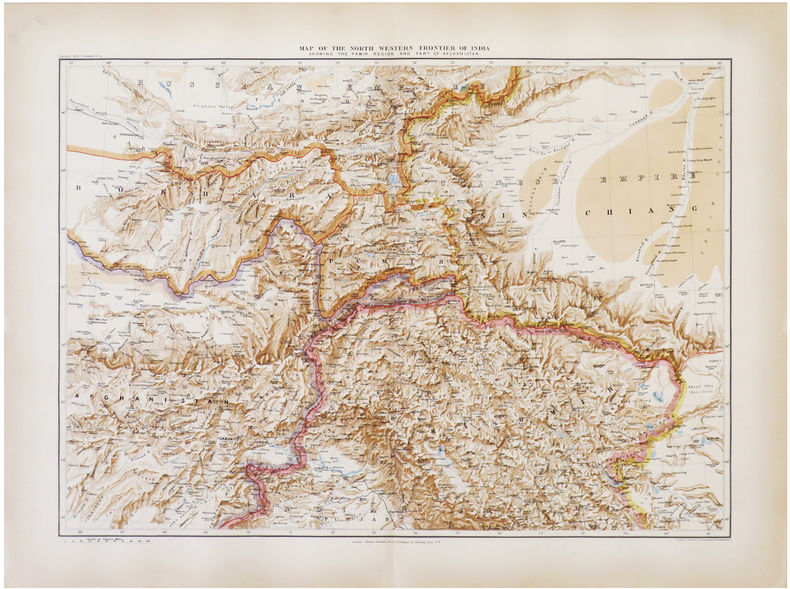
1896Best.-Nr. LBW-6821London, Edward Stanford, 1896. 470 x 640 mm.
1910Very Good Turkish, Ottoman (1500-1928) Paperback. With a pictorial cover. Large roy. 8vo. (23 x 18 cm). In Ottoman script [and French on the cover]. 355-442 pp., ills. Bilingual cover is written 'Medeniyet Ordusu Yemen çöllerinde' and 'L!Armee dans le Desert de Yemen' bilingual in Turkish with Arabic script and in French. [i.e. The Ottoman civilized army in the desert of Yemen]. Extremely rare.
19308vo., First Edition, on laid paper, with large folding map on japon, half-title and title very lightly spotted, lower corner of half-title and several following leaves lightly creased; handsomely bound in full dark red crushed morocco, sides with gilt frame border, back with raised bands, second and fourth compartments lettered and ruled in gilt, all other compartments tooled and ruled in gilt, gilt top, hand-made endpapers, ribbon marker, fore-edge faintly spotted else an attractive copy ideal as a gift or for presentation. With a double-page genealogy of the House of Sa'ud. Published in Benn's series 'The Modern World'. Bright copy of a key work by the great Arabist.
1866Best.-Nr. 80646Paris, Librairie Hachette et Cie 1866 Deux volumes. In-8 24 x 15 cm.Reliures demi-chagrin cerise, dos à nerfs, caissons ornés, 429-346 pp. Bien complet de la carte et des 4 plans en noir hors-texte. Humidité clair marginale en fin du premier volume. Coins lég. émoussés. Bon exemplaire
1780Best.-Nr. 144401780. Irwin Eyles. A Series of Adventures in the Course of a Voyage up the Red Sea 1780. Early Dublin edition of Irwin's firsthand account of his 1777 journey along the Arabian and Egyptian coasts of the Red Sea and through the deserts of Upper Egypt. Born in Calcutta and employed by the British East India Company Irwin undertook the journey after his dismissal from Company service in 1776 traveling to England to seek redress. His eleven-month passage involved encounters with pirates detention difficult desert crossings and travel through territories seldom described firsthand by European visitors. Written as a series of letters addressed to an unnamed lady the narrative records maritime commerce Bedouin encounters local customs and relations between European travelers and Arab populations in the late eighteenth century. Irwin's account also documents the practical difficulties of traveling between British India and Europe through the Red Sea and Ottoman-controlled Egypt. Irwin Eyles. A Series of Adventures in the Course of a Voyage up the Red Sea on the Coast of Arabia and Egypt; and of a Route through the Deserts of Thebais Hitherto Unknown to the European Traveller in the year MDCCLXXVII in Letters to a Lady. Dublin: Sleater Whitestone Potts Colles Wilson Jenkins Flin et al. 1780. Early Dublin edition. One volume 576 pages described as quarto 4to. Bound in antique full leather with gilt decoration to the spine and original title label. Retains the original folding map of the Red Sea with two additional maps lacking. The narrative follows Irwin's passage from India toward England including his experiences along the Arabian coast and his overland journey from Cosseir Quseir through the Egyptian desert toward the Nile Luxor Cairo and Alexandria. His letters describe encounters with local inhabitants the difficulties of desert transportation and conditions in the ports and settlements through which he traveled. The text also includes Irwin's poems "Ode to the Desert" and "Ode to the Nile." The work is referenced in Blackmer Collection 865 and Atabey Collection 609. Published in 1780 Irwin's narrative belongs to the early literature of British travel through the Arabian Peninsula and Egypt when the East India Company's expanding commercial interests made the Red Sea an increasingly consequential passage between India and Europe. His descriptions of Bedouin groups including episodes characterized by the historian Kathryn Tidrick as a prolonged account of Bedouin treachery also preserve the prejudices and expectations through which British travelers interpreted Arab societies. The letters combine personal misadventure with geographical observations and descriptions of regional transportation commerce and encounters between foreign travelers and local authorities. The rear board has been reattached with dark stitching while the front hinge has a 3½" split but remains firm. Corners are bumped and worn with wear and some chipping to the head and foot of the spine. Interior pages remain in very good condition; overall good condition. An early Dublin printing retaining its folding Red Sea map and Irwin's account of travel through Arabia and Egypt in 1777. unknown
1780Best.-Nr. 144401780. Irwin Eyles. A Series of Adventures in the Course of a Voyage up the Red Sea 1780. Early Dublin edition of Irwin's firsthand account of his 1777 journey along the Arabian and Egyptian coasts of the Red Sea and through the deserts of Upper Egypt. Born in Calcutta and employed by the British East India Company Irwin undertook the journey after his dismissal from Company service in 1776 traveling to England to seek redress. His eleven-month passage involved encounters with pirates detention difficult desert crossings and travel through territories seldom described firsthand by European visitors. Written as a series of letters addressed to an unnamed lady the narrative records maritime commerce Bedouin encounters local customs and relations between European travelers and Arab populations in the late eighteenth century. Irwin's account also documents the practical difficulties of traveling between British India and Europe through the Red Sea and Ottoman-controlled Egypt. Irwin Eyles. A Series of Adventures in the Course of a Voyage up the Red Sea on the Coast of Arabia and Egypt; and of a Route through the Deserts of Thebais Hitherto Unknown to the European Traveller in the year MDCCLXXVII in Letters to a Lady. Dublin: Sleater Whitestone Potts Colles Wilson Jenkins Flin et al. 1780. Early Dublin edition. One volume 576 pages described as quarto 4to. Bound in antique full leather with gilt decoration to the spine and original title label. Retains the original folding map of the Red Sea with two additional maps lacking. The narrative follows Irwin's passage from India toward England including his experiences along the Arabian coast and his overland journey from Cosseir Quseir through the Egyptian desert toward the Nile Luxor Cairo and Alexandria. His letters describe encounters with local inhabitants the difficulties of desert transportation and conditions in the ports and settlements through which he traveled. The text also includes Irwin's poems "Ode to the Desert" and "Ode to the Nile." The work is referenced in Blackmer Collection 865 and Atabey Collection 609. Published in 1780 Irwin's narrative belongs to the early literature of British travel through the Arabian Peninsula and Egypt when the East India Company's expanding commercial interests made the Red Sea an increasingly consequential passage between India and Europe. His descriptions of Bedouin groups including episodes characterized by the historian Kathryn Tidrick as a prolonged account of Bedouin treachery also preserve the prejudices and expectations through which British travelers interpreted Arab societies. The letters combine personal misadventure with geographical observations and descriptions of regional transportation commerce and encounters between foreign travelers and local authorities. The rear board has been reattached with dark stitching while the front hinge has a 3½" split but remains firm. Corners are bumped and worn with wear and some chipping to the head and foot of the spine. Interior pages remain in very good condition; overall good condition. An early Dublin printing retaining its folding Red Sea map and Irwin's account of travel through Arabia and Egypt in 1777. unknown books
1955Exemplaire sur vélin Plumex numéroté (n° 3361), Edition illustrée de 80 aquarelles par Van Dongen, 3 vol. fort in-4 carré cartonnage éditeur réalisé d'après des maquettes de Paul Bonet, NRF, Gallimard, Fasquelle, Paris, 1955 Bon exemplaire bien complet des étuis, et des prospectus d'origine (2 prospectus du tome I et 1 prospectus du tome II). Bon état (accroc à un rhodoïde, un étui lég. frotté) pour cet exemplaire de l'édition en cartonnage Bonet illustré par Van Dongen. Français
Best.-Nr. DADAX0195074408New unknown
1949Light rubbing to spine ends. Hinges professionally repaired. ; Profusely illustrated, partly in color: maps, charts, photographs ; 8vo; 648 pages
Best.-Nr. DADAX0415728800New unknown
London and Cambridge, MacMillan and Co., 1866, volumi 2, in-8, legatura editoriale in piena tela verde con figura di beduino che conduce un cammello impressa in oro al centro dei piatti anteriori, titolo e numero di volumi in oro ai dorsi, pp. XII, [2], 466, [2] - [8], 398, [2]. Con ritratto dell'autore in antiporta al primo volume, una grande carta geografica dell'Arabia più volte ripiegata e 4 piante ripiegate f.t. Esemplare più che buono: solo la cerniera del piatto anteriore del primo volume è usurata all'interno, nel punto di contatto fra la controguardia anteriore e la prima carta di guardia.