(Jamaica) Sterne, HenryBiblio.com

1837Best.-Nr. 333372London: Printed by J. C. Chappell 1837. First edition. xii 282 vii 1pp. 8vo. Contemporary cloth black morocco spine label yellow endpapers. First edition. xii 282 vii 1pp. 8vo. An impassioned appeal by Henry Sterne resident of St. George Jamaica in defense of "apprentices" i.e. newly-freed slaves following the 1834 emancipation in the West Indies who have suffered mistreatment citing detailed legal cases and presenting legal and religious arguments: "The iron yoke of slavery for apprenticeship is equally as bad if not worse still reigns. The lash dungeons and chains are in constant attendance throughout the land and will remain so for near four long years to come" p. vii. Sabin 91337; not in Cundall Printed by J. C. Chappell unknown
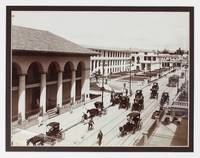
1910Best.-Nr. 5793Kingston: A. Duperly & Sons 1910. About very good. Eight glossy sepia-toned photographs each approximately 6 x 9 inches; matted to 14 x 16 inches. Some creasing and wear more pronounced on a handful of images. Minor soiling minimal fading crisp images. A nice group of photographs from the noted Kingston studio of A. Duperly and Sons initially established by patriarch Adolphe Duperly in the 1840s. The images here show local life and scenery including a view of the rebuilt King Street following the 1907 earthquake; local women with baskets perched atop their heads; a man carrying bananas; and several images featuring locals at bends in a river notably one that shows a dapper Black man seated by a stream beneath some palm trees his hat resting on his upturned knee. A wonderful representation of the work accomplished by the Duperly studio after it was rebuilt following the Kingston Earthquake of 1907. A. Duperly & Sons unknown books
1910Best.-Nr. 5793Kingston: A. Duperly & Sons 1910. About very good. Eight glossy sepia-toned photographs each approximately 6 x 9 inches; matted to 14 x 16 inches. Some creasing and wear more pronounced on a handful of images. Minor soiling minimal fading crisp images. A nice group of photographs from the noted Kingston studio of A. Duperly and Sons initially established by patriarch Adolphe Duperly in the 1840s. The images here show local life and scenery including a view of the rebuilt King Street following the 1907 earthquake; local women with baskets perched atop their heads; a man carrying bananas; and several images featuring locals at bends in a river notably one that shows a dapper Black man seated by a stream beneath some palm trees his hat resting on his upturned knee. A wonderful representation of the work accomplished by the Duperly studio after it was rebuilt following the Kingston Earthquake of 1907. A. Duperly & Sons unknown
1989Best.-Nr. 81445Knopf. New. Paperback. FREE UPGRADE to Courier/Priority Shipping Upon Request - IN STOCK AND IMMEDIATELY AVAILABLE FOR SHIPMENT - FLAWLESS COPY BRAND NEW PRISTINE NEVER OPENED -- - Corresponds to ASIN: B002WWWWWI. 18 pages 4to. 9 illustrations. -- with a bonus offer-- . 1989. Knopf paperback
1989Best.-Nr. 81444Knopf. New. Hardcover. FREE UPGRADE to Courier/Priority Shipping Upon Request - IN STOCK AND IMMEDIATELY AVAILABLE FOR SHIPMENT - FLAWLESS COPY BRAND NEW PRISTINE NEVER OPENED -- - Corresponds to ASIN: B001ISIFZ0. 18 pages 4to. 9 illustrations. -- with a bonus offer-- . 1989. 0394580354 . Knopf hardcover
1998Best.-Nr. 91227New York New York U.S.A.: Umbrage Editions. New. Hardcover. FREE UPGRADE to Courier/Priority Shipping Upon Request - IN STOCK AND IMMEDIATELY AVAILABLE FOR SHIPMENT - FLAWLESS COPY BRAND NEW PRISTINE NEVER OPENED - SIGNED AND DATED BY GEESAMAN. First edition so stated. -- with a bonus offer--; POETICS PHOTOGRAPHS LITERARY CRITICISM POETRY . 1998. 1884167012 . Umbrage Editions hardcover
1998Best.-Nr. 91226New York New York U.S.A.: Umbrage Editions. New. Hardcover. FREE UPGRADE to Courier/Priority Shipping Upon Request - IN STOCK AND IMMEDIATELY AVAILABLE FOR SHIPMENT - FLAWLESS COPY BRAND NEW PRISTINE NEVER OPENED - First edition so stated. -- with a bonus offer--; POETICS PHOTOGRAPHS LITERARY CRITICISM POETRY . 1998. 1884167012 . Umbrage Editions hardcover
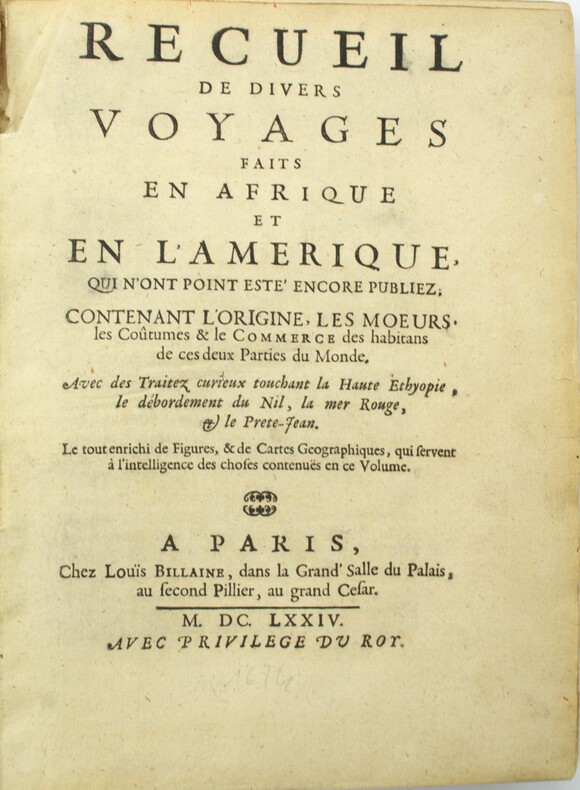
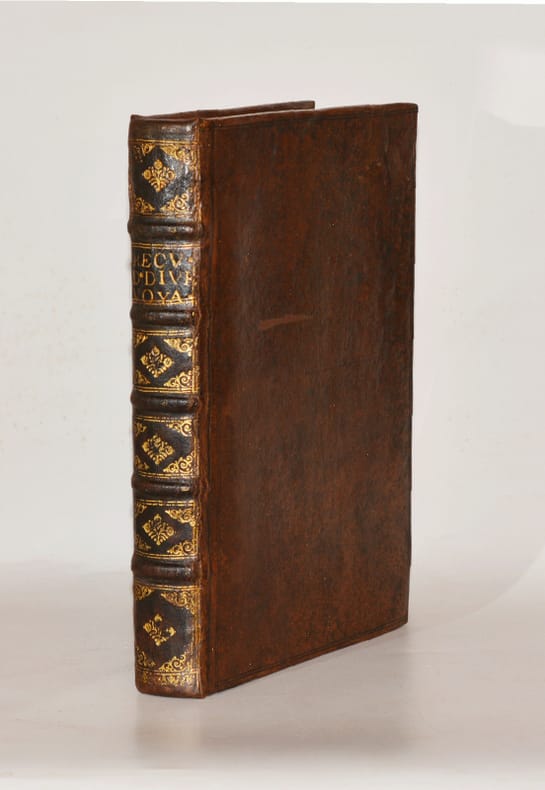
1674Best.-Nr. PHO-2243Paris, Louis Billaine, 1674, in-4 (228x164), basane postérieure (19eme), dos à nerfs avec titre, lieu et date, tranches marbrées, réparations au dos et aux coins, petite réparation au pli de la carte des Barbades, intérieur frais, illustré de 12 planches (13) et trois cartes dépliantes (Barbades, Jamaïque et Virginie, Maryland et la Nouvelle-Angleterre) manque la carte du Nil comme souvent et un faux titre
1986Best.-Nr. 60767New York:: Library Fellows of the Whitney Museum of American Art 1986. First edition; one of 145 copies signed by Jamaica Kincaid and Eric Fischl. publisher's black cloth in slipcase. A very fine copy except for a few slight marks to the black cloth in a near fine slipcase. Oversized folio. Illustrated with seven lithographs by Fischl. Library Fellows of the Whitney Museum of American Art, hardcover
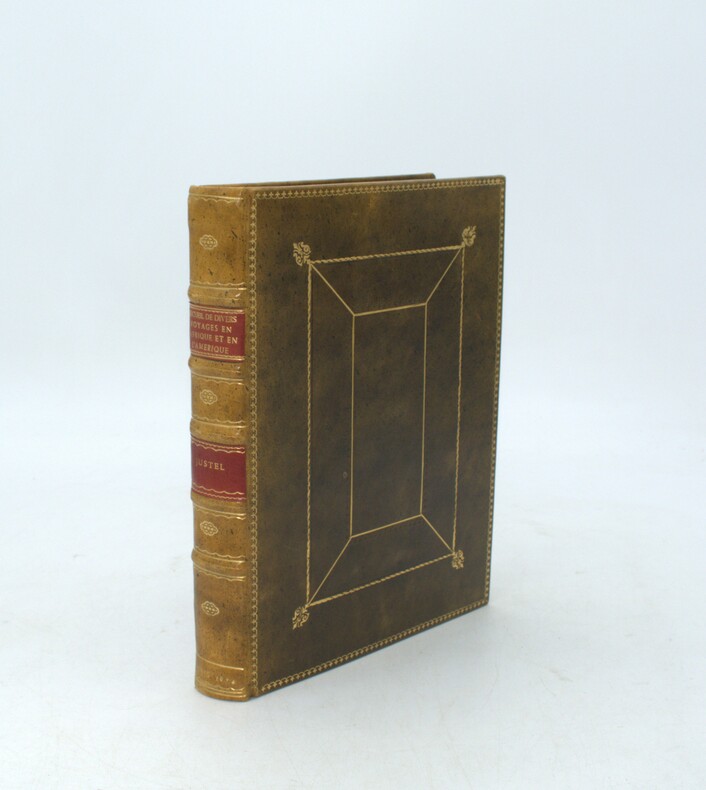
1674Best.-Nr. PHO-2032Paris, Louis Billaine, 1674. in-4 (228x164) , relié plein veau , filets sur les plats , dos à nerfs orné avec titre , auteur et date (reliure pastiche),tranches rouge. L'ouvrage est illustré de 12 planches hors texte, une carte de l'Éthiopie dans le texte, trois cartes dépliantes (Barbades, Jamaïque et Virginie, Maryland et la Nouvelle-Angleterre) manque la carte du Nil, mouillures, déchirure et réparation au pli (carte des Barbardes)
1758FIRST AND ONLY EDITION OF THIS ATLAS OF THE BRITISH WEST INDIES, published in France during the Seven Years' War (also known as the "French and Indian War".) xii, 171 pp + engraved title and THIRTEEN FINE MAPS, of which 8 are folding (complete). Also illustrated with ten headpieces, nine of which depict the entry into a major port. Includes Jamaica (with several maps), Barbuda, St. Kitts, Nevis, the Virgin Islands, Anguilla, Antigua, the Lucayes (now the Bahamas), and Bermuda. 4to (26 x 20.3 cm). Attractively bound in contemporary calf, with the ARMS OF KING LOUS XV OF FRANCE EMBLAZONED IN GILT ON FRONT AND BACK COVERS. Binding restored at head and tail of spine, and very solid. Small, faint marginal stain to engraved title-page, else INTERNALLY FINE AND BRIGHT, WITH MAPS AND TEXT VERY FRESH. Sabin 4553. RARE AND IMPORTANT.
Best.-Nr. 3417Fischl Eric. Fischl Ericillus. ANNIE GWEN LILLY PAM AND TULIP by Jamaica Kincaid. American Livre de Peintre 16. Whitney Museum NY 1986. Edition of 145 copies signed by Fischl and Kincaid. Oversize folio black cloth slipcase in green cloth 28 pp. text and nine lithographs five in color. Fine throughout. "Fischl's illustrations perfectly match the exotic heat of the tale and its latent sexuality. The prints are variosly folded tipped-in and bound to echo the tale's unexpected turnings. He brgins in black and white presenting the five as if at some camp overnight. He moves on to luxuriant colors and suggestive scenes showing them tempted to leave each other for the unknown." The Print Collector's Newsletter. hardcover
Best.-Nr. 005460Paris, Louis Billaine, 1674. Cinq parties reliées en un volume in-quarto (180 X 250 mm) basane fauve marbrée, dos brun à nerfs orné de fers dorés, titre doré, tranches mouchetées en rouge (Reliure de l’époque) ; (8) ff. de titre, avis au lecteur, extrait du privilège, 262 pages, 14 planches h.-t. (dont 7 dépliantes) - 23 pages - 49 pages, 3 planches h.-t. - 83 pages [et non 81 pages, il y a en effet deux pages 54/55], 1 planche dépliante h.-t. - 35 pages, 1 planche dépliante h.-t. Discrètes et habiles restaurations à la reliure, épidermures sur les plats, infime travail de ver en fond de cahier sans atteinte au texte du premier tiers de l'ouvrage. SANS le faux titre "Colonies Anglaises" ni la CARTE de la "Description Topographique et mesure de l'Isle des Barbades aux Indes Occidentales" qui manque souvent.
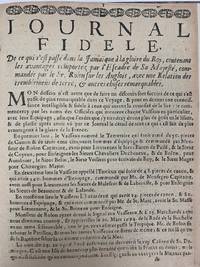
1695Best.-Nr. 60184to. 227 x 170 mm. 8 pp. Bound in marbled paper over boards. Margins short cropping page numbers on 2 leaves and just touching but not obscuring the top of some letters of text. Generally very good. Very rare with one recorded copy in Bordeaux of a detailed and lively account of this French expedition against Jamaica during the Nine Years War comprising a string of brutal attacks over the summer of 1694 led by Jean-Baptiste Du Casse. Appointed Governor of Saint-Domingue in 1691 Du Casse had earlier in his career been involved with the slave-trading Compagnie du Senegal and had served throughout the Atlantic world in various capacities including as admiral and privateer. Very familiar with the Caribbean and the ways of the filibusterers and buccaneers operating there he was the best candidate for the difficult job of rallying competing interests to align with those of la France d'outre-mer at a time when funding from France was scarce with Louis XIV distracted by the War of the League of Augsburg closer to home. In brief 3 French warships accompanied by numerous transport ships under the command of Captain Rollon were sent to Saint Dominique to provide support to the colonists against the Spanish in neighboring Hispaniola. Soon after their arrival they were reassigned by Du Casse to cruise off Jamaica in early April 1694 where they eventually landed at Port Morant on the eastern coast of the island. Over a period of six to seven weeks they ravaged plantations destroyed over 50 sugar-works and kidnapped hundreds of slaves along with killing and torturing numerous English colonists. Soon to follow Du Casse assembling a small fleet of colonial brigantines and sloops embarked from Saint Dominique with 1500 men for Jamaica. He set sail down the southern coast to Carlisle Bay en route to Spanish Town which he planned to plunder. However a militia company of planters and slaves successfully defended their ground and Du Casse withdrew to St. Dominque but not before destroying Carlisle Bay. "The expeditions richest prize was undoubtedly the 1300 to 3000 captured slaves who proved crucial to the immediate future prosperity of the French colony" Pritchard p. 318 where our narrator points out they could be sold for 60 to 120 piastres each. Narrated chronologically the eye-witness account gives vivid testimony to the preparations execution and aftermath of the expedition against Jamaica over the spring and summer months and into the fall of 1694 touching on the internal state of martial affairs between the Spanish and French on the divided island they occupied together. The narrator's lively digressions and personal reflections leave no doubt that he was on the spot when he comments on the disease probably Yellow Fever which ravaged the crews the tremors under foot which incited fear of another earthquake like the one which flattened Port Royal two years before the unexpected collateral encounters and skirmishes with the English in the area related through colorful anecdotes and the general atmosphere of depravation of the crews and the weakness of the Saint Dominique defenses against incursion by the Spanish as a result in large part to the lack of sufficient material support coming from France. "If Du Casse could declare the attack on Jamaica a success the same conclusion could not be made by the navy. By August sickness was swiftly reducing crew numbers. Le Solide which had been long in the Islands was immediately sent back to France her crew being too diminished for further use. Le Téméraire had lost 50 of her best sailors and the captain of the English prize now called Le Faucon had died. By September L'Envieux had lost 100 men including her captain and disease claimed Captain du Rollon of Le Téméraire. The four warships including Le Hazardeux departed Cap Francais in early October but further disaster awaited them in the Atlantic" Pritchard p.318– storms capture by the English starvation fire shipwreck disappearance and death. Of the 350 men who departed France at the beginning of the year only 130 returned by year's end. Collated against the copy at the Collection de la ville de Bordeaux Bibliotheque municipale see https://issuu.com/scduag/docs/bbx17016 a copy with numerous printer's creases significantly obscuring text; Pritchard In Search of Empire: The French in the Americas 1670-1730 Cambridge 2004; Charlevoix Histoire de l'Isle Espagnole ou de S. Domingue 1731 vol. 2 p. 261. Not in Landis. hardcover books
1695Best.-Nr. 60184to. 227 x 170 mm. 8 pp. Bound in marbled paper over boards. Margins short cropping page numbers on 2 leaves and just touching but not obscuring the top of some letters of text. Generally very good. Very rare with one recorded copy in Bordeaux of a detailed and lively account of this French expedition against Jamaica during the Nine Years War comprising a string of brutal attacks over the summer of 1694 led by Jean-Baptiste Du Casse. Appointed Governor of Saint-Domingue in 1691 Du Casse had earlier in his career been involved with the slave-trading Compagnie du Senegal and had served throughout the Atlantic world in various capacities including as admiral and privateer. Very familiar with the Caribbean and the ways of the filibusterers and buccaneers operating there he was the best candidate for the difficult job of rallying competing interests to align with those of la France d'outre-mer at a time when funding from France was scarce with Louis XIV distracted by the War of the League of Augsburg closer to home. In brief 3 French warships accompanied by numerous transport ships under the command of Captain Rollon were sent to Saint Dominique to provide support to the colonists against the Spanish in neighboring Hispaniola. Soon after their arrival they were reassigned by Du Casse to cruise off Jamaica in early April 1694 where they eventually landed at Port Morant on the eastern coast of the island. Over a period of six to seven weeks they ravaged plantations destroyed over 50 sugar-works and kidnapped hundreds of slaves along with killing and torturing numerous English colonists. Soon to follow Du Casse assembling a small fleet of colonial brigantines and sloops embarked from Saint Dominique with 1500 men for Jamaica. He set sail down the southern coast to Carlisle Bay en route to Spanish Town which he planned to plunder. However a militia company of planters and slaves successfully defended their ground and Du Casse withdrew to St. Dominque but not before destroying Carlisle Bay. "The expeditions richest prize was undoubtedly the 1300 to 3000 captured slaves who proved crucial to the immediate future prosperity of the French colony" Pritchard p. 318 where our narrator points out they could be sold for 60 to 120 piastres each. Narrated chronologically the eye-witness account gives vivid testimony to the preparations execution and aftermath of the expedition against Jamaica over the spring and summer months and into the fall of 1694 touching on the internal state of martial affairs between the Spanish and French on the divided island they occupied together. The narrator's lively digressions and personal reflections leave no doubt that he was on the spot when he comments on the disease probably Yellow Fever which ravaged the crews the tremors under foot which incited fear of another earthquake like the one which flattened Port Royal two years before the unexpected collateral encounters and skirmishes with the English in the area related through colorful anecdotes and the general atmosphere of depravation of the crews and the weakness of the Saint Dominique defenses against incursion by the Spanish as a result in large part to the lack of sufficient material support coming from France. "If Du Casse could declare the attack on Jamaica a success the same conclusion could not be made by the navy. By August sickness was swiftly reducing crew numbers. Le Solide which had been long in the Islands was immediately sent back to France her crew being too diminished for further use. Le Téméraire had lost 50 of her best sailors and the captain of the English prize now called Le Faucon had died. By September L'Envieux had lost 100 men including her captain and disease claimed Captain du Rollon of Le Téméraire. The four warships including Le Hazardeux departed Cap Francais in early October but further disaster awaited them in the Atlantic" Pritchard p.318– storms capture by the English starvation fire shipwreck disappearance and death. Of the 350 men who departed France at the beginning of the year only 130 returned by year's end. Collated against the copy at the Collection de la ville de Bordeaux Bibliotheque municipale see https://issuu.com/scduag/docs/bbx17016 a copy with numerous printer's creases significantly obscuring text; Pritchard In Search of Empire: The French in the Americas 1670-1730 Cambridge 2004; Charlevoix Histoire de l'Isle Espagnole ou de S. Domingue 1731 vol. 2 p. 261. Not in Landis. hardcover
1662Best.-Nr. 250234Southampton House England 1662. 1 bifolium 11-3/4 x 8-1/4 in. accomplished entirely in manuscript. Docketed verso: "Sr Tho. Whetstones warrant for £100 out of the privy seals dormant. indistinct initials follow.". 1 vols. 4to. Former fold lines per usual; some surface soil to recto of document; heavy surface soil to verso of integral cognate; small perimeter chips and light distress. 1 bifolium 11-3/4 x 8-1/4 in. accomplished entirely in manuscript. Docketed verso: "Sr Tho. Whetstones warrant for £100 out of the privy seals dormant. indistinct initials follow.". 1 vols. 4to. According to David F. Marley's Pirates of the Americas Sir Thomas Whetstone 1630/31-1668 was a nephew of Oliver Cromwell "reduced from a Commonwealth naval Commodore into an impoverished West Indian rover before dying in Spanish hands." Whetstone is described by ODNB as a naval officer and adventurer and a son of the favorite sister of the protectorate. Through nepotism per the protector's "misplaced patronage" Whetsone quickly rose through the naval ranks. He ascended from a volunteer on Penn's flagship in the 1654 expedition to Hispaniola was given command of a ship on the return voyage home and eventually commanded a squadron cruising the waters between Malta and Crete. Whetstone soon became a man of questionable integrity. He flouted orders sold grain seriously needed to sustain the fleet for his own profit quarreled with officers and in general showed high levels of insolence incompetence and dallied onshore avoiding naval duties. Cromwell's death changed Whetstone's fortunes. When it became apparent to political forces that his usefulness as a pawn to control the naval fleet was insignificant Whetsone returned to England at the restoration impoverished and spent. By 1661 he was in a debtor's jail in Marshalsea where he became a royal nuisance by "bombarding" the government for employment and begging relatives for money. Finally to put this embarrassment out of harm's way the King agreed in April 1662 to give Whetstone £100 and to establish him as a Jamaican planter. The money was considered "royal bounty for his encouragement in settling a plantation in the Isle of Jamaica." Additionally Whetsone was given twelve indentured men to help him establish a foothold in the New World. Here then is the material evidence that propels Whetstone towards his destiny in the West Indies. The document is signed "T. Southampton" by Sir Lawrence Tanfield Earl of Southampton Keeper of the Privy Seal. Addressed to and directing Sir Robert Pye auditor of the exchequer and indicating that he is to give Sir Thomas Whetstone £100 ". as of his Majesty's free gift for his incouragement sic in settling a plantation in the Island of Jamaica." With this document a new chapter in Whetstone's life opened upon his arrival in Jamaica in 1662. As Marley notes Whetstone's first actions in the West Indies was not to become a sedentary planter but to be a privateer. With an Indian crew he began operating and raiding off the Cuban coast. Then personally providing recent intelligence to the infamous Sir Christopher Myngs 1625-1666 an English admiral and pirate whose riotous atrocities with his buccaneers were legendary Whetstone joined in Myngs' 1662 sacking of Santiago de Cuba. Myngs was hated by the Spanish and famed for his unbridled cruelty. His atrocities next year in 1663 with pirates Henry Morgan and Abraham Blauvelt would alarm and forced King Charles II to call for a moratorium on further attacks. In the same year Whetstone was likewise endeavoring: on record as commander of a 7-gun Spanish prize manned by sixty souls and noted as one of the "private ships of war belonging to Jamaica." In addition to his exploits at sea Whetsone was heavily involved with the arrest and deposal of the Jamaican Speaker of Assembly Samuel Long on charges of treason in 1664. By 1666 Whetsone himself became Speaker of the Jamaica House of Assembly. Circa this period he was captured by the Spanish on Providencia Island carried as a prisoner to Portobelo and then force-marched to Panama City where he was tossed in the dungeon. So angry were the Spanish at Whetstone's piratical depredations the Governor Juan Perez de Guzman wrote to Madrid blaming the man for planning "all the damage done on these coasts." Whetsone died in Spanish captivity in 1667. See ODNB; Marley Pirates of the Americas pp. 399-405 unknown books
1662Best.-Nr. 250234Southampton House England 1662. 1 bifolium 11-3/4 x 8-1/4 in. accomplished entirely in manuscript. Docketed verso: "Sr Tho. Whetstones warrant for £100 out of the privy seals dormant. indistinct initials follow.". 1 vols. 4to. Former fold lines per usual; some surface soil to recto of document; heavy surface soil to verso of integral cognate; small perimeter chips and light distress. 1 bifolium 11-3/4 x 8-1/4 in. accomplished entirely in manuscript. Docketed verso: "Sr Tho. Whetstones warrant for £100 out of the privy seals dormant. indistinct initials follow.". 1 vols. 4to. According to David F. Marley's Pirates of the Americas Sir Thomas Whetstone 1630/31-1668 was a nephew of Oliver Cromwell "reduced from a Commonwealth naval Commodore into an impoverished West Indian rover before dying in Spanish hands." Whetstone is described by ODNB as a naval officer and adventurer and a son of the favorite sister of the protectorate. Through nepotism per the protector's "misplaced patronage" Whetsone quickly rose through the naval ranks. He ascended from a volunteer on Penn's flagship in the 1654 expedition to Hispaniola was given command of a ship on the return voyage home and eventually commanded a squadron cruising the waters between Malta and Crete. Whetstone soon became a man of questionable integrity. He flouted orders sold grain seriously needed to sustain the fleet for his own profit quarreled with officers and in general showed high levels of insolence incompetence and dallied onshore avoiding naval duties. Cromwell's death changed Whetstone's fortunes. When it became apparent to political forces that his usefulness as a pawn to control the naval fleet was insignificant Whetsone returned to England at the restoration impoverished and spent. By 1661 he was in a debtor's jail in Marshalsea where he became a royal nuisance by "bombarding" the government for employment and begging relatives for money. Finally to put this embarrassment out of harm's way the King agreed in April 1662 to give Whetstone £100 and to establish him as a Jamaican planter. The money was considered "royal bounty for his encouragement in settling a plantation in the Isle of Jamaica." Additionally Whetsone was given twelve indentured men to help him establish a foothold in the New World. Here then is the material evidence that propels Whetstone towards his destiny in the West Indies. The document is signed "T. Southampton" by Sir Lawrence Tanfield Earl of Southampton Keeper of the Privy Seal. Addressed to and directing Sir Robert Pye auditor of the exchequer and indicating that he is to give Sir Thomas Whetstone £100 ". as of his Majesty's free gift for his incouragement sic in settling a plantation in the Island of Jamaica." With this document a new chapter in Whetstone's life opened upon his arrival in Jamaica in 1662. As Marley notes Whetstone's first actions in the West Indies was not to become a sedentary planter but to be a privateer. With an Indian crew he began operating and raiding off the Cuban coast. Then personally providing recent intelligence to the infamous Sir Christopher Myngs 1625-1666 an English admiral and pirate whose riotous atrocities with his buccaneers were legendary Whetstone joined in Myngs' 1662 sacking of Santiago de Cuba. Myngs was hated by the Spanish and famed for his unbridled cruelty. His atrocities next year in 1663 with pirates Henry Morgan and Abraham Blauvelt would alarm and forced King Charles II to call for a moratorium on further attacks. In the same year Whetstone was likewise endeavoring: on record as commander of a 7-gun Spanish prize manned by sixty souls and noted as one of the "private ships of war belonging to Jamaica." In addition to his exploits at sea Whetsone was heavily involved with the arrest and deposal of the Jamaican Speaker of Assembly Samuel Long on charges of treason in 1664. By 1666 Whetsone himself became Speaker of the Jamaica House of Assembly. Circa this period he was captured by the Spanish on Providencia Island carried as a prisoner to Portobelo and then force-marched to Panama City where he was tossed in the dungeon. So angry were the Spanish at Whetstone's piratical depredations the Governor Juan Perez de Guzman wrote to Madrid blaming the man for planning "all the damage done on these coasts." Whetsone died in Spanish captivity in 1667. See ODNB; Marley Pirates of the Americas pp. 399-405 unknown
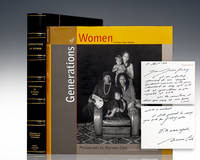
Best.-Nr. 149944San Francisco: Chronicle Books 1998. First edition of this multidimensional visual portrayal of women’s lives. Quarto original publisher's cloth illustrated with black and white photographs. Presentation copy with a lengthy autograph notecard inscribed by the photographer Mariana Cook to Ruth Bader Ginsburg laid in. The recipient American lawyer and jurist Ruth Bader Ginsburg served as an associate justice of the Supreme Court of the United States from 1993 until her death in 2020 and was responsible for some of the most eventful legal decisions of the past half-century. Nominated by President Bill Clinton in 1993 to replace retiring justice Byron White Ginsburg became the first Jewish woman and the second woman to serve on the Court after Sandra Day O’Connor. Ginsburg spent much of her legal career as an advocate for gender equality and women’s rights winning many arguments before the Supreme Court. During her tenure as associate justice of the Supreme Court Ginsburg received attention for her fiery and passionate dissents that reflected liberal views of the law. She was popularly dubbed “the Notorious R.B.G.” a moniker she later embraced. She authored several important majority opinions related to gender discrimination voting rights and affirmative action in cases such as United States v. Virginia 1996 which struck down the Virginia Military Institute’s male-only admissions policy as violating the Equal Protection Clause of the Fourteenth Amendment Olmstead v. L.C. 1999 in which the Court ruled that mental illness is a form of disability covered under the Americans with Disabilities Act of 1990 and Friends of the Earth Inc. v. Laidlaw Environmental Services Inc. 2000 in which the Court held that residents have standing to seek fines for an industrial polluter that affected their interests and that is able to continue doing so. Fine in a fine dust jacket. From the library of American lawyer and jurist Ruth Bader Ginsburg. Housed in a custom half morocco clamshell box. Photographic and literary exploration of the relationships between women across different generations. The book features intimate black-and-white portraits of grandmothers mothers and daughters accompanied by personal narratives that reflect on themes of heritage identity and familial bonds. Through these stories Cook captures the complexities of womanhood emphasizing both the shared experiences and the individuality of each subject. Chronicle Books hardcover
1789Best.-Nr. 227355London: Sold by B. White and Son 1789. Third edition first edition was 1756. 49 copper-engraved plates by George Dionysius Ehret. viii 503 646 Index pp. 1 vols. Folio. Bound in contemporary diced calf rebacked. Bookplate of Clarence Dillon Dunwalke Library and with a note that it comes from the Library of Owen D. Young Esq. Third edition first edition was 1756. 49 copper-engraved plates by George Dionysius Ehret. viii 503 646 Index pp. 1 vols. Folio. Browne was an Irish physician who lived for several years in the West Indies and settled in Jamaica in 1746. This is his major work particularly valuable for its contribution to botany. Sabin 8671; Nissen BBl 255; Cundal Bibliographia Jamaicensis 416 Sold by B. White and Son unknown books
1789Best.-Nr. 227355London: Sold by B. White and Son 1789. Third edition first edition was 1756. 49 copper-engraved plates by George Dionysius Ehret. viii 503 646 Index pp. 1 vols. Folio. Bound in contemporary diced calf rebacked. Bookplate of Clarence Dillon Dunwalke Library and with a note that it comes from the Library of Owen D. Young Esq. Third edition first edition was 1756. 49 copper-engraved plates by George Dionysius Ehret. viii 503 646 Index pp. 1 vols. Folio. Browne was an Irish physician who lived for several years in the West Indies and settled in Jamaica in 1746. This is his major work particularly valuable for its contribution to botany. Sabin 8671; Nissen BBl 255; Cundal Bibliographia Jamaicensis 416 Sold by B. White and Son unknown
1962Best.-Nr. 2409180259xbvkJamaica, Island Worcester [and Things] - Ceramics, 1962. Material: Ceramic / Total height (Pot with lid): ca. 39 cm; diameter at foot: ca. 15 cm, largest diameter (open top of 'pot'): ca. 24 cm. / Colour: lightbrown-rosé with white partly gilt-lined embossments and partly gilt inscriptions; foot and pineapple-top: white. / Weight: ca. 3 kg.