765 résultats
réf. Z1-T-006-01760British Film Institute. Used - Good. Ships from UK in 48 hours or less usually same day. Your purchase helps support Sri Lankan Children's Charity 'The Rainbow Centre'. Ex-library so some stamps and wear but in good overall condition. 100% money back guarantee. We are a world class secondhand bookstore based in Hertfordshire United Kingdom and specialize in high quality textbooks across an enormous variety of subjects. We aim to provide a vast range of textbooks rare and collectible books at a great price. Our donations to The Rainbow Centre have helped provide an education and a safe haven to hundreds of children who live in appalling conditions. We provide a 100% money back guarantee and are dedicated to providing our customers with the highest standards of service in the bookselling industry. British Film Institute unknown
réf. Z1-T-037-00508British Film Institute. Used - Good. Ships from UK in 48 hours or less usually same day. Your purchase helps support Sri Lankan Children's Charity 'The Rainbow Centre'. Ex-library so some stamps and wear but in good overall condition. May contain underlining and/or highlighting. 100% money back guarantee. We are a world class secondhand bookstore based in Hertfordshire United Kingdom and specialize in high quality textbooks across an enormous variety of subjects. We aim to provide a vast range of textbooks rare and collectible books at a great price. Our donations to The Rainbow Centre have helped provide an education and a safe haven to hundreds of children who live in appalling conditions. We provide a 100% money back guarantee and are dedicated to providing our customers with the highest standards of service in the bookselling industry. British Film Institute unknown
1890réf. 231711890. Stereoview archive of the post-emancipation Caribbean showing how the islands were marketed to western viewers through plantation labor export agriculture civic spectacle and catastrophe. As a group these photos function not only as an ethnographic travel archive but as evidence of the visual economy that followed slavery. The British West Indies moved through emancipation in 1834 to 1838 the French Caribbean in 1848 Puerto Rico in 1873 and Cuba in 1886 yet plantation production remained central to regional life well into the early twentieth century. These stereoviews preserve a colonial way of seeing in which Black and Afro-Caribbean labor rural discipline and extractive agriculture remained the background condition of "tropical" beauty and commercial modernity. Cuba's sugar economy in particular expanded through the nineteenth century and slavery was not abolished there until 1886 while Weyler's later reconcentration policy during the Cuban War of Independence violently reorganized rural life. Martinique after 1848 likewise shifted into new labor regimes including imported workers from India and China. Archive of 11 stereoview cards late 1890s to early 1900s depicting Cuba Jamaica Martinique Puerto Rico and the Dominican Republic. Most black and white with a few colorized. Each measure 3.5" x 7". All with captions on the margins. "Reconcentrado Farming Scene Province of Havana Cuba" links agricultural production to the brutal displacements of Spain's reconcentration campaign; "Cutting sugar cane Montego Bay Jamaica W.I." records cane labor in a colony where emancipation had not ended plantation dependency; and "Harvesting Coconuts Porto Rico" likewise frames Caribbean land through export work rather than local life. Other views extend that economic framing through cacao and coffee scenes while the paired Havana cards shift into urban leisure and public display including "Beautiful Central Park Havana Cuba" and "Holiday in Havana Cuba" the latter with both Cuban and American flags visible a telling image of the new imperial order after 1898. The disaster views from Martinique and the Lesser Antilles show how stereoview publishers also turned Caribbean destruction into consumable spectacle. the Morne Rouge card is accompanied on the reverse by the grim printed text "Dead bodies which were to be seen in Morne Rouge." while the wider context is the 1902 eruptions of Mount Pelée in Martinique and La Soufrière on Saint Vincent two catastrophes that killed roughly 30000 and 1600 people respectively and devastated local communities and agriculture. Some corner wear light toning scattered surface and edge wear. Overall very good condition. This collection gives direct visual representation of Caribbean history Atlantic slavery and emancipation plantation labor and U.S. imperial expansion in the circum-Caribbean preserving the transition from slavery to post-abolition labor. unknown
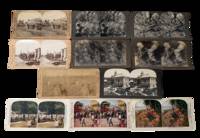
1890réf. 231711890. Stereoview archive of the post-emancipation Caribbean showing how the islands were marketed to western viewers through plantation labor export agriculture civic spectacle and catastrophe. As a group these photos function not only as an ethnographic travel archive but as evidence of the visual economy that followed slavery. The British West Indies moved through emancipation in 1834 to 1838 the French Caribbean in 1848 Puerto Rico in 1873 and Cuba in 1886 yet plantation production remained central to regional life well into the early twentieth century. These stereoviews preserve a colonial way of seeing in which Black and Afro-Caribbean labor rural discipline and extractive agriculture remained the background condition of "tropical" beauty and commercial modernity. Cuba's sugar economy in particular expanded through the nineteenth century and slavery was not abolished there until 1886 while Weyler's later reconcentration policy during the Cuban War of Independence violently reorganized rural life. Martinique after 1848 likewise shifted into new labor regimes including imported workers from India and China. Archive of 11 stereoview cards late 1890s to early 1900s depicting Cuba Jamaica Martinique Puerto Rico and the Dominican Republic. Most black and white with a few colorized. Each measure 3.5" x 7". All with captions on the margins. "Reconcentrado Farming Scene Province of Havana Cuba" links agricultural production to the brutal displacements of Spain's reconcentration campaign; "Cutting sugar cane Montego Bay Jamaica W.I." records cane labor in a colony where emancipation had not ended plantation dependency; and "Harvesting Coconuts Porto Rico" likewise frames Caribbean land through export work rather than local life. Other views extend that economic framing through cacao and coffee scenes while the paired Havana cards shift into urban leisure and public display including "Beautiful Central Park Havana Cuba" and "Holiday in Havana Cuba" the latter with both Cuban and American flags visible a telling image of the new imperial order after 1898. The disaster views from Martinique and the Lesser Antilles show how stereoview publishers also turned Caribbean destruction into consumable spectacle. the Morne Rouge card is accompanied on the reverse by the grim printed text "Dead bodies which were to be seen in Morne Rouge." while the wider context is the 1902 eruptions of Mount Pelée in Martinique and La Soufrière on Saint Vincent two catastrophes that killed roughly 30000 and 1600 people respectively and devastated local communities and agriculture. Some corner wear light toning scattered surface and edge wear. Overall very good condition. This collection gives direct visual representation of Caribbean history Atlantic slavery and emancipation plantation labor and U.S. imperial expansion in the circum-Caribbean preserving the transition from slavery to post-abolition labor. unknown books
réf. 35602001, Paris, Dentu, an IX ( 1801); in-8, demi-veau blond, fil. et fleurons dor., tr. jasp. (Laurenchet). VIIIpp., 490pp.- Une grande carte dépliante par Tardieu. EDITION ORIGINALE EN FRANÇAIS. Elle est très rare. Sabin 21902 ne cite que la deuxième édition de 1804, tout comme Muller 550. Pas dans Leclerc.- Monglond V, 659 signale cette première édition, ainsi que le cat. Beinecke Lesser 557. Bryan Edwards (1743-1800) fut recueilli jeune en Jamaïque par un oncle qui lui légua sa fortune. En 1784 il fut à la tête d’une plantation de sucre. Nommé membre de l’assemblée de la Jamaïque il prononça en 1789 un discours contre les propositions de Wilberforce sur la traite des noirs. En 1791 il se rendit à St Domingue pour assister à la révolte. Peu après il retourna en Angleterre où il publia cet ouvrage en 1793.- Histoire, géographie, histoire naturelle, coutumes de la Jamaïque, de la Barbade, St Vincent, la Dominique, St Christophe, Antigua, Montserrat. Importants chapitres sur la traite et sur l’esclavage des noirs, sur la canne à sucre.- Les pp. 411 à 480 donnent une relation sur la colonie française de St Domingue, et le témoignage des scènes vues et vécues par l’auteur lors de son séjour à Port au Prince en 1791.
1828réf. PHO-1507London, John Murray, 1828, 4 volumes, 8vo.,xii-473,(4)-490,viii-413,vii-489, with 2 folding maps , half calf and corners, nice copy, well bound.
1853réf. 13173Firmin Didot frères Paris 1853 2 vol. 2 vol. grand in-8 de VI 660 pp. et VI 613 pp. 1 f.n.ch. (errata); demi-basane de l'époque, dos lisse fileté.
1777réf. 2318BBLeipzig, Weidmanns Erben und Reich, 1777. Gr.-8°. 1 Portrait, 13 Bl., 574 S.; 1 Bl., 618 S., 29 Bl. Mit 4 gefalteten Karten und 1 Tafel. Pappbände der Zeit mit Rückensch. + Wichtig: Für unsere Kunden in der EU erfolgt der Versand alle 14 Tage verzollt ab Deutschland / Postbank-Konto in Deutschland vorhanden +, A|B|C 2 Bände.
1777réf. 2318BB2 Bände. Leipzig, Weidmanns Erben und Reich, 1777. Gr.-8°. 1 Portrait, 13 Bl., 574 S.; 1 Bl., 618 S., 29 Bl. Mit 4 gefalteten Karten und 1 Tafel. Pappbände der Zeit mit Rückensch.
19548vo., Second Impression, with numerous plates, full-page facsimile and endpaper maps; handsomely bound in full dark green crushed morocco, sides with gilt frame border, back with raised bands, second and fourth compartments lettered and ruled in gilt, all other compartments tooled in gilt, gilt top, ribbon marker, an elegant copy ideal as a gift or for presentation. Among other adventures, Mitchell-Hedges details the discovery in 1924 of the Crystal Skill at Lubaantun (then British Honduras; now Belize). Published in the same month as the first edition. SCARCE.
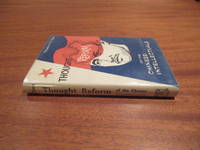
1960réf. 025662Hong Kong: Hong Kong University Press / Oxford University Press / Institute of Pacific relations 1960. First Edition First Printing . Hardcover. Near Fine/Near Fine Dustjacket. Xiii 247. Orange Cloth. One Of 2000 Copies Of The First Printing But This Copy With Printed $5 Us Price At Bottom Of Front Flap So Perhaps An American Issue. Slight Signs Of Usage To Book And Dj. Inscribed To Mr. And Mrs. Z. T. Nyi Zau Tsung Nyi Of Los Angeles "With High Esteem And Respect". Information From His Archives At Usc: Theodore H.E. Chen Ph.D. 1939 Was Chairman Of Usc's Department Of Asian Studies From 1940 To 1968 And From 1960 To 1971 He Directed The East Asian Studies Center In Support Of Which He Had Obtained The First Federal Grants. Chen Also Secured Outside Funding For A Project To Help Train And Advise High School Teachers Of Chinese And Japanese. A Native Of Fuzhou China Chen Was President Of Fukien Christian University In 1946 And 1947 While On Leave To Participate In Postwar Rehabilitation. He Also Helped Organize Tunghai University In Taiwan As A Representative Of The United Board Of Christian Colleges. He Was The Author Of Nine Books Including Thought Reform Of Chinese Intellectuals And Maoist Educational Revolution And Chinese Education. Dr Chen Hits An Easy Target; The Worst Governments Are Those Who Try To Control What And How People Think And How And Where They Communicate Because Their Leaders Have An Excess Of The Oldest Disease Of Officials Crap-In-The-Brain Which Prevents Them From Engaging In Exchanges Of Facts And Ideas. Hong Kong University Press / Oxford University Press / Institute of Pacific relations hardcover
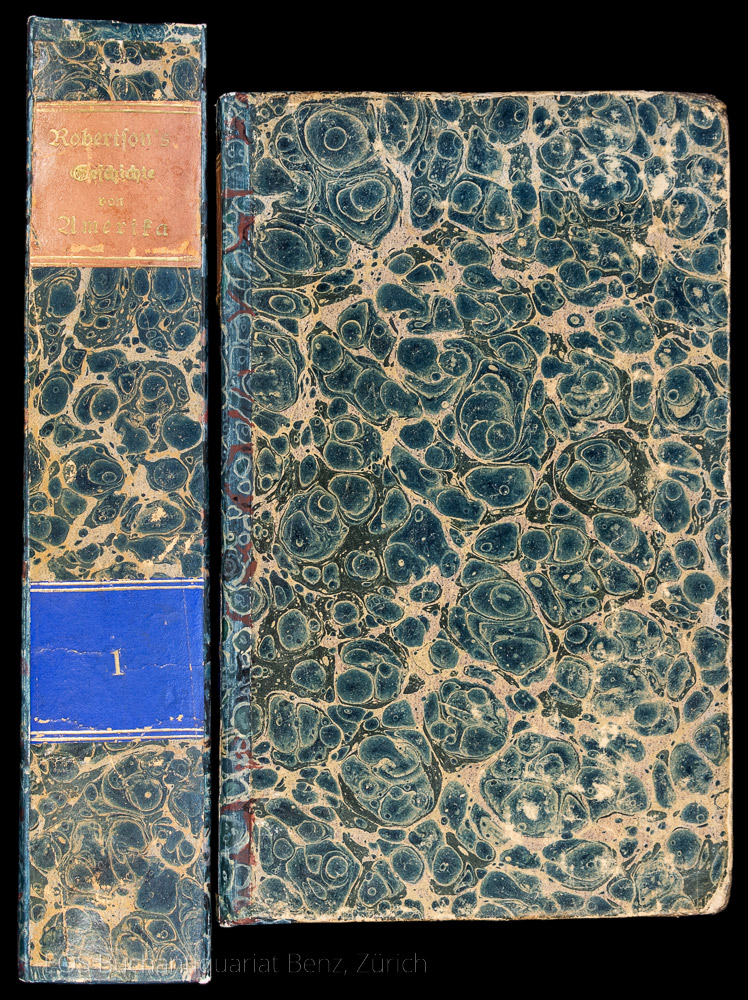
1751réf. PHO-1679Londres, Nourse, 1751. 2 volumes in-12, veau marbré, dos à nerfs orné, pièces de titre et de tomaison, tranches rouges (Reliure de l'époque), coiffes usées, manque les pièces de titre et tomaison au tome 2
1916réf. biblio1324This is an unusual first printing from 1916---extremely rare in this propitious 100-year anniversary a year featuring the reopening of normal relations and the visit of the U.S. President. This volume which describes in prase charts and photos the favorable advantages of 1916 Cuba may be one of the few that exist in the original state---there do not appear to be any offered in the marketplace making it an ideal addition to any collection of historical Cuba-related items. Photos on request. Foreign Publishing Company hardcover
900Jamaica South Coast Port Royal and Kingston Harbours surveyed by Captain J.W.F. Combe assisted by Lieutenant L.G. Garbett and Lieutenants J.A. Rupert-Jones & E.V Shankland 1913 Soundings East of Kingston by Lieut-Comm.r J.A. Edgell Surveying Ship "Mutine" 1914. Additional soundings from a Survey by Staff Comm.r G. Stanley 1873-4. Kingston and adjacent topography chiefly from a Colonial map.London Published at the Admiralty 18 January 1916 under the Superintendence of Captain J.F. Parry. Small corrections: 1931. Folded
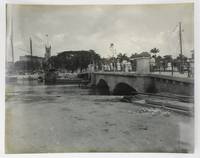
1925réf. 6159Various places 1925. Very good. Fourteen silver gelatin photographs 8 x 10 inches. Minor wear and soiling. Images generally crisp and clear. A handsome group of photographs possibly taken on someone's holiday through the Caribbean showing scenes in Barbados Martinique the Panama Canal and Guaira Venezuela. Five of the images show Barbados. Of note are a view taken from the water showing the harbor and the local boats with the dock workers; a tree-lined dirt avenue with houses on one side; and a handsome view of locals crossing a bridge with Parliament in the background. Of the four views of Martinique three show Mount Pelee and the fourth is a lovely shot of two local women on a dirt road barefoot and carrying baskets of produce on their heads. The three images of Venezuela are all taken from aboard a ship and show coastline. The two photos of the Panama Canal depict a ship -- presumably the author's vessel -- transiting the locks. Both are well-composed and give an early view of this important technological wonder. A nice group. unknown
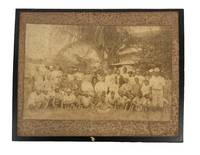
1890réf. 208021890. Unidentified photographers two albumen photographs of Black laborers circa 1890s to early 1900s document agricultural and skilled work performed by African Americans in the decades following emancipation when systems of sharecropping and tenant farming structured rural economies across the American South and parts of the Caribbean. These images provide visual evidence of labor organization racial hierarchy and economic dependency that persisted after the formal end of slavery with large groups of Black workers shown in relation to white overseers or employers. One photograph presents approximately forty five Black men gathered around three centrally seated white men emphasizing supervisory roles and social stratification within plantation labor systems. The clothing of the workers including cotton shirts loose trousers and wide brimmed hats reflects adaptation to agricultural work in hot climates while a smaller number of individuals in jackets and pocket watches suggests internal distinctions within Black labor communities. The second image depicts six Black carpenters engaged in coordinated manual work at an outdoor shop indicating the presence of skilled trades alongside agricultural labor. Group of two albumen photographs mounted on original cardstock measuring approximately 8 x 9.5 inches and 10 x 12 inches. The larger photograph shows an outdoor woodworking scene with six men using tools including a hammer and saw working under a thatched structure suggestive of southern or Caribbean environments. The second photograph shows a large assembled group of plantation workers with three white men seated at center. Faint pencil annotations appear in the margins of one mount. Both photographs retain strong compositional clarity with figures arranged to emphasize both collective labor and hierarchical relationships. These photographs contribute to the study of post emancipation Black life by documenting how agricultural dependency and limited access to capital shaped labor conditions into the late nineteenth and early twentieth centuries. The plantation scene illustrates the persistence of racially stratified labor organization while the carpentry image provides evidence of skilled Black tradesmen operating within local economies often without institutional support or pathways to independent enterprise. The visual contrast between collective field labor and artisanal work expands the interpretive scope of the archive situating these images within broader histories of labor race and economic transition following the end of slavery. Edge wear and minor chipping to mounts with noticeable foxing to one image primarily at the margins; images remain legible and structurally intact. Overall good condition. unknown
1890réf. 208021890. Unidentified photographers two albumen photographs of Black laborers circa 1890s to early 1900s document agricultural and skilled work performed by African Americans in the decades following emancipation when systems of sharecropping and tenant farming structured rural economies across the American South and parts of the Caribbean. These images provide visual evidence of labor organization racial hierarchy and economic dependency that persisted after the formal end of slavery with large groups of Black workers shown in relation to white overseers or employers. One photograph presents approximately forty five Black men gathered around three centrally seated white men emphasizing supervisory roles and social stratification within plantation labor systems. The clothing of the workers including cotton shirts loose trousers and wide brimmed hats reflects adaptation to agricultural work in hot climates while a smaller number of individuals in jackets and pocket watches suggests internal distinctions within Black labor communities. The second image depicts six Black carpenters engaged in coordinated manual work at an outdoor shop indicating the presence of skilled trades alongside agricultural labor. Group of two albumen photographs mounted on original cardstock measuring approximately 8 x 9.5 inches and 10 x 12 inches. The larger photograph shows an outdoor woodworking scene with six men using tools including a hammer and saw working under a thatched structure suggestive of southern or Caribbean environments. The second photograph shows a large assembled group of plantation workers with three white men seated at center. Faint pencil annotations appear in the margins of one mount. Both photographs retain strong compositional clarity with figures arranged to emphasize both collective labor and hierarchical relationships. These photographs contribute to the study of post emancipation Black life by documenting how agricultural dependency and limited access to capital shaped labor conditions into the late nineteenth and early twentieth centuries. The plantation scene illustrates the persistence of racially stratified labor organization while the carpentry image provides evidence of skilled Black tradesmen operating within local economies often without institutional support or pathways to independent enterprise. The visual contrast between collective field labor and artisanal work expands the interpretive scope of the archive situating these images within broader histories of labor race and economic transition following the end of slavery. Edge wear and minor chipping to mounts with noticeable foxing to one image primarily at the margins; images remain legible and structurally intact. Overall good condition. unknown books
1751réf. 1177351751 A Londres, Chez Nourse, 1751, 2 volumes in-12 de 95x165 mm environ, (2) ff., 285 pages - (1) f., 248 pages, complet des 6 planches dépliantes. Pleines reliures marbrées d'époque, dos longs portant titres et tomaisons dorées, fers dorés, filet d'encadrement à froid sur les plats, filet doré sur les coupes, tranches mouchetées, gardes de papier marbré à la coquille. Coins légèrement émoussés, quelques griffures et épidermures sur le cuir, rares rousseurs sinon bon état.
1817réf. PHO-2154Paris, Bechet,1817. 3 parties en 2 vol in 8°, (23x 13cm), demi veau époque, dos lisse orné, pièce de titre rouge, xxxii, 507 pp errata, 394 pp.-1f. (errata)- 2ff.-160pp.-1f (errata), demi veau époque, dos lisse orné avec tomaison et pièce de titre, frottements et épidermures, manque de papier au tome 2 et au dos, intérieur frais.
1759réf. 6261BBLeipzig, Arkstee und Merkus, 1759. 4°. (1) Bl., (8) 726 (42) S., (1) Bl. Mit 17 (dv. 12 gef.) gest. Karten u. 11 gest. Tafeln. Lederband der Zeit mit restauriertem Rücken, schlichte Vergoldung und Rückenschild. + Wichtig: Für unsere Kunden in der EU erfolgt der Versand alle 14 Tage verzollt ab Deutschland / Postbank-Konto in Deutschland vorhanden +, A|B 17. Band.
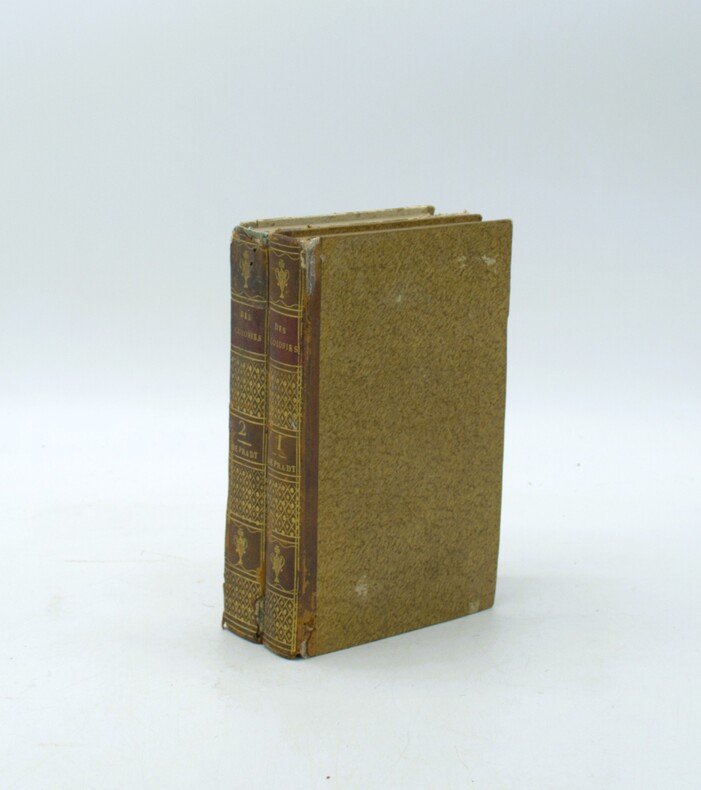
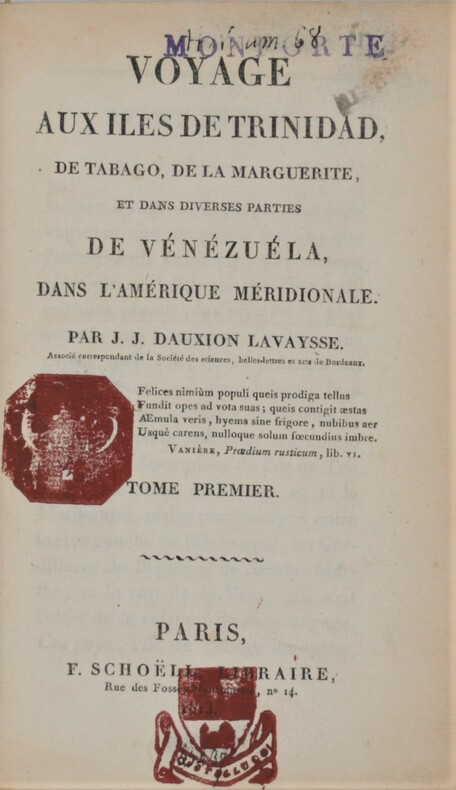
1813réf. PHO-844Paris, F. Schoëll, Libraire, 1813. In-8 (20,5 x 13,5 cm),XXVI-411 pp.,3ff-480pp-4ff (table et errata), illustré de 3 cartes déplantes et 5 tableaux dépliants .Reliure de l'époque demi-basane havane, dos lisse orné, manque au dos ,un plat détaché ,charnières faibles, cachets répétés, déchirure au pli à 1 carte. Édition très rare.
1826réf. 14630Dufart Paris 1826 1 vol. In-8 de 332 pp., demi-chagrin de l'époque, dos à nerfs orné.
1825réf. 13130Janet, Ponthieu Paris 1825 1 vol. In-8 de VII 480 pp., pleine basane racinée de l'époque, dos lisse orné, pièce de titre, tranches marbrées.
1759réf. 6261BB17. Band. Leipzig, Arkstee und Merkus, 1759. 4°. (1) Bl., (8) 726 (42) S., (1) Bl. Mit 17 (dv. 12 gef.) gest. Karten u. 11 gest. Tafeln. Lederband der Zeit mit restauriertem Rücken, schlichte Vergoldung und Rückenschild.
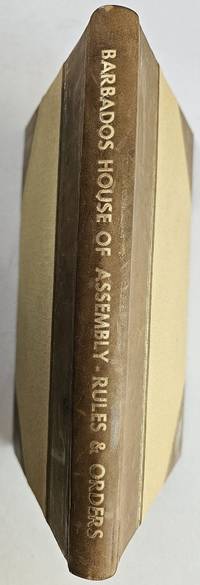
1867réf. BK0152Barbados: Office of "The Official Gazette" No. 14 Broad Street 1867. 30 pp. with unnumbered index 42 pp. Half leather over cloth boards. Ink ownership inscription "W. Brandford Griffith / 1869" on a preliminary blank. Scattered foxing and light toning. A locally printed manual for the Barbados House of Assembly with the ownership inscription of William Brandford Griffith then both a member of the Assembly and the island's auditor-general. Griffith served in the Assembly from 1861 to 1874 and was appointed auditor-general in 1863; he subsequently held several other colonial offices before becoming governor of the Gold Coast in 1885. The rules numbered through 271 and accompanied by an extensive alphabetical index set out the conduct of the Assembly's public business. The index includes procedures for issuing election writs and returning the names of elected members to the governor and council together with the course to be followed when writs had not been executed. Although published well after emancipation these rules governed an Assembly whose electorate remained restricted by property qualifications. Free men of color had gained voting rights subject to those qualifications in 1831 and Samuel Jackman Prescod entered the Assembly in 1843. Planters and merchants nevertheless continued to dominate both the Assembly and the Legislative Council during the period in which Griffith served. OCLC records the 1867 edition OCLC 823344433 but we have been unable to identify a current institutional holding. . Office of "The Official Gazette," No. 14, Broad Street unknown