500 résultats
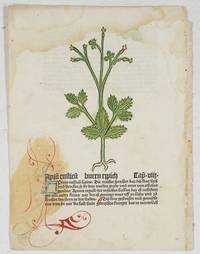
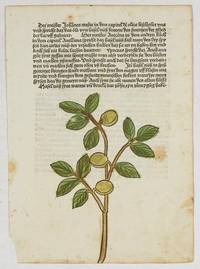
1485réf. 707391485. Mainz Peter Schöffer 28 März 1485 1 einspaltiges original Inkunabelblatt 238 x 171 mm 1 alt color. Holzschnitt. Erstdruck! CAp. 280: Nux avellana - haselnuß. Corylus avellana L. Kapitelende. Cap. 281: Nux Vsualis siue magna - welch nuß; Juglans regia L.; Darstellung: stelisiert. "Im Gegensatz zu den meisten Kräuterbuch-Inkunabeln lässt sich das Druckdatum des "Gart der Gesundheit genau auf den 28. März 1485 festlegen wie es am Ende des Werks vermerkt ist: "Disser Herbarius ist rzu mentz gedruckt und geendet uff dem XXVIII dage des mertz -Anno-M-CCCC-LXXXV". An gleicher Stelle wird Peter Schöffer als Drucker durch das Fust-Schöffersche Signet bestätigt. Der "Gart der Gesundheit gilt wie Muther 1884: 88: "als wichtigstes naturhistorisches Werk des Mittelalters" und Klebs/Becher 1925: 11: "The most important mediaeval work on natural history with illustrations Choulant the publication of which forms an important landmark in the history of botanical Illustration and marks perhaps the grea-test single Step ever made in that art" meinten als wichtigste bebilderte Arzneipflanzen-Inkunabel. Auch Keil 1982: 604 bestätigte später diese Aussage: "Zweifellos ist der "Gart das wichtigste naturhistorische Werk des Mittelalters". Auf 359 Seiten die in 435 Kapitel gegliedert sind wird der gesamte zur damaligen Zeit bekannte Arzneischatz abgehandelt und mit 382 Holzschnitten illustriert. Die wichtigsten 366 Heilpflanzen zwei Wiederholungen werden jeweils einzeln in den verschiedenen Kapiteln beschrieben und abgebildet. Der Text ist 42zeilig geordnet." B. Baumann & H. Baumann Die Mainzer Kräuterbuch-Inkunabeln 2010 p.111 Johann Wonnecke von Kaub um 1430 in Kaub am Rhein; gestorben 1503/04 in Frankfurt am Main auch Johannfes Dronnecke bzw. Johannes de Cuba er selbst nannte sich "Johan von Cube" war ein deutscher Arzt und Botaniker. Am Mainzer Hof wirkte er als Leibarzt. unknown
réf. a718971951 Freeport Sulphur Company of New York City. All original mimeos of typed documents. 4to. 289 leaves rectos only 4 large foldout maps gilt titled limp black boards with 3 metal studs for binding. VG. Scarce. . hardcover
réf. 86083hardcover. 202pp. 8vo modern cloth; orig. wrs. bound in unopened. Madrid: Aurelio Alaria 1881. First Edn. unknown
1485réf. 707801485. Mainz Peter Schöffer 28 März 1485 2 einspaltige original Inkunabelblätter 266 x 210 mm 2 alt color. Holzschnitte; etwas fleckig. Erstdruck! Cap. 8: Apium rusticum - buern eppich. Apium graveolens L. Kultursorte. Darstellung: schematisiert. Cap. 9: Apium emorroidarum - fickblatern eppich. Ranunculus ficaria subsp. Ficariiformis F. Schulz Rouy et Fouc. "Im Gegensatz zu den meisten Kräuterbuch-Inkunabeln lässt sich das Druckdatum des "Gart der Gesundheit genau auf den 28. März 1485 festlegen wie es am Ende des Werks vermerkt ist: "Disser Herbarius ist rzu mentz gedruckt und geendet uff dem XXVIII dage des mertz -Anno-M-CCCC-LXXXV". An gleicher Stelle wird Peter Schöffer als Drucker durch das Fust-Schöffersche Signet bestätigt. Der "Gart der Gesundheit gilt wie Muther 1884: 88: "als wichtigstes naturhistorisches Werk des Mittelalters" und Klebs/Becher 1925: 11: "The most important mediaeval work on natural history with illustrations Choulant the publication of which forms an important landmark in the history of botanical Illustration and marks perhaps the grea-test single Step ever made in that art" meinten als wichtigste bebilderte Arzneipflanzen-Inkunabel. Auch Keil 1982: 604 bestätigte später diese Aussage: "Zweifellos ist der "Gart das wichtigste naturhistorische Werk des Mittelalters". Auf 359 Seiten die in 435 Kapitel gegliedert sind wird der gesamte zur damaligen Zeit bekannte Arzneischatz abgehandelt und mit 382 Holzschnitten illustriert. Die wichtigsten 366 Heilpflanzen zwei Wiederholungen werden jeweils einzeln in den verschiedenen Kapiteln beschrieben und abgebildet. Der Text ist 42zeilig geordnet." B. Baumann & H. Baumann Die Mainzer Kräuterbuch-Inkunabeln 2010 p.111 Johann Wonnecke von Kaub um 1430 in Kaub am Rhein; gestorben 1503/04 in Frankfurt am Main auch Johannfes Dronnecke bzw. Johannes de Cuba er selbst nannte sich "Johan von Cube" war ein deutscher Arzt und Botaniker. Am Mainzer Hof wirkte er als Leibarzt. unknown
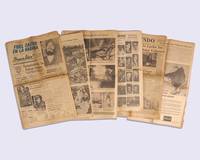
réf. 900066CASTRO'S ARRIVAL IN HAVANA AND THE EARLY DAYS OF THE REVOLUTION CUBA MEXICO AND MIAMI A collection of newspapers spanning the years 1959-1960 Mexico City/Miami Beach: El Mundo Prensa Libre Ultimas Noticias Excelsior 1950-60 A collection of five newspapers each measuring up to 62 x 40cm when fully unfolded; between 8 and 26 pages in length including 'El Mundo' 'Presna Libre' and 'Ultimas Noticias Excelsior' printed mostly in black but with occasional titles in blue; containing numerous black and white photographs of Fidel and Ramon Castro Che Guevara Celia Sanchez Adolfo Lopez Mateos and other members of the Revolution including the execution of Garcia Olayon as well as Richard Nixon J. F. K and other political figures; all newspapers fragile and toned in accordance with age with some splits and chips along folds some loss of text in places; chips to edges and occasional brown spots; one small annotation in blue ink of 'Imogen Browning National Coffee Shop' in Miami; remarkable survivals nonetheless and very good overall. A scarce collection of newspapers which together portray a vivid picture of the turbulent political and social scene towards the end of the 1950s. Articles include 'The Destruction of Santa Clara' and 'With the Rebel Leaders in the Villages' with copious photographs and there are numerous celebratory passages welcoming in Fidel Castro the 'Supreme Leader' and 'Los Gloriosos Heroes de la Revolucion'. There is also a map of the invasion of Cuba and advertisements for children's toys which include automatic pistols army trucks and plastic rockets. All text in Spanish. Please note that these items contain some graphic images unknown
réf. a58469A wonderful and poignant collection of 8 letters written by a Spanish emigrant in Cuba 1905-06. The letters total 39 sides on 12 sheets of paper all handwritten in ink in Spanish and addressed to Sra. Mercedes Chueca Alonso in Barcelona. All are signed Pepe who also identifies himself as Jose Vila Maria and as Jose Vicente. The letters include a fairly detailed account of his voyage to Cuba via Barcelona Paris Marseille; a comparison of Havana to Barcelona; advice to a prospective emigrant Mercedes's brother; and some account of his attempts to seek his fortune apparently in the miitary. In passing he mentions something of the events of the time - the August 1906 uprising and subsequent American military intervention:.El haberme hecho ciudadano Cubano fue con objecto de ingresor en la academia del cuerpo de artilleria mas me imponian condiciones que no pude aceptar pues tenia que entrar de soldado y firmar un contrato por cuartro anos y el examen para oficial era libre pues aqui el servicio es voluntario mas illegible quiero que aqui solo illegible la influencias y son muchos los libertadores que de la ultima guerra existen resultan que por muy benos examanes que se hagan podran illegible a extranjero a illegible la plaza inguesaron cuando la intervencion americana fueron relevados en sus cargoes. April 1 1906 .Hace unos dia me intregaron dos targeta y una carta tuya; en esta ultima me manifiestas estraneza por no tenor noticia mas.a circumstancias por que ha estado atravesando la Habana; pues en momentos en que ya tenia el nombramiento.a ingresor en el cuerpo del ejercito contro lo que era de esperar intervinieron los americanos por lo que me virprecisado a marcher a Port Tampa Estados Unidos en donde he permanecido hasto unos dias antes de pasar por aqui.los muchos destrozos que en esta capital. November 20 1906 Also included is a letter from Pedro Marden of Barcelona postmarked 1907 informing Sra Chueca of the death of Vicente presumably the Pepe of the other letters in Cuba of unknown causes. Together with 9 stamp-bearing envelopes. . unknown
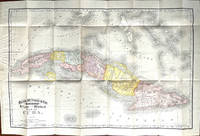
1892réf. 62697Chicago IL: Rand McNally & Co. 1892. One pocket map. 12mo. sized 3.75 x 6 in. which folds out into 21.5 x 15 in. colour-lithograph map printed index on verso. Brown embossed publisher’s cloth gilt lettering on front cover slight shelfwear very slight rubbing light toning & edgewear to map still a VG bright copy. First edition thus of this “Business” pocket map of Cuba issued by the Rand McNally Co. the same year that Jose Marti established the Cuban Revolutionary Party to organize independence of Cuba and Puerto Rico from Spain. The printed index on verso references islands lakes mountains provinces rivers and towns in Cuba. Although several different versions of this particular map were produced by Rand McNally along with the San Francisco Chronicle and versions including an inset map of Havana Harbor none located in Worldcat are the same maps as this pocket map. Rand McNally & Co., hardcover
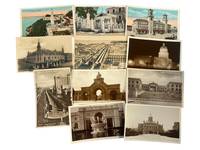
1920réf. 224751920. Cuba Havana landmarks and urban development real photo post card archive ca. 1920s-1940s. 11 color and sepia real photo postcards of iconic civic and cultural architecture in Havana Cuba. Each measure 4" x 6". Many with captions identifying the locations in the negative or en verso with some printed in English and others in Spanish signaling their intended audience of both locals and foreign tourists. A compelling photo archive documenting early 20th-century Havana's architectural and political aspirations this collection showcases prominent landmarks that symbolized Cuba's nationalist identity international cosmopolitanism and American-influenced modernization in the decades between independence from Spain and the Cuban Revolution. The archive includes silver gelatin and printed color views of the National Theatre Cuba's Capitol Building Central Railway Station Gran Casino Nacional National University and the grand gateway of Havana's Colón Cemetery. Other views depict Paseo de Martí one of Havana's most iconic boulevards lined with vintage American cars and flanked by ornate colonial facades and new Art Deco-style hotels evidence of the influx of U.S. capital and tourism during the Batista era. Havana in this period was rapidly transforming into a showcase city of the Caribbean its urban core reflecting both Spanish colonial heritage and American urban planning models. The presence of monumental buildings like El Capitolio constructed between 1926 and 1929 and modeled after the U.S. Capitol in Washington D.C. points to Cuba's alignment with American political aesthetics and aspirations toward modern statehood. Similarly the University and Gran Casino Nacional represent both the intellectual elite and leisure-class investment that typified pre-revolutionary Cuban society. The mixture of European and U.S. architectural influences ranging from Beaux-Arts to Art Deco speaks to the layered colonial legacy and new economic dependency forged during the Platt Amendment era. Some mild edge wear. One card with a small corner crease others clean. Overall very good condition. This archive captures Havana in the midst of dramatic urban renewal and internationalization before the massive ruptures brought on by the 1959 revolution. unknown
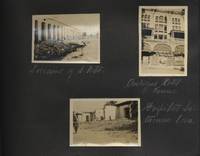
1932réf. 50120Santiago de Cuba 1932. A unique album of 19 leaves of heavy black stock 7 x 5 1/2 inches with 67 mounted b&w silver photographs of varying sizes 1 3/4 x 2 1/2 inches - 3 1/2 x 5 7/8 inches all captioned in white ink. The album is titled and decorated in gilt on the upper cover "PHOTOGRAPHS: SOUVENIR OF SANTIAGO CUBA and tied with a cloth lace. Very good. An earthquake of 6.7 magnitude struck the city of Santiago de Cuba at dawn on 3 February 1932. Over half the buildings were destroyed or damaged and reports of the deaths range to 1500. These photographs show the destruction to the commercial and residential buildings and the Cathedral and the tents set up as temporary shelters. A few of the photographs were made by local commercial photographers just after the quake and the remainder within days. All captions in Spanish. unknown
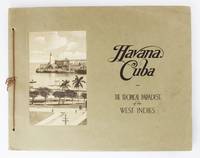
1925réf. 6379Havana: American Photo Studios 1925. Very good plus. 48pp. each with 6x8-inch photographic prints directly mounted. Original card wrappers photo-illustrated and string-tied. Minor wear and dust soiling. Images strong and clear. An attractive and uncommon 1920s travel brochure distributed by ocean liners sailing to and from Havana. This album of photographic prints opens with shots of Ward Line and P & O steamships entering and leaving the city harbor. The images by American Photo Studios images encompass views of Havana's Carnival Hotel Plaza Colon Park the old city walls the Santa Clara Convent and the monument to the USS Maine on Malecon Drive. Also included are views of freshly built suburbs stately homes on "Fifth Avenue" the Havana Country Club Jockey Club and even a view of the Hershey Company's sugar mill. An engaging album that shows Havana at the beginning of its run as a Caribbean destination for American high society in the first half of the 20th century. American Photo Studios unknown
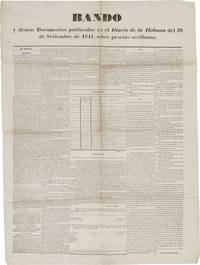
1841réf. 15527Havana. Sept. 29 1841. A proclamation by the Spanish military government in Cuba concerning legal tender and its circulation and providing a series of regulations for commerce and exchange. Broadside 23 x 16 1/2 inches. Splitting on middle fold else very good. unknown
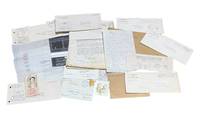
1945réf. 9277New York New York and Havana Cuba 1945. William John Mantz Jr. worked as an engineer and assistant manager for the West Indies Sugar Corporation for 10 years traveling back and forth frequently between his home in Tarrytown New York and the sugar plantations in Havana Cuba. This archive contains travel materials government documents and other personal artifacts pertaining to his time in Cuba and concerning his status with the draft during World War II. Most correspondence in original postmarked envelope. Included: - One black and white photograph of Bill and Marjorie Mantz - Birth certificate copy with raised seal for Bill Mantz dated January 1938 - Two personal letters from Marjorie to Bill in 1938 that mention her recent travels to visit him in Cuba - Cuban drivers license for Bill dated January 1940 with photo attached and stamped by the police department - Cuban Foreign Identification Card for Marjorie dated June 1940 with receipt and three copies of her photo attached - Receipt for surrendered passport in Miami Florida December 1940 - Letter from Bill's sister Margie in May 1942 forwarding paperwork from Selective Services - Two Cuban tax withholding documents from May/July 1942 - Letter from Bill in Spanish requesting the renewal of Marjorie's Foreigner's Identification card in May 1943 and follow up letter to a different recipient in English dated June 1943 regarding missing documents - Three permits from Selective Services for to depart from the United States 1943-1945 plus one duplicate - Four pieces of correspondence from the American Consulate in Cuba dated December 1944 - April 1945 regarding passports medical exams and registering the Mantz’s infant daughter - Sixteen letters and other correspondence between Bill his boss Arthur Kirstein and Selective Services mostly regarding Bill’s draft status but also some sugar industry business such as frequent air travel to Havana trains and fuel options and US politics after Truman assumed the presidency. . unknown
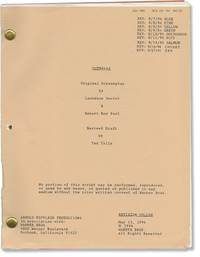
1994réf. 170268Burbank CA: Warner Brothers 1994. Revised Draft script for the 1995 film. Bound in at the rear of the script are nine pages relating to revisions to the script. US Army doctors race to find the cure to a deadly virus quickly spreading from Africa to North America by way of a smuggled capuchin monkey. Shot on location in California and Hawaii. Self wrappers. Title page present dated May 13 1994 noted as REVISION POLISH with credits for screenwriters Laurence Dworet and Robert Roy Pool and revision credits for uncredited screenwriter Ted Tally. 174 leaves with last page of text numbered 136. Xerographic duplication rectos only with rainbow revision pages throughout dated variously between August 7 and 17 1994. Pages Near Fine bound with two gold brads. Warner Brothers unknown
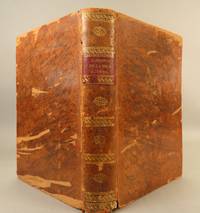
1830réf. 8598Two volumes in one with continuous pagination. No further volumes were published. Spanish text. Full mottled calf with red morroco label to spine and gilt particulars. Marbled endpapers. Loss to foot of spine see image and to corners. No previous owners' names or other defacements. Very scarce. 6 x 8.25 in Imprenta de las Viudas de Arazoza y Soler hardcover
1906réf. ZB705570Habana: 1906-1931 passim. Tomo I 1906 Tomo III 1906 a 1908 Tomo IV 1909 a 1911 Tomo VIII 1917 a 1919 Tomo 10 1921 a 1923 Tomo XII 1925-1927 Tomo XIII Vol. I 1927 a 1929 Tomo XIII Vol. 2 1929 a 1931 only; first editions; small usually thick quartos; ex library original cloth bindings smudged and worn with one side and a few text leaves detached most hinges cracked or broken text age toned but not fragile reading copies only. - If you are reading this this item is actually physically in our stock and ready for shipment once ordered. We are not bookjackers. Buyer is responsible for any additional duties taxes or fees required by recipient's country. Photos available upon request. Habana: hardcover
1895réf. 87496Havana: Castro Fernandez 1895. First. hardcover. near fine. Folding table. 414pp. 1/2 modern lavender buckram marbled boards original wrappers bound in. Habana: Castro Fernandez 1895. First Edition. Near Fine. Laws regulating the telephone and telegraph industries. Castro, Fernandez unknown
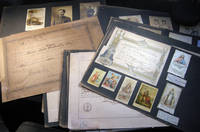
1857réf. 030167Cuba 1857. The Carbonells were of great political scientific diplomatic and business prominence in Cuba before the 20th century Revolution as evidenced here by the various degrees awards and membership documents including that signed by the President of the Republic. Most members subsequently emigrated to the U.S. after their properties were confiscated under the Castro regime. Of particular interest is the career of José María Zarragoitia y Carbonell a Havana-born engineer who graduated from Norwich University Vermont in 1906 and went on to a long career in engineering in his home country "…having helped to construct the important Air Base of San Julian Pinar del Rio Cuba working steadily there up to the time of its completion. His last work was in the Pontezuela Dam for the aqueduct of the City of Canaguey…When the United States declared war on Japan he went to the U S. Embassy here in Havana to offer his services if not for active duty due to his age at least as an engineer…" Rosa and Mercedes Carbonell writing notice of their brother's death for the Norwich University Record publication In roughly chronological order the collection includes: Photographs: 1865 - 1887 5 photos; 1887 Mercedita & criandera Maria Tejera ; Grandfather 1875; and again in 1878 graduating with his law degree Habana; 1865 carte-de-visite of Dr. Manuel Carbonell y Ruiz "hermano de Abuelo"; a group photo of grandparents & Rosa Rita & Mercedita. Affixed to the same sheet is the thermoplastic business card of Establecimiento Fotografico de G. Fernandez Carrido Habana. 1868 - 1898 Group of 6 photos family portraiture of Meredith & Rosa Rita Carbonell brothers as children; the brothers at Guanabacoa school and a 1868 carte-de-visite of grandfather after his graduation. A faded photo of Guanabacoa 1897-1898 shows the brothers and their dogs staff and Black servants. 1899 - 1908 Carbonell brothers Ramon Raul & Jose New York; a photo of Rosa Rita & Mercedita and grandparents "En los Catskills 1908"; and three tintypes in their holders of Ramon & Jose as children and one-year old Mercedita and her un-named Black criandera nanny. C. 1904 - 1908 Series of three portrait photographs identified as Jose Carbonell y Zarragoitia while a student at Norwich University; two of these in cadet uniform. Approx. 3 ½" x 5 ½"; laid-down to paper backer. Awards Certificates Degrees Appointments: 1857 Universidad de la Habana baccalaureate degree in Philosophy for Carbonell y Ruiz signed and sealed; Latin text. Approx. 12 ½" x 18" overall size; old discoloration at lower left corner; in good condition. 1857 Another as above awarding the baccalaureate in Philosophy of Science. 1861 Universidad de la Habana baccalaureate degree in jurisprudence for Carbonell y Ruiz signed and sealed; Latin text. Approx. 11 ½" x 17" overall size; old discoloration at lower right corner; in fair to good condition. 1861 Membership certificate for the Real Sociedad Economica de la Habana signed by this learned society's governing board and welcoming Ramon Carbonell y Ruiz as a member. Approx. 12 1/2" x 17 1/4"; affixed to black paper backer; old discoloration at left side; in fair to good condition. 1866 Leceo Artistico y Leterario del Havana graduation diploma for Jose maria Carbonell y Ruiz signed by school dignitaries. Approx. 12 ½" x 16 ¼"; affixed to black paper backer; corners chipped and worn away old discoloration in bottom corner; in fair to good condition. 1867 Certificate Utile Dulci Recreo de Pueblo-Nuevo Matanzas certifying Carbonell y Ruiz as Socio Facultativo and signed. Approx. 12 ½" x 18"; affixed to black paper backer; couple of corners chipped and worn away old discolorations and trimmed close at bottom and top; in fair to good condition. 1871 Another Real Sociedad Economica de la Habana certificate noting membership in good standing and signed by this learned society's leadership board. Approx. 9" x 11 1/2"; affixed to black paper backer; in very good condition. 1875 Universidad de la Habana awarding Asignatura de Economia Politica y Estadristica honors course for Carbonell y Ruiz signed and sealed. Approx. 10" x 15 1/2" overall size; old discoloration at lower left corner and poor paper repair also at left obscuring some letters; top corner chipped; in fair to good condition. 1892 Certificate El Circulo de Abogados de la Habana signed and sealed. Approx. 8" x 13"; affixed to black paper backer; edges crudely trimmed; in good condition. 1894 Certificate of academic excellence from Escuelas Pias de Guanabacoa for Jose Carbonell y Zarrogoitia signed. Approx. 8" x 12"; affixed to black paper backer. In very good condition. 1894 Certificate of academic excellence as above from Escuelas Pias de Guanabacoa for Ramon Carbonell y Zarrogoitia signed. Approx. 8" x 12"; affixed to black paper backer. In very good condition. 1910 Certificate of citizenship for Ramon Ysidro Restituto Margarita Carbonell y Ruiz the Republica de Cuba signed by Jose Francisco Remirez de Estenoz Secretary of the Republic and with official blind-stamp seal. Approx. 11 ¼" x 12 ¾"; affixed to black paper backer; in very good condition. 1914 Certificate signed and with his blind-stamp seal by Mario G. Menocal 1866 - 1941 3rd Presidente of the Republica bestowing the "Titulo de Notario" for Carbonel y Ruiz resident of Mayare. Two-sided with additional attestations and signatures on the reverse. Approx. 12 1/2" x 17 ¾"; old paper tape at left margin; document paper darkened with some bleed-through of reverse writing and with old spotting and discoloration; in fair to good condition. Miscellaneous: 1918 Certificate Asociacion General Del Rosario Perpetuo membership for Rosa Carbonell. Approx. 8" x 9 ¾"; printed with colors and affixed to black paper backer trimmed oddly along left edge; along with 6 color-printed religious cards; one is dated 1908 in pen; two small pasted-in note-slips noting the Primera Comunion de Gerardo Montejo y Carbonell la Vibora Habana in 1917 and another for the First Holy Communion of Amelia Desvernine at the Church of the Sacred Heart New York in 1909. In very good condition. Undated Typed poetry broadside with manuscript title "Un Hombre Agradecido" - Estimado Carbonel:/Por juzgarlo procedente/cojo maquina y papel/y le escribio lo siguiente:…" Unsigned and undated. Approx. 4 ¼" x 10 ½" size; pasted down to backer; faint old fold line; in very good condition. 1886 - 1895 A group of mostly French & European-printed Christian religious inspirational cards; one card with elaborate layers of decoration. With various notes for Mercedes Carbonell y Zarragoitia; Rosa Rita Carbonell y Zarragoitia and Maria Ana a Rosa Rita & Maria Fejera. Another sheet Of 15 religious cards various sizes and styles. Another sheet Of 9 religious cards. Evidence of the loss of one card removed. Condition as noted; good overall. . Collection. Good.
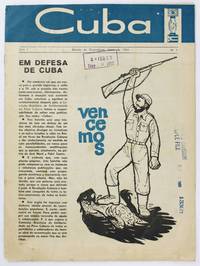
1961réf. 5832Guanabara 1961. About very good. 111pp. Small folio. Original pictorial self-wrappers stapled. Contemporary and slightly later ink stamps to front wrap. Light edge wear. Some tanning and dust soiling. First issue of this evidently unrecorded periodical published by the "Comissão Brasileira de Solidariedade ao Pavo Cubano" in May 1961. The publication contains numerous positive stories on the progress of the Cuban Revolution and support of the cause from the Brazilian people. Illustrated throughout with photographs and drawings including the beginning of a serial comic on the history of the revolution at the rear. The front wrap depicts Fidel Castro with his foot on the chest of a supine eagle and a rifle raised triumphantly over his head. Interesting support for the Communist cause in Cuba from South America. Not in OCLC. unknown
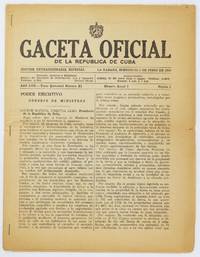
1959réf. 5470Habana: June 3 1959. Good plus. 11pp. Small folio. Previously folded; stapled along gutter margin. Some edge and corner wear; closed tear to initial leaf from fore-edge along old fold. Toned cheap newsprint. A special edition of the Gaceta Oficial of Communist Cuba devoted to the printing of the First Agrarian Reform Law passed and signed on May 17 1959. The law effected the first major land redistribution under Fidel Castro and the Communist Party. Under its authority all properties were over 420 hectares were confiscated and redistributed to the people and native businesses. Prior to the law over 80% of Cuban land was owned by foreign mostly American companies. The preamble and sixty-seven articles lay out the motivations for the law the parameters for confiscation by the Department of Agriculture the mechanisms for seizure and redistribution and the creation of a new government organization to facilitate the land transfers the Instituto Nacional de Reforma Agraria. Signed in print by Fidel as Prime Minister Manuel Urrutia Lleo as President and a slew of other officials. June 3 unknown
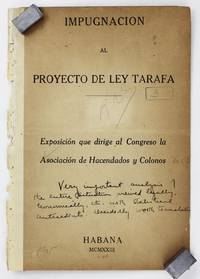
1923réf. 5672Havana 1923. Fair. 14pp. Original wrappers rear cover lacking. Contemporary ink notation to front cover reinforced at spine with later paper tanned. Text guillotined; leaves silked some chipping and wear at edges. A rare work arguing against railroad consolidation in Cuba and a victim of the New York Public Library's microfilming project. The subtitle reads "Exposicion que dirige al Congreso la Asociacion de Hacendados y Colonos." We locate only the microfilm copy at NYPL in OCLC no physical copies. unknown
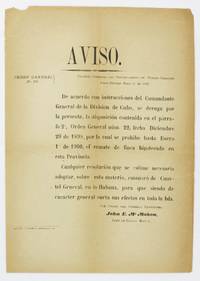
1899réf. 5378Puerto-Principe Cuba: Imp. el Progreso-Soledad January 11 1899. Good. Broadside 11.75 x 8.25 inches. Old folds minor chip at top left corner uniformly tanned and somewhat tender. An unrecorded general order issued in Spanish by the American "Jefe de Estado Mayor" Chief of Staff John E. McMahon during the military occupation of Cuba in the Spanish-American War. The order stipulates that a paragraph in a previous order prohibiting the auction of mortgaged property in the province of Puerto-Principe until January 1 1900 is hereby repealed and any further instructions on this matter will come from the Army's General Headquarters in Havana. McMahon issued several general orders during the American Army's occupation of Cuba and all appear to be rare. An interesting artifact from America's expansionist period with no other copies in OCLC auction history or the trade. Imp. el Progreso-Soledad, January 11 unknown
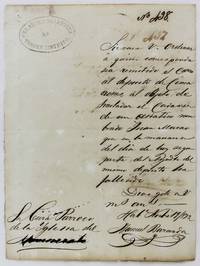
1872réf. 3066Havana 1872. Very good. Manuscript form approximately 8.5 x 6.25 inches. Minor wear at edges; a few small worm holes. Contemporary ink stamp. Light tanning and offsetting. This 1872 manuscript form from a Havana jail the Celaduria de la Punta notes the death there of an "Asiatico" a Chinese indentured servant with the given name of Juan Macao and orders the transfer of the body to the mortuary for cremation. Indentured servants found themselves jailed for several reasons including suspicion of theft and other crimes recapture following runaway or mere suspicion of abandoning a contract. unknown
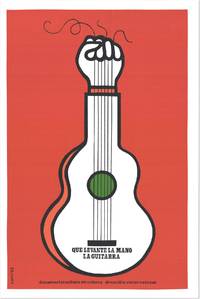
1983réf. 83069Havana: S.i. 1983. Original illustrated poster with text and pictorial elements silkscreened in four colors on white stock measuring 51cm x 76.25cm 20 1/8" x 30". Mild handling to extremities ele a bright Fine copy unbacked. Striking poster designed by Concepción Robinson Mendoza aka. "Coni" for Victor Cassaus's 1983 documentary Que Levante la Mano la Guitarra centered around Cuban musician and folk singer Silvio Rodríguez Domínguez. 83069. S.i. unknown
1887réf. 64748Barcelona Spain: Campania Trasatlantica Espanola S.A. C.T.E. 1887. 8vo. 72 pp. With 2 large double-page colour maps 5 large folding engraved colour deck plans for CTE ocean liners. Red cloth-backed colour chromolithograph boards cover art of CTE liner in port at Gibraltar CTE Barcelona insignia on back cover minor scuffing edgewear minor soiling front cover slightly shaken 2 deckplans w/ very minor closed tears still a VG- copy. First edition of this very rare transatlantic guidebook timetable and deck plans for the Campania Trasatlantica Espanola S.A. Barcelona CTE ocean liner service between Spain Cuba Mexico New York & Colombia. Ports of call after New York included Boston Philadelphia Baltimore Georgetown Charleston Savannah and New Orleans with stops in various ports in Cuba Puerto Rico Jamaica Veracruz Mexico as well as several in Colombia and the Guiana’s. Deck plans engraved by Hermenagilda Miralles Bailan in Barceolna include those for the 8600 ton Reina Ma Cristina 9850 ton Buenos Aires 5450 ton Veracruz 6720 ton Ciudad de Santander and finally the 9700 ton Alfonso XII. Founded originally in 1850 by Spanish businessman and slave trader Don Antonio L. Lopez in 1850 to feed African-American slaves into both Havana as well as Mobile AL & New Orleans LA prior to the Civil War and headquarters was established in Barcelona after the marriage of Lopez to Luisa Bru Lassus. After 1883 Don Claudio B. Lopez took charge of the company and by 1887 had reached over 30 steamships and ocean liners many of which were used by the Spanish Navy following the outbreak of the Spanish-American War. Campania Trasatlantica [Espanola S.A.] (C.T.E.), hardcover
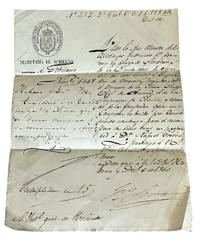
1860réf. 234291860. Spanish colonial administration in Havana used port health regulation as a mechanism of commercial and maritime control with the Captaincy General directing military customs and sanitary officials through centralized orders. This December 6 1860 manuscript concerns the "Junta local de Sanidad" "víveres averiados" and Dr. Rafael Cortés placing damaged provisions public health authority and port enforcement within the same bureaucratic chain. The phrase "usando de las facultades que me competen" invokes the vested powers of the colonial government confirming that the matter was handled through Spanish imperial authority rather than local civic discretion. Gobierno y Capitanía General de la Isla de Cuba. Secretaría de Gobierno sección de Gobierno. Manuscript order. Havana Cuba: December 6 1860. Single folded manuscript document with printed colonial seal and heading docketed "Habana y Dic. 6 de 1860" and addressed to maritime or port authorities. The text instructs compliance with a petition or order involving the local Board of Health damaged provisions or foodstuffs and Dr. Rafael Cortés with official endorsements and large administrative signatures below. The verso bears docketing and filing marks consistent with bureaucratic circulation. The document belongs directly to Spanish colonial governance in Cuba where the Governor and Captain General exercised civil military and administrative power over the island until the end of Spanish rule in 1898. Its contents connect colonial rule to the management of ports food safety and public health all crucial areas in Havana's nineteenth-century Atlantic economy. Folded as issued with toning scattered foxing edge wear and original folds; seal heading date and principal manuscript text remain legible. Overall good condition. unknown