2 484 résultats
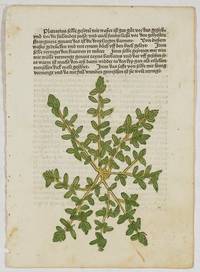
1485réf. 707321485. Mainz Peter Schöffer 28 März 1485 1 einspaltiges original Inkunabelblatt 238 x 171 mm 1 alt color. Holzschnitt. Erstdruck! Cap. 347: Salvia - heysset selbe. Savia triloba L. Kapitelende. Cap. 348: Serpillum - heysset quendel; Thymus sibthorpii L.; Darstellung: schematisiert. "Im Gegensatz zu den meisten Kräuterbuch-Inkunabeln lässt sich das Druckdatum des "Gart der Gesundheit genau auf den 28. März 1485 festlegen wie es am Ende des Werks vermerkt ist: "Disser Herbarius ist rzu mentz gedruckt und geendet uff dem XXVIII dage des mertz -Anno-M-CCCC-LXXXV". An gleicher Stelle wird Peter Schöffer als Drucker durch das Fust-Schöffersche Signet bestätigt. Der "Gart der Gesundheit gilt wie Muther 1884: 88: "als wichtigstes naturhistorisches Werk des Mittelalters" und Klebs/Becher 1925: 11: "The most important mediaeval work on natural history with illustrations Choulant the publication of which forms an important landmark in the history of botanical Illustration and marks perhaps the grea-test single Step ever made in that art" meinten als wichtigste bebilderte Arzneipflanzen-Inkunabel. Auch Keil 1982: 604 bestätigte später diese Aussage: "Zweifellos ist der "Gart das wichtigste naturhistorische Werk des Mittelalters". Auf 359 Seiten die in 435 Kapitel gegliedert sind wird der gesamte zur damaligen Zeit bekannte Arzneischatz abgehandelt und mit 382 Holzschnitten illustriert. Die wichtigsten 366 Heilpflanzen zwei Wiederholungen werden jeweils einzeln in den verschiedenen Kapiteln beschrieben und abgebildet. Der Text ist 42zeilig geordnet." B. Baumann & H. Baumann Die Mainzer Kräuterbuch-Inkunabeln 2010 p.111 Johann Wonnecke von Kaub um 1430 in Kaub am Rhein; gestorben 1503/04 in Frankfurt am Main auch Johannfes Dronnecke bzw. Johannes de Cuba er selbst nannte sich "Johan von Cube" war ein deutscher Arzt und Botaniker. Am Mainzer Hof wirkte er als Leibarzt. unknown
1485réf. 707701485. Mainz Peter Schöffer 28 März 1485 1 einspaltiges original Inkunabelblatt 266 x 196 mm; etwas fleckig. Erstdruck! Cap. 41: Asafetida - dufels dreck. Ferula assa-foetida L. Kapitelende. Cap. 42: Amidum vel amilum - krafft mele. Amylum. "Im Gegensatz zu den meisten Kräuterbuch-Inkunabeln lässt sich das Druckdatum des "Gart der Gesundheit genau auf den 28. März 1485 festlegen wie es am Ende des Werks vermerkt ist: "Disser Herbarius ist rzu mentz gedruckt und geendet uff dem XXVIII dage des mertz -Anno-M-CCCC-LXXXV". An gleicher Stelle wird Peter Schöffer als Drucker durch das Fust-Schöffersche Signet bestätigt. Der "Gart der Gesundheit gilt wie Muther 1884: 88: "als wichtigstes naturhistorisches Werk des Mittelalters" und Klebs/Becher 1925: 11: "The most important mediaeval work on natural history with illustrations Choulant the publication of which forms an important landmark in the history of botanical Illustration and marks perhaps the grea-test single Step ever made in that art" meinten als wichtigste bebilderte Arzneipflanzen-Inkunabel. Auch Keil 1982: 604 bestätigte später diese Aussage: "Zweifellos ist der "Gart das wichtigste naturhistorische Werk des Mittelalters". Auf 359 Seiten die in 435 Kapitel gegliedert sind wird der gesamte zur damaligen Zeit bekannte Arzneischatz abgehandelt und mit 382 Holzschnitten illustriert. Die wichtigsten 366 Heilpflanzen zwei Wiederholungen werden jeweils einzeln in den verschiedenen Kapiteln beschrieben und abgebildet. Der Text ist 42zeilig geordnet." B. Baumann & H. Baumann Die Mainzer Kräuterbuch-Inkunabeln 2010 p.111 Johann Wonnecke von Kaub um 1430 in Kaub am Rhein; gestorben 1503/04 in Frankfurt am Main auch Johannfes Dronnecke bzw. Johannes de Cuba er selbst nannte sich "Johan von Cube" war ein deutscher Arzt und Botaniker. Am Mainzer Hof wirkte er als Leibarzt. unknown
1485réf. 707741485. Mainz Peter Schöffer 28 März 1485 1 einspaltiges original Inkunabelblatt 239 x 150 mm; etwas fleckig. Erstdruck! Cap. 37: Aloes lignum - exn holtz. Aquilaria malaccensis La./ A. agallocha Rpxb. Kapitel Ende. Cap. 38: Aurum - golt. Aurum. "Im Gegensatz zu den meisten Kräuterbuch-Inkunabeln lässt sich das Druckdatum des "Gart der Gesundheit genau auf den 28. März 1485 festlegen wie es am Ende des Werks vermerkt ist: "Disser Herbarius ist rzu mentz gedruckt und geendet uff dem XXVIII dage des mertz -Anno-M-CCCC-LXXXV". An gleicher Stelle wird Peter Schöffer als Drucker durch das Fust-Schöffersche Signet bestätigt. Der "Gart der Gesundheit gilt wie Muther 1884: 88: "als wichtigstes naturhistorisches Werk des Mittelalters" und Klebs/Becher 1925: 11: "The most important mediaeval work on natural history with illustrations Choulant the publication of which forms an important landmark in the history of botanical Illustration and marks perhaps the grea-test single Step ever made in that art" meinten als wichtigste bebilderte Arzneipflanzen-Inkunabel. Auch Keil 1982: 604 bestätigte später diese Aussage: "Zweifellos ist der "Gart das wichtigste naturhistorische Werk des Mittelalters". Auf 359 Seiten die in 435 Kapitel gegliedert sind wird der gesamte zur damaligen Zeit bekannte Arzneischatz abgehandelt und mit 382 Holzschnitten illustriert. Die wichtigsten 366 Heilpflanzen zwei Wiederholungen werden jeweils einzeln in den verschiedenen Kapiteln beschrieben und abgebildet. Der Text ist 42zeilig geordnet." B. Baumann & H. Baumann Die Mainzer Kräuterbuch-Inkunabeln 2010 p.111 Johann Wonnecke von Kaub um 1430 in Kaub am Rhein; gestorben 1503/04 in Frankfurt am Main auch Johannfes Dronnecke bzw. Johannes de Cuba er selbst nannte sich "Johan von Cube" war ein deutscher Arzt und Botaniker. Am Mainzer Hof wirkte er als Leibarzt. Kapitel nicht vollständig. unknown
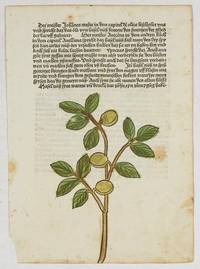
1485réf. 707391485. Mainz Peter Schöffer 28 März 1485 1 einspaltiges original Inkunabelblatt 238 x 171 mm 1 alt color. Holzschnitt. Erstdruck! CAp. 280: Nux avellana - haselnuß. Corylus avellana L. Kapitelende. Cap. 281: Nux Vsualis siue magna - welch nuß; Juglans regia L.; Darstellung: stelisiert. "Im Gegensatz zu den meisten Kräuterbuch-Inkunabeln lässt sich das Druckdatum des "Gart der Gesundheit genau auf den 28. März 1485 festlegen wie es am Ende des Werks vermerkt ist: "Disser Herbarius ist rzu mentz gedruckt und geendet uff dem XXVIII dage des mertz -Anno-M-CCCC-LXXXV". An gleicher Stelle wird Peter Schöffer als Drucker durch das Fust-Schöffersche Signet bestätigt. Der "Gart der Gesundheit gilt wie Muther 1884: 88: "als wichtigstes naturhistorisches Werk des Mittelalters" und Klebs/Becher 1925: 11: "The most important mediaeval work on natural history with illustrations Choulant the publication of which forms an important landmark in the history of botanical Illustration and marks perhaps the grea-test single Step ever made in that art" meinten als wichtigste bebilderte Arzneipflanzen-Inkunabel. Auch Keil 1982: 604 bestätigte später diese Aussage: "Zweifellos ist der "Gart das wichtigste naturhistorische Werk des Mittelalters". Auf 359 Seiten die in 435 Kapitel gegliedert sind wird der gesamte zur damaligen Zeit bekannte Arzneischatz abgehandelt und mit 382 Holzschnitten illustriert. Die wichtigsten 366 Heilpflanzen zwei Wiederholungen werden jeweils einzeln in den verschiedenen Kapiteln beschrieben und abgebildet. Der Text ist 42zeilig geordnet." B. Baumann & H. Baumann Die Mainzer Kräuterbuch-Inkunabeln 2010 p.111 Johann Wonnecke von Kaub um 1430 in Kaub am Rhein; gestorben 1503/04 in Frankfurt am Main auch Johannfes Dronnecke bzw. Johannes de Cuba er selbst nannte sich "Johan von Cube" war ein deutscher Arzt und Botaniker. Am Mainzer Hof wirkte er als Leibarzt. unknown
1485réf. 707831485. Mainz Peter Schöffer 28 März 1485 1 einspaltiges original Inkunabelblatt 239 x 169 mm; etwas fleckig. Erstdruck! Cap. 53: Betonica - betonien. Stachys officinalis L. Trev. Kapitelende. "Im Gegensatz zu den meisten Kräuterbuch-Inkunabeln lässt sich das Druckdatum des "Gart der Gesundheit genau auf den 28. März 1485 festlegen wie es am Ende des Werks vermerkt ist: "Disser Herbarius ist rzu mentz gedruckt und geendet uff dem XXVIII dage des mertz -Anno-M-CCCC-LXXXV". An gleicher Stelle wird Peter Schöffer als Drucker durch das Fust-Schöffersche Signet bestätigt. Der "Gart der Gesundheit gilt wie Muther 1884: 88: "als wichtigstes naturhistorisches Werk des Mittelalters" und Klebs/Becher 1925: 11: "The most important mediaeval work on natural history with illustrations Choulant the publication of which forms an important landmark in the history of botanical Illustration and marks perhaps the grea-test single Step ever made in that art" meinten als wichtigste bebilderte Arzneipflanzen-Inkunabel. Auch Keil 1982: 604 bestätigte später diese Aussage: "Zweifellos ist der "Gart das wichtigste naturhistorische Werk des Mittelalters". Auf 359 Seiten die in 435 Kapitel gegliedert sind wird der gesamte zur damaligen Zeit bekannte Arzneischatz abgehandelt und mit 382 Holzschnitten illustriert. Die wichtigsten 366 Heilpflanzen zwei Wiederholungen werden jeweils einzeln in den verschiedenen Kapiteln beschrieben und abgebildet. Der Text ist 42zeilig geordnet." B. Baumann & H. Baumann Die Mainzer Kräuterbuch-Inkunabeln 2010 p.111 Johann Wonnecke von Kaub um 1430 in Kaub am Rhein; gestorben 1503/04 in Frankfurt am Main auch Johannfes Dronnecke bzw. Johannes de Cuba er selbst nannte sich "Johan von Cube" war ein deutscher Arzt und Botaniker. Am Mainzer Hof wirkte er als Leibarzt. unknown
1485réf. 707871485. Mainz Peter Schöffer 28 März 1485 1 einspaltiges original Inkunabelblatt 238 x 171 mm. Erstdruck! Cap. 395: Titmallus - springwortz. Euphorbia lathyrism L. Kapitelende. "Im Gegensatz zu den meisten Kräuterbuch-Inkunabeln lässt sich das Druckdatum des "Gart der Gesundheit genau auf den 28. März 1485 festlegen wie es am Ende des Werks vermerkt ist: "Disser Herbarius ist rzu mentz gedruckt und geendet uff dem XXVIII dage des mertz -Anno-M-CCCC-LXXXV". An gleicher Stelle wird Peter Schöffer als Drucker durch das Fust-Schöffersche Signet bestätigt. Der "Gart der Gesundheit gilt wie Muther 1884: 88: "als wichtigstes naturhistorisches Werk des Mittelalters" und Klebs/Becher 1925: 11: "The most important mediaeval work on natural history with illustrations Choulant the publication of which forms an important landmark in the history of botanical Illustration and marks perhaps the grea-test single Step ever made in that art" meinten als wichtigste bebilderte Arzneipflanzen-Inkunabel. Auch Keil 1982: 604 bestätigte später diese Aussage: "Zweifellos ist der "Gart das wichtigste naturhistorische Werk des Mittelalters". Auf 359 Seiten die in 435 Kapitel gegliedert sind wird der gesamte zur damaligen Zeit bekannte Arzneischatz abgehandelt und mit 382 Holzschnitten illustriert. Die wichtigsten 366 Heilpflanzen zwei Wiederholungen werden jeweils einzeln in den verschiedenen Kapiteln beschrieben und abgebildet. Der Text ist 42zeilig geordnet." B. Baumann & H. Baumann Die Mainzer Kräuterbuch-Inkunabeln 2010 p.111 Johann Wonnecke von Kaub um 1430 in Kaub am Rhein; gestorben 1503/04 in Frankfurt am Main auch Johannfes Dronnecke bzw. Johannes de Cuba er selbst nannte sich "Johan von Cube" war ein deutscher Arzt und Botaniker. Am Mainzer Hof wirkte er als Leibarzt. unknown
1485réf. 707841485. Mainz Peter Schöffer 28 März 1485 1 einspaltiges original Inkunabelblatt 265 x 196 mm; etwas fleckig. Erstdruck! Cap. 53: Betonica - betonien. Stachys officinalis L. Trev. Kapitelende. "Im Gegensatz zu den meisten Kräuterbuch-Inkunabeln lässt sich das Druckdatum des "Gart der Gesundheit genau auf den 28. März 1485 festlegen wie es am Ende des Werks vermerkt ist: "Disser Herbarius ist rzu mentz gedruckt und geendet uff dem XXVIII dage des mertz -Anno-M-CCCC-LXXXV". An gleicher Stelle wird Peter Schöffer als Drucker durch das Fust-Schöffersche Signet bestätigt. Der "Gart der Gesundheit gilt wie Muther 1884: 88: "als wichtigstes naturhistorisches Werk des Mittelalters" und Klebs/Becher 1925: 11: "The most important mediaeval work on natural history with illustrations Choulant the publication of which forms an important landmark in the history of botanical Illustration and marks perhaps the grea-test single Step ever made in that art" meinten als wichtigste bebilderte Arzneipflanzen-Inkunabel. Auch Keil 1982: 604 bestätigte später diese Aussage: "Zweifellos ist der "Gart das wichtigste naturhistorische Werk des Mittelalters". Auf 359 Seiten die in 435 Kapitel gegliedert sind wird der gesamte zur damaligen Zeit bekannte Arzneischatz abgehandelt und mit 382 Holzschnitten illustriert. Die wichtigsten 366 Heilpflanzen zwei Wiederholungen werden jeweils einzeln in den verschiedenen Kapiteln beschrieben und abgebildet. Der Text ist 42zeilig geordnet." B. Baumann & H. Baumann Die Mainzer Kräuterbuch-Inkunabeln 2010 p.111 Johann Wonnecke von Kaub um 1430 in Kaub am Rhein; gestorben 1503/04 in Frankfurt am Main auch Johannfes Dronnecke bzw. Johannes de Cuba er selbst nannte sich "Johan von Cube" war ein deutscher Arzt und Botaniker. Am Mainzer Hof wirkte er als Leibarzt. unknown
1485réf. 707861485. Mainz Peter Schöffer 28 März 1485 1 einspaltiges original Inkunabelblatt 238 x 168 mm. Erstdruck! Cap. 336: Ruta - heysset ruten. Ruta graveoleus L. Kapitelende. "Im Gegensatz zu den meisten Kräuterbuch-Inkunabeln lässt sich das Druckdatum des "Gart der Gesundheit genau auf den 28. März 1485 festlegen wie es am Ende des Werks vermerkt ist: "Disser Herbarius ist rzu mentz gedruckt und geendet uff dem XXVIII dage des mertz -Anno-M-CCCC-LXXXV". An gleicher Stelle wird Peter Schöffer als Drucker durch das Fust-Schöffersche Signet bestätigt. Der "Gart der Gesundheit gilt wie Muther 1884: 88: "als wichtigstes naturhistorisches Werk des Mittelalters" und Klebs/Becher 1925: 11: "The most important mediaeval work on natural history with illustrations Choulant the publication of which forms an important landmark in the history of botanical Illustration and marks perhaps the grea-test single Step ever made in that art" meinten als wichtigste bebilderte Arzneipflanzen-Inkunabel. Auch Keil 1982: 604 bestätigte später diese Aussage: "Zweifellos ist der "Gart das wichtigste naturhistorische Werk des Mittelalters". Auf 359 Seiten die in 435 Kapitel gegliedert sind wird der gesamte zur damaligen Zeit bekannte Arzneischatz abgehandelt und mit 382 Holzschnitten illustriert. Die wichtigsten 366 Heilpflanzen zwei Wiederholungen werden jeweils einzeln in den verschiedenen Kapiteln beschrieben und abgebildet. Der Text ist 42zeilig geordnet." B. Baumann & H. Baumann Die Mainzer Kräuterbuch-Inkunabeln 2010 p.111 Johann Wonnecke von Kaub um 1430 in Kaub am Rhein; gestorben 1503/04 in Frankfurt am Main auch Johannfes Dronnecke bzw. Johannes de Cuba er selbst nannte sich "Johan von Cube" war ein deutscher Arzt und Botaniker. Am Mainzer Hof wirkte er als Leibarzt. unknown
1485réf. 707881485. Mainz Peter Schöffer 28 März 1485 1 einspaltiges original Inkunabelblatt 238 x 171 mm. Erstdruck! Cap. 370: Scammonea - scammonea also genat. Convolvulcus scammonia L. Kapitelende. "Im Gegensatz zu den meisten Kräuterbuch-Inkunabeln lässt sich das Druckdatum des "Gart der Gesundheit genau auf den 28. März 1485 festlegen wie es am Ende des Werks vermerkt ist: "Disser Herbarius ist rzu mentz gedruckt und geendet uff dem XXVIII dage des mertz -Anno-M-CCCC-LXXXV". An gleicher Stelle wird Peter Schöffer als Drucker durch das Fust-Schöffersche Signet bestätigt. Der "Gart der Gesundheit gilt wie Muther 1884: 88: "als wichtigstes naturhistorisches Werk des Mittelalters" und Klebs/Becher 1925: 11: "The most important mediaeval work on natural history with illustrations Choulant the publication of which forms an important landmark in the history of botanical Illustration and marks perhaps the grea-test single Step ever made in that art" meinten als wichtigste bebilderte Arzneipflanzen-Inkunabel. Auch Keil 1982: 604 bestätigte später diese Aussage: "Zweifellos ist der "Gart das wichtigste naturhistorische Werk des Mittelalters". Auf 359 Seiten die in 435 Kapitel gegliedert sind wird der gesamte zur damaligen Zeit bekannte Arzneischatz abgehandelt und mit 382 Holzschnitten illustriert. Die wichtigsten 366 Heilpflanzen zwei Wiederholungen werden jeweils einzeln in den verschiedenen Kapiteln beschrieben und abgebildet. Der Text ist 42zeilig geordnet." B. Baumann & H. Baumann Die Mainzer Kräuterbuch-Inkunabeln 2010 p.111 Johann Wonnecke von Kaub um 1430 in Kaub am Rhein; gestorben 1503/04 in Frankfurt am Main auch Johannfes Dronnecke bzw. Johannes de Cuba er selbst nannte sich "Johan von Cube" war ein deutscher Arzt und Botaniker. Am Mainzer Hof wirkte er als Leibarzt. unknown
réf. 7078571000. Mainz Peter Schöffer 28 März 1485 1 einspaltiges original Inkunabelblatt 265 x 198 mm. Erstdruck! Cap. 165: Elleborus albus - nyeswortz wyß. Veratrum album L. Kapitelende. "Im Gegensatz zu den meisten Kräuterbuch-Inkunabeln lässt sich das Druckdatum des "Gart der Gesundheit genau auf den 28. März 1485 festlegen wie es am Ende des Werks vermerkt ist: "Disser Herbarius ist rzu mentz gedruckt und geendet uff dem XXVIII dage des mertz -Anno-M-CCCC-LXXXV". An gleicher Stelle wird Peter Schöffer als Drucker durch das Fust-Schöffersche Signet bestätigt. Der "Gart der Gesundheit gilt wie Muther 1884: 88: "als wichtigstes naturhistorisches Werk des Mittelalters" und Klebs/Becher 1925: 11: "The most important mediaeval work on natural history with illustrations Choulant the publication of which forms an important landmark in the history of botanical Illustration and marks perhaps the grea-test single Step ever made in that art" meinten als wichtigste bebilderte Arzneipflanzen-Inkunabel. Auch Keil 1982: 604 bestätigte später diese Aussage: "Zweifellos ist der "Gart das wichtigste naturhistorische Werk des Mittelalters". Auf 359 Seiten die in 435 Kapitel gegliedert sind wird der gesamte zur damaligen Zeit bekannte Arzneischatz abgehandelt und mit 382 Holzschnitten illustriert. Die wichtigsten 366 Heilpflanzen zwei Wiederholungen werden jeweils einzeln in den verschiedenen Kapiteln beschrieben und abgebildet. Der Text ist 42zeilig geordnet." B. Baumann & H. Baumann Die Mainzer Kräuterbuch-Inkunabeln 2010 p.111 Johann Wonnecke von Kaub um 1430 in Kaub am Rhein; gestorben 1503/04 in Frankfurt am Main auch Johannfes Dronnecke bzw. Johannes de Cuba er selbst nannte sich "Johan von Cube" war ein deutscher Arzt und Botaniker. Am Mainzer Hof wirkte er als Leibarzt. unknown
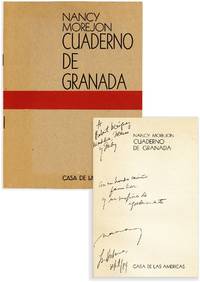
1984réf. 88455Havana: Casa de las Americas 1984. First Edition. Slim quarto 23.75cm; original printed card wrappers with French flaps stapled; 16pp; text is entirely in Spanish. Inscribed by Morejon on the title page to Puerto Rican editor translator and literary critic Roberto Márquez and his family: "A Robert Márquez Maddie Maceo y Gaby / Con un hondo cariño familiar y suspiro de agradecimiento y un suspiro de agradecimiento / Nancy / La Habana / Sept/84." Trivial external wear and a hint of sunning to spine-fold; touch of oxidation to staples; contents fresh; Near Fine. Short collection of verse by the noted Afro-Cuban poet critic and essayist gathrering nine poems. A nice inscription connecting two prominent Caribbean literary figures. 88455. Casa de las Americas unknown
2004réf. 88456Buffalo NY: White Pine Press 2004. First Edition. First Printing. Small quarto 25.5cm; original glossy pictorial card wrappers; 910-1155pp; illus.; with parallel text in English and in Spanish. Inscribed by Morejon on the half-title page to Puerto Rican editor translator and literary critic Roberto Márquez and his wife: "Para Maddie y Roberto y los nenes que ya no lo son / Su negra / Nancy Morejon / 10/10/10." Hint of sunning to spine tiny crease to upper right corner of front wrapper; Near Fine. Collection of verse by the noted Afro-Cuban poet written between the summers of 1986-87 pairing her poems prose poems and vignettes with photos by Milton Rogovin. A nice inscription connecting two prominent Caribbean literary figures. 88456. White Pine Press unknown
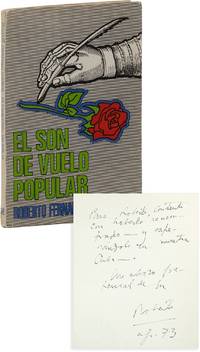
1972réf. 88465Havana: UNEAC 1972. First Edition. First Impression one of 10000 copies. Octavo 21cm; original pictorial wrappers with French flaps; 89-897pp; text is entirely in Spanish. Inscribed by Retamar on the front endpaper to Puerto Rican editor translator and literary critic Roberto Márquez: "Para Roberto / Contento con haberlo rencontrado - y esperandolo en nuestra Cuba - Un abrazo fraternal del Roberto / Ap. 73." The recipient's pervasive ink annotations and markings appear throughout the text. Edgeworn a few tiny tears and creases and a 2" split at upper front joint; Very Good. Collection of four extended essays on Nicolas Guillen by the noted Cuban poet essayist and literary critic. A warm inscription and a nice association to Marquez a Guillen scholar and translator of his work. 88465. UNEAC unknown
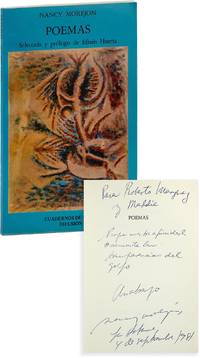
1980réf. 88457Mexico City: Difusion Cultural Departamiento de Humanidades / Universidad Nacional Autónoma de México 1980. First Edition. First Impression one of 2000 copies. Small octavo 18cm; original pictorial card wrappers; 89-62pp. With a full-page inscription from Morejon to Puerto Rican editor translator and literary critic Roberto Márquez and his wife signed and dated in Havana 4 September 1981." Mild surface wear else a fresh very Near Fine copy. A collection of verse by the noted Afro-Cuban poet selected and edited by Mexican poet and journalist Efraín Huerta Roma 1914-1982. A nice inscription connecting two prominent Caribbean literary figures. 88457. Difusion Cultural Departamiento de Humanidades / Universidad Nacional Autónoma de México unknown
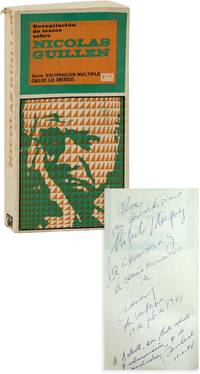
1974réf. 88452Havana: Casa de las Americas 1974. First Edition. First Impression one of 18000 copies. Narrow octavo 22.75cm; original pictorial card wrappers; 67-4293pp; illus.; text is entirely in Spanish. Inscribed by Guillen on the title page to Puerto Rican editor translator and literary critic Roberto Márquez: "Para Roberto Márquez / con el fraternal cariño de Nicolas / La Habana Feb. 74." Signed directly beneath by an unknown figure and below that by Afro-Cuban poet and journalist Marcelino Arozarena 1912-1996. The opposing page is inscribed for Márquez in verse with a small drawing by an undetermined poet signed "David Feb.74." The verso of the half-title page is warmly inscribed by Cuban poet and critic Nancy Morejón who has written the foreword to this volume: "Para mi queridísimo Roberto Marquez / la admiracion y el cariño immenso de Nancy / La Habana / 19 de feb. de 1974." Directly beneath this is another warm year of publication inscription by an underemined individual. This volume has been extensively marked-up by Márquez whose contribution "Introducción a Guillén" appears on pp.127-138. Some wear to extremities a few nicks and tears to spine ends with some creases to wrappers; Very Good. A key volume of critical texts on Guillén 1902-1989 the national poet of Cuba by many of his contemporaries like Mirta Aguirre Angel Augier Roberto Fernández Retamar Nancy Morejón Alejo Carpentier Pablo Neruda Ciro Alegría and others. This copy bears a number of contemporary inscriptions to Márquez a Guillén scholar who has written extensively on his work and has translated several of the poet's works faithfully from Spanish into English. 88452. Casa de las Americas unknown
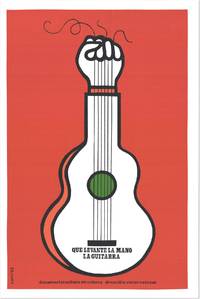
1983réf. 83069Havana: S.i. 1983. Original illustrated poster with text and pictorial elements silkscreened in four colors on white stock measuring 51cm x 76.25cm 20 1/8" x 30". Mild handling to extremities ele a bright Fine copy unbacked. Striking poster designed by Concepción Robinson Mendoza aka. "Coni" for Victor Cassaus's 1983 documentary Que Levante la Mano la Guitarra centered around Cuban musician and folk singer Silvio Rodríguez Domínguez. 83069. S.i. unknown
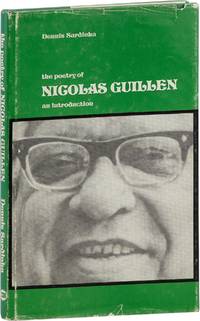
1976réf. 85000London & Port of Spain: New Beacon Books 1976. First Edition. First Impression cloth issue. Octavo 22.25cm; green paper-covered boards with titles stamped in gilt on spine; dustjacket; 45-80pp. This copy is from the library of to Puerto Rican editor translator and literary critic Roberto Marquez with his ink name at upper margin of title page and inscribed to him by the author on the front endpaper: "To Roberto / with love best wishes / Dennis / London 1976." About Fine in a Very Good dustjacket unclipped priced £2.50 gently spine-sunned and lightly shelfworn with a few tiny nicks small tears and attendant creases. Text of a lengthly lecture on Guillen by the Trinidadian author which he delivered to members of the Caribbean Artists Movement in London. It includes the text of an interview between Ciro Bianchi Ross and Guillen on the poet's 70th birthday. A nice association linking two Guillen scholars; Marquez has written extensively on Guillen and has translated several of his works faithfully from Spanish into English. 85000. New Beacon Books unknown
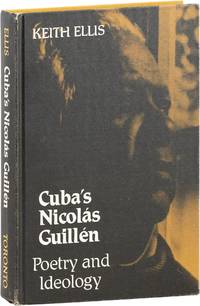
1983réf. 85035Toronto: University of Toronto Press 1983. First Edition. First Impression. Octavo 23.5cm; pictorial cloth-covered boards; x34-251252-254pp. This copy is from the library of to Puerto Rican editor translator and literary critic Roberto Marquez with his ink markings and notations throughout the text and inscribed to him by the author on the title page: "To Robert / as a token of my highest esteem and my admiration for your work / Keith." Base of spine gently nudged light wear to extremities with a few dog-eared pages; Very Good and sound without dustjacket as issued. Scholarly work on the writings of Nicolás Guillén 1902-1989 with a particularly generous inscription to Marquez who has written extensively on Guillén and has translated several of the poet's works faithfully from Spanish into English. A nice association linking two Guillén scholars. Uncommon inscribed. University of Toronto Press unknown
2017réf. 1-3639733894Editorial Académica Española 2017. Paperback. New. 88 pages. Spanish language. 8.66x5.91x0.20 inches. Editorial Académica Española paperback
2012réf. 1-3659056022Editorial Académica Española 2012. Paperback. New. 96 pages. Spanish language. 8.66x5.91x0.22 inches. Editorial Académica Española paperback
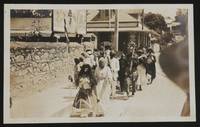
réf. PD19Oblong Folio album ca. 285x36 cm. 49 black paper album leaves. With ca. 260 mounted gelatin silver photographs of various size including ca. 20 large photos from ca. 245x32 cm 9 ½ x 12 ½ in to ca. 155x225 cm 6 x 8 ¾ in and 21 panoramas ca. 85x29 cm 3 ¼ x 11 1 /2 in or slightly smaller. The rest of the photos are from ca. 12x17 cm 4 ¾ x 6 ¾ in to ca. 4x6 cm 1 ½ x 2 ¼ in; most photos are ca. 8x14 cm 3 ¼ x 5 ½ in. No captions. About twenty photos with period ink notes “D.K.M. 10” in the corners. Period style black half morocco with cloth boards; decorative gilt-tooled borders on both boards and spine. Album leaves brittle several with tears and losses on extremities two large photos with tears and losses on extremities two small photos with losses of one corner each one photo has been apparently previously removed a few photos smildly faded or with mild silvering but overall a very good album of interesting photos. Historically significant album with lively amateur snapshots and original studio photos taken and collected by a family of American tourists during a Caribbean cruise in the early 1910s onboard the steamship “Moltke” of the Hamburg America Line Hamburg-Amerikanische Packetfahrt-Aktien-Gesellschaft or HAPAG. Launched in 1901 S.S. “Moltke” went on regular cruises around the Caribbean and the Mediterranean until it was seized by Italy in 1915 in the course of WW1. Her Caribbean or West Indies cruises departed from New York and included stops in Cuba Puerto Rico Jamaica Panama Canal Venezuela Trinidad Barbados Martinique St. Thomas Dutch West Indies Bermuda & Bahamas. The album opens with several large views and panoramas of Havana harbour and waterfront featuring Castillo del Morro the iconic building of Lonja del Comercio commodities and stock exchange and S.S. “Moltke.” The other photos show Havana streets and passers-by the interior of a Catholic church &c. Over twenty photos are the views of the city and harbour of Charlotte Amalie on St. Thomas Island – then the capital of the Danish West Indies since 1917 the U.S. Virgin Islands. The images show the city harbour from the distance and close-up a sign of “St. Thomas Bay & Rum Co.” is seen on one of the photos the statue of King Christian IX erected in the Emancipation Garden in 1909 removed in 2021 streets residential neighbourhoods on sloping hills a local market an official residence with the waving Danish flag garden of a Catholic convent with one of the monks posing alone and with a young tourist &c. Over thirty identified views of Puerto Rico a U.S. colony since 1898 a Commonwealth controlled by the U.S. since 1952 show San Juan: Plaza de Armas with the City Hall completed in 1842 Palacio de la Real Independencia now housing the Department of State of Puerto Rico Castillo San Felipe del Morro in the San Juan Bay Plaza Colon with Christopher Columbus monument San Juan harbour city streets and shops building of the “Hotel y Banos” a passenger train with the travellers walking at the front native cart drivers passers-by &c. A large group of photos ca. sixty depict the French Island of Martinique with a series of views of Fort-de-France: statues of Empress Josephine erected in 1859 destroyed in 2020 and Victor Schloelcher erected in 1904 removed in 2020 St. Louis Cathedral with the spire still under construction city streets and harbour “Hotel de l’Europe” distinctive cliffs on the coast near Fort-de-France &c. The views of Martinique include over twenty images of the ill-fated town of St. Pierre which perished during Mount Pelee’s eruption in May 1902. The photos include one view of St. Pierre before the destruction as well as general views of the ruins and desolation with posing tourists. Several images show the ruins of the Co-Cathedral of Our Lady of Assumption the downtown core with a grid of destroyed buildings and charred trees wrecked ships in the harbour a surviving bridge and the remains of the victims. A couple of images feature the top of Mount Pelee with a distinctive lava spine or the “Needle of Pelee” which was formed in October 1902 and collapsed in March 1903. Among the identified photos of Nassau Bahamas are the views of the famous silk cotton tree St. Matthews Anglican church completed in 1802 and the interior of Fort Charlotte. The other images show sugar cane plantations and native workers Caribbean residences streets and markets ports the American coastal steamer “Colonia” a series of scenes from a street carnival procession portraits of local market goers families diving children &c. Several images portray the tourists on board the S.S. Moltke including a group portrait with a lifebuoy of “Moltke Hamburg”. Overall a historically significant visual source on the history of American tourism to the Caribbean in the early 20th century with interesting views of the aftermath of the destruction of St. Pierre by the volcanic eruption. hardcover
1971réf. 47663Miami: Ediciones Universal 1971. First Edition. Octavo 20.5cm.; publisher's pictorial card wrappers; 263pp. Light shelf wear tiny dampstain to bottom fore-edge corner of textblock else Near Fine. Account of present-day Cuba by the exiled Cuban journalist who nearly twenty-five years earlier was nominated Vice President by the Socialist Revolutionary Movement with twenty-two-year-old Enrique Ovares as President. According to the author biography on the rear cover: "Ni un sólo minuto de sa vida no está dedicado a Cuba. Nadie lo aventaja en la lucha constante contra el régimen castrista y contra los malandrines que ofenden la dignidad nacional. Ediciones Universal unknown
1938réf. 030447New York: Time - Fortune Inc. 1938. First Edition . Illustrated Wrappers. Very Good. 14" Tall. Spine Has Wear Split At Top 1" 1/2" Chip And Associated Tears And Wrinkling At Lower Tip Of Front Cover Faint Circular Glass Mark On Front Cover. Time - Fortune, Inc. unknown
1916réf. 029952London: East And West Ltd.1917 1916. 1st Edition . Soft cover. Good. 27 Pp. Orange Covers Printed In Black. Light Wear But Front Cover Neatly Detached Along Spine Thus Loose. A Few Hand Corrections Of Names And A Comment Correcting The Author's Final Statement By Reference To A Source Both By A 1962 Rhodes Scholar. East And West, Ltd.[1917?] paperback
1916réf. 029953London: East And West Ltd. 1916. 1st Edition . Soft cover. Good. 15 Pp. Orange Covers Printed In Black. Wear Small Chip At Upper Left Corner Of Front Cover. Last Sentence With Warning That The West "Will See What We Can Do To Our Foes Who Dare Think Of Humiliating Us". East And West, Ltd. paperback