LA RIVIERE, Henri-François de.Livre Rare Book

8862 risultati
rif. 95570A Paris, chez Debure l'aîné, Tillard, 1751, 2 volumes in-12 de 165x95 mm environ, tome I : (1) f., XXXIV-(1)-376, (1) f., - tome II : (1) f., 1 titre, 459-(2) ff. (table, approbation et privilège), plein veau marbré cognac, dos à nerfs portant titres et tomaisons dorés sur pièces de titres bordeaux et pièces de tomaisons havane, ornés de caissons à fleurons et motifs dorés, coupes dorées, gardes marbrées, tranches rouges. Coins émoussés, petits trous et galeries de ver sur le dos des 2 tomes avec manque de cuir sur une coiffe et un plat, traces d'ex-libris arachés sur le premier contreplat des 2 volumes, 2 feuillets manquants (p. 347-250 du tome I, une photocopie du texte jointe), quelques rousseurs et mouillures claires dans les marges.
1833rif. PHO-1343Paris (Imprimerie Royale) 1833/35. 3 vol. grand in-8°, 25,5 x 17 cm, 3ff-XLI-558pp; 6ff-481pp; 6ff-510pp., illustré d’une grande carte dépliante, reliure éditeur ,non rogné , non coupé , début de fente tome 1 et 3 , mouillures aux reliures tome 1 et 2, rousseurs éparses.
1738rif. 113961738 reliure plein veau havane (binding full calfskin) in-quarto, dos 6 nerfs (spine with raised bands) - entre-nerfs à fleuron au fer évidé avec des rinceaux aux angles (floweret with hollowed out blocking stamp with foliages carried out with the angles) - titre frappé or (gilt title) - manque de cuir au bas du dos (miss leather with the bottom of), coins écornés (corners dog-eared), tranches rouges décolorées (faded reds edges), texte 2 colonnes (text - 2 coloumns), illustrations : orné de bandeaux - lettrines et de culs-de-lampe (illuminated of headpieces and dropped initials and of tailpieces), rousseurs en début d'ouvrage (redness marks at the beginning of book), 604+XXXV Index Rerum et Verborum+92 pages avec Approbation & Privilège du Roy, 1738 Lugduni Sumptibus Petri Bruyset,
1881rif. 15501Calmann Lévy Paris 1881 1 vol. In-8 de 2 ff.n.ch. 293 pp. 1 f.n.ch., demi-chagrin de l'époque, dos à nerfs orné.
1881rif. 55866Paris, Calmann Lévy, 1881, in-8, portrait-frontsipice, (4), 293pp, (1)f. de table, 17pl, percaline à la bradel marron, dos lisse orné, 1° plat ill. (Souze), tranches dorées (cartonnage éd. de l'époque), Un portrait d'Henri Rivière, 17pl. et 45 vignettes in-texte par J. Férat. PREMIERE EDITION. Henri Rivière (1827-1883) était un officier de marine française. Héros de la conquête du Tonkin, sa mort déclencha la guerre franco-chinoise. En 1876 il est affecté à la division navale de Nouvelle-Calédonie et sera chargé de réprimander l'insurrection canaque de 1878, levée contre la politique de colonisation française. Rousseurs claires. Néanmoins bon exemplaire en cartonnage éd. avec un plat illustré de Paul Souze Couverture rigide
1659rif. 7653GB1659. Lyon A. Cellier 1659. Gest. Titelvign. 4 Bl. 311 S. 4 Bl. Lederband der Zeit mit Rückenvergoldung berieben Deckel leicht verzogen Kapitale und angrenzende Gelenksabschnitte beschädigt. Umlaufend roter Sprenkelschnitt. Vorne ohne fliegendes Blatt. Vorderes Innengelenk geplatzt hinteres angeplatzt. Inneneinband und Titel mit Besitzvermerken von alter Hand. Durchgehend leicht gebräunt sowie leicht bis mäßig stockfleckig. Auf einzelnen Seiten etwas Wurmfraß Feuchtigkeitsflecken oder Einrisse. Sonst in schöner Erhaltung. Krivatsy 9718; vgl. Hirsch/H. V 830; vgl. Heirs of Hippocrates 1990 461: 'His observationum medicarum is a collection of four hundred short case histories taken from his practice.' - Lazare Rivière 1589-1655 Prof. der prakt. Medizin war der erste der die spagirische paracelsistisch-spezifische Heilmethode besonders die innere Anwendung metallischer Heilmittel in die Schule von Montpellier eingeführt hat. Seine Schriften fanden großen Beifall und erlebten wie auch das vorliegende Werk viele Auflagen. unknown
1920rif. 84411La maison des amis des livres | Paris 1920 | 19.50 x 25 cm | broché
1913rif. 21564Roma: Imprimerie Polyglotte 1913. First edition. Hardcover. Near fine. 8vo. xvi 323pp. Illustrated. Full scarlet morocco intricately tooled in gilt on the boards spine in six compartments gilt gilt inner dentelles all edges gilt. Deep blue-green endpapers. Upper hinge nearly invisibly strengthened else this is a fine copy of a lovely binding by Riviere and Son signed on the front inner board. In Italian . Imprimerie Polyglotte hardcover
1913rif. 21564Roma: Imprimerie Polyglotte 1913. First edition. Hardcover. Near fine. 8vo. xvi 323pp. Illustrated. Full scarlet morocco intricately tooled in gilt on the boards spine in six compartments gilt gilt inner dentelles all edges gilt. Deep blue-green endpapers. Upper hinge nearly invisibly strengthened else this is a fine copy of a lovely binding by Riviere and Son signed on the front inner board. In Italian . Imprimerie Polyglotte hardcover books
1735rif. D6963Venice: ex Typographia Balleoniana 1735. Hardcover. Very Good. Folio 375 x 240mm. xxiv 572pp. 4 208pp. Title in red and black with ornamental device of the muses. Diagrams interspersed numerous ornamental initials and head-and tail-pieces. Preface by Jacopo Grando. Contemporary vellum lacking plate joints splitting intermittent foxing. Ownership inscription A. Docinelli A. M. D. 1864 on title and also Di Giorgio Bonelli da Mondovi. P.P. Pictorial wood-engraved ex-libris by Leo Wyatt for Lord Norwich on pastedown. Complete medical works of Rivière. The complete medical works of Lazare Rivière 1589-1655 professor at Montpellier consists of the Institutiones medicae together with the Praxeos medicae and an additional 17 parts on the head the sense organs the teeth the thorax and abdomen the joints womens illnesses and fevers. Also included are 400 observations by the author approximately 250 communicated to him by fellow physicians and finally the Arcana a collection of secrets giving the chemical formulae for a large number of preparations together with their medicinal properties. At the end separately paginated is added a treatise on the symptoms cause and cure of respiratory problems by Fabrizio Bartoletti 1586-1630. Rivière was the first to introduce the therapy of using metallic compounds internally known as the spagiric or paracelsian-specific method and the first to note aortic constriction. Rivières work was instrumental in the French Renaissance of medicine. ex Typographia Balleoniana hardcover
1735rif. D6963Venice: ex Typographia Balleoniana 1735. Hardcover. Very Good. Folio 375 x 240mm. xxiv 572pp. 4 208pp. Title in red and black with ornamental device of the muses. Diagrams interspersed numerous ornamental initials and head-and tail-pieces. Preface by Jacopo Grando. Contemporary vellum lacking plate joints splitting intermittent foxing. Ownership inscription A. Docinelli A. M. D. 1864 on title and also Di Giorgio Bonelli da Mondovi. P.P. Pictorial wood-engraved ex-libris by Leo Wyatt for Lord Norwich on pastedown. Complete medical works of Rivière. The complete medical works of Lazare Rivière 1589-1655 professor at Montpellier consists of the Institutiones medicae together with the Praxeos medicae and an additional 17 parts on the head the sense organs the teeth the thorax and abdomen the joints womens illnesses and fevers. Also included are 400 observations by the author approximately 250 communicated to him by fellow physicians and finally the Arcana a collection of secrets giving the chemical formulae for a large number of preparations together with their medicinal properties. At the end separately paginated is added a treatise on the symptoms cause and cure of respiratory problems by Fabrizio Bartoletti 1586-1630. Rivière was the first to introduce the therapy of using metallic compounds internally known as the spagiric or paracelsian-specific method and the first to note aortic constriction. Rivières work was instrumental in the French Renaissance of medicine. ex Typographia Balleoniana hardcover books
1898rif. 64137Bay View & La Conner WA: A. Eugene Lovell 1898. Oblong 12mo. 7 x 5.5 in. 12 pp unpaginated. thick gray card stock slotted die-cut windows for inserting photos with 11 original photographs sized 3.25 x 4.25 in. 6 albumen on thin photo paper 5 silver gelatin on matte finish photo paper 1 manuscript Christmas note presenting the album Christmas 1898 a few ever-so-faint pencil manuscript captions below. Pebbled textured black cloth silver lettering stamped on front cover minor edgewear soiling to rear pastedown minor soiling to final image still a VG- exemplar. This souvenir album opens with beautiful sunset shot across the Columbia River followed by a photo of a young woman standing in front of well-appointed home with Hops growing along the porch. These are followed by photos capturing shipping along the Columbia River with the British sailing yacht Samantha out of Liverpool tied up to the Bailey Gatzert sternwheeler; the sternwheeler Kehani which operated from Portland originally launched in 1890 and was rebuilt and renamed Ottawa in 1905; a nice front view of the passenger sternwheeler Regulator built originally in 1891 by Louis Paget for The Dalles Portland & Astoria Naviagation Co. known as the Regulator Line operating steamer service from The Dalles to the Lower Columbia River past Kalama. Other photos depict a stately Victorian hotel on pilings near the shipping channel; a shipwreck of a 3-masted schooner on its’ side buried in the sand; and Cape Horn along the River prior to construction of the rail line. The final photo captures the waterfront of Astoria in 1898 with warehouses and canneries on pilings and houses above on the bluffs. Lovell 1883-1976 moved from Illinois to Washington following the death of his father William Lovell with his mother Susan Lovell and brothers Charles & Harry Lovell who homesteaded near La Conner WA after first settling in Bay View WA in late 1898. The trip must have been prior to July 12 1898 as the Regulator sternwheeler depicted in one of the photos wrecked at the Cascade Locks July 12 1898 was salvaged and rebuilt with a larger and heavier hull launching Feb. 1899. A. Eugene Lovell, hardcover
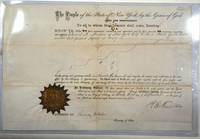
1847rif. 28447New York 1847. A certificate complete with seal signed by R. E. Fenton and Chauncey DePew. Hell Gate is a narrow part of the East River in New York City the phrase taken from the Dutch 'Hellegat.' The name refers to the whirlpool that results from the currents rocks and narrow channel and dangers to merchant travel through the area. Hell Gate Pilots were experienced and authorized by the state to navigate vessels through the channel. Reuben E. Fenton was a merchant and politician and governor of New York from 1865-1868. Chauncey Depew was an attorney businessman and politician as well as US Senator from New York. 16 3/8 x 10 3/4" cream paper original folds gold seal with manuscript additions and signatures with signed and stamped swearing in page for the County Clerk's Office in New York County 8 1/2 x 7" cream paper manuscript additions. Some folds are split with slt loss. Otherwise very good and an interesting piece of nautical history. unknown
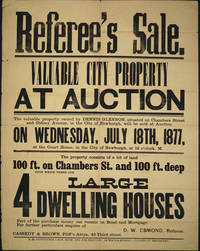
1877rif. 24402Newburgh NY: E. M. Ruttenber & Son 1877. Good condition. Large impressive broadside printed in a variety of type fonts for Hudson River property that is currently on the southern edge of the campus of Mount Saint Mary College and Bishop Dunn School. The broadside lists the owner as Dennis Glennon located at Chambers Street and Gidney Avenue Newburgh NY. Referee's Sale with Auction date Wednesday July 18th 1877 at the Court House in the city of Newburgh. The property is a lot measuring 100 X 100ft with 4 large dwelling houses D. W. Esmond Referee. Printed in black on yellow paper. Period folds some slt. holes at intersection of some folds a couple of crease separations short tear upper left corner repaired. 19 x 24". Not recorded in OCLC. E. M. Ruttenber & Son unknown
rif. elala2368Madrid: Francisco Xavier García 1771. First Edition. cfCamus-Dupin 2304 4th Edn. 4to. pp. 6 p.l. lxx cccxliv 1 leaferrata. woodcut title vignette & initial. paste-over cancel on Ss4v. contemporary mottled calf gilt back extremities worn wormhole in centre through first half more extensive worming in gatherings Q-Bb but no terrible loss of text institutional bookplate & rubberstamps on a2. some old ms. marginal notes Madrid: Francisco Xavier, García, 1771 unknown
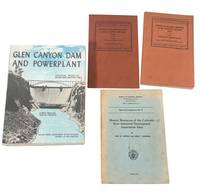
1933rif. 236831933. Colorado River development publications from 1933 to 1970 documenting the federal transformation of the river at a scale that continues to shape water rights regional growth and the ecology of the American West. The group traces the movement from basinwide stream measurement to large-scale storage hydroelectric generation irrigation municipal supply and industrial planning culminating in the construction of Glen Canyon Dam and the creation of Lake Powell. Together the publications record the governmental and technical systems that made extensive control of the Colorado River possible while noting the environmental consequences and increasingly contested allocation of a finite water supply. Group of six reports and illustrated brochures. 1 Grover Nathan C. et al. Surface Water Supply of the United States 1933. Part 9 Colorado River Basin. Washington: Government Printing Office 1935. Geological Survey Water Supply Paper 749 recording gaging stations and discharge across the Colorado River system. 2 Grover Nathan C. et al. Surface Water Supply of the United States 1937. Part 9 Colorado River Basin. Washington: Government Printing Office 1938. Geological Survey Water Supply Paper 829 with expanded records for Arizona Colorado New Mexico Utah and Wyoming. 3 Dietrich John W. and John T. Lonsdale. Mineral Resources of the Colorado River Industrial Development Association Area. Austin: Bureau of Economic Geology University of Texas 1958. Report of Investigations No. 37 surveying building stone limestone clay lignite salt sulfur and related resources in ten Texas counties. 4 United States Bureau of Reclamation. Colorado River Storage Project. Circa 1970. Illustrated brochure explaining interstate allocation irrigation municipal supply reservoirs and power financing. 5 United States Bureau of Reclamation. Colorado River Storage Project Power Operations Center Montrose Colorado. Circa 1970. Folding brochure describing the operation of storage units powerplants and approximately 1800 miles of transmission lines. 6 United States Bureau of Reclamation. Glen Canyon Dam and Powerplant: Technical Record of Design and Construction. Denver 1970. Extensively illustrated technical record with pencil annotations and page references concerning surveys diversion tunnels spillways dam elevations archaeology temperature records and construction chronology. The two Geological Survey volumes preserve the hydrological data used to quantify and divide the river before the era of major Upper Basin dams. The Glen Canyon record documents the engineering of one of the most consequential and controversial water projects in the American West whose reservoir inundated Glen Canyon and permanently altered downstream flow sediment movement temperature habitat and access to the river. The Texas mineral survey and Reclamation brochures place this development within a broader program of industrial expansion irrigated agriculture municipal growth and federally financed electrical infrastructure. Light to moderate wrapper wear toning rubbing and occasional staining; pronounced discoloration to the mineral report; extensive pencil annotation in the Glen Canyon volume. Overall good condition. The archive records the policies and engineering that reshaped the Colorado River with enduring relevance to environmental history water scarcity western development and the struggle over who controls and benefits from the region's water. unknown
1933rif. 236831933. Colorado River development publications from 1933 to 1970 documenting the federal transformation of the river at a scale that continues to shape water rights regional growth and the ecology of the American West. The group traces the movement from basinwide stream measurement to large-scale storage hydroelectric generation irrigation municipal supply and industrial planning culminating in the construction of Glen Canyon Dam and the creation of Lake Powell. Together the publications record the governmental and technical systems that made extensive control of the Colorado River possible while noting the environmental consequences and increasingly contested allocation of a finite water supply. Group of six reports and illustrated brochures. 1 Grover Nathan C. et al. Surface Water Supply of the United States 1933. Part 9 Colorado River Basin. Washington: Government Printing Office 1935. Geological Survey Water Supply Paper 749 recording gaging stations and discharge across the Colorado River system. 2 Grover Nathan C. et al. Surface Water Supply of the United States 1937. Part 9 Colorado River Basin. Washington: Government Printing Office 1938. Geological Survey Water Supply Paper 829 with expanded records for Arizona Colorado New Mexico Utah and Wyoming. 3 Dietrich John W. and John T. Lonsdale. Mineral Resources of the Colorado River Industrial Development Association Area. Austin: Bureau of Economic Geology University of Texas 1958. Report of Investigations No. 37 surveying building stone limestone clay lignite salt sulfur and related resources in ten Texas counties. 4 United States Bureau of Reclamation. Colorado River Storage Project. Circa 1970. Illustrated brochure explaining interstate allocation irrigation municipal supply reservoirs and power financing. 5 United States Bureau of Reclamation. Colorado River Storage Project Power Operations Center Montrose Colorado. Circa 1970. Folding brochure describing the operation of storage units powerplants and approximately 1800 miles of transmission lines. 6 United States Bureau of Reclamation. Glen Canyon Dam and Powerplant: Technical Record of Design and Construction. Denver 1970. Extensively illustrated technical record with pencil annotations and page references concerning surveys diversion tunnels spillways dam elevations archaeology temperature records and construction chronology. The two Geological Survey volumes preserve the hydrological data used to quantify and divide the river before the era of major Upper Basin dams. The Glen Canyon record documents the engineering of one of the most consequential and controversial water projects in the American West whose reservoir inundated Glen Canyon and permanently altered downstream flow sediment movement temperature habitat and access to the river. The Texas mineral survey and Reclamation brochures place this development within a broader program of industrial expansion irrigated agriculture municipal growth and federally financed electrical infrastructure. Light to moderate wrapper wear toning rubbing and occasional staining; pronounced discoloration to the mineral report; extensive pencil annotation in the Glen Canyon volume. Overall good condition. The archive records the policies and engineering that reshaped the Colorado River with enduring relevance to environmental history water scarcity western development and the struggle over who controls and benefits from the region's water. unknown books
1936rif. 233041936. Springfield Massachusetts flood photographs documenting the March 1936 Connecticut River disaster in western Massachusetts with direct evidence of how floodwater moved through streets bridges utility plants churches and commercial blocks in one of the worst flood events in regional history. Images record the city at the point where river flooding became an urban systems failure not only inundating homes and business districts but also interrupting power transport and street circulation in a manufacturing center already under Depression era strain. The 1936 flood in Springfield formed part of the larger New England catastrophe that left 15000 city residents homeless and pushed federal and local authorities toward new flood control measures including the broader post 1936 buildout of levees dikes and river management works under the Flood Control Act of 1936. Photo archive of 16 sepia photographs with printed captions on lower margin 3.25" x 4.75" Springfield Massachusetts 1936. The photographs are captioned beneath the image area with specific locations including "North Main St. Flood Scene" "Plainfield Street" "Flood Barricade Telephone Bldg." "St. James M.E. Church" "U. E. Light Power Plant" and "Railroad Bridge Conn. to name a few. Several views show entire streets turned into waterways with tree trunks porches and first floors standing in still floodwater. One Plainfield Street view shows two men navigating a rowboat between commercial buildings. The Telephone Building appears protected by sandbags stacked across low window openings showcasing emergency defense. The St. James M.E. Church photograph shows water standing nearly to the base of the windows around the church grounds. Memorial Bridge and the railroad bridge are both shown against a swollen Connecticut River while the riverfront and power plant views place industrial and utility structures at the flood edge. The Locust and Main Street image shows crowds boats automobiles and rescue activity gathered at a flooded intersection and the State Street at Main view shows a truck moving through deep water in the downtown business district. The South Main Street and South End views extend that disruption into retail and industrial blocks where storefronts sidewalks and roadbeds disappear under the flood. The flood followed a severe winter deep snowpack frozen ground and heavy March rain across the Connecticut River Valley. In Springfield and nearby West Springfield existing dikes were overtopped undermined and eroded while floodwater cut off neighborhoods and disabled normal traffic. The Connecticut River Valley was a manufacturing corridor the surrounding area was still recovering from the Great Depression; this economic downturn resulted in greater structural change. The disaster helped drive the Flood Control Act of 1936 and in West Springfield the U.S. Army Corps of Engineers began a local protection project in 1939 to enlarge and rehabilitate flood defenses completed in 1942. Light wear and mild toning; captions remain clear and the photographs present well. Overall very good condition. A visual documentation of the flood that forced Springfield to reshape the infrastructure of their river front environment. unknown
1936rif. 233041936. Springfield Massachusetts flood photographs documenting the March 1936 Connecticut River disaster in western Massachusetts with direct evidence of how floodwater moved through streets bridges utility plants churches and commercial blocks in one of the worst flood events in regional history. Images record the city at the point where river flooding became an urban systems failure not only inundating homes and business districts but also interrupting power transport and street circulation in a manufacturing center already under Depression era strain. The 1936 flood in Springfield formed part of the larger New England catastrophe that left 15000 city residents homeless and pushed federal and local authorities toward new flood control measures including the broader post 1936 buildout of levees dikes and river management works under the Flood Control Act of 1936. Photo archive of 16 sepia photographs with printed captions on lower margin 3.25" x 4.75" Springfield Massachusetts 1936. The photographs are captioned beneath the image area with specific locations including "North Main St. Flood Scene" "Plainfield Street" "Flood Barricade Telephone Bldg." "St. James M.E. Church" "U. E. Light Power Plant" and "Railroad Bridge Conn. to name a few. Several views show entire streets turned into waterways with tree trunks porches and first floors standing in still floodwater. One Plainfield Street view shows two men navigating a rowboat between commercial buildings. The Telephone Building appears protected by sandbags stacked across low window openings showcasing emergency defense. The St. James M.E. Church photograph shows water standing nearly to the base of the windows around the church grounds. Memorial Bridge and the railroad bridge are both shown against a swollen Connecticut River while the riverfront and power plant views place industrial and utility structures at the flood edge. The Locust and Main Street image shows crowds boats automobiles and rescue activity gathered at a flooded intersection and the State Street at Main view shows a truck moving through deep water in the downtown business district. The South Main Street and South End views extend that disruption into retail and industrial blocks where storefronts sidewalks and roadbeds disappear under the flood. The flood followed a severe winter deep snowpack frozen ground and heavy March rain across the Connecticut River Valley. In Springfield and nearby West Springfield existing dikes were overtopped undermined and eroded while floodwater cut off neighborhoods and disabled normal traffic. The Connecticut River Valley was a manufacturing corridor the surrounding area was still recovering from the Great Depression; this economic downturn resulted in greater structural change. The disaster helped drive the Flood Control Act of 1936 and in West Springfield the U.S. Army Corps of Engineers began a local protection project in 1939 to enlarge and rehabilitate flood defenses completed in 1942. Light wear and mild toning; captions remain clear and the photographs present well. Overall very good condition. A visual documentation of the flood that forced Springfield to reshape the infrastructure of their river front environment. unknown books
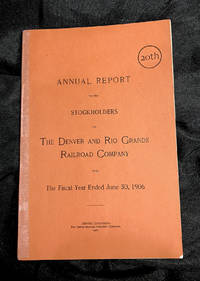
1906rif. 74THE DENVER & RIO GRANDE RAILROAD. 20th ANNUAL REPORT TO THE STOCKHOLDERS OF THE DENVER and RIO GRANDE RAILROAD COMPANY For The Fiscal Year EndeD June 30 1906 Denver Colorado: The Smith-Brooks Printing Company 1906 Original printed burnt orange wrappers front and back Very good plus to near fine condition; one small chips on lower margin of back cover; spine reinforced with special conservation tape; interior pages and map very good plus to near fine; several tiny splits in map folds conserved. Publication dimensions:6 inches by 8-7/8 inches46 pages Map dimensions:20 inches by 15 inches COLORADO ARTIFACTUAL The Smith-Brooks Publishing Co. paperback
1934rif. 158567N.p.: N.p. 1934. Vintage photographic print of a portrait of Mexican-American actress Dolores del Rio circa 1933-1934 created by painter and film director Hugo Ballin. Stamp of photographer Clyde Stoughton on the verso along with the stamp of Acme Engraving Company and annotations in manuscript pencil regarding cropping. New York-born artist and muralist Hugo Ballin began working for Goldwyn Studios in 1917 in New Jersey as an art director and production designer moving to Los Angeles in 1921 at the request of Samuel Goldwyn. He enjoyed a brief career as a director writer and producer of silent films but decided to return to painting upon the advent of sound films. He is best remembered for his murals many of which still stand today throughout Los Angeles. 8 x 10 inches. Very Good lightly edgeworn and age toned with a short closed tear at the top edge. N.p. unknown
1934rif. 158567N.p.: N.p. 1934. Vintage photographic print of a portrait of Mexican-American actress Dolores del Rio circa 1933-1934 created by painter and film director Hugo Ballin. Stamp of photographer Clyde Stoughton on the verso along with the stamp of Acme Engraving Company and annotations in manuscript pencil regarding cropping. New York-born artist and muralist Hugo Ballin began working for Goldwyn Studios in 1917 in New Jersey as an art director and production designer moving to Los Angeles in 1921 at the request of Samuel Goldwyn. He enjoyed a brief career as a director writer and producer of silent films but decided to return to painting upon the advent of sound films. He is best remembered for his murals many of which still stand today throughout Los Angeles. 8 x 10 inches. Very Good lightly edgeworn and age toned with a short closed tear at the top edge. N.p. unknown books
1879rif. 89341Paris: Au siège de la société d'acclimatation 1879. Fine. Au siège de la société d'acclimatation Paris 1879 17.5 x 28 cm Relié First edition illustrated with 62 figures in the text or full-page included in the pagination.Half green oasis morocco spine with five raised bands marbled paper sides endpapers and pastedowns of marbled paper original wrappers and spine preserved top edge gilt modern binding signed Laurenchet.A few small spots of foxing manuscript ex-dono at the head of the front wrapper.A pleasing copy. Au siège de la société d'acclimatation hardcover
1984rif. 48501Paris: Gallimard 1984. Fine. Gallimard Paris 1984 15 x 22 cm broché First edition of the French translation one of 20 numbered copies on Hollande tirage de tête. A very good copy. Gallimard unknown
1867rif. 50353J. Rotschild, éditeur 1867 In-4 27,5 x 17 cm. Reliure demi-maroquin cerise, dos à nerfs, caissons ornés à froid de motifs floraux, X- 286 pp. 75 planches lithographiées en couleurs sous serpente, 112 figures. Très légèrs frottements. Infimes rousseurs.