5920 risultati
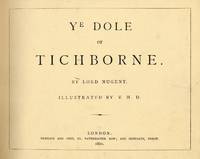
1871rif. 2200159Oblong 8vo pp. 4 with nine anastatic plates by 'V H D'arwin the first folding and with poetic verses facing two leaves of introduction in the original publisher's bind stamped green cloth upper board lettered in gilt inner joints lightly cracked else a very good sound copy. Published to capitalise on the infamous Tichborne case then beginning to run its course through the courts. The poem recounts the history of the Tichborne dole of bread a charity festival active until the 1790's and held at the village of Tichborne in Hampshire during the Feast of the Annunciation. The tale concerns a curse by twelfth century Lady Mabella Tichborne on her descendants. This predicted that should the dole stop the family would produce only daughters and die out which indeed did happen with the male issue cut down by early death and shipwreck all of which paved the way to the interminable Tichborne claimant cause. The illustrations are very clearly in the style of Richard Doyle's The Manners and Customs of Ye Englyshe which first appeared in Punch in 1849 they capture many of the more absurd parts of the tale in a mock medieval manuscript technique replete with a border of a dragon. The illustrator Violetta Harriot Darwin 1826-1880 was a half cousin to the famous Charles both sharing Erasmus Darwin as a grandfather. Although Charles descended through Erasmus' first wife Polly and Violetta through his second wife Elizabeth the cousins despite being near contemporaries appear to have had very little contact. A number of Violetta's anastactic topographical views were published in the 1860's and her illustrated version of Southey's Bishop Hatto: a legend of the Mouse-Tower on the Rhine in 1861 but these are both in a quite different style. The author of the poems Lord Nugent unlike many of the Grenville clan supported the cause of anti-slavery parliamentary reform religious liberty penal reform and the amelioration of the condition of the rural poor. He also inherited an aptitude for literary and scholarly pursuits as well as their tendency to corpulence and financial ineptitude. He was not a great poet however some of his smaller works found a willing space in the 'Annuals'. Under the less antiquated title 'The Dole of Tichborne' the poem first appeared first in the 1830 volume of The Gem. OCLC records only a second edition at the National library of Wales only. Bemrose and Sons
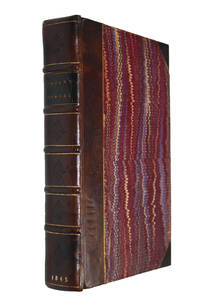
1845rif. A63207London: John Murray 1845. viii 519 1 14 text figs. . HB. Small 8vo 178x124mm rebound in antique-style half calf spine with raised bands gilt rules blind stamped floral motifs to compartments leather title piece marbled boards. Occasional light foxing/spotting. Vg. Second edition corrected with additions. Taken from Darwin's journals while on the H.M.S. Beagle these notes form a background for ideas he would later develop in On the Origin of Species while also serving as an excellent travel narrative of the voyage around South America New Zealand and Australia as well as the famous survey of the Galapagos Islands.Freeman 14. John Murray hardcover
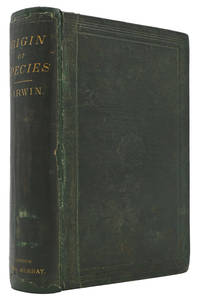
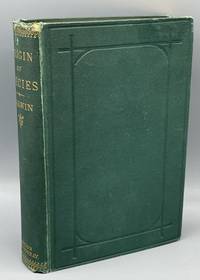
1873rif. 8223London: John Murray 1873. 8vo pp. xxi i 458 folding diagram. Ads at rear discarded. Original green cloth boards blocked with a simple frame in blind spine lettered in gilt. A little spotting a few marginal pencil marks and minor dampmarks. Sometime neatly rebacked preserving most of original cloth. Ink ownership insciption to title-page dated 26/5/75 in Calcutta later ownership stamp to contents page. John Murray hardcover
1871rif. 2602020032D. Appleton and Company 1871. First Edition. Hardcover. Very Good. FIRST AMERICAN EDITION FIRST ISSUE. Includes the first appearance of the word "evolution" in any of Darwin's works. 2 volume set. Bound in publisher's russet cloth. Hardcover. Good binding and cover. Clean unmarked pages. 4 vi 409 3. Slight bubble on front cover of v.1 but near fine besides. 'The word 'evolution' occurs for the first time in any of Darwin's works on page 2 of the first volume of the first edition that is to say before its appearance in the sixth edition of The origin of species in the following year.' Freeman 941. "In the Origin Darwin had avoided discussing the place occupied by Homo sapiens in the scheme of natural selection stating only that 'life will be thrown on the origin of man and his history.' Twelve years later he made good his promise with The Descent of Man in which he compared man's physical and psychological characteristics to similar traits in apes and other animals showing how even man's mind and moral sense could have developed through evolutionary processes. In discussing man's ancestry Darwin did not claim that man was directly descended from apes as we know them today but stated simply that the extent ancestors of Homo sapiens would have to be classified among the primates; however this statement as misinterpreted by the popular press caused a furor second only to that raised by the Origin" Norman 599. D. Appleton and Company hardcover
rif. 324832London: Hotel Cecil. First Edition; First Printing. Hardcover. Very Good in boards. Closed tears on spine crown and heel. Hotel Cecil hardcover
1876rif. 4345Half polished calf; marbled boards & endpapers; five raised bands; ruled black morocco label to spine. Three line errata slip facing p.viii. Wear to head of spine & corners see images otherwise a nice clean copy without previous owners' names or other markings. viii 482 John Murray hardcover
1884rif. 12288London: John Murray 1884. Octavo 7.75 x 5.25" green cloth with gilt spine lettering xxi 1 458 pp. Sixth Edition with editions and corrections to 1872 Twenty-Sixth Thousand. An early edition of this classic. An attractive copy with wear to corners mild fraying to spine tips slight discoloration to covers bit of rubbing and soiling to endpapers rear endpaper lacking owner inscription to front endpaper. John Murray hardcover
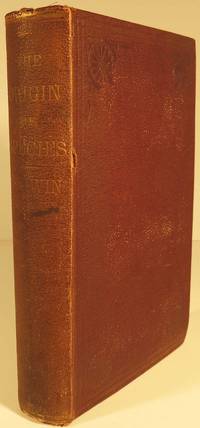
1871rif. 40592New York: D. Appleton and Co. 1871. Fifth Edition with Additions and Corrections. Octavo original brown blind stamped pebbled cloth. Very Good with light edge wear including lightly bumped spine ends and a short abrasion on the side of the spine. D. Appleton and Co. hardcover
1889rif. 69842New York: D. Appleton and Company 1889. Hardcover. Good. Third edition with an appendix by Prof. T.G. Bonney D.Sc. F.R.S. F.G.S. 344 p. with three folding plates and the publisher's ads. Octavo. Original brown cloth binding with decorative gilt and black stamping. An ex-library copy with minimal markings: a bookplate to the front pastedown and a small numeric label to the spine. Minor creases to the folding plates. The top edge is a trifle dust stained with some mild foxing to the fore-edge. There is also a small bit of rubbing to the corners and tips. From the library of the esteemed American paleontologist Stephen Jay Gould 1941-2002. In his essay "Worm for a Century" from the collection Hen's Teeth and Horse's Teeth: Further Reflections in Natural History 1983 Gould argued that this Darwin's first book on a specific subject is essential to understanding his theoretical approach: "This book is about coral but it is also about historical reasoning. Vegetable mold formed fast enough to measure its rate directly; we capture the past by summing effects of small and observable present causes. But what if rates are too slow or scales too large to render history by direct observation of present processes For such cases we must develop a different method. Since large-scale processes begin at different times and proceed at diverse rates the varied stages of different examples should exist simultaneously in the present. To establish history in such cases we must construct a theory that will explain a series of present phenomena as stages of a single historical process. The method is quite general. Darwin used it to explain the formation of coral reefs. We invoke it today to infer the history of stars. D. Appleton and Company hardcover
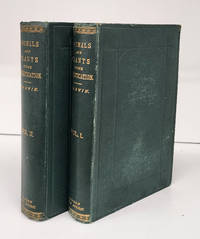
1868rif. 157199London: John Murray Titles state 1868. First Edition second issue. Hardcover. Good. 2 vols.: viii 411 32; viii 486 2 p. 23 cm. 43 b&w illustrations in vol. I. Original publisher's green cloth with blank impressing on boards gilt on spine. Corners worn some dents to edges softening to spine ends stains and rubbing to cloth. Vol. II has scuff on lower spine. Bookplates on front pastedowns. Endpapers at front have stuck together in vol. II and were formerly stuck in vol. I; the latter has scuffs at front. Light stains to vol. I bottom edge. 32 p. publisher's catalogue at rear of vol. I dated February 1871. 2 p. publisher's list at rear of vol. II dated February 1868. One line Erratum to vol. I and no errata to vol. II. Incudes the first appearance of the phrase "survival of the fittest" in any of Darwin's works on p. 6 of vol. I where he gives credit for the phrase to Herbert Spencer. A large part of the book contains discussion of artificial selection and pangenesis the mechanism he suggested to explain heredity. John Murray hardcover
1980rif. 38839Wellington NZ: Nova Pacifica 1980. Darwin Charles 1809-82 ed. The zoology of the voyage of H. M. S. Beagle during the years 1832-1836. Facsimile reprint. 3 vols. 4to. Variously paginated. 111 plates incl. color. Wellington New Zealand: Nova Pacifica 1980. 319 x 250 mm. Original quarter morocco cloth boards. Fine. No. 147 of 750 copies. Excellent facsimile reproduction of one of the rarest Darwin titles "a superb example of nineteenth-century scientific book publishing" "Publisher's Note". Originally published in parts and in book form between 1838 and 1843 The Zoology of the Voyage of H. M. S. Beagle had never been reprinted prior to this facsimile edition. Nova Pacifica unknown
1877rif. 14434London and New York: Macmillan and Co. 1877. FIRST EDITION. Half-calf and marbled boards; an excellent copy with the bookplate of Charles Edward Fewster of Hull. First printing of Darwin’s original paper discussing sexual selection in his 1871 work Descent of man stating that the case of the “brightly-coloured hinder ends and adjoining parts of certain monkeys” was the most interesting and perplexing to him. He quotes a work by Johan von Fischer partly published in Der zool. Garten. April 1876 dealing with the expression of monkeys under various emotions “which is well worthy of study by any one interested in the subject.” An interesting article on an interesting subject. Also included in this volume are two reviews of Darwin books as follows: 1 Review of the second edition of Geological observations on the volcanic islands and parts of South America London Smith Elder and Co. 1876 by John W. Judd. pp. 289-290; and 2 Review of The effects of cross- and self-fertilisation in the vegetable kingdom London Murray 1876 by W. T. Thiselton Dyer pp. 329-332. In addition there are two testimonials to Darwin. The first p. 356 is a testimonial on Darwin’s sixty-ninth birthday a mistake in that he was sixty-eight in February 1877 from a group of 154 men of science of Germany presenting to him an album of their photographs. Darwin also received an album with the photographs of 217 distinguished professors and lovers of science from Holland. The second testimonial pp. 410-412 comes from Prof. P. Harting of Utrecht University also on the occasion of Darwin’s birthday who has sent a letter along with the photograph album referred to above from the Directors of the Netherlands Zoological Society and includes Darwin’s reply. The volume includes articles by many of the most important scientists of the day. Freeman 1773; Freeman 1776. Macmillan and Co. unknown
1980rif. 38839Wellington NZ: Nova Pacifica 1980. Darwin Charles 1809-82 ed. The zoology of the voyage of H. M. S. Beagle during the years 1832-1836. Facsimile reprint. 3 vols. 4to. Variously paginated. 111 plates incl. color. Wellington New Zealand: Nova Pacifica 1980. 319 x 250 mm. Original quarter morocco cloth boards. Fine. No. 147 of 750 copies. Excellent facsimile reproduction of one of the rarest Darwin titles "a superb example of nineteenth-century scientific book publishing" "Publisher's Note". Originally published in parts and in book form between 1838 and 1843 The Zoology of the Voyage of H. M. S. Beagle had never been reprinted prior to this facsimile edition. Nova Pacifica unknown books
1877rif. 14434London and New York: Macmillan and Co. 1877. FIRST EDITION. Half-calf and marbled boards; an excellent copy with the bookplate of Charles Edward Fewster of Hull. First printing of Darwin’s original paper discussing sexual selection in his 1871 work Descent of man stating that the case of the “brightly-coloured hinder ends and adjoining parts of certain monkeys” was the most interesting and perplexing to him. He quotes a work by Johan von Fischer partly published in Der zool. Garten. April 1876 dealing with the expression of monkeys under various emotions “which is well worthy of study by any one interested in the subject.” An interesting article on an interesting subject. Also included in this volume are two reviews of Darwin books as follows: 1 Review of the second edition of Geological observations on the volcanic islands and parts of South America London Smith Elder and Co. 1876 by John W. Judd. pp. 289-290; and 2 Review of The effects of cross- and self-fertilisation in the vegetable kingdom London Murray 1876 by W. T. Thiselton Dyer pp. 329-332. In addition there are two testimonials to Darwin. The first p. 356 is a testimonial on Darwin’s sixty-ninth birthday a mistake in that he was sixty-eight in February 1877 from a group of 154 men of science of Germany presenting to him an album of their photographs. Darwin also received an album with the photographs of 217 distinguished professors and lovers of science from Holland. The second testimonial pp. 410-412 comes from Prof. P. Harting of Utrecht University also on the occasion of Darwin’s birthday who has sent a letter along with the photograph album referred to above from the Directors of the Netherlands Zoological Society and includes Darwin’s reply. The volume includes articles by many of the most important scientists of the day. Freeman 1773; Freeman 1776. Macmillan and Co. unknown books
1877rif. 50988Paris, C. Reinwald et Cie, 1877. 8vo. Uncut, unopened in the original publisher's embossed full green cloth with gilt lettering to spine. Small red label pasted on to top left corner of inner front board. Light brownspots throughout. XV, (1), 496, (2) pp.
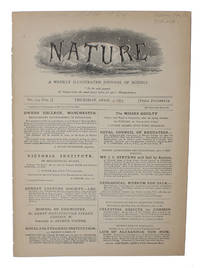
1873rif. 60133London, 1873. Small folio. Extracted, with traces from the sewn cords, in the original printed wrappers. In ""Nature"", No. 179, Vol. 7, April 13. Entire issue offered. Front wrapper detached, otherwise fine and clean. Housed in a portfolio with white paper title-label to front board. Darwin's notice: Pp. 417-18. [Entire issue: Pp. (1), cx-cxvi, 417-436].
1877rif. 50988Paris C. Reinwald et Cie 1877. 8vo. Uncut unopened in the original publisher's embossed full green cloth with gilt lettering to spine. Small red label pasted on to top left corner of inner front board. Light brownspots throughout. XV 1 496 2 pp. The rare first French translation of Darwin's work the first edition being published the year before in 1876 on cross and self-fertilization - a continuation of his "Fertilisation of Orchids". "It was too technical and too detailed to command a wide sale" which is why it was published in a rather small number.It was translated into French German and italian in Darwin's lifetime.Freeman 1265 hardcover
1873rif. 60133London 1873. Small folio. Extracted with traces from the sewn cords in the original printed wrappers. In "Nature" No. 179 Vol. 7 April 13. Entire issue offered. Front wrapper detached otherwise fine and clean. Housed in a portfolio with white paper title-label to front board. Darwin's notice: Pp. 417-18. Entire issue: Pp. 1 cx-cxvi 417-436. First appearance of Darwin's comment to an article in NATURE of March 20 1873 containing his view on the origin of certain instincts. "THE writer of the interesting article in NATURE of March 20 doubts whether my belief “that many of the most wonderful instincts have been acquired independently of habit through the preservation of useful variations of pre existing instincts” means more than “that in a great many instances we cannot conceive how the instincts originated.” This in one sense is perfectly true but what I wished to bring prominently forward was simply that in certain cases instincts had not been acquired through the experience of their utility with continued practice during successive generations. I had in my mind the case of neuter insects which never leave offspring to inherit the teachings of experience and which are themselves the offspring of parents which possess quite different instincts. The Hive-bee is the best known instance as neither the queen nor the drones construct cells secrete wax collect honey &c." From the present paper. Freeman 1760. unknown
1928Very Good Turkish, Ottoman (1500-1928) Contemporary fine dark green cloth bdg. Art-nouveau decorations embossed on boards. Roy. 8vo. (24 x 17 cm). In Ottoman script. 734, [2], [1] p., index. The Scopes trial (1925) fuelled discussion in the United States on the social and political implications of Darwinism. For the defenders of the 1925 Tennessee law - which prohibited the teaching of Darwinism in schools - Darwinism was, amongst other things, responsible for the German militarism which eventually led to the First World War. This view was supported by Ismail Fennî, a late Ottoman intellectual, who authored this book immediately after the trial which aimed to debunk scientific materialism. In it, he claimed that Darwinism blurred the distinction between man and beast and thus destroyed the foundations of morality. However, despite his anti-Darwinist stance, Ismail Fennî argued against laws forbidding the teaching of Darwinism in schools and emphasized that even false theories contributed to the scientific improvement. Indeed, because of his belief in science, he claimed that Muslims should not reject Darwinism if it were supported by future scientific evidence. It is composed of 7+1 chapters to criticize the materialist and positivist philosophical movements and especially the work of the positivist German philosopher Ludwig Bücher 'Kraft und Stoff'. The first part of the book focuses on the evidence presented of the proof of god in the Western and Islamic philosophies. In the second chapter, the issue of immortality of soul and spirit is addressed. In the third chapter, 'the wahdat al-wujud' (vahdet-i vücûd) current is examined. The fourth chapter, examined some famous scholars' thoughts about the matter, materialism, laws of nature, etc. In the fifth chapter, the work of the positivist German philosopher Büchner 'Kraft und Stoff', in the sixth chapter, monism (monism), in the seventh ch. positivism is criticized. In the last ch., there are descriptions and some thoughts on the theory of evolution and the Indian fakirs (fakers). Ismail Fenni Ertugrul was a Turkish mystic, philosopher, writer, musician, lyricist, and composer. He studied traditional madrasah education and learned Arabic and Persian. He was in various state posts. After the retirement, he began to be interested in poetry, music, and philosophy. Before his death, he donated his library including 9050 books to the Library of Beyazit. (Source: An Ottoman response to Darwinism: Ismail Fennî on Islam and evolution, Bilgili). First and Only Edition. Extremely rare. Özege 11879. Alper 195.
1899rif. TS367London: John Murray 1899. sixth Impression Second Edition . Hardback. Fine. 8vo. xvi 300pp. Pub. green cloth gilt. Single blind ruled border to the boards The half-title page present but has offsetting from the fonr board A fine copy with unfaded binding and a tight and very clean text block. Large owners name to the front free end-paper otherwise a lovely copy. This issue has no adverts at the rear. John Murray hardcover
1915rif. 167211New York: Caulon Press 1915. First edition first printing of this biographical pamphlet celebrating the lives of the first women stockbrokers. Woodhull 1838-1927 and Claflin 1846-1923 were key figures in American first-wave feminism as advocates for women's education employment and free love. "Their history is really the history of women in America during the last half century" Introduction. After making a living as clairvoyants and spiritual healers in the Midwest the sisters moved to New York during the late 1860s. They opened their Wall Street brokerage firm Woodhull Claflin & Co. on 19 January 1870 to prove that "woman no less than man can qualify herself for the more onerous occupations of life" Robb p. 114. With some initial support from Claflin's lover Cornelius Vanderbilt 1794-1877 and the extensive publicity generated by a press fascinated with the "Queens of Finance" their firm was relatively profitable at first. They cornered a source of investment capital - the fortunes and business interests of women - which other brokerages had either deliberately or otherwise failed to tap. However the sisters' energies soon drifted to other causes and helped by the Panic of 1873 the brokerage house closed its doors the same year. "However brief perfunctory and ultimately unsuccessful Woodhull and Claflin's brokerage career proved to be it remains an important watershed in women's history" ibid. p. 121. Undeterred Claflin and Woodhull continued to break down barriers while advocating for women's rights and labour reforms. They were among the first women to found a newspaper in America: Woodhull & Claflin's Weekly provided extensive coverage of economic issues and prided itself on exposing fraudulent dealings and corporate corruption and it was also the first American periodical to print The Communist Manifesto. In addition both sisters ran for office Claflin running for Congress in 1871 and Woodhull becoming the first woman to run for President of the United States in 1872. There is little information available about the author M. F. Darwin. He states in the introduction that he came across Woodhull and Claflin's story "when perusing old files of American newspaper" and was "so deeply touched by the work and terrible experiences of the sisters that I at once made up my mind to write their lives". He also writes that the pamphlet was intended to precede a forthcoming larger work on Woodhull and Claflin but we have been unable to trace evidence that this ever appeared. This work is relatively uncommon institutionally. WorldCat locates 11 copies all of which are in the US: New York State Library American Antiquarian Society Library Massachusetts Historical Society Library and the university libraries of Michigan Texas Yale Cornell Kansas Hamilton College Johns Hopkins and Princeton. We can trace no copies in auction records. Small octavo. With 15 full-page illustrations. Original printed wrappers wire-stitched. Nicks to extremities slight soiling to wrappers centrally creased contents clean: a very good copy. George Robb Ladies of the Ticker: Women and Wall Street from the Gilded Age to the Great Depression 2017. unknown
rif. 41899by means of natural selection or the preservation of favoured races in the struggle for life. With portrait. London : John Murray 1891. Two volumes octavo original publisher's gilt-lettered grey-green cloth light corner wear lightly bruised with small tears at head and foot of spine spine lightly sunned original navy blue chalk-surfaced endpapers; Vol. I pp. ii xxvi 366 2 adv. verso blank; portrait frontispiece with tissue-guard folding diagram; Vol. II pp. vi 340; glossary index light foxing to preliminaries. A very good set. A very good copy of the sixth edition of one of the most important texts in the history of science. The first edition of 1859 a great rarity is described in Freeman as "". the most important biological work ever written.""; Dibner "". the most important single work in science.""; Printing & the Mind of Man "". revolutionized our methods of thinking and our outlook on the natural order of things. The recognition that constant change is the order of the universe had been finally established and a vast step forward in the uniformity of nature had been taken."" The Sixth Edition was the final edition extensively edited by Darwin and the first edition to drop the word 'ON' from the title and the first edition of the 'Origin' to use the word 'evolution'. The Glossary was compiled by W. S. Dallas at Darwin's request. This two-volume edition the second in this form it having first been issued in 1888 Freeman 422 as the 'Library Edition' is a handsome work with larger type and printed on thicker paper. The title-pages to this set are cancels suggesting it may simply be a re-issue of the 1888 edition and there is no indication of a 'Library Edition' as such however the word 'indigeens' in Chapter IV has been corrected to 'indigenes' and the text is clearly printed from stereos at least in part so the reason for the cancels is somewhat obscure and as such not noted by Freeman. Both of these two-volume issues are very seldom seen on the market presumably being destined for libraries and were probably produced in quite limited numbers this issue having no 'thousand' designation and the original two-volume issue of 1888 sharing the Thirty-third Thousand designation with another one-volume issue having the regular pagination and small type of the one-volume sixth edition. Freeman 437 hardcover
1873rif. 1344339New York: D. Appleton and Co 1873. First US Edition. Hardcover. Octavo 374 pages 14. In Good plus condition. Bound in publisher's brown cloth boards with gilt lettering on spine embossed designs on front and rear board. Boards show some bumping and fraying at the corners and loth torn but intact at the spine edges. Text block has light age toning to pages throughout but otherwise clean. Seven heliotype plates of which three are folding. Previous owner's stamp on front paste-down. EO Consignment. Shelved in Case 10. 1344339. Shelved Dupont Bookstore. D. Appleton and Co hardcover
1873rif. 1344339New York: D. Appleton and Co 1873. First US Edition. Hardcover. Octavo 374 pages 14. In Good plus condition. Bound in publisher's brown cloth boards with gilt lettering on spine embossed designs on front and rear board. Boards show some bumping and fraying at the corners and loth torn but intact at the spine edges. Text block has light age toning to pages throughout but otherwise clean. Seven heliotype plates of which three are folding. Previous owner's stamp on front paste-down. EO Consignment. Shelved in Case 10. 1344339. Shelved Dupont Bookstore. D. Appleton and Co hardcover books
1860rif. 967676John Murray 1860. Hardcover. Used-Good. Orig. dec. cloth 519 pp. 32 pp. ads. Illus. New edition; Tenth thousand. Final text. General wear to binidng and endpapers with visible repairs to spine. Endpapers quite edgeworn but beyond them the copy is quite good internally. John Murray hardcover